
Experts Matter. Find Yours.
Connect for media, speaking, professional opportunities & more.

Faculty from Georgia Southern University’s Jiann-Ping Hsu College of Public Health (JPHCOPH) have secured a federal grant totaling more than $1.8 million from the U.S. Department of Health and Human Services to promote inclusive excellence in health informatics and health equity. With the goal of empowering minority students through education, JPHCOPH’s Professor and Department Chair Gulzar Shah, Ph.D., as principal investigator, and Associate Dean for Academic Affairs Nandi Marshall, DrPH, as co-investigator, received the grant as part of the $7.98 million award for the TRIUMPH (Training in Informatics for Underrepresented Minorities in Public Health) consortium, which included three other universities and four public health organizations. “This initiative will help our college foster collaborations and community engagement involving influential public health agencies, academic institutions, community organizations and public health agencies,” stated Shah. “It will assist with paid practical experience for students and the practicum sites, and better prospects of job placements for the graduates. The grant will also involve health informatics capacity-building in the current public health workforce in Georgia.” In addition, the grant will help facilitate a new fully online concentration in public health informatics within the University’s existing Master of Public Health (MPH) program. This concentration will feature new courses focused on health information systems, data analytics and public health data visualization for evidenced-based practice. The courses will also be available as elective options for students in the Doctor of Public Health program. As well, the award also provides several graduate assistant opportunities to support students enrolled in the new MPH concentration. If you're a reporter looking to know more about this important topic - then let us help with your coverage and stories. JPHCOPH’s Professor and Department Chair Gulzar Shah, Ph.D, is available to answer your questions - simply reach out to Georgia Southern Director of Communications Jennifer Wise at jwise@georgiasouthern.edu to arrange an interview today.


Battleground Georgia: All eyes on the Peach State with midterms in sight
The US midterm elections are quickly approaching, and with key Senate seats and the governor's mansion up for grabs in Georgia, the Peach State will be low hanging fruit for anyone looking to see where the balance of power rests in the country. With reporters across America covering the latest developments, we asked Augusta University's Mary-Kate Lizotte to answer a few questions that are top of mind for reporters and political junkies alike. The strength of endorsements? Q: What kind of an impact could Mike Pence backing Gov. Brian Kemp have going forward? It could have an influence on the willingness of Republicans who are not former President Trump supporters to contribute to the Kemp campaign and be sure to show up to vote for Kemp. But, it will likely not have much of an influence. Research does not find a huge, lasting impact of endorsements. Ultimately, Trump supporters are unlikely to stay home and not vote for Kemp given that they likely are very against Stacey Abrams becoming governor. For Abrams supporters, she has already begun to use Indiana as a comparison with Georgia to say that Indiana under Pence was more moderate, including Medicaid expansion in comparison with Georgia under Kemp. I doubt this will influence Republican voters who like Pence to vote for Abrams, but it could influence some Independents/moderates to vote for Abrams. It is important to note, however, that most Independents/moderates tend to consistently vote for one party's candidates and thus may not be influenced by this either. A fractured right? Q: Could Pence's support also divide the Republican party somewhat after former President Trump backed David Perdue? Yes, but will likely not have a substantial impact on the election. It is unlikely that Trump supporters and/or Perdue voters will stay home on election day. They will likely vote for Kemp as their most preferred candidate who is running. Goal line stand? Q: Herschel Walker won the Republican primary by a large margin. How does he stack up against Sen. Raphael Warnock in the general election? Polling is currently showing a close race within the margin of error. Warnock has not been running against Walker up until now because Walker had not won the primary, but Walker and conservative groups have been able to run against Warnock because there was no reason to believe that he would not win his primary. In terms of experience, Warnock is the incumbent and thus has more experience. Walker is a complicated and controversial public figure but also is loved among University of Georgia football fans. Warnock has focused on putting out positive campaign advertisements up to this point. But, since there are already attack ads against Warnock, the Warnock campaign or groups supporting the Warnock campaign need to begin airing attack ads against Walker to improve the Warnock standing in the polls. The research indicates that it is best to go negative once you have been attacked. Follow the money? Q: Are we likely to see a record amount of cash flow for candidates in Georgia over the next several months knowing it will be a key swing state? Definitely. People from out of state who will be watching these elections closely will likely contribute. We saw that when Abrams and Kemp ran against one another in 2018 and in the special election that elected Warnock in 2020. If you are a journalist covering this topic, then let our experts help. Dr. Mary-Kate Lizotte is an expert in political and voter behavior. She is available to talk about the upcoming midterm and gubernatorial elections in Georgia. Click on her name to schedule an interview.


Van Gogh is coming to Augusta. Are you ready to immerse yourself in 300 of the artist's works?
Beyond Van Gogh — The Immersive Experience is coming to Augusta later this month. The exhibit has been getting rave reviews and has wowed more than 5 million art lovers interested in the famous Dutch painter since it began touring in 2017. It has been named 2021's best immersive experience by USA Today and was ranked among the 12 best immersive experiences in the world by CNN. But before it arrives, hear from Scott Thorp, chair of the Augusta University Pamplin College of Arts, Humanities and Social Sciences Department of Art and Design, for an expert's perspective before the exhibit opens locally. Why do you think an exhibit like this has exceeded expectations nationwide for those who've come to see it? I believe these types of exhibitions exceed expectations because they are so stimulating. They include a new type of interactive media that entirely surrounds the viewer. You are more of a participant than a viewer in these situations. It’s like Disney is coming to your hometown. People are used to craning their necks to view static art on a wall. With this, you have to keep looking around to ensure you are getting everything. The technology here is relatively novel. Plus, it’s all around you. Sometimes museums feel intimidating, stuffy, or exclusive, so not everyone feels comfortable in those environments. However, blockbuster shows for Van Gogh or Monet have historically done exceptionally well. I look back to an exhibition at the Corcoran Gallery of Art in 2003 as a precursor to exhibits that use the work of established artists to create new and interesting environments. A sculptor named Seward Johnson exhibited his sculptural interpretations of impressionist paintings at the Corcoran Gallery of Art. It was called “Beyond the Frame.” And it was a huge success. You could walk into Van Gogh’s bedroom or Renoir’s “Luncheon of the Boating Party.” Do you think we'll see more exhibits like this in the future with other artists? Yes, this is only the beginning. There are several companies like Meow Wolf that do this all the time. Meow Wolf started back in 2008 and has been creating all kinds of engaging, high-tech installations. This will spread to more permanent venues such as the Illuminarium in Atlanta. The Illuminarium currently has a Georgia O’Keefe exhibition up. Could you see permanent exhibits like this in museums to give visitors a unique experience? I actually see these popping up all over the place. As they move forward, I’m sure artists will use this medium as their own. So it won’t be just about an artist of the past; the experience will be the actual work of contemporary artists. One thing that’s also interesting is there are applications for interactive spaces in many fields. Augusta University has an interactive wall in radiology. Thorp is also associate vice president for research at Augusta University and has worked for more than a decade as an exhibiting artist. His research interests include user-centered design, design thinking, and the psychology of creativity. Scott is available to speak about Beyond Van Gogh — The Immersive Experience. Simply click on his icon now to arrange an interview today.


Expert Perspective: New Proposal to Use Southern Plantations to Teach Kids About Racism
America's history is steeped in racism - and how the country accepts and reconciles its past has been a topic of much debate and consideration. Last year, Georgia Southern University Associate Professor of Geography Amy Potter, Ph.D., was awarded a $75,000 National Science Foundation grant for the project, “The Role of Museums in the Landscape of Minority Representation.” And recently, she co-authored a fantastic piece titled, New Proposal to Use Southern Plantations to Teach Kids About Racism, that has been getting a lot of pick-up from news organizations across the country. New Proposal to Use Southern Plantations to Teach Kids About Racism State legislatures across the United States are cracking down on discussions of race and racism in the classroom. School boards are attempting to ban books that deal with difficult histories. Lawmakers are targeting initiatives that promote diversity, equity and inclusion in higher education. Such efforts raise questions about whether students in the U.S. will ever be able to engage in free and meaningful discussions about the history of slavery in America and the effect it had on the nation. As cultural geographers, we see a potential venue for these kinds of discussions that we believe to be an overlooked and poorly used resource: plantation museums... April 02 - Yahoo!News If you're a reporter looking to know more about this important topic - then let us help with your coverage and stories. Amy Potter, Ph.D., is available to answer your questions - simply reach out to Georgia Southern Director of Communications Jennifer Wise at jwise@georgiasouthern.edu to arrange an interview today.

Questions about colon cancer? Our experts are here to help with your coverage
Every year, National Colorectal (colon) Cancer Awareness Month is observed during the month of March in an effort to raise awareness of the importance for colon cancer screenings. The recognition offers health care providers the opportunity to educate the general public about a disease that can be preventable, but can sometimes be seen as difficult for patients to discuss with their doctors. In the spirit of education, one of Augusta University’s experts has provided some insight into the subject of colon cancer. Dr. Asha Nayak-Kapoor is an associate professor of medicine in the Division of Hematology/Oncology in the Department of Medicine at the Medical College of Georgia at Augusta University. Nayak is certified by the American Board of Internal Medicine in Hematology and Oncology Specialties. Q: What are the primary risk factors for colon cancer? “Risk factors for colon cancer include: being overweight or obese, not being physically active, certain types of diets, smoking, alcohol use, being older, a personal history of colorectal polyps or colorectal cancer, a personal history of inflammatory bowel disease, a family history of colorectal cancer or adenomatous polyps, having an inherited syndrome. Common symptoms of colorectal cancer include: bloody stool or rectal bleeding, an ongoing change in bowel habits (diarrhea, constipation, chance in stool consistency), abdominal pain or cramping, gas or persistent abdominal discomfort, you feel like your bowels are not voiding completely, weakness, fatigue, or unexplained weight loss.” Q: How can a person protect themselves from the risks of colon cancer? “Colon cancer is largely preventable if patients undergo screening tests, like a surveillance colonoscopy starting at 45 years or earlier depending on family history. Many lifestyle-related factors have been linked to colorectal cancer. In fact, the links between diet, weight, and exercise and colorectal cancer risk are some of the strongest for any type of cancer. Getting to and staying at a healthy weight may help lower your risk. A diet that's high in red meats (such as beef, pork, lamb, or liver) and processed meats (like hot dogs and some luncheon meats) raises your colorectal cancer risk. Cooking meats at very high temperatures (frying, broiling, or grilling) creates chemicals that might raise your cancer risk. It’s not clear how much this might increase your colorectal cancer risk. Stop smoking. It is best not to drink alcohol. People with a history of colorectal cancer in a first-degree relative (parent, sibling, or child) are at increased risk. The risk is even higher if that relative was diagnosed with cancer when they were younger than 50, or if more than one first-degree relative is affected.” Q: It sometimes seems that colon cancer prevention is aimed more towards men compared to women, but cancer.org lists the risks at 1 in 23 (4.3%) for men and 1 in 25 (4.0%) for women. Is there a reason why perhaps a stigma about colon cancer affecting men more has been created? “According to focus group studies, it can be seen as a taboo topic that is uncomfortable to discuss, and it is not discussed as openly in public as prostate and breast cancer screenings. It can seem embarrassing or humiliating, and can be seen as distasteful dealing with prolonged bowel preparation.” Nayak is a member of several committees, including Onyx and Bayer Speaker Bureau for Nexavar, MCG Cancer Center Molecular Oncology Programme, and MCG Cancer Center Gastrointestinal Tumor Board Committee. If you are a journalist looking to know more about colorectal cancer and would like to speak with an expert for your stories, then let us help. Nayak is available to speak with media about this important subject. Simply click on her icon now to arrange an interview today.


Earlier this month, Georgia Southern University's Regina Rahimi, Ed.D., chatted with a journalist from Insight into Diversity to discuss the importance of trauma-informed education and how it is becoming a popular treatment for those dealing with the stress of COVID 19 and other sources of anxiety. "In recent years, a growing number of schools of education have begun focusing on trauma-informed teaching practices to help educators holistically address negative academic and social outcomes for students. Now, amid the COVID-19 pandemic, widespread racial injustice, and a host of other major stressors for U.S. youth, these concepts have become more popular, and important, than ever. “When the pandemic came, people really became concerned and interested in new traumas that were [affecting] students,” explains Regina Rahimi, Ed.D, a professor of education at Georgia Southern University. “Not only were students isolated, but if they were in an abusive household or they lived in a community where violence was prevalent, these things all became more pervasive in their lives, so that trauma was just further exacerbated.” March 16 - Insight into Diversity The full article is attached below. If you are a journalist looking to know more about trauma-informed education then let us help with your stories. Regina Rahimi is a professor in the Department of Middle Grades and Secondary Education at Georgia Southern University where her research is focused on issues of gender and sexuality in education and middle and high school drop-outs. She is available to speak with media about this important topic - simply click on her icon now to arrange an interview today.


Why pollen season arrives earlier each year: Q&A with Georgia Southern biology professor Alan Harvey
As a seasonal allergy sufferer, Alan Harvey, Ph.D., biology professor in Georgia Southern University's College of Science and Mathematics, was curious what types of pollen were causing his sniffles and sneezes. As a scholar and educator, Harvey did what any curious mind would do — he began exploring the types of pollen in the region while trying to narrow down the culprit of his symptoms. What he didn’t expect to find was an interesting narrative that led to a collaborative art-science project and soon a full exhibit on pollen at the Georgia Southern Museum. Read on to learn more about Harvey’s research on pollen, upcoming exhibit, “Pollen Nation,” and why pollen season begins earlier each year. Q: Tell us about yourself — Who are you? What do you teach? How long have you been a professor here? A: I’m a professor and faculty member at Georgia Southern. This is my 23rd year here and I teach a variety of biology courses including field biology, invasive species and evolutionary ecology. Q: How long have you studied pollen and what interested you in studying this? A: I’ve not actually studied pollen for that long. I really wanted to figure out how to deal with my own severe allergies to it. Q: What is the most common pollen in our region? A: The most common pollen depends on the time of year. Any plant that produces flowers will produce pollen. But if you’re looking at a plant with nice, pretty flowers, that pollen is not going to be what you’d normally encounter or notice causing your allergies because that pollen is being transmitted by insects or other pollinators who are specifically being attracted by the pretty flowers. The kind of pollen that you do encounter is from plants that you wouldn’t even notice have flowers like pine, oak, maple and birch trees. Those are all wind-pollinated, so they don’t need pretty flowers. They’re not trying to attract anybody, they just have to produce a lot of pollen for the wind to blow around. This time of year, pine and oak are going to be the two common pollens. Q: When does pollen season usually begin in our region? A: It starts in the early spring and ends in late fall. And again, it’s different plants blooming during the course of that year. So this time of year, as I mentioned, is going to be pines and oaks. In the middle of the year, it will be more grasses, and toward the end of the year, it’s going to be things like ragweed. What scientists have discovered is that every year the pollen season starts earlier and lasts longer. Q: Why will it begin early this year? A: This is where we get into a sort of controversial subject, but basically, climate change issues are the main culprit in a couple of ways. First of all, plant growth is tied to temperature. So the earlier temperatures get warmer, the earlier in the year the plant is going to start actively growing and producing pollen. So, warmer temperatures are leading to earlier seasonal starts. Temperatures are warmer than they were at this time a few decades or 100 years ago. Q: Why is pollen important? A: It’s an essential component of sexual reproduction in plants, so in the absence of pollen, we would lose many, if not virtually all of the plants around us that we depend upon. It’s fundamentally important to life on Earth that those plants are able to continue to reproduce. In terms of its impact on known pollinators, when a bee visits a flower, it is, of course, looking for nectar that the plants produce, but they also are looking for pollen. So it’s a food source for a lot of animals as well. Q: What is an interesting fact or little-known fact about pollen? A: Pollen plays a role in some various religious ceremonies of other cultures. The one I’m most familiar with is in the Navajo Nation. In particular, corn pollen is at the core of a great many, if not virtually all, of the Navajo religious ceremonies. It’s also been used to solve crimes and there is a whole field of forensic pollen analysis. It’s also an important tool for paleontologists, anthropologists and archaeologists who are trying to understand past civilizations. Because pollen is incredibly resilient, it may be small, but it is darn near indestructible. You would need a pretty powerful microscope to see any of these, but with that tool, you can study pollen grains that are hundreds of millions of years old. They will last that long. They’re so, so tough. Q: Tell us about the new mural in the Biological Sciences Building — What inspired it? Who helped work on it? A: A number of years ago, a colleague in the Betty Foy Sanders Department of Art, Jeff Shmucki, and his wife Wendy Deschene and I came together and started collaborating on art-science projects because we realized we both are observers of the natural world, we just approach it from somewhat different ways. One of those projects was creating a mural of ecologically or environmentally important organisms surrounding students that they may not be aware of. For the first mural, we looked at salamanders of Georgia. We got a bunch of photographs of the salamanders and we cut them away from the background, blew them up and installed the murals. It was a big community project and students got involved in all phases of it. So I thought, ‘Well, that was really successful.’ What can we do next? And because I was in the middle of allergy attacks, I thought, ‘Well, what about pollen?’ Q: Tell us how the mural inspired your upcoming exhibit, “Pollen Nation,” at the Georgia Southern Museum. A: There are a lot of interesting layers to this basic idea of pollen that can’t really be shown in a mural, and the Georgia Southern Museum is a perfect place to explore those kinds of ideas in one common theme. Q: What can people expect to see at the “Pollen Nation” exhibit? A: There’ll be a lot of big, spectacular images of pollen and the plants that produce them. It’s going to be a mix of striking imagery and some interactive sort of game-like activities. You’ll also have the opportunity to look at some of the pollen in a microscope. Interested in learning more? Let us help. Allan Harvey, Ph.D., is available to answer your questions - simply reach out to Georgia Southern Director of Communications Jennifer Wise at jwise@georgiasouthern.edu to arrange an interview today.
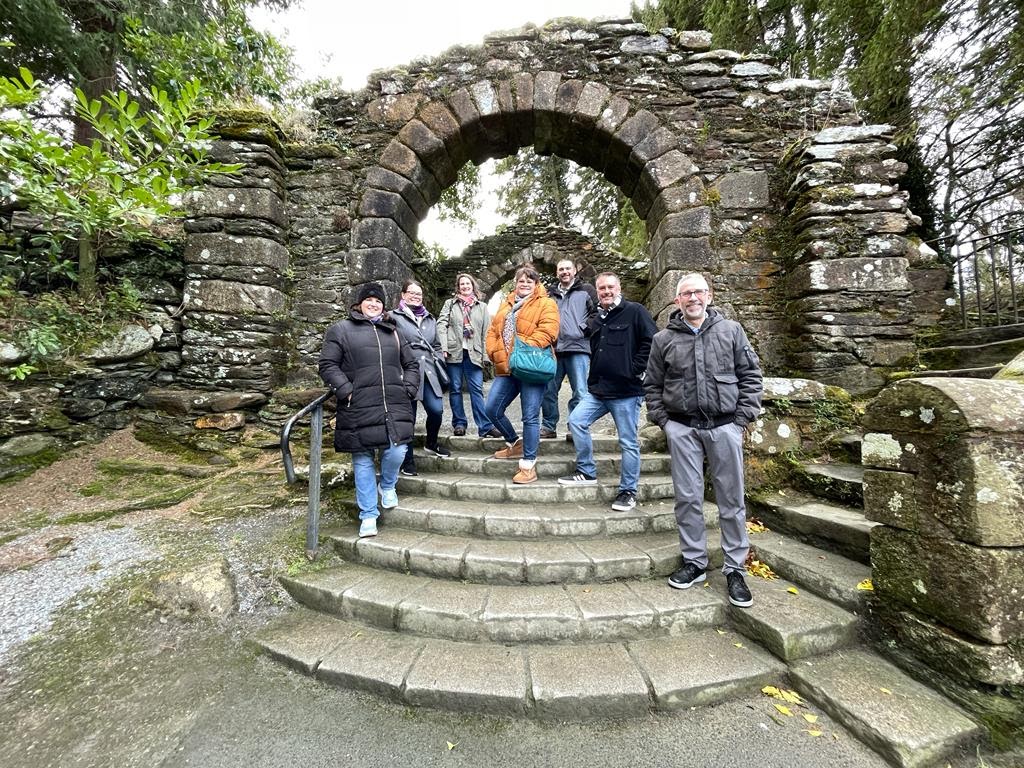
$100K student scholarship pool available for 2022 summer courses in Ireland Six professors from Georgia Southern University’s College of Education (COE) recently broadened their horizons during a trip to Ireland as they learned from and shared insight with instructors and educational leaders in the Wexford County community. Led by Howard Keeley, Ph.D., director of the University’s Center for Irish Research and Teaching, COE faculty traveled to Georgia Southern’s learning center in Wexford, Ireland, to observe Irish educational settings and exchange ideas with local leaders just ahead of a summer study abroad program opportunity for Georgia Southern students in which $100,000 of scholarship funding is available. “The main thing we did was get in front of leaders in the education space in Ireland,” stated Keeley. “We spoke to a number of folks who are either principals or vice principals or, in some way, senior administrators in a variety of schools including all-boys, all-girls, religious, secular and mixed schools.” The group included Catherine Howerter, Ph.D., associate professor of elementary and special education; Kip Sorgen, Ph.D., assistant professor of leadership, technology and human development; Alex Reyes, Ph.D., assistant professor of middle grades and secondary education; Amanda Wall, Ph.D., associate professor of middle grades and secondary education; Betsy Barrow, Ed.D., assistant professor of middle grades and secondary education; and Dan Calhoun, Ph.D., professor of leadership, technology and human development. Reyes, who trains pre-service and in-service teachers to work with culturally and linguistically diverse students, was excited to travel to Wexford after a study abroad program in Czech Republic she spearheaded with Wall was canceled in March 2020 due to the pandemic. Intrigued by Ireland, a plurilingual country, she was curious to see how Wexford’s environment might benefit students culturally. “I thought it was really exciting,” said Reyes. “All of the street signs are in Irish, even though English is the main language spoken. That prioritizing of that cultural heritage is fascinating. It was great to learn that the students in their primary and secondary schools take Irish language and culture as a subject every year.” She was especially motivated by a field trip to an Irish-language school, Meanscoil Gharman, which serves middle and high school students. With the exception of one daily class in English, teachers and students conducted all lessons in Irish. “It was really interesting to see that perspective,” she said. “There has been a revitalization of that culture. I thought that was fascinating to see how that can be handled in school.” In addition, Reyes was duly impressed with the country’s prioritization of social and emotional literacy for children, and the mandated well-being hours that are incorporated into daily school routines as a result of the pandemic. A program that promotes hygiene and an anti-bullying campaign also fit into the wellness curriculum. “It really impressed me that as a nation they prioritize the wellness of students, and how language and cultures can really be supported in a meaningful way,” Reyes said. “It’s affirming to see a proactive approach that has positive outcomes. Now, thinking ahead, we can look at how we can create opportunities for our students to experience this kind of approach.” Sorgen, who teaches in the educational leadership program at Georgia Southern, was interested in Ireland’s professional preparation. “None of them had advanced degrees, like what we offer at Georgia Southern,” noted Sorgen. “Learning about how to be a principal in Ireland is on-the-job training. In Georgia, there are specific educational requirements for our school administrators guided by professional standards. In Ireland, they generally ascend through the ranks, which makes professional mentoring essential to their success. We are exploring ways our educational leadership students could learn from Irish administrators about their experience, specifically with mentoring.” He also foresees the international partnership as a two-way exchange. “Given educational leadership programs are not common in Ireland, our faculty are considering ways in which we could use our expertise to foster leadership development of principals and teachers in Wexford,” said Sorgen. “We would utilize the Georgia Southern Wexford campus to host some of these sessions, furthering Georgia Southern’s relationship within the Wexford community.” Keeley also arranged meetings with education policy makers, including an extended meeting with an Irish congressman who is a representative for the County of Wexford in the Irish national parliament and chairs the joint committee for the Irish equivalent of the House and Senate Committee on education and higher education. “That was a tremendous opportunity for our faculty to talk to somebody at the highest level of government in Ireland, creating Irish state policy on education,” said Keeley. “And I know from the feedback we got from our College of Education colleagues that particularly for those in higher education, that to them was a really useful, next-step experience.” The trip exceeded expectations. “It was a fantastic learning experience for everyone,” said Keeley. “We had lots of high-level and also very practical experiences, and I could see our College of Education team thinking, ‘How can I bring what I’m learning, what I’m experiencing in this moment, into my classroom, into my curriculum, into my prospective study abroad courses in a way to build student success for our Georgia Southern folks.’ I think it was a great visit.” Complementing the faculty’s trip, a COE Irish study abroad program on diverse education in Ireland was recently approved for Summer 2022 and will give education students the opportunity to take one or two courses with the study abroad component. This will be a part of a broader study abroad program in Wexford, presented by the Honors College and the Center for Irish Research and Teaching, with assistance from the Office of the Provost and the Office of Global Engagement. The costs for undergraduate students at Georgia Southern’s Wexford campus will be offset by a $100,000 scholarship fund with awards of $1,000 for each student accepted into the program. “For students traveling to Wexford, Ireland, this summer, we will be able to defray the cost of the program through a generous travel scholarship through the Georgia Southern University Foundation,” said Dustin Anderson, Ph.D., associate provost for Student Success. “The donation makes these the most affordable multi-week programs that we ever have been able to offer.” Keeley is thrilled the gifts from generous donors will enable a number of students to earn valuable global experiences. “For students to have an opportunity to have international lives is powerful, and it’s powerful in ways that sometimes we can’t even predict,” he said. “Just the very fact of being abroad is going to change any of us, right? It can have a really transformative effect to feel a sense that, you know, as a student, ‘I can do this,’ and then a sense after the fact, ‘I did this,’ and just that in itself is educational. Giving students a safe space in Wexford, Ireland, to grow and feel that they are in a sense global citizens and bring the best of America, bring the best of Georgia, bring the best of the states from Savannah to Ireland, and learn to be an ambassador. That’s wonderful.” In addition to the education courses, students will also be able to choose from a Wexford-Savannah honors inquiry and an interdisciplinary program open to all students on human migration with courses in geography, religious studies, public health and a CORE study abroad course. Students interested can learn more about the program by clicking here and can email Kristin Karam in the Office of Global Engagement for more information about the scholarships. Georgia Southern University-Wexford is a global hub for learning housed in a historic building constructed in 1812. The space now features state-of-the-art classrooms and student apartments. Georgia Southern is the first public university in the United States to open an outreach learning facility in Ireland. If you're a reporter looking to know more about this initiative, then let our experts help. Howard Keeley, Ph.D., is the director of the Center for Irish Research and Teaching at Georgia Southern University. He is available - simply click on his icon now to arrange an interview today.


Georgia Southern now one of nation’s Top Ten Military Friendly® Schools
Georgia Southern University has earned a 2022-2023 Top Ten Military Friendly® distinction by Viqtory. Georgia Southern ranked at number nine on the Top Ten list. Being named a Military Friendly School is nothing new for Georgia Southern University, having earned a gold-level distinction for the past 10 years. “We are extremely proud to be recognized as being among the 10 most military friendly universities in the country, especially after learning that more than 1,800 schools participated in the survey,” said Georgia Southern University President Kyle Marrero. “With our connections to Fort Stewart, and the fact that about 10% of our student body is military-connected, we have a responsibility to ensure our people and our processes are attuned to the needs of those who are serving selflessly, who are retired or who are related to a veteran or active-duty service member. My thanks to all our faculty and staff who have worked hard to earn this recognition.” Institutions earning the Military Friendly® School designation were evaluated using both public data sources and responses from a proprietary survey. More than 1,800 schools participated in the 2022-2023 survey with 665 earning special awards for going above the standard. Georgia Southern University has a strong and proud history of supporting veterans, current-serving military personnel and their families, and has accumulated many awards for its dedication to the military community. Information and resources are available on the Military and Veteran Services webpage. “We are honored to receive such a significant recognition as a Top Ten Military Friendly® institution,” said retired Col. George Fredrick, Ed.D., director of Military and Veteran Services. “Georgia Southern University maintains strong ties to the military forces in our region, specifically Fort Stewart, Hunter Army Airfield, the Marines, the Georgia National Guard, the Air Force, and the Coast Guard. We proudly serve our veterans and their families while on their academic journeys. We are indebted to our faculty, staff, students and communities for their continued support of our military-connected student population.” Methodology, criteria and weightings were determined by Viqtory with input from the Military Friendly® Advisory Council of independent leaders in the higher education and military recruitment community. Final ratings were determined by combining the institution’s survey scores with the assessment of the institution’s ability to meet thresholds for student retention, graduation, job placement, loan repayment, persistence (degree advancement or transfer) and loan default rates for all students and, specifically, for student veterans. “Military Friendly® is committed to transparency and providing consistent data-driven standards in the designation process,” said Kayla Lopez, national director of Military Partnerships, Military Friendly®. “Our standards provide a benchmark that promotes positive outcomes and support services that better the educational landscape and provide opportunity for the Military Community. This creates a competitive atmosphere that encourages colleges to evolve and invest in their programs consistently. Schools who achieve awards designation show true commitment in their efforts, going over and above that standard.” The 2022-2023 Military Friendly® Schools list will be published in the May and October issue of G.I. Jobs magazine and can be found at www.militaryfriendly.com. Retired Col. George Fredrick is available to answer your questions - simply reach out to Georgia Southern Director of Communications Jennifer Wise at jwise@georgiasouthern.edu to arrange an interview today.

Will voters 'hit' or 'hold' on allowing legal gambling in Georgia?
Could we see horse racing and other forms of gambling come to Georgia in the near future? The Georgia state legislature is looking at the possibility of legalizing gambling on horse racing and the decision could land in the hands of the voters. Proponents say there is potential for a billion dollars in economic benefits, from job creation to a boost in revenues. Marsha Loda is an associate professor at Augusta University’s Hull College of Business. She said if approved, it will likely take more than horse racing for a track to survive. Loda cites Kentucky as an example of what tracks are doing there. “A lot of people think of Kentucky as the mecca of horse racing, but they don’t realize it might not exist without historical horse racing machines," said Loda. "HHRs are slot-like machines that let players wager on past horse races by a random number generator.” Many tracks nationwide have also expanded into casino and sports betting. While this isn’t what Georgia is looking to do initially, it’s not far off to think it could be on the horizon, with horse racing being the first step. Loda, who previously served as marketing director at Harrah’s Cherokee Resort in North Carolina, knows if casino gambling is approved in the future, most of those people who visit need to come from out of town. “You need to be able to import your people who are going to bet. That means you’re importing revenue. Otherwise you’re taking what’s already spent in your community and just slicing it up and giving it to different places. You’re not growing the pie at all,” said Loda. She has also seen the benefits of legalized betting, citing the added jobs a casino would offer. One aspect of gambling that has exploded is sports betting. More than two dozen states have legalized sports betting. Loda thinks if sports betting was on a ballot and went in front of the public for a vote, it would stand a better chance of passing. “I wouldn’t be surprised to see Georgia pass sports betting. I think sports betting has been very well accepted. I think they would come much closer to getting more voters to approve it if it were sports betting than if it’s horse racing or casino gambling.” This is an important topic with many angles to cover, and if you are a reporter looking to know more, then let our experts help. Loda is a leading marketing expert helping businesses in the hospitality industry bounce back from crises, including the COVID-19 pandemic, and also has had extensive experience in the gambling industry. She is available to speak with media regarding the idea of gambling coming to Georgia. Simply click on her icon now to arrange an interview today.
