
Experts Matter. Find Yours.
Connect for media, speaking, professional opportunities & more.

Former U.S. Attorney: Family Separation Is "A Moral Outrage"
Professor David Iglesias, a former U.S. Attorney in New Mexico who also served as chair of the border and immigration subcommittee under John Ashcroft, is available for interviews about the zero tolerance and family separation immigration policies. "The president's zero tolerance for people crossing the border is more than just a moral outrage--it rejects decades of administrations deferring to prosecutors in the region know how best to deal with immigration cases," he says. Iglesias, who is an associate professor of politics and law and director of the Wheaton Center for Faith, Politics, and Economics, is among a bipartisan group of former U.S. Attorneys who have called on Attorney General Jeff Sessions to end family separation. "Zero tolerance may make a catchy bumper sticker, but it is the very definition of bad public policy," Iglesias says. To request an interview with Professor Iglesias, e-mail media.relations@wheaton.edu. Source:


The Struggle for DREAMers in Utah - Explore DACA
On Tuesday, April 24, 2018, a third federal judge ruled against the Trump administration’s push to end Deferred Action for Childhood Arrivals (DACA). U.S. District Judge John Bates called the administration’s attempts to end DACA “arbitrary,” “virtually unexplained,” and “unlawful.” He put a hold on the decision, allowing the Department of Homeland Security 90 days to give better reasoning to cancel the program or it would be fully reinstated. Dr. Stephen Allen, associate provost of International Affairs at Southern Utah University and expert on American immigration policy, sees the struggle for “DREAMers” in Utah and across the nation. “In March, the Supreme Court refused to hear a challenge to DACA,” said Dr. Allen. “That decision, along with the April 24 federal court ruling, has taken pressure off of Congress to act on the issue. The result is a great deal of uncertainty for DREAMers, families, and employers.” Originally enacted by President Obama, DACA is an immigration policy that shields undocumented immigrants that were brought to the United States as children. The youth apply to obtain a renewable two-year deferred action from deportation and to be eligible for a work permit. DACA has helped hundreds of thousands obtain driver’s licenses, social security numbers and attend school. Steps to eliminate DACA were initiated by the Trump administration in late 2017, but previous federal rulings have stalled the efforts. “Rescinding DACA would have a tremendous impact on Utah,” said Dr. Allen. “The program has allowed nearly 10,000 young people in Utah to come forward and pass background checks and live legally in the United States. There is strong evidence that the majority of these young people are productive citizens who are gainfully employed and/or enrolled in school. According to the non-profit and non-partisan organization Interfaith Worker Justice (IWJ), ending DACA would cost Utah alone nearly $476.5 million in annual GDP losses.” Dr. Allen believes that in general, Utahan’s have a strong commitment to keeping families together. “The United States is the only country most DREAMers have known. Deporting nearly 700,000 individuals would result in separation from families and losing the ability to legally work in the United States.” Dr. Allen specializes in international enrollment and admissions, developing global partnerships, and international education. He is familiar with the media and available for an interview. Source:

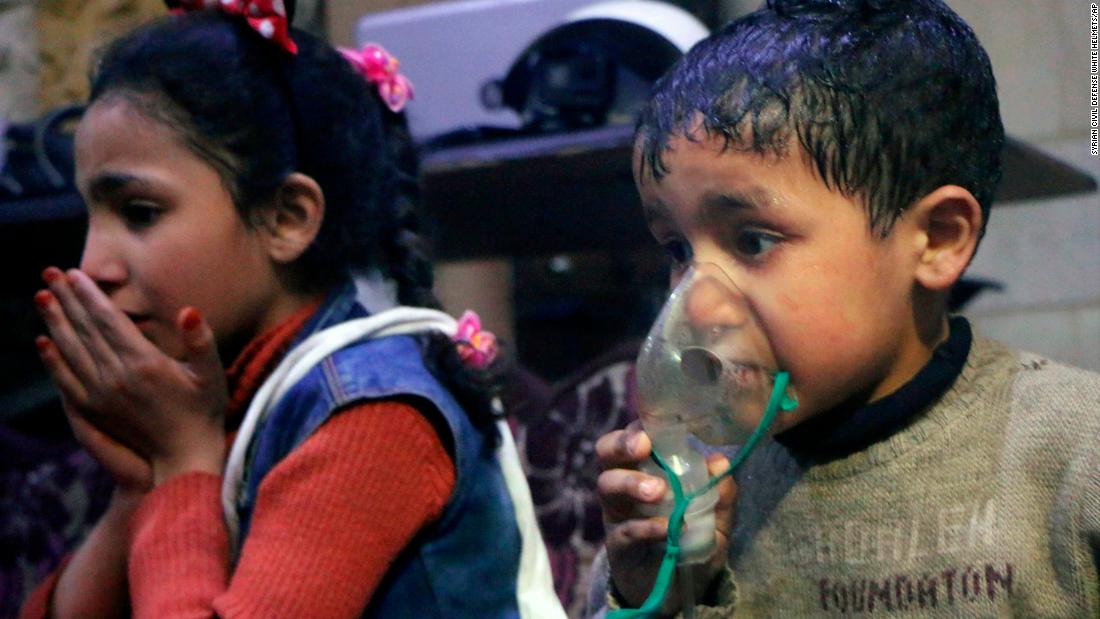
How serious is the sabre-rattling over Syria?
Last Saturday, though not ‘officially confirmed,’ a poisonous gas attack happened in the besieged Syrian town of Douma. The World Health Organization has confirmed that 500 people showed symptoms of being exposed to "toxic chemicals". This act of aggression supposedly by the Assad government has opened a Pandora’s Box. President Donald Trump is threatening missile strikes. Russian officials are threatening retaliation for any American aggression. Many world leaders are on edge and watching closely – Syria has become a powder keg and what happens next could have global implications. What are President Trump’s options? What could happen if the Russians counter? Is there a diplomatic option? There is an enormous amount at stake and a lot of scenarios to consider. That’s where experts from Missouri State University can help. Dr. David Romano, political science professor at Missouri State University, researches Middle Eastern politics and government. He's an expert in theories of peace and conflict, and foreign policy. He's available to speak about the escalating tensions, potential outcomes and consequences regarding any action in Syria. Click on his icon to arrange an interview. Source:


The Empathy Gap Between White Social Workers and Clients of Color
Empathy is a core human attribute — but it is far from infallible. In social work, an empathy gap tied to racial identity can lead to worse outcomes for people of color. We like to think of ourselves and our colleagues as empathetic, but our experiences and actions can often contradict this notion. What does this mean for education and the world at large, and how can we improve this? Terence Fitzgerald, clinical associate professor at the USC Suzanne Dworak-Peck School of Social Work and scholar of institutional racism, policy and child welfare, shares his recent research on racial empathy in social work. Source:


School shootings and widespread community gun violence are far greater in the United States than other nations. America cannot be great and realize its promise of life, liberty, and the pursuit of happiness if our children are not safe from gun violence. Although security measures are important, a focus on simply preparing for shootings is insufficient. We need a change in mindset and policy from reaction to prevention. Prevention entails more than security measures and begins long before a gunman comes to school. We need a comprehensive public health approach to gun violence that is informed by scientific evidence and free from partisan politics. A public health approach to protecting children as well as adults from gun violence involves three levels of prevention: (1) universal approaches promoting safety and well-being for everyone; (2) practices for reducing risk and promoting protective factors for persons experiencing difficulties; and (3) interventions for individuals where violence is present or appears imminent. Source:

Legal and illegal immigrants who are facing possible deportation may be held indefinitely without bail, the U.S. Supreme Court ruled Tuesday. The court overruled a decision by the 9th Circuit Appeals Court that gave detained immigrants the right to a bond hearing every six months. The 5-3 decision affects all immigrants, including asylum seekers and green card holders. This ruling raises a lot of questions, and our experts can help. Dr. Martha Ginn, assistant dean of Pamplin College and associate professor of political science, is an expert in Supreme Court decision-making. Her research focuses on how Supreme Court justices make decisions, how information they receive from amicus curiae influences court rulings, and how controversial decisions can affect the court's legitimacy. Ginn is available to discuss: -What factors influence the justice's decision-making process in controversial rulings. -How public opinion on controversial topics affects the Supreme Court's legitimacy. -How the definition of "immigrant" in this case may impact Trump's immigration policy. Source:


What will Donald Trump’s National Defense Strategy mean for Americans and its citizens?
The Department of Defense recently published an unclassified synopsis of the Trump administration’s first National Defense Strategy (NDS). The document, is missing the usual and sometimes expected Trump-like rhetoric of ‘America First’ and instead focuses on a balanced and cooperative approach among nations. At Augusta University, our experts have been examining the strategy, they have found that within the NDS the following stood out: • More money will be spent on military, private military contracting firms and cyber firms. This could benefit the local economy but does show that we’re worried. • Our military is growing more high-tech with artificial intelligence and robotics. The future of warfare could start to resemble something out of Hollywood. • For the last two decades, we were concerned with small-scale wars, counter-insurgency and counter-terrorism. Now, we are preparing our military for a Great Power War. In other words, we are preparing for a WWII type engagement, versus Iraq or Afghanistan. • Trump’s policy is very assertive whereas Obama’s policy was more conciliatory and forgiving in nature. • We are clearly focused on reasserting ourselves as the superpower. But what will this mean for every-day Americans? Will it be a boost to our economy as we invest in our military or will it mean other programs suffer as a result? Are we on the verge of another cold war? There are a lot of questions to answer – and that’s where our experts can help. Dr. Craig Albert is an expert on American politics and political philosophy. He was recently appointed director of Augusta University’s new Masters of Arts in Intelligence and Security Studies. Dr. Albert has experience with all forms of national and local news organizations and is available to speak to media regarding Donald Trump’s National Defense Strategy. Simply click on his icon to arrange an interview. Source:

Trade, security and America First – Does Donald Trump’s new National Security Strategy make sense?
On Monday, President Donald Trump released his National Security Strategy. In a bold delivery that was almost more of a campaign speech than a policy announcement, President Trump was focused on terrorism, dictatorships, cyberterrorism and even referenced immigration as a potential threat to national security. Trump referred to China and Russia as "rival powers" who "seek to challenge American influence, values and wealth” but seemed more diplomatic than worried. "We will attempt to build a great partnership with those and other countries, but in a manner that always protects our national interest," Trump said But what will this mean for the Trump Administration and America moving forward? Will America’s polices become more assertive? Will the pursuit to eradicate ISIS and terrorist threats expand? Trump also referenced trade, never leaving out the opportunity to maintain his agenda of keep America’s economy and his efforts to strengthen it on the public’s radar. But what does this have to do with national security? There are a lot of questions still to be answered. That’s where the experts from Augusta University can help. Dr. Craig Albert is an expert on American politics and political philosophy. He was recently appointed director of Augusta University’s new Masters of Arts in Intelligence and Security Studies. Dr. Albert has experience with all forms of national and local news organizations and is available to speak to media regarding this latest development in Washington. Simply click on his icon to arrange an interview. Source:
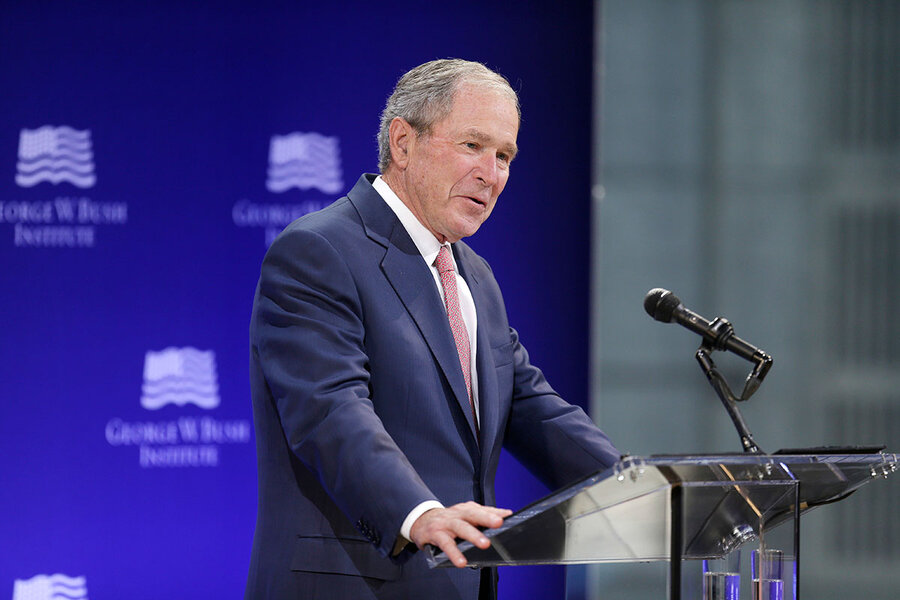
Presidential Rhetoric Expert Shares Thoughts on Bush's Speech
Presidential rhetoric expert Martin J. Medhurst, Ph.D., Distinguished Professor of Rhetoric and Communication and professor of political science in Baylor’s College of Arts & Sciences, is quoted in this article about speeches given last week by two former U.S. presidents and a former presidential candidate that warned of the dangers to the nation and the world if divisive politics continues to cleave the American electorate into thoughtlessly hostile warring camps. “They ... talk about American ideals, they ... talk about the story of America, the American creed and the need to reinvigorate democracy and continue to be the exemplar to the world of democratic values,” Medhurst said. Source:


This column by The Atlanta Journal-Constitution columnist Matt Kempner quotes business expert Peter Klein, Ph.D., professor of entrepreneurship in Baylor’s Hankamer School of Business and Senior Research Fellow with Baylor's Baugh Center for Entrepreneurship and Free Enterprise. Kempner asked several business and management professors to discuss President Trump’s management style. Klein said Trump's "style and manner is the dramatic departure from predecessors, not so much his policy." And regarding the differences in government versus business? “I understand the wish to make agencies more efficient,” Klein said. “But at the end of the day, government organizations are not like businesses.” ABOUT PETER KLEIN Peter G. Klein is Professor of Entrepreneurship at the Hankamer School of Business, Baylor University, and Senior Research Fellow with Baylor's Baugh Center for Entrepreneurship and Free Enterprise. His research focuses on the links between entrepreneurship, strategy, and organization, with application to innovation, diversification, vertical coordination, health care, and public policy. Source:
