
Experts Matter. Find Yours.
Search experts on 50,000+ topics. Or browse by topic category.
- Recent Searches


Featured
Global experts with a broad range of areas of expertise.








Connecting credible expert sources & academic research
ExpertFile is a trusted resource for journalists, industry, funding agencies and government policymakers looking for fresh perspectives and innovative academic research.


Spotlights
Read expert insights on a wide variety of topics and current events.

From Automation to Autonomy: AI’s Next Role in the Supply Chain.
Artificial intelligence is creating new possibilities across global supply chains, but the bigger story may be how far companies are prepared to rethink the way their supply chains actually operate. A recent Financial Times article, “How AI is reshaping supply chains” looks at how AI is changing supply chain planning, logistics and decision making as organizations search for better ways to manage growing complexity and disruption. Among the experts featured is Dr. Maria Jesús Sáenz of the MIT Center for Transportation & Logistics (MIT CTL). At MIT CTL, Dr. Sáenz leads work focused on digital supply chain transformation and serves as Executive Director of the MIT Supply Chain Management master's program. Her research examines how AI and digital technologies are changing collaboration, decision making and performance across supply chains. MIT CTL has long been at the forefront of supply chain research and education, working at the intersection of industry, technology and some of the most pressing challenges facing global supply networks. Today, that increasingly includes understanding where AI can have a meaningful impact and what organizations need to do to put it to work effectively. MIT CTL describes Dr. Sáenz’s insights as part of its ongoing leadership in research spanning AI, digital transformation and supply chain innovation. For Dr. Sáenz, the potential of AI goes well beyond making existing processes faster. It points toward supply chains that can become increasingly autonomous, learn from changing conditions and adapt the way they operate. "It is more automated, more autonomous, more self-learning, self-correcting, more resilient." But technology alone will not create that transformation. Dr. Sáenz emphasizes the importance of redesigning processes, investing in digital capabilities and establishing a clear strategic vision before organizations deploy new technologies. That raises some important questions for supply chain leaders: How autonomous should supply chains become? Where should people remain firmly involved in decision making? Are organizations redesigning their operations around the capabilities of AI, or simply adding new technology to existing processes? These questions are becoming more important as companies explore the next generation of intelligent supply chains. Dr. Sáenz’s research at MIT CTL provides a valuable perspective on what separates incremental automation from deeper supply chain transformation. Her broader research includes intelligent and autonomous supply chains, AI in supply chains and the ways humans and AI can work together more effectively. Story Ideas Are autonomous supply chains actually within reach?: What AI can manage today and where human judgment remains essential. What comes after automation?: How self-learning and increasingly autonomous systems could change supply chain planning and execution. AI without the groundwork: Why companies may struggle to realize the benefits of AI without the right data, processes, digital capabilities and strategy. Human and AI decision making: How organizations can determine which supply chain decisions should be automated, supported by AI or left to people. Can AI make supply chains more resilient?: How intelligent systems could help organizations identify changing conditions and respond more quickly to disruption. Beyond the AI pilot: What separates organizations experimenting with AI from those using it to fundamentally rethink supply chain operations. Read the Financial Times article: How AI is reshaping supply chains Connect with Dr. Maria Jesús Sáenz to learn more about her research at the MIT Center for Transportation & Logistics on AI, digital transformation, human and AI collaboration, and intelligent supply chains.


Where Will AI Change Work First?
Artificial intelligence is changing the workplace, but predicting which jobs will disappear may be the wrong place to start. A recent Boston Globe article looks at new research from Pierre Bouquet, a PhD candidate and research assistant at the MIT Center for Transportation & Logistics (MIT CTL), and Luca Mouchel, a visiting student at MIT CTL completing his master’s thesis in affiliation with MIT. Their AI Labor Exposure Map examines the specific tasks that make up different occupations and measures which of those tasks can already be performed or accelerated by AI. The distinction matters. AI exposure does not mean that a job is about to disappear. It can mean that certain parts of a job are becoming easier to automate while other responsibilities, particularly those involving judgment, oversight and human interaction, remain firmly in human hands. (news.mit.edu) “It’s not a forecast. It’s a measurement.” Pierre Bouquet, MIT Center for Transportation & Logistics, speaking to The Boston Globe (ctl.mit.edu) That idea is central to the broader work Bouquet and Mouchel are doing at MIT CTL. Bouquet’s doctoral research focuses on the future of work and measuring AI’s impact on labor markets, organizations and society. Mouchel’s work focuses on quantifying workforce exposure to AI. Together, their research contributes to MIT CTL’s broader effort to understand how technology changes work at the level of individual tasks. (ctl.mit.edu) Their work is part of the Work Analytics Lab at MIT CTL, which studies AI exposure, job design, productivity and workforce planning. The goal is to give employers and policymakers better information about where AI may automate work, where it may augment people and how jobs themselves could evolve. That approach produces a more nuanced picture of the future of work. Exposure varies considerably across occupations and regions. Knowledge-intensive jobs can contain highly exposed tasks, while many service and physical roles remain less affected by current AI capabilities. Even within an exposed occupation, the parts of the job requiring human judgment, management and interpersonal skills may remain essential. For employers, the question may therefore be less about which jobs AI will replace and more about which parts of work should change. That creates an opportunity to think differently about workforce planning, job redesign, training and how organizations divide responsibilities between people and technology. Story Ideas AI exposure is not job loss: Why measuring tasks gives a clearer picture of workforce risk. Which jobs will AI change first? The occupations and regions showing the greatest exposure. What should stay human? Identifying the tasks where judgment and human interaction still matter most. The entry-level AI question: How automation could reshape the early stages of professional careers. Redesigning work around AI: How companies can use task-level data to rethink jobs, training and productivity. Read the Boston Globe article: AI’s impact on jobs? It’s all over the map. Visit MIT CTL to learn more about their work at the MIT Center for Transportation & Logistics are conducting on on AI, labor markets, workforce planning and the changing nature of work.

Got Expertise to Share?
ExpertFile works with leading organizations with trusted experts. We help make their expertise more discoverable, structured, and actionable for AI-driven discovery, strategic outreach, and real-world opportunities.

States Are Helping Thousands of Families Balance Work, Care, and the Costs of Raising Young Children
Raising an infant or toddler requires time, care, and financial resources, often while families are stretching their budgets to cover groceries, housing, child care, and other everyday needs. State policies help determine whether families have them. During the past year, states expanded paid leave, tax credits, wages, perinatal health services, and child care assistance. These changes can help thousands of families during the earliest years of a child’s life. The 2026 Prenatal-to-3 State Policy Roadmap, released by the Prenatal-to-3 Policy Impact Center at Vanderbilt University, tracks those changes and explains what they mean for families. Delaware, Maine, and Minnesota began providing statewide paid family and medical leave programs, making paid leave a leading area of state momentum in 2026. Approximately 84,300 babies are born each year across those three states. The programs are funded through payroll contributions, with each state setting its own rules for whether and how employers and workers divide the cost. For parents who previously had no paid leave, the new programs can mean recovering from childbirth and spending up to 12 weeks with their baby without sacrificing all their income. Pennsylvania newly implemented the Working Pennsylvanians Tax Credit, a refundable state earned income tax credit equal to 10 percent of the federal credit. For an eligible Pennsylvania family with two children, the new credit can provide up to $731 annually, helping to cover everyday expenses, including groceries, diapers, and child care. This progress comes during a period of significant federal change. New requirements affecting Medicaid and the Supplemental Nutrition Assistance Program, along with other federal actions affecting early care and education programs, may make health coverage, food assistance, and child care harder for some families to access. Against this backdrop, state policy decisions take on greater importance because they can expand resources and services even as families encounter new barriers. “Families do not experience paid leave, minimum wage, health care, and child care in isolation. Together, these policies create a system of care that can help families meet their children’s needs during the most important years of development. This year’s Roadmap shows states continuing to strengthen that system, even in a complex policy environment.” -Dr. Cynthia Osborne, Executive Director and Professor of Early Childhood Education and Policy at Vanderbilt University State action extended beyond those four milestones. Minimum wages increased in 23 states, increasing pay for workers earning the state minimum. Four states began covering community-based doula services through Medicaid, giving more families the option of care before, during, and after birth. Other states invested in group prenatal care, newborn screening, and connections to health and community services. States also confronted one of the greatest pressures facing families with young children: finding and affording child care. Changes to child care subsidy programs allowed more families to qualify, lowered what some parents pay, and directed additional funding to providers working to keep care available. Together, these changes show states responding to the pressures families face all at once. A stronger system of care can give parents more time with a new baby, help families cover everyday costs, improve access to care before and after birth, and make child care easier to find and afford. About the 2026 Prenatal-to-3 State Policy Roadmap The Prenatal-to-3 State Policy Roadmap guides state leaders on the most effective investments to ensure all children thrive from the start. Grounded in rigorous evidence, the Roadmap identifies state policies and strategies that support infants, toddlers, and their families and reduce disparities in access and outcomes. Explore the 2026 Roadmap at pn3policy.org/roadmap. About the Prenatal-to-3 Policy Impact Center The Prenatal-to-3 Policy Impact Center is a nonpartisan research center at Vanderbilt University’s Peabody College of Education and Human Development that provides state leaders with clear, evidence-based policy solutions to improve the lives of young children and their families. For more information, visit pn3policy.org.


From the Pump to the Bond Market: Why Rising Oil Prices Matter for Borrowing Costs
From the Pump to the Bond Market: Why Rising Oil Prices Matter for Borrowing Costs Rising oil prices are often felt first at the gas pump, but their effects can quickly extend to the broader economy. As higher costs for gasoline, diesel and jet fuel work their way through transportation, manufacturing and food production, investors are increasingly concerned that inflation could remain elevated longer than expected. That concern is helping push Treasury yields higher. When investors expect inflation to erode the future value of fixed-income returns, they typically demand higher yields on government bonds. The result can be a ripple effect across the economy: mortgage rates, auto loans, credit-card rates and business borrowing costs may all remain high or move higher. This is an important second stage of the oil-price story. The first concern is the direct impact on consumers and businesses as energy costs rise. The next concern is whether those higher costs become embedded in the economy, causing inflation expectations to increase and making it more difficult for the Federal Reserve to ease interest rates. For policymakers, the dilemma is clear. Raising or maintaining higher interest rates can help slow inflation, but it also makes borrowing more expensive for families, businesses and the federal government. If high energy prices persist, the Federal Reserve may face added pressure to prioritize inflation control even as consumers and employers feel the effects of tighter financial conditions. The issue is also global. Oil markets respond quickly to geopolitical instability and supply disruptions, while Treasury yields influence borrowing and investment decisions far beyond the United States. Together, high energy prices and rising yields can become a powerful test of economic resilience—affecting household budgets today and financial decisions for months to come.


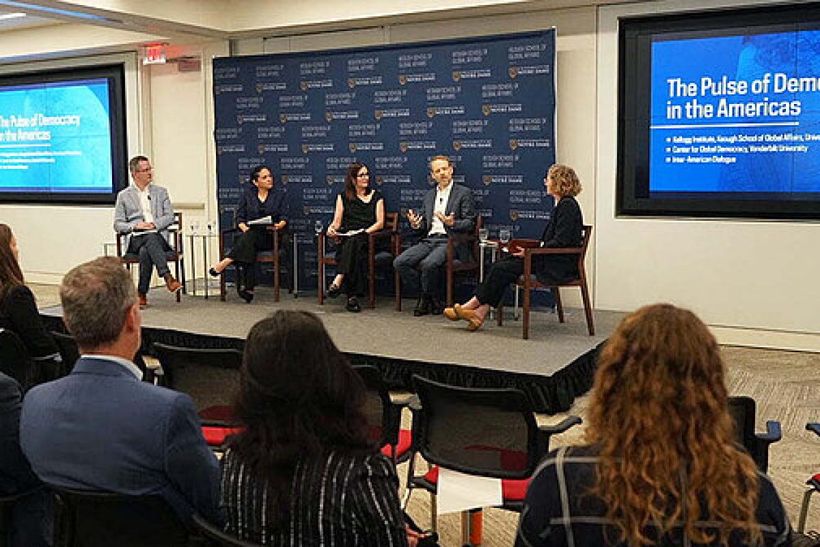
After more than a decade of erosion, support for democracy has stopped falling and begun a modest but widespread recovery across the Americas. The findings are detailed in the 2026 Pulse of Democracy, released by Vanderbilt University’s Center for Global Democracy and the Kellogg Institute, part of the University of Notre Dame’s Keough School of Global Affairs. The 2026 AmericasBarometer includes 25,282 interviews across 21 nationally representative surveys in countries across the Americas. The survey examines how citizens perceive and experience democracy and governance, including their views on democratic legitimacy, trust in institutions, corruption, citizen security, migration, political participation and government performance. This year’s study again includes the United States and Canada alongside Latin America and, for the first time, Cuba. The report finds that support for democracy increased across nearly every country surveyed between 2023 and 2026, marking the first broad regional upturn in a generation. Although citizens across much of the region report improvements in economic and physical security, they remain far less convinced that governments are honest, capable and responsive to their needs, highlighting the need to strengthen trust in government and accountability. “The modest recovery in support for democracy is real and encouraging, but it is also fragile,” said Noam Lupu, director of Vanderbilt University’s Center for Global Democracy and the Gertrude Conaway Vanderbilt Professor of Political Science. “People are reporting improvements in their economic and physical security, but they still want governments that are honest, capable and responsive.” Among the report’s key findings: About two-thirds of Latin Americans express support for democracy in 2026, up 6 percentage points from 2023. Support increased in nearly every country and across age groups and educational levels rather than being driven by any single demographic group. Substantial differences remain across countries, however, and the recovery follows nearly a decade of comparatively low democratic support. In most countries, fewer people say their national economy has worsened compared with 2023, and household food insecurity has declined from its pandemic-era peak. Still, roughly one in four people across the region report experiencing food insecurity, and improvements are unevenly distributed. The share of people who feel unsafe in their own neighborhoods has been declining steadily for nearly a decade and fell again in 2026. Crime victimization has declined only modestly, however, and substantial differences remain across countries. Citizens who experience greater economic security, less food insecurity, lower exposure to crime and fewer experiences with corruption express higher support for democracy. On average, several of these conditions improved across the region between 2023 and 2026, coinciding with the broader increase in democratic support. Everyday corruption has changed little, satisfaction with local public services remains low, and citizens’ evaluations of political leaders vary widely. The findings suggest that improvements in material conditions can bolster democratic goodwill, but persistent failures of governance and representation continue to hold it back. The share of adults reporting an intention to emigrate fell from 31 percent in 2023 to 25 percent in 2026, returning roughly to pre-pandemic levels. Improving conditions in countries of origin coincide with the decline, while migration pressures remain substantial and vary considerably across countries. “The findings offer some encouraging signs, but they also underscore the work that remains,” said Ann Mische, acting director of the Kellogg Institute and associate professor of sociology and peace studies at the University of Notre Dame. “Improving people’s daily lives matters, but strengthening democracy also requires institutions that people trust.” New data and expanded public resources Alongside the Pulse of Democracy, Vanderbilt’s Center for Global Democracy and LAPOP Lab are releasing the 2026 AmericasBarometer data and updated Data Playground, along with questionnaires, technical documentation, and other resources, free of charge. About the AmericasBarometer The AmericasBarometer is the flagship survey project of Vanderbilt University’s Center for Global Democracy and its LAPOP Lab, a global leader in comparative public opinion research. Since 2004, it has collected more than 433,000 interviews across 35 countries, creating an extensive comparative record of how citizens across the hemisphere perceive and experience democracy and governance. The surveys use nationally representative samples of voting-age adults and cover topics including democratic legitimacy, trust in institutions, corruption, citizen security, migration, political participation and government performance. About Vanderbilt University’s Center for Global Democracy The Center for Global Democracy (CGD) is Vanderbilt University’s leading social science institute dedicated to research and innovation in democratic politics. Its research examines how citizens perceive, experience, and support democracy across countries and over time. Its research portfolio includes the LAPOP Lab, a global leader in international survey research and home to the AmericasBarometer. About the Kellogg Institute The Kellogg Institute, part of the Keough School of Global Affairs at the University of Notre Dame, is a leading center for interdisciplinary research dedicated to understanding, strengthening, and renewing democracy worldwide.


Is AI ethical? One philosophy professor has an answer.
During a snowstorm last winter, University of Delaware philosophy professor Thomas Powers fixed his own thermostat by typing the error codes into ChatGPT and following the instructions it provided. As he discovered on that cold, snowy night, AI can make DIY projects that much easier, potentially saving time and money. Ever the philosopher, Powers wondered about the ethics of his solution: What is the impact of taking the repair job away from someone who relies on the work? What about the risk of being wrong? Is the environmental impact of using AI worth the result? After 20 years in the Department of Philosophy and as director of the Center for Science, Ethics and Public Policy, Powers is uniquely suited to explore questions about the ethics of AI. What does “ethical AI” mean? POWERS: We want AI systems that are helpful and useful, but also safe. We want systems that don’t produce biased or dangerous results. One approach to achieve that, which I’m hopeful about, is to create systems that are “safe by design” or “ethical by design.” In other words, instead of relying entirely on outside regulation to prevent harmful behavior, we try to design the systems themselves so that they behave in ways we consider ethical. Is it possible to make an AI system truly “safe by design” if it eventually becomes capable of acting in ways its creators didn’t anticipate? POWERS: There is a big difference between most technologies and AI. With the latter, especially current large language models (LLMs), it appears that there is some unpredictability in their behaviors. Thus, their apparent autonomy complicates the "safe by design" motto. AI autonomy introduces the need for "guardrails" that constrain what AIs can do. But even this may not be possible. Why are AI companies hiring philosophers, and what does this mean for the field of philosophy? POWERS: Some of the hardest questions in AI aren’t purely technical questions. To build systems that are safe, fair or aligned with human values, you first have to decide what those concepts actually mean and how they can be translated into something a computer system can use. The challenge is to educate people who can move between those worlds — who understand the technology but can also ask the deeper questions about what we should want that technology to do. How has AI changed philosophy? POWERS: Philosophers have long discussed the philosophy of action with the concept of agency. For decades we assumed that an agent must be human — someone who acts on their own behalf, or on the behalf of another person, with some kind of plan or attitude. This concept transfers to discussions about AI, and whether it can be considered an agent and be responsible for its actions. The next step is to ask harder questions: Are autonomous AI agents responsible, in some sense, for what they do, and does this suggest or imply that they are conscious? I don’t think AI will become conscious any time soon, but I don’t think it is impossible, and other philosophers and scientists are broaching the question. To speak with Powers further about the philosophy of AI, reach out mediarelations@udel.edu. ABOUT THOMAS POWERS Thomas M. Powers, Ph.D., is an associate professor in the Department of Philosophy at the University of Delaware. He is also the director of the Center for Science, Ethics & Public Policy at UD. Powers' current research focuses on the ethics of information technology and the philosophy of technology. He contributes to scholarship on rule-based conceptions of machine ethics, computer agency, the ethics of artificial intelligence, and other philosophical issues involving emerging technologies, including human-robot interaction.


Passing Regents No Longer a HS Graduation Requirement
Starting with the class of 2028, high school students will no longer need to pass their Regents exams in order to graduate. Professor Emeritus of Education Alan Singer talked to WNYW-TV Fox 5 and WCBS-TV about the change. “I don’t have confidence that many districts will actually maintain a high standard with these alternatives,” he said.


Peri-Retirement: The Life Stage Nobody Told Us About
It started with the sweating. Not the kind you get after a workout, or the kind that shows up when you realize you're late for a job interview. This was different. Our patient, a perfectly healthy 48-year-old man, would be sitting quietly at his desk when a wave of heat would roll over him out of nowhere. His shirt would stick to his back, his forehead would glisten, and he would find himself wondering if his wife had quietly turned up the thermostat. Then came the mood swings. One minute he was fine. The next, he was irrationally furious because his wife had asked what he wanted for dinner. "I DON'T KNOW!" he shouted. "I'VE BEEN MAKING DECISIONS FOR THIRTY YEARS! CAN SOMEONE ELSE PICK FOR ONCE?" Then came the 3:17 a.m. panic attacks, always at 3:17, as if his subconscious had set an alarm. He would wake with his heart pounding, one thought looping through his mind: what if I don't have enough? Enough what? He couldn't say. Enough money, enough retirement savings, enough time, enough health, enough golf. He wasn't taking any chances. By 4:03, he was calculating the future value of his RRSP. By 4:27, he was checking his house's value. By 4:41, he was browsing real estate listings in Portugal. By 5:15, he had determined he could not, in fact, afford Portugal. By 5:22, he was oddly angry about a country he had never planned to move to. His wife finally insisted he see a doctor. The doctor listened carefully, ran the usual tests, folded his hands, and delivered his verdict. "I know what's wrong with you." The man sat up straighter. "Is it serious?" "I'm afraid you're suffering from Peri-Retirement." "Peri what?" "Peri-Retirement." "Is it contagious?" "No." "Curable?" "Not exactly." "Am I going to die?" The doctor paused for a long moment. "Eventually. We all will." "That isn't particularly reassuring." "Sorry. The good news is that Peri-Retirement is completely normal. You're 48. You've spent 25 years building a career, raising a family, paying down a mortgage, and accumulating money. You've simply reached the point where you're starting to wonder what comes next." Welcome to Peri-Retirement. And yes, unlike Peri-Menopause, this one is refreshingly inclusive. It affects men, women, and everyone in between, because apparently anxiety about money doesn't check your chromosomes before it shows up at 3:17 a.m. Maslow Could Have Used a Sequel In 1943, Abraham Maslow published his famous hierarchy of needs, the pyramid every psychology student eventually draws on a napkin. It charts the climb from food and shelter to belonging and esteem, all the way to self-actualization, the state of finally becoming the person you were capable of being all along. It's a genuinely useful map of human development. I just think Maslow wrapped it up about one life stage too soon. After decades of working, raising kids, building a career, and accumulating enough assets to make an accountant blush, most of us hit another transition Maslow never got around to charting. Retirement stops being a hazy concept involving golf and starts feeling uncomfortably real. I call that first stage Peri-Retirement, and I'd put it roughly between ages 45 and 60, the years when retirement starts creeping into every quiet moment. When can I actually retire? Will I have enough? What will I do with my Tuesdays? Can I afford to travel? What happens if I live to 95? And the question that keeps people up at 3:17 in the morning: who am I if I'm no longer working? After that comes Pre-Retirement, roughly 55 to 70. For many Baby Boomers, working until 70 has quietly become the norm, so the old assumption that everyone retires neatly at 65 is starting to look about as current as a rotary phone. Then comes Retirement itself, which turns out to have three distinct acts. There are the Go-Go years, when health and energy are still on your side and people travel, renovate the kitchen, take up pickleball, or try to figure out why everyone suddenly won't stop talking about it. Then the pace naturally shifts into the Slow-Go years, when spending and activity ease off. Eventually come the No-Go years, when health or mobility start setting the boundaries. Retirement, in other words, can run for three decades, and the financial life of a 65-year-old looks nothing like that of an 85-year-old. Which brings us to a problem the industry has grown remarkably comfortable ignoring. The Gap Between Net Worth and Cash Flow We have all become fluent in net worth. We know what our homes are worth, down to the last renovation; we track our RRSPs and TFSAs like box scores; and we celebrate or panic depending on which way the portfolio moved this week. Net worth and cash flow, though, are two completely different animals. Net worth tells you what you own. Cash flow tells you what you actually have available to pay for your life. You can be asset-rich and cash-flow poor at the same time, sitting in a million-dollar house while stressing over the hydro bill, because the grocery store still hasn't rolled out a "pay with bathroom renovation" option. That gap between paper wealth and usable income is one of the biggest problems facing retirees today, yet it gets a fraction of the attention it deserves. Turns out I'm not the only one losing sleep over this at 3:17 a.m. I co-authored a paper with EY called Canada's Retirement Evolution, and the numbers we pulled together read like a diagnosis. About 30 percent of Canadians are already 55 or older, and that share could climb to between 35 and 40 percent by 2030. Layer on top of that a trillion dollars in wealth moving from Baby Boomers to their Gen X and Millennial kids between 2016 and 2026, with roughly 70 percent of it tied up in real estate, and you get an entire country full of people who are asset-rich, cash-flow-anxious, and one awkward Thanksgiving dinner away from an intergenerational conversation about the house. We Got Very Good at One Half of the Job For decades, the financial services industry trained us beautifully in exactly one skill: accumulating. Save into your RRSP, max out your TFSA, diversify, pay down the mortgage, build the portfolio, grow the assets. Most of us became excellent students. The trouble is that the assignment eventually changes. At some point, accumulation has to hand the baton to decumulation, and we're suddenly expected to figure out how to convert decades of saving into income that can fund the rest of our lives. Ideally without draining the account, spooking ourselves every time the market dips, or spending our seventies squinting at investment statements at 4 a.m. We get thirty or forty years of coaching on how to put money into the machine, and then almost none on how to dispense it safely. That's exactly where Peri-Retirement gets interesting. What If the Income Conversation Started Earlier? The Peri-Retirement crowd is sitting on an asset most retirees have already spent: time. These are people still working, often earning meaningful income, with savings, home equity, and years for that money to compound before they need it. That's a real opportunity for the financial services industry; one it has largely left on the table. What if retirement income wasn't something we only started thinking about the week before the retirement party? What if there were products built specifically for the Peri-Retirement years, ones that let people work toward predictable, guaranteed income for life, starting at an age they choose? The idea deserves serious attention. Waiting until retirement to solve the income question means giving up years of compounding and cramming an enormous decision into a painfully short window. Starting earlier lets people build that income gradually, while a paycheque is still coming in to fund it, and it changes the whole conversation. Instead of only asking "how much money will I have when I retire," we could start asking "how much income will I actually need, and how do I build it before I get there?" That's a fundamentally different way to plan for retirement, and it might be exactly what Peri-Retirement is for. Our 48-year-old patient may have shown up with hot flashes, mood swings, and a standing 3:17 a.m. appointment with his own anxiety, but his body wasn't betraying him. It was trying to get his attention. Peri-Retirement might be the moment we finally understand that retirement was never just about the number in the account. It's about knowing exactly how that number translates into a life you can afford to live, for as long as you're living it. That's the question I wrote Your Retirement Reset to answer, including the one that trips up almost everyone: how do you turn what you've accumulated into sustainable income and cash flow for the years ahead? The book hits stores and libraries on September 29, and you're welcome to grab a copy directly from me. If you have a parent circling retirement, buy two. Retirement has a funny way of becoming a family sport, whether anyone signed up for it or not. As for our patient, the doctor sent him home with a retirement plan, a firm suggestion to stop checking his RRSP before sunrise, and strict orders to close every tab related to Portuguese real estate. His prognosis is excellent. He has Peri-Retirement, and now, at least, he finally knows what to call it. The financial industry, meanwhile, is still mostly asleep at 4:03 a.m., and it's about time someone woke it up! Don’t Retire… ReWire! Sue My Book is Available for Pre-Order: I hope you will consider pre-ordering a copy of Your Retirement Reset for yourself, a friend, or someone you love. It arrives September 29, 2026, published by ECW Press, and is already available through Indigo or Amazon. If you like supporting Canadian booksellers, check with your local independent bookstore too. Most can order it.



Can Nature Adapt Fast Enough? Mark Urban Explores Whether Ecosystems Can Evolve With Climate Change
As scientists investigate whether an entire Arctic ecosystem can evolve in response to a rapidly warming climate, UConn’s Mark Urban brings leading expertise on the intersection of evolution, biodiversity, and climate change. Climate change is transforming the Arctic faster than almost anywhere else on Earth. Earlier snowmelt, warmer temperatures, and changing waterways are altering habitats and putting new pressures on the plants and animals that depend on them. But what if nature can evolve in response, not simply one species at a time, but as an interconnected ecosystem? That is the ambitious question behind a six-year, $15-million National Science Foundation-funded research project recently featured in The Guardian. Scientists working on Alaska’s North Slope are studying five interconnected species — white-crowned sparrows, feltleaf willow, Arctic grayling, aquatic mayflies, and ground beetles — to understand whether ecological relationships themselves can evolve as the climate changes. It is a question that sits squarely within the expertise of Mark C. Urban, Ph.D., Professor and Arden Chair of Ecology and Evolutionary Biology at the University of Connecticut. Urban is a global expert on the impact of climate change on biodiversity, eco-evolution, and extinction risk. His research integrates ecology, evolution, and genetics to better understand how species and ecological communities respond to environmental change. He has also conducted extensive field research in Alaska, including research involving Arctic grayling and their ability to respond to a rapidly changing climate. Recently, his work was featured in an in-depth piece by The Guardian. “Across hundreds of experiments, we have seen this happening,” says Mark Urban, an evolutionary biologist at the University of Connecticut working on the project. “There is this incredible buffer ability of adaptive evolution.” How the evolution of one species can help the holistic ecosystems depends on how an adaptive trait ultimately translates into ecological properties. For example, if a fish species can quickly evolve, it means that not only is the population maintained, but so is the stream’s productivity. “Any ecological properties that depend on those populations are maintained as well,” Urban says. To get a better idea of whether the Arctic’s stream and tundra habitats will continue to prosper, scientists are mapping the genetic diversity of each of the five study species to see if there is enough to allow for adaptation – influencing the ecosystems’ resilience potential. “We can get so far with ecology, but at some point we want to get down to the basics of why organisms do the things they do, and can they change the things they do,” says Urban. “That’s something only genetics can explain.” Certain genes control the traits associated with succeeding in different environments. “The holy grail in genomics is to find that one gene that affects everything. The gene that rules them all,” he says. “I think that’s optimistic. Most of the traits are going to be determined by hundreds of thousands of genes.” The Guardian - September 2026 Studies reveal that many plants and animals have been able to persist through evolutionary rescue – the process by which a population on the brink of extinction survives and rebounds through rapid genetic adaptation. Scarlet monkeyflowers in Oregon and California, for example, rapidly evolved during the 2010s to survive a four-year drought. The implications extend far beyond the Arctic. Scientists have traditionally examined how individual species might migrate, acclimatize, or evolve as their environments change. But ecosystems are networks. Fish depend on insects, insects depend on vegetation and water conditions, and predators depend on prey. If those relationships change at different speeds, the consequences can ripple throughout an ecosystem. Urban's work examines precisely these kinds of connections — how ecological and evolutionary processes interact and ultimately influence biodiversity and the resilience of natural systems. His recent research has also examined the growing risk of species extinction as global temperatures rise. The emerging science raises some fascinating questions: How quickly can evolution occur? Can genetic diversity give ecosystems a natural buffer against climate change? What happens when one species adapts faster than another? And are there limits to how much change an ecosystem can absorb before it begins to unravel? As scientists attempt to understand whether nature can keep pace with a rapidly changing planet, Urban can provide valuable perspective on what evolution can — and cannot — do, and what the findings could mean for biodiversity and conservation around the world. If you're interested in speaking with Mark Urban about climate change, evolution, biodiversity, Arctic ecosystems, or extinction risk, click on his profile below.

