
Experts Matter. Find Yours.
Connect for media, speaking, professional opportunities & more.

Paper ballots, risk-limiting audits can help defend elections and democracy, IU study finds
BLOOMINGTON, Ind. -- With just over two months before the 2020 election, three professors at the Indiana University Kelley School of Business offer a comprehensive review of how other nations are seeking to protect their democratic institutions and presents how a multifaceted, targeted approach is needed to achieve that goal in the U.S., where intelligence officials have warned that Russia and other rivals are again attempting to undermine our democracy. But these concerns over election security are not isolated to the United States and extend far beyond safeguarding insecure voting machines and questions about voting by mail. Based on an analysis of election reforms by Australia and European Union nations, they outline steps to address election infrastructure security -- such as requiring paper ballots and risk-limiting audits -- as well as deeper structural interventions to limit the spread of misinformation and combat digital repression. "In the United States, despite post-2016 funding, still more than two-thirds of U.S. counties report insufficient funding to replace outdated, vulnerable paperless voting machines; further help is needed," said Scott Shackelford, associate professor of business law and ethics in the Kelley School, executive director of the Ostrom Workshop and chair of IU's Cybersecurity Program. "No nation, however powerful, or tech firm, regardless of its ambitions, is able to safeguard democracies against the full range of threats they face in 2020 and beyond. Only a multifaceted, polycentric approach that makes necessary changes up and down the stack will be up to the task." For example, Australia -- which has faced threats from China -- has taken a distinct approach to protect its democratic institutions, including reclassifying its political parties as "critical infrastructure." This is a step that the U.S. government has yet to take despite repeated breaches at both the Democratic and Republican national committees. Based on an analysis of election reforms by Australia and European Union nations, they outline steps to address election infrastructure security -- such as requiring paper ballots and risk-limiting audits -- as well as deeper structural interventions to limit the spread of misinformation and combat digital repression. "In the United States, despite post-2016 funding, still more than two-thirds of U.S. counties report insufficient funding to replace outdated, vulnerable paperless voting machines; further help is needed," said Scott Shackelford, associate professor of business law and ethics in the Kelley School, executive director of the Ostrom Workshop and chair of IU's Cybersecurity Program. "No nation, however powerful, or tech firm, regardless of its ambitions, is able to safeguard democracies against the full range of threats they face in 2020 and beyond. Only a multifaceted, polycentric approach that makes necessary changes up and down the stack will be up to the task." For example, Australia -- which has faced threats from China -- has taken a distinct approach to protect its democratic institutions, including reclassifying its political parties as "critical infrastructure." This is a step that the U.S. government has yet to take despite repeated breaches at both the Democratic and Republican national committees. The article, "Defending Democracy: Taking Stock of the Global Fight Against Digital Repression, Disinformation and Election Insecurity," has been accepted by Washington and Lee Law Review. Other authors are Anjanette "Angie" Raymond, associate professor of business law and ethics, and Abbey Stemler, assistant professor of business law and ethics, both at Kelley; and Cyanne Loyle, associate professor of political science at Pennsylvania State University and a global fellow at the Peace Research Institute Oslo. Aside from appropriating sufficient funds to replace outdated voting machines and tabulation systems, the researchers said that Congress should encourage states to refuse to fund voting machines with paperless ballots. The researchers also suggest requiring risk-limiting audits, which use statistical samples of paper ballots to verify official election results. Other suggested steps include: Congress requiring the National Institute of Standards and Technology to update their voting machine standards, which state and county election officials rely on when deciding which machines to purchase. Australia undertook such a measure. Creating a National Cybersecurity Safety Board to investigate cyberattacks on U.S. election infrastructure and issue post-elections reports to ensure that vulnerabilities are addressed. Working with universities to develop training for election officials nationwide to prepare them for an array of possible scenarios, and creating a cybersecurity guidebook for use by newly elected and appointed election officials. "With regards to disinformation in particular, the U.S. government could work with the EU to globalize the self-regulatory Code of Practice on Disinformation for social media firms and thus avoiding thorny First Amendment concerns," Raymond said. "It could also work to create new forums for international information sharing and more effective rapid alert and joint sanctions regimes. "The international community has the tools to act and hold accountable those actors that would threaten democratic institutions," added Stemler, who also is a faculty associate at Harvard University's Berkman Klein Center for Internet and Society. "Failing the political will to act, pressure from consumer groups and civil society will continue to mount on tech firms, in particular Facebook, which may be sufficient for them to voluntarily expand their efforts in the EU globally, the same way that more firms are beginning to comply with its General Data Protection Regulation globally, as opposed to designing new information systems for each jurisdiction."


Airing commercials after political ads actually helps sell nonpolitical products
About $7 billion reportedly will be spent this fall on television and digital commercials from political campaigns and political action committees, filling the airwaves with political ads many viewers dislike. Companies running ads immediately afterward have been concerned about the potential of a negative spillover effect on how they and their products and services are perceived. But new research from the Indiana University Kelley School of Business finds that the opposite is true. Contrary to mainstream thought, political ads instead yield positive spillover effects for nonpolitical advertisers. And this happens regardless of whether the political ad is an attack ad or not, who the ad supports, and whether it's sponsored by a candidate, political party or PAC. Political advertising accounts for nearly 10 percent of all U.S. television ad revenue. The findings are in the article "Impact of Political Television Advertisements on Viewers' Response to Subsequent Advertisements" -- accepted for publication in Marketing Science -- by Beth Fossen, assistant professor of marketing; Girish Mallapragada, associate professor of marketing and Weimer Faculty Fellow; and doctoral candidate Anwesha De, all from the Kelley School of Business. "Our investigations provide insights into the previously unexplored ad-to-ad spillover effects and, more broadly, provides insights into how political messages influence consumers," Fossen said. "Nonpolitical ads that follow political ads benefit through a reduction in audience decline and an increase in positive post-ad chatter." Using data for 849 national prime-time ads during the 2016 U.S. general election, the researchers found that ads airing after a political commercial saw an 89 percent reduction in audience decline and a 3 percent increase in post-ad chatter online. Their findings remained consistent when examining the effect by TV network and political party affiliation. "It seems reasonable to assume that Fox News viewers are more likely to be positively stimulated by pro-Republican ads than viewers of other channels," researchers wrote. "However, evidence from our data suggests that the positive spillover from pro-Republican ads is not higher and is nearly lower on Fox News viewership decline than when pro-Republican ads air on other channels." They found a similar trend when it came to advertising on MSNBC, whose viewers frequently identify with the Democratic Party and progressive causes. Mallapragada said the findings show that television networks and stations can leverage the positive spillover effects on subsequent ads by implementing differential pricing and systematic ad sequencing. Prevailing belief in the business industry has suggested that political ads on television hurt the effectiveness of subsequent ads. To illustrate this concern, during the 2020 Super Bowl, game broadcaster Fox isolated political ads from other paying advertisers in their own ad breaks, a decision that cost the network millions in ad revenue, because it ran nonpaid show promos alongside the political ads instead of commercials from paying advertisers. "The insights from this research enable advertisers to advocate for the inclusion of ad positioning in ad buys and, specifically, negotiate that their ads follow political ads," he said. "Our results may also encourage advertisers outside of the television context to experiment with advertising next to political content, an experimentation that may be especially beneficial for online advertisers given that they commonly blacklist political topics to avoid having their ads appear near political content." Editors: Contact George Vlahakis at vlahakis@iu.edu for a copy of the paper.
A record number of female candidates are running in 2020
It’s been a full century since the 19th Amendment was passed in the United States, giving women the right to vote. This year, women are not only casting their ballots - they're appearing on them in record numbers. A record number of women are running for Congress this year, boosted in part by a surge of Republican women seeking office in a party struggling to regain lost ground with female voters. The influx adds to the advances female candidates — mostly Democrats — made in the 2018 midterm election that helped reshape the makeup of Congress. It also has echoes in the presidential race, based on voting patterns from two years ago and Democrat Joe Biden’s lead in polls over President Donald Trump among female voters. Biden has vowed to pick a woman as running mate. As of July 1, 574 women had filed to run in primaries for U.S. House seats, topping the record 476 from two years ago, according to data compiled by the center. Another 58 women filed to run for the Senate, compared with 53 in 2018. In all, that’s a 20% increase in women making congressional bids. July 13 – Providence Journal It is an impressive number and one every American should be proud of. But there are a few questions that still need to be asked. With close to 220 GOP women vying for a seat in Congress – has the party that traditionally does not have the support of women voters finally changed its course? Are female candidates motivated by the need to change when it comes to key issues like health care, the environment, and the economy? If you are a journalist looking to cover the increased number of females running for elected office this November – then let our experts help. Dr. Rosalyn Cooperman, associate professor of political science at the University of Mary Washington and member of Gender Watch 2018, is an expert on women in politics. She is available to speak with media regarding this topic – simply click on her icon to arrange an interview.



Canadian's Digital Behavioral Shifts in Relation to the The Coronavirus Pandemic
This article is part of a series of insights that reveal a Canadian perspective on the impact of the COVID-19 pandemic on consumer behavior and significant audience shifts across digital platforms. Things are moving fast. Following our last update regarding digital media consumption during the Coronavirus pandemic, this article will highlight some of the major category changes reflected as of the week March 16 - 22, 2020. Key Insights from Our Analysis Digital consumption continues to grow: the visits and minutes curve is not flattening Key content categories such as news, social media, and government are being driven by higher engagement: metrics include visits and duration More engagement with news sites: sites categorized as local, business/finance, and general news are main drivers Categories that focus on entertaining, kids, food, financial advice, and children’s education are also seeing growth: growth comes from increases in aggregate unique visitors, visits and minutes Automotive manufacturers, real estate, sports and travel entities have seen decreases: however, they are poised for major increases and a bounce back. Mobile platforms are driving growth: some differences between desktop and mobile engagement Canadian's total digital consumption continues to grow When we analyzed Canadian total digital media consumption to compare the percentage change between the week of March 16, 2020 and the first weeks of January 2020, February 2020, and March 2020, we found that overall digital engagement is not flattening. Even comparing the beginning of March against mid-March, we can see visitation, visits, and engagement continuing to grow. Looking at the total digital consumption trend over time, we can see growth in total minutes spent online while total visits have remained relatively flat. Media Consumption Growth by Category There are several content categories that we are seeing major growth in each of the time periods: These digital categories of news/information, social media, entertainment, government and games are showing continuous growth. The need for ongoing news and information updates, government information, flocking to social media to bring community together and message, and the need to be entertained with visitation and engagement on Entertainment and Games Entities. News and Information Category Insights To look at the news/information category a bit closer – it is amazing to see the category growth over the past few weeks of Canadians going to news entities to get updates. The hockey stick growth from the start of March 2020 is very evident. The news and information growth is being driven by local news, general news, and business/finance news. That being said – technology, politics, and weather are also seeing growth. Through these time periods, we are also seeing some other categories that are showing significant growth. Many of the categories are a result of many Canadians being home bound and isolated, and with families with kids having the kids at home. Platform Variance for Media Consumption One of the areas that we have been asked most about is whether we find any variances between desktop and mobile platforms. When reviewing the data, there is greater engagement with mobile platforms in the week of March 16 compared to other weeks. Amidst the global COVID-19 pandemic, we are seeing a significant increase in digital consumption amongst Canadian consumers. The data trends show Canadians are flocking online with significant growth in news entities, instant messaging, social media, government resources, entertainment, music destinations, video, and financial websites. What this means for marketers and advertisers is a significant opportunity to reach Canadians who are highly engaged and are looking for relevant and timely content. It comes down to delivering the right message, at the right time, in front of the right audience, in brand safe environments.



Insights and Analysis of Canadian Digital Media Consumption During the Coronavirus Pandemic
In the midst of the COVID-19 crisis, millions of Canadians are staying home and turning to their computers, smartphones, and tablets as a core source of news, information, education, and entertainment. This article is part of a series of insights that reveal a Canadian perspective on the impact of the COVID-19 pandemic on consumer behavior and significant audience shifts across digital platforms. This week we will highlight some of the major category changes reflected as of the week March 23 - 29, 2020. Key Insights from Our Analysis: Digital consumption continues to grow, although at a slower pace Canadians are still consuming news at a record pace, but growth is slowing Sports and Real Estate declines are slowing Retail overall is stable but key categories like Toys, Apparel, and Books are increasing in consumption Canadian usage in Dating, Pets, Food, and Family & Youth Education on the rise Canada's Total Digital Population An analysis of Canadian Total Digital Media consumption looking at the percent change from week of March 23, 2020 to March 29, 2020 from the previous week of March 16, 2020 to March 22, 2020 showed continued increase of Unique Visitors (UVs), Visits, and Minutes, but does reveal that some increases are at a slower rate than previous weeks. Unique Visitors grew by +1%, Visits by +2%, and Minutes by +5%. At a top line that is still substantial growth, but throughout this release we will give insights into what is driving these increases, and in some cases highlight categories that are starting to show recovery. Analysis from the News and Information Category This category has been a huge focus over the past few releases given the amazing growth of Unique Visitors, Visits, and Minutes as COVID-19 became more prevalent in Canada. Canadians flocked to News/Information websites in record numbers driven by General News, Local News, Weather, and Politics. With that being said, during our latest week of data (week of March 23, 2020 to March 29, 2020) we have seen a lower percentage increase for the category. There is still growth, but the growth is at a slower rate. The category is still a huge area of focus and visitation and engagement are near record high levels. Analysis from the Retail Category The Retail category has also been a particular focus as bricks and mortar shopping has significantly changed, and in some places closed where they are deemed non-essential. Overall, the Retail category has seen a pretty flat line of growth in Unique Visitors, Visits, and Minutes. That being said, we have seen some sub-categories show growth that is greatly over-indexing. This growth in the Retail category is being driven by these subcategories: Toys, Books, Apparel, Sports/Outdoor, Department Stores/Malls. Toys is leading the charge with a 27% week-over-week growth in Unique Visitors. Analysis from Sports and Real Estate Categories The Sports and Real Estate categories have been two of several categories hit by major decreases in visitation and engagement during the COVID-19 pandemic in Canada. With live sports on hold for most of the major sports leagues in North America – there has been a decline across the board. That being said, during the week of March 23, 2020 to March 29, 2020 for the first time since our COVID-19 analysis began we have seen a decrease in the rate of decline in Visitation, and an in fact an increase in week-over-week Minutes. In terms of the Real Estate category, we have seen small week-over-week decreases with -3% in Unique Visitors, -7% in Visits, and -6% in Minutes – compared to the double-digit declines in the past few weeks. Insights from Other Categories of Interest There were a few other categories that hit our radar this week when looking at the data. These categories have seen week-over-week increases – that show Canadians are increasing Visitation and Engagement with this content. Many of these categories reflect the reality that people are isolated at home – with either kids (whom they must entertain and educate) or without kids or a partner – and they are looking to meet new people (Dating). The Pets category showed big increases, and Lifestyle – Food showed increases in activity. Canadians are apparently focused on love, kids, pets, and their tummies!

Racial and LGBT bias persists in ridesharing drivers despite mitigation efforts
Despite efforts by ridesharing companies to eliminate or reduce discrimination, research from the Indiana University Kelley School of Business finds that racial and LGBT bias persists among drivers. Platforms such as Uber, Lyft and Via responded to drivers' biased behavior by removing information that could indicate a rider's gender and race from initial ride requests. However, researchers still found that biases against underrepresented groups and those who indicate support for the LGBT community continued to exist after drivers accepted a ride request -- when the rider's picture would then be displayed. In other words, their efforts shifted some of the biased behavior until after the ride was confirmed, resulting in higher cancellation rates. Understanding whether bias has been removed also is important for ridesharing companies as they not only compete against each other but also with traditional transportation options. "Our results confirm that bias at the ride request stage has been removed. However, after ride acceptance, racial and LGBT biases are persistent, while we found no evidence of gender biases," said Jorge Mejia, assistant professor of operations and decision technologies. "We show that signaling support for a social cause -- in our case, the lesbian, gay, bisexual and transgender community -- can also impact service provision. Riders who show support for the LGBT community, regardless of race or gender, also experience significantly higher cancelation rates." Mejia and co-author Chris Parker, assistant professor in the information technology and analytics department at American University in Washington, believe they are the first to use support for social causes as a bias-enabling characteristic. Their article, "When Transparency Fails: Bias and Financial Incentives in Ridesharing Platforms," is published in Management Science. They performed a field experiment on a ridesharing platform in fall 2018 in Washington, D.C. They randomly manipulated rider names, using those traditionally perceived to be white or Black, as well as profile pictures to observe drivers' behavior patterns in accepting and canceling rides. To illustrate support for LGBT rights, the authors overlaid a rainbow filter on the rider's picture profile. "We found that underrepresented minorities are more than twice as likely to have a ride canceled than Caucasians; that's about 3 percent versus 8 percent," Mejia said. "There was no evidence of gender bias." Mejia and Parker also varied times of ride requests to study whether peak price periods affected bias. They found that higher prices associated with peak times alleviated some of the bias against riders from the underrepresented group, but not against those who signal support for the LGBT community. They believe that ridesharing companies should use other data-driven solutions to take note of rider characteristics when a driver cancels and penalize the driver for biased behavior. One possible way to punish drivers is to move them down the priority list when they exhibit biased cancellation behavior, so they have fewer ride requests. Alternatively, less-punitive measures may provide "badges" for drivers who exhibit especially low cancellation rates for minority riders. But, ultimately, policymakers may need to intervene, Mejia said. "Investments in reducing bias may not occur organically, as ridesharing platforms are trying to maximize the number of participants in the platform -- they want to attract both riders and drivers," he said. "As a result, it may be necessary for policymakers to mandate what information can be provided to a driver to ensure an unbiased experience, while maintaining the safety of everyone involved, or to create policies that require ridesharing platforms to monitor and remove drivers based on biased behavior. "Careful attention should be paid to these policies both before and after implementation, as unintended consequences are almost sure to follow any simple fix."

New System of Infrared Sensors Maintains Privacy While Keeping Patients Safe
Short of cameras, there are few tools at the disposal of health care providers or loved ones to remotely monitor patient safety within hospitals and assisted living care facilities. This challenge was on Bob Karlicek's mind when he and a team of other researchers developed a new system of infrared sensors that is able to provide real-time data about a person’s movements in a room while also maintaining their privacy. “We can thread this balance of information and privacy,” said Karlicek, the director of the Center for Lighting Enabled Systems & Applications (LESA). “It turns out that lighting and light field sensing give us a tremendously powerful tool for figuring out where people are and estimating what they are doing, but without creating an image of who they are.” The system relies on what Karlicek calls occupant-centric control. More specifically, a set of sensors uses infrared light to measure distances between sensors and objects in order to identify where someone may be in a room. This information can help determine if a person is standing, sitting, or lying down on the floor. It can also distinguish between where people are standing and how they are interacting with other people. Such measurements could alert a caregiver that someone has fallen or document the last time someone checked on their loved one. The use of infrared light to measure distance is not a new concept. What’s novel about this approach, Karlicek said, is the development of a very inexpensive sensor that has data analytics built right into it, allowing the sensors to collect data, process it, and communicate with each other in order to track movement within a room. Karlicek is available to discuss this technology and other efforts LESA is working on to make buildings more capable, efficient, and helpful to the people who use them.



Virtual Reality-Based Surgical Simulations Could Make Patients Safer
Suvranu De, the director of the Center for Modeling, Simulation, and Imaging in Medicine at Rensselaer, has dedicated more than a decade of research to making surgery safer by developing virtual reality-based surgical training simulations that closely mimic the optics and haptics a surgeon may encounter in the operating room. A new $2.3 million grant from the National Institute of Biomedical Imaging and Bioengineering of the National Institutes of Health will further his research in this space, by supporting the development of a collaborative virtual reality-based surgical simulation environment that allows medical professionals to practice technical, cognitive, and interpersonal skills as a team. “People will be wearing head-mounted displays, and they will be immersed in a virtual operating room working on a virtual patient as a team,” De said. “We want to have an expert team in the operating room focused on the treatment of a patient, and not just a team of experts.” Conceptually, this approach is similar to crew resource management practiced by aviation pilots, which has led to a significant reduction in aircraft accidents. The Virtual Operating Room Team Experience (VORTeX) simulation system will provide realistic distractions, interruptions, and other stressors that medical professionals may encounter in an operating room. Traditionally, this type of simulation training has required mannequins, instructors, and a dedicated space, as well as significant coordination and resources. In contrast, the VORTeX system will be both distributed and asynchronous – allowing participants to join the simulation from different locations, and instructors to review the simulation and provide feedback at their convenience. Machine learning algorithms will be used to crunch the data and provide feedback to participants, who will be able to return to the virtual environment to review their performance. De is available to discuss how this type of virtual training is developed and implemented.
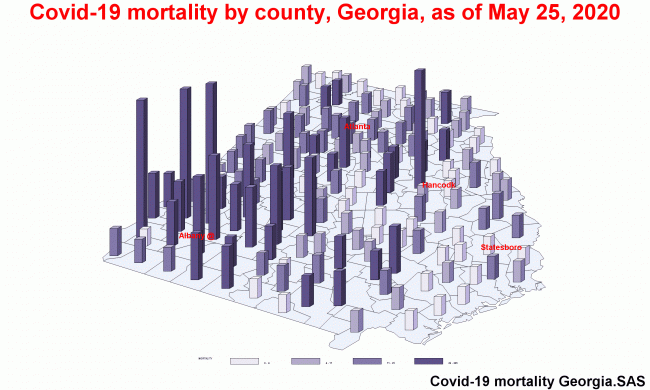
Graduate students in the Jiann-Ping Hsu College of Public Health at Georgia Southern University analyzed mortality data to reveal that a county in southwest Georgia is dealing with deaths from COVID-19 at a rate higher than most other counties in the country. The students found that the mortality rate of 305 per 100,000 residents (as of May 28, 2020) for Terrell County in southwestern Georgia, is 50% higher than that of New York state’s Nassau County, the documented highest rate in New York. The three other Georgia counties that are highest in terms of mortality rate are Hancock, Early and Dougherty counties. Three out of these four are in southwest Georgia, around the Albany area. That accounts for almost half of the 10 counties in the United States with the highest mortality rate, which is defined as a measure of the frequency of occurrence of death among a defined population. However, it’s interesting to note that none of Georgia counties reached the top 20 in terms of incidence and the death numbers per 100 confirmed Covid-19 cases, said professor Dr. Jian Zhang, a veteran medical epidemiologist. “Georgia is doing pretty well to stop the spread of the virus, and hospitals in Georgia are doing well to save hospitalized COVID-19 patients. The high mortality rate, in this case, may be deeply rooted in the historical burden of poverty in Georgia,” Zhang said. The findings are part of a service-learning project Zhang led. A six-student group formed the surveillance team that began running a real-time COVID-19 numbers in his Public Health Surveillance class. If you are a journalist covering COVID-19 and would like to learn more about this research taking place at Georgia Southern University – then let us help. Dr. Jian Zhang has worked with the Chinese Centers for Disease Control and Prevention, and the World Health Organization prior to moving to the United States.


CAA Insurance Company has developed a list of 10 questions that customers can ask their insurance companies to make sure they are covering all the bases when it comes to finding savings while staying protected. “As of right now, much of the relief provided by insurance companies during the COVID-19 pandemic will soon expire, and customers will be looking for ways to continue to save since many cars are still sitting in the driveway,” said Elliott Silverstein, director, government relations, CAA Insurance. “We felt it was important to empower people with the information they need to continue to advocate for lower premiums for the months ahead.” In a recent survey conducted in late April by CAA South Central Ontario, only one out of five CAA members surveyed were aware that their insurance company had provided relief during COVID-19. The most preferred action to lower auto insurance premium was reviewing their policy with an agent/broker to ensure coverage and costs meet individual needs. Based on this data, CAA Insurance wanted to make sure that people are asking the right questions. Customers are encouraged to call their agent or broker and review the following list of questions to make sure they are receiving all the potential savings available. What savings relief payments or refunds do you have for me during the pandemic? Are there coverages that I can reduce or put on hold while I’m not driving? Can we do a review to see if I can save more on my policy? Will increasing my deductible provide me cost savings? Do you have an insurance policy where I would only pay for insurance while I am driving, for example, pay-as-you-go? When does my policy renew and is there a penalty if I cancel my policy mid-term to save money with another insurance company? What can I do if I can’t make my insurance payments this month? Will changing my coverage from commuting to pleasure help me save money? Are there any other ongoing discounts you offer that I might qualify for? What can I do to keep my rates low after the pandemic?

