
Experts Matter. Find Yours.
Connect for media, speaking, professional opportunities & more.

Richard G. Cuming Appointed Chief Operating Officer of ChristianaCare
(WILMINGTON, Del. – June 26, 2023) Richard G. Cuming, Ed.D., MSN, RN, NEA-BC, FAAN, has been named ChristianaCare’s chief operating officer (COO). Cuming has been serving as interim COO since the beginning of this calendar year. He joined ChristianaCare in 2016 as the system’s first Chief Nurse Executive. In his role as COO, Cuming oversees the delivery of efficient and fiscally responsible system operations. He also works with other leaders to ensure high-quality and safe patient care. “Ric has been an invaluable asset to ChristianaCare over the past seven years, especially in navigating the many challenges of the COVID-19 pandemic” said Janice E. Nevin, M.D., MPH, ChristianaCare president and chief executive officer. “As leader of our extraordinary, Magnet®-designated nursing staff and president of ChristianaCare HomeHealth, he has improved the lives of patients and caregivers alike. I look forward to him flourishing in this new role.” Prior to coming to ChristianaCare, Cuming oversaw the operations and strategic direction of nursing services, perioperative and emergency services at Einstein Medical Center Philadelphia, Einstein Medical Center Elkins Park, MossRehab, Einstein Center One and Willowcrest, a skilled nursing center. Ric also previously worked at Jackson Health System in Miami as senior vice president and chief nursing executive, and he served as senior vice president and chief administrative officer at Jackson South Community Hospital. Cuming serves on the board of directors of the DAISY Foundation and board of trustees of the Association of Perioperative Registered Nurses Foundation. He was inducted into the American Academy of Nursing and is an alumnus of both the Robert Wood Johnson Foundation Executive Nurse Fellowship Program and the Wharton School of Business General Management Program. Cuming earned his diploma of collegial studies in nursing at John Abbott College in Montreal, his Bachelor of Science in nursing from the University of Ottawa, his Master of Science in nursing at the University of Miami and his doctorate in adult education and human resource development with a minor in advanced nursing administration from Florida International University.



Post-pandemic, can America's kids catch up on lackluster literacy rates?
When COVID-19 hit, the education system nearly came to a halt. It went from in-person education in classrooms to virtual learning. Everyone knew there would be learning losses across the board. The question was how severe would they be and could those losses be mitigated? Literacy rates took a big hit, especially in younger students. Without in-classroom instruction, children started to fall further behind. According to the New York Times, about a third of children in the youngest grades are missing reading benchmarks, which is up significantly from before the pandemic. While every demographic has been affected, Black and Hispanic children and those from low-income families have fallen the furthest behind. Can anything be done to help students catch up? Betsy VanDeusen, PhD, director of the Augusta University Literacy Center, said a lot of research is coming out now and what’s being called “high dosage tutoring” is the way kids can catch up. “That just means you have to be able to see students more and more intensive,” said VanDeusen. “So we request for the kids that are at the lowest that we see them three times a week; one time a week won’t do it.” While that works on an individual basis, VanDeusen said there’s no magic bullet. While some schools here and there, and even a few states, may have found a way to help with literacy rates, the field continues to search for ways to implement needed changes across the entire educational system to support all students. She also added the decline in literacy actually started before the pandemic. “We’ve lost a tremendous amount. We lost 20 years of growth on the one national test that’s given. The achievement gap has been documented for decades and it has just been made worse.” This is an important topic and if you're a journalist covering education or how the impacts of COVID-19 are still being felt across the country, then let us help with your coverage. Betsy VanDeusen, PhD, director of Augusta University’s Literacy Center, is available to speak with reporters, simply click on her icon now to arrange an interview today.


Michael Huggins, Ph.D., will join Georgia Southern University on August 1 as the Dean of the College of Science and Mathematics. “I am excited to welcome Dr. Huggins to our academic leadership,” said Provost and Vice President for Academic Affairs Carl Reiber, Ph.D. “Dr. Huggins has a distinguished career filled with research, service and mentorship. He will be a valuable partner as we move forward with our leadership goals. He brings with him the working knowledge of how to lead a College, along with the foundations needed to advance our research mission.” Huggins comes to Georgia Southern from Tarleton State University, where he has served as a dean since 2020. He led three academic departments with nine undergraduate degree programs and three master’s degree programs. While serving as dean at Tarleton State, Huggins established a $15 million College of Science and Mathematics (COSM) fundraising initiative. He also led efforts to improve COSM First-Time-In-College (FTIC) retention rates resulting in an improvement from 67.3% COSM FTIC retention for the Fall 2019 cohort to 71.7% retention rate for the Fall 2021 COSM FTIC cohort; a 6.5% improvement in just two years. “I am excited to join the Georgia Southern team,” Huggins said. “I look forward to working with the faculty and staff to develop initiatives that support the growth of the College of Science and Mathematics and to ensure the success for all students during their time at the University and beyond.” Huggins holds a B.S. in Chemistry from the University of West Florida, a Ph.D. in Chemistry from University of Nevada, Reno and completed his postdoctoral at University of Texas at Austin. He is also a graduate from the Harvard University Institute for Management and Leadership in Education. To connect with Michael Huggins or to learn more about Georgia Southern University — simply reach out to Georgia Southern's Director of Communications Jennifer Wise at jwise@georgiasouthern.edu to arrange an interview today.

If you’re looking for comment on this week’s announcement about government’s proposed £50bn investment in creative industries we have a design expert available. Dr Tim Whitehead is associate dean and senior lecturer, engineering and technology, Aston University. He believes that although the Tory's promise spending for the creative industries they need to invest in education first. His full response is attached and below: “This week the government announced a plan to boost the creative industries by £50bn by 2030 and invest £77m in funding for the sector. “This news is fantastic and long overdue. The UK design economy contributes £97.4bn GVA and for every £1 invested in design we see a return of £4 to the wider economy. “The creative sector is a major British export with film, TV, music being some of the biggest exports. However, we also have physical products; If you’ve ever used an iPhone, a Dyson or ridden on a London double decker bus then you’ve used world class British design. “The funding is welcome, however we really need investment in our schools to teach creativity and align this with recent announcements in maths education. “The majority of our most successful designers / creative engineers started with Design and Technology at school. “Between academic years 2009-10 and 2021-22, the proportion of pupils taking Design and Technology GCSEs fell from around 42% to 27% in all schools in England. With only a minor increase in pupils taking Art and Design GCSE which increased from 27% to 29% over the same period. “There is a big gap here, and we really need to ensure that children have access to a creative education as school. “By embedding creativity into the next generation it will help foster new creative engineers data scientists etc. and the next Dyson.” Dr Tim Whitehead, associate dean and senior lecturer, engineering and technology, Aston University For inquiries contact Nicola Jones, Press and Communications Manager, on (+44) 7825 342091 or email: n.jones6@aston.ac.uk


Georgia Southern professor earns Fulbright US Scholar Award for 2023-2024
A noted Georgia Southern University public health professor has earned a Fulbright U.S. Scholar Program award in All Disciplines to Latvia for the 2023-2024 academic year from the U.S. Department of State and the Fulbright Foreign Scholarship Board. Yelena N. Tarasenko, DrPH, is a professor in the Department of Biostatistics, Epidemiology and Environmental Health Sciences at Georgia Southern’s Jiann-Ping Hsu College of Public Health. Her Fulbright project is titled “Strengthening research and teaching capacity in cancer prevention globally.” She will collaborate with personnel and students at the Faculty of Medicine and Institute of Clinical and Preventive Medicine at the University of Latvia, as well as colleagues at the International Agency for Research on Cancer to help improve cancer care coordination and screening in Latvia and 14 European countries participating in the “Towards gastric cancer screening implementation in the European Union” project. Given Tarasenko’s expertise in legal and cancer epidemiology, she will engage in (i) implementation research focused on cancer screening and patient navigation, and (ii) teaching activities focused on fostering research productivity (e.g., guest lecturing, curriculum development, advising, and mentoring). Tarasenko is among more than 800 U.S. citizens who will teach or conduct research abroad for the 2023-2024 academic year through the Fulbright U.S. Scholar Program. Fulbright scholars engage in cutting-edge research and expand their professional networks, often continuing research collaborations started abroad and laying the groundwork for forging future partnerships between institutions. Upon returning to their home countries, institutions, labs and classrooms, they share their stories and often become active supporters of international exchange, inviting foreign scholars to campus and encouraging colleagues and students to go abroad. As Fulbright Scholar alumni, their careers are enriched by joining a network of thousands of esteemed scholars, many of whom are leaders in their fields. Notable Fulbright alumni include 62 Nobel Prize laureates, 89 Pulitzer Prize recipients, 78 MacArthur Fellows and 41 who have served as a head of state or government. Since 1946, the Fulbright Program has provided more than 400,000 participants from over 160 countries – chosen for their academic merit and leadership potential – with the opportunity to exchange ideas and contribute to finding solutions to challenges facing our communities and our world. “This is a wonderful validation of Dr. Tarasenko’s scholarship and expertise, and another example of Georgia’s Southern’s expanding reputation for public-impact research,” said Carl Reiber, Ph.D., Georgia Southern University provost and vice president for academic affairs. “Fulbright scholars are among the world’s most talented academicians, and we congratulate Dr. Tarasenko for this achievement.” More than 800 U.S. scholars — faculty members, artists, and professionals from all backgrounds — teach or conduct research overseas through the Fulbright U.S. Scholar Program annually. In addition, over 2,000 U.S. students, artists, and early career professionals from all backgrounds in more than 100 different fields of study receive Fulbright U.S. Student Program awards annually to study, teach English, and conduct research overseas. “I’m excited to help expand our expertise on global health and develop a relationship with the only classical university in Latvia,” Tarasenko said. “This proposed project meets the university’s strategic pillars, as its leadership looks for ways to create and encourages opportunities for the exchange of teaching, research, scholarship, and professional development. It also meets the Jiann-Ping Hsu College of Public Health’s values and goals in terms of thinking globally and acting locally.” The Fulbright Program is the U.S. government’s flagship international educational exchange program and is supported by the people of the United States and partner countries around the world. The Fulbright Program is funded through an annual appropriation made by the U.S. Congress to the U.S. Department of State’s Bureau of Educational and Cultural Affairs. Participating governments and host institutions, corporations, and foundations around the world also provide direct and indirect support to the Program. In the United States, the Institute of International Education supports the implementation of the Fulbright U.S. Student and Scholar Programs on behalf of the U.S. Department of State, including conducting an annual competition for the scholarships. For more information about the Fulbright Program, visit https://fulbrightprogram.org. To connect with Yelena N. Tarasenko — simply reach out to Georgia Southern's Director of Communications Jennifer Wise at jwise@georgiasouthern.edu to arrange an interview today.

Program addresses disparities in breast cancer between Black and white women ChristianaCare’s Helen F. Graham Cancer Center & Research Institute is partnering with Susan G. Komen®, the world’s leading breast cancer organization, in an expansion of Komen’s screening and diagnostics program to income-eligible residents of Delaware. Under the program, Delaware women who meet income qualifications will be able to access no-cost breast cancer screening mammograms and necessary diagnostic follow-up tests. Once approved by Susan G. Komen for care, they can select ChristianaCare for services. ChristianaCare is one of 20 health systems nationwide partnering with Susan G. Komen in the program, which seeks to reduce disparities in areas where the breast cancer mortality gap between Black and white women is the greatest. “The Graham Cancer Center is proud of its longstanding partnership with Susan G. Komen to bring breast cancer screenings to our community and to reduce disparities and save lives,” said Nicholas Petrelli, M.D., Bank of America endowed medical director of the Helen F. Graham Cancer Center & Research Institute. “This new partnership with Komen is an innovative way that we are stronger together as we continue to reduce barriers to care and help more Delaware women access timely breast imaging and treatment,” he said. “The screening and diagnostics program is critical for individuals who may have been putting off their breast cancer screening due to concerns about cost,” said Nora Katurakes, RN, OCN, manager of the Graham Cancer Center’s Community Outreach & Education program. “Early detection saves lives, and cost should not be a barrier to accessing high-quality health care services for anyone in need. This program seeks to achieve health equity for all.” “Early detection saves lives, and cost should not be a barrier to accessing high-quality health care services for anyone in need,” said Nora Katurakes, RN, OCN, manager of Community Outreach and Education According to the Delaware Division of Public Health, breast cancer is the most common cancer diagnosed among women in Delaware, and Black women are disproportionately more affected by breast cancer than white and Hispanic women and have a higher mortality rate. In addition, Black women in Delaware have among the highest incidence rates in the U.S. of triple negative breast cancer, an aggressive form of the disease that is harder to treat and more likely to return. The Komen screening and diagnostics program is a service provided through the Komen Patient Care Center. Last year, Susan G. Komen provided nearly 3,000 screening and diagnostics services. Komen hopes to serve another 3,000 individuals in 2023. To be eligible for the program, individuals must have a current annual household income at or below 300% of the Federal Poverty Level. For one person that is $43,740. A two-person family must have a $59,160 household income to be eligible. The Tatiana Copeland Breast Center at the Helen F. Graham Cancer Center & Research Institute is one of the few facilities in the region devoted exclusively to breast care, diagnosis and treatment, and was the first center in the state to offer high-definition 3D mammography imaging. About Breast Cancer Screening Screening mammography tests are used to find breast cancer before it causes any warning signs or symptoms. Regular screening tests along with follow-up tests and treatment, if diagnosed, reduce an individual’s chance of dying from breast cancer. Mammography is a test that uses X-rays to create images of the breast. These images are called mammograms. A radiologist trained to read mammograms studies the images and looks for signs of breast cancer. A mammogram may show: No signs of breast cancer. A benign (not cancer) condition or other change that does not suggest cancer. An abnormal finding that needs follow-up tests to rule out cancer. Income eligible people seeking access to a breast cancer screening mammogram or diagnostic service should contact the Komen Breast Care Helpline at 1-877-465-6636 or helpline@komen.org to learn more. Individuals who would like more information about breast cancer screening in Delaware can also call ChristianaCare Community Health Outreach & Education at 302-623-4661.

Georgia Southern adding two engineering doctorates this fall
Georgia Southern University is launching two new engineering doctorates – a Ph.D. in applied computing degree and a Ph.D. in engineering – after approval of the programs this week from the University System of Georgia’s Board of Regents. With almost 4,000 students in its programs, Georgia Southern’s Allen E. Paulson College of Engineering and Computing identified the need for the new graduate degrees to sustain growth in the discipline, continue to aid workforce development in the region, add substantially to the university’s research capabilities, and provide additional teacher-scholars for Georgia. “In line with Georgia Southern’s Strategic pillars, the new Ph.D. programs will greatly enhance the University’s research capabilities and further advance key partnerships in the region,” said Carl Reiber, Ph.D., Georgia Southern’s provost and vice president for academic affairs. “A strong Ph.D. program improves faculty recruiting and is a prerequisite for applying for research grants from sources such as the National Science Foundation, the National Institutes of Health, the Department of Energy and the Department of Defense.” The proposed engineering Ph.D. program will have concentrations in civil, electrical, advanced manufacturing and mechanical engineering, and will fuel future multidisciplinary research synergies with other departments and centers within Georgia Southern in fields such as natural sciences, environmental sustainability, public health and education. Greater scholarly collaborations with sister institutions within the university system and beyond are also envisioned. The Ph.D. in engineering program will have a positive impact on the economic and technological development of Southeast Georgia, contributing significantly to the growth of the I-16 technology corridor. The Ph.D. in applied computing degree program will be offered jointly by the Department of Computer Science and the Department of Information Technology within the Allen E. Paulson College of Engineering and Computing at Georgia Southern Universit. The program will provide students with the requisite foundation to conduct basic and applied research to solve advanced technical problems in computing foundations, cybersecurity and machine learning. The program aims to promote the education of individuals who will become exceptional researchers, high-quality post-secondary educators, and innovative leaders and entrepreneurs in the field of applied computing. It will advance research and the generation of new knowledge in applied computing and support the growing knowledge-based economy in Southeast Georgia. The mission of the Ph.D. in applied computing degree program is to ensure student, graduate and faculty success by preparing graduates with the skills and depth of knowledge to advance the computing disciplines through application and scholarship. It will mentor students who will support faculty in their scholarly pursuits as they prepare to assume professional computing and computing-related positions that utilize their applied technical skills, problem-solving aptitude and scholarly abilities upon graduation. “The addition of these two new degree programs is part of Georgia Southern University’s commitment to be a world-class institution that provides a population of advanced graduates who can contribute to regional economic development and public-impact research,” Reiber said. “The programs will enhance the vitality and growth of the bachelor’s and master’s computer science and information technology degree programs by expanding the academic and research missions of the Allen E. Paulson College of Engineering and Computing." For more information about these new engineering doctorates coming to Georgia Southern this fall research or to speak with Carl Reiber, Ph.D., Georgia Southern’s provost and vice president for academic affairs — simply reach out to Georgia Southern's Director of Communications Jennifer Wise at jwise@georgiasouthern.edu to arrange an interview today.

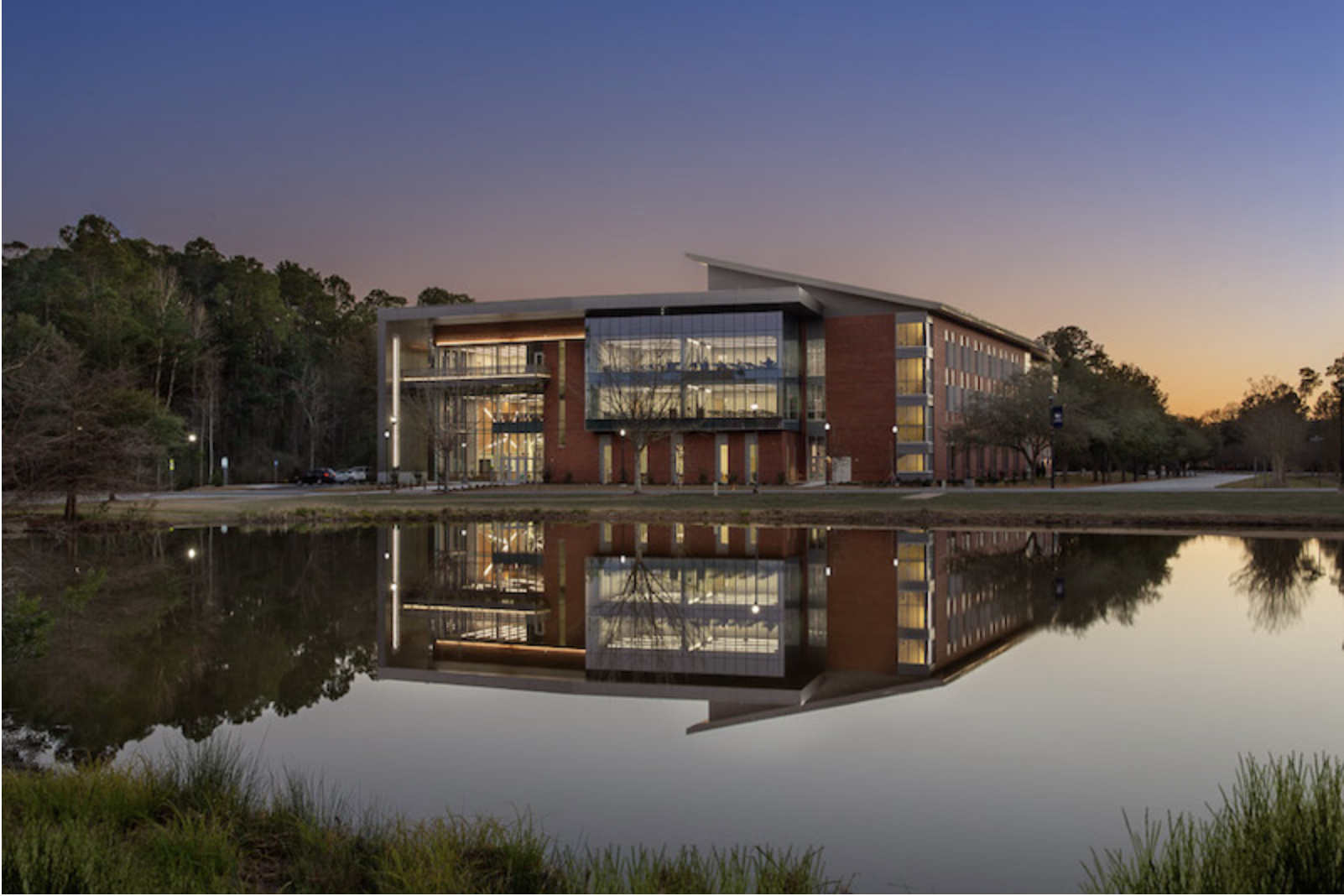
Health Professions Academic Building on the Armstrong Campus in Savannah Georgia’s only public medical school has received funding approval to open a new four-year campus in Savannah, an expansion that will provide greater access to education and training for medical students and ease the state’s ongoing shortage of physicians. The new campus of Augusta University’s Medical College of Georgia (MCG) is expected to enroll its first students on the Armstrong Campus of Georgia Southern University by Fall 2024, pending approval by the Liaison Committee on Medical Education, the accrediting body for medical schools in the U.S. and Canada. The campus will be located in the existing Armstrong Center and the Health Professions Academic Building of Georgia Southern’s Waters College of Health Professions. Located down the street from Savannah’s St. Joseph’s Hospital, it would be MCG’s third four-year campus in Georgia. The MCG educational experience is anchored at its main campus in Augusta, with another four-year campus located in Athens in partnership with the University of Georgia. “Georgia ranks 40th in the nation for both the number of active physicians and the number of primary care doctors,” Georgia House Speaker Jon Burns said. “Georgians experience this reality every day. Increasing opportunities within the University System of Georgia allows Augusta University’s Medical College of Georgia to educate and train more students and meets a clear need to make sure our communities receive better health care. Georgia needs more doctors, and I’m proud we are making this investment in our future.” The Board of Regents of the University System of Georgia (USG) on Tuesday approved $1.7 million for renovations at Georgia Southern’s Armstrong Campus to help make the new campus a reality. The money was included in the fiscal year 2024 state budget passed earlier this year by the Georgia General Assembly and signed by Gov. Brian Kemp on May 5. “We’re grateful to Governor Kemp, Speaker Burns, Lt. Gov. Jones and the General Assembly for their support in helping MCG and the university system expand one of the best public medical colleges in the nation and help get more doctors into our local communities,” USG Chancellor Sonny Perdue said. Four-year campuses provide the full spectrum of medical education, from basic sciences to clinical experiences. “This campus expansion is a momentous milestone for Augusta University and the Medical College of Georgia, standing as a testament to the unwavering support we have received from Speaker Burns, state Rep. Butch Parrish, Governor Kemp, the entire General Assembly and Chancellor Perdue,” said Augusta University President Brooks A. Keel, PhD. “Through this collaboration, we are forging a brighter future for health care in Georgia and fulfilling our shared commitment to producing more doctors for our state. I extend my deepest gratitude to all those who have championed this vision, including St. Joseph’s/Candler Health System, whose exceptional partnership has provided invaluable clinical experiences for our students. Together, we are bolstering the state’s medical community and strengthening Southeast Georgia’s access to quality health care.” MCG’s statewide educational model also has students learning at two-year, clinically focused regional campuses in every corner of the state, including the Southeast Campus, established in 2011 and based at St. Joseph’s/Candler in Savannah, and Southeast Georgia Health System in Brunswick. Other regional campuses include the Southwest Campus based in Albany and the Northwest Campus based in Rome. “This partnership with Augusta University and the Medical College of Georgia is another example of how together, the governor, our legislators, the University System of Georgia and Georgia Southern University are collaborating to meet the growing needs of Southeast Georgia,” added Georgia Southern University President Kyle Marrero. “These programs on our Savannah campus further Armstrong’s history of being a leader in training health care professionals and complement our efforts to expand nursing education and develop our future physician assistant program.” Through this partnership, Georgia Southern is providing approximately 23,000 square feet of instructional and lab space in its Armstrong Center and the Waters College of Health Professions’ Health Professions Academic Building. This includes 10,000 square feet of dedicated student group workspace and faculty and staff offices and 13,000 square feet of shared anatomy lab and large classroom space. The renovations include the creation of a new anatomy lab within the Health Professions Building, as well as minor renovations and new furniture, fixtures and equipment for the student group workspace and faculty and staff offices. The new campus would allow MCG to accept 40 more students per year, increasing its class size, already one of the nation’s largest, to 304 students per class. “As the state’s only public medical school, it is both our responsibility and commitment to produce more doctors for Georgia, and this growth in our class size is one way we can fulfill what I consider to be our most critical mission” said MCG Dean David Hess, MD. “This expansion would not be possible without the support of Governor Kemp, the Georgia Legislature, the University System of Georgia, Augusta University President Brooks Keel, and our colleagues at Georgia Southern University. I am also thankful for the unwavering support of St. Joseph’s/Candler Health System, including its CEO Paul Hinchey and chief medical officer Dr. Julia Mikell, a 1976 MCG graduate. Physicians and staff at St. Joseph’s/Candler have been exceptional educational partners, serving as a home base for our Southeast Campus, and providing rich clinical experiences for our third- and fourth-year students, for well over a decade. I know that commitment will extend to students at this new four-year campus.” “This is a sentinel event not only for the future of health care in Georgia, but also for Savannah and the region,” added Paul P. Hinchey, president and CEO of St. Joseph’s/Candler. “We have had a great relationship with MCG for more than a decade and our physicians have been instrumental as faculty in teaching third- and fourth-year students in Savannah. SJ/C has also served as a longstanding clinical site for nursing students from Georgia Southern and from the Armstrong campus. Creating a four-year medical school campus in Savannah will strengthen the medical community in Savannah and throughout Southeast Georgia. I want to thank Speaker Burns, Dr. Hess and the University System of Georgia for making this great vision a reality.” “I am excited to help build a campus that will continue MCG’s mission of educating the next generation of physicians,” said Elizabeth Gray, MD, associate dean at MCG’s Southeast Campus, based in Savannah and Brunswick. “I am confident that Georgia Southern will be an exceptional educational partner, and am excited to continue working with the leadership, physicians and staff at our longtime partners St. Joseph’s/Candler to help increase the number of physicians in this area of the state and beyond.” Interested in learning more? For more information about this exciting new development — simply reach out to Georgia Southern's Director of Communications Jennifer Wise at jwise@georgiasouthern.edu to arrange an interview today.
Aston University appoints new Deputy Vice-Chancellor Academic
Professor Osama Khan has nearly 20 years’ experience as an academic leader and innovator He will lead academic strategy, new educational model and student experience strategy in line with Aston 2030 Strategy Osama will join Aston University in October 2023. Aston University has appointed Professor Osama Khan as its new Deputy Vice-Chancellor Academic. With a successful career in higher education for nearly 20 years, Professor Khan will be joining Aston University from the University of Surrey where he is currently Pro-Vice-Chancellor Academic, leading on education strategy, teaching excellence and student learning experience. In his new role, he will play a central part in the development of Aston University’s academic strategy in line with the University 2030 Strategy. Responsibilities will include leading the University's academic portfolio incorporating education, curriculum, digital offerings, careers and placements, library and information services, student experience and services. Educated at Independent University, Bangladesh, University of Surrey and University of Cambridge, Osama began his academic career as a lecturer (and then senior teaching fellow) at University of Surrey in 2004. He moved to Solent University in 2012, where he held a variety of roles including director of learning and teaching at Solent Learning and Teaching Institute. He was appointed the first Pro Vice-Chancellor, Students and Teaching at Solent University leading on curriculum, digital services, learning space transformation. He was appointed as Vice-Provost, Education at University of Surrey in 2019. Subsequently his remit extended to form the Pro Vice-Chancellor, Academic portfolio with responsibility for education, curriculum, student services, digital transformation, and learning spaces. He has 25 years of teaching experience in corporate finance at various renowned universities. Professor Aleks Subic, Vice-Chancellor and Chief Executive of Aston University, said: “I am delighted to welcome Osama to Aston University and the executive team at a crucial time when we are shaping our bold strategy for 2030 and beyond. “Osama is a proven academic leader and innovator, who has who has achieved sector leading outcomes in student experience and educational quality. His strong commitment to values-based leadership is aligned well with our approach to working with our people and the diverse communities we serve. “I look forward to working with Osama to position Aston University as the leading university in the United Kingdom for student experience, employability and social mobility.” Professor Osama Khan said: “Aston University's unwavering commitment to academic excellence, coupled with its dedication to equality, diversity and inclusion, resonates deeply with me. Moreover, I commend Aston University's efforts in narrowing the awarding gaps, striving for equity in education and promoting fairness in the academic journey, for it is through education that we empower generations and create lasting impact. “I am honoured to join this creative institution as its next Deputy Vice-Chancellor Academic, where we will prioritise inclusive education and foster an environment where every individual can thrive and succeed. “I eagerly look forward to working with our exceptional faculty, dedicated staff, and talented students to shape the next chapter of excellence through the new Aston University 2030 strategy. Together, we will transform lives, foster innovation and forge a path towards a brighter tomorrow." Professor Khan will be taking up his post in October 2023.

The memorandum of understanding (MoU) will strengthen existing partnership and form basis for future collaborations Official signing took place during an official visit by delegation from NEFU and AEMG on 22 May Delegation met senior staff from College of Engineering and Physical Sciences as well as NEFU students studying at Aston University. Aston University in Birmingham, UK and Northeast Forestry University (NEFU) in Harbin City in Heilongjiang Province, China have signed a memorandum of Understanding (MoU) to develop their strategic partnership. The MoU will see the universities renew and strengthen their existing partnership and explore future collaborations in the areas of both teaching and research. The partnership is facilitated by AEMG Education, who have over 20 years of experience in brokering strategic relationships with Chinese universities. The official signing by Professor Aleks Subic, Vice-Chancellor and Chief Executive of Aston University, Professor Li Shunlong, Vice President of Northeast Forestry University and Mr Stephen Connelly, Vice President of AEMG Education, took place on 22 May during a visit to Aston University by a senior delegation from NEFU and AEMG Education. The delegation from NEFU also included Professor Liu Zhiming, Dean of Aulin College, Mr Sun Zhiping, Director of the International Cooperation Office and Professor Li Hongfen, Associate Professor of the College of Civil Engineering. AEMG Education was represented by Mr Stephen Connelly, Vice President of Business Development and Engagement, Dr Jacko Feng, Director of Research and Partnerships and Ms Sarah Armstrong, Director of Business Development, UK & Europe. During the visit, the delegation met with senior staff from the Department of Civil Engineering and the College of Engineering and Physical Sciences, including Executive Dean, Professor Stephen Garrett. They also had the opportunity to meet with the NEFU students studying at Aston University who have just completed their final year examinations. The Aston University/NEFU partnership was established around the development of a joint programme in BSc Construction Project Management which was approved by the Chinese Ministry of Education (MoE) in January 2018, under which students from NEFU are able to transfer into the final year of the programme at Aston University. In 2021/22, the first cohort of 21 students successfully finished their studies,10 of whom achieved first class degrees. Professor Aleks Subic, Vice-Chancellor and Chief Executive of Aston University, commented: “I am delighted to welcome visitors from NEFU and AEMG to Aston University and to sign the Memorandum of Understanding with NEFU. “This represents an important milestone in taking forward our collaboration. We are committed to continuing to strengthen our strategic relationship with NEFU and look forward to welcoming more students in the future.”