
Experts Matter. Find Yours.
Connect for media, speaking, professional opportunities & more.

Baylor Expert: Día De Los Muertos - A Celebration of Life and Death
Día De Los Muertos – or Day of the Dead – has grown in popularity in the United States over the past decade, with the 2017 Disney/Pixar film, Coco, bringing greater attention to the holiday and its colorful sugar skulls and skeleton decorations. Although these decorations can be found in stores next to Halloween items, this unique Mexican holiday – celebrated Nov. 1 through Nov. 2 – isn’t another version of Halloween but a way for families to honor and remember their loved ones who have died, said Baylor University death studies scholar and author Candi Cann, Ph.D. It’s importance to world culture as recognized in 2008 when UNESCO inscribed the holiday in the Representative List of Intangible Cultural Heritage of Humanity. Cann, who is an associate professor of religion in the Honors College at Baylor, said it’s not surprising that the holiday is becoming popular outside of Mexico. There are no other traditions in the United States about death that are not mournful. The opportunity to celebrate loved ones in a way beyond the funeral process resonates with people, Cann said. “It’s a beautiful tradition that helps people with the grief process,” she said. Día De Los Muertos is time for past and present generations to come together. Unlike Halloween, interacting with the dead isn’t scary, but more like a family reunion, Cann said. “On that day, the dead return to visit the living,” she said. “It is a time to have fun and celebrate our connection to our ancestors.” Traditional Día De Los Muertos Celebrations can include: Calaveras – The most recognized symbol of the holiday, sugar skulls are offered as gifts to both the living and the dead. A representation of the La Calavera Catrina, the skulls are decorated with colorful icing, sequins or feathers. The Ofrenda – Families will set up altars in their house or at the grave site to honor their family members. The Ofrenda is colorfully decorated with pictures of the deceased along with paper banners, candles, marigolds, small gifts, favorite foods and calaveras. Costumes – Colorful costumes with vibrant skull makeup reminiscent of the Calaveras are another way to celebrate Día De Los Muertos. Children and adults alike can dress up in Calaveras makeup. The purpose is not to look macabre but to be a festive way to celebrate all members of the family living and dead. Food and Drink – This not only is an offering to the deceased but a way for the living to come together and share a meal with their loved ones. Traditional dishes included tamales, Pan de Muerto (or “Bread of the Dead”) and Pan dulce. Cann suggests if you are interested in celebrating Día De Los Muertos, start by finding a community festival or parade, such as Saturday’s Día De Los Muertos Parade & Festival at Indian Spring Park in downtown Waco. “This is a great way to learn more about the holiday and how you can celebrate with your family,” Cann said. “Most importantly, keep the focus on the family. The heart of the holiday is on remembering and honoring our loved ones.”



Georgia Southern University opens doors to Gullah Geechee Cultural Heritage Center
Georgia Southern University’s Gullah Geechee Cultural Heritage Center officially opened its doors with a grand opening and ribbon cutting on June 19. Coinciding with the Center’s Juneteenth celebration, the public was invited to attend the afternoon festivities at 13040 Abercorn Street in Savannah. The ribbon cutting saw many local dignitaries in attendence, including Savannah Mayor Van R. Johnson, Georgia Rep. Carl Gilliard, Georgia Sen. Derek Mallow and Chatham County Chairman Chester Ellis, as well as Gullah Geechee Cultural Heritage Corridor Executive Director Victoria Smalls, Gullah Geechee historian and preservationist Queen Quet and Georgia Southern Provost and Vice President for Academic Affairs Carl Reiber, Ph.D., offered opening remarks. “This is a monumental occasion,” said Maxine Bryant, Ph.D., director of the Gullah Geechee Center. “To celebrate our grand opening on the nationally recognized Juneteenth is extremely meaningful. We will simultaneously honor the freedom of enslaved Black Americans and the Gullah Geechee culture that has preserved more African traditions than any other group.” The Gullah Geechee people of Coastal Georgia are descendants of enslaved Africans from plantations along the lower Atlantic coast. Many came from the rice-growing region of West Africa and were brought to the Americas for their agricultural and architectural knowledge and skills. The enslaved Africans were isolated on the Sea Islands. This isolation enabled them to create and maintain a unique culture steeped in remnants of Africa. This culture became known as Gullah Geechee and is visible in the people’s distinctive arts, crafts, foodways, use of waterways, music, dance and language. Much of the Gullah Geechee community today, which is estimated to be a population of 1 million, can speak the African Creole language or tell the stories of their ancestors who are credited with influencing southern and American culture. Local Gullah Geechee artists and the McIntosh County Shouters showcased their talent at the event. The Gullah Geechee Cultural Heritage Center, established in 2019, honors myriad contributions made by Gullah Geechee people, provides educational resources for the public, promotes scholarship and research, and serves as a model for national reconciliation and reparations. It is part of the Gullah Geechee Corridor, which stretches across 27 counties in Georgia, South Carolina, North Carolina and Florida. If you're interested in learning more about Georgia Southern University’s Gullah Geechee Cultural Heritage Center - then let us help. Simply reach out to Georgia Southern's Director of Communications Jennifer Wise at jwise@georgiasouthern.edu to arrange an interview today.


Podcast: UK’s first non-white prime minister is ‘big moment’ – but can Rishi Sunak survive?
Academic focuses on importance of UK having its first prime minister of Indian descent Rishi Sunak’s personal family history could be seen as a testament to the ‘British dream’, as he is also ‘richest man’ ever to sit in the House of Commons But his ability at restoring economic stability and tackling cost-of-living crisis will decide his fate at the polls Having the first non-white leader of the UK is undoubtedly a “big moment” in the history of British politics, according to an academic at Aston University. But, although he may be able to count on the British Asian vote at the next general election, Rishi Sunak faces a major challenge to remain in No 10 due, in part, to the growing number of Conservative MPs intending to stand down. Mr Sunak’s rise to become Britain’s first Asian and first Hindu leader has been discussed by Dr Parveen Akhtar, a senior lecturer and deputy head of politics, history and international relations at Aston University. Dr Akhtar, who has studied across Europe and authored a book on British Muslim politics, was speaking as part of the latest episode in the 'Society matters' podcast series, presented by journalist Steve Dyson. She said Rishi Sunak benefitted from a “privileged upbringing”, but also married into wealth in the form of the daughter of Indian billionaire N R Narayana Murthy, co-founder of information technology company Infosys. With the couple having a combined wealth of £730 million, Parveen said Rishi Sunak can “allegedly lay claim to another title – the richest man to ever sit in the House of Commons”. A “scandal” over his wife’s non-domiciled tax status had even threatened to end Sunak’s career less than a year ago. But she added: “Whatever the mixed feelings are around his personal fortune, this is nevertheless a big moment. Becoming the first non-white leader of the UK is important. It’s important for the country and it’s important for the UK’s ethic minority communities too.” Dr Akhtar, who is currently writing a new book on the politics of Pakistan and Pakistanis abroad, said Rishi Sunak’s paternal grandparents were from Gujranwala, which is in present-day Pakistan. Sunak, himself, was born in Southampton, but his father Yashvir, a family doctor, and mother, Usha, a pharmacist who studied at Aston University, were born and brought up in present-day Kenya and Tanzania respectively.However, they joined an exodus of Asians from East Africa in the second half of the last century, fuelled by Idi Amin’s wholesale expulsion of Asians from Uganda in 1972. Sunak’s “cultural affinity” lies with his Indian roots, Dr Akhtar said, including being a practising Hindu, and he himself had said that ‘British Indian’ is what he ticks on the census. She added: “The Sunaks’ personal family history could be read as a testament to the British dream: the idea that the UK is a land of opportunity where, no matter who you are, if you work hard, you can make it right to the top. The formula for success is simple: head down, hard work perseverance.” While Sunak was privately educated at Winchester, and went on to study at both Oxford University in England and Stanford University in the US, he has spoken about various jobs, including being a waiter in an Indian restaurant. Dr Akhtar said that, in some ways, the Conservative Party has a “lot to be proud of” when it comes to promoting ethnic minority colleagues, as reflected by three key posts in Liz Truss’s short-lived administration, and Suella Braverman as the current Home Secretary. Sunak’s own heritage could prove to be an asset in strengthening ties and negotiating trade deals with other countries, with India’s Prime Minister referring to him as the ‘living bridge’ of UK Indians, and US President Joe Biden describing his success as a ‘ground-breaking milestone’. But can an unelected Sunak win the next election amidst soaring inflation and the cost-of-living crisis? Dr Akhtar replied: “These are challenging times to be at the helm of the ship, a ship which many in his party appear to be jumping off, given the number of Conservative MPs who have announced their intention not to stand at the next general election. “If, in the coming months, people feel further fiscal pain, if there are prolonged strikes by teachers and nurses, firefighters and railway workers, if the NHS is overwhelmed this winter, then no matter how slick Sunak’s PR messaging, he will not be elected come election time.”


Winnipeg, MB, March 16, 2022 - Longing for your next adventure? Look no further because CAA Manitoba has unveiled a new set of luxurious travel packages designed for travellers who are ready to embark on an iconic Canadian adventure. As part of each package, travellers will be flying on a CAA chartered jet with all business class seating, offered in partnership with Air Canada. They will be joined only by those travelling on a Premier Collection tour. Itineraries are curated with affordable luxury in mind. “Our research has shown us that Canadians are looking to experience travel in a more intimate setting and at this time, many are still looking to stay closer to home,” said Susan Postma, regional manager, CAA Manitoba. “By coupling the best of Canadian culture, food and heritage, with the safety and luxury of travelling on a CAA chartered plane, we are confident that these packages will give travellers a delightful option to start exploring again.” Travellers will rediscover the nation’s greatest sights, sounds and smells on one of five journeys showcasing Canada’s unforgettable wonders and hidden gems. “For many of us, travelling again for the first time is a momentous occasion and we wanted to make that extra special by cultivating a premium experience with the utmost attention to health and safety,” said Postma. “Each destination encourages travellers to immerse themselves in every moment and create lasting memories.” Packages feature everything from stargazing to whale watching; enjoying a pancake brunch on a maple farm to World Famous “Digby Scallops” in Nova Scotia; witnessing the highest tides in the world in New Brunswick to taking in Quebec’s most breathtaking waterfall and many more unique experiences in between. “We are very pleased that CAA is recognizing our superior customer service in choosing Air Canada for its unique, luxury travel packages. Our private charter service, Air Canada Jetz, is specially designed for ultra-premium customers, such as pro athletes, celebrities and music stars, ensuring CAA’s explorers will travel in extraordinary style wherever their adventure takes them,” said Eric Bordeleau, senior director, Network Scheduling and Charters at Air Canada. Tours and dates include: Glorious Lakes and Glaciers: Banff, Jasper and Beyond (August 13-20, 2022) – 8 Days Savour Quebec: A Culinary Journey Through Quebec City, Charlevoix and Montreal (August 15 – 24, 2022) – 10 Days Rich and Enticing Quebec: Explore the Spectacular Gaspé Peninsula (August 15 – 24, 2022) – 10 Days Magical Maritimes: Acadian Culture, Delicious Flavours and Historic Charms (September 10-19, 2022) – 10 Days Platinum Journey - Mountains and Memories: Wonders of the West and Rocky Mountaineer (September 13-21, 2022) – 9 Days CAA Travel has over 50 years of experience in helping members plan and book unforgettable travel excursions around the world. CAA’s new Premier Tours Collection packages are part of CAA’s Extraordinary Explorations collection and range in price starting at $6,300 CDN. Extraordinary Explorations is CAA’s collection of unique travel adventures designed for adventurous travellers looking to embark on a luxe vacation for an affordable price. Experience one-of-a-kind destinations, intriguing itineraries and exceptional excursions. Available as escorted and hosted packages, every exploration is guaranteed to create lasting memories. The 2022 Premier Collection packages can be purchased at all CAA stores or by phone at 1-844- 202-8045. Click here for more information.


Georgia Southern launches Asian Studies Digital collection
Georgia Southern University Libraries and Nalanda Roy, Ph.D., recently launched a digital collection, “An Integral History: Asian Studies Digital Archive.” The archive provides a curated collection of multidisciplinary resources in support of the Asian American and Pacific Islander community in the United States. Contributions are curated from Digital Commons, the University’s open-access institutional repository, and highlight Georgia Southern’s scholarly and cultural assets related to the Asian Studies minor. The collection represents faculty and student research, books, videos, community resources and campus events. “The Asian Studies Digital Archive is an important addition to Georgia Southern’s collections because developing an understanding of other cultures will create a cultural awareness,” said Roy, an associate professor of international studies and Asian politics and coordinator of the University’s Asian Studies program. “It will also teach us to have more meaningful interactions with others around us, and celebrate our differences and similarities.” Each May, Asian American and Pacific Islander Heritage Month is observed to recognize the Asian Americans and Pacific Islanders who have contributed to American history, society and culture. The Asian Studies Digital Archive will carry that legacy forward, and continue to grow, as faculty are encouraged to participate in the initiative. “As the coordinator of the Asian Studies program at Georgia Southern University, creating the Digital Archive has been a dream project,” said Roy, who is a Certified Diversity Executive and a former Inclusive Excellence Faculty Fellow at Georgia Southern. “I am very happy to work with the Georgia Southern Libraries to create a resource that will be helpful to both the Georgia Southern and local communities.” For more information on the Asian Studies Digital Archive, visit: Facts about Asian American and Pacific Islander Heritage Month *U.S. Census Bureau 1978 — Congress passed a resolution creating Asian/Pacific American Heritage Week. 1992 — The observance expanded to a month (May), timed to coincide with two important milestones in Asian/Pacific American history: arrival of the first Japanese immigrants in the United States (May 7, 1843) and completion of the transcontinental railroad on May 10, 1869 (the majority of workers who laid the tracks were Chinese immigrants). 2020 — Total Asian population in the U.S. is roughly 6% or 20 million. 5.1 million — The estimated number of the Asian population of Chinese, except Taiwanese, descent in the U.S. in 2020. The Chinese (except Taiwanese) population was the largest Asian group in the U.S. 690,000 — The estimated number of total Native Hawaiian and Other Pacific Islander population in the U.S. 607,010 — Native Hawaiian residents make the largest NHPI group in the U.S If you're a reporter looking to know more about "An Integral History: Asian Studies Digital Archive" - then let us help with your coverage and stories. Nalanda Roy, Ph.D., is available to answer your questions - simply reach out to Georgia Southern Director of Communications Jennifer Wise at jwise@georgiasouthern.edu to arrange an interview today.
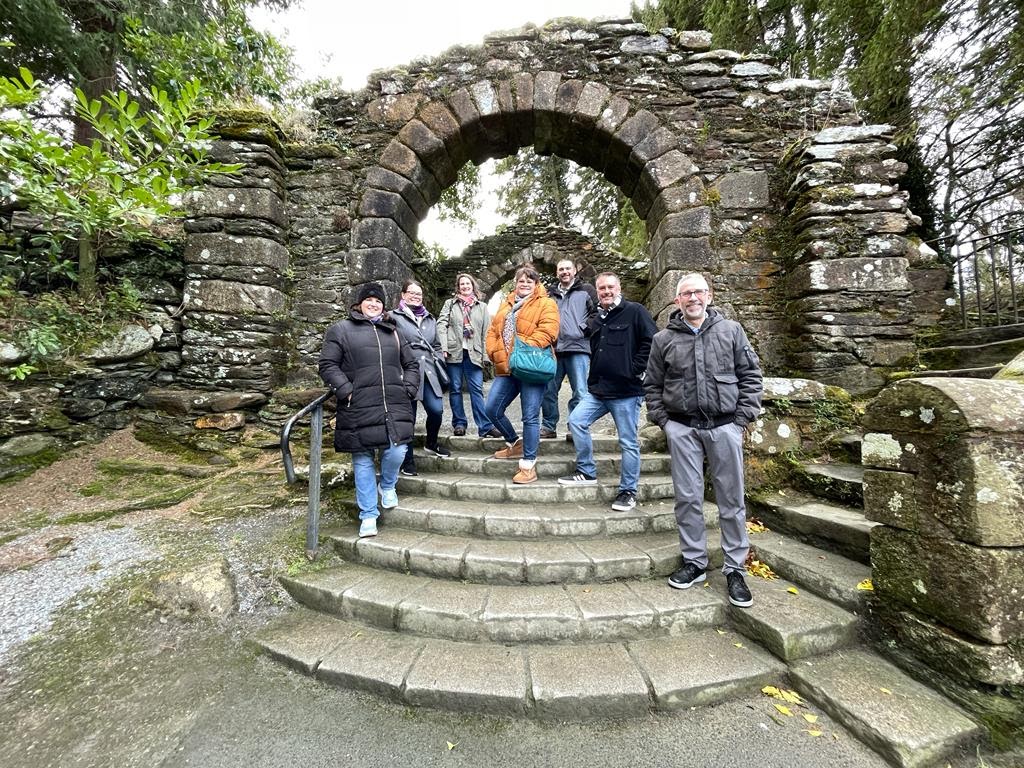
$100K student scholarship pool available for 2022 summer courses in Ireland Six professors from Georgia Southern University’s College of Education (COE) recently broadened their horizons during a trip to Ireland as they learned from and shared insight with instructors and educational leaders in the Wexford County community. Led by Howard Keeley, Ph.D., director of the University’s Center for Irish Research and Teaching, COE faculty traveled to Georgia Southern’s learning center in Wexford, Ireland, to observe Irish educational settings and exchange ideas with local leaders just ahead of a summer study abroad program opportunity for Georgia Southern students in which $100,000 of scholarship funding is available. “The main thing we did was get in front of leaders in the education space in Ireland,” stated Keeley. “We spoke to a number of folks who are either principals or vice principals or, in some way, senior administrators in a variety of schools including all-boys, all-girls, religious, secular and mixed schools.” The group included Catherine Howerter, Ph.D., associate professor of elementary and special education; Kip Sorgen, Ph.D., assistant professor of leadership, technology and human development; Alex Reyes, Ph.D., assistant professor of middle grades and secondary education; Amanda Wall, Ph.D., associate professor of middle grades and secondary education; Betsy Barrow, Ed.D., assistant professor of middle grades and secondary education; and Dan Calhoun, Ph.D., professor of leadership, technology and human development. Reyes, who trains pre-service and in-service teachers to work with culturally and linguistically diverse students, was excited to travel to Wexford after a study abroad program in Czech Republic she spearheaded with Wall was canceled in March 2020 due to the pandemic. Intrigued by Ireland, a plurilingual country, she was curious to see how Wexford’s environment might benefit students culturally. “I thought it was really exciting,” said Reyes. “All of the street signs are in Irish, even though English is the main language spoken. That prioritizing of that cultural heritage is fascinating. It was great to learn that the students in their primary and secondary schools take Irish language and culture as a subject every year.” She was especially motivated by a field trip to an Irish-language school, Meanscoil Gharman, which serves middle and high school students. With the exception of one daily class in English, teachers and students conducted all lessons in Irish. “It was really interesting to see that perspective,” she said. “There has been a revitalization of that culture. I thought that was fascinating to see how that can be handled in school.” In addition, Reyes was duly impressed with the country’s prioritization of social and emotional literacy for children, and the mandated well-being hours that are incorporated into daily school routines as a result of the pandemic. A program that promotes hygiene and an anti-bullying campaign also fit into the wellness curriculum. “It really impressed me that as a nation they prioritize the wellness of students, and how language and cultures can really be supported in a meaningful way,” Reyes said. “It’s affirming to see a proactive approach that has positive outcomes. Now, thinking ahead, we can look at how we can create opportunities for our students to experience this kind of approach.” Sorgen, who teaches in the educational leadership program at Georgia Southern, was interested in Ireland’s professional preparation. “None of them had advanced degrees, like what we offer at Georgia Southern,” noted Sorgen. “Learning about how to be a principal in Ireland is on-the-job training. In Georgia, there are specific educational requirements for our school administrators guided by professional standards. In Ireland, they generally ascend through the ranks, which makes professional mentoring essential to their success. We are exploring ways our educational leadership students could learn from Irish administrators about their experience, specifically with mentoring.” He also foresees the international partnership as a two-way exchange. “Given educational leadership programs are not common in Ireland, our faculty are considering ways in which we could use our expertise to foster leadership development of principals and teachers in Wexford,” said Sorgen. “We would utilize the Georgia Southern Wexford campus to host some of these sessions, furthering Georgia Southern’s relationship within the Wexford community.” Keeley also arranged meetings with education policy makers, including an extended meeting with an Irish congressman who is a representative for the County of Wexford in the Irish national parliament and chairs the joint committee for the Irish equivalent of the House and Senate Committee on education and higher education. “That was a tremendous opportunity for our faculty to talk to somebody at the highest level of government in Ireland, creating Irish state policy on education,” said Keeley. “And I know from the feedback we got from our College of Education colleagues that particularly for those in higher education, that to them was a really useful, next-step experience.” The trip exceeded expectations. “It was a fantastic learning experience for everyone,” said Keeley. “We had lots of high-level and also very practical experiences, and I could see our College of Education team thinking, ‘How can I bring what I’m learning, what I’m experiencing in this moment, into my classroom, into my curriculum, into my prospective study abroad courses in a way to build student success for our Georgia Southern folks.’ I think it was a great visit.” Complementing the faculty’s trip, a COE Irish study abroad program on diverse education in Ireland was recently approved for Summer 2022 and will give education students the opportunity to take one or two courses with the study abroad component. This will be a part of a broader study abroad program in Wexford, presented by the Honors College and the Center for Irish Research and Teaching, with assistance from the Office of the Provost and the Office of Global Engagement. The costs for undergraduate students at Georgia Southern’s Wexford campus will be offset by a $100,000 scholarship fund with awards of $1,000 for each student accepted into the program. “For students traveling to Wexford, Ireland, this summer, we will be able to defray the cost of the program through a generous travel scholarship through the Georgia Southern University Foundation,” said Dustin Anderson, Ph.D., associate provost for Student Success. “The donation makes these the most affordable multi-week programs that we ever have been able to offer.” Keeley is thrilled the gifts from generous donors will enable a number of students to earn valuable global experiences. “For students to have an opportunity to have international lives is powerful, and it’s powerful in ways that sometimes we can’t even predict,” he said. “Just the very fact of being abroad is going to change any of us, right? It can have a really transformative effect to feel a sense that, you know, as a student, ‘I can do this,’ and then a sense after the fact, ‘I did this,’ and just that in itself is educational. Giving students a safe space in Wexford, Ireland, to grow and feel that they are in a sense global citizens and bring the best of America, bring the best of Georgia, bring the best of the states from Savannah to Ireland, and learn to be an ambassador. That’s wonderful.” In addition to the education courses, students will also be able to choose from a Wexford-Savannah honors inquiry and an interdisciplinary program open to all students on human migration with courses in geography, religious studies, public health and a CORE study abroad course. Students interested can learn more about the program by clicking here and can email Kristin Karam in the Office of Global Engagement for more information about the scholarships. Georgia Southern University-Wexford is a global hub for learning housed in a historic building constructed in 1812. The space now features state-of-the-art classrooms and student apartments. Georgia Southern is the first public university in the United States to open an outreach learning facility in Ireland. If you're a reporter looking to know more about this initiative, then let our experts help. Howard Keeley, Ph.D., is the director of the Center for Irish Research and Teaching at Georgia Southern University. He is available - simply click on his icon now to arrange an interview today.


Photo Credit: Sandy Nicholson / FUZE Reps Longing for your next adventure? Look no further because CAA South Central Ontario (CAA SCO) has unveiled a new set of luxurious travel packages designed for travellers who are ready to embark on an iconic Canadian adventure. As part of each package, travellers will be flying on a CAA chartered jet with all business class seating, offered in partnership with Air Canada. They will be joined only by those travelling on a Premier Collection tour. Itineraries are curated with affordable luxury in mind. “Our research has shown us that Canadians are looking to experience travel in a more intimate setting and at this time, are still looking to stay closer to home,” said Susan Postma, Regional Manager, CAA. “By coupling the best of Canadian culture, food and heritage, with the safety and luxury of travelling on a CAA chartered plane, we are confident that these packages will give travellers a delightful option to start exploring again.” Travellers will rediscover the nation’s greatest sights, sounds and smells on one of five journeys showcasing Canada’s unforgettable wonders and hidden gems. “For many of us, travelling again for the first time is a momentous occasion and we wanted to make that extra special by cultivating a premium experience with the utmost attention to health and safety,” said Postma. “Each destination encourages travellers to immerse themselves in every moment and create lasting memories.” Packages feature everything from stargazing to whale watching; enjoying a pancake brunch on a maple farm to World Famous “Digby Scallops” in Nova Scotia; witnessing the highest tides in the world in New Brunswick to taking in Quebec’s most breathtaking waterfall and many more unique experiences in between. “We are very pleased that CAA is recognizing our superior customer service in choosing Air Canada for its unique, luxury travel packages. Our private charter service, Air Canada Jetz, is specially designed for ultra-premium customers, such as pro athletes, celebrities and music stars, ensuring CAA’s explorers will travel in extraordinary style wherever their adventure takes them,” said Eric Bordeleau, senior director, Network Scheduling and Charters at Air Canada. Tours and dates include: Glorious Lakes and Glaciers: Banff, Jasper and Beyond (August 13-20, 2022) – 8 Days Savour Quebec: A Culinary Journey Through Quebec City, Charlevoix and Montreal (August 15 – 24, 2022) – 10 Days Rich and Enticing Quebec: Explore the Spectacular Gaspé Peninsula (August 15 – 24, 2022) – 10 Days Magical Maritimes: Acadian Culture, Delicious Flavours and Historic Charms (September 10-19, 2022) – 10 Days Platinum Journey - Mountains and Memories: Wonders of the West and Rocky Mountaineer (September 13-21, 2022) – 9 Days CAA Travel has over 50 years of experience in helping members plan and book unforgettable travel excursions around the world. CAA’s new Premier Tours Collection packages are part of CAA’s Extraordinary Explorations collection and range in price starting at $6,300 CDN. Extraordinary Explorations is CAA’s collection of unique travel adventures designed for adventurous travellers looking to embark on a luxe vacation for an affordable price. Experience one-of-a-kind destinations, intriguing itineraries and exceptional excursions. Available as escorted and hosted packages, every exploration is guaranteed to create lasting memories. The 2022 Premier Collection packages can be purchased at all CAA stores or by phone at 1-844-202-8045. Click here for more information.

Experts in the Media – Learn how UMW is doing its part to preserve Indigenous history
The members of Virginia’s Rappahannock and Patawomeck tribes can trace their roots back to the times before the first European contact. For hundreds of years, their people fished the rivers and inhabited the area near the Potomac and Rappahannock rivers. It was a rich history and today the efforts to preserve the stories and records of those times are being bolstered by UMW students and faculty. The work was recently featured in a piece by NBC-4 in Washington, D.C. Professor Lauren McMillan and her students are helping with that mission. King George County economic development officials approached her with an idea to create a Native American heritage trail, hopeful that it would drive ecotourism and draw visitors to public access points. “The first step that we did was say we need to consult with the tribes whose stories we’d be telling," McMillan said. Then the class did a deep dive. "We then started diving into the archives, the historical records, oral histories and the archaeological record as well,” McMillan said. They’ve created signs that will go up in seven different locations in King George. Each one tells a different story about the local tribes, spotlighting the past and present. “When you learn Virginia history, you learn about a lot of stuff that happened in Jamestown and that’s kind of the last place you learn about Indians in Virginia history, but we've been here all along,” Brad Hatch, a member of the Patawomeck Tribe, said. “We’ve been preserving our own culture and heritage and it's here for everybody to see." The students worked hard to put that heritage and culture on full display. They also envision their project inspiring others to do some research of their own about Virginia’s first residents. December 07 - NBC News Indigenous history is a fascinating topic – and one being covered more and more by media. And if you’re a reporter looking to know about the work UMW is doing with of the Rappahannock and Patawomeck tribes or other topics – then let us help. Lauren McMillan is the University of Mary Washington's resident historical archaeologist and an expert on middle-Atlantic American history. Dr. McMillan is available to speak with media – simply click on her icon now to arrange an interview today.


How rabbits help restore unique habitats for rare species
European wild rabbits are a ‘keystone species’ that hold together entire ecosystems – according to researchers at the University of East Anglia. Our campus is home to hundreds of rabbits and Prof Diana Bell, from our School of Biological Sciences, has been researching them for more than 30 years. Now, she is one of the lead researchers on a new report which aims to restore and protect at-risk wildlife habitats which are rabbit dependent. The report shows how their grazing and digging activity keeps the ground in a condition that is perfect for sustaining other species that would otherwise move on – or die out. But their numbers are declining regionally, nationally and globally. And they are even being classed as endangered in their native region, the Iberian Peninsula. The findings come as efforts to save England’s most threatened species from extinction are turning the tide for wildlife in Norfolk and Suffolk thanks to the Shifting Sands project. Shifting Sands is one of 19 projects across England that make up the national Back from the Brink initiative. Together, these projects aim to save 20 species from extinction and benefit over 200 more. Lead partner of the rabbit work-stream and rabbit expert Prof Diana Bell, from UEA’ School of Biology, said: “The Breckland-based Shifting Sands project was set up to save some of the region’s rarest wildlife. “After several years of hard work by this multi-partner project, the fortunes of species classed as declining, rare, near-threatened or endangered are now improving in the Brecks. “The project has seen species recover in record numbers – including endangered beetle and plants, one of which is found nowhere else in the world. “Rabbits are incredibly important because their grazing and digging activity keeps the ground in a condition that is perfect for sustaining other species. “Sadly, rabbit populations have declined dramatically in the UK and across Europe, and the European wild rabbit is now listed as endangered in its ancestral Iberian Peninsula range. Their decline is largely due to a spill-over of new viruses from commercially bred rabbits. “The Shifting Sands project has shown us how important rabbits are to entire ecosystems, and it is vital that these habitats are conserved and protected. “We encouraged a rabbit revolution in the Brecks and we have produced a toolkit in partnership with Natural England to help landowners of similar rabbit-dependent habitats to do the same.” “Simple cost-effective ways of encouraging rabbits include creating piles of felled branches, known as brush piles, and banks of soil.” Monitoring over the past three years has shown the interventions are working, with evidence of significantly higher amounts of rabbit activity. Prof Bell said: “Our work resulted in evidence of rabbit activity in significantly higher numbers. 91 per cent of brush piles showed paw scrapes and 41 per cent contained burrows. Even when burrows did not form, the brush piles helped expand the range of rabbit activity.” The UEA research team worked in collaboration with Natural England, Forestry England, Plantlife, Breckland Flora Group, Norfolk Wildlife Trust, Suffolk Wildlife Trust, Butterfly Conservation, Buglife, the Elveden Estate and the RSPB to deliver this ambitious partnership project. It has seen five kilometres of ‘wildlife highways’ created, more than 100 specimens of rare plants re-introduced, habitat created and restored across 12 sites, species encouraged, and landscape-management practices improved. As a result, seven species of plant, bird and insect are increasing in number and many more are benefiting in turn. Among those species recovering are rare plants such as the prostrate perennial knawel that is unique to the Brecks, basil thyme and field wormwood. The endangered wormwood moonshiner beetle, lunar yellow underwing moth and five-banded digger tailed wasp are also increasing. All these species are identified in the UK’s Biodiversity Action Plan as being priorities for conservation. The open habitat maintained by rabbits supports two rare plants: the prostrate perennial knawel – found nowhere else in the world – and field wormwood. Pip Mountjoy, Shifting Sands project manager at Natural England, said: “The Brecks were described by Charles Dickens as “barren”. They are anything but. Their 370 square miles of sandy heathland, open grassland and forest support almost 13,000 species, making it one of the UK’s most important areas for wildlife. “That wildlife is under threat. Felling trees and encouraging a species that is often considered a pest may seem a strange solution. But in this instance, carefully managed ‘disturbance’ is exactly what this landscape and its biodiversity needs.” “The project’s interventions have provided a lifeline for this unique landscape, and shown how biodiversity can be promoted by ‘disturbing’ places – not just by leaving them alone. “ “These rare habitats are becoming overgrown and species are declining as a result of changing land management practices and human impacts. It’s our responsibility to restore and maintain these spaces for nature. Some of these species exist only here and, if lost, will be lost forever.” Established in 2017 with £4.7m from the Heritage Lottery Fund and £2.1m from other bodies, Back from the Brink was the first nationwide co-ordinated effort to bring together charities, conservation organisations and government bodies to save threatened species. More information about the Brecks, Shifting Sands, Back from the Brink and a toolkit to help rabbit conservation is available via www.naturebftb.co.uk.


Spring 2021 begins a season of resiliency. After a long and particularly snowy winter in New York, I look forward to welcoming my favorite cherry blossoms. It’s been a year now since the COVID shutdowns took hold and the pandemic pause has required enormous energy from all of us at Japan Society, from remote work with constant online meetings, to safeguarding our 50-year-old building, to pivoting to online programming and finding new ways to bring in revenue. It’s not really been a “pause” in the traditional sense, it’s been a race for organizational transformation, adaptation to new ways of communicating with our colleagues and our members, and now — a reopening! This spring, we are delighted to celebrate our reopening with When Practice Becomes Form: Carpentry Tools from Japan, a special exhibition that explores the extraordinary, centuries-long tradition of Japanese architecture and woodworking artistry, and features a range of hand tools and models that reflect techniques used for hundreds of years to build and restore Japan’s wooden architectural masterpieces — temples, shrines, and bridges. Philosophy of Japanese woodworking The philosophy that undergirds Japanese woodworking is deeply engrained in Japan Society’s own history. As master woodworker George Nakashima wrote in his book, The Soul of a Tree, “We can walk in step with a tree to release the joy in her grains, to join with her to realize her potentials, to enhance the environments of man.” Fifty years ago, Junzo Yoshimura, the architect of Japan Society’s now-landmarked building, asked that Japanese hinoki cedar be used for the coffered ceilings in the Society’s lobby and selected with his own hands stones to be shipped from Japan for the foyer garden. He also specified furniture to be crafted by Nakashima in his New Hope, Pennsylvania workshop, furniture that has stood the test of time and is still in use today. Precision is a hallmark of the Japanese experience. One of the many ways to view this is through the concept of kodawari — a unique Japanese notion that is difficult to translate — referring to the uncompromising, relentless devotion to one’s art, pursuit, profession, or activity. In a world turned upside down by a pandemic, there has never been a more welcome time to explore this relentless pursuit of precision and quality in one’s work at all levels of kodawari — in the form of Japanese woodworking. Tools of leadership, alliance & innovation The resilient spirit of Japanese craftsmanship resonates, especially in these unusual times. The presence of tools in our galleries and an exploration of their longstanding heritage for a broad audience highlights the persistent strength of U.S.-Japan relations and human ingenuity. As a leader, I take my own inspiration from Nakashima, using the strength of the oak tree in the West and flexibility of bamboo in the East to bring out the strength, resiliency, and innovation of the U.S.-Japan alliance through my own set of tools. These are the tools of leadership, which require the knowledge and precision of a master carpenter, building for the present while planning for the future. As Nakashima writes, “Each cut requires judgments and decisions on what the log should become.” In kigumi — traditional Japanese wooden joinery — each part plays a crucial role since the joints are fitted together without any nails or fasteners. To have structural integrity, the work — whether furniture or architecture — needs to be weight bearing, and with its direct connections, the whole will ultimately be stronger than its separate elements. In an ongoing cycle of repair and renewal, old joints are replaced by new ones, allowing traditional Japanese buildings to stand for hundreds of years. I find a parallel in the U.S.-Japan alliance, where our direct connection is the strength of our relationship — a collective strength where each nation can accomplish more together. Fifty years ago, as Japan Society’s new building was preparing to open to the public, Deputy Executive Director Daniel J. Meloy wrote to George Nakashima: “Your first shipment to us arrived safely today with all pieces in good shape. We have unwrapped them, dusted them, carried them to their respective rooms, and we love them.” This spring, I invite you to visit When Practice Becomes Form, and help us celebrate our reopening. Let’s work together, using the tools of tradition and innovation, to build the next 50 years of our alliance. Given the challenges the world has faced this past year, the U.S.-Japan alliance has never been more necessary — as acknowledged by the fact that the first world leader to visit President Biden’s White House will be Japanese Prime Minister Yoshihide Suga. The personification of the importance of this relationship through this visit, along with the elevation of the “Quad” meeting between the leaders of Australia, India, Japan, and the United States, indicates a new emphasis in American foreign policy. In addition to the geopolitical challenges confronting our nations, Americans have been struggling domestically with the rise in anti-Asian hate crimes and harassment — a powerful reminder of critical battles still to be fought at home. The Japanese American experience, including forced relocation to internment camps during World War II and the 1980s discrimination triggered by economic tensions with Japan, are only two examples of the long history of anti-Asian racism we continue to confront as a country and community. Now, more than ever, we must bring our collective strength to bear to fight hate and bigotry — and build a stronger and more resilient society. Joshua Walker (@drjwalk) is president and CEO of Japan Society. Follow @japansociety. The views expressed in this article are the writer’s own.

