
Experts Matter. Find Yours.
Connect for media, speaking, professional opportunities & more.

Celebrating on July 4th! Let us help if you need a quick history lesson about Independence Day
Independence Day marks the historic moment when the nation declared its independence from British rule. This event is deeply significant to the public as it symbolizes the birth of the United States as a sovereign nation, highlighting themes of freedom, democracy, and national pride. It is not only a day of celebration with fireworks, parades, and barbecues but also an opportunity for reflection on the country's history, values, and ongoing struggles for equality and justice. The significance of Independence Day offers a rich tapestry of story angles for journalists to explore, including: Historical Perspectives: Examining the events leading up to the Declaration of Independence, the key figures involved, and the document's lasting impact on American society and governance. Modern Interpretations of Freedom: Discussing how the concepts of liberty and independence have evolved over time and what they mean to different communities in contemporary America. Patriotic Celebrations: Covering local and national festivities, exploring how communities across the country celebrate Independence Day and what traditions they uphold. Civic Engagement and Activism: Highlighting how modern movements for civil rights and social justice draw inspiration from the principles of independence and freedom. Immigrant Experiences: Sharing stories of immigrants and how they perceive and celebrate Independence Day, adding depth to the national narrative of inclusion and diversity. Educational Initiatives: Showcasing efforts by schools and organizations to educate the public, especially the younger generation, about the historical significance and values associated with Independence Day. Independence Day is more than a historical milestone; it is a lens through which to view the American experience, providing ample material for journalists to craft compelling and diverse stories that resonate with a broad audience. Connect with an Expert about American History: Patrick Jung, Ph.D. Professor · Milwaukee School of Engineering Kevin P. McDonald Associate Professor of History · Loyola Marymount University Micki McElya, Ph.D. Professor of History · University of Connecticut Michelle Orihel Associate Professor of History · Southern Utah University Chris DeRose Attorney and Author · Movable Type Management Blaine McCormick, Ph.D. Professor of Management · Baylor University To search our full list of experts visit www.expertfile.com Photo credit: Camylla Battani


#ExpertSpotlight: Who is Vladimir Putin?
In the intricate arena of global politics, the life of Vladimir Putin stands as a pivotal narrative, encapsulating the rise of one of the most influential and controversial leaders of our time. This topic is not only newsworthy because of Putin's significant impact on international relations and global security but also due to the profound influence he wields over Russia’s political landscape and its socioeconomic dynamics. Understanding Putin’s life, leadership style, and strategic decisions offers critical insights into current geopolitical tensions, energy politics, and global governance. The biography of Vladimir Putin presents multiple angles that are of substantial interest to a broad audience, including: Early Life and Rise to Power: Exploring Putin's background, education, and career trajectory that led to his ascendancy in Russian politics. Leadership Style and Governance: Analyzing Putin's approach to leadership, his consolidation of power, and the mechanisms he uses to maintain political control. Domestic Policies and Economic Impact: Assessing the domestic policies implemented during Putin’s tenure, their impact on the Russian economy, and public opinion within Russia. Foreign Policy and Geopolitical Influence: Investigating Putin's foreign policy strategies, his influence on international relations, and key events such as the annexation of Crimea and involvement in Syria. Human Rights and Democratic Challenges: Examining issues related to human rights, freedom of speech, and the state of democracy under Putin’s rule. Energy Politics and Economic Leverage: Understanding Russia’s role in global energy markets, Putin's use of energy resources as a tool of political influence, and the economic implications for Europe and beyond. The life of Vladimir Putin offers journalists a rich tapestry of storylines that delve into the complexities of his leadership and its far-reaching consequences on both national and global stages. Connect with an Expert about Russia and Vladimir Putin: Glen Duerr, Ph.D. Professor of International Studies · Cedarville University Lynne Hartnett, PhD Associate Professor and Chair of History | College of Liberal Arts and Sciences · Villanova University Craig Albert, PhD Professor of Political Science and Graduate Director of the Master of Arts in Intelligence and Security Studies · Augusta University Stephen Dyson, Ph.D. Professor of Political Science · University of Connecticut Erica Frantz Assistant professor of political science · Michigan State University To search our full list of experts visit www.expertfile.com Photo credit: ANTIPOLYGON YOUTUBE

Trump’s Election Interference Case on Hold
Professor of Law James Sample appeared on CNN with Julia Chatterley to discuss the Georgia Court of Appeals putting an indefinite hold on former President Donald Trump’s election interference case. James Sample is a Professor of Law at Hofstra University and previously served as an attorney in the Democracy Program at the Brennan Center for Justice at New York University School of Law. James is available to speak with media - simply click on his icon now to arrange an interview today.


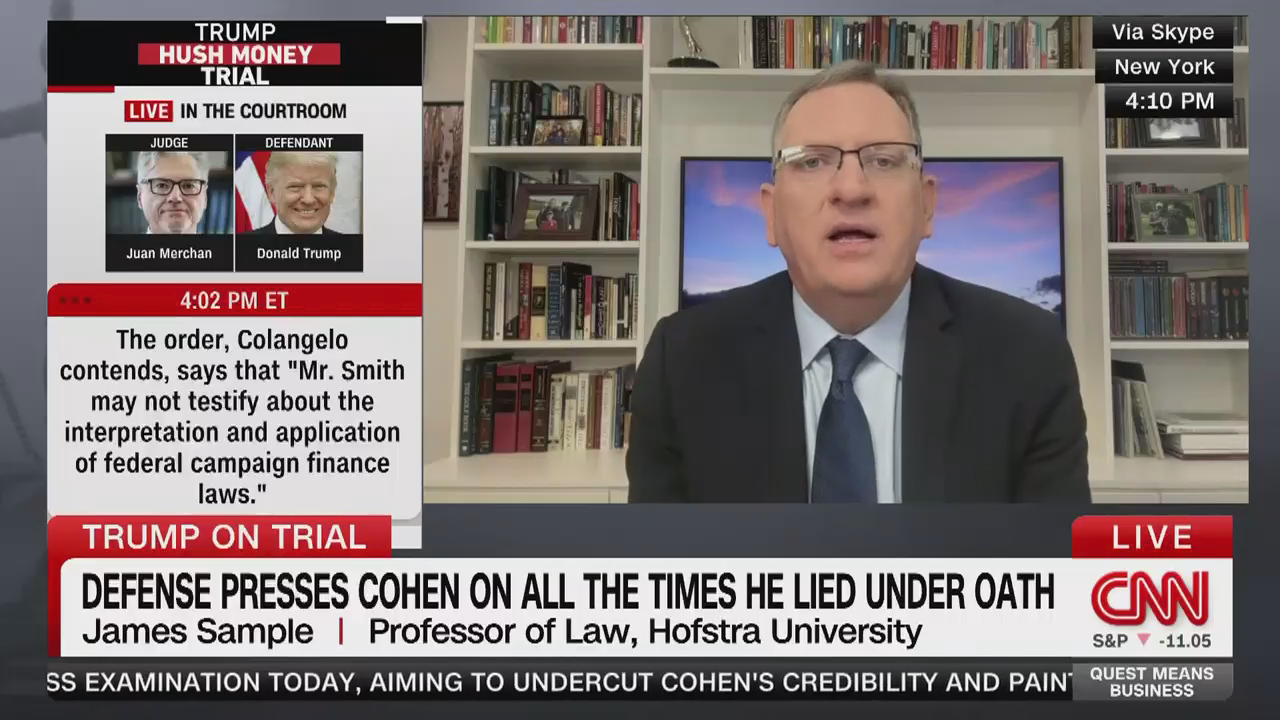
#Experts in the Media: Cohen Testifies in “Hush Money” Trial
The trials of Donald Trump are making headlines across the country and media are looking for key experts to offer opinion, perspective and insight to just about every angle and witness that's playing a part of this legal and political narrative day after day. Professor of Law James Sample was interviewed on CNN International’s Quest Means Business and in The Atlantic about the Michael Cohen’s testimony in former President Trump’s criminal trial in New York. These trials are daily news and if you're a journalist working this story - then let us help. James Sample is a Professor of Law at Hofstra University and previously served as an attorney in the Democracy Program at the Brennan Center for Justice at New York University School of Law. James is available to speak with media - simply click on his icon now to arrange an interview today.

Freedom House 'Nations in Transit 2024' Report | Media Advisory
The annual release of the Freedom House 'Nations in Transit' report serves as a critical barometer for assessing the state of democracy, human rights, and governance across the countries of Central and Eastern Europe, the Balkans, and Eurasia. As governments and societies navigate various political, economic, and social challenges, this report provides invaluable insights into the progress and setbacks in the region's democratic development. The report's findings are pertinent to the public because they shed light on the status of fundamental freedoms, rule of law, and democratic institutions, influencing regional and global policies. Key angles for coverage could include: Democratic Erosion and Backsliding: Analysis of countries experiencing democratic decline and the factors driving it. Civil Society and Activism: Profiles of grassroots movements and civil society organizations advocating for change. Media Freedom and Disinformation: Examination of threats to press freedom and challenges posed by disinformation campaigns. Corruption and Governance: Investigations into corruption scandals and efforts to enhance transparency and accountability. Human Rights and Minorities: Coverage of human rights abuses and discrimination against marginalized communities. Geopolitical Dynamics: Discussions on the geopolitical implications of democratic trends in the region and their impact on international relations. The 'Nations in Transit 2024' report is not just a documentation of regional developments; it's a reflection of the ongoing struggle for democracy and human rights, making it a crucial resource for journalists and policymakers alike. Connect with an Expert about the 'Nations in Transit 2024' For journalists with questions or looking to cover the Freedom House 'Nations in Transit' report, here is a select list of experts. To search our full list of experts visit www.expertfile.com Muqtedar Khan Professor, Political Science and International Relations · University of Delaware Jane Landers Gertrude Conaway Vanderbilt Professor of History · Vanderbilt University Christopher Fettweis Associate Professor · Tulane University Lowell Gustafson, PhD Professor of Political Science | College of Liberal Arts and Sciences · Villanova University Heangjin Park Assistant Professor of Asian and Asian American Studies · Loyola Marymount University Photo Credit: Yannhis H

NATO Turning 75 | Media Advisory
The 75th anniversary of the North Atlantic Treaty Organization (NATO) holds immense significance for the public as it marks three-quarters of a century of collective defense, cooperation, and peacekeeping among member nations. This event matters as it symbolizes NATO's enduring commitment to safeguarding the freedom and security of its member states in an ever-changing global landscape. As the world faces new security challenges, NATO's role in promoting stability, democracy, and international cooperation remains vital to ensuring peace and prosperity for generations to come. Story angles of interest to a broad audience may include: The historical context and founding principles of NATO NATO's contributions to peacekeeping and crisis management operations Evolving security threats and NATO's adaptation to meet modern challenges NATO's partnerships with non-member states and international organizations The role of NATO in addressing emerging security threats such as cyber warfare and terrorism The future of NATO and the importance of transatlantic cooperation in an increasingly uncertain world. Connect with an Expert about NATO For journalists with questions or looking to cover the history, purpose and role the North Atlantic Treaty Organization plays on the global stage, here is a select list of experts. To search our full list of experts visit www.expertfile.com David R. Dorondo Professor · Western Carolina University Frank Costigliola, D.Phil. Distinguished Professor, Department of History · University of Connecticut Craig Albert, PhD Professor of Political Science and Graduate Director of the Master of Arts in Intelligence and Security Studies · Augusta University Randall Stone Professor of Political Science and Director of the Skalny Center for Polish & Central European Studies · University of Rochester Glen Duerr, Ph.D. Professor of International Studies · Cedarville University Photo Credit: Marek Studzinski

National Vietnam Veterans Day | Media Advisory
Tomorrow is National Vietnam Veterans Day commemorates the sacrifices of Vietnam veterans and their families, reflecting on the complex legacy of the Vietnam War. This observance not only serves as a reminder of the past but also fosters dialogue on veterans' affairs, mental health, and the evolving understanding of war's impact on society. Delving into this topic provides an opportunity to explore: The historical context and legacy of the Vietnam War Mental health support for veterans The evolution of veterans' benefits over time Public perceptions of the Vietnam War and its veterans The role of education in preserving the history of the Vietnam War Connect with an Expert about National Vietnam Veterans Day For journalists seeking research or insights for their coverage about the Vietnam War and Veterans in America, here is a select list of experts from our database. To search our full list of experts visit www.expertfile.com Christian Appy Professor of History and Director of the Ellsberg Initiative for Peace and Democracy – University of Massachusetts Amherst Kara Dixon Vuic LCpl. Benjamin W. Schmidt Professor of War, Conflict, and Society in 20th-Century America – Texas Christian University Neil Maher Professor – New Jersey Institute of Technology Thomas Schwartz Distinguished Professor of History – Vanderbilt University Lawrence A. Tritle Professor Emeritus of History – Loyola Marymount University Photo Credit: Caleb Fisher

What Happened to Haiti to Make it a Perpetual Failed State? | Media Advisory
Haiti's prolonged struggle with political instability, economic hardship, and natural disasters raises critical questions about international aid, governance, and the path to sustainable development. This topic is not just newsworthy for its historical complexity but also for its implications on human rights, regional stability, and global efforts to address poverty and inequality. Haiti's story prompts a deeper examination of: The impact of foreign intervention and aid Political corruption and its effects on governance Economic policies and their role in sustainable development Social movements and the fight for democracy Environmental degradation and resilience Connect with an Expert about What Happened to Haiti to Make it a Perpetual Failed State? For journalists seeking research or insights for their coverage about the ongoing crisis in Haiti, here is a select list of experts from our database. To search our full list of experts, visit www.expertfile.com Ken Keen Associate Professor in the Practice of Organization & Management; Associate Dean for Leadership; Lieutenant General, USA (Retired) – Emory University, Goizueta Business Robert Fuller, M.D., FACEP UConn Health Chairman of Emergency Medicine – University of Connecticut Benjamin Hebblethwaite Associate Professor in the Department of Languages, Literatures and Cultures – University of Florida Paul Kramer Associate Professor of History – Vanderbilt University Photo credit: Heather Suggitt

2024 presidential and Michigan state elections: MSU experts can comment
MSU experts can discuss national political issues to the Supreme Court and constitutional issues to Michigan's state politics and races The 2024 presidential election is in full swing. As President Joe Biden is set to cruise to the Democratic nomination and former President Donald Trump is likely poised to receive the Republican nomination, 2024 is setting up to be a rematch of 2020. Michigan’s primary is now earlier on the calendar, Feb. 27, with the Republicans holding a caucus to award their remaining delegates on March 2. Despite being a presidential election year, Michigan has important statewide elections. An open U.S. Senate seat, vacated by retiring Sen. Debbie Stabenow, could tip the balance of power in the Senate, potentially deciding which party holds the majority. Michigan’s seventh and eight congressional races have incumbents leaving office, making those set to be some of the most nationally watched and funded races nationally. The state House currently has an exact bipartisan split, setting up races with very high stakes. Michigan State University experts are available to comment on many issues of the presidential election including: political parties and their evolution, campaign strategy and polling, Trump’s legal troubles and the U.S. Supreme Court, political diversity and messaging and local elections and voting. Additionally, several of these experts can comment on Michigan’s federal and state elections. General presidential and Michigan election issues Corwin Smidt is an associate professor of American politics and research methods in the Department of Political Science in the College of Social Science. He can comment on national elections and polling for the presidential election as well as statewide elections. Contact: smidtc@msu.edu "Michigan continues to trend toward being a battleground state, but right now it looks like a battle of attrition. Donald Trump's poll numbers really haven't improved as much since 2021 as Joe Biden's have declined, but Governor Whitmer's popularity remains high. The state Republican party continues to have fights over its management and will have a contested and possibly divisive Senate primary. Despite this, Republicans have a chance to pick up seats in the US House and state legislature because of Democratic retirements and ongoing redistricting changes." Matt Grossmann is the director of MSU’s Institute for Public Policy and Social Research and a professor of political science. He is an expert on a broad range of topics surrounding the 2024 election, including political parties ,campaigns and elections. He also oversees survey research, candidate development and legislative training at MSU. Additionally, he can discuss Michigan’s primary and elections. Contact: grossm63@msu.edu “The presidential nomination process evolved out of reforms to the delegate selection process for those conventions, which now means delegates are overwhelmingly selected based on presidential primary results. From the voters’ perspective, it often looks like any other election where you select your preferred candidate. But the parties still have power to coordinate their rules and selection procedures. Michigan has an opportunity to set the terms for future elections, showing that it can become engaged, with diverse interests, and earn the right to vote early in the process in 2028. Since Michigan does not have party registration, voters will be able to participate in the primary of their choice, which has provided an incentive for individuals to vote in the contest that presents the most uncertainty.” Read more from Grossmann on MSUToday. Dante Chinni is a research specialist in MSU’s School of Journalism and is the director of the American Communities Project in the College of Communication Arts and Sciences. He can discuss polling and changes in the parties over time, as well as the voting patterns among groups in specific places. He can also comment on various Michigan political issues. Contact: chinni@msu.edu “In Michigan, and in other states, the 2024 election will be determined by the margin of victory in different kinds of places. Can the Democrats get what they need out of the big city and college town communities, like Wayne, Ingham and Washtenaw counties? Can the Republicans get the numbers they need out of blue-collar middle suburbs, such as Macomb? The turnout and margins in those kinds of places, and others, will determine who wins in November.” Constitutional issues and the Supreme Court Jordan Cash is an assistant professor of political theory and constitutional democracy in James Madison College. He can comment on general requests about the presidency and national elections as well as issues surrounding the Supreme Court. Contact: cashjor1@msu.edu “The 2024 election is already shaping up to be one of the most unusual elections in American history, but one of the most unique aspects is the role that the judiciary is likely to play in the process. With former president and likely Republican nominee Donald Trump facing indictments at both the state and federal levels, the election season is as likely to be punctuated with legal news and updates as it is with campaign speeches and negative advertising. Moreover, the Supreme Court will be critical as it has heard or will likely be hearing cases surrounding whether states can disqualify Trump from the ballot under the 14th Amendment and whether he has absolute immunity from when he was president. When we also consider that President Joe Biden is facing his own investigations from House Republicans, the election seems poised to not only raise the political stakes but also considerable constitutional and legal questions.” Read more from Cash about presidential elections on MSUToday. Brian Kalt is a professor of law and the Harold Norris Faculty Scholar in the College of Law. He can comment on 20th Amendment issues, the electoral college and presidential prosecution and immunities. Contact: kalt@law.msu.edu “A lot of constitutional law questions that seemed purely theoretical are now front and center in our election campaign. Hopefully, the Supreme Court will move quickly and provide some clarity and certainty on these issues so that when November rolls around, voters can make a fully informed choice.” Ryan Black is a professor of American politics in the Department of Political Science in the College of Social Science, and a faculty affiliate in the College of Law. His expertise includes public opinion and the Supreme Court, and he can speak to appointments and vacancies. Contact: rcblack@msu.edu “Results of the 2024 election have the potential to profoundly shift the center of gravity in the politics of appointments to the federal judiciary, which includes, most importantly, the Supreme Court. There is no doubt that a president's most enduring legacy is who they put on the High Court, but confirmation politics today make the partisan makeup of the Senate a prominent roadblock in a president’s path to success.” Erica Frantz is an associate professor of comparative politics in the Department of Political Science in the College of Social Science. She is a specialist on issues and themes relating to authoritarianism. Contact: frantzer@msu.edu “Today’s democracies typically fall apart at the hands of their elected leaders, such that elections are critical focal points for understanding democratic trajectories. Importantly, research shows that where leaders come to power backed by personalist parties – or parties that are synonymous with the leader’s persona – the risk of democratic erosion increases substantially. For the U.S., this implies that the more the Republican Party becomes indistinguishable from Trump, the more American democracy is vulnerable to collapse from within should Trump return to the presidency.” Political messaging and diversity Dustin Carnahan is an associate professor in the College of Communication Arts and Sciences. His work focuses on how exposure to political information influences people’s attitudes, beliefs and decisions. His recent research focuses on how people come to encounter and believe misinformation and the effectiveness of messages designed to correct misinformed beliefs. Contact: carnaha9@msu.edu “While research suggests that political misinformation does not have a profound impact on voters’ decisions, the proliferation of misinformation can have more subtle effects on voters and elections – such as fostering toxic discourse around issues and candidates, promoting political polarization and distracting from more substantive matters. Concerns around misinformation are likely to be of great interest during the upcoming election cycle as advances in AI technology pose significant challenges to voters’ ability to identify what is real and what is fake.” Eric Juenke is an associate professor of American politics in the Department of Political Science in the College of Social Science. He can comment on issues relating to minority candidates, specifically the candidacy and election of minority candidates. Additionally, he teaches in the Chicano/Latino Studies program. Contact: juenke@msu.edu “While we do seem to have a rematch at the top of the ticket, with a vice president who is a woman of color and another vice president who has yet to be announced but could also be a woman candidate, we will be seeing a continued diverse candidate pool this cycle, I expect. It’s still early yet in the congressional races, but there should be a number of high-profile races in the country and in Michigan that should highlight a more diverse candidate pool. While the parties still have a long, long way to go in recruiting and supporting women and racial and ethnic minority candidates to run for office, the trajectory is positive.” Daniel Bergan is an associate professor and the director of master’s studies in the College of Communication Arts and Sciences, who also has an appointment in James Madison College. His research focuses on constituent communications with policymakers. Contact: bergan@msu.edu “When communicating with a policymaker, especially one with whom you disagree, you want to prevent them from discounting your opinion. One way to do this is by citing quality evidence to support your position. When contacting a policymaker about an issue, be aware that they may discount your opinion if they disagree. But note also that carefully crafted communications can convey your position without being written off — and could improve how accurately the policymaker understands public attitudes about public policies.” Read more from Bergan on MSUToday. Importance of local elections Sarah Reckhow is a professor of American politics in the Department of Political Science in the College of Social Science. She can comment on topics related to education policy in the presidential election. She is a specialist on local elections and school board elections. Contact: reckhow@msu.edu “Partisan polarization is having a growing impact on education politics, and we can see growing disagreement between Democrats and Republicans on key issues such as school choice and curriculum. This polarization is playing a role in elections, even nonpartisan school board elections, and it will be an important trend to watch in 2024.” Erin Kramer is the community liaison coordinator for MSU Community and Student Relations. She also advises MSUVote to support students and the local community voting. She can comment on efforts to promote voting efforts and resources that can be offered by universities and municipalities. Contact: kramere6@msu.edu “Michigan State University is home to MSUvote, an Initiative that strives to support students in their civic engagement. Student participation in voting is both a right and a responsibility. MSUvote is committed to getting out the vote,getting out the vote, reducing barriers to registration, and supporting all educational initiatives. Over the years, Michigan State has been fortunate to work with the East Lansing, Lansing, Meridian Township, and Bath Clerks to support our students in exercising their right to vote. Participation is foundational to the function of democracy, and we are committed to supporting students in that activity. MSUvote has hosted registration rallies, absentee parties, and worked to facilitate awareness of elections through multiple campus channels over the years to support participation and education. This year, the MSU STEM Building will be home to one of East Lansing’s Early Voting Centers, it will be operating Saturday Feb. 17 through Sunday Feb. 25.” Top issues for voters David Ortega is an associate professor in the Department of Agricultural, Food and Resource Economics in the College of Agriculture and Natural Resources, where he is also a faculty laureate. He can comment on consumer, producer and agribusiness decisions that affect the agricultural and food sectors, including the cost of food, which remains a concern for many Americans. Contact: dlortega@msu.edu “Persistent high food prices are a constant reminder of the economic difficulties facing voters. Although overall inflation has cooled and grocery price increases have moderated, food costs 25% more today than it did four years ago. And given the frequent nature of grocery shopping, food costs have a disproportionate impact on how voters perceive inflation.” Robert Brathwaite is the associate dean for research and an associate professor with a specialization in international relations in James Madison College. He can comment on foreign conflict and relations, including how it will impact U.S. policy and the presidential election. Contact: brathwa1@msu.edu “As the war between Russia and Ukraine approaches it two-year mark, the political and economic ramifications of this conflict are becoming more profound. Some political dynamics to watch this year associated with this conflict include changes in NATO’s military posture, political unity of the European Union, deepening Sino-Russian strategic cooperation, and the 2024 US presidential election. This conflict will also impact important global economic trends this year that include global energy supplies, food security, technology export controls, and the role of the US dollar in the global economy. More importantly, this ongoing conflict is a catalyst to evolving changes in the global security architecture with costs and consequences that are unknown.” Jason Miller is the interim chairperson of them Department of Supply Chain Management and the Eli Broad Professor in Supply Chain Management in the Broad College of Business. He can comment on various supply chain issues such as the impact of Suez Canal diversions on disruptions and inflation as well as the impact of tariffs on U.S. firms and consumers, as foreign conflict and trade are top of mind this presidential election. Contact: mill2831@broad.msu.edu “Business leader across industries ranging from manufacturing and mining to retailing are closely watching the 2024 election cycle, as the outcome could substantially shape the business landscape in the form of tariffs, foreign policy toward China and Russia, and the extent of military escalation in the Mideast. All of these policies affect strategic, long-term decisions regarding global sourcing, market entry strategies, and capacity and demand planning.” Antonio Doblas Madrid is an associate professor in the Department of Economics in the College of Social Science. He can comment on the economy and the effect of inflation, which remains a top issue for voters this year. Contact: doblasma@msu.edu “The economy and inflation is an issue on the minds of many Americans.Forecasters and market-based measures of expectations both predict that inflation is likely to continue falling gradually in 2024, to about 2.5%. Thus, the inflation shock that hit the economy is expected to continue fading, although it may take some time to go that last mile from 3% to 2%. The Fed also appears to be quite optimistic on inflation, given its latest forward guidance.” Read more from Doblas Madrid on the economy and inflation on MSUToday.


In Poland, the Debate Over Solidarity's Legacy Continues
On November 13, 2023, Poland’s parliament convened for the first time since a centrist-progressive coalition won a legislative majority, ending the eight-year rule of the right-wing Law and Justice party. The recent political shift has been heralded by some as the most significant since 1989, when the then-Soviet-controlled government allowed the country’s first elections in over four decades. That year, an anti-authoritarian movement called “Solidarity” seized all but one seat in the Senate and every contested seat in the Sejm (or lower chamber). A stunning rebuke for the Soviet regime, the landslide victory effectively signaled the end of Communism in Poland—and served as a harbinger of the Eastern Bloc’s collapse. Gerald Beyer, PhD, is a professor of Christian ethics in Villanova University’s College of Liberal Arts and Sciences, the instructor of the class “Solidarity and Peacebuilding in Central and Eastern Europe” and the author of Recovering Solidarity: Lessons from Poland’s Unfinished Revolution. He recently shared his thoughts concerning the parallels being drawn between 1989 and 2023, the complicated legacy of Poland’s anti-Communist struggle and what can be gleaned from studying and reconsidering the Solidarity movement. Q: As a new Polish government takes shape, how would you describe the current political situation in the country? Dr. Beyer: At the present moment, Poland finds itself at a major crossroads. Like the United States, the country is very divided, politically speaking. On the one hand, you have people who believe that Poland has turned away from the European Union (EU) to a troubling extent and backslid into authoritarianism under the Law and Justice party’s rule. So, you have a significant portion of Polish society who believe that this recent election [in October] was about protecting democracy and ensuring the future of democracy in the country. On the other hand, you have an equally significant portion of the population who think democracy has not been in peril—and that, in this year’s election, what’s at stake was a sense of Polish national values and national sovereignty. Q: Is there any credence to the new legislative majority’s claims that the Law and Justice party “overstepped” while in governance? DB: I think there’s reason to ask that question. The EU has sanctioned Poland during the present ruling party’s tenure for weakening the autonomy of the judicial system, and there has been concern over the ruling party exerting undue influence on state-based Television Poland (TVP). Poland, however, has a very vibrant free press—and has since 1989… I would contend that there’s been some backsliding on measures that would not score well on the democracy metrics, but I would not say that Poland has been existing under an authoritarian regime. Q: Do you consider this year’s election comparable to the election of 1989? DB: It’s certainly one of monumental significance. You may have noted the turnout of 74-plus percent. That’s historic for Poland, that massive turnout. At the same time, the overthrow of the Communist system in ’89 stands out as a unique and discrete moment in Polish history. So, there are ways that a comparison can be made, but there are ways in which I don’t believe it’s particularly apt. Q: What makes tying the events of 1989 and 2023 a complicated issue? DB: Whether or not 2023 is directly comparable to 1989 is a matter of perspective, and there are a number of different perspectives that exist in Poland today. Since the fall of Communism, there has been an ongoing conflict over Solidarity, its history and its legacy, and various political actors and parties have claimed their objectives are in concert with the values and principles of the movement. In this year’s election, the Law and Justice party’s candidates presented themselves as guarantors of freedom, which was at the heart of the Solidarity movement, by stressing their opposition to external forces like the EU. In addition, during their time in leadership, the party’s officials worked to institute a number of social welfare programs that were designed to help people economically, providing something akin to what Catholic social teaching calls a “family living wage.” So, they were actively trying to raise the standard of living in a way that was arguably analogous to Solidarity. On the other side of this equation, the election-winning opposition parties emphasized their status as defenders of democracy—once again, a core tenet of Solidarity. As we discussed, many members of that alliance and their supporters felt that the independent judiciary had been stifled by the Law and Justice-run government; they also voiced concerns about the free press. On both sides, there has existed and continues to exist a sense that they are the ones best suited, maybe even solely suited in the current political landscape, to carry on Solidarity’s legacy and to ensure Poland thrives. Herein lies the source of conflict. Q: Despite the ongoing debate over Solidarity’s legacy, are there any lessons from the movement’s history that might prove helpful today? DB: Sadly, much of Poland’s current political acrimony can be traced to the “war at the top” that emerged within Solidarity in the wake of 1989, when longstanding tensions within the movement manifested in political rivalries. Once united, anti-Communist organizers became adversaries in the years after the Soviet regime’s dissolution, laying the groundwork for the divisive rhetoric of the current day. Looking beyond what’s transpired over the past three decades, however, I think much can be learned from Solidarity in its early years and at its core. When the movement first took shape, its central aim was attaining a society characterized by unity among differences. And, to achieve this end, its leaders and supporters recognized the “necessity of dialogue,” a concept frequently invoked in Father Józef Tischner’s The Spirit of Solidarity. Given the stark divides that currently define Polish politics, I think these origins and these concepts should be revisited—and that it’s important to look at Solidarity not just as a political moniker, but as an objective and a virtue. Personally, I believe that people can change. And if they are reacquainted with the principles that inspired and guided their struggle for freedom and democracy, perhaps Poland’s elected officials can change for the better.
