
Experts Matter. Find Yours.
Connect for media, speaking, professional opportunities & more.

Myanmar Faces Allegations of Genocide
A United Nations report in September alleged Myanmar security forces had engaged in arson, rape and killings that forced more than 730,000 people to flee for Bangladesh. The countless Rohingya Muslims that remain in Myanmar face the threat of genocide. At a recent International Court of Justice hearing, Nobel Peace Prize laureate Aung San Suu Kyi defended her country's government against the allegations of genocide. Timothy Horner, a professor at Villanova's Center for Peace and Justice Education with a focus on genocide, said it is not new for leaders to defend their countries against charges of atrocity, even genocide. However, it is new to have that leader be a Nobel Prize winner. "Aung San Suu Kyi was given the award in 1999 while she was under house arrest in Myanmar," says Horner. "She was released in 2010 and rose to become the de facto leader of Myanmar since 2016. Her contention is that the West has been duped by 'fake news.' It is mystifying to many international observers to see her turn from an activist for democracy and open government to a nationalistic defender of the Myanmar military. But her willingness to represent Myanmar at the ICC [International Criminal Court] has only increased her already booming popularity within the country." "Since 2017, satellite imagery, video footage and numerous reports from the hundreds of thousands of Rohingya fleeing the country have catalogued a long list of structured ethnic violence, ethnic cleansing and perhaps even genocidal actions taken against this beleaguered ethnic Muslim group. These have allegedly been carried out by the Myanmar military in operations that have been widely supported not only by Myanmar civilians, but also by radical Buddhist monks who see in the Rohingya an existential threat to Myanmar's national security. "There have been deaths on both sides, but the dozens of deaths at the hands of the Rohingya are dwarfed by the tens of thousands of deaths that have come at the hands of the military and vigilante groups in the region. Nearly 750 thousand Rohingya have fled the country since 2017. Many are still stranded in camps on the border in Bangladesh. They have no recourse to the courts in Myanmar because they are not considered citizens by any government. The international community has seen this coming for a long time, but the presence of Suu Kyi has added an ironic twist to the proceeding." Horner says it's very hard to prove genocide—and that it will take time. "It will take years. Individual generals could be imprisoned. Architects as well. It is very hard to prove genocide. It's only been done a few times. Proving genocide is all about intention. You have to prove that the intention behind the actions is designed to destroy the group. Leaders have gotten better at hiding their tracks. But it's possible to work back from the action, but problematic. They have to eliminate every possible intention, leaving only genocide."


Why are the wolves of Wall Street so worried about Elizabeth Warren?
Elizabeth Warren started her campaign for the presidency far from being the front-runner. She trailed the likes of Joe Biden and Bernie Sanders dramatically, often in third place or worse and usually in single digits. But her resolve stood, she provided plans and policy planks. And … she found a target and took aim at the wealthy. All of her ideas that include costly policies about health care and education come with billion- and even trillion-dollar price tags. Usually these concepts are laughed off the debate stage – but Warren carefully and strategically costed them out. And those covering the costs of her ideas are the banks along with the rich and wealthy. Her ideas caught fire with supporters and now Warren is seen as a legitimate contender for the White House. It has some nervous and many taking notice. It’s a role that Ms. Warren unabashedly embraces, as an increasing number of voters, as well as a few veterans of the finance industry, see her as the policymaker who can address the growing wealth gap in the United States and take on the corruption and excess in the business world. Ms. Warren has made battling corporate greed and corruption a central theme of her fiercely populist campaign, mixing anti-elitist oratory with policy plans calling for sweeping new regulations. On Friday morning she released an ambitious proposal to pay for her “Medicare for all” program, with provisions directly affecting Wall Street: aggressive new taxes on billionaires, an additional tax on financial transactions like stock trades and annual investment gains taxes for the wealthiest households. Just hours later she told an audience in Iowa: “Our democracy has been hijacked by the rich and the powerful.” Interviews with more than two dozen hedge-fund managers, private-equity and bank officials, analysts and lobbyists made clear that Ms. Warren has stirred more alarm than any other Democratic candidate. (Senator Bernie Sanders, who describes himself as a socialist, is also feared, but is considered less likely to capture the nomination.) November 04 – New York Times Are you a journalist covering the race for the Whitehouse? Then let our experts help. Dr. Stephen Farnsworth is professor of political science and international affairs at the University of Mary Washington. A published author and a media ‘go-to’ on U.S. politics, he is available to speak with media regarding this topic. Simply click on his icon to arrange an interview.



High tensions in Hong Kong. Let our experts help with your ongoing coverage
It’s been more than 10 weeks of protests in Hong Kong and tensions are rising. With thousands taking to the streets, airports closed and clashes between protesters and police escalating – the world is watching to see just how patient the Chinese government will be with those demanding freedom and democracy. This isn’t the first time descent has taken place in China. But looking back 30 years to The Tiananmen Square, some are wondering if much has changed when it comes to actual calls for change in the new world power that is China? If you are a reporter covering this story and need a supporting source, expert opinion or global perspective on what is going on, why and what the potential outcomes may be – then let our experts help. Mark Caleb Smith is the Director of the Center for Political Studies at Cedarville University. Mark is available to speak with media regarding the current situation in Hong Kong, simply click on his icon to arrange an interview.


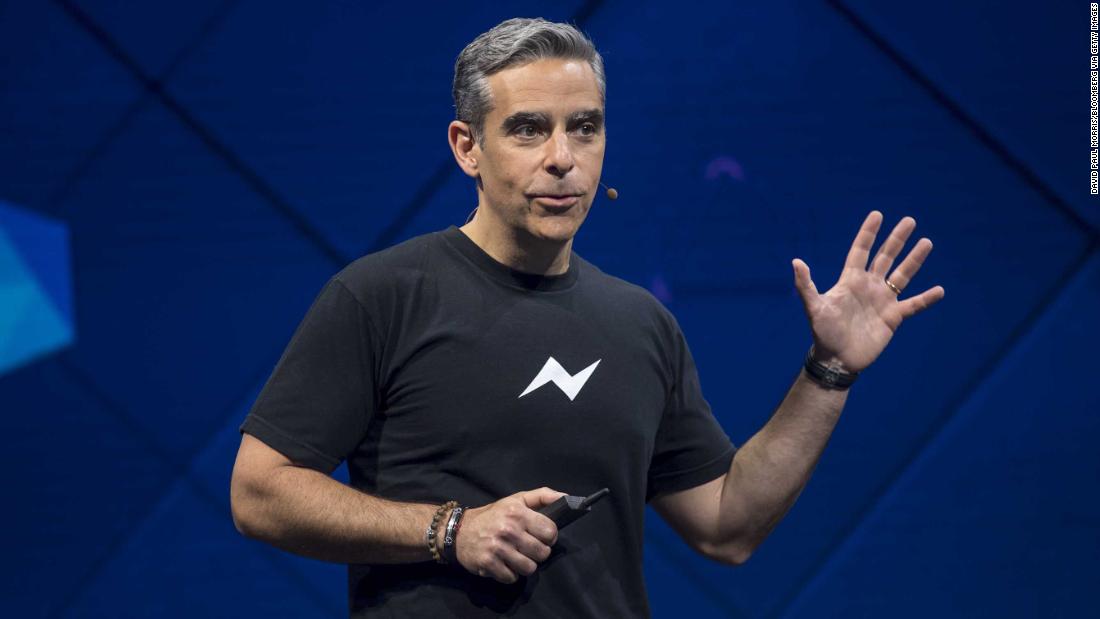
It’s not the first time Facebook has faced Congress. This time, the social media giant came to Washington to discuss its new Libra cryptocurrency. As their new venture into the Fintech industry. Libra, claims Facebook, will keep a customer’s money safe by using the blockchain process. However, the talks didn’t seem to generate a lot of ‘likes’ by members of either party on the Hill. Many lawmakers questioned Facebook (FB) executive David Marcus about why people should trust the company to manage their money and why they should trust Facebook to lead the way on a major new fintech regulation that could fundamentally change global financial systems. "Facebook's motto is move fast and break things," Sherrod Brown, the Committee's senior member, said. "They've moved fast and are helping to undermine our democracy. Now they're expecting us to trust them with our paychecks." July 16 – CNN There are concerns about the currency undermining the federal reserve, about control, regulation and responsibility. But should lawmakers be that worried? What are the potential consequences to Libra launching? What are the benefits? And why is Facebook even going down this path? There are a lot of questions to be asked – and if you are a reporter covering this topic, our experts can help. Eric Overby's research focuses on the transition from physical to electronic modes of interaction and its effect on market efficiency. Eric is available to speak to media regarding blockchain or any other technology related topics – simply click on his icon to arrange an interview.

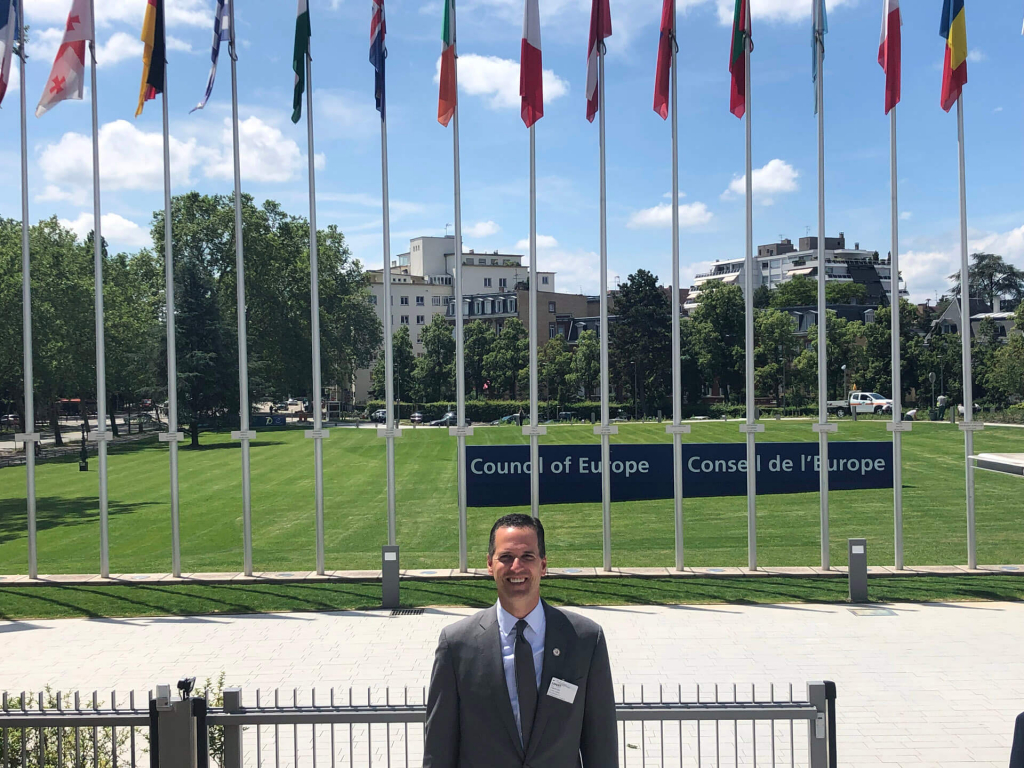
A global commitment to democracy
When I was invited to attend the Global Forum on Academic Freedom, Institutional Autonomy, and the Future of Democracy held this June in Strasbourg, France, I jumped at the chance. I was proud to add Otterbein’s support to a movement of global leaders committing to protecting democracy. I attended the forum along with more than 100 higher education leaders from around the world. Since its founding, Otterbein has stood for the rights of academic freedom and autonomy, as well as the freedom of speech of individuals, and we continue to stand resolute today. Otterbein believes that all voices from different walks of life must be represented, respected and valued, and we are committing to be a national and global leader in preserving democratic societies and values. The Global Forum was co-organized by the Council of Europe; the International Consortium for Higher Education, Civic Responsibility, and Democracy; the Organization of American States; and other partners, notably the International Association of Universities and the Magna Charta Observatory. It gathered higher education leaders and representatives of public authorities and NGOs from Europe and the United States, as well as smaller numbers from Australia, Asia, Africa, the Middle East and Latin America. - John Comerford Are you a journalist covering topics about democracy and how it is being threatened around the world? What role does higher education play in global democracy? And what countries or regions are the most at risk? There are a lot of questions regarding this topic – and that’s where we can help. John Comerford is an expert in higher education, regional and national topics. He is the President of Otterbein University and is available to speak with media regarding this issue and how higher-education needs to be made available to everyone in America regardless of income, family name or background. Simply click on his icon to arrange an interview.

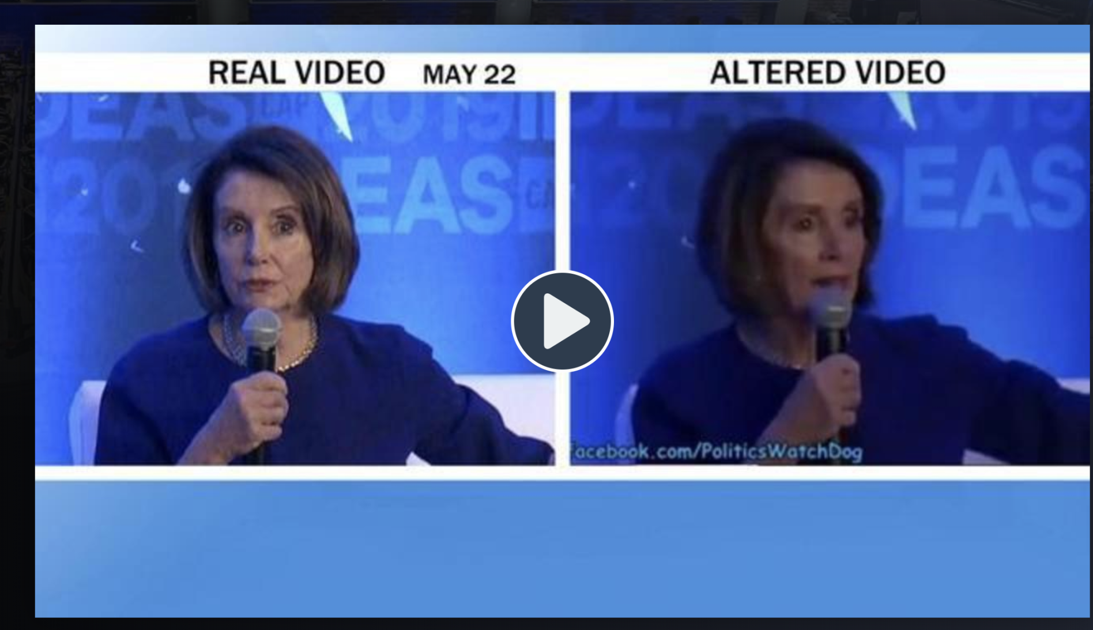
A closer look at deepfakes. Let our experts explain if there’s a reason to worry.
Deepfakes…they’re eerie, entertaining and getting a lot of attention. Deepfake videos are made using artificial intelligence technology which can manipulate someone's face in a video to make it look like they are saying something that they didn't. It's one level up from dubbing, or lip syncing, and can appear very convincing. One example is a video that was made using footage of Mark Zuckerburg in 2017; it was doctored and falsely portrays the Facebook CEO discussing how he had stolen data. – The Sun, June 26 The new concept is all the rage and has seen people spoofed, mocked and tricked. But as once again technology outpaces legislation and with an election approaching, deepfakes have some people going off the deep end. Every day, thousands of videos are posted online, which means that any potential filtering program would need to be able to quickly and efficiently detect fake content. Even then, such media would likely be removed only after being published, meaning that the video would likely have already had an impact. For these reasons, deepfakes are expected to contribute to the upcoming 2020 election in the United States, likely acting as an agent of spreading fake news. However, Edward Delp, a Purdue University professor who developed a computer program to help detect these videos, believes deepfakes pose a bigger threat. “Deepfakes pose a threat to more than just political videos,” he said. “It can be used in making fake child pornography, revenge porn and financial bribes. Just general criminal behavior.” – The Exponent (Purdue University), June 21 As deepfakes become more common on social media and the internet, odds are they will make their way – accidentally or not – into the actual media. And as America still battles with the fake news phenomenon, will Deepfakes further erode our trust in media and our leaders? As deepfakes become more common on social media and the internet, odds are they will make their way into the actual media. So, what can be done? How will these deepfakes affect the perception of news media? What simple advice can we apply to verify if something is real or fake? And do these videos represent a threat to democracy, as some experts are saying? Dr. Gregg R. Murray, professor of political science at Augusta University, is available to talk about the implications of this new threat. Murray’s research focuses on political behavior and psychology with specific interests in voter mobilization and turnout. He is also executive director of the Association for Politics and the Life Sciences.


The Increasing Tension Between the U.S. and Iran
Two oil tankers were attacked in the Gulf of Oman and an unmanned drone was shot down in the last two weeks, escalating tensions between the United States and Iran. After a last-minute bailout of a retaliatory airstrike, President Donald Trump announced additional sanctions against Iran on June 24. Lowell Gustafson, PhD, a political science professor, taught American foreign policy and a course titled "Theories of War and Peace" for several years. He says, with the talk of airstrikes and President Trump claiming there will be "obliteration like you've never seen before," Congress needs to step in. "Congress should immediately hold hearings and vote on exactly what conditions would need to be met before such an order was given. Before Congress makes an initial authorization to use force against Iran, the military should not follow any order to do so by the President. Our founders gave Congress the power to declare war since a single executive, whether monarch or president, should not have the authority to make such a weighty decision unilaterally." Dr. Gustafson noted that so far, sanctions have proven counterproductive and a "unilateral presidential decision to use force undermines American constitutional democracy." He said the president's failure to think systematically about this issue leaves us moving from tactic to tactic.


Civics Education Expert Comments on Sandra Day O'Connor's Legacy, Inspiration
O’Connor’s creation of iCivics ‘was the catalyst for much of my work in civics education,’ says Brooke Blevins This week, the nation heard from former U.S. Supreme Court Justice Sandra Day O’Connor, the first woman to serve on the nation’s highest court, that she is officially stepping away from public life due to health reasons. In her letter to the nation, O’Connor shared about her commitment to civics education and, specifically, the creation of iCivics – free online interactive games and curriculum designed to teach the core principles of civics to middle and high school students. Brooke Blevins, Ph.D., serves as associate professor of social studies education and associate chair of the department of curriculum and instruction in Baylor’s School of Education. She and Karon LeCompte, Ph.D., associate professor of curriculum and instruction, conducted the first independent research study of iCivics effectiveness. Blevins and LeCompte also launched iEngage Summer Civics Institute. The researchers were honored by O’Connor for their research and commitment to iCivics and civics education. Dr. Blevins wrote the following when she learned of Justice O’Connor’s announcement: We are saddened to learn about the news that Justice Sandra Day O’Connor is stepping away from public life due to her health. Justice O’Connor is undoubtedly one of the most profound figures in our country—a boundary-breaking woman who fought tirelessly to encourage collaboration, democratic discourse, and working toward the common good. Her legacy is one that has had a deep impact on my own life, my academic pursuits and the Baylor community as a whole. Justice O’Connor’s efforts to start iCivics, an online civics education platform that provides interactive games and curriculum designed to help students learn about the core principles of democracy in an engaging and relevant manner, was the catalyst for much of (the Baylor School of Education’s and) my own work in civics education. In 2012, my colleague, Dr. Karon LeCompte, and I had the privilege of conducting the first independent research study examining the effectiveness of iCivics on students’ civic knowledge, skills and dispositions. Working with more than 300 students in Waco ISD and Midway ISD, we implemented a six-week unit using iCivics games and curriculum. In April of that year, we had the honor of presenting our encouraging findings to Justice O’Connor in a community symposium in which she also honored Waco area students, teachers and district administrators. It was from the inspiring work of Justice O’Connor and iCivics that our work in civics education at Baylor University has continued, including the creation of the Baylor University iEngage Summer Civics Institute—a program designed to take the principles learned in iCivics and put them into action in the community. As Justice O’Connor has said time and time again, “It’s not enough to understand; you’ve got to do something.” Justice O’Connor’s efforts to reinvigorate civics education, re-engage young people in civic life and ensure the future of our democracy are enduring and inspiring for all of us. These efforts to reform and reinvigorate civics education are ongoing and in need of our support and resources. As she noted in her final letter, “It is my great hope that our nation will commit to educating our youth about civics, and to helping young people understand their crucial role as informed, active citizens in our nation.” This is why the Baylor University School of Education is committed to pioneering innovative approaches and research in civics education. We are grateful for the work of Justice Sandra Day O’Connor and her light that shines bright throughout our world.

Misleading our children – is revisionist history harming the education of our nation’s students?
It’s astounding and almost as if it’s a scene from a movie – meddling, mid-level politicians trying to revise and alter curriculums to ensure children in classrooms are only getting certain points of few and perspectives when it comes to key moments in American history. It’s a level of petty-propaganda usually associated with paranoid regimes in far-away countries. But these days, it’s a homegrown problem. In Texas, the state Board of Education is being slammed for altering facts, twisting perspectives and intentionally omitting moments in history from it’s curriculum. According to USA Today, “The state is considering revisions to the 2010 standards, which a group of academics slammed in a report Thursday. Among their complaints: lessons downplaying slavery as the Civil War's cause, exaggerating the influence of Moses on U.S. democracy and applauding the National Rifle Association and Newt Gingrich's Contract with America. "The quibble over wording here could not be more misleading," said Emile Lester, a report co-author and political science professor at the University of Mary Washington in Virginia.” So how does this happen and how is it allowed in modern America? And how common is this throughput the country? Is it a matter of too much power in the hands of those with an agenda or a reflection on an education system in a sate of neglect by elected officials? There are a ton of questions that need to be asked. That’s where an expert from at the University of Mary Washington can help. Dr. Emile Lester, associate professor of political science at the University of Mary Washington, an expert in church and state issues is available to speak with media regarding this issue. Simply click on Emile’s icon to arrange an interview. Source:

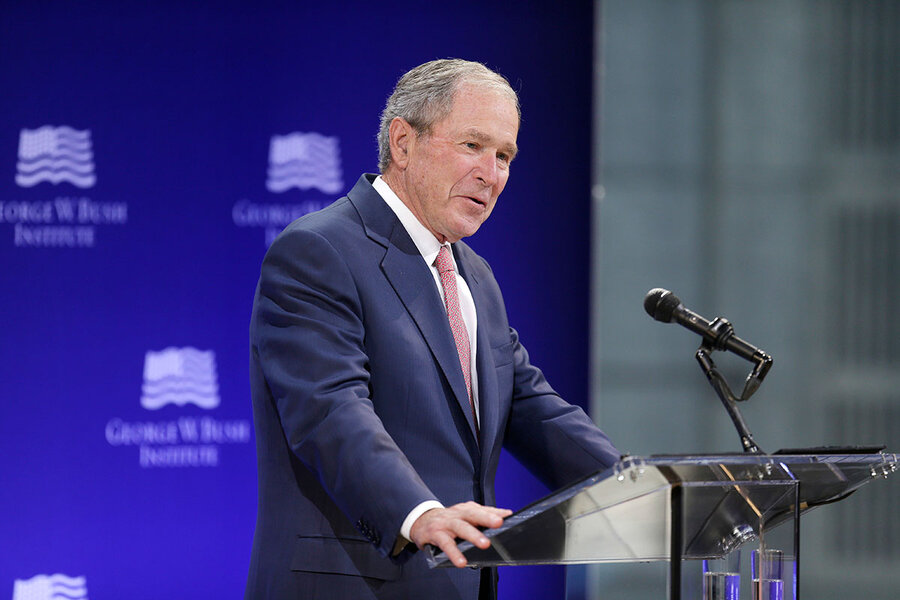
Presidential Rhetoric Expert Shares Thoughts on Bush's Speech
Presidential rhetoric expert Martin J. Medhurst, Ph.D., Distinguished Professor of Rhetoric and Communication and professor of political science in Baylor’s College of Arts & Sciences, is quoted in this article about speeches given last week by two former U.S. presidents and a former presidential candidate that warned of the dangers to the nation and the world if divisive politics continues to cleave the American electorate into thoughtlessly hostile warring camps. “They ... talk about American ideals, they ... talk about the story of America, the American creed and the need to reinvigorate democracy and continue to be the exemplar to the world of democratic values,” Medhurst said. Source: