
Experts Matter. Find Yours.
Connect for media, speaking, professional opportunities & more.
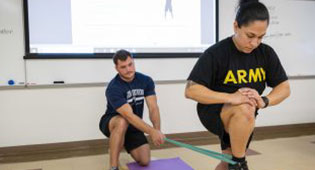
What began in 2016 as a partnership between Georgia Southern University and the Third Infantry Division at Fort Stewart has become a nationally recognized educational and research program with $5.68 million in federal funding to improve soldier health and performance to ensure force readiness. Now called the Soldier Performance and Readiness (SPAR) program, this Georgia Southern project aligns with the U.S. Army’s Holistic Health and Fitness (H2F) initiative and represents a multifaceted partnership with the Army to provide onsite training that decreases musculoskeletal injuries; deliver an online certificate program in tactical fitness for college credit; collaborate with the Army’s Research Institute for Environmental Medicine (USARIEM); and develop programs to enhance and assess cognitive performance in tactical situations. The initial partnership program to prevent musculoskeletal injuries was delivered at first to small cohorts to implement new practices in the physical training of their squads and platoons in a train-the-trainer model. Results were so encouraging, the program expanded at Fort Stewart and to training brigades at Fort Benning last year with the assistance of $1.5 million in Department of Defense funding. Studies show significant preparedness and financial benefits from reducing musculoskeletal injuries to soldiers during drilling and training exercises. In April 2020, officials determined that 58,000 soldiers (the equivalent of 13 Brigade Combat Teams) had injuries that classified them as non-deployable. In 2019, more than half of soldiers experienced a new injury, resulting in 10 million limited-duty days. Musculoskeletal injuries account for nearly 25% of all military injuries and approximately $557 million in acute patient care. Most of these injuries were associated with fitness training-related activities Georgia Southern’s online Tactical Athlete Certificate program was first offered in 2020 and is available exclusively to soldiers on active duty, in the National Guard or reserve. Through a series of three courses, the program teaches foundational exercise and biomechanical concepts, strength and conditioning principles, and rehabilitation. The coursework parallels the Army’s Master Fitness Trainer curriculum, with additional rehabilitation principles, and teaches soldiers how to develop evidence-based and well-rounded physical training programs while minimizing risk of musculoskeletal injury. Certificate completion provides soldiers with nine college credits with Georgia Southern, potential promotion opportunities in the Army, and preparation for the National Strength and Conditioning Association’s TSAC-F exam. “By sharing knowledge, expertise and experience between our faculty and doctoral students with soldiers, drill instructors, and brigade combat fitness teams to create aligned programs that improve tactical performance and force readiness, the SPAR program has become a national model of public-impact research,” said Christopher Curtis, Ph.D., Georgia Southern’s vice provost for research. “We are excited about the future of this partnership. We relish the significant support and encouragement we receive from the Army commands at Fort Stewart, Fort Benning, USARIEM, and the Training and Doctrine command (TRADOC), and we are grateful to Congressman Carter and his fellow members of the Georgia Congressional delegation who have advocated for the value of the partnership on our behalf.” The progress and continued success of this program would not have been possible without several years of support from the Georgia Congressional Delegation and especially the leadership and support of Congressman Buddy Carter, who represents Fort Stewart and the Armstrong Campus of Georgia Southern in Savannah. “Providing for our nation’s defense is the number one responsibility of the federal government. Innovation and research, which is what these dollars will fund at Georgia Southern, will improve working conditions for our brave servicemen and women by providing them with top-of-the-line training and resources,” said Rep. Buddy Carter (R-GA). “I am a proud supporter of Georgia’s military community and am happy that the federal government is investing in these necessary programs.” SPAR programming allocated in the FY23 federal budget will enable Georgia Southern to: Develop protocols and expand delivery of the onsite musculoskeletal injury prevention training and the Tactical Athlete Certificate to commands at Fort Gordon in Augusta and to the Georgia National Guard. Develop and deploy similar online certificate programs for soldiers in Cognitive Performance and Nutrition to further support the Army’s H2F program. Host a national conference on “Charting Future Readiness Needs” in partnership with the U.S. Army Training and Doctrine Command and U.S. Army Forces Command that will bring together other research universities who also work in partnership with the Army. Work with the Army commands to develop specific academic degree programs to meet the specific H2F professional workforce needs at the brigade level. Army officials estimate approximately 3,000 personnel will need graduate degrees or advanced certifications in the next six years. Develop a Tactical Performance Research Lab in Savannah to support the fundamental research and innovation activities of Georgia Southern’s Tactical Performance Group that supports the Army’s H2F program as well as translational research to apply the knowledge and practices broadly to law enforcement and other first responders. Looking to know more - then let us help. Christopher Curtis is available to speak to media - for more information simply click on his icon here or reach out to Georgia Southern Director of Communications Jennifer Wise at jwise@georgiasouthern.edu to arrange an interview today.


Combating Hate Speech in 2023 (and Beyond)
The arrival of a new year often initiates a reflection on the previous one. And according to Billie Murray, PhD, associate professor in the Department of Communication, reflecting on America’s past begins with acknowledging the country’s history of and ever-growing propensity towards hate speech. As defined by Dr. Murray in her book Combating Hate: A Framework for Direct Action, hate speech “defames, denigrates, dehumanizes and/or inspires violence against particular groups of people on the basis of their religion, ethnicity, nationality, race, gender or other identity category.” Hateful rhetoric is not restricted to the fringes of society as it once might have been. It is emerging within schools, localities and central government. Yet, as Dr. Murray points out, America’s enmeshment is not fated. Dr. Murray’s commitment to fieldwork has taken her throughout the country to protests at hate group rallies in Stone Mountain and Newnan, Georgia, Columbia, South Carolina, and Washington, D.C. At these rallies, and through the lens of a researcher, scholar and activist, Dr. Murray sought to identify oppositional tactics used by counter-protestors that succeeded in diminishing the presence and the effects of hate speech. As a result of her observations, Dr. Murray devised the Counterspeech System, a strategy based on the idea that more speech (not avoidance) is the best way to counter hate speech. And there are two successful ways of doing just that: Confrontational Tactics focus on combating hate through direct action. For example, ‘Angel Action’ is a term used for a confrontational tactic employed at funerals in which activists dress in white angel costumes, rising seven feet tall with ten-foot wing spans, to form a shield with their bodies while creating a barrier between mourners and hate groups. For non-funeral occasions, counteractive celebratory events such as public dance parties, pride celebrations and noise brigades (the drowning out of hate speech with things like kazoos or brass bands) aim to quell hate with love. Persuasive-Dialogic Tactics focus on both public and interpersonal discussions. For example, persuadable members of the general public may receive the message that hate is a problem (through media campaigns and education) and thus come to the conclusion that action must be taken to combat it. Additionally, an interpersonal dialogue with individual members of a hate group in which messaging about compassion, human dignity and mutual respect is initiated can lead to self-reflection and the use of resources such as de-radicalization support groups (like Life After Hate). It is important to acknowledge that although successful, Counterspeech System tactics do not prevent hate groups from organizing or disseminating information. More speech serves to combat existing hateful rhetoric. “Our country needs a shift in how it understands free speech and the role of police protection of hate groups, especially if we are going to continue to win this fight,” says Dr. Murray. It will take federal action coupled with a coalition of those engaging in oppositional tactics to bring about lasting change. However, despite the challenges, Dr. Murray affirms that combating hate speech is worth the fight.


Partnership with Hims & Hers Expands In-Person Healthcare Access in Four States
Hims & Hers Health, Inc. (“Hims & Hers”, NYSE: HIMS), the trusted consumer-first platform focused on providing modern personalized health and wellness experiences to consumers, and one of the nation’s premier health systems, ChristianaCare, today announced a partnership that will expand access to healthcare services and create a more seamless care journey for patients. The partnership will benefit customers in Delaware, Maryland, New Jersey and Pennsylvania, and expands the Hims & Hers’ partnership network with providers to now include 10 states and Washington D.C. Hims & Hers offers treatments for a broad range of conditions, including those related to sexual health, hair loss, dermatology, mental health and primary care. This collaboration allows licensed medical providers on the Hims & Hers platform to connect patients with ChristianaCare’s industry leading Center for Virtual Health and extensive primary and specialty care provider network when appropriate. Referrals may occur if a patient presents with a complex medical history, requires additional in-person follow up or evaluation, or needs care for a condition that the Hims & Hers platform does not support. This collaboration advances the Hims & Hers mission to expand access to high-quality, convenient and affordable care by adding another high-quality health system to its growing network of provider relationships. “ChristianaCare stands for excellence in healthcare and is rated as one of the best hospitals in America, making them an excellent and trusted partner in ensuring a high-quality care experience throughout a consumer’s journey,” said Hims & Hers Chief Operating Officer Melissa Baird. “Healthcare consumers today want easy-to-use, on-demand access to high-quality care both digitally and in-person, so our proprietary platform, coupled with partnerships such as ChristianaCare, help them smoothly navigate more of their healthcare needs.” ChristianaCare is one of the country’s most dynamic healthcare organizations that is committed to improving health outcomes, increasing access to high-quality care and lowering the costs for patients. Its Center for Virtual Health makes health care accessible and convenient, available 24/7 through computer, tablet or smartphone. By partnering with Hims & Hers, ChristianaCare gains access to a broader patient population for its Center for Virtual Health and extensive network of primary care, outpatient services, and specialty care services, including its comprehensive stroke center and regional centers of excellence in heart and vascular care, cancer care and women’s health. “ChristianaCare is thrilled to partner with Hims & Hers to make high-quality health care available to its customers who have complex needs or need additional services that Hims & Hers does not provide,” said Sharon Anderson, MS, RN, FACHE, ChristianaCare’s chief virtual health officer and president of ChristianaCare’s Center for Virtual Health. “At ChristianaCare, our Center for Virtual Health provides personalized health care consultations that are immediate, coordinated, continuous and available 24/7, delivering value to our patients and making a positive impact on health,” she said. This partnership with ChristianaCare builds upon established relationships with other high-quality providers, including Carbon Health in California; Oschner in Louisiana; Mount Sinai Health System in New York City; and Privia in the District of Columbia, Georgia, Maryland, Texas, and Virginia. ChristianaCare will provide support to select counties within Delaware, New Jersey, Pennsylvania and Maryland.


How will debates affect upcoming elections? Expert examines Walker-Warnock Senate matchup
Mid-term elections are nearly here and it is debate season for candidates. In Georgia, Sen. Raphael Warnock is set to debate Herschel Walker in Savannah on Oct. 14. This may be the only time the two candidates face off in a debate. But can these events sway a voter one way or another? Augusta University’s Mary-Kate Lizotte is an expert in political and voter behavior and said research shows debates do not have a substantial influence on election outcomes. “Most individuals who watch debates are well informed and therefore very likely to already have a party identification,” Lizotte said. “Sometimes debates do lead to a bump in the polls for a candidate if various news outlets agree that the candidate won. Most of the times, such bumps do not last that long.” But when it comes to a particular issue, she said there is some research that shows if it’s a newer topic, then it can influence public opinion. There has been a lot of attention on this particular debate since Warnock has unsuccessfully tried to engage Walker in other debates. Walker has said he’s not the polished speaker Warnock is and has downplayed the debate during recent speeches. “Walker is probably doing what others have done against a candidate with established oratory skills," adds Lizotte. "George H.W. Bush, George W. Bush, Sarah Palin and Mitt Romney, or their people, worked to lower expectations by conceding that their opponent was a fantastic debater/speaker; then the news media positively covered their debate performance when they performed moderately well or when their opponent does not trounce them.” “This could work in Walker’s favor if they only have one debate. If he gets positive coverage for doing better than expected, then he likely won’t agree to another debate.” With the mid-term elections inching closer and each Senate race crucial to determining the balance of power in Washington, these campaigns will get attention from state and national media. And if you're a reporter looking to cover the race in Georgia, then let us help. Dr. Mary-Kate Lizotte is an expert in political and voter behavior. She is available to talk about the upcoming midterm and gubernatorial elections in Georgia. Click on her name to schedule an interview.


What's next in Georgia's 2020 election saga?
All eyes are on Georgia once again, but this time it's not about an upcoming election. As we sort through the 2020 election aftermath that saw Georgia in a tug-of-war between lawyers, politicians and pundits, the actions a few important figures may now be coming to light. Rudy Giuliani, the former advisor to President Trump, may be in some serious trouble according to Augusta's leading political expert, Dr. Gregg Murray. "When politicians are involved, there are almost always political calculations," Murray said. "But there’s a lot of information suggesting there may be problematic behavior that he was heavily involved with. There are reports of investigations involving several possible Georgia law violations: solicitation of election fraud, making false statements to local officials, conspiracy, racketeering, violations of oath of office and involvement in violence or threats of violence, according to Voice of America." As for Sen. Lindsey Graham, he, too, has been summoned to appear and explain how he may or may not have attempted to influence the election outcome. A federal judge on Monday turned down Sen. Lindsey Graham’s bid to throw out a subpoena compelling him to testify before the Atlanta-area grand jury investigating Donald Trump’s effort to overturn the 2020 election. “[T]he Court finds that the District Attorney has shown extraordinary circumstances and a special need for Senator Graham’s testimony on issues relating to alleged attempts to influence or disrupt the lawful administration of Georgia’s 2022 elections,” U.S. District Court Judge Leigh Martin May wrote in a 22-page opinion rejecting Graham’s effort and sending the matter back to state courts for further proceedings. Politico, Aug. 15 According to Murray, defying the judge's request might be the likely choice for the senator. "It seems the Republican party is still clearly tied to Trump," Murray adds. "I don’t think he would be hurt politically by not showing up. It’s an interesting question if some people would hold it against him for showing up." This legal wrangling will be long and drawn out, so if you are covering this topic, let our expert help with your story. Dr. Gregg Murray is available to talk about the election audit and what it might mean for voters in Georgia and across the country. Murray’s research focuses on political behavior and psychology with specific interests in voter mobilization and turnout. He is also executive director of the Association for Politics and the Life Sciences. Simply click on Murray's icon to arrange an interview today.


Politics, policy and public safety: Experts explain why a popular Atlanta festival was canceled
A sad tune is being hummed in Atlanta, where it was announced the popular annual Music Midtown festival is not happening, possibly in part due to the state’s laws surrounding guns in public parks. The event's cancellation, which brought tens of thousands of music lovers to the city -- along with the tourism dollars they spend -- has caused disappointment and drawn local and national media coverage. Calling it a “sad day” for the city, Atlanta City Council President Doug Shipman wrote on Twitter that: “Public policy has real impacts and, in this case, economic and social implications on a great tradition.” And state Democrats chastised Republicans for adopting a raft of pro-gun legislation, including a 2022 law that allows Georgians to carry concealed handguns without first getting a license from the state. The governor, who is seeking a second term, did not immediately comment on the festival’s decision. But state Rep. Rick Jasperse, a Jasper Republican who sponsored the 2014 law, said the measure is designed with public safety in mind. He said those intent on “causing chaos and crime in Georgia” won’t care if the festival bans firearms and would try to bring them in regardless. “Good Georgians who can qualify for a permit and carry a weapon do so to protect themselves from that element in our society,” he said. -- The Atlanta Journal Constitution, Aug. 1, 2022 Organizers of events like Music Midtown could look at Georgia’s gun laws and regulation of firearms as a potential legal liability. If there is a firearms incident, organizers may fear being held legally accountable and sued for any potential damages. The companies and their risk management advisors might think twice about holding large events in Georgia. Augusta University's Dr. William Hatcher, an expert when it comes to public administration and social, economic and political institutions in local communities, agrees that event organizers might be rethinking their plans in the state. "Yes. I think so. These types of laws have an impact on the economy and the business decisions of firms. We may see future effects on the economic behavior of individuals and firms." This topic could have further economic impact beyond canceled events, including affecting property values and home prices. If you're a journalist looking to know more, then let us help with your stories. Dr. William Hatcher is a professor of political science and chair of Augusta University’s Department of Social Sciences. He is an expert in the areas of public administration and social, economic and political institutions. Hatcher is available to speak with media regarding this topic. To arrange an interview today, simply click on his icon now.


What the Roe V. Wade Reversal Means for Data Privacy
Following the US Supreme Court decision to overturn Roe V Wade on the 26th June 2022, abortion laws are now changing across states on an almost daily basis. The landmark decision and huge signifier for the rights of women in the United States and across the world of 1973, is now nothing but history. In 13 states with “trigger laws”, abortion laws will take immediate effect, with others being implemented about a month after the ruling. While ‘the patchwork of state laws and barrage of court filings mean that for half the country', the legal status of abortion remains ambiguous, a month on, one thing remains certain - concerns regarding tech companies and the protection of user privacy in regards to abortion cases are only growing. New questions have been raised and existing debates regarding data privacy have been reignited. Debates center on the extent to which tech companies should protect the information of users seeking abortions and the steps that both consumers and companies can take in line with current laws. While many large corporations, including tech companies Microsoft, Apple, Meta, Disney, Uber, Netflix and Amazon have announced they will provide travel expenses for abortions if they are not available in the state, the role of tech companies in protecting private users' information remains unclear. What are the concerns? Location Tracking On Tuesday May 24th, 42 Democratic lawmakers urged Google SEO Sundar Pirchai to stop collecting and keeping unnecessary or non-aggregated location data which could be used against people seeking abortions. Before the overruling, the lawmakers wrote “if abortion is made illegal…it is inevitable that right-wing prosecutors will obtain legal warrants to hunt down, prosecute and jail women for obtaining critical and reproductive health care.” In comparison to Apple, which has demonstrated that smartphone companies do not need to retain customer location data, Google ‘has created a new digital divide’, which makes ‘privacy and security a luxury’. Ultimately, privacy for Americans who cannot afford an iPhone is at greater risk. While Google sent a company-wide email stating they would cover out-of-state travel expenses for abortion, they have still made no statement in response to the Democratic lawmaker's request on customer location data since the rollback of Roe V Wade. Period-Tracking Apps Alongside concerns about location tracking data with companies such as Google, one of the newer sources of anxiety in terms of data privacy is the use of cycle tracking apps. Since the draft decision was leaked in early May, there have been widespread concerns over the use of period-tracking apps and calls for American women to delete them to avoid their data being used against them in court. Danielle Citron, Professor of Law at the University of Virginia School of Law expresses her concern that using such tracking apps could help build a legal case against a woman who has had an abortion. She states "you got your period on X date, you missed your period, then let's say, for example, 20 weeks later you got your period again, and that in that time period your location shows that you went to a clinic either in the state or out of the state — that in so many respects is the circumstantial evidence that a prosecutor needs.” Tech policy researcher Eva Blum-Dumontet tells Insider that if people find period-tracking apps genuinely useful they shouldn’t feel they have to get rid of them ‘because the risk of data being handed to law enforcement is low’. But at the same time, ‘it is not impossible.' One of the main period tracking apps, Flo, has issued a statement in response to Roe V Wade which reads ‘we will do everything in our power to protect the data and privacy of our users', with an additional feature to existing security measures including “anonymous mode”, which allows users to remove their personal identity from their Flo account. Flo has stated that more clarity will be given in the coming weeks and months. Limiting Online Discussion of Abortion Pills and Aid Since the Supreme Court’s verdict, online memes, statuses and posts have exploded, sharing resources and thoughts on the decision. Facebook and Instagram have started removing posts related to abortion pills, following the rise in the discussion of access to them and offers to mail them across the US. Media intelligence firm Zignal Labs records that general mentions of abortion pills, as well as posts mentioning specific versions such as mifepristone and misoprostol, suddenly spiked on Friday morning across Twitter, Facebook, Reddit and TV Broadcasts. Following the release of a screenshot obtained by the Associated Press of an Instagram post from a woman who offered to buy and send abortion pills through the mail, being taken down within a few minutes by Instagram, AP decided to test out how Meta would respond to a similar post on Facebook. On Monday, the AP reporter wrote “If you send me your address, I will mail you abortion pills.” The post was removed in under one minute. Interestingly, when the AP reporter made the same post but ‘swapped out the words “abortion pills” for “a gun”, the post remained untouched.’ Can past cases inform the future? While the response of tech companies in protecting public data regarding the concerns raised above is still relatively ambiguous, we can refer to past cases where smartphone data was used as evidence in cases against women. In 2018, Lattice Fisher was charged with second-degree murder after she experienced a ‘stillbirth at home and a state medical examiner claimed the baby had been born alive and died of asphyxiation, according to Oktibbeha County court records.’ Fisher’s mobile data records allegedly contained a search for “buy abortion pills”, and mifepristone and misoprostol, the two main forms of self-managed abortion medications. Although Fisher got out of jail later in 2018, Laurie Bertram Roberts, co-founder of the Mississippi Reproductive Freedom Fund and the executive director of Yellow Hammer Fund, who had been heavily involved with Fisher’s bail, said that the impact will forever taint Fisher’s life. “Anytime someone Googles her for a job that mugshot with a story of her being indicted for a second-degree murder will always be there.” In 2015, Purvi Patel was prosecuted in Indiana under the state’s feticide law after she took safe, well-known abortion medication. Prosecutors had claimed that the baby was born alive and did not survive. In this case, Patel’s text messages mentioning the abortion pills were the main evidence used against her. She was sentenced to 20 years in prison, but her conviction was overturned and she was released after serving 18 months. Many people had wondered how the case had happened when abortion was a protected right under the constitution. With the right to abortion in the US now only marking a historical moment, the role of tech companies in the protection of user data will only become increasingly pivotal in a post-Roe world.


Researchers in Georgia Southern University’s Tactical Athlete Readiness and Preparedness Program (TARP) have teamed up with the Georgia Public Safety Training Center (GPSTC) to ensure the readiness and resilience of Georgia’s public safety officials. Members of the TARP in the Waters College of Health Professions have worked to revise the fitness training standards for Georgia’s police cadets with a focus on functional fitness, mental resilience and injury prevention. In addition, the program has formed a partnership with the GPSTC, Georgia’s premier training facility for all state and local public safety related units to include police, fire and communication. Bridget Melton, Ed.D., professor of exercise science and lead faculty member of TARP, said that due to high stress and health concerns, some police and public safety officials are at high risk for cardiovascular disease or other fatal illnesses. “Our program provides state academies with fitness exercises that increase overall cadet fitness and focuses on injury prevention,” said Melton. “Our program focuses on occupational focused fitness to hopefully encourage a more positive view of exercise that will stick with cadets even after their academy training is done.” Richard Cleveland, Ed.D., associate professor of leadership, technology and human development, heads resilience and mental health for the TARP team, and has created a Mindfulness-Based Tactical Instruction curriculum for the state of Georgia. “Tactical athletes need training and support for resilience and mental health, but too often it’s only presented as a one-time workshop or seminar,” said Cleveland. “Our program dovetails into the state’s resilience curriculum for officers, but provides ‘bite-sized’ mindfulness practices within the fitness program. This gives cadets repeated practice at using mindfulness and embeds it within their context using police language, actions and behaviors.” The partnership was made possible due to a subgrant GPSTC was awarded from the Criminal Justice Coordinating Council to fund TARP at their facilities due to the program’s comprehensive view of officer wellness, which is aimed at improving de-escalation skills among recruits through mental and physical training. “We are pleased to form a partnership with the GPSTC and the Tactical Athlete Readiness and Preparedness Program,” stated Chris Wigginton, director of GPSTC. “This partnership will allow public safety professionals to be better prepared in their personal and professional lives. Some of the many benefits will be a reduction in injuries, being better prepared to use needed skills in rapidly evolving situations, and the resiliency and mental health component. As word has gotten out of the possibility of the GPSTC implementing this program we have already been contacted by several states regarding the initiative.” Additionally, graduate students in the Department of Health Sciences and Kinesiology participate in the program and gain firsthand and practical experience by performing training and assessment for state instructors. TARP is part of Georgia Southern’s Tactical Athlete Initiative, which aims to reduce the number of injuries and increase readiness and preparedness of tactical athletes. The interdisciplinary team consists of the following Georgia Southern faculty members: • Bridget Melton, Ed.D., Professor • Richard Cleveland, Ed.D., Associate Professor • Greg Grosicki, Ph.D., Assistant Professor • Haresh Rochani, DrPH, Associate Professor • Mary Beth Yarbrough, Lecturer • Sarah Davis, Lecturer TARP is just one example of the work coming from Georgia Southern University’s Tactical Athlete Initiative. The Tactical Athlete Initiative is a multi-discipline collaboration providing research, training and support for military, police, fire and EMS workers. The Tactical Athlete Initiative has partnered with multiple agencies including the Statesboro Police Department, Statesboro Fire Department, Bulloch County Sheriff’s Office, Forsyth County Sheriff’s Office, Waycross Fire Department, Georgia Public Safety Training Centers, Federal Law Enforcement Training Centers and the United States Army. If you're a reporter looking to know more about this partnership at Georgia Southern University - the let us help. Richard Cleveland, Ph.D., is an assistant professor in the Department of Leadership, Technology & Human Development at Georgia Southern - simply click on his icon to get in touch or contact Georgia Southern Director of Communications Jennifer Wise at jwise@georgiasouthern.edu to arrange an interview today.


The economy may be slowing - but remains strong according to Georgia Southern expert
Georgia Southern’s Economic Monitor Q1 reports regional economy slows, retains strength Georgia Southern University’s latest Economic Monitor, which reflects Q1 2022, reports that growth in the Savannah metro economy moderated during the opening quarter of the year. “The broadest indicators of economic activity — overall regional employment and electricity sales to residential, industrial and commercial users — continue to signal strength,” stated Michael Toma, Ph.D., Georgia Southern’s Fuller E. Callaway Professor of Economics. “After good performance in the fourth quarter, there was a mild pull-back during the first quarter in tourism and port activity. In general, the regional economy maintained its forward momentum, but slowed its rate of acceleration. Toma also noted that the Savannah metro economy will grow approximately 2% through the remainder of 2022, noticeably slower as compared to the rebound year of 2021. The economic future is somewhat murkier now as inflation surges, the Federal Reserve tightens, and global energy and commodities markets remain rocked by Russia’s invasion of Ukraine, he said. Overall Strength, but Some Sectoral Weakness The business index for the Savannah metro economy increased 1.3% in the opening quarter of 2022, roughly half the pace of the previous quarter. The index of current economic activity increased to 207.3 from 204.7. The index was buoyed by solid employment growth of 1.6% during the quarter and electricity sales growth of 2.1%. Indicators of port activity, tourism and retail sales slowed during the quarter. Metro Savannah employers added 3,100 jobs pushing total regional employment to 197,500 — more than 5,000 jobs and 3% higher than the pre-pandemic peak of 192,100 in the fourth quarter of 2019. The Georgia Department of Labor recently completed its annual benchmarking process for employment in which the monthly payroll survey data is benchmarked against headcount data. Total employment data did not change significantly but business and professional industry services were revised downward while the information sector, including the film and entertainment industry, was revised upward substantially. A full media release detailing key indicators such as Employment Trends, Housing Market, and that Slowing Regional Growth Expected is attached. About the Indicators The Economic Monitor provides a continuously updated quarterly snapshot of the Savannah Metropolitan Statistical Area economy, including Bryan, Chatham and Effingham counties in Georgia. The coincident index measures the current economic heartbeat of the region. The leading index is designed to provide a short-term forecast of the region’s economic activity in the upcoming six to nine months. Looking to know more - then let us help. The Economic Monitor is available by email and at the Center’s website. If you would like to receive the Monitor by email send a ‘subscribe’ message to CBAER@georgiasouthern.edu. For more information or to arrange an interview - simply reach out to Georgia Southern Director of Communications Jennifer Wise at jwise@georgiasouthern.edu to arrange an interview today.
Georgia Southern University’s annual economic impact soars to more than $1B
The latest report released by the University System of Georgia (USG) shows that Georgia Southern continues to have a strong economic impact on the region it serves and significantly contributed to the USG’s $19.3 billion total economic impact between July 1, 2020, and June 30, 2021. The report indicates that Georgia Southern’s annual economic impact has soared to more than $1 billion for FY 2021, a 7.4% increase over FY 2020. The report found these economic impacts demonstrate that continued emphasis on colleges and universities as a pillar of the state’s economy translates into jobs, higher incomes and greater production of goods and services. “We faced unprecedented challenges in FY 2021, but we’ve come out stronger than ever,” said Georgia Southern President Kyle Marrero. “With more than $1.03 billion of direct impact on southeast Georgia, Georgia Southern will continue to create more academic programs that meet specific needs for economic development. Informed by our regional academic plan and University strategic plan, we’re committed to making our region a thriving economic hub in Georgia.” There are 3,250 jobs on Georgia Southern’s campuses in Statesboro, Savannah and Hinesville. Because of institution-related spending, 6,363 jobs exist off-campus. Georgia Southern’s “initial spending” is $806,753,630. That breaks down in three areas: $235,513,929 is spent on personnel services $161,882,006 is spent on operations $409,357,695 is spent by Georgia Southern’s students Included in the initial spending by USG institutions are rounds of funding from the Higher Education Emergency Relief Fund (HEERF), which are federal funds allocated by the Coronavirus Response and Relief Supplemental Appropriations Act that provided emergency grants for postsecondary education. The study is conducted on behalf of USG by Jeffrey M. Humphreys, Ph.D., director of the Selig Center for Economic Growth in the University of Georgia’s Terry College of Business. If you are a journalist looking to know more about the positive economic Georgia Southern is having - then let us help. Georgia Southern President Kyle Marrero is available to speak with media - simply reach out to Georgia Southern Director of Communications Jennifer Wise at jwise@georgiasouthern.edu to arrange an interview today.