
Experts Matter. Find Yours.
Connect for media, speaking, professional opportunities & more.

Aston University appoints translator in residence to inspire future literary translators
Aston University and Writing West Midlands have appointed Sarah Letza, a professional translator from the region to the role She will be working on community engagement activities at Aston University and with the West Midlands community The project is funded by Arts Council England. Aston University has appointed a translator in residence as part of a project developed by the translators Daniel Hahn and Ros Schwartz, a new one-off literary translation residency for 2022 based in Birmingham. Sarah Letza, a professional translator from the region, has been appointed to the position until March 2023. The project is funded by Arts Council England and will be run in partnership with Aston University and Writing West Midlands. Sarah’s residency will encourage an interest in literary translation and translated literature, and the valuing of languages, among communities in and around Birmingham through workshops, talks and other public engagement and collaborative participation projects. Sarah Letza, translator in residence at Aston University, said: “I hope to draw attention to the opportunities that translation and language learning can lead to and capitalise on the wealth of talent that can be drawn from Midlands schools and universities. “There is the potential to be involved with the many translation research projects already under development at Aston University as well as promoting and supporting languages and translation pathways. “I want to showcase Birmingham as a city that has been built on cultural crossings, intellectual exchange and creativity, all of which are the bedrock of both translation and language learning.” Dr David Orrego-Carmona, a lecturer in English, languages and applied linguistics at Aston University, said: “Birmingham is an incredibly multilingual city and Aston University is particularly well-placed to raise awareness and showcase the value of languages, translation and intercultural exchanges. “We are certain the programme will provide inspiring experiences for our beneficiaries in Birmingham and the region, and we are looking forward to the engaging activities that Sarah is already planning.” For more information about our courses in translation click here.


12 tips to help you build your networking skills in Canada
Your professional network will be one of your most valuable assets in the Canadian job market. Whether you’re trying to land your first job or are looking for a mentor, your network can play an important role in helping you achieve professional success in Canada. As a newcomer to Canada, you’ll have to work harder and refine your networking skills to build connections from scratch in your new country. This article will provide you with tips to help you build your networking skills, so you can start nurturing meaningful professional relationships. 1. Understand that communication is two-sided One of the many advantages of networking is that it’s as much about promoting your personal brand as it is about learning from the experience of others. When someone takes time to speak with you, give them a chance to talk. Active, attentive listening is an essential networking skill that ensures you absorb the information being shared with you. You can then ask intelligent, relevant questions and get insights that might be useful for your professional success in Canada. Keep distractions away and focus on the conversation. It is rude to interrupt when someone is talking, so save your questions until they’ve finished speaking. 2. Improve your public speaking skills Many newcomers avoid networking or public speaking as they lack confidence in their English language or interpersonal skills. However, practice is the best way to overcome the fear of speaking in public. Take the time to work on your language skills. There are many English as a Second Language (ESL) resources and community groups available across the country to help newcomers improve their speaking and listening skills. Practice speaking in front of a mirror or with your friends. Don’t feel insecure if you have an accent or have trouble understanding some words. Remember, Canada is a diverse, multicultural country, and most people are accepting of the fact that English may not be your first language. 3. Practice both verbal and non-verbal communication What you say is only half the image you present—non-verbal communication is just as important. Your body language conveys a lot about your personality and how engaged you are in a meeting. Avoid crossing your arms, closing your fists tightly, or hunching your shoulders, as this can make you seem unfriendly. Practice smiling and gesturing with your hands as you talk in front of a mirror. Be aware of your posture and make eye contact with the people you are talking to. While networking in-person, speak confidently. Respect people’s personal space and avoid standing too close to them. 4. Learn the art of small talk Small talk is culturally important in Canada. It serves as an icebreaker before you get to the actual topic of conversation. Since small talk is meant to create a safe, comfortable environment, be sure to choose non-controversial, light topics. Some common small talk topics include the weather, sports, arts, entertainment, hobbies, and current events. Stay away from topics like politics, personal or family matters, income, and religion. As a newcomer, you can build your small talk skills by staying up-to-date on the news, developing an interest in Canadian arts, culture, and, of course, sports. 5. Ask for constructive feedback An easy way to build your networking skills is to get an honest opinion on what you maybe doing wrong or need to improve. Before an important networking meeting, do a practice run with some friends and ask them for feedback on your small talk, elevator pitch, questions, and overall communication skills. You can also ask for constructive feedback towards the end of your networking meetings. Be open and humble when you ask for tips to help you build your networking skills. In most cases, people are willing to offer guidance and insights that you can leverage in future meetings. 6. Give before you get One mistake many newcomers make is to only think about what they can get out of a connection, without considering what they may be able to offer in return. Networking is not one-sided, so be sure to make a list of your unique skills and strengths before you start. Even if you are new to the Canadian job market, review the LinkedIn profile of the person you’re going to meet to understand their role and see where you can contribute. During your meeting, convey your willingness to help and ask if there’s anything you can support them with. By offering to give before you get, you can build meaningful connections and also prove your value to your network. Once they’ve seen your skills in action, they’ll be more likely to offer guidance, connect you to others, or refer you to job opportunities. 7. Attend networking events and workshops One way to build your networking skills is to jump right in and start networking. Look for both virtual and in-person networking events on industry association websites or on platforms like Eventbrite and Meetup, and attend as many as you can. In addition to making connections, this will also give you a chance to observe the way other people network. You’ll be able to pick up best practices related to small talk, ways to introduce yourself, verbal and non-verbal communication, and questions to ask. If you meet someone particularly impressive, don’t hesitate to follow up and ask if they would be willing to share some tips to help you network better. 8. Prepare, prepare, prepare When it comes to networking meetings, preparation can make all the difference. Put your research skills to good use and learn as much as you can about the background, role, and career path of the individual you’re going to meet. Know what you want to get from your networking meetings—further connections, guidance, or referrals. Prepare a list of questions accordingly, and customize your list based on each person’s industry, skills, and position. Finally, spend some time creating an engaging, authentic elevator pitch. Remember that an elevator pitch is not a sales pitch, but a chance to tell your story and highlight your skills in an impactful way. 9. Ask for recommendations and introductions In Canada, every professional you meet will likely have their own network. As a newcomer, it might not be easy to ask the people you meet to connect you with others. This is a networking skill that you’ll need to build as you start to grow and nurture your network. Before you meet someone for a coffee chat, go through their LinkedIn network and see if they know someone you’d like to be introduced to. If you’re looking for specific information or trying to build a particular skill, it is a good idea to ask your connections if they can recommend someone in their industry or organization who might be able to help. If you’ve cultivated a meaningful relationship, you might also be able to get an introduction to someone in their network. When you are introduced to a person by someone they know and trust, they are more likely to take out time to speak with you. 10. Keep track of your networking meetings For most newcomers, the first few months of networking can be overwhelming. Since you’re building your network from scratch in Canada, you might be meeting as many as four or five people each week. This makes it hard to keep track of who you’ve met and what you discussed. As a result, you might forget valuable insights or miss out on following up with some people. Keeping track of your meetings is an important networking skill. Create a list with names of people you meet, meeting dates, their designations and organization, discussion points, and follow-up actions. When you set up follow-up meetings, you’ll be able to refer to your list to review points that you had discussed with them earlier. This list can also help you identify connections who might be useful when you’re applying for a job. You’ll also be able to clearly see gaps in your network, such as industries you don’t have connections in, so you can focus on those in the future. 11. Follow up and follow through Building meaningful professional relationships takes time and in most cases, the first meeting is only an introduction. The value you can leverage from your connections often depends on how much time and effort you invest in maintaining them. You can start by sending a personalized thank you note within 24 hours of your meeting. If you’ve agreed upon any action items during your meetings, don’t forget to deliver on them. After your initial meeting, you can keep the conversation going by regularly sharing relevant developments and insights, engaging on their social media posts, or asking for their opinion on topics related to the ones you discussed. 12. Don’t give up Finally, patience is another skill you’ll need as you start building your network in Canada. It’s easy to become demotivated when your LinkedIn connection requests go unanswered or when the people you connect with online are unwilling to meet you. Even after the initial coffee chats, some of your connections may not be able or willing to offer you the advice, guidance, or contacts you need. It takes time to nurture relationships and identify how and where someone might be able to add value. You might also have to demonstrate your own willingness to help before someone agrees to support you. Even if some meetings don’t go as well as you had hoped, don’t give up. Each new meeting is a learning opportunity, so keep an open mind. Remember that it only takes one connection or referral to land your dream job in Canada. Networking plays a crucial role in the Canadian job market. However, networking may not come naturally to everyone. As a newcomer to Canada, improving your networking skills will help you build meaningful relationships with people who can bring you closer to achieving your career goals. Original article located here, published by Arrive. About Arrive Arrive is powered by RBC Ventures Inc, a subsidiary of Royal Bank of Canada. In collaboration with RBC, Arrive is dedicated to helping newcomers achieve their life, career, and financial goals in Canada. An important part of establishing your financial life in Canada is finding the right partner to invest in your financial success. RBC is the largest bank in Canada* and here to be your partner in all of your financial needs.


Technical training, exposure to multiple industries and an open and inclusive culture help IT Associates innovate across CCG. They are often the quiet contributors to a project, taking a business idea from concept to delivery to allow strategic business endeavours to get off the ground. What they do and how they do it can be mysterious to many, with technical jargon, architectural details and complex processes at play. To succeed in IT requires incredible technical knowledge, a solid understanding of business processes, and innovative mindset with a natural curiosity to understand how multiple industry business systems all work together. Most importantly what’s needed is the desire for continuous learning. The IT department at CCG has enjoyed an incredible period of growth and development over recent years. In the last decade alone, CCG has undergone a major technology transformation, replacing every major business system required to support the different lines of business under the CCG umbrella including CAA Insurance, Orion Travel Insurance, CAA Travel, Membership and Emergency Roadside Services, while also implementing industry-leading innovations like CAA MyPace. We spoke to three tenured Associates to uncover their secret to success working in IT. What drives the culture of a team that often works behind the scenes but is vital to the success of all organizational projects? Lindsay Lamothe Typically, IT Associates have exposure to many business areas, giving them a well-rounded view of the various industries in which CCG operates. At first glance, one might think that this kind of exposure helps drive innovation and growth. But, while this is true for many, Lindsay Lamothe, Senior Business Systems Analyst for CCG’s Roadside Product Management, explains it’s more nuanced. “I think working in multiple lines of business at the organization led me down the path towards IT. I have no formal training in IT but having exposure to the business side of things gave me insights that continue to be valuable now that I work in a business enablement area,” shared Lamothe. “Being exposed to multiple industries while working in IT is a valuable opportunity to grow knowledge, but I think anyone who can learn more about the multiple industries we operate in would be well-positioned to do well in IT.” Lamothe started at CCG as a summer student to pay for university and eventually came on full-time working in auto travel, helping Members with TripTiks. She worked on the frontlines for ten years before shifting into IT and roadside assistance and has now been at the company full-time for 18 years. Her sense of purpose comes through very clearly when you speak to her about the impact of her work. “I am proud to work in IT at CCG because I am passionate about roadside operations. What we do saves lives,” said Lamothe. “If each code fix or enhancement that we work on gets us to the Member even five seconds sooner, that could be a matter of life or death. I know that we are making a difference in people's lives.” Voytek Bialkowski Voytek Bialkowski, just accepted a promotion to a director position in Enterprise Resource Planning. He also started his career at CCG and credits the technical learning opportunities offered for his continued success. Next month he marks the impressive milestone of 15 years with the company. “CCG is unparalleled in the marketplace in terms of professional growth and learning opportunities,” shares Bialkowski. “Our senior leaders have created a true knowledge culture by encouraging and celebrating professional development, certification, and lifelong learning. In my time with the IT department, I have earned four SAP certifications that furthered my technical skillset. I have also leveraged many of the programs available for Associates, such as the Lean Six Sigma White Belt and the Queens mental health certificate.” What truly sets CCG’s IT department apart is the emphasis on technical training that many Associates can receive right out of school or with little prior knowledge. Bialkowski explains, “CCG has provided me with multiple avenues for technological growth. Working on best-in-class systems and learning their functional and technical components has allowed me to become intimately familiar with SAP’s software suite, Greenfield SAP strategies and methodologies, data quality and data migration, application management, software development and testing lifecycle, as well as SQL and other query languages.” It's clear through the experiences of Lamothe and Bialkowski that learning opportunities and a broad array of opportunities to contribute to different areas of the business are key drivers of the success of CCG’s IT Associates. While hard skills and insights are essential, equally important is the culture of a team and the people that one works with to get things done. John Zhao John Zhao, Manager Quality Assurance in IT App Development & Architecture, shared his take on CCG’s culture and how that plays a role in delivering exceptional service to CCG’s business areas. “Collaboration and mutual respect underpin everything we do in IT. This is a big part of how we continue to learn and support each other,” shares Zhao. “Beyond these two values, we are encouraged to apply innovation to our daily process and products.” Innovation, being care-driven, leading by example, and collaboration are values that define CCG’s corporate culture across departments. Still, it is evident in speaking to Zhao that with tight deadlines and often unexpected challenges, they are especially engrained in the culture and approach of the IT department. Zhao’s experience at CCG aligns with Bialkowski and Lamothe’s, showcasing how fostering and developing technical knowledge internally and maintaining a broad perspective that can connect the dots across multiple industries are standard features of our IT approach. All three Associates underscore how the innovative and best-in-class approach of our IT department starts at the top. From Jay Woo, our CEO, to Apra Sekhon, our Chief Innovation Officer and Kin Lee-Yow, our Chief Information Officer, and their leaders. Together, they set the bar on integrating technology and innovation to ensure everyone aligns on promoting growth and knowledge to drive success for CCG’s IT Associates. As technology and innovation continue to grow, it’s valuable for all Associates to understand how this hardworking group of individuals support the essential work we do at CCG.


Why pollen season arrives earlier each year: Q&A with Georgia Southern biology professor Alan Harvey
As a seasonal allergy sufferer, Alan Harvey, Ph.D., biology professor in Georgia Southern University's College of Science and Mathematics, was curious what types of pollen were causing his sniffles and sneezes. As a scholar and educator, Harvey did what any curious mind would do — he began exploring the types of pollen in the region while trying to narrow down the culprit of his symptoms. What he didn’t expect to find was an interesting narrative that led to a collaborative art-science project and soon a full exhibit on pollen at the Georgia Southern Museum. Read on to learn more about Harvey’s research on pollen, upcoming exhibit, “Pollen Nation,” and why pollen season begins earlier each year. Q: Tell us about yourself — Who are you? What do you teach? How long have you been a professor here? A: I’m a professor and faculty member at Georgia Southern. This is my 23rd year here and I teach a variety of biology courses including field biology, invasive species and evolutionary ecology. Q: How long have you studied pollen and what interested you in studying this? A: I’ve not actually studied pollen for that long. I really wanted to figure out how to deal with my own severe allergies to it. Q: What is the most common pollen in our region? A: The most common pollen depends on the time of year. Any plant that produces flowers will produce pollen. But if you’re looking at a plant with nice, pretty flowers, that pollen is not going to be what you’d normally encounter or notice causing your allergies because that pollen is being transmitted by insects or other pollinators who are specifically being attracted by the pretty flowers. The kind of pollen that you do encounter is from plants that you wouldn’t even notice have flowers like pine, oak, maple and birch trees. Those are all wind-pollinated, so they don’t need pretty flowers. They’re not trying to attract anybody, they just have to produce a lot of pollen for the wind to blow around. This time of year, pine and oak are going to be the two common pollens. Q: When does pollen season usually begin in our region? A: It starts in the early spring and ends in late fall. And again, it’s different plants blooming during the course of that year. So this time of year, as I mentioned, is going to be pines and oaks. In the middle of the year, it will be more grasses, and toward the end of the year, it’s going to be things like ragweed. What scientists have discovered is that every year the pollen season starts earlier and lasts longer. Q: Why will it begin early this year? A: This is where we get into a sort of controversial subject, but basically, climate change issues are the main culprit in a couple of ways. First of all, plant growth is tied to temperature. So the earlier temperatures get warmer, the earlier in the year the plant is going to start actively growing and producing pollen. So, warmer temperatures are leading to earlier seasonal starts. Temperatures are warmer than they were at this time a few decades or 100 years ago. Q: Why is pollen important? A: It’s an essential component of sexual reproduction in plants, so in the absence of pollen, we would lose many, if not virtually all of the plants around us that we depend upon. It’s fundamentally important to life on Earth that those plants are able to continue to reproduce. In terms of its impact on known pollinators, when a bee visits a flower, it is, of course, looking for nectar that the plants produce, but they also are looking for pollen. So it’s a food source for a lot of animals as well. Q: What is an interesting fact or little-known fact about pollen? A: Pollen plays a role in some various religious ceremonies of other cultures. The one I’m most familiar with is in the Navajo Nation. In particular, corn pollen is at the core of a great many, if not virtually all, of the Navajo religious ceremonies. It’s also been used to solve crimes and there is a whole field of forensic pollen analysis. It’s also an important tool for paleontologists, anthropologists and archaeologists who are trying to understand past civilizations. Because pollen is incredibly resilient, it may be small, but it is darn near indestructible. You would need a pretty powerful microscope to see any of these, but with that tool, you can study pollen grains that are hundreds of millions of years old. They will last that long. They’re so, so tough. Q: Tell us about the new mural in the Biological Sciences Building — What inspired it? Who helped work on it? A: A number of years ago, a colleague in the Betty Foy Sanders Department of Art, Jeff Shmucki, and his wife Wendy Deschene and I came together and started collaborating on art-science projects because we realized we both are observers of the natural world, we just approach it from somewhat different ways. One of those projects was creating a mural of ecologically or environmentally important organisms surrounding students that they may not be aware of. For the first mural, we looked at salamanders of Georgia. We got a bunch of photographs of the salamanders and we cut them away from the background, blew them up and installed the murals. It was a big community project and students got involved in all phases of it. So I thought, ‘Well, that was really successful.’ What can we do next? And because I was in the middle of allergy attacks, I thought, ‘Well, what about pollen?’ Q: Tell us how the mural inspired your upcoming exhibit, “Pollen Nation,” at the Georgia Southern Museum. A: There are a lot of interesting layers to this basic idea of pollen that can’t really be shown in a mural, and the Georgia Southern Museum is a perfect place to explore those kinds of ideas in one common theme. Q: What can people expect to see at the “Pollen Nation” exhibit? A: There’ll be a lot of big, spectacular images of pollen and the plants that produce them. It’s going to be a mix of striking imagery and some interactive sort of game-like activities. You’ll also have the opportunity to look at some of the pollen in a microscope. Interested in learning more? Let us help. Allan Harvey, Ph.D., is available to answer your questions - simply reach out to Georgia Southern Director of Communications Jennifer Wise at jwise@georgiasouthern.edu to arrange an interview today.

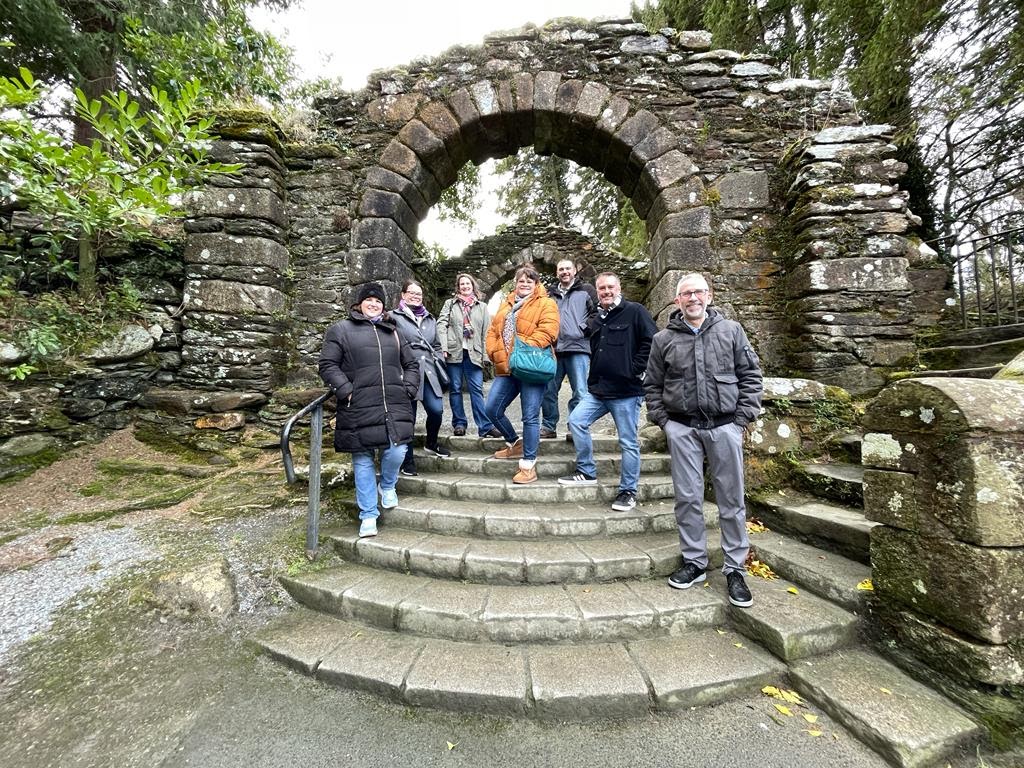
$100K student scholarship pool available for 2022 summer courses in Ireland Six professors from Georgia Southern University’s College of Education (COE) recently broadened their horizons during a trip to Ireland as they learned from and shared insight with instructors and educational leaders in the Wexford County community. Led by Howard Keeley, Ph.D., director of the University’s Center for Irish Research and Teaching, COE faculty traveled to Georgia Southern’s learning center in Wexford, Ireland, to observe Irish educational settings and exchange ideas with local leaders just ahead of a summer study abroad program opportunity for Georgia Southern students in which $100,000 of scholarship funding is available. “The main thing we did was get in front of leaders in the education space in Ireland,” stated Keeley. “We spoke to a number of folks who are either principals or vice principals or, in some way, senior administrators in a variety of schools including all-boys, all-girls, religious, secular and mixed schools.” The group included Catherine Howerter, Ph.D., associate professor of elementary and special education; Kip Sorgen, Ph.D., assistant professor of leadership, technology and human development; Alex Reyes, Ph.D., assistant professor of middle grades and secondary education; Amanda Wall, Ph.D., associate professor of middle grades and secondary education; Betsy Barrow, Ed.D., assistant professor of middle grades and secondary education; and Dan Calhoun, Ph.D., professor of leadership, technology and human development. Reyes, who trains pre-service and in-service teachers to work with culturally and linguistically diverse students, was excited to travel to Wexford after a study abroad program in Czech Republic she spearheaded with Wall was canceled in March 2020 due to the pandemic. Intrigued by Ireland, a plurilingual country, she was curious to see how Wexford’s environment might benefit students culturally. “I thought it was really exciting,” said Reyes. “All of the street signs are in Irish, even though English is the main language spoken. That prioritizing of that cultural heritage is fascinating. It was great to learn that the students in their primary and secondary schools take Irish language and culture as a subject every year.” She was especially motivated by a field trip to an Irish-language school, Meanscoil Gharman, which serves middle and high school students. With the exception of one daily class in English, teachers and students conducted all lessons in Irish. “It was really interesting to see that perspective,” she said. “There has been a revitalization of that culture. I thought that was fascinating to see how that can be handled in school.” In addition, Reyes was duly impressed with the country’s prioritization of social and emotional literacy for children, and the mandated well-being hours that are incorporated into daily school routines as a result of the pandemic. A program that promotes hygiene and an anti-bullying campaign also fit into the wellness curriculum. “It really impressed me that as a nation they prioritize the wellness of students, and how language and cultures can really be supported in a meaningful way,” Reyes said. “It’s affirming to see a proactive approach that has positive outcomes. Now, thinking ahead, we can look at how we can create opportunities for our students to experience this kind of approach.” Sorgen, who teaches in the educational leadership program at Georgia Southern, was interested in Ireland’s professional preparation. “None of them had advanced degrees, like what we offer at Georgia Southern,” noted Sorgen. “Learning about how to be a principal in Ireland is on-the-job training. In Georgia, there are specific educational requirements for our school administrators guided by professional standards. In Ireland, they generally ascend through the ranks, which makes professional mentoring essential to their success. We are exploring ways our educational leadership students could learn from Irish administrators about their experience, specifically with mentoring.” He also foresees the international partnership as a two-way exchange. “Given educational leadership programs are not common in Ireland, our faculty are considering ways in which we could use our expertise to foster leadership development of principals and teachers in Wexford,” said Sorgen. “We would utilize the Georgia Southern Wexford campus to host some of these sessions, furthering Georgia Southern’s relationship within the Wexford community.” Keeley also arranged meetings with education policy makers, including an extended meeting with an Irish congressman who is a representative for the County of Wexford in the Irish national parliament and chairs the joint committee for the Irish equivalent of the House and Senate Committee on education and higher education. “That was a tremendous opportunity for our faculty to talk to somebody at the highest level of government in Ireland, creating Irish state policy on education,” said Keeley. “And I know from the feedback we got from our College of Education colleagues that particularly for those in higher education, that to them was a really useful, next-step experience.” The trip exceeded expectations. “It was a fantastic learning experience for everyone,” said Keeley. “We had lots of high-level and also very practical experiences, and I could see our College of Education team thinking, ‘How can I bring what I’m learning, what I’m experiencing in this moment, into my classroom, into my curriculum, into my prospective study abroad courses in a way to build student success for our Georgia Southern folks.’ I think it was a great visit.” Complementing the faculty’s trip, a COE Irish study abroad program on diverse education in Ireland was recently approved for Summer 2022 and will give education students the opportunity to take one or two courses with the study abroad component. This will be a part of a broader study abroad program in Wexford, presented by the Honors College and the Center for Irish Research and Teaching, with assistance from the Office of the Provost and the Office of Global Engagement. The costs for undergraduate students at Georgia Southern’s Wexford campus will be offset by a $100,000 scholarship fund with awards of $1,000 for each student accepted into the program. “For students traveling to Wexford, Ireland, this summer, we will be able to defray the cost of the program through a generous travel scholarship through the Georgia Southern University Foundation,” said Dustin Anderson, Ph.D., associate provost for Student Success. “The donation makes these the most affordable multi-week programs that we ever have been able to offer.” Keeley is thrilled the gifts from generous donors will enable a number of students to earn valuable global experiences. “For students to have an opportunity to have international lives is powerful, and it’s powerful in ways that sometimes we can’t even predict,” he said. “Just the very fact of being abroad is going to change any of us, right? It can have a really transformative effect to feel a sense that, you know, as a student, ‘I can do this,’ and then a sense after the fact, ‘I did this,’ and just that in itself is educational. Giving students a safe space in Wexford, Ireland, to grow and feel that they are in a sense global citizens and bring the best of America, bring the best of Georgia, bring the best of the states from Savannah to Ireland, and learn to be an ambassador. That’s wonderful.” In addition to the education courses, students will also be able to choose from a Wexford-Savannah honors inquiry and an interdisciplinary program open to all students on human migration with courses in geography, religious studies, public health and a CORE study abroad course. Students interested can learn more about the program by clicking here and can email Kristin Karam in the Office of Global Engagement for more information about the scholarships. Georgia Southern University-Wexford is a global hub for learning housed in a historic building constructed in 1812. The space now features state-of-the-art classrooms and student apartments. Georgia Southern is the first public university in the United States to open an outreach learning facility in Ireland. If you're a reporter looking to know more about this initiative, then let our experts help. Howard Keeley, Ph.D., is the director of the Center for Irish Research and Teaching at Georgia Southern University. He is available - simply click on his icon now to arrange an interview today.


Georgia Southern now one of nation’s Top Ten Military Friendly® Schools
Georgia Southern University has earned a 2022-2023 Top Ten Military Friendly® distinction by Viqtory. Georgia Southern ranked at number nine on the Top Ten list. Being named a Military Friendly School is nothing new for Georgia Southern University, having earned a gold-level distinction for the past 10 years. “We are extremely proud to be recognized as being among the 10 most military friendly universities in the country, especially after learning that more than 1,800 schools participated in the survey,” said Georgia Southern University President Kyle Marrero. “With our connections to Fort Stewart, and the fact that about 10% of our student body is military-connected, we have a responsibility to ensure our people and our processes are attuned to the needs of those who are serving selflessly, who are retired or who are related to a veteran or active-duty service member. My thanks to all our faculty and staff who have worked hard to earn this recognition.” Institutions earning the Military Friendly® School designation were evaluated using both public data sources and responses from a proprietary survey. More than 1,800 schools participated in the 2022-2023 survey with 665 earning special awards for going above the standard. Georgia Southern University has a strong and proud history of supporting veterans, current-serving military personnel and their families, and has accumulated many awards for its dedication to the military community. Information and resources are available on the Military and Veteran Services webpage. “We are honored to receive such a significant recognition as a Top Ten Military Friendly® institution,” said retired Col. George Fredrick, Ed.D., director of Military and Veteran Services. “Georgia Southern University maintains strong ties to the military forces in our region, specifically Fort Stewart, Hunter Army Airfield, the Marines, the Georgia National Guard, the Air Force, and the Coast Guard. We proudly serve our veterans and their families while on their academic journeys. We are indebted to our faculty, staff, students and communities for their continued support of our military-connected student population.” Methodology, criteria and weightings were determined by Viqtory with input from the Military Friendly® Advisory Council of independent leaders in the higher education and military recruitment community. Final ratings were determined by combining the institution’s survey scores with the assessment of the institution’s ability to meet thresholds for student retention, graduation, job placement, loan repayment, persistence (degree advancement or transfer) and loan default rates for all students and, specifically, for student veterans. “Military Friendly® is committed to transparency and providing consistent data-driven standards in the designation process,” said Kayla Lopez, national director of Military Partnerships, Military Friendly®. “Our standards provide a benchmark that promotes positive outcomes and support services that better the educational landscape and provide opportunity for the Military Community. This creates a competitive atmosphere that encourages colleges to evolve and invest in their programs consistently. Schools who achieve awards designation show true commitment in their efforts, going over and above that standard.” The 2022-2023 Military Friendly® Schools list will be published in the May and October issue of G.I. Jobs magazine and can be found at www.militaryfriendly.com. Retired Col. George Fredrick is available to answer your questions - simply reach out to Georgia Southern Director of Communications Jennifer Wise at jwise@georgiasouthern.edu to arrange an interview today.

Podcast: Women in business - why it’s a strength, not a weakness
Self-confidence is the key when it comes to overcoming barriers in the male-dominated boardroom Unlock the value of mentoring and the ‘coaching culture’ to get the best out of yourself and your business Successful female business leader launched company while doing an MBA at Aston University and caring for her baby. Budding female entrepreneurs should ignore the “voice on the shoulder” undermining their confidence and fulfil their dream of starting their own business. That is the advice given by a professor at Aston University and a successful female business leader in a podcast created to mark International Women’s Day on 8 March. Helen Higson, professor of higher education learning and management at Aston Business School, spoke about the challenges facing women in the latest episode of the ‘Aston means business' podcast series, presented by journalist Steve Dyson. Daniella Genas, who launched her consultancy company She’s The Boss International while studying for her MBA at Aston Business School, was also interviewed on the podcast. Professor Higson, who was awarded an OBE in 2011 for services to higher education, said she had three main tips for women seeking to start their own businesses. She said: “Be yourself, be authentic, don’t try to mimic anyone else, and don’t let that voice on the shoulder chipping away at your confidence win out. “Where this lack of confidence comes from, I do not know, but self-doubt can really get in the way, so have a conversation with your lack of self-confidence by saying ‘shut up you, I will show you’.” The second piece of advice was to “challenge yourself kindly, be very kind to yourself, and don’t beat yourself up”, while the third was to grasp the “power of mentoring and coaching”, with Professor Higson herself having trained as an executive coach during lockdown. She added: “Coaching culture is fashionable now but it’s actually only trying to help people to take responsibility for maximising their own performance.” Daniella Genas, who also completed the Goldman Sachs 10,000 Small Businesses programme at Aston Business School, has similar advice for women looking to emulate her success. She explained that the first issue was for women to “see your difference as a strength, not as a weakness”. She said: “If more women embraced their femininity, their knowledge and competence, and stop allowing the fact that they are women to make them second guess themselves, we’d be able to get so much further.” Ms Genas said women entrepreneurs should also focus on key systems when building businesses so they are not heavily reliant on the owner. She said: “If you do need to step away to have a child, you are [then] not put in a position where you have to sell your business”. That is particularly relevant to Ms Genas as she was forced to sell her first business, Aspire For You, which she set up in 2006, after becoming pregnant with her first child. However, that decision led her to study rather than go on maternity leave, starting with the Goldman Sachs 10,000 Small Businesses programme and then the MBA at Aston Business School, while caring for her baby. Goldman Sachs 10,000 Small Businesses programme, she recalled, “really changed my mindset”. She said: “I found there were businesses double, triple, quadruple the size that I had that were facing the exact same challenges and problems.” Daniella, who obtained a distinction with her MBA, said completing the programmes gave her the confidence to say ‘I am as good as anybody else and probably better in many areas’. She added: “The idea that I may be seen as less than because I am a woman kind of left my brain.” Her company, which helps female-run businesses grow but in a sustainable way, recently became She’s The Boss International after taking on clients in the US and St Maarten. It is a far cry, she says, from being told by teachers at her comprehensive school that she should set her sights a bit lower, even asking her ‘have you considered being a cleaner?’. Professor Higson said Daniella’s story demonstrated the value of education and energy. “You shouldn’t see anything as a barrier,” she said. “I am quite small, 5ft 2in, and one woman leader said to me: ‘You’re going to find it very difficult to be a female leader because you are so small.’ I replied ‘I may be small but I make up for it with my energy.’ It’s about your impact rather than what you look like.” Episode 7 in series 4 of ‘Aston Means Business’ podcast can be found HERE.

Kelley professor’s M-Score model remains most viable means of predicting corporate fraud
BLOOMINGTON, Ind. — Enhanced oversight over the auditing profession and firms’ financial reporting has led to a proliferation of models to predict financial statement fraud. But one of the first forensic models, the M-Score, devised by an Indiana University Kelley School of Business professor in the late 90s, remains accurate and is the most economically viable for investors to use, according to a forthcoming paper in The Accounting Review — the official journal of the American Accounting Association. The article, “The Costs of Fraud Prediction Errors,” co-authored by M. Daniel Beneish, professor of accounting and the Alva L. Prickett Chair at Kelley, compares seven fraud prediction models with a cost-based measure that nets the benefits of correctly anticipating instances of fraud against the costs borne by incorrectly identifying non-fraud firms as fraudulent. Even though newer fraud models early doubled the success rate of M-Score, which Beneish developed, they did so at the cost of a much larger number of false positives. As a result, the other models are not used in practice by auditors because they are too costly to implement as all flagged firms must be carefully investigated. “I have long known from my experience consulting with Arthur Andersen — for whom my model detected Enron before the debacle — and other public accounting firms, that litigation concerns relating to false positives — firms incorrectly flagged as having fraudulent financial statements — created an unwillingness by auditors’ general counsel to use fraud prediction models in practice,” Beneish said. “My efforts back then to improve the M-Score in the context of auditing failed because I could not increase the model’s success rate without increasing the number of false positives. It seems that the new models cannot either,” he added. Interestingly, as early as 2017 the M-Score flagged Kangmei Pharmaceutical, a Chinese publicly traded company that was involved in financial reporting fraud between 2016 and 2018. Like the Enron scandal in the U.S., the Kangmei Pharmaceutical scandal helped trigger new regulation in China that increased regulatory penalties for financial fraud (effective March 2020) and last November became China’s first successful class-action lawsuit involving corporate fraud. Its chairman was sentenced to 12 years in prison. “The main purpose of our paper is to provide evidence on the costs and benefits of using fraud prediction models, and to show whether using these models is economically viable for auditors, investors and regulators,” Beneish said. “This is important because the traditional measures commonly used in recent research to justify new models are misleading about model performance in fraud samples as the proportion of fraud firms in the population is very small, and as they typically assume that the cost of a false positive and false negatives (missed detections) are equal.” For example, assume that among 10,000 publicly traded firms, there are about 60 fraud firms and 9,940 firms without misreporting. The newer models detected 42 frauds (70% of the total frauds), and incorrectly flagged 3,976 firms (40% of the non-frauds). The latter is too large a number for most decision makers to investigate. “Our evidence that a cost-based assessment of models is preferable to traditional model comparison measures (e.g., area under the curve), should become even more important as efforts by future researchers in the areas of data mining and machine learning intensify,” Beneish said. Patrick Vorst of Maastricht University, assistant professor in financial accounting and accounting & information management, co-authored the paper with Beneish.


Widening participation expert joins Aston University as visiting professor
Liz Thomas is a leading researcher in widening participation and closing the achievement gap She has a very strong international and national reputation for using her research to inform policy and practice Professor Thomas will work within the University’s College of Business and Social Sciences. A leading researcher whose work addresses patterns of under-representation in higher education has joined Aston University as a visiting professor. Liz Thomas is an expert in widening participation and closing the achievement gap. She has joined the University’s College of Business and Social Sciences to work largely with Aston Business School on inclusivity and employability. Professor Thomas has previously worked on the Teaching Excellence Framework Main Panel (Widening Participation Expert), been Chair of Advisory Group, Evaluation of pre-16 outreach work, Office for Fair Access (now Office for Students) as well as an International member of the Vice Chancellor’s Quality Review, University of South Wales, Australia. During the next Research Excellence Framework (REF) period her research will focus on higher education student and graduate experiences in the ‘new new normal’. The COVID-19 pandemic resulted in an emergency pivot by higher education providers worldwide, from predominantly present-in-person teaching, to primarily or exclusively remote and online learning. As the pandemic has progressed, HE providers have adapted to the new normal, providing a range of hybrid learning, engagement and support opportunities. Employers are also seeing the advantages of more flexible and hybrid ways of working, and this suggests that graduates will need demonstrate additional skills and competencies in relation to autonomy and time management, team working, digital skills and effective communication through a wider range of media. Professor Liz Thomas said: “I am very excited to have been appointed visiting professor in the College of Business and Social Sciences at Aston University. “I'm very much looking forward to working with colleagues on equity in higher education and employment. “Belonging will continue to be an important theme within my research, both conceptually and practically, and within higher education and employment, in the post-pandemic world. We need to capitalise on the advantages that have emerged, and ensure inclusion, and equitable outcomes for all.” Professor Helen E Higson, associate dean accreditations at Aston Business School, said: “I am looking forward to welcoming Liz to Aston Business School to share her knowledge on inclusivity and employability. “She will bring further leadership internally in areas which fit very well with Aston University’s values, student demographics and objectives. “She has a very strong international and national reputation for using her research-informing policy. Much current practice and policy in HE in the UK is influenced by her work.”

Podcast: Academics behind new course say ‘team leaders are the future’
Inspirational Team Coaching course aims to develop leaders for the 21st century New course needed because occasional team-building activities and ‘away days’ are not enough for the needs of today Inspirational Team Coaching will be split into three modules with launch due this autumn. Top business academics at Aston University are devising a new team coaching course with the aim of ‘upskilling’ the entrepreneurs of tomorrow. The Inspirational Team Coaching course, to be launched this autumn, will lead to a Postgraduate Certificate from the Centre for Innovation in Enterprise Education at Aston Business School. It has been developed by senior lecturer Dr Uwe Napiersky and senior teaching fellow Dr Elinor Vettraino, who discussed their plans in the latest episode in the ‘Aston means business' podcast series, presented by journalist Steve Dyson. Dr Napiersky, who spent more than 20 years in international consultancy, explained that his motto for team coaching was “team excellence doesn’t come by itself”. He said: “Focused team coaching makes the difference between muddling through or performing as one – the team as a whole is the key, not the different egos. We all know the old ‘sum of the parts’ sentence which is more important than ever.” Dr Napiersky said the new course helped their learners in areas such as collective team objectives and processes, and improved team dynamics. He said coaching was a “billion-dollar” industry and team coaching was one of the “newest kids in town. He added: “One of my slogans is ‘innovation is a team effort’. Many leaders still believe in this model of the 20th century, but it’s more about the 21st century, leadership more in a team direction.” His colleague Dr Vettraino, who incorporates team coaching into her consultancy work, said: “Organisations make an assumption that people know how to work together in teams and actually that’s often not the case.” She said that while employers tend to have team building activities, “they don’t address the day-to-day challenges and benefits of working in teams the way a coaching process can.” Dr Vettraino explained that team coaching can lead to increased motivation for staff, enabling innovation and creativity to grow, along with collaboration – which she said was “a key to surviving in industry nowadays”. She added: “Being supported by a team coach adds tremendous benefit to an organisation.” The course, to be delivered by experienced coaches and team leaders, is divided into three modules, with the first on ‘foundational knowledge and essentials’. Dr Napiersky said: “We go into team learning, we go into the area of innovating teams, and we will definitely look into real world team challenges our students will have.” The second module is focused on ‘Tasks and Mindset’. Dr Vettraino said its purpose was to take some of the foundational knowledge and put it into practice, by “looking at developing participants’ innovation, creativity, problem-solving and risk-taking capacity and mindset”. She added: “It’s going to enable the participants to really dig into the playfulness and creativity of their own coaching practice that will enable them to find new and different ways of working with teams.” The third and final module looks at developing ‘Professional Practice’. “It’s really in the third unit that participants start their own swimming and with their own swimming style,” explained Dr Napiersky. The understanding goes from unprepared to clear for themselves, from singular to systemic, from messy to focused or muddling through to structured.” Dr Vettraino chipped in: “There’s a lot of opportunity here to develop really rich projects in relation to their coaching practice. What we want them to do is hone their skills and capacity for inspirational team coaching with real clients they are working with so they can develop a very rich understanding of putting the first year module’s learning into practice.” To prepare students for the real world, Dr Napiersky said: “There’s a lot for internal coaches to do – getting teams clearer, getting them working, and helping them to build up more capacity, and applying the skills they will learn on this course.” Dr Vettraino said: “This skill base will enable people who are currently practising, perhaps as consultant coaches of their own practice, to develop something that adds to their toolkit. They can take it into their own practice and potentially even coaching other organisations.” To find out more about the programme email e.vettraino@aston.ac.uk or u.napiersky@aston.ac.uk. ▪ Episode 5 in series 4 of ‘Aston means business’ podcast can be found HERE.