
Experts Matter. Find Yours.
Connect for media, speaking, professional opportunities & more.
UConn Expert, 10 Years after Sandy Hook, on the Lies that 'Plague the U.S.'
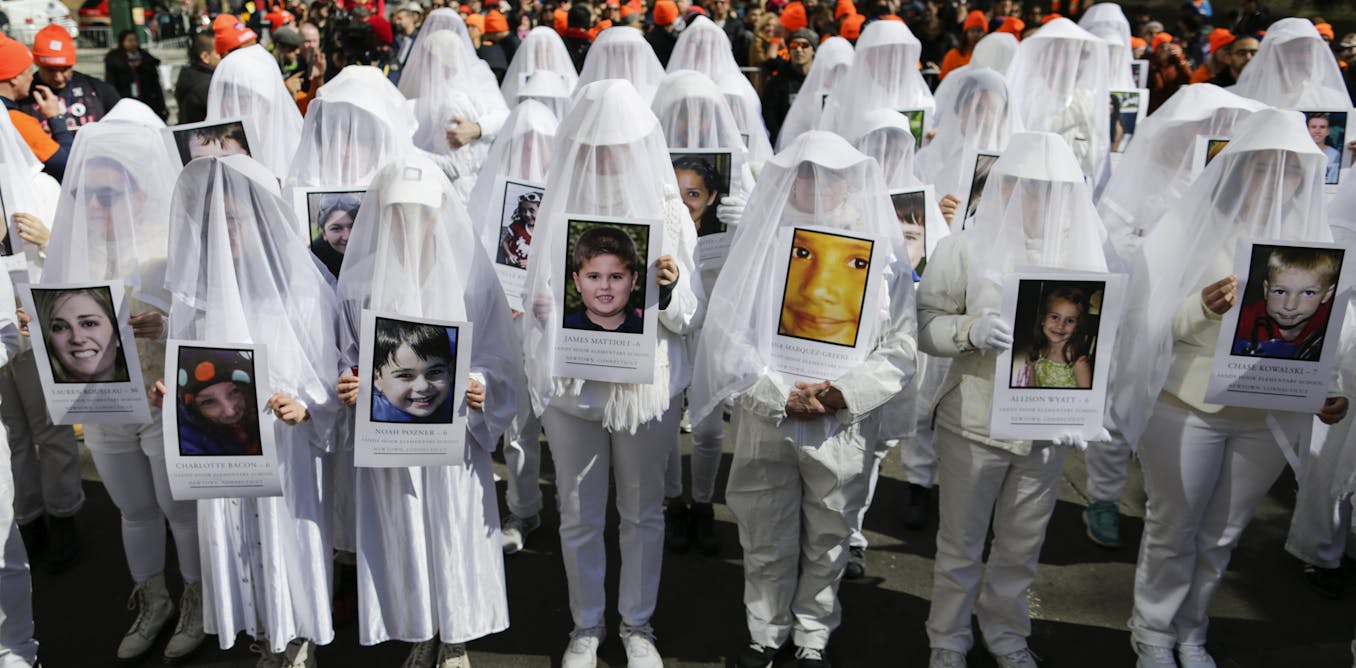
UConn professor and journalist Amanda J. Crawford considers the misinformation that spread like wildfire after tragic school shooting at Sandy Hook Elementary School to be "the first major conspiracy theory of the modern social media age." Ten years after 26 young students and school staff were killed in the massacre, the impact of that day in 2012 continues to reverberate in America today. On this solemn anniversary, Crawford writes about the aftermath of Sandy Hook misinformation in a new essay for The Conversation: Conspiracy theories are powerful forces in the U.S. They have damaged public health amid a global pandemic, shaken faith in the democratic process and helped spark a violent assault on the U.S. Capitol in January 2021. These conspiracy theories are part of a dangerous misinformation crisis that has been building for years in the U.S. While American politics has long had a paranoid streak, and belief in conspiracy theories is nothing new, outlandish conspiracy theories born on social media now regularly achieve mainstream acceptance and are echoed by people in power. Recently, one of the most popular American conspiracy theorists faced consequences in court for his part in spreading viral lies. Right-wing radio host Alex Jones and his company, Infowars, were ordered by juries in Connecticut and Texas to pay nearly $1.5 billion in damages to relatives of victims killed in a mass shooting at Sandy Hook Elementary School a decade ago. Jones had falsely claimed that the shooting was a hoax. As a journalism professor at the University of Connecticut, I have studied the misinformation that surrounded the mass shooting in Newtown, Connecticut, on Dec. 14, 2012 – including Jones’ role in spreading it to his audience of millions. I consider it the first major conspiracy theory of the modern social media age, and I believe we can trace our current predicament to the tragedy’s aftermath. Ten years ago, the Sandy Hook shooting demonstrated how fringe ideas could quickly become mainstream on social media and win support from various establishment figures – even when the conspiracy theory targeted grieving families of young students and school staff killed during the massacre. Those who claimed the tragedy was a hoax showed up in Newtown and harassed people connected to the shooting. This provided an early example of how misinformation spread on social media could cause real-world harm. Amanda J. Crawford is a veteran political reporter, literary journalist, and expert in journalism ethics, misinformation, conspiracy theories, and the First Amendment. Click on her icon now to arrange an interview with her today.


Podcast: UK’s first non-white prime minister is ‘big moment’ – but can Rishi Sunak survive?
Academic focuses on importance of UK having its first prime minister of Indian descent Rishi Sunak’s personal family history could be seen as a testament to the ‘British dream’, as he is also ‘richest man’ ever to sit in the House of Commons But his ability at restoring economic stability and tackling cost-of-living crisis will decide his fate at the polls Having the first non-white leader of the UK is undoubtedly a “big moment” in the history of British politics, according to an academic at Aston University. But, although he may be able to count on the British Asian vote at the next general election, Rishi Sunak faces a major challenge to remain in No 10 due, in part, to the growing number of Conservative MPs intending to stand down. Mr Sunak’s rise to become Britain’s first Asian and first Hindu leader has been discussed by Dr Parveen Akhtar, a senior lecturer and deputy head of politics, history and international relations at Aston University. Dr Akhtar, who has studied across Europe and authored a book on British Muslim politics, was speaking as part of the latest episode in the 'Society matters' podcast series, presented by journalist Steve Dyson. She said Rishi Sunak benefitted from a “privileged upbringing”, but also married into wealth in the form of the daughter of Indian billionaire N R Narayana Murthy, co-founder of information technology company Infosys. With the couple having a combined wealth of £730 million, Parveen said Rishi Sunak can “allegedly lay claim to another title – the richest man to ever sit in the House of Commons”. A “scandal” over his wife’s non-domiciled tax status had even threatened to end Sunak’s career less than a year ago. But she added: “Whatever the mixed feelings are around his personal fortune, this is nevertheless a big moment. Becoming the first non-white leader of the UK is important. It’s important for the country and it’s important for the UK’s ethic minority communities too.” Dr Akhtar, who is currently writing a new book on the politics of Pakistan and Pakistanis abroad, said Rishi Sunak’s paternal grandparents were from Gujranwala, which is in present-day Pakistan. Sunak, himself, was born in Southampton, but his father Yashvir, a family doctor, and mother, Usha, a pharmacist who studied at Aston University, were born and brought up in present-day Kenya and Tanzania respectively.However, they joined an exodus of Asians from East Africa in the second half of the last century, fuelled by Idi Amin’s wholesale expulsion of Asians from Uganda in 1972. Sunak’s “cultural affinity” lies with his Indian roots, Dr Akhtar said, including being a practising Hindu, and he himself had said that ‘British Indian’ is what he ticks on the census. She added: “The Sunaks’ personal family history could be read as a testament to the British dream: the idea that the UK is a land of opportunity where, no matter who you are, if you work hard, you can make it right to the top. The formula for success is simple: head down, hard work perseverance.” While Sunak was privately educated at Winchester, and went on to study at both Oxford University in England and Stanford University in the US, he has spoken about various jobs, including being a waiter in an Indian restaurant. Dr Akhtar said that, in some ways, the Conservative Party has a “lot to be proud of” when it comes to promoting ethnic minority colleagues, as reflected by three key posts in Liz Truss’s short-lived administration, and Suella Braverman as the current Home Secretary. Sunak’s own heritage could prove to be an asset in strengthening ties and negotiating trade deals with other countries, with India’s Prime Minister referring to him as the ‘living bridge’ of UK Indians, and US President Joe Biden describing his success as a ‘ground-breaking milestone’. But can an unelected Sunak win the next election amidst soaring inflation and the cost-of-living crisis? Dr Akhtar replied: “These are challenging times to be at the helm of the ship, a ship which many in his party appear to be jumping off, given the number of Conservative MPs who have announced their intention not to stand at the next general election. “If, in the coming months, people feel further fiscal pain, if there are prolonged strikes by teachers and nurses, firefighters and railway workers, if the NHS is overwhelmed this winter, then no matter how slick Sunak’s PR messaging, he will not be elected come election time.”


New research highlights the economic importance of live music to Birmingham and the West Midlands
It found local authorities need to more explicitly recognise the economic, social and cultural value of live music and live music venues The report calls for dialogue between music stakeholders and government The research is published by Aston University and supported by the AHRC-funded Creative Industries Policy and Evidence Centre. New research by the Birmingham Live Music Project (BLMP) highlights the huge economic value of Birmingham’s live music scene, the vital contribution small independent venues make, the ongoing impact of the pandemic and what is needed to support the recovery of the sector in the city. The research is published by Aston University, with colleagues from Newcastle University and Birmingham City University, and supported by the Arts and Humanities Research Council (AHRC)-funded Creative Industries Policy and Evidence Centre. In 2019, the UK’s live music sector was valued at over £1.3 billion. After almost a decade of strong growth the sector helped push the UK music’s overall GVA from £3.5 billion in 2012 to £5.8 billion in 2019, the outbreak of the global pandemic brought it to a near standstill. This paper explores, through a local lens and a focus on Birmingham, the challenges stakeholders across the live music sector have faced in recent years. The research finds that small live music venues are the lifeblood of this financial, cultural and community asset for the city. In 2019 Birmingham helped bring 877,000 music tourists to the West Midlands, with a total cultural spend in the region of £252,000,000 (UK Music). But during summer 2020, the research published today found, Birmingham’s live music capacity of approx. 98,000 dropped by around 75%. This impacted ticket prices, the availability of events across the city, and the economic viability of shows – while some venues could stay open, they couldn’t make a profit. The report makes clear independent venues need protection and support particularly in the wake of the pandemic. It calls for dialogue between music stakeholders and government in advance of the 2025 review of the EU-UK Trade and Co-Operation Agreement to identify the best means of reducing friction and support for the efforts to improve the Agreement, for example work on border force training, expanding the number of checkpoints where carnets and Music Instrument Certificates can be checked, reducing bureaucracy for live event transport and haulage, examination of further measures to develop the ’dual registration’ system for specialist hauliers to ease pressure on touring. Dr Patrycja Rozbicka, a senior lecturer in politics and international relations at Aston University and one of the report authors, said: “Local authorities need to more explicitly recognise the economic, social and cultural value of live music and live music venues, including grassroots venues, to their region(s). “Environmental, health, culture and city regeneration strategies have to take account of the existing and huge potential contribution of live music to the city and region. “What is needed is a cross-policy approach, implementation of a Night-time Industry Impact Assessment and dialogue between local authorities and the music sector, where the recently launched West Midlands Music Board could play a role. “We would like to see the creation of information hubs to support local venues and audiences with initiatives such those undertaken by the Liverpool City Region including a Music Fund which supports activities of the Liverpool City Region Music Board as well as helping with funding applications and advice. You can read the full report here.


Advantage Ukraine? A surprising surge has Russia in retreat
The war in Ukraine has taken a surprising turn. A hard surge in the northeast of the country has seen Ukraine soldiers reclaiming lost ground and in some cases, even pushing Russian troops back to the border. It's a David and Goliath scenario, and at the moment, Ukraine finally seems to have the upper hand over the larger and more equipped Russian forces that have been clawing away at the country since February. There's been an enormous amount of media attention and reporters are looking to experts for perspective, opinion and explanation. “It seems to be a complete failure of logistics and strategy tactics on the Russian side," said Dr. Craig Albert, director of the Master of Arts in Intelligence and Security Studies at Augusta University. "Everything is just falling apart; their lines are collapsing. Troops are running and leaving behind all their ammunition, leaving vehicles, leaving weapons. That’s just astonishing to me that it is such a disorganized kind of retreat. Russia can use all their propaganda and say they are retrenching elsewhere and trying to solidify their forces further east and further south, but it’s a disorganized retreat and they’re losing lots of numbers but leaving all their equipment to the Ukrainians." Albert can explain what could happen next in Ukraine, as there are several possible scenarios and outcomes in the long and short term of this war. And if you’re a journalist looking to know more about what lies ahead as the war between Ukraine and Russia continues and how it may impact the United States, then let us help with your questions and coverage. Albert is director of the Master of Arts in Intelligence and Security Studies at Augusta University. He is a leading expert on war, terrorism and American politics. This is an important national and international issue. Albert is available to speak with media – simply click on his name to arrange an interview today.


What's next in Georgia's 2020 election saga?
All eyes are on Georgia once again, but this time it's not about an upcoming election. As we sort through the 2020 election aftermath that saw Georgia in a tug-of-war between lawyers, politicians and pundits, the actions a few important figures may now be coming to light. Rudy Giuliani, the former advisor to President Trump, may be in some serious trouble according to Augusta's leading political expert, Dr. Gregg Murray. "When politicians are involved, there are almost always political calculations," Murray said. "But there’s a lot of information suggesting there may be problematic behavior that he was heavily involved with. There are reports of investigations involving several possible Georgia law violations: solicitation of election fraud, making false statements to local officials, conspiracy, racketeering, violations of oath of office and involvement in violence or threats of violence, according to Voice of America." As for Sen. Lindsey Graham, he, too, has been summoned to appear and explain how he may or may not have attempted to influence the election outcome. A federal judge on Monday turned down Sen. Lindsey Graham’s bid to throw out a subpoena compelling him to testify before the Atlanta-area grand jury investigating Donald Trump’s effort to overturn the 2020 election. “[T]he Court finds that the District Attorney has shown extraordinary circumstances and a special need for Senator Graham’s testimony on issues relating to alleged attempts to influence or disrupt the lawful administration of Georgia’s 2022 elections,” U.S. District Court Judge Leigh Martin May wrote in a 22-page opinion rejecting Graham’s effort and sending the matter back to state courts for further proceedings. Politico, Aug. 15 According to Murray, defying the judge's request might be the likely choice for the senator. "It seems the Republican party is still clearly tied to Trump," Murray adds. "I don’t think he would be hurt politically by not showing up. It’s an interesting question if some people would hold it against him for showing up." This legal wrangling will be long and drawn out, so if you are covering this topic, let our expert help with your story. Dr. Gregg Murray is available to talk about the election audit and what it might mean for voters in Georgia and across the country. Murray’s research focuses on political behavior and psychology with specific interests in voter mobilization and turnout. He is also executive director of the Association for Politics and the Life Sciences. Simply click on Murray's icon to arrange an interview today.


Is Chechnya next as the war in Ukraine shows no signs of stopping?
A long history of conflict in regions such as Eastern Europe, the Balkans and Russia shows these conflicts often grow and eventually draw in other armies or countries. With all eyes on the ongoing war between Russia and Ukraine, there are serious concerns that the powder keg could soon blow. Augusta University's Dr. Craig Albert shares his expertise on war, terrorism and what could be next for the region. As this war between Ukraine and Russia goes on, how does Chechnya come into play? "Chechnya has units fighting on both sides of the conflict. There is a large contingent of independence fighters, rebels and militants fighting for Ukraine, as they have historical grievances with Putin and Russia dating to the Russo-Chechen wars beginning in the early '90s. The official stance of Chechnya, however, under the dictatorship of Kadyrov, is pro-Putin, and has sent upwards of 10,000 troops to fight against Ukraine. Thus, we have the potential of an ethnic civil war breaking out within Chechnya, as they dispute their differences on the battlefield." Do they look at this as an opportunity to break free from Russia? "There are many Chechens that may think this is the perfect strategic opportunity to break away from Russia and claim independence. Others within Chechnya see this as a perfect opportunity to carry out the deeds of the Islamic Caucasus Emirate, officially a part of ISIS, and claim more space for ISIS to operate. It should be noted, most of the civilians just want to live in peace and have economic opportunity as they are still recovering from decades of war in the '90s-2000s." What would that look like if they decided to go on attack? "Depending on which group initiates conflict, it would most likely look like some form of terrorism or insurgency operation. Small-scale and limited in scope. Political assassination could also come into play depending on the side of the people that seek violence." If you’re a journalist looking to know more about the war between Ukraine and Russia and how Chechnya may soon be a factor, then let us help with your questions and coverage. Dr. Craig Albert is director of the Master of Arts in Intelligence and Security Studies at Augusta University. He is a leading expert on war, terrorism and American politics. This is an important national and international issue. Albert is available to speak with media – simply click on his name to arrange an interview today.

The Pope, Papal Politics and Apologies: Our Experts Can Help
Last month, Pope Francis made an historic trip to Canada. It was the first time in 35 years that a Pontiff had visited an Indigenous community. It was also significant because it was deemed "a penitential pilgrimage" with the purpose of apologizing for the role of the Catholic Church in the abuse of Indigenous children in residential schools. The visit was covered extensively by media from across the globe, and each story came with questions regarding papal policy, religious context and historical interpretation. That's where experts like Massimo Faggioli, PhD, a Villanova University professor who studies the history and administrative inner workings of the Catholic Church, answered the call. As quoted in The Washington Post: "Massimo Faggioli, a professor of theology at Villanova University, said the pope 'smartly framed' the issue of the Church’s role in the residential school system 'inside a wider picture that he's been working on for many years now, which he calls 'ideological colonization'... 'He believes that, as Catholics, we're part of the historical problem, but we're also part of the solution...'" Reporting on the Vatican, papal politics and the Pope requires experts—and that's where Villanova can help. Dr. Faggioli, among other University professors, is currently available to speak with media regarding the Pontiff and the Catholic Church; simply click on his icon above to arrange an interview today.

Politics, policy and public safety: Experts explain why a popular Atlanta festival was canceled
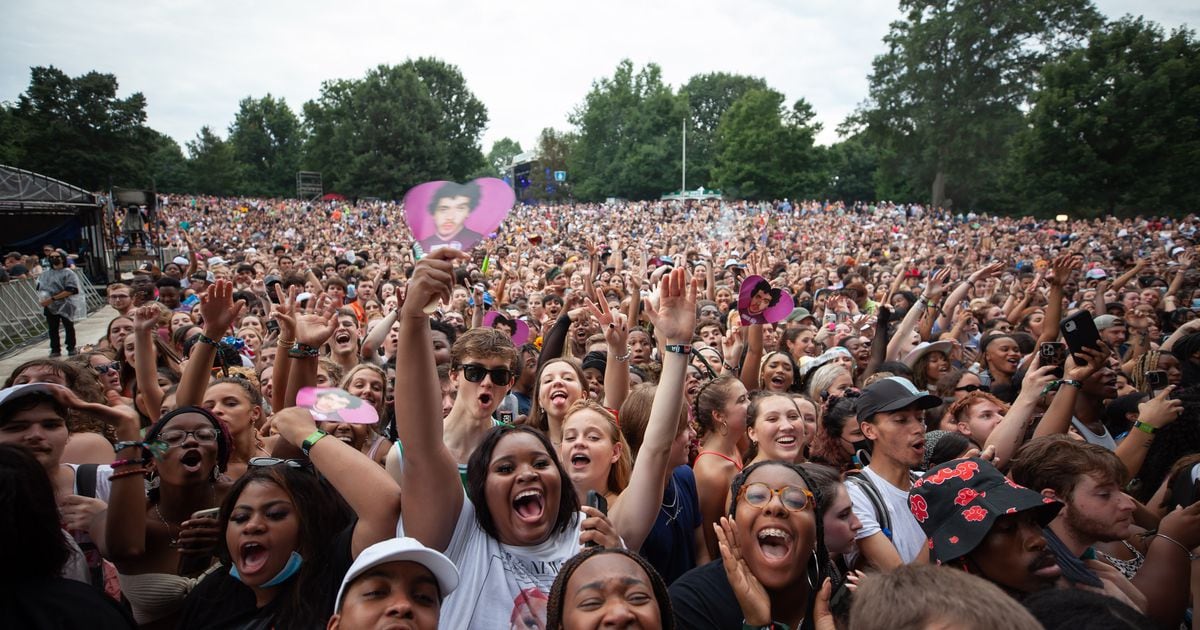
A sad tune is being hummed in Atlanta, where it was announced the popular annual Music Midtown festival is not happening, possibly in part due to the state’s laws surrounding guns in public parks. The event's cancellation, which brought tens of thousands of music lovers to the city -- along with the tourism dollars they spend -- has caused disappointment and drawn local and national media coverage. Calling it a “sad day” for the city, Atlanta City Council President Doug Shipman wrote on Twitter that: “Public policy has real impacts and, in this case, economic and social implications on a great tradition.” And state Democrats chastised Republicans for adopting a raft of pro-gun legislation, including a 2022 law that allows Georgians to carry concealed handguns without first getting a license from the state. The governor, who is seeking a second term, did not immediately comment on the festival’s decision. But state Rep. Rick Jasperse, a Jasper Republican who sponsored the 2014 law, said the measure is designed with public safety in mind. He said those intent on “causing chaos and crime in Georgia” won’t care if the festival bans firearms and would try to bring them in regardless. “Good Georgians who can qualify for a permit and carry a weapon do so to protect themselves from that element in our society,” he said. -- The Atlanta Journal Constitution, Aug. 1, 2022 Organizers of events like Music Midtown could look at Georgia’s gun laws and regulation of firearms as a potential legal liability. If there is a firearms incident, organizers may fear being held legally accountable and sued for any potential damages. The companies and their risk management advisors might think twice about holding large events in Georgia. Augusta University's Dr. William Hatcher, an expert when it comes to public administration and social, economic and political institutions in local communities, agrees that event organizers might be rethinking their plans in the state. "Yes. I think so. These types of laws have an impact on the economy and the business decisions of firms. We may see future effects on the economic behavior of individuals and firms." This topic could have further economic impact beyond canceled events, including affecting property values and home prices. If you're a journalist looking to know more, then let us help with your stories. Dr. William Hatcher is a professor of political science and chair of Augusta University’s Department of Social Sciences. He is an expert in the areas of public administration and social, economic and political institutions. Hatcher is available to speak with media regarding this topic. To arrange an interview today, simply click on his icon now.


The EU-UK Trade and Cooperation Agreement is costly, what does the UK need to do? | Aston Angle
As far as trade is concerned, the EU exit has been rather costly to the UK. At the Centre for Business Prosperity, we have been tracking the performance of UK trade in recent years. The UK’s trade dropped sharply during COVID. Like other nations, this was due to the global recession and supply chain disruptions. However, the UK failed to recover and enjoy the boom, despite the tariff-free terms of trade in goods set out in the EU-UK Trade and Cooperation Agreement (TCA). The UK now trades less with the EU, its largest trading partner, than in 2019. During the same period, Germany and the Netherlands grew trade with the EU by nearly a quarter, and US trade with the EU has also grown considerably. Reports suggest, including those from the British Chambers of Commerce, that exporting to the EU has become much more costly and in some cases, unviable. It appears that the “certainty” provided by the TCA has not reversed the declining trend of the UK-EU trade so far. Our new paper for the Enterprise Research Centre (ERC) has found that UK exports experienced a large, negative, statistically significant decline in 2021 at the end of the transition after the EU-UK Trade and Cooperation Agreement (TCA) was put into force. We estimate that this amounts to a 22% reduction in exports to the EU and a 26% reduction in imports from the EU over the first half of 2021, relative to the counterfactual scenario of the UK remaining in the EU. How did this happen? After all, the TCA ensures that goods moving between the UK and the EU have no tariffs or quotas, so long as the rules of origin are complied with. Rules of origin help you work out where your goods originate from and which goods are covered in trade agreements. Our research found that non-tariff measures (NTMs) were responsible for the adverse TCA effect on UK trade with the EU and that the magnitude of loss was significant. It was equivalent to a reduction of £12.4 billion in UK exports over the first six months period of 2021. This equals 16% of UK total exports in the first half of 2019 and 70% of the documented total reduction in the EU exports in the same period. A number of factors can be attributed to the decline of UK exports to the EU. In particular, the increased trade frictions that occurred mainly due to sanitary and phytosanitary (SPS) and technical barriers to trade (TBT) as a result of entering the TCA. Sanitary and Phytosanitary (SPS) measures refer to the EU controls to protect animal, plant or public health. And technical barriers to trade (TBT) refers to mandatory technical regulations and voluntary standards that define specific characteristics that a product should have, such as its size, shape, design, labelling/marking/packaging, functionality or performance. On average, for the first six months of 2021, a 1% increase in SPS resulted in a 13–15% reduction in exports to the EU, most notably in the food and drink, wood and chemicals sectors. Furthermore, a 1% increase in TBT led to a 2–3% reduction in exports, especially in metals, equipment, machines and miscellaneous industrial products. What next? Since the post-Brexit dysfunctions are now diagnosed, in theory we could move on. The UK can directly tackle the trade challenges, so long as other things, such as politics, do not stand in the way. Fundamentally, what needs to happen is the removal or relief of the root causes coded by the TCA – the trade barriers newly erected. This is a key task; it is challenging but not impossible. Trade frictions due to the SPS measures are an acute problem of Brexit. Reducing some of the non-tariff measures between the EU-UK would help by exploring other mechanisms such as equivalent SPS measures or other ways to reduce businesses burden to a minimum. The technical barriers to trade are more complicated and challenging and they could potentially cause significant damage to the UK economy. Despite its limitation, maintaining and broadening the established arrangements of the current TCA provision, through some form of mutual recognition of specific practices or international regulations for selected sectors, should be the ambition of UK government to help ease the TBT trade barriers. Future EU-UK co-operation is critical and mutually beneficial but requires political will and strong leadership. In the short and medium term, supporting firms should be the priority, especially small- and medium-sized firms that are productive enough to have exported to the EU in the past, but now face hurdles to continue exporting. These firms tend to be limited on resource but have the infrastructure and ambition to internationalise. Targeted support for specific challenges could be also fruitful. The UK Department for International Trade Export Support Service, the British Chambers of Commerce and local growth hubs have the expertise and experience to help firms export. Therefore, resources should be made available to allow for customised and responsive support with exports, as well as taking advantage of technologies that can identify and reach businesses who require support. Provision should also be made to collect feedback on the quality of the support provided, to enable further improvement. Helping businesses continue to access EU markets, while enabling the economy to take advantage of welfare-enhancing benefits from trade, remains imperative. Given the economic benefits of the roll-out, the new free trade agreements are expected to be limited and effective only in the long term. UK domestic policies should be the focus to improve the competitiveness of exporters and their ecosystem. By Professor Jun Du Director of the Centre for Business Prosperity Professor of Economics, Finance and Entrepreneurship, Aston Business School Lecturer in Politics and International Relations School of Social Science and Humanities Dr Oleksandr Shepotylo Senior Lecturer, Economics, Finance and Entrepreneurship, Aston Business School


'I knew the men murdered in the Amazon—and their alleged killer'
On June 5, 2022, Indigenous expert Bruno Pereira of Brazil and freelance reporter Dom Phillips of Britain went missing while working in a remote part of the Amazon. Since then, a suspect in the case has confessed to their murders. But the story hasn't ended there. As journalists and experts take a closer look, the plot behind the story has thickened with politics, Indigenous rights, and organized crime. Scott Wallace, an associate professor of journalism at the University of Connecticut and author of The Unconquered: In Search of the Amazon’s Last Uncontacted Tribes, has worked extensively in Brazil's Javari Valley. He shared his perspective -- as someone who knew the victims as well as the alleged perpetrator, with National Geographic: The increasingly brazen intruders are no longer small-time players with a net or rifle seeking to put a meal on the family table. Members of the Indigenous patrols say that more and more, poaching crews appear to be highly-capitalized ventures, backed by a shadowy network of outside investors with suspected links to the illicit drug trade. Their fishing boats feature high-horsepower motors, and they carry large quantities of fuel, expensive gill nets, ice, and hundreds of kilos of salt to preserve bushmeat and critically endangered pirarucu, one of the world’s largest freshwater fish. In a rare police action, officers in March intercepted fishermen leaving the reserve with two dozen endangered river turtles, 650 pounds of salted bushmeat, and nearly 900 pounds of salted pirarucu. The evident outlays of cash create both the ability and the imperative for fishermen such as Oliveira to head deeper into the Javari territory, stay there longer, and return with hefty payloads to settle their debts. Unconfirmed reports indicate that Oliveira may have owed a Peruvian financier nicknamed “Colombia” more than $15,000 because a load of his contraband had been intercepted by the Indigenous patrols. As intruders penetrate into the depths of the Javari, Indigenous leaders and their allies fear the growing likelihood of a conflagration involving the uncontacted nomads roaming the forest. “They’re definitely putting the isolados—the isolated ones—at risk,” says Orlando Possuelo, Sydney’s son, who is based in Atalia do Norte and has been working alongside Pereira in advising the Indigenous patrols for the past two years. Poachers are pillaging the animals the isolated groups depend on for survival. And uncontacted groups remain highly vulnerable to contagious diseases, for which they have little to no immunological defense. Finally, and perhaps most immediately, there’s the very real danger of violence. “These fishermen don’t hesitate to shoot,” Orlando says. “If they’re willing to kill outside the reserve, there’s no doubt the lives of the isolated ones are in danger.” An uncontacted Indigenous group would have no way to peacefully communicate with interlopers entering their territory. Their likely first response would be to attack, which could provoke a bloodbath when intruders respond to spears or arrows with far more lethal bullets, says Paulo Marubo. “Anyone knows what the results will be between those carrying firearms and those who do not have them.” The hope of averting that alarming possibility was what led Pereira to risk his life. “The greatest concern that I have is the advance of outsiders—be they for projects authorized by the government or illegal players like loggers, miners, and land-grabbers—into the territories of the isolados,” Pereira told me in a phone call in 2019 after he was ousted from heading the isolated tribes department. “At the same time, you have the crippling of FUNAI and the department to protect the isolated tribes. It’s a very dangerous mix.” Scott Wallace is a bestselling author, photojournalist and educator who covers the environment and vanishing cultures worldwide. Scott is available to speak to media - simply click on his icon now to arrange an interview today.
