Experts Matter. Find Yours.
Connect for media, speaking, professional opportunities & more.
October is Disability Awareness Month - contact a UMW expert if you are covering
One in four Americans lives with a disability, according to the Centers for Disease Control and Prevention. At the University of Mary Washington, it’s one in eight. “With those sorts of numbers, it’s mind-boggling [that] disability doesn’t have more automatic inclusion when people think about diversity,” said UMW Professor of English Chris Foss. As the Americans with Disabilities Act’s 30th year and October’s Disability Awareness Month shine a light on one of the country’s most underrepresented groups, so does a new UMW course. Offered for the first time this fall, Intro to Disability Studies (IDS) delves into the 21st-century experience of a diverse population, exploring cognitive, sensory, mobility and other differences as just as essential to the human condition as gender and race. The 16-week course fans out across disciplines, examining disability throughout the lifespan in historical, political, social and other contexts. Years in the making, the class is team-taught by faculty and staff – from art history, education, English, historic preservation, psychology and the Office of Disability Resources (ODR) – who’ve poured their time and passion into the topic in hopes it gains traction. “It took a lot of meetings, discussion and work on Google Docs to pull this together,” said Professor of Art History Julia DeLancey, who borrows from her first-year seminar, “The Beauty Difference Gives Us,” to deliver an IDS session on how disabilities affect artists’ work. If you are a journalist looking to cover Disability Awareness Month and the Americans with Disabilities Act’s 30th year, then let the experts from the University of Mary Washington help with your story. Dr. Julia DeLancey and Dr. Chris Foss are available to speak with media about this important topic – simply click on either icon to arrange an interview today.




Start Your Children's Day Off Right So They Can Be Productive at School
Though the 2020 school year may be very different from past years, it's still an ideal time to get kids back on track—with their activity, nutrition and overall wellness to support a productive and happy school year. Breakfast is an important meal for kids and should not be overlooked. According to the Academy of Nutrition and Dietetics, kids who eat breakfast in the morning are more alert during the school day and perform better. If you don’t have a lot of time for a sit-down breakfast, try brown-bagging it with a banana, a bag of trail mix made with whole-grain cereal, shelled pistachios and a favorite dried fruit (like diced apricot, pineapple or mango). "When it comes to school lunches, even if lunch break this year means your child is sitting at your kitchen table and not at the school cafeteria, that does not mean you can't have fun and pack a nutritious lunch," says Rebecca Shenkman, MPH, RDN, LDN, director of the MacDonald Center for Obesity Prevention and Education at Villanova's M. Louise Fitzpatrick College of Nursing. A continued favorite lunch box fad for kids is the Bento Box lunch. "These sleek lunch boxes offer an easy way to provide a visually appealing meal for kids while helping parents compartmentalize and assemble a healthy meal by placing a different food group in each section," says Shenkman, who suggests cut-up grapes, whole wheat crackers with peanut butter, cheese sticks and sliced cherry tomatoes—"anything to get kids to eat healthier and that you can keep in the fridge until they're ready to eat knowing that you provided them nutritional energy for the day."


As battle-weary Americans struggle to emerge from the anxiety and worry of COVID-19, there might be even more bad news around the corner this fall for parents of young children. The U.S. Centers for Disease Control and Prevention (CDC) is sounding the alarm now about increased cases of acute flaccid myelitis (AFM) in the coming fall. It is of a rare but serious polio-like condition that surfaces every two years and children under five are its main target. On average, patients during the last outbreak in 2018 were aged 5 years old. Limb weakness and paralysis is the most common symptom of the condition which affects the nerve cells in the gray matter of the spinal cord. Others include a fever, pain, or numbness in one or more limbs, problems walking normally, a headache, back or neck pain, issues with swallowing or talking, and weakness in the face or neck. Patients may also have had a recent or current respiratory illness. August 05 - Newsweek In what has already been a harrowing year, it looks like there may be another serious health concern on the horizon. And if you are an expert covering children’s health the potential for acute flaccid myelitis to peak in 2020 – then let our experts help. Dr. Elizabeth Sekul is a highly acclaimed pediatric neurologist specializing in electrodiagnostic medicine and neuromuscular diseases. She also works as an associate professor at the Medical College of Georgia's Department of Neurology and the Department of Pediatrics and Child Neurology. If you are a journalist looking to book an interview – simply click on Dr. Sekul’s icon and arrange a time today.


A new program being offered by the Waters College of Health Professions at Georgia Southern University is helping soldiers with the 3rd Infantry Division (ID) rank up their readiness by offering a new Tactical Athlete Certificate (TAC) program. This program is designed to help soldiers improve their performance, avoid musculoskeletal injuries in physical training, receive college credits and points toward promotions. The program comprises three courses including a basic course, trainer course and programming course. “The Tactical Athlete Certificate is a beneficial program for both the military as a whole and the individual soldier,” said Nancy Henderson, Ph.D., assistant professor in the Department of Rehabilitation Sciences. “The military gains more knowledgeable soldiers who can develop science-based and comprehensive physical training plans, and the individual soldier benefits by receiving college credits, which can help them as they advance in their military careers.” Each course is a three-week hybrid course with two weeks online and one week of face-to-face instruction and could be completed in one semester. Institutional fees are waived for active-duty military, and the admissions process does not require a minimum GPA or SAT/ACT score. If you are a journalist and are looking to cover this topic or learn more about how Georgia Southern University is working with the armed forces, the let us help with your stories. Dr. Nancy Henderson is an assistant professor in the Department of Rehabilitation Sciences at Georgia Southern University. She is an expert in injury prevention, running form and assessing meaningful change of interventions. Nancy is available to speak with media regarding this topic – simply click on her icon to arrange an interview.



Georgia Southern University President Kyle Marrero delivered a virtual State of the University fall 2020 address to faculty and staff, broadcast live from the Performing Arts Center on the Statesboro Campus on Aug. 12. Maxing out with 1,507 viewers at one point, University members tuned in from remote locations to hear the president discuss how Georgia Southern is successfully adapting during extraordinarily difficult times and will continue to be nimble during the fall semester. “We are being asked to be innovative, flexible, nimble and willing to adapt and change,” Marrero said after welcoming all back to the three campuses. “And I want to thank you. You all have been tremendous, remarkable, heroic even, as we made it through these times and as we navigate through these uncertain times.” Marrero touted the herculean efforts of faculty and staff, who maintained the integrity of the University’s five pillars — student success, teaching and research, inclusive excellence, operational efficiency, effectiveness and sustainability, and community engagement, in the midst of a pandemic that caused the University to move fully online in March. He cited specific examples of performance excellence since March with the following collective efforts: Moved more than 5,000 classes to fully online to complete the Spring 2020 Semester; Delivered summer term fully online while seeing credit-hour generation move up by more than 4%, compared to the Summer 2019 Semester; Moved 4,600 students out of housing and provided support for more than 100 students who remained on campus; Refunded almost $11 million in housing, dining and fees to students; Held virtual Spring 2020 Commencement, viewed by more than 100,000 worldwide; Provided more than $11 million in CARES Act grant funding directly to students; Developed and began implementation of Initial Return to Campus and Return to Campus Plans, based on input from more than 130 faculty staff across campus and public health guidance from the Centers for Disease Control and Prevention and the Georgia Department of Public Health; Modeled a 14% state budget reduction for FY21, then completed a 10% realized reduction, totaling $14.2 million; Developed and implemented flexible and remote work processes; Assessed and modified almost 5,000 courses for fall 2020; Prepared campus with signage, cloth face coverings, face shields, PPE, hand sanitizer stations; Formed and implemented the CARES Service Center; Continued communication, coordination and monitoring of community health care providers, public/private schools, municipalities and agencies. Marrero also presented August figures showing that fall 2020 enrollment looks strong compared to this same time last year, however, he was quick to note that the figures may fluctuate based on various factors throughout the semester. Final fall enrollment figures will be released in October. “We can continue to move forward,” he said. “We can continue to elevate and live our mission and our vision and our values even in these times. We will adapt, we’ll be nimble and we’ll ensure that every day that the public health and safety of our faculty, staff, students and our community is of paramount importance. “I am confident that we are ready as we can be and together we’ll assess and navigate the entirety of the fall semester with the goal and outcome of our students being successful. As a whole Georgia Southern University can make it through this together.” If you are journalist and would like to know more about Georgia Southern university and how it is succeeding during COVID-19, simply reach out to Georgia Southern Director of Communications Jennifer Wise at jwise@georgiasouthern.edu to arrange an interview today.
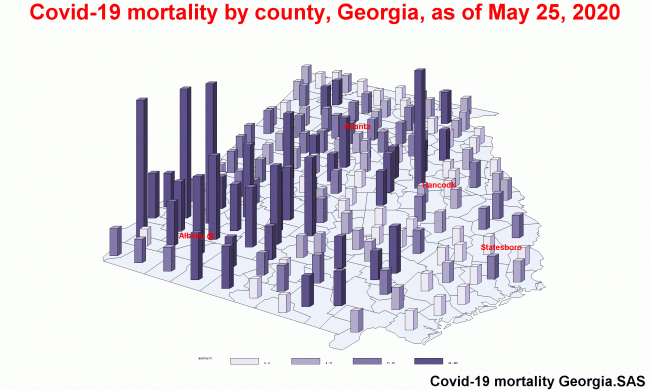
Graduate students in the Jiann-Ping Hsu College of Public Health at Georgia Southern University analyzed mortality data to reveal that a county in southwest Georgia is dealing with deaths from COVID-19 at a rate higher than most other counties in the country. The students found that the mortality rate of 305 per 100,000 residents (as of May 28, 2020) for Terrell County in southwestern Georgia, is 50% higher than that of New York state’s Nassau County, the documented highest rate in New York. The three other Georgia counties that are highest in terms of mortality rate are Hancock, Early and Dougherty counties. Three out of these four are in southwest Georgia, around the Albany area. That accounts for almost half of the 10 counties in the United States with the highest mortality rate, which is defined as a measure of the frequency of occurrence of death among a defined population. However, it’s interesting to note that none of Georgia counties reached the top 20 in terms of incidence and the death numbers per 100 confirmed Covid-19 cases, said professor Dr. Jian Zhang, a veteran medical epidemiologist. “Georgia is doing pretty well to stop the spread of the virus, and hospitals in Georgia are doing well to save hospitalized COVID-19 patients. The high mortality rate, in this case, may be deeply rooted in the historical burden of poverty in Georgia,” Zhang said. The findings are part of a service-learning project Zhang led. A six-student group formed the surveillance team that began running a real-time COVID-19 numbers in his Public Health Surveillance class. If you are a journalist covering COVID-19 and would like to learn more about this research taking place at Georgia Southern University – then let us help. Dr. Jian Zhang has worked with the Chinese Centers for Disease Control and Prevention, and the World Health Organization prior to moving to the United States.


As the global pandemic touches almost all parts of the United States – it is essential that the public receives only accurate and definitive information from credible and expert sources as news, media and information reaches million of people across the country. An invisible enemy is killing thousands and forcing people worldwide to cower behind closed doors. Unfounded conspiracy theories and miracle “cures” abound on social media. Politicians and pundits send mixed messages about how to protect yourself. Who you gonna call? - Bedford Gazette, April 14 As the coronavirus rampages, the public increasingly is turning to experts in academia and government -- the educated, experienced “elites” that many Americans had tuned out. The Coronavirus 2019 (COVID-19) situation is certainly new to all of us. As guidance from the CDC changes and instructional methods transition, there are experts at Georgia Southern who can help to answer questions such as: How should we best address this pandemic as a nation? How should we best address this pandemic individually? What does it mean to “flatten the curve?" What is the economic impact of COVID-19? How do you best manage employees virtually? Why are grocery stores having trouble keeping inventory on their shelves? Should we prepare for a lapse in groceries and goods? What contributes to the fear and panic in disasters and pandemics? What do educators, parents and students need to know to prepare for online learning in the K-12 and college settings? If you are a reporter covering COVID-19, let the team of experts from Georgia Southern help with your coverage. Public Health: Atin Adhikari, Ph.D. Associate Professor of Environmental Health Sciences, Department of Biostatistics, Epidemiology and Environmental Health Sciences, Jiann-Ping Hsu College of Public Health Dr. Adhikari brings over 15 years of extensive research experience on aerosols, airborne microorganisms, other air pollutants, and related respiratory disorders. His current research areas include environmental air quality, exposure assessment, occupational health and safety, environmental microbiology, and respiratory health. Before joining JPHCOPH, Dr. Adhikari was also involved (Co-I) with two DoD-DTRA and U.S. Office of Naval Research funded projects on inactivation of hazardous microorganisms. Chun Hai (Isaac) Fung, Ph.D. Associate Professor, Department of Biostatistics, Epidemiology and Environmental Health Sciences, Jiann-Ping Hsu College of Public Health Dr. Isaac Chun-Hai Fung is a digital health expert and an infectious disease epidemiologist. He analyses social media data for public health surveillance and health communication and uses digital technologies for public health interventions. He investigates the transmission of communicable diseases with a focus on respiratory infections and environmentally transmitted infections. He applied a variety of methods, from classical statistical methods to machine learning and mathematical modeling, to address public health problems and to provide solutions to policy-makers. He is especially interested in assisting public health agencies in their responses to public health emergencies. He is currently a guest researcher with the Health Economics and Modeling Unit, Division of Preparedness and Emerging Infections, National Center for Emerging and Zoonotic Infectious Diseases, Centers for Disease Control and Prevention (CDC). Examples of his recent projects include: Surveillance of unplanned school closures through social media platforms, Analysis of social media posts pertinent to public health emergencies, such as Ebola, MERS and Zika. Jessica Schwind, Ph.D. Assistant Professor, Department of Biostatistics, Epidemiology, and Environmental Health Sciences, Jiann-Ping Hsu College of Public Health Dr. Jessica Smith Schwind is an epidemiologist and program evaluator. She joined the Department of Biostatistics, Epidemiology and Environmental Health Sciences at JPHCOPH in August 2017. Her current research interests include disease surveillance, capacity building and risk communication for the prevention and/or early recognition of outbreaks with a focus on: best practices for operationalizing the ‘One Health’ approach, understanding and improving capacity building efforts and priorities for increasing health surveillance, and improving early warning systems for disease detection and response by bridging the gap between global digital databases and local health information. Schwind also conducts SoTL research on innovative online/onsite teaching and evaluation with a focus on immersive and service-learning practices. Pandemics, panic and the public: Amy Ballagh, Ed.D. Associate Vice President of Enrollment Management Featured in the Washington Post : Jessica Schwind, Ph.D. Assistant Professor, Department of Biostatistics, Epidemiology, and Environmental Health Sciences, Jiann-Ping Hsu College of Public Health Dr. Jessica Smith Schwind is an epidemiologist and program evaluator. She joined the Department of Biostatistics, Epidemiology and Environmental Health Sciences at JPHCOPH in August 2017. Her current research interests include disease surveillance, capacity building and risk communication for the prevention and/or early recognition of outbreaks with a focus on: best practices for operationalizing the ‘One Health’ approach, understanding and improving capacity building efforts and priorities for increasing health surveillance, and improving early warning systems for disease detection and response by bridging the gap between global digital databases and local health information. Schwind also conducts SoTL research on innovative online/onsite teaching and evaluation with a focus on immersive and service-learning practices. Jodi Caldwell, Ph.D. Executive Director of the Georgia Southern University Counseling Center On a national level, Dr. Caldwell is currently serving her second elected term to the Directorate Board of the Commission for Counseling and Psychological Services of the American College Personnel Association and is a certified Red Cross Disaster Mental Health Responder. COVID-19 and logistics, the economy and the workforce: Alan Mackelprang, Ph.D. Associate Professor, Department of Logistics & Supply Chain Management Currently the director of the Ph.D. in Logistics and Supply Chain Management program, his research interests include examining interdependencies among supply chain partners, JIT/Lean production, manufacturing flexibility as well as supply chain integration. Scott Ellis, Ph.D. Associate Professor, Department of Logistics & Supply Chain Management Scott Ellis’ research interests center on the study of purchasing and supply management processes and functions. He has published in Journal of Operations Management and Journal of Supply Chain Management, among others. Richard McGrath, Ph.D. Professor, Parker College of Business Richard McGrath researches immigration, consumer survey methodology, and applied microeconomics. He is a long time expert on the economy in Savannah and the Coastal Empire. Michael Toma, Ph.D. Fuller E. Callaway Professor of Economics Michael Toma is a professor and lead analyst for the Center for Business Analytics and Economic Research, a student- and faculty-staffed applied research group focused on the Savannah-area economy that works with many local partners on special initiatives, customized applied business research and impact studies. Based on Toma's analytics, the Center publishes the quarterly Coastal Empire Economic Monitor, a closely watched economic report. Toma's community ties are also strong in the area. He serves on the Board of Directors for United Way of the Coastal Empire and on the organization's Executive Committee as chair of the Community Investments Committee. David Sikora, Ph.D. Assistant professor of management David Sikora’s research interests include strategic human resource management and the business impact of employee management practices. He has published his research in such journals as the Journal of Applied Psychology, Leadership Quarterly, Human Resources Management Review, International Journal of Selection and Assessment, and International Journal of Human Resources Development and Management. Prior to his academic career, David had extensive corporate experience in human resources and marketing including serving as human resources vice president at Cigna Corporation and director of human resources product management at Gevity HR, Incorporated. Steven Charlier, Ph.D. Associate Professor, Department of Management Charlier’s research interests are focused on the modern work environment, and include virtual teams, e-learning, leadership in a virtual world, and management education. His work has been published in several leading international academic journals, including The Leadership Quarterly, Human Resource Management, Journal of Organizational Behavior, Academy of Management Learning & Education, and Human Resource Management Review. Online teaching and learning: Charles Hodges, Ph.D. Professor, Department of Leadership, Technology and Human Development Hodges is a tenured professor of instructional technology at Georgia Southern with over 20 years of online teaching experience. As an active researcher in online teaching and learning, Hodges presents regularly at the national and international levels. He currently serves as the editor-in-chief of the journal and he is a long-time member of the Association for Educational Communications and Technologies, a professional organization for Educational Technology scholars and practitioners. Featured in the Inside Higher Ed article (published 3/11/20): Jeffrey Tysinger, Ph.D. and Dawn Tysinger, Ph.D. Professors, Department of Leadership, Technology and Human Development The Tysingers are one of very few individuals who are actively researching in the area of crisis preparedness in K-12 online learning Professors, Department of Leadership, Technology and Human Development The Tysingers are one of very few individuals who are actively researching in the area of crisis preparedness in K-12 online learning: o https://digitalcommons.georgiasouthern.edu/nyar/vol2/iss1/4/ o https://dl.acm.org/doi/10.5555/2811036.2811057 o https://eric.ed.gov/?q=Tysinger&id=EJ1147626 o https://eric.ed.gov/?q=Tysinger&id=ED595756 Dawn Tysinger, NCSP, serves as professor and program director for the nationally-recognized, National Association of School Psychologists-Approved Education Specialist program in school psychology at Georgia Southern University. Tysinger has contributed to her field through active participation in NASP, publications in school psychology journals, and presentations at the local, state, regional, national, and international levels. She currently serves on the NASP program review board for school psychology programs and as a member of the editorial boards of Journal of School Psychology, Psychology in the Schools, Trainers’ Forum: Journal of the Trainers of School Psychologists, National Youth-At-Risk Journal and Journal of Online Learning Research. Jeff Tysinger, NCSP, is a professor of school psychology at Georgia Southern University. He has been the president of the Kansas Association of School Psychologists (KASP), editor of the KASP Newsletter, KASP Futures committee member, KASP NCSP committee member, member of National Association of School Psychologists (NASP) since 1997, Nationally Certified School Psychologist since 1997, NASP Program Reviewer, NCSP Portfolio Reviewer, member of NCATE Board of Examiners, member of Georgia Association of School For parents at home with (k-12) children now distance learning: Chelda Smith Associate Professor, Department of Elementary and Special Education Smith’s master's thesis focused on parents as the first teachers of children and can speak to how parents can be empowered in that role. Her research agenda continues to focus on home and community assets, of which parents/caregivers are the primary influence and factor for positive outcomes. Lastly, as a parent of both a middle schooler and a toddler, Smith is navigating the process of being a primary educator in the home in real-time. Each expert is available to speak with media – simply contact Melanie Simon at 912.313.3245 to arrange an interview today.

Don’t Neglect Spiritual, Mental Health During this Time of Health Crisis, Baylor Expert Says
In a difficult and ever-changing time of crisis surrounding the spread of coronavirus, the basic needs of health and safety come first. But as these basic physiological needs are met, the more advanced care for spiritual and mental health can remain overlooked or ignored altogether. Baylor University’s Holly Oxhandler, Ph.D., LMSW., associate dean for research and faculty development and assistant professor the Diana R. Garland School of Social Work, is an expert on mental health, primarily anxiety and depression, as well as religion and spirituality in clinical practice. In this Q&A, she shares tips and resources to help unhook from the baser instincts of fear and anxiety, even momentarily, to monitor and care for spiritual and mental health needs. Q: During a crisis, why do spiritual and mental health needs tend to be overlooked or ignored? A: In the midst of a crisis, our natural reaction is to go into a fight-or-flight response to the situation. Our most basic needs must be met, such as finding a sense of safety, and our bodies are doing what they were designed to do: to protect us. For example, if we were to encounter a bear on a hiking trail, our sympathetic nervous system would be activated to meet the basic need of keeping us safe. Our spiritual and mental health are not primary needs in that moment of crisis. If we were to run from that bear and reach safety, our emotions would eventually become regulated, our breathing would become normal, and we could return to a generally balanced way of being that allows for attention to our spiritual and mental health. However, we are in a prolonged moment of crisis surrounded by uncertainty, constantly evolving news updates and daily threats to our and loved ones’ safety regarding our health, finances and sense of normalcy. In this state of constant stress, it can be really hard to unhook from the fight-or-flight response and remember to tend to our spiritual and mental health. Q: How can people tend to their spiritual health during this time of crisis? A: In this moment, most of us are being forced to be still and/or surrender the illusion of control in ways we have never faced before. In this stillness, our spiritual practices can help remind us of a divine Love that is with us through each moment, but we must intentionally set time aside to practice them. Plus, many research studies have shown healthy, positive spiritual practices have the potential to support our mental and physical health. One thing that’s very important, especially in the midst of this crisis, is that we do not spiritually bypass what’s happening. It may be tempting to want to jump to hope and ignore the pain, but to the best of our ability, our faith traditions teach us we must sit with and feel the grief rooted in the overwhelming change and loss we and our neighbors are facing. As Fr. Richard Rohr says, “If we do not transform the pain, we will most assuredly transmit it – usually to those closest to us.” We must be with the fear and uncertainty, grieve the loss of life as we knew it a few weeks ago, pray the psalms of lament, and feel the freedom to wrestle with and/or cry out to God in ways we read about others doing so in our sacred texts. The important thing is that each of us engages in something tied to our faith, regardless of what we believe in, and to be consistent in the practice, continually learning to surrender that sense of control we’re all finding ourselves learning to do right now. Spiritual Health Tips Prayer Reading our sacred text Meditation Centering prayer (my personal favorite, which teaches us silence, solitude and stillness) Breath prayers (here are some examples) Engaging in creativity (music, dance, art) as an act of worship Practicing gratitude Seeking beauty in the mundane Yoga Journaling Especially in this time of increased isolation, I would recommend inviting others into these practices for a sense of solidarity and community, including those within our home or via social media, video conferencing or by phone. Q: How can people tend to their mental health needs? A: The first practice I would recommend is to pause and breathe deep for 4-5 seconds, noticing your belly rise instead of your chest, and breathe out for 6-7 seconds. The second would be grounding. When our brain is flooded with information and emotion, it is hard to stay present. In grounding, we take a deep breath and ask ourselves five questions to return to the present moment: What do I smell right now? What do I taste? What do I see in front of me? What can I touch and feel the surface of? What do I hear? A third recommendation would be to get outside as often as you can and, ideally, into some sunlight. I would also recommend the practice of tuning into our bodies. For many of us, it can be difficult to pay attention to what our bodies are trying to tell us, in the same way our thoughts and emotions communicate with us. Especially now, pay attention to the tension in your neck, the overall exhaustion, the pain in your arm muscles, the tightness in your chest, or any other experiences you notice by tuning in. Your body may be trying to tell you to spend less time watching the news (maybe cut back to 1-2 times a day), to take a nap or to move it and exercise. Last, and perhaps most importantly, do not hesitate to reach out for help if you are noticing changes in your appetite, sleep, mood, thoughts or feelings. Stay in communication with loved ones but just as you would seek a medical doctor for a broken arm, seek a therapist when you notice changes in your mental health. Many therapists are quickly adapting to telehealth services in this moment to meet growing demands and social distancing expectations. Some sites for finding a therapist include Psychology Today or HelpPRO, and if you or a loved one are deeply struggling, please reach out to the National Suicide Hotline or call 800-273-TALK (8255). Reaching out for help with your mental health is a sign of courage, not weakness. Q: During this time of crisis, what populations do you feel are most vulnerable to mental or spiritual health decline? A: Honestly, I think every single one of us are vulnerable to mental and spiritual health decline during this moment for varying reasons. As mentioned before, these parts of us are easily brushed aside when we’re most focused on ensuring our basic needs of safety and security are met. Still, there are a few groups I’m especially sensitive to. The first are the helpers on the front line facing far more need than resources, time or energy to meet those needs. These include our health care providers, social workers, therapists, grocery and restaurant employees, teachers, parents, nonprofit organizations, faith leaders, volunteers, community leaders, pharmacists, lab technicians, scientists and more. These helpers are at such high risk of burnout and my hope is that, to the best of their ability, they are caring for themselves holistically in order to care for others well. I’m also sensitive to a few other groups who are vulnerable to mental and spiritual health decline. First, older adults are the most religious cohort and are already at risk for depression and isolation even without a crisis, so I worry for them in light of the necessary social distancing. Second, in light of added pressures, those with various mental illnesses must continue to care for themselves via the medication or therapy they need. Third, I’m sensitive to those who are recovering from a substance or behavioral addiction and are now surrounded by overwhelming stressors that put them at a higher risk of relapse. Thankfully, recovery groups are now moving online and I would encourage those in recovery or remain plugged into a group. Q: Many people are unable to access a doctor or professional therapist to get help. What are some resources for those that may need free or low-cost options? A: There are a number of websites that can help individuals find a professional mental health care provider, such as a licensed clinical social worker, psychologist, counselor or marriage and family therapist. I mentioned Psychology Today, HelpPRO, and the Suicide Prevention Hotline above, but there are others. Better Help and Talk Space are two growing online therapy sites and Low Cost Help elevates providers with affordable rates. I also host a weekly podcast, CXMH: Christianity and Mental Health, which has a ton of episodes on various topics related to this intersection, including a recent one specifically on COVID-19. You can also contact your insurance provider to see who is in network or, if you do have a primary care provider, see if they have any recommendations. Your local faith communities may also have a list of mental health care providers to consider. There are also many organizations committed to providing resources, including the Substance Abuse & Mental Health Services Administration, National Alliance on Mental Illness, and the National Institute on Mental Health. Q: How can neighbors help neighbors and individuals help individuals outside of the professional or therapy setting? A: I really want to emphasize that, especially in this moment, we must practice extending grace, being still and holistically caring for ourselves so that we can care for others well. We can do our part to serve those who are serving others, even if that means practicing social distancing and stillness, while tending to our spiritual and mental health. Discerning what is ours to do in this moment to offer help, healing, hope and love to our neighbors as well as ourselves, and to help protect our helpers from burning out, will be critical in the days and weeks ahead. As Chris and Phileena Heuertz shared in their prayer, A Call to Solidarity During COVID-19: “You’re not alone. We’re in this together. We’ll do everything we can to help.” ABOUT BAYLOR UNIVERSITY Baylor University is a private Christian University and a nationally ranked research institution. The University provides a vibrant campus community for more than 18,000 students by blending interdisciplinary research with an international reputation for educational excellence and a faculty commitment to teaching and scholarship. Chartered in 1845 by the Republic of Texas through the efforts of Baptist pioneers, Baylor is the oldest continually operating University in Texas. Located in Waco, Baylor welcomes students from all 50 states and more than 90 countries to study a broad range of degrees among its 12 nationally recognized academic divisions. ABOUT THE DIANA R. GARLAND SCHOOL OF SOCIAL WORK AT BAYLOR UNIVERSITY Baylor University’s Diana R. Garland School of Social Work is home to one of the leading graduate social work programs in the nation with a research agenda focused on the integration of faith and practice. Upholding its mission of preparing social workers in a Christian context for worldwide service and leadership, the School offers a baccalaureate degree (B.S.W.); a Master of Social Work (M.S.W.) degree available on the Waco or Houston campuses or online; three joint-degree options, M.S.W./M.B.A., M.S.W./M.Div. and M.S.W./M.T.S., through a partnership with Baylor’s Hankamer School of Business and George W. Truett Theological Seminary; and an online Ph.D. program. Visit www.baylor.edu/social_work to learn more.



Myth-breaking and COVID-19 (Coronavirus) – Manhattanville Expert Answers Your Questions
Information, news stories, articles and advice are coming at Americans from all sides these days when it comes to COVID-19, its spread, prevention, those vulnerable, and whether America should continue to shut down or carry on carefully. There’s a lot to know and it is vitally important that accurate, credible and reliable information is what’s being shared. That’s where the experts from Manhattanville College can help. Orhan Hakli, RN, MS-FNP-C, is an administrator in the School of Nursing and Health Sciences at Manhattanville College. He is a certified Family Nurse Practitioner in private practice who has worked in various areas of health care including medical-surgical nursing, cardiology, geriatrics, wound care, hyperbaric medicine, and primary care. Here are a few of the questions he has been facing in recent days from patients. Below, he breaks down some of the myths that are surfacing with facts. I heard drinking alcohol- especially Vodka- decreases my risk of getting COVID-19. MYTH- There is no credible evidence to support that alcohol consumption decreases the risk of COVID-19. Using hand sanitizers that contain at least 60% alcohol to clean your hands can be helpful. So, using hand sanitizers with 60% alcohol yes, drinking to prevent COVID-19 is a hard no. I heard coronavirus comes from animals. I have a dog at home. Should I get rid of him/her? MYTH- It is true that Coronavirus is common in animals but not in household pets, so cuddle away but wash your hands afterwards for personal hygiene purposes. If I go out, I will get sick MYTH- We recommend social distance, not social isolation. As long as you keep 6 feet from people, do not touch your mouth, nose, or eyes and wash your hands frequently, you should be fine. If I was in contact with someone who had the coronavirus, I should start taking antibiotics immediately. MYTH- This is a viral disease; antibiotics have no effects on viral diseases. They are effective only on bacterial infections. Getting products in the mail from China will make people sick. MYTH- The Centers for Disease Control and Prevention (CDC) tells us that Coronavirus, like many other viruses, do not stay alive for very long especially on the product surfaces that are in transit for days. There are two major ways that the virus can spread. Either people who are in close contact (within about 6 feet) through respiratory droplets produced when an infected person coughs or sneezes (which is the main way) or touching a surface or object that is contaminated with the virus then touching your mouth, nose, or eyes. The second way is not thought to be the main way the virus spreads. Coronavirus can live up to two days on surfaces but loses its effect as time passes. Takeaway point - keep your 6-foot distance from people and do not touch your mouth, nose, or eyes after touching objects. I heard African-American people cannot get coronavirus. MYTH- The CDC clearly indicates that this is a virus that affects the respiratory system regardless of race. Everyone is at equal risk of getting COVID-19. If I have Coronavirus I will likely end up in the ICU and die. MYTH- The World Health Organization (WHO) indicates that most people- in fact up to 80%- will recover on their own having mild to no symptoms at all. How the disease will affect you depends on age and other comorbidities you may have. Orhan Hakli is available to speak with media about the virus as a contagious disease, prevention, myths, strains on the health care system and public health measures. He has recently been advising the food service industry on measures they can take to prevent the spread of Coronavirus. To book an interview – simply click on his icon to arrange a time.


The global pandemic of COVID-19 is no longer just daily news, it is pretty much the only news happening right now across America and most of the globe. Reporters and journalists are working hard to cover this story that is changing and progressing almost exponentially by the day. There are multiple angles to consider, and each storyline is just as important as the other when it comes to informing the public and ensuring that the correct and proper facts are relayed to an audience that is concerned, curious and waiting for answers. If you are a journalist covering COVID-19 – then let our team of experts help. Our experts can assist with and answer your questions about transmission, vulnerable populations and age groups, prevention and how the medical system is handling this outbreak. Emi Minejima is an Assistant Professor of Clinical Pharmacy at USC School of Pharmacy and an expert in infectious diseases pharmacotherapy and antimicrobial stewardship. She is an infectious diseases specialist at LAC+USC Medical Center. Irving Steinberg is the Associate Dean for Faculty Affairs & Associate Professor of Clinical Pharmacy and Pediatrics at USC School of Pharmacy and Keck School of Medicine. He is a pediatric pharmacist at LAC+USC Medical Center and an expert in the areas of predictive performance of pharmacokinetic models for dosing in children. Annie Wong-Beringer is the Associate Dean for Research and Graduate Education & Professor of Clinical Pharmacy at USC School of Pharmacy and an expert in bacterial resistance and virulence, host microbial interactions and host immune response. All three experts are available and ready to speak with reporters – simply click on an individual's icon to make contact and arrange an interview.