
Experts Matter. Find Yours.
Connect for media, speaking, professional opportunities & more.

Baylor Researcher Seeks to Understand the Drive for the Perfect Tan
Despite being one of the most preventable cancers, the desirability of tanning is often stronger than the dangers of harmful UV exposure. Getty Images With summer on the horizon, the quest for the perfect tan has begun. However, there is no such thing as a healthy tan. Despite being one of the most preventable cancers, skin cancer is the most common cancer in the United States, with more than 5 million cases of skin cancer diagnosed each year, according to the Skin Cancer Foundation. Baylor University researcher Jay Yoo, Ph.D., associate professor of apparel merchandising in Baylor’s Robbins College of Health and Human Sciences, found that the social and cultural influences on the desirability of tanning – which has been associated with good health and an active lifestyle since the 1920s – is often stronger than the dangers of harmful UV exposure. “The appeal of a tan is so strong in U.S. culture, it may be difficult for some people to stop or even reduce the amount of tanning,” Yoo said. In his 2019 study, “Identifying factors that influence individuals’ intentions to quit body tanning: A sociocultural perspective,”, published in the international journal Social Behavior and Personality, Yoo identified what motivates people to seek the “perfect” tan. Yoo surveyed 385 college students to understand how society effects their tanning behaviors and intention to quit tanning. His research found that the greatest influence on reducing risky tanning behavior was the perceived attractiveness from tanning, whereas skin-aging concerns positively influence their intention to quit tanning. FINDINGS Yoo’s findings provide important implications for skin cancer prevention campaigns. Instead of promoting the message of body tanning as an unhealthy behavior, focusing instead on untanned healthy bodies as a positive image can serve as an effective approach to decreasing skin cancer incidence. Using messages that accentuate a healthy body without tanned skin should be promoted to boost a positive body image and to reduce the likelihood of engaging in risky tanning behaviors. ACTIONS To protect yourself and look great, the Skin Cancer Foundation recommends: Avoid tanning entirely: It’s the best way to safeguard against unhealthy, unsightly skin damage. Fake, don’t bake: If you want a golden glow, consider sunless tanning products. There are many options, but remember, when in the sun, you still need sun protection. Tone, don’t tan: Get radiant skin through exercise. Working out feels good and boosts your mood. Hydrate and eat great: Drink lots of water and choose whole, unprocessed foods. You don’t need to tan to look slim and your skin will thank you.


Nicholas Petrelli, M.D., Receives Lifetime Achievement Award
Nicholas Petrelli, M.D., Bank of America Endowed Medical Director of ChristianaCare’s Helen F. Graham Cancer Center & Research Institute, has received the Lifetime Achievement Award from Tulane University School of Medicine in New Orleans, Louisiana. Petrelli is a 1973 graduate of the school. Dr. Petrelli, center, receives the Lifetime Achievement Award from Julius L. Levy, Jr., M.D., past president, Tulane Medical Alumni Association, left, and Lee Hamm, M.D., senior vice president & dean of the School of Medicine, and the James R. Doty Distinguished Professor and Chair, Tulane University School of Medicine, New Orleans, Louisiana. The award recognizes an alumnus of the school who has made significant contributions to the field of medicine and has offered outstanding leadership in the community. Under Petrelli’s leadership at ChristianaCare since 2001, the Helen F. Graham Cancer Center & Research Institute has become a national model for multidisciplinary cancer care and a top enroller in U.S. clinical research trials. The Graham Cancer Center is a National Cancer Institute Community Oncology Research Program and one of only five hybrid academic community cancer centers in the nation. Through the work of the Graham Cancer Center and partnerships with health care providers, community organizations and the state to improve the prevention, diagnosis and treatment of cancer, Delaware’s cancer mortality rate has dropped twice as fast as the national rate. In addition, the state is outpacing the nation in reducing deaths from a number of cancers. Delaware has gone from number one in cancer mortality 22 years ago to number 17 today. Petrelli has numerous achievements in cancer care and research. He has established several firsts for Delaware, including a multidisciplinary disease center site, the Cawley Center for Translational Cancer Research, a tissue procurement center, an adult genetic counseling program, a statewide high-risk family cancer registry consisting of more than 500,000 individuals and an innovative oncology express unit to provide patients with cancer a way to address urgent care needs without having to go to the emergency department. Among his accomplishments on the national level are the first primary care practice established at a cancer center and the first gene editing research program integrated into a community cancer center. Through a unique research partnership with the Ellen and Ronald Caplan Cancer Center of The Wistar Institute, he has brought cutting-edge cancer treatments and diagnostics to Delawareans. And in a ground-breaking collaboration among the government, community organizations and the Graham Cancer Center nearly 10 years ago, Delaware ended the disparity between Black and white people for colorectal cancer screenings and mortality, which continues to this day. Petrelli has received numerous awards and has authored 360 peer-reviewed manuscripts and 31 book chapters. He has served on advisory panels of the National Cancer Institute, the American Society of Clinical Oncology, the American Cancer Society and the Society of Surgical Oncology. He was president of the Society of Surgical Oncology from 2007 to 2008. In 2013 he received the Order of the First State Award, the highest honor in the state, from Delaware Gov. Jack Markell. In 2019 he received the James Tilton award (named for the first U.S. Army Surgeon General) from the Medical Society of Delaware.



Georgia Southern professor earns Fulbright US Scholar Award for 2023-2024
A noted Georgia Southern University public health professor has earned a Fulbright U.S. Scholar Program award in All Disciplines to Latvia for the 2023-2024 academic year from the U.S. Department of State and the Fulbright Foreign Scholarship Board. Yelena N. Tarasenko, DrPH, is a professor in the Department of Biostatistics, Epidemiology and Environmental Health Sciences at Georgia Southern’s Jiann-Ping Hsu College of Public Health. Her Fulbright project is titled “Strengthening research and teaching capacity in cancer prevention globally.” She will collaborate with personnel and students at the Faculty of Medicine and Institute of Clinical and Preventive Medicine at the University of Latvia, as well as colleagues at the International Agency for Research on Cancer to help improve cancer care coordination and screening in Latvia and 14 European countries participating in the “Towards gastric cancer screening implementation in the European Union” project. Given Tarasenko’s expertise in legal and cancer epidemiology, she will engage in (i) implementation research focused on cancer screening and patient navigation, and (ii) teaching activities focused on fostering research productivity (e.g., guest lecturing, curriculum development, advising, and mentoring). Tarasenko is among more than 800 U.S. citizens who will teach or conduct research abroad for the 2023-2024 academic year through the Fulbright U.S. Scholar Program. Fulbright scholars engage in cutting-edge research and expand their professional networks, often continuing research collaborations started abroad and laying the groundwork for forging future partnerships between institutions. Upon returning to their home countries, institutions, labs and classrooms, they share their stories and often become active supporters of international exchange, inviting foreign scholars to campus and encouraging colleagues and students to go abroad. As Fulbright Scholar alumni, their careers are enriched by joining a network of thousands of esteemed scholars, many of whom are leaders in their fields. Notable Fulbright alumni include 62 Nobel Prize laureates, 89 Pulitzer Prize recipients, 78 MacArthur Fellows and 41 who have served as a head of state or government. Since 1946, the Fulbright Program has provided more than 400,000 participants from over 160 countries – chosen for their academic merit and leadership potential – with the opportunity to exchange ideas and contribute to finding solutions to challenges facing our communities and our world. “This is a wonderful validation of Dr. Tarasenko’s scholarship and expertise, and another example of Georgia’s Southern’s expanding reputation for public-impact research,” said Carl Reiber, Ph.D., Georgia Southern University provost and vice president for academic affairs. “Fulbright scholars are among the world’s most talented academicians, and we congratulate Dr. Tarasenko for this achievement.” More than 800 U.S. scholars — faculty members, artists, and professionals from all backgrounds — teach or conduct research overseas through the Fulbright U.S. Scholar Program annually. In addition, over 2,000 U.S. students, artists, and early career professionals from all backgrounds in more than 100 different fields of study receive Fulbright U.S. Student Program awards annually to study, teach English, and conduct research overseas. “I’m excited to help expand our expertise on global health and develop a relationship with the only classical university in Latvia,” Tarasenko said. “This proposed project meets the university’s strategic pillars, as its leadership looks for ways to create and encourages opportunities for the exchange of teaching, research, scholarship, and professional development. It also meets the Jiann-Ping Hsu College of Public Health’s values and goals in terms of thinking globally and acting locally.” The Fulbright Program is the U.S. government’s flagship international educational exchange program and is supported by the people of the United States and partner countries around the world. The Fulbright Program is funded through an annual appropriation made by the U.S. Congress to the U.S. Department of State’s Bureau of Educational and Cultural Affairs. Participating governments and host institutions, corporations, and foundations around the world also provide direct and indirect support to the Program. In the United States, the Institute of International Education supports the implementation of the Fulbright U.S. Student and Scholar Programs on behalf of the U.S. Department of State, including conducting an annual competition for the scholarships. For more information about the Fulbright Program, visit https://fulbrightprogram.org. To connect with Yelena N. Tarasenko — simply reach out to Georgia Southern's Director of Communications Jennifer Wise at jwise@georgiasouthern.edu to arrange an interview today.


Why does Alabama have more gun deaths than New York? UConn expert explains.
Only five million people live in Alabama, but the state has the fourth highest firearms death rate in the country. In 2021, the state had 26.4 firearm deaths per 100,000 people, according to the Centers for Disease Control and Prevention. Compared to New York -- a state with about 20 million people and a rate of 5.4 gun deaths per 100,000 in 2021 -- the question becomes: Why does such a small state rank so high for gun violence? UConn expert Kerri Raissian offered perspective and insight on the causes and reasons why these tragic incidents occur in specific regions and states more often across America in an interview with the Alabama Reflector: A 2019 brief published by the Rockefeller Institute of Government, a nonprofit research center for the State University of New York (SUNY) system, said universal background checks, concealed carry permits and laws prohibiting people who have committed violent misdemeanors reduce gun homicides. “One policy that has come up against legal challenges recently has been not allowing people under the age of 21 years old to have certain guns or types of weapons,” Raissian said. “It is helpful. That age group has the highest risk of perpetuating homicides of any age group in the U.S.” Social policies can also deter gun violence. “It is laws, it is access to guns, it is also poverty,” Raissian said. “We have a lot of evidence that laws that you wouldn’t think have anything to do with gun violence, like Medicaid access, summer school for kids, employment opportunities for kids, are really good at reducing gun violence.” Raissian cited a randomized controlled trial of a youth summer employment program that was established in Chicago that had reduced incidents of gun violence compared to a control group. “It is not just about keeping them busy because these differences persist,” Raissian said. “It is also learning conflict resolution. It is also learning communication skills — all those things that come from employment and positive interactions tend to reduce violence of any form.” But Raissian and Grant Reeher, a professor of political science at Syracuse University, both said no single law will solve the issues of gun violence. The full article is attached above, and well worth the read. Kerri Raissian is an associate professor in the School of Public Policy at the University of Connecticut, director of the University of Connecticut's UConn’s Center for Advancing Research, Methods, and Scholarship (ARMS) in Gun Violence Prevention, and co-director of the Institute for Collaboration on Health, Intervention, and Policy (InCHIP) Gun Violence Prevention Research Interest Group. She is available to speak to media about this important topic - simply click on her icon now to arrange an interview today.


UConn Expert: An athletic trainer saved my life as a teen. Student athletes don't have to die
Dr. Douglas Casa was a 16-year-old student athlete when he collapsed during a 10K race -- in the midst of a life-threatening exertional heat stroke, or EHS, the quick action of an athletic trainer saved him. Now a professor of kinesiology a UConn and CEO of the Korey Stringer Institute, Casa is a leading voice on heat-related illnesses and preventing sudden death in sport -- and he has lifesaving advice for parents and policymakers as the summer sports season begins, published recently in the Courier-Journal: Change happens when a few key leaders come together to find a path to advocate for these life-saving policies. The key factor that determines if a high school athlete will live or die is the actions in the first 10 minutes after a condition presents itself. EHS has a 100% survival rate if cooling is done correctly, and proper prevention strategies can prevent nearly all EHS cases. Cardiac conditions survival rates can be as high as 90% when an AED is applied within 3 minutes of onset. When the moment comes and your child’s life lies in the balance, you want to be sure these life-saving policies are in place and that the appropriately trained licensed medical professional (i.e. AT) is on-site. So much hinges on those first few minutes. Most of all, your life will never return to normal if your child dies from a condition that is nearly always survivable when cared for properly. Do whatever you can before they die. Dr. Douglas Casa is available to speak with the media today - simply click on his icon now to arrange an interview.

Candida auris: The deadly fungus is spreading and proving difficult to fight
Candida auris is making headlines - and for all the wrong reasons. The fungus can lead to severe infections causing long term health issues and even death. Recently, Fox News in Los Angeles was covering this emerging threat and reached out to Augusta University's Dr. Jose Vazquez for his expert insight and opinion. Here's the piece: The Centers for Disease Control & Prevention says Candida auris, or C. auris, is an emerging health threat, a type of fungus can cause severe, potentially life-threatening infections in people hospitalized with compromised immune systems. Dr. Jose Vasquez, chief of infectious diseases at the Medical College of Georgia at Augusta University, says there are several reasons for concern about this fungus. "The biggest fear is that it is multi-drug resistant," he says. "So, it is resistant to many different drugs." The CDC says most C. auris infections respond to antifungal medication, but some do not. Vasquez says C. auris is also hard to detect without highly specialized lab equipment that many hospitals do not have. And, he says, it is hard to stop the fungus once it gets into a hospital setting, such as an ICU or nursing care facility. C. auris can live on a person's skin without causing symptoms, allowing it to be transmitted from one person to another, or to get into a patient's body through contaminated surfaces or medical equipment like mechanical ventilators, feeding tubes and central lines. 'It is one of the Candidas that lives the longest on a surface, and we're talking about weeks," he sys. "So it can live there, dry and desiccated. Once it gets there, it kind of sets up shop, and it is very, very difficult to eradicate." The rest of the news story is attached: Looking to know more? That’s where Augusta University can help. Dr. Jose Vazquez, division chief and professor of Medicine at the Medical College of Georgia, is an expert in the realm of infectious diseases. He studies and treats infectious diseases, including antibiotic-resistant superbugs and fungal infections. He has been a reliable source for local, statewide and national media regarding the coronavirus outbreak. Dr. Vazquez is available to speak with media regarding this topic – simply click on his icon to arrange an interview.


Researchers fight cybercrime with new digital forensic tools and techniques
Irfan Ahmed, Ph.D., associate professor of computer science, provides digital forensic tools — and the knowledge to use them — to the good guys fighting the never-ending cyber-security war. Ahmed is director of the Security and Forensics Engineering (SAFE) Lab within the Department of Computer Science and VCU Engineering. He leads a pair of interrelated projects funded by the U.S. Department of Homeland Security (DHS) aimed at keeping important industrial systems safe from the bad guys — and shows the same tools crafted for investigating cyber attacks can be used to probe other crimes. The goal of cyber attacks on physical infrastructure may be to cause chaos by disrupting systems and/or to hold systems for ransom. The SAFE lab focuses on protecting industrial control systems used in the operation of nuclear plants, dams, electricity delivery systems and a wide range of other elements of critical infrastructure in the U.S. The problem isn’t new: In 2010, the Stuxnet computer worm targeted centrifuges at Iranian nuclear facilities before getting loose and infecting “innocent” computers around the world. Cyber attacks often target a portion of the software architecture known as the control logic. Control logic is vulnerable in that one of its functions is to receive instructions from the user and hand them off to be executed by a programmable logic controller. For instance, the control logic monitoring a natural gas pipeline might be programmed to open a valve if the system detects pressure getting too high. Programmers can modify the control logic — but so can attackers. One of Ahmed’s DHS-supported projects, called “Digital Forensic Tools and Techniques for Investigating Control Logic Attacks in Industrial Control Systems,” allows him to craft devices and techniques that cyber detectives can use in their investigations of attacks on sensitive critical infrastructure. Their investigation capabilities, he explains, is an under-researched area, as most of the emphasis to date has been on the prevention and detection of their cyber attacks. “The best scenario is to prevent the attacks on industrial systems,” Ahmed said. “But if an attack does happen, then what? This is where we try to fill the gap at VCU. And the knowledge that we gain in a cyber attack investigation can further help us to detect or even prevent similar attacks.” In the cat-and-mouse world of cyber security, the way cybercriminals work is in constant evolution, and Ahmed’s SAFE lab pays close attention to the latest developments by malefactors. For instance, an attacker may go for a more subtle approach than modifying the original control logic. An attack method called return-oriented programming sees the malefactor using the existing control logic code, but artfully switching the execution sequence of the code. Other attackers might insert their malware into another area of the controller, programmed to run undetected until it can replace the function of the original control logic. Attackers are always coming up with new methods, but each attack leaves evidence behind. The SAFE lab examines possible attack scenarios through simulations. Scale models of physical systems, including an elevator and a belt conveyor system, are housed at the SAFE lab to help facilitate this. The elevator is a four-floor model with inside and outside buttons feeding into a programmable logic controller. The conveyor belt is more advanced, equipped with inductive, capacitive and photoelectric sensors and able to sort objects. The tools and methods applied in cybercrime can be useful in tracking down other malefactors. That’s where Ahmed’s second DHS-funded project comes in. It’s called “Data Science-integrated Experiential Digital Forensics Training based-on Real-world Case Studies of Cybercrime Artifacts.” Ahmed is the principal investigator, working with co-PI Kostadin Damevski, Ph.D., associate professor of computer science. The goal is to keep law enforcement personnel abreast of the latest trends in the field of cybercrime investigation and to equip them with the latest tools and techniques, including those developed in the SAFE lab. “For example, investigators often have to go through thousands of images, or emails or chats, looking for something very specific,” Ahmed said. “We believe the right data science tools can help them to narrow down that search.” The FBI and other law enforcement agencies already have dedicated cybersleuthing units; the Virginia State Police have a computer evidence recovery section in Richmond. Ahmed and Damevski are arranging sessions showing investigators how techniques from data science and machine learning can make investigations more efficient by sorting through the mounds of digital evidence that increasingly is a feature of modern crime.


Approximately 30 University Police officers recognized for mental health training
Student mental health is a constant concern on a university campus. It is not uncommon for someone in distress to call 9-1-1. A police officer could be the first person to interact with a person who needs specialized attention. To help evaluate and properly handle such situations, every officer at Georgia Southern has completed Crisis Intervention Training (CIT), presented by the Georgia Public Safety Training Center in collaboration with the Georgia Department of Behavioral Health and Developmental Disabilities, and the Georgia Chapter of the National Alliance on Mental Illness. The training ensures that people with mental illnesses and other brain disorders will receive treatment in lieu of incarceration in most cases. On top of that training, the University System of Georgia offers two additional programs to law enforcement officers: QPR Suicide Prevention Training – QPR stands for Question, Persuade and Refer – the three simple steps anyone can learn to help save a life from suicide. Just as people trained in CPR and the Heimlich maneuver help save thousands of lives each year, people trained in QPR learn how to recognize the warning signs of a suicide crisis and how to question, persuade and refer someone to help. Adult Mental Health First Aid (MHFA) Training – MHFA is a skills-based training course that teaches people how to identify, understand and respond to signs of mental illness and substance use disorder. for police officers to help recognize and handle mental health issues and mental health disorders. So far, almost 30 police officers at Georgia Southern University have completed the three different training programs, earning each officer a Mental Health Initiative pin. “I am very proud of these officers, and appreciate them taking the time to better prepare for handling any situation they may encounter,” said Laura McCullough, chief of police at Georgia Southern. “The pins they now wear are a symbol of the care they invest in our community.” State and University officials lauded the officers’ achievements. “This law enforcement mental health certification program could not come at a better time for our university communities, given the state of mental health in our country and on our campuses,” said Jodi Caldwell, director of Georgia Southern’s Counseling Center. “Law enforcement personnel are increasingly the first responders to individuals experiencing mental health emergencies. It comes as no surprise to the staff of the Counseling Center that Georgia Southern’s University police department is leading the way in Georgia for law enforcement interest and willingness to become trained in recognizing and responding to individuals in mental health distress.” Caldwell spoke at a ceremony last month to present the pins and honor the officers. Also attending were Alexis Belvin, Georgia Southern’s SGA President and Chip Reese, Ed.D., former system project director for the University System of Georgia (USG) Mental Health Initiative. “The USG Mental Health Initiative was launched during COVID to allow us to focus more intentionally on the needs of our students,” Reese said. “We have expanded clinical counseling services and supported mental health and wellness resources and programming across the state. I’m particularly proud of the QPR and MHFA training and hope it will better equip the officers who are already on the first ones we call whenever someone needs help.” The following officers were awarded the Mental Health Initiative Pin: Tim Alderman, Josh Barker, Richard Bashlor, Charles Bowen, Ian Craig, Laurence Croy, Steven Cushner, Sam Derr, Christion Doyle, Bailey Dyches, Jonathan Finley, Danny Garrigus, Kenneth Glover, Clay Gracen, Sarah Grey, Lanier Griswold, Patrick Holloway, Tyrone McBride, Chris McBride, Erk McCurdy, BJ McKellar, Alex Morris, Todd Olsen, Kurt Purtee, Dexter Renfroe, Erick Riner, Lamar Stephens, and Crystal Thomas. Looking to know more - then let us help. Jodi Caldwell, director of Georgia Southern’s Counseling Center, is available to speak regarding this important topic - simply click on here icon here or simply reach out to Georgia Southern Director of Communications Jennifer Wise at jwise@georgiasouthern.edu to arrange an interview today.

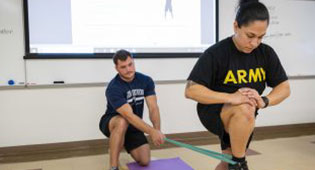
What began in 2016 as a partnership between Georgia Southern University and the Third Infantry Division at Fort Stewart has become a nationally recognized educational and research program with $5.68 million in federal funding to improve soldier health and performance to ensure force readiness. Now called the Soldier Performance and Readiness (SPAR) program, this Georgia Southern project aligns with the U.S. Army’s Holistic Health and Fitness (H2F) initiative and represents a multifaceted partnership with the Army to provide onsite training that decreases musculoskeletal injuries; deliver an online certificate program in tactical fitness for college credit; collaborate with the Army’s Research Institute for Environmental Medicine (USARIEM); and develop programs to enhance and assess cognitive performance in tactical situations. The initial partnership program to prevent musculoskeletal injuries was delivered at first to small cohorts to implement new practices in the physical training of their squads and platoons in a train-the-trainer model. Results were so encouraging, the program expanded at Fort Stewart and to training brigades at Fort Benning last year with the assistance of $1.5 million in Department of Defense funding. Studies show significant preparedness and financial benefits from reducing musculoskeletal injuries to soldiers during drilling and training exercises. In April 2020, officials determined that 58,000 soldiers (the equivalent of 13 Brigade Combat Teams) had injuries that classified them as non-deployable. In 2019, more than half of soldiers experienced a new injury, resulting in 10 million limited-duty days. Musculoskeletal injuries account for nearly 25% of all military injuries and approximately $557 million in acute patient care. Most of these injuries were associated with fitness training-related activities Georgia Southern’s online Tactical Athlete Certificate program was first offered in 2020 and is available exclusively to soldiers on active duty, in the National Guard or reserve. Through a series of three courses, the program teaches foundational exercise and biomechanical concepts, strength and conditioning principles, and rehabilitation. The coursework parallels the Army’s Master Fitness Trainer curriculum, with additional rehabilitation principles, and teaches soldiers how to develop evidence-based and well-rounded physical training programs while minimizing risk of musculoskeletal injury. Certificate completion provides soldiers with nine college credits with Georgia Southern, potential promotion opportunities in the Army, and preparation for the National Strength and Conditioning Association’s TSAC-F exam. “By sharing knowledge, expertise and experience between our faculty and doctoral students with soldiers, drill instructors, and brigade combat fitness teams to create aligned programs that improve tactical performance and force readiness, the SPAR program has become a national model of public-impact research,” said Christopher Curtis, Ph.D., Georgia Southern’s vice provost for research. “We are excited about the future of this partnership. We relish the significant support and encouragement we receive from the Army commands at Fort Stewart, Fort Benning, USARIEM, and the Training and Doctrine command (TRADOC), and we are grateful to Congressman Carter and his fellow members of the Georgia Congressional delegation who have advocated for the value of the partnership on our behalf.” The progress and continued success of this program would not have been possible without several years of support from the Georgia Congressional Delegation and especially the leadership and support of Congressman Buddy Carter, who represents Fort Stewart and the Armstrong Campus of Georgia Southern in Savannah. “Providing for our nation’s defense is the number one responsibility of the federal government. Innovation and research, which is what these dollars will fund at Georgia Southern, will improve working conditions for our brave servicemen and women by providing them with top-of-the-line training and resources,” said Rep. Buddy Carter (R-GA). “I am a proud supporter of Georgia’s military community and am happy that the federal government is investing in these necessary programs.” SPAR programming allocated in the FY23 federal budget will enable Georgia Southern to: Develop protocols and expand delivery of the onsite musculoskeletal injury prevention training and the Tactical Athlete Certificate to commands at Fort Gordon in Augusta and to the Georgia National Guard. Develop and deploy similar online certificate programs for soldiers in Cognitive Performance and Nutrition to further support the Army’s H2F program. Host a national conference on “Charting Future Readiness Needs” in partnership with the U.S. Army Training and Doctrine Command and U.S. Army Forces Command that will bring together other research universities who also work in partnership with the Army. Work with the Army commands to develop specific academic degree programs to meet the specific H2F professional workforce needs at the brigade level. Army officials estimate approximately 3,000 personnel will need graduate degrees or advanced certifications in the next six years. Develop a Tactical Performance Research Lab in Savannah to support the fundamental research and innovation activities of Georgia Southern’s Tactical Performance Group that supports the Army’s H2F program as well as translational research to apply the knowledge and practices broadly to law enforcement and other first responders. Looking to know more - then let us help. Christopher Curtis is available to speak to media - for more information simply click on his icon here or reach out to Georgia Southern Director of Communications Jennifer Wise at jwise@georgiasouthern.edu to arrange an interview today.


Cancer Program Earns Reaccreditation From the Commission on Cancer
Report cited zero deficiencies and highlights leadership, innovative programs and strong research program The Commission on Cancer, a quality program of the American College of Surgeons, has granted three-year reaccreditation to the cancer program at ChristianaCare’s Helen F. Graham Cancer Center & Research Institute, one of the original National Cancer Institute Community Cancer Centers Program sites in the U.S. ChristianaCare has received accreditation since 1951. To earn accreditation, a cancer program must meet 34 quality care standards, be evaluated every three years through a survey process and maintain levels of excellence in the delivery of comprehensive patient-centered care. The Commission cited zero deficiencies during its site visit and in its final report. “Earning this prestigious accreditation with no deficiencies cited is a testament to the unparalleled expertise and quality of care our entire team at the Graham Cancer Center provides to our patients and community across the continuum of cancer care,” said Nicholas Petrelli, M.D., Bank of America Endowed Medical Director of the Helen F. Graham Cancer Center & Research Institute. “Patients in the communities we are privileged to serve can be assured of groundbreaking cancer treatments, innovative technology, state-of-the-art research, prevention, education and the most caring, dedicated team anywhere.” “Innovative programs that address community need” The Graham Cancer Center was recognized in the reaccreditation report for taking a multidisciplinary approach to treating cancer as a complex group of diseases that requires consultation among surgeons, medical and radiation oncologists, diagnostic radiologists, pathologists and other cancer specialists. This multidisciplinary partnership results in exceptional patient care. In its performance report, the Commission on Cancer praised the Graham Cancer Center’s leadership that has built a “culture of continual process improvement across all areas from prevention, screening, treatment and support for the patient.” It highlighted “innovative programs that address community need,” such as its on-site primary care practice and its Oncology Express Unit, which offers urgent care for patients with advanced disease. The report also stated that the “research trial offerings are a strong point.” Clinical trials test new drugs and combinations of treatments, as well as new techniques using surgery, radiation therapy, gene therapy, immunotherapy and biologics. ChristianaCare is among the national leaders in cancer clinical trials; patient enrollment rates into clinical trials at the Graham Cancer Center are at 29% which is seven times the national average. A national standard for accreditation The Commission on Cancer accreditation program provides the framework for the Graham Cancer Center to improve its quality of patient care through various cancer-related programs that focus on the full spectrum of cancer care including prevention, early diagnosis, cancer staging, optimal treatment, rehabilitation, life-long follow-up for recurrent disease and end-of-life care. When patients receive care at a Commission on Cancer-accredited facility, they also have access to information on clinical trials and new treatments, genetic counseling and patient-centered services including psycho-social support, a patient navigation process and a survivorship care plan that documents the care each patient receives and seeks to improve cancer survivors’ quality of life. Like all Commission on Cancer-accredited facilities, the Graham Cancer Center maintains a cancer registry and contributes data to the National Cancer Database, a joint program of the Commission on Cancer and American Cancer Society. This nationwide oncology outcomes database is the largest clinical disease registry in the world. Data on all types of cancer is tracked and analyzed through the database and used to explore trends in cancer care. Cancer centers, in turn, have access to information derived from this type of data analysis, which is used to create national, regional and state benchmark reports. These reports help facilities with their quality improvement efforts. Established in 1922 by the American College of Surgeons, the Commission on Cancer is a consortium of professional organizations dedicated to improving patient outcomes and quality of life for patients with cancer through standard-setting, prevention, research, education and the monitoring of comprehensive, quality care. There are currently more than 1,500 Commission on Cancer-accredited programs in the U.S. and Puerto Rico that diagnose and treat more than 70% of all patients newly diagnosed with cancer.