
Experts Matter. Find Yours.
Connect for media, speaking, professional opportunities & more.
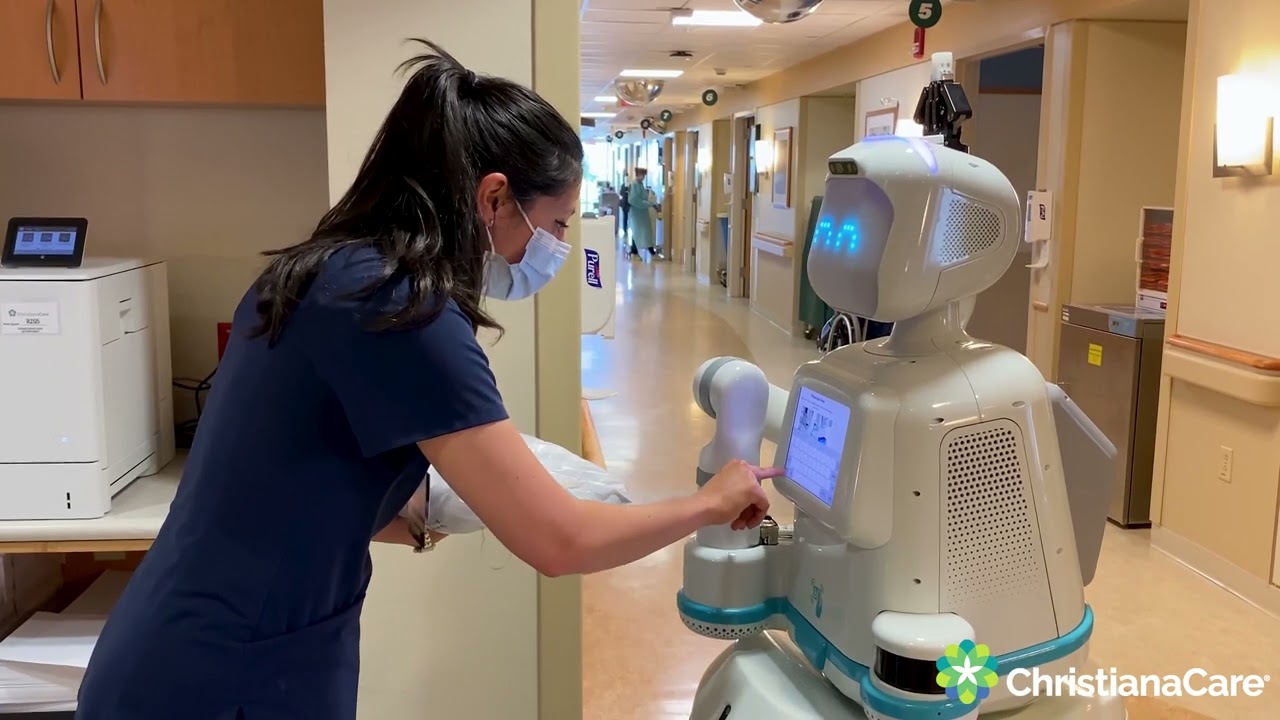
ChristianaCare is the first health system in the Philadelphia region piloting an innovative tool called Moxi, a collaborative robot — or “cobot”— that can assist in the hospital by making deliveries and performing other non-clinical tasks so that nurses and other clinical staff can spend more time focused on what they do best—caring for patients. With a landmark $1.5 million grant from the American Nurses Foundation, ChristianaCare will deploy a total of five Moxi cobots at Christiana Hospital. It is the largest single grant in the history of Nursing at ChristianaCare. Research published in the Journal of Nursing Management shows that nurses spend a significant amount of time — up to 33% of their shifts — on time-consuming but simple tasks such as dropping off lab specimens, collecting supplies or picking up medications from the pharmacy. By taking over these time-consuming but simple tasks, Moxi enables nurses to focus on patient care, where their skills are most needed. “Nurses need the time and space to deliver care and patient education at the top of their license,” said Ric Cuming, Ed.D., MSN, RN, NEA-BC, FAAN, chief nurse executive and president, ChristianaCare HomeHealth. “Moxi will be doing those hunting and gathering tasks such as getting equipment and supplies, which nurses are doing today but don’t need to be doing.” Cobots are designed to share workspace and interact directly with people. In ChristianaCare’s initiative, the Moxi cobots will be integrated with the Cerner Corporation electronic health record (EHR) platform and use artificial intelligence to proactively identify when nurses will need equipment, supplies, medications and lab tests. The Moxi cobots will be deployed to 11 inpatient units, partnering with more than 400 nurses. The American Nurses Foundation grant will enable ChristianaCare to evaluate the impact of cobots on nursing practice with the goal of scaling the technology if successful. “Moxi is not a replacement for a nurse or nursing position — or any position,” Cuming said. “It is an additional resource for nurses and their teams. “With robotic technology, we are using resources wisely and effectively, creating more efficient workflows, reducing repetitive tasks and freeing up nurses’ time for the complex clinical work that they excel at doing.” Reimagining Nursing ChristianaCare is one of 10 grant recipients from the American Nurses Foundation Reimagining Nursing (RN) Initiative. “We are proud that the American Nurses Foundation has the confidence in bold nurse-led ideas that will lead to large-scale, replicable change,” said Katherine Collard, MS, RN-BC, chief nursing informatics officer at ChristianaCare. “This grant will support nurses at ChristianaCare and our nursing colleagues across the nation in realizing their full potential, giving them the tools, resources and power to improve health care now and in the future.” With the American Nurses Foundation grant, ChristianaCare will conduct research on driving nursing outcomes through robotics. “We have a transformative opportunity to generate new knowledge and to move the science forward around robotics in nursing and in health care,” said Susan Birkhoff, Ph.D., RN, nurse scientist at ChristianaCare. “Through research, we will study Moxi’s impact to nursing caregivers that will have broad implications for nursing practice, workforce and education,” she said. ChristianaCare began exploring the potential of robotics to support Nursing with two Moxi cobots acquired in February, funded through the generosity of donors including Good Samaritan, Inc. and E.J. “Woody” Rice. With the grant, said Birkhoff, ChristianaCare will take Moxi to the next “bold frontier,” adding three more cobots with the goal of automating and optimizing nurses’ workflow without interrupting care. With five total cobots, ChristianaCare will be home to the largest number of Moxi robots in health care. The Little Bot That Can Before Moxi can become fully part of the care team, it must learn to navigate the hospital and respond to the nurses’ needs. Using artificial intelligence, Moxi is mapping out Christiana Hospital through sensors and other machine-learning technology so that the cobots can ultimately navigate and work autonomously. “When the Moxi cobots are fully integrated, we anticipate that they will complete up to 200 delivery tasks a day,” Collard said. “By making point-to-point deliveries, Moxi can save nurses hours of time and thousands of steps.” Designed to be compatible with the busy environments of hospitals, Moxi’s features include: Social intelligence: Moxi won’t bump into people or objects in hallways, waves when it sees someone new and happily poses for selfies. Mobile manipulation: Moxi can learn to use its robotic arm to operate existing automatic doors and elevator panels. Human-guided learning: The more Moxi is used, the more Moxi learns and adapts to the environment and specific ways of doing things. Friendly and safe design: With heart-shaped eyes and a friendly appearance, Moxi is designed to navigate safely and get the job done so nurses can focus on patient care. “What Moxi is doing in health systems like ChristianaCare is really transforming the way we think about health care and allowing staff to focus on the people in the hospital as opposed to the tasks,” said Dr. Andrea Thomaz, CEO and co-founder of Diligent Robotics, which created Moxi. “Robots are not something way in the future. Our robots work side-by-side with humans to ease the stress and workload of one of the most demanding jobs in society, nursing. The partnership between Diligent and ChristianaCare shows that the future is now.” Hospital Helper Directly from the Cerner EHR, Moxi will be able to anticipate clinician and patient needs and perform tasks without human involvement. Examples could include: Delivering items to patients based on nurses’ order requests. Making rounds across units to deliver lab samples on collections completed in the electronic health record. Making just-in-time deliveries of pharmaceuticals not stocked on the floor. Prioritizing tasks based on the nursing workload in a unit, so that the busiest nurses will get help first. “Connecting Moxi to the existing technology that clinicians use on a daily basis is key to making it easier to anticipate needs so clinicians can spend more time on patient care,” says Eva Karp, DHA, MBA, RN-BC, senior vice president, chief clinical and patient safety, Cerner. “Moxi could make a real difference in a nurse’s day — alleviating burnout and staffing shortages, which have become especially prevalent since the pandemic.” Incorporating the electronic health record into Moxi is part of the study funded by the American Nurses Foundation. “It’s absolutely in the best interest of our patients that Moxi can work alongside nurses so we can spend more time working directly with our patients to do what we do best,” said Pam Owen, MSN, RN-BC, nurse manager on 7E, one of the pilot units. “And Moxi brings a smile to people’s faces.” Fast Facts About Moxi Works in 22-hour shifts. Needs only two hours of charging time. Weighs about 300 pounds. Can carry a total weight of 70 pounds. Gender-neutral. Pronouns are “it” for a single Moxi cobot and “they” for more than one. Named one of America’s Greatest Disruptors in 2021 by Newsweek and one of the Best Inventions of 2019 by Time Magazine. About ChristianaCare Headquartered in Wilmington, Delaware, ChristianaCare is one of the country’s most dynamic health care organizations, centered on improving health outcomes, making high-quality care more accessible and lowering health care costs. ChristianaCare includes an extensive network of primary care and outpatient services, home health care, urgent care centers, three hospitals (1,299 beds), a freestanding emergency department, a Level I trauma center and a Level III neonatal intensive care unit, a comprehensive stroke center and regional centers of excellence in heart and vascular care, cancer care and women’s health. It also includes the pioneering Gene Editing Institute. ChristianaCare is nationally recognized as a great place to work, rated by Forbes as the 2nd best health system for diversity and inclusion, and the 29th best health system to work for in the United States, and by IDG Computerworld as one of the nation’s Best Places to Work in IT. ChristianaCare is rated by Healthgrades as one of America’s 50 Best Hospitals and continually ranked among the nation’s best by U.S. News & World Report, Newsweek and other national quality ratings. ChristianaCare is a nonprofit teaching health system with more than 260 residents and fellows. With its groundbreaking Center for Virtual Health and a focus on population health and value-based care, ChristianaCare is shaping the future of health care.



Studying glaciers . . . from Florida
By Emma Richards On the surface, the University of Florida seems an unlikely place to find cutting-edge research on ice sheets. But Emma “Mickey” MacKie says this is the perfect place for her work — thanks in large part to HiPerGator, one of the fastest supercomputers in higher education. MacKie, an assistant professor of geological sciences and glaciologist, joined UF in August 2021 and said her decision hinged largely on access to HiPerGator and the university’s focus on machine learning and artificial intelligence technologies. MacKie uses machine learning methods to study subsurface conditions of glaciers in polar regions and access to a powerful supercomputer is crucial given the large data sets her research generates. “I'm very happy to be in a place with lots of people who are working on different types of problems and are interested in developing these different tools,” MacKie said. “There are a number of members of my department in geology who are studying glacial geology through different lenses. And so, there's all of this complementary geological and machine learning knowledge at UF that I'm very excited to bring together.” MacKie has set up the Gator Glaciology Lab, where she and a team of seven undergraduate students from the fields of geology, computer science, physics, math and data science are using AI to analyze what lies beneath glaciers and how they are moving and melting. “Our work is part of a bigger effort in the glaciology community to start working on quantifying our uncertainty in future sea-level rise projections so that we can give policy makers this information.” It’s a very difficult challenge, MacKie said, because of limited access to polar regions and the miles-thick ice covering the ground. Then there is the scale of ice sheets; Antarctica, for example, is the size of U.S. and Mexico combined. Measurements of the topography below such glaciers are gathered using radars mounted on airplanes to “see” through ice. Her team then uses HiPerGator to simulate realistic looking topography in places where there are gaps or blank spots in the measurements. They generate hundreds of maps to represent different possible ice sheet conditions, which could be used to determine numerous possible sea level rise scenarios. “Our work is part of a bigger effort in the glaciology community to start working on quantifying our uncertainty in future sea-level rise projections so that we can give policy makers this information,” she said. Earlier this spring, MacKie swapped out her flip-flops for snow boots to study subsurface glacial conditions in Svalbard, which is next to northeastern Greenland. Visiting Svalbard will help her test and develop data collection and analysis techniques that could be applied to Antarctica or Greenland, which both contain large ice sheets that could have serious environmental impacts if they experience significant melting. In Svalbard, MacKie and Norwegian researchers from the University of Bergen and the University Centre in Svalbard took seismic and radar measurements of glaciers that will be used to make estimates about conditions beneath the ice. Among glaciers of concern is the Thwaites “Doomsday Glacier,” which is losing the most ice of any glacier in Antarctica. There are signs showing Thwaites’ ice shelf could start to break in the next few years. MacKie said it will likely be a few hundred years before the glacier could undergo significant collapse and jeopardize the West Antarctica Ice Sheet, leading to several meters of sea level rise. The effects of Thwaites and other ice sheet melts in Antarctica and Greenland will become apparent in decades to come, with the potential for a meter of sea level rise by the end of the century, which MacKie and other researchers hope to predict more accurately. “The state of Florida has the most to lose when sea level rises,” she said in an episode of the From Florida podcast. “And so, I think we have a lot of skin in the game and it’s really important to be studying this question here in Florida.” To hear more about MacKie’s work, listen to From Florida at this link.


Meet the astrobiologist and her students who are searching for life on Mars
By Emma Richards, University of Florida From a young age, Amy Williams wondered if life existed beyond Earth amidst the dark abyss of space, stars and planets — a curiosity that years later landed her a career researching and exploring Mars. Williams, an assistant professor of geology and an astrobiologist at the University of Florida, works as a participating scientist on the Perseverance and Curiosity Rover Science Teams and previously served as a postdoctoral research associate at NASA’s Goddard Space Flight Center. As an astrobiologist and geobiologist, she uses techniques from geology, microbiology and chemistry to search for life beyond Earth. “Even as a little kid watching meteor showers with my family, I wondered if there was someone out there in the stars looking back at Earth.” “Even as a little kid watching meteor showers with my family, I wondered if there was someone out there in the stars looking back at Earth,” she said in an episode of the From Florida podcast. “It’s been a passion of mine my whole career and now it’s the most amazing opportunity to serve on both of the active Mars rover missions.” Williams’ journey to Mars began as a graduate student when a research professor gave her the opportunity to work on the NASA Curiosity mission. From there, Williams built her way up and is now a participating scientist working on day-to-day rover operations. Williams also is opening doors for graduate students at UF to work on Mars research, helping upcoming generation of scientists follow her path. She is specifically interested in involving women and underrepresented groups in her work. Based on her research, Williams said life on Mars, if found, will likely look less like Marvin the Martian and more like microbial life similar to bacteria on Earth. Curiosity landed on Mars in 2012 and Perseverance landed in 2021. The rovers are searching for potential life on Mars by going to habitable environments and searching for evidence of water and essential elements that could supported such life forms. Curiosity has spent nearly its entire mission exploring a large five-kilometer-tall mountain in Gale Crater known as Mount Sharp. The scientists can see Mars’ history and climate based on changes in the chemistry and sediments of the mountain. As for Perseverance, the rover is exploring Jezero Crater, with emphasis on its delta, a geologic deposit that is formed when water from a river flows into a lake. Perseverance will help collect rock and sediment samples from Mars that will be the first brought back to Earth. NASA is also working on a program to eventually send humans to Mars, which will likely take many decades; the first stage in the project will be returning humans to the Moon. “But in the meanwhile, these robots, these rovers that we send to the red planet, they are our proxy,” Williams said. “And looking through the robot rover’s eyes, the images that are returned to us, I recognize this is the closest I will ever be to standing on Mars and looking up at these beautiful geological units, looking up at an alien world that’s so familiar because the tenets of geology apply on Mars, the same as they do on Earth.” To hear more about the Amy Williams' Mars research, listen to the episode on From Florida at this link. Listen to other episodes in the "From Florida" series at this link. To learn more about her work, watch this video featuring Professor Williams:


Expert Opinion: Understanding Whiteness to Understand White Supremacy
In the aftermath of last week's tragic shooting in Buffalo, many have described the violence as representative of a mental health crisis, growing extremism, hatred, and bigotry, likening manifestos left by shooters as the racist rhetoric of radicalized individuals. "But that conclusion is a pleasant fiction," writes Matthew Hughey -- a professor of sociology at UConn and a renowned scholar of racism and racial inequality in identity formation, organizations, media, politics, science, religion, and public advocacy -- in a powerful new essay for Slate. As part of his work as a researcher, Hughey examines the manifestos of white-supremacist shooters as well as their intersection with race, knowledge, media, power, religion, and science. To understand white supremacy and the violence it precipitates, Hughey explains, we need to first understand whiteness: The category of whiteness, like “race,” is a biological fiction with a social function. Whiteness emerged early in American history to rationalize exploitation. Early American colonists were slow to develop racial worldviews. But by the mid-1600s, philosophers and scientists like Bernard Varen, John Ray, and François Bernier began to publish ideas about African savagery and European civilization, which were progressively applied to resolve who should be the rulers versus the ruled. These ideas were codified into our legal system. In 1662, for instance, British statutory law conferred slavery with a biological status: Any child born to an enslaved woman would also be a slave. Over time, through a series of laws and social mores, a hierarchy that conferred legal privileges to “white” men, while stripping Black people and Native Americans of their humanity and standing in the legal and political arenas, was cemented. Put another way, whiteness is not an inherent identity so much as a consolidation of lofty biological, legal, and theological notions that serve to buttress the social and political power of people bearing lighter skin. As W.E.B. Du Bois points out in his 1920 essay “The Souls of White Folk,” whiteness is a modern concept: "The discovery of personal whiteness among the world’s peoples is a very modern thing. … The ancient world would have laughed at such a distinction. … This assumption that of all the hues of God whiteness alone is inherently and obviously better than brownness or tan leads to curious acts. … I am given to understand that whiteness is the ownership of the earth forever and ever, Amen! Now what is the effect on a man or a nation when it comes passionately to believe such an extraordinary dictum as this?" The effect is a Faustian bargain. And as a result, whiteness exists in a state of perpetual social anxiety. White people are taught that their biological, cultural, and/or God-given nature is to be “inherently and obviously better” than people of color and to have “ownership of the earth.” These ideals are, of course, so lofty that they are unachievable. Discontent is inevitable. Whiteness is a deal with the devil. Consequently, white people move neither into nor out of moments of racial anxiety, nor do they—despite the popularity of the cliché—experience flashes of “white fragility.” Whiteness does not wax or wane relative to racial pressures, cracking to expose either reactionary political movements or even the occasional mass shooting. Rather, whiteness is an omnipresent imbroglio; it cannot live up to the greatness it assumes it can naturally realize. Reconciling the peril that results from the inability to fully manifest white power necessitates a scapegoat. And so the crisis of whiteness is continually externalized onto racial “others.” This helps to explain why an increasing number of white people now believe they have been cheated out of their birthright—an inheritance of domination stolen by people of color. White nationalism and supremacy could not function under absolutist apartheid; it is an ideology and practice that requires the presence of people of color to justify its own shortcomings. White peril and white power go hand in hand. Professor Hughey is available for interviews -- click on his icon to contact him today.


Expert opinion: Why aren't mass shootings considered acts of terrorism?
With tragic news of a mass shooting in Buffalo this past weekend, and along with it evidence that the massacre was racially motivated, some leaders and citizens alike are calling to have this crime considered an act of terrorism. Though that may be the immediate reaction of some, Augusta University's Dr. Lance Hunter, associate professor of political science in the Katherine Reese Pamplin College of Arts, Humanities, and Social Sciences, explains why there's a lot to consider before rushing to brand an action as terrorism. “We argue that it’s very important to consider these acts of domestic terrorism if they fit the definition, because it’s easier for governments to monitor individuals that may possibly carry out these attacks,” said Hunter. “Looking at the incident in Buffalo, in my estimation and based on the evidence that I’ve seen, it fits all the criteria to be considered a form of domestic terrorism.” If that's the case, then why are people reluctant to consider mass shootings an act of terrorism? “I think individuals at times tend to have a preconception that terrorism tends to be something that’s carried out by ISIS or Al Qaeda, or a group of organizations such as that, and if it’s an individual outside of those organizations, it may not be considered terrorism. But when you look at the actions, they clearly fit the criteria for terrorism. Secondly, I think it’s the form of the attack type that does matter a lot, regarding people’s perceptions.” When it comes to domestic terrorism, what about privacy rights? What about an invasion of privacy? "We’re not arguing to create a policy saying we are constantly monitoring people for no reason at all," said Hunter. "What we’re arguing is someone who’s showing extremist tendencies and then also a tendency to possibly violently harm people, are there warning signs? In a lot of cases of mass murders, there are warning signs. If these individuals are monitored more closely, it’s not 100% guarantee these attacks will be prevented, but the likelihood will be much greater it could have possibly been prevented and we’ve seen this throughout a lot of cases and our research.” Dr. Lance Hunter is an assistant professor of political science with a background in international relations. His research focuses on how terrorist attacks influence politics in democratic countries and how political decisions within countries affect conflicts worldwide. Hunter is available to speak with media about this important topic - simply click on his icon to arrange an interview today.


UConn Expert Weighs In On 'What Drives a Black Mass Shooter?'
“We would be missing a critical moment," says Dr. Wizdom Powell, "for us to look at the systems that we have set up and ask ourselves, are we serving every person who has a mental health need well, and if we’re not, what are we going to do about it?” Director of the Health Disparities Institute and associate professor of psychiatry at UConn Health, Dr. Powell studies the impact of modern racism and gender norms on African American male health outcomes and healthcare inequities. In a recent interview with the Amsterdam News following a mass shooting incident involving an alleged Black suspect, Dr. Powell weighed in the ways in which implicit racism can frame how law enforcement classifies shootings, the importance of deconstructing harmful racial and gender stereotypes, and the delivery of mental health services to communities and individuals in need: “When you call something gang violence, I think people’s empathy goes down to zero because they think those people are killing themselves,” said Powell. “You know, it’s their problem. Nevermind the victims.” Powell said that in the event of a mass shooting incident there is usually a “sympathy” conveyed for a person as a “complicated human” as opposed to a person of color who was involved in a gang shooting. “When do you get a full picture of that person? Who they were as a child, all of the traumas they experienced, their lack of resources,” said Powell. Powell thinks there’s a conflation in general between individuals who are mentally ill and those who commit mass shootings. She said mass shootings are a massive public health crisis with many factors contributing, with mental illness being one of many. ********** Powell said that the emotionality or interior lives of Black men are always spoken about with an undue amount of concentrated attention on their anger. She strives to deconstruct the stereotype of the ‘angry Black male.’ She said that there is a prevailing presumption that anger is somehow bad or pathological when it’s actually a legitimate response to emotional suffering and injustice. So when an incident that fits the stereotype of the ‘angry Black male’ occurs, people hyper focus on it because it confirms their bias. “I think there is a disproportionality in our reporting about these incidents by race,” said Powell, “we also tend to paint the picture of these shooters more sympathetically, when the shooters are non-Hispanic white males as opposed to males from other socially marginalized groups.” In the 1960s, said Powell, there was a shift in the way that the field of psychology and psychiatry viewed Black men and their symptomatology while civil rights protests were erupting around the country. Prior to the ’60s “middle class, white housewives” were diagnosed with schizophrenia more often, but there was a sharp uptick among Black males afterwards. “Again, reminiscent of an earlier time where Black people’s quest for liberation was pathologized,” said Powell. Powell said that health and science is still at the “tip of the iceberg” in identifying symptoms of depression in Black men. She said her studies have found that societal racism or experiencing racism or secondary traumas of racial reckoning is definitively at the root of Black and Brown male depression. Dr. Powell is available to speak with media – simply click on her icon now to arrange an interview today.

Disney and other corporations are being pushed into social and political battles
At one time, corporations didn't get get in the middle of social and political battles, according to David Primo, professor of political science and business administration at the University of Rochester. The Disney Corporation recently came out in opposition to Florida's "Don't Say Gay" law, and Primo says it was "dramatic" how quickly the state responded by removing the company's self-governing special district status. As Primo sees it, increased political polarization across the country is leading employees, consumers, and activists to push corporations to take positions on issues like police brutality and LGBTQ rights. The irony, though, is that Americans are polarized over whether corporations ought to be doing this. "In general, Democrats are highly supportive of this, and Republicans are not," says Primo. "It's pretty straight forward to think that a corporation ought to be taking positions on issues related to its core business operations," says Primo. "The challenge for an executive, who has a fiduciary responsibility to the company, is knowing where to draw the line." So, if a company stakes out a position, Primo says it's just as likely to alienate a significant portion of its consumer base, as it is to gain the support of another portion of its base.


Aston University experts to take part in Pint of Science 2022
Pint of Science, the world’s largest festival of public science talks, will run from 9 – 11 May Experts from universities, including Aston University, will take part across 32 UK cities Aston University academics will appear in front of audiences at Birmingham venues: The Woodman, Grain & Glass and Café Artum at Hockley Social Club. Tickets have gone on sale for Pint of Science 2022 which is returning on its 10th anniversary. The festival will bring thousands of scientists and their research out of the lab and into our pubs, cafes and community halls from 9 to 11 May 2022. Experts from universities in Birmingham including Aston University, Birmingham City University and University of Birmingham, will take part in 16 events across the city. The festival will take place in 32 UK cities, with events in hundreds of cities across 25 countries. Each event will provide a unique line up of talks, demonstrations and live experiments, held in a relaxed and informal environment. Aston University academics taking part in Pint of Science will appear in front of audiences at a number of Birmingham venues, including, The Woodman, Grain & Glass and Café Artum at Hockley Social Club. They will host talks on topics around the Pint of Science themes of: Beautiful Mind; Atoms to Galaxies; Our Body; Planet Earth; Tech me out; Our Society. Seven Aston University experts are leading talks including ‘The science of swearing’, ‘How much microplastic is in your pint: does it matter?’ and ‘How facial expressions guide our eating behaviour’. Dr Robbie Love, a lecturer in English at Aston University, who is taking part in Pint of Science 2022 and who is hosting a talk about the science of swearing said: “I am really looking forward to an evening of linguistic libations at Café Artum for Pint of Science 2022. “Swearing might seem like a bit of fun, but the science behind swearing shows us that it plays a really important role in human communication. Plus, I’m looking forward to hearing everyone’s favourite swear words!” Katie Edwards, a PhD student at Aston University who is taking part in Pint of Science 2022 said: “I am really looking forward for this year’s Pint of Science festival to chat about eating behaviour. “I will be talking about how other people's food enjoyment can impact our eating. “It is a great opportunity to hear about current scientific research whilst relaxing with a drink.” You can find out more about full line up of events in Birmingham, which includes experts from the University of Birmingham and Birmingham City University, here.


Expert Perspective: New Proposal to Use Southern Plantations to Teach Kids About Racism
America's history is steeped in racism - and how the country accepts and reconciles its past has been a topic of much debate and consideration. Last year, Georgia Southern University Associate Professor of Geography Amy Potter, Ph.D., was awarded a $75,000 National Science Foundation grant for the project, “The Role of Museums in the Landscape of Minority Representation.” And recently, she co-authored a fantastic piece titled, New Proposal to Use Southern Plantations to Teach Kids About Racism, that has been getting a lot of pick-up from news organizations across the country. New Proposal to Use Southern Plantations to Teach Kids About Racism State legislatures across the United States are cracking down on discussions of race and racism in the classroom. School boards are attempting to ban books that deal with difficult histories. Lawmakers are targeting initiatives that promote diversity, equity and inclusion in higher education. Such efforts raise questions about whether students in the U.S. will ever be able to engage in free and meaningful discussions about the history of slavery in America and the effect it had on the nation. As cultural geographers, we see a potential venue for these kinds of discussions that we believe to be an overlooked and poorly used resource: plantation museums... April 02 - Yahoo!News If you're a reporter looking to know more about this important topic - then let us help with your coverage and stories. Amy Potter, Ph.D., is available to answer your questions - simply reach out to Georgia Southern Director of Communications Jennifer Wise at jwise@georgiasouthern.edu to arrange an interview today.


Why pollen season arrives earlier each year: Q&A with Georgia Southern biology professor Alan Harvey
As a seasonal allergy sufferer, Alan Harvey, Ph.D., biology professor in Georgia Southern University's College of Science and Mathematics, was curious what types of pollen were causing his sniffles and sneezes. As a scholar and educator, Harvey did what any curious mind would do — he began exploring the types of pollen in the region while trying to narrow down the culprit of his symptoms. What he didn’t expect to find was an interesting narrative that led to a collaborative art-science project and soon a full exhibit on pollen at the Georgia Southern Museum. Read on to learn more about Harvey’s research on pollen, upcoming exhibit, “Pollen Nation,” and why pollen season begins earlier each year. Q: Tell us about yourself — Who are you? What do you teach? How long have you been a professor here? A: I’m a professor and faculty member at Georgia Southern. This is my 23rd year here and I teach a variety of biology courses including field biology, invasive species and evolutionary ecology. Q: How long have you studied pollen and what interested you in studying this? A: I’ve not actually studied pollen for that long. I really wanted to figure out how to deal with my own severe allergies to it. Q: What is the most common pollen in our region? A: The most common pollen depends on the time of year. Any plant that produces flowers will produce pollen. But if you’re looking at a plant with nice, pretty flowers, that pollen is not going to be what you’d normally encounter or notice causing your allergies because that pollen is being transmitted by insects or other pollinators who are specifically being attracted by the pretty flowers. The kind of pollen that you do encounter is from plants that you wouldn’t even notice have flowers like pine, oak, maple and birch trees. Those are all wind-pollinated, so they don’t need pretty flowers. They’re not trying to attract anybody, they just have to produce a lot of pollen for the wind to blow around. This time of year, pine and oak are going to be the two common pollens. Q: When does pollen season usually begin in our region? A: It starts in the early spring and ends in late fall. And again, it’s different plants blooming during the course of that year. So this time of year, as I mentioned, is going to be pines and oaks. In the middle of the year, it will be more grasses, and toward the end of the year, it’s going to be things like ragweed. What scientists have discovered is that every year the pollen season starts earlier and lasts longer. Q: Why will it begin early this year? A: This is where we get into a sort of controversial subject, but basically, climate change issues are the main culprit in a couple of ways. First of all, plant growth is tied to temperature. So the earlier temperatures get warmer, the earlier in the year the plant is going to start actively growing and producing pollen. So, warmer temperatures are leading to earlier seasonal starts. Temperatures are warmer than they were at this time a few decades or 100 years ago. Q: Why is pollen important? A: It’s an essential component of sexual reproduction in plants, so in the absence of pollen, we would lose many, if not virtually all of the plants around us that we depend upon. It’s fundamentally important to life on Earth that those plants are able to continue to reproduce. In terms of its impact on known pollinators, when a bee visits a flower, it is, of course, looking for nectar that the plants produce, but they also are looking for pollen. So it’s a food source for a lot of animals as well. Q: What is an interesting fact or little-known fact about pollen? A: Pollen plays a role in some various religious ceremonies of other cultures. The one I’m most familiar with is in the Navajo Nation. In particular, corn pollen is at the core of a great many, if not virtually all, of the Navajo religious ceremonies. It’s also been used to solve crimes and there is a whole field of forensic pollen analysis. It’s also an important tool for paleontologists, anthropologists and archaeologists who are trying to understand past civilizations. Because pollen is incredibly resilient, it may be small, but it is darn near indestructible. You would need a pretty powerful microscope to see any of these, but with that tool, you can study pollen grains that are hundreds of millions of years old. They will last that long. They’re so, so tough. Q: Tell us about the new mural in the Biological Sciences Building — What inspired it? Who helped work on it? A: A number of years ago, a colleague in the Betty Foy Sanders Department of Art, Jeff Shmucki, and his wife Wendy Deschene and I came together and started collaborating on art-science projects because we realized we both are observers of the natural world, we just approach it from somewhat different ways. One of those projects was creating a mural of ecologically or environmentally important organisms surrounding students that they may not be aware of. For the first mural, we looked at salamanders of Georgia. We got a bunch of photographs of the salamanders and we cut them away from the background, blew them up and installed the murals. It was a big community project and students got involved in all phases of it. So I thought, ‘Well, that was really successful.’ What can we do next? And because I was in the middle of allergy attacks, I thought, ‘Well, what about pollen?’ Q: Tell us how the mural inspired your upcoming exhibit, “Pollen Nation,” at the Georgia Southern Museum. A: There are a lot of interesting layers to this basic idea of pollen that can’t really be shown in a mural, and the Georgia Southern Museum is a perfect place to explore those kinds of ideas in one common theme. Q: What can people expect to see at the “Pollen Nation” exhibit? A: There’ll be a lot of big, spectacular images of pollen and the plants that produce them. It’s going to be a mix of striking imagery and some interactive sort of game-like activities. You’ll also have the opportunity to look at some of the pollen in a microscope. Interested in learning more? Let us help. Allan Harvey, Ph.D., is available to answer your questions - simply reach out to Georgia Southern Director of Communications Jennifer Wise at jwise@georgiasouthern.edu to arrange an interview today.