
Experts Matter. Find Yours.
Connect for media, speaking, professional opportunities & more.

Belief in the ‘Prosperity Gospel’ Does Not Turn People into Successful Entrepreneurs
But the belief that God financially rewards the faithful can fuel values linked to entrepreneurial thinking, Baylor University study finds Belief in the “Prosperity Gospel” — that God financially blesses faithful followers — does not turn individuals into successful entrepreneurs. But prosperity beliefs can fuel values linked to entrepreneurial thinking, such as power and achievement, according to a Baylor University study. However, researchers found no direct relationship between prosperity beliefs and willingness to take risks, and little connection to recognizing opportunities. Risk-taking and identifying opportunities are typical traits of entrepreneurs, according to the national study. “As revealed in our findings, a belief that God will provide financial benefit to the faithful is not enough to push someone to launch a business,” said lead author Kevin D. Dougherty, Ph.D., associate professor of sociology in Baylor’s College of Arts & Sciences. “The relationship between prosperity beliefs and starting a business is indirect and inconsistent.” The study — Prosperity Beliefs and Value Orientations: Fueling or Suppressing Entrepreneurial Activity” — is published in the Journal for the Scientific Study of Religion. For the study, researchers analyzed data from a nationally representative survey of 1,066 working adults. Their goal was to connect prosperity beliefs, human values, entrepreneurial attitudes and entrepreneurial action. They found that values — both by themselves and in conjunction with religious beliefs — are important predictors of how and whether individuals might launch a business. Participants responded to a three-item scale to measure beliefs that faith and faithful behavior lead to success at work and in business. The items included: “God promises that those who live out their faith will receive financial success;” “Believers who succeed in business are evidence of God’s promised blessing;” and “I believe faithful believers in God receive real financial benefits in this life.” Participants also responded to questions relating to The Theory of Basic Human Values, which recognizes such universal values as openness to change, achievement, security, power and benevolence. In general, “entrepreneurs tend to think differently than non-entrepreneurs, prizing achievement and self-direction while downplaying tradition and conformity,” said co-author Mitchell J. Neubert, Ph.D., professor of management in Baylor’s Hankamer School of Business. Value orientations of self-enhancement and openness to change are associated with recognizing opportunities and taking risks — entrepreneurial behaviors that correlate with creating new businesses. While prosperity beliefs by themselves show little direct impact on entrepreneurship, they do influence the impact of values and attitudes related to creating a business. Prosperity beliefs can strengthen the relationship between self-enhancement values and opportunity recognition, but they seem to reduce the relationship between openness to change and willingness to take risks. Another significant finding pertains to gender. Men and women who accept prosperity beliefs are no different in their willingness to take risks or start businesses, said co-author Jerry Z. Park, Ph.D., associate professor of sociology in Baylor’s College of Arts & Sciences. In general, risk-taking and business startups are more common among men. The study also shows that education and experience are key predictors of entrepreneurship, but those resources may be difficult to acquire for some prosperity believers because of social and economic circumstances. While individuals in that group have hope, it seems contingent on divine action rather than human action, Neubert said. “Can prosperity preachers Joel Osteen and T.D. Jakes save the U.S. economy? Probably not. But nor are they damning it,” Dougherty said. “The type of positive, self-help gospel they preach can enhance specific value orientations that are related to entrepreneurial thinking and entrepreneurial behavior.” *The research was supported by a National Science Foundation grant. ABOUT BAYLOR UNIVERSITY Baylor University is a private Christian University and a nationally ranked research institution. The University provides a vibrant campus community for more than 17,000 students by blending interdisciplinary research with an international reputation for educational excellence and a faculty commitment to teaching and scholarship. Chartered in 1845 by the Republic of Texas through the efforts of Baptist pioneers, Baylor is the oldest continually operating University in Texas. Located in Waco, Baylor welcomes students from all 50 states and more than 90 countries to study a broad range of degrees among its 12 nationally recognized academic divisions. ABOUT THE COLLEGE OF ARTS & SCIENCES AT BAYLOR UNIVERSITY The College of Arts & Sciences is Baylor University’s oldest and largest academic division, consisting of 25 academic departments and seven academic centers and institutes. The more than 5,000 courses taught in the College span topics from art and theatre to religion, philosophy, sociology and the natural sciences. Faculty conduct research around the world, and research on the undergraduate and graduate level is prevalent throughout all disciplines. Visit www.baylor.edu/artsandsciences.





Georgia Southern researchers find adverse childhood experiences associated with short sleep duration
Georgia Southern University professors from the Jiann-Ping Hsu College of Public Health (JPHCOPH) recently completed a study that shows adverse childhood experiences are associated with short sleep duration in adults. Recently, the study was published in SLEEP, the benchmark international journal for sleep and circadian science. The JPHCOPH team looked at nationally representative data from 22,403 adults. Participants in the study who had adverse childhood experiences were more likely to have short sleep duration (less than 6 hours per night) than those without such experiences. Each adverse experience increased the likelihood of insufficient sleep by over 20%, and the association remained throughout adulthood. The study participants were part of the 2011 Behavioral Risk Factor Surveillance System, conducted by the Centers for Disease Control, in which they completed questionnaires detailing childhood experiences of abuse, neglect and household challenges as well as how many hours they sleep nightly as adults. Short sleep duration was not accounted for by mental health challenges or poor physical health, which suggests there are different underlying causes. Over 60% of adults in the U.S. report having experienced at least one adverse childhood experience. The results emphasize the importance of childhood neurodevelopment on long-term health outcomes. Also, the data provides new information on how long adverse childhood experiences may affect sleep and calls for further investigation of the role of childhood experiences in people with sleep challenges. Do you need to know more? Are you looking at stories or to cover how adverse childhood experiences impact sleep and how the long-term effects can follow that individual into adulthood? Let our experts help. Kelly Sullivan, Ph.D., is an expert in epidemiology and neurological diseases and Haresh Rochani, DrPh, is the director of the Karl Peace Center for Biostatistics in the Jiann-Ping Hsu College of Public Health at Georgia Southern University. Both experts are available to speak to this topic – simply click on either icon to arrange an interview.


Cybersecurity – Is it finally getting the attention it deserves? Ask our experts!
It’s been talked about, dominated the news and has cost some companies billions – but it seems like finally America’s leaders are taking the issue of cybersecurity seriously. With an election looming and non-stop threats coming from enemies near and afar, it seems like America’s leaders are now on side in the battle against cybersecurity. Last week President Trump signed an executive order directing the creation of programs to grow and strengthen our cybersecurity workforce to meet the challenges of the 21st century. “America built the internet and shared it with the world; now we will do our part to secure and preserve cyberspace for future generations.” President Donald J. Trump It’s a lofty goal – and odds are an expensive one, but will it work? Who are the chief actors behind potential cyber-attacks? What are the key targets? What are the costs to secure America’s cyber-territory? And more importantly, what are the consequences if we do not? There are a lot of questions out there and that’s where out experts can help. Dr. Seth Hamman earned his Ph.D. in computer science with an emphasis in cybersecurity at the Air Force's graduate school, the Air Force Institute of Technology, located at Wright-Patterson Air Force Base. As a researcher he is interested in helping to shape the young and growing discipline of cybersecurity education. Contact him today for your story! Simply click on his icon to arrange an interview.

Working together to promote veteran education
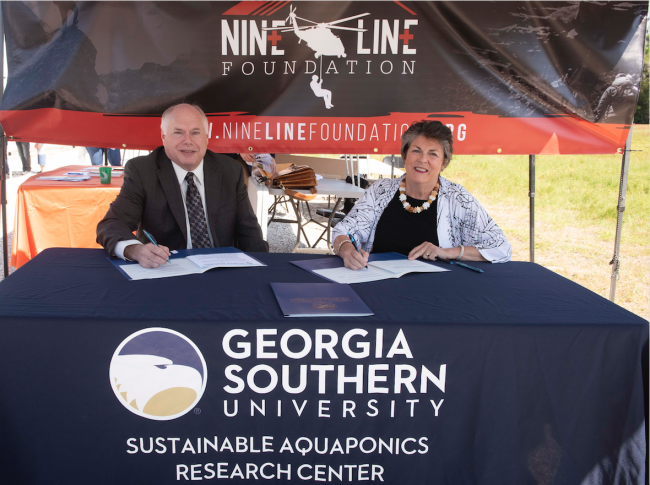
Georgia Southern University recently signed an agreement (see attached) with Nine Line Foundation that will assist veterans as they transition back into civilian life. Veterans will be enrolled in an aquaponics training program with the University’s Armstrong Campus’ Sustainable Aquaponics Research Center (SARC) at a compound at Nine Line Apparel in Savannah, Georgia. Aquaponics, or soilless farming, mixes aquaculture, the farming of fish, and hydroponics, to fuel the growth of plants in water. The SARC, a 4,100 square-foot greenhouse, has four independent recirculating systems, each containing 900-gallon tanks capable of holding more than 100 mature tilapia. Working within the College of Science and Mathematics, the SARC is focused on providing students, faculty and volunteers with the opportunity to conduct fundamental, interdisciplinary research in the area of aquaponics. The partnership with Nine Line Foundation will extend education opportunities to area homeless veterans and provide faculty and students an opportunity to engage with the veterans. Are you interested in learning more about his project and how Nine Line Foundation and Georgia Southern University are working together to provide opportunities and training to veterans? SARC’s director, Brent Feske available to speak with media – simply click on his icon to arrange an interview.


Just how big of a deal is AI? At this year’s Directions 2019, IDC Canada experts will be speaking to a variety of topics that are reshaping the digital visions and tactics modern companies are using to compete. Explore how AI encompasses a huge spectrum of technologies for the enterprise and how at the center of it all is data. On May 02, join Warren Shiau, Research Vice-President with IDC Canada as he presents a highly anticipated talk on AI: Process Animation at 11:20 AM. Warren will look at what’s being adopted by Canadian enterprise under the banner of AI; and why AI can generate significant business value even in the absence of large data science teams and enterprise-wide high-quality data. Deep learning may rule the future but “small AI” targeting things like process automation rules the day. Organizations are rethinking digital transformation – join us May 02 to learn more. Location: St. James Cathedral Centre: Snell Hall, 65 Church Street | Toronto Date: May 2, 2019 Time: 8:00 AM - 8:30 AM - Registration & Networking Breakfast | 8:30 AM - 3:30 PM Conference Program Register Today before it's too late! If you're a member of the media and would like to attend this event, please contact Cristina Santander at csantander@idc.com


Trading rights for favors – Are Brunei’s new anti-LGBT laws all about pleasing Saudi Arabia?
Brunei is now the first country in Southeast Asia to adopt a country-wide sharia penal code – this decision swiftly brought with it concern and condemnation from around leaders around the globe and organizations like Amnesty International. The Sultan of Brunei laid down new and harsh anti-LGBT laws earlier this month that under a new penal code that now includes death by stoning for gay sex and adultery. But why so harsh and why now? Brunei’s economy is faltering, and some are wondering if these moves are simply to curry favor and please countries like Saudi Arabia as it seeks distance from the dependence it has on China and America as trading partners. University of Mary Washington’s Professor of Political Science and International affairs Elizabeth Freund Larus recently weighed in on the situation with media. "Early measures included the 2015 ban on the celebration of Christmas and jail terms for homosexuality. The most recent measures announced Wednesday put some teeth into Brunei’s penal code." April 05 – MEAWW Are you covering this topic? Do you need an expert to help explain the political and economic situation Brunei faces and what these measures may mean in the short and long term for the small country? That’s where our experts can help. Professor Larus teaches political science at the University of Mary Washington and is an #expert on China and the field of Asian studies. She is available to speak to other media pursuing this this subject – simply click on her icon to arrange an interview.



Is there a storm coming in the South China Sea?
There’s trouble brewing in the South China Sea and there doesn’t seem to be a any way to calm the waters. Taiwan, the small island country that has been persistently seeking independence is pushing toward that goal at a fevered pace. Meanwhile China disagrees, wants Taiwan back in the fold and has stated that the country is seeking one unified China - and soon. At a recent speech, Chinese President Xi threatening to use force to bring Taiwan under its control, though said China would strive to achieve this peacefully. And with a military budget this year of 177 billion dollars (US), China will be able to dictate its definition of the term ‘peacefully’ to suit any of its likely goals. So, what’s next? Can international intervention or pressure call China off its mission to absorb Taiwan? Can China be stopped? Does Taiwan have the political capital at the UN to find actual support or protection and from who? And what would the consequences be in China took Taiwan with force? There are a lot of questions to be asked and that’s where we can help. Professor Elizabeth Larus was recently featured on CNBC Asia and updated their audience on the most recent developments and outlined what seems to be China’s next steps. Professor Larus teaches political science at the University of Mary Washington and is an #expert on China and the field of Asian studies. She is available to speak to other media pursuing this this subject – simply click on her icon to arrange an interview.

Another shutdown? Let our experts explain if there's a reason to worry about the economy
It lasted longer than a month, and for now we’re on a three-week reprieve – but the federal government shutdown that saw Democrats and Republican dueling at a safe 20 paces while 800,000 federal employees were watching unpaid from the sidelines is over. But from the financial side, the big picture for America was hardly touched. Will that still be true this time around? But with the shutdown over and employees back to work, for three weeks while politicians negotiate a final deal – there are still a lot of questions outstanding? What industries are most vulnerable to another government stoppage? Is there anything that can be done politically to stop federal government employees from being used as pawns in future negotiations? Despite the economy carrying on – are investors dissuaded by these shutdowns? David M. Primo is the Ani and Mark Gabrellian Professor and an associate professor of political science and business administration at the University of Rochester. He is the author of three books and is a go-to for media in New York and nationally for his expertise on topics like this. David is available to speak with media regarding the economic effects of the shutdown – simply click on his icon to arrange an interview.



Preaching to choirs, playing it safe and not saying much at the State of the Union
One Tuesday evening – pretty much everything seemed to go to plan. President Trump stuck to script, Republicans stood and clapped on cue, Democrats scoffed and scowled when required and we all listened closely for a total of one hour and twenty minutes – the second longest SOTU ever given. President Trump called for unity, touted the economy, acknowledged the white-wave of females on Congress and how there are now more women employed in America. He played to his base on topics like immigration and abortion and then oddly let everyone know that the only thing holding America back were expensive wars and pointless investigations. He also thanked veterans for defeating the Nazis. Left out was any mention of climate change or Russia. Of course, afterwards the Democrats responded, politicians flocked to reporters and pundits weighed in. President Trump played it safe and kept to the prompter, and according to CBS Evening News an overwhelming 76 percent of Americans liked what they heard. But the day after … there are still a few questions to be asked: Did President Trump deliver the speech e needed to deliver? Outside of the beltway, how was this received by voters? Does this point out a pathway for either Democrats or Republicans for 2020? And by not saying much, did Trump say everything he needed to? If you are covering, let an expert from the University of Mary Washington help. Dr. Stephen Farnsworth is professor of political science and international affairs at the University of Mary Washington. A published author and a media ‘go-to’ on U.S. politics, he is available to speak with media regarding this issue. Simply click on his icon to arrange an interview.


There were only two things happening this past weekend: The Super Bowl and what appears to be the downward spiral of the once prominent and popular Virginia Governor Ralph Northam. It was news that had pundits, journalists and political junkies glued to their televisions and smart phones as the story progressed and played out. As the Governor fought to hold on to his office and career by a string, media from across the country were contacting the University of Mary Washington’s Dr. Stephen Farnsworth to find out what was going on and what would happen next. Here are a few samples and snippets from some of the media that Dr. Farnsworth spoke to over the weekend. “Northam's appeal to the voters was that he wasn't an ordinary politician. But if he had been more of an ordinary politician, that press conference probably wouldn't have gone as badly as it did," said University of Mary Washington political science professor Stephen Farnsworth. Chicago Daily Herald and the San Francisco Chronicle Stephen J. Farnsworth, a political scientist at the University of Mary Washington, said the Northam controversy may trigger more revelations of racial misconduct, the same way that the #MeToo movement emboldened women to come forward after years of silence. “Other politicians who have similar controversies in their past have to be prepared for them to be disclosed,” Farnsworth said. “And there may be additional pressure on Virginia government to deal with legacies of the Confederacy and Jim Crow in terms of statues and renaming of public parks.” Washington Post “Ralph Northam’s time as governor is hanging by a thread,” University of Mary Washington political science professor Stephen Farnsworth said earlier in the day. “The forward movement of any agenda items that the governor has, has stopped.” ABC News, Washington When news was breaking – media knew who to call and how to reach them. When you have breaking news any day of the week, let an expert from the University of Mary Washington help. Dr. Stephen Farnsworth is professor of political science and international affairs at the University of Mary Washington. A published author and a media ‘go-to’ on U.S. politics, he is available to speak with media regarding this issue. Simply click on his icon to arrange an interview.