Experts Matter. Find Yours.
Connect for media, speaking, professional opportunities & more.

Legal and illegal immigrants who are facing possible deportation may be held indefinitely without bail, the U.S. Supreme Court ruled Tuesday. The court overruled a decision by the 9th Circuit Appeals Court that gave detained immigrants the right to a bond hearing every six months. The 5-3 decision affects all immigrants, including asylum seekers and green card holders. This ruling raises a lot of questions, and our experts can help. Dr. Martha Ginn, assistant dean of Pamplin College and associate professor of political science, is an expert in Supreme Court decision-making. Her research focuses on how Supreme Court justices make decisions, how information they receive from amicus curiae influences court rulings, and how controversial decisions can affect the court's legitimacy. Ginn is available to discuss: -What factors influence the justice's decision-making process in controversial rulings. -How public opinion on controversial topics affects the Supreme Court's legitimacy. -How the definition of "immigrant" in this case may impact Trump's immigration policy. Source:

Misleading our children – is revisionist history harming the education of our nation’s students?
It’s astounding and almost as if it’s a scene from a movie – meddling, mid-level politicians trying to revise and alter curriculums to ensure children in classrooms are only getting certain points of few and perspectives when it comes to key moments in American history. It’s a level of petty-propaganda usually associated with paranoid regimes in far-away countries. But these days, it’s a homegrown problem. In Texas, the state Board of Education is being slammed for altering facts, twisting perspectives and intentionally omitting moments in history from it’s curriculum. According to USA Today, “The state is considering revisions to the 2010 standards, which a group of academics slammed in a report Thursday. Among their complaints: lessons downplaying slavery as the Civil War's cause, exaggerating the influence of Moses on U.S. democracy and applauding the National Rifle Association and Newt Gingrich's Contract with America. "The quibble over wording here could not be more misleading," said Emile Lester, a report co-author and political science professor at the University of Mary Washington in Virginia.” So how does this happen and how is it allowed in modern America? And how common is this throughput the country? Is it a matter of too much power in the hands of those with an agenda or a reflection on an education system in a sate of neglect by elected officials? There are a ton of questions that need to be asked. That’s where an expert from at the University of Mary Washington can help. Dr. Emile Lester, associate professor of political science at the University of Mary Washington, an expert in church and state issues is available to speak with media regarding this issue. Simply click on Emile’s icon to arrange an interview. Source:



Competitors or Teammates: How Proper Names Influence Each Other
Current research by Lisa Abrams and Danielle K. Davis of the University of Florida published in the Current Directions in Psychological Science documents how proper names are more difficult to learn and remember than other types of words. Various causes of this difficulty have been proposed to better understand how proper names are represented in memory and the degree to which names compete with each other. In the retrieval of names, some studies show competition, whereas other studies find facilitation. During comprehension, names demonstrate competition by causing a Moses illusion: People erroneously answer invalid questions such as “How many animals did Moses take on the ark?”, failing to detect that Noah is the correct name for the question. Errors in both name retrieval and comprehension are more likely when the correct name and distractor name sound similar, share biographical characteristics, or have some visual resemblance. However, shared visual information has played a competitive role more consistently in name comprehension than retrieval, an asymmetry that remains to be investigated. To view the full research article go to: http://journals.sagepub.com/doi/abs/10.1177/0963721416677804 Source:


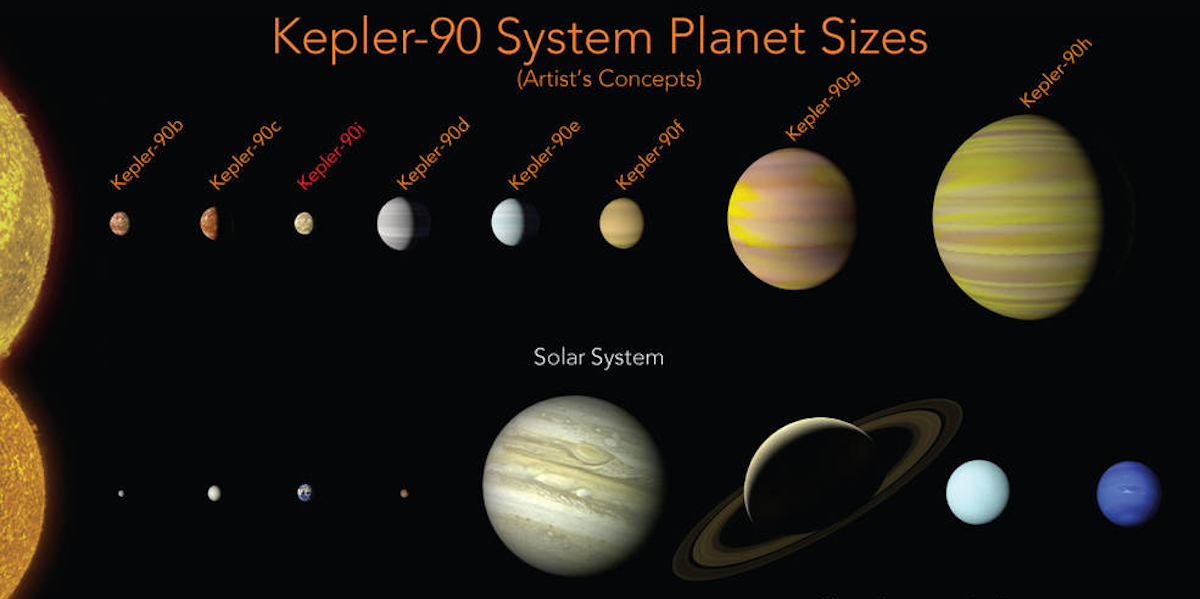
Another planet discovered by NASA – 2,545 light-years from Earth
Today, the scientific world was watching as NASA made a big announcement. Its Kepler Space Telescope, which has been conducting an intensive planet-hunting mission since 2009, had new results to share with the public. A media release from NASA states: “Our solar system now is tied for most number of planets around a single star, with the recent discovery of an eighth planet circling Kepler-90, a Sun-like star 2,545 light years from Earth. The planet was discovered in data from NASA’s Kepler Space Telescope. The newly-discovered Kepler-90i – a sizzling hot, rocky planet that orbits its star once every 14.4 days – was found using machine learning from Google. Machine learning is an approach to artificial intelligence in which computers “learn.” In this case, computers learned to identify planets by finding in Kepler data instances where the telescope recorded signals from planets beyond our solar system, known as exoplanets." There are some very technical and scientific data and information here. As well, a lot of questions to be asked and answered. That’s where experts like Dr. Michael Reed from Missouri State University can help. Dr. Reed is a professor of astronomy at Missouri State. He researches extrasolar planets and pulsating stars. Dr. Reed is available to speak to the media and can explain what this all means for science, the study of space and if there might actually be life out there. Click on his icon to connect with him. Source:


Will a Roy Moore win be a blessing or a curse for the GOP?
Tomorrow is Election Day in Alabama - and all eyes are on a special senatorial election that should have flown under the radar for this traditionally Republican-friendly state. That was until Judge Roy Moore won the primary and his past suddenly became public. To date, eight women have come forward with accusations ranging from sexual impropriety to molesting of a 14 year old girl when Moore was in his 30s. When the accusations surfaced, at first the Republican establishment started to abandon Moore - recently that mood has changed. With a Moore victory on Tuesday the GOP stands to bolster its hold on power in the Senate. A loss would reduce the Trump administration’s grip on control. However, Republican victory could also be a double-edged sword. What does it say to Americans if a person with so many allegations is elected to office? Will Moore have any credibility once he arrives in Washington? And will his election signal a revolt to the Democratic side come the mid-term elections in 2018? With polling showing a virtual tie between the Republicans and Democrats in Alabama - what will Tuesday’s result mean for America and the ongoing scandals emerging in Washington, Hollywood and across the country. There are a lot of scenarios that could play out and even more questions to be asked - that’s where the experts from Cedarville can help. Dr. Mark Caleb Smith is Professor of Political Science and the Director of the Center for Political Studies at Cedarville University. He is an expert in the areas of American politics and particularly presidential politics. Dr. Smith is a media-regular and was interviewed often during the last presidential election. He is available to speak to this latest development in politics. To book an interview – simply click on Dr. Smith’s icon to arrange a time. Source:


Sabres are rattling. What’s next for North Korea?
On Wednesday, North Korea launched another missile. This is the 15th launch this year, but this one appears different. North Korea claims this is new type of intercontinental ballistic missile with a "super-large heavy warhead" — which is capable of striking the US mainland. America is on alert. New sanctions are being implemented and every effort seems to be in play to avoid conflict. But can conflict be avoided? Has North Korea over-played its hand with a Trump administration that has already vowed ‘the situation will be handled.’ What is left to do and what can be done? That’s where the experts from Cedarville University can help. Dr. Glen Duerr is an associate professor of International Studies at Cedarville University. His research and expertise includes nationalism and secession, comparative politics, and international relations theory. Dr. Frank Jenista is a political science professor at Cedarville University. Before returning to the academic world, Frank spent 25 years of service as a U.S. diplomat working as a Senior Foreign Service Officer at U.S. embassy in Japan, Indonesia, New Zealand, South America, and the Philippines. Dr. Jenista is an expert on foreign relations, international issues and diplomacy. Both experts are available to speak with media regarding this issue. Simply click on either icon to arrange an interview. Source:


Baldwin 2020? It could be happening
On Monday, Alec Baldwin took to the stage not in New York – but Des Moines, Iowa as the keynote speaker at the Iowa Democratic Party's fall fundraiser. Known for his visceral Donald Trump imitations that have been one-part in the resurgence of Saturday Night Live, the Golden Globe and Emmy award winning actor took a serious tone in front of an audience of 3,000 party loyalists. On Monday he was calling for unity and pledging that he’s ready to fight to help the Democrats win. It’s also a known fact that the Iowa Democratic Party fall fundraiser has also been the starting point for campaigns. Is Alec Baldwin considering a run for the Oval Office in 2020? Does he have what it takes to win the Democratic primary? Could he beat Trump? And, is a battle of big screen celebrities what America needs in a leader? These are all interesting questions – and that’s where the experts from Cedarville University can help. Dr. Mark Caleb Smith is Professor of Political Science and the Director of the Center for Political Studies at Cedarville University. He is an expert in the areas of American politics and particularly presidential politics. Dr. Smith is a media-regular and was interviewed often during the last presidential election. He is available to speak to this latest development in politics. To book an interview – simply click on Dr. Smith’s icon to arrange a time. Source:
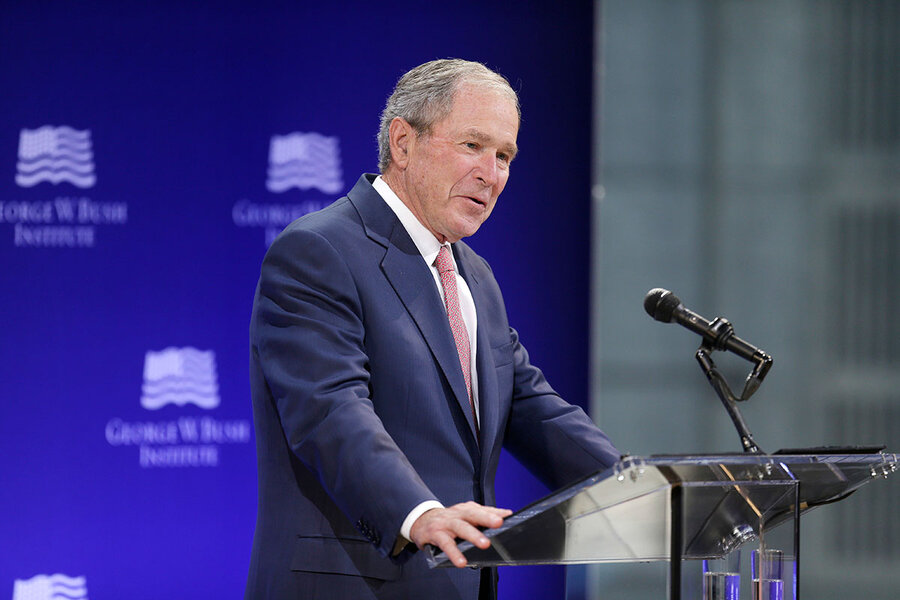
Presidential Rhetoric Expert Shares Thoughts on Bush's Speech
Presidential rhetoric expert Martin J. Medhurst, Ph.D., Distinguished Professor of Rhetoric and Communication and professor of political science in Baylor’s College of Arts & Sciences, is quoted in this article about speeches given last week by two former U.S. presidents and a former presidential candidate that warned of the dangers to the nation and the world if divisive politics continues to cleave the American electorate into thoughtlessly hostile warring camps. “They ... talk about American ideals, they ... talk about the story of America, the American creed and the need to reinvigorate democracy and continue to be the exemplar to the world of democratic values,” Medhurst said. Source:


Seeing the light of neutron star collisions
UNIVERSITY PARK, Pa. — When two neutron stars collided on Aug. 17, a widespread search for electromagnetic radiation from the event led to observations of light from the afterglow of the explosion, finally connecting a gravitational-wave-producing event with conventional astronomy using light, according to an international team of astronomers. Previous gravitational-wave detections by LIGO (Laser Interferometer Gravitational-Wave Observatory) and Virgo, a European observatory based in Pisa, Italy, were caused by collisions of two black holes. Black hole collisions generally are not expected to result in electromagnetic emissions and none were detected. "A complete picture of compact object mergers, however, requires the detection of an electromagnetic counterpart," the researchers report online today (Oct. 16) in Science. The Aug.17 detection of a gravitational wave from the collision of two neutron stars by gravitational wave observatories in the U.S. and Europe initiated a rapid cascade of observations by a variety of orbiting and ground-based telescopes in search of an electromagnetic counterpart. Two seconds after detection of the gravitational wave, the Gamma Ray Burst monitor on NASA's Fermi spacecraft detected a short gamma ray burst in the area of the gravitational wave's origin. While the Swift Gamma Ray Burst Explorer — a NASA satellite in low Earth orbit containing three instruments: the Burst Alert Telescope, the X-ray Telescope and the Ultraviolet/Optical Telescope — can view one-sixth of the sky at a time, it did not see the gamma ray burst because that portion of the sky was not then visible to Swift. Penn State is in charge of the Mission Operations Center for Swift. The satellite orbits the Earth every 96 minutes and can maneuver to observe a target in as little as 90 seconds. Once the Swift team knew the appropriate area to search, it put the satellite's instruments into action. Swift is especially valuable in this type of event because it can reposition to a target very quickly. In this case, the telescope was retargeted approximately 16 minutes after being notified by LIGO/Virgo, and began to search for an electromagnetic counterpart. Read more about Swift's involvement in detecting the neutron star collision here: https://www.eurekalert.org/pub_releases/2017-10/ps-stl101617.php To speak with Penn State's Swift researchers, contact Joslyn Neiderer at jms1140@psu.edu. Source:


These days, it doesn’t take much to turn a civil conversation into a full-blown catastrophe. Just mention the words “climate change” and feathers can start to ruffle. But it doesn’t have to be that way, says Dan Peppe, Ph.D., climate change expert and associate professor of geosciences at Baylor University. His research focuses on understanding how plant and animal communities have responded to changes in climate throughout Earth’s history. “Climate change is a fundamentally important issue to our society and is vital for us to have open and honest discussions about it and its potential impacts,” Peppe said. He said the best place to start such a dialogue is with scientific observation. Have a discussion about increases in temperature, he said. Understand what scientists are saying about those temperature changes and their effects. The trick to keeping this cordial? Keep politics out. “All of this conversation is a scientific one based on observation, and as such, shouldn't be a political one,” he said. “Once that baseline is established, we can then begin a conversation of the many possible ways to address those risks.” Peppe said there is often more than one solution to issues of climate change, but people need to listen to each other. “Hopefully there can be a respectful and civil conversation around those potential solutions,” he said. As part of Earth Science Week, Peppe is taking part in the Earth Science Symposium at The Mayborn Museum in Waco, Texas, where he will moderate a panel discussion on climate change. Panelists will discuss the science of climate change, the risks associated with it, and some of the potential solutions. “We hope that this will be a really productive discussion, and one in which the audience can participate,” Peppe said. Source: