
Experts Matter. Find Yours.
Connect for media, speaking, professional opportunities & more.

New £1.5 million healthcare simulation facilities to open at Aston University
New clinical simulation facilities for medical, pharmacy and optometry students are set to open in 2022 Including an ocular simulation unit facility which will be the only one in Europe, as part of further investment in clinical facilities in the College of Health and Life Sciences at Aston University. The facilities are part funded by the Office for Students which awarded the University £806,226 to set up a ‘high fidelity’ simulation A&E room with further expenditure by Aston University on an ocular simulation unit. Aston Medical and Pharmacy School students will be able to practise in emergency settings using high quality manikins where they will simulate treating patients for acute conditions such as a heart attack or learning how to intubate a patient onto a ventilator. The high-fidelity acute care simulation room will be equipped with recording facilities, a debrief room and control room. The funding will allow for the purchase of other training equipment such as a hospital grade bed and single task trainer simulation equipment. For example, male and female catheterisation models, pelvic and rectal trainers, venepuncture arms, breast trainers and abdominal trainers. Professor Liz Moores, deputy dean of the College of Health and Life Sciences, said: “We are really excited to have the support from both the Office for Students and Aston University in building these state-of-the-art facilities for our students and can’t wait to start using them. “The acute care simulation room will allow us to simulate a variety of emergency resuscitation scenarios that are very difficult to teach in real life situations, such as heart attacks, acute breathlessness and severe allergic reaction and will be of great value in training students of medicine and pharmacy.” Students in the School of Optometry will also be equipped with simulation facilities to carry out treatment on patients. Professor James Wolffsohn, head of the School of Optometry said: “The ocular simulation facility at Aston University will be unique in Europe, allowing students to refine their skills in examining the health of the front and back of the eyes and to experience a wide range of eye disease. “One of the simulators even allows them to utilise their smartphone to practice at home. They can gain direct feedback and be assessed by the simulators, allowing more flexible, diverse and intensive learning than can be achieved with clinical practice placements.” It is hoped these facilities will help plug some of the gaps in clinical placements that are currently affecting students since the COVID-19 pandemic. As a result of the pandemic, alternative ways are being explored to gain high quality authentic ‘clinical’ experiences, whilst not exposing patients, staff, or students, to risk. The health crisis has also increased pressure on the NHS creating a need for alternative but appropriate training facilities, to ensure that students are fully prepared for the medical profession. The simulation facilities are due to be open in time for the September 2022 intake of students.

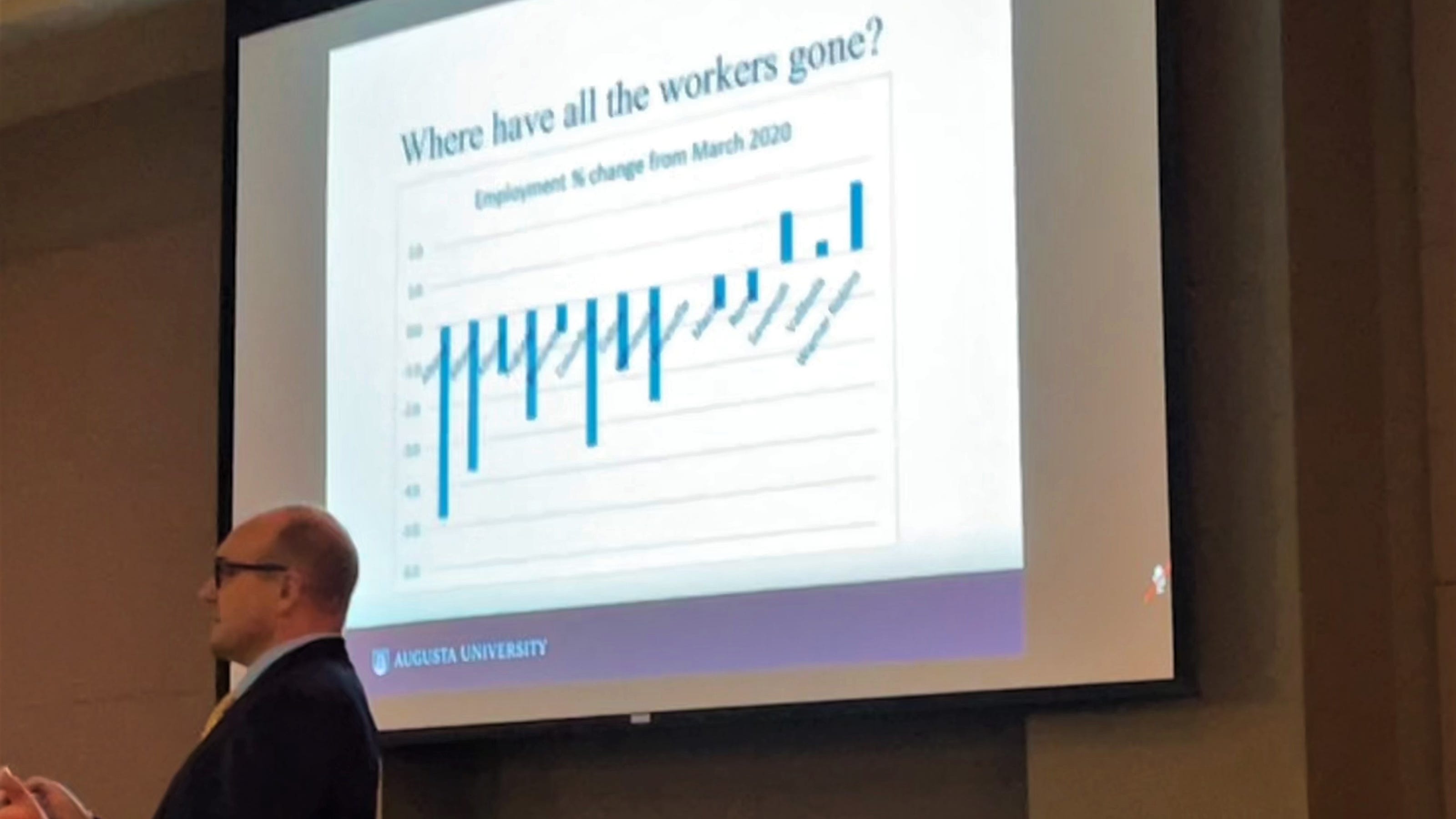
As the legendary political guru James Carville used to say, "It’s the economy, stupid." And these days with housing prices, inflation and the cost of living all pointing up in a very steep trajectory – the state of the economy is front and center for a lot of politicians, Americans and families as the year comes to a close. There’s a lot to be considered, and that’s where experts like Augusta’s Dr. Simon Medcalfe are being sought out to explain economic trends what is behind them. “U.S. retail sales are high,” explains Medcalfe “We had a lot of stimulus checks coming through the door and that’s really spurred extra spending and it’s across a whole range of retail sectors.” According to Medcalfe, household items are also seeing double-digit price increases. “What we’ve seen over the last 18 months during the pandemic, is a shift in our consumer preferences and consumer behavior.” • Furniture sales are up 29% • Used cars and cars in general are up 25-26% • Gardening and building supplies are up 14% • Electronics have seen an almost 30% increase • Clothing sales are up a whopping 50% But it’s not all good news - as the price of everything as we know is going up. “Inflation is running about 6.8% nationally,” Medcalfe explains. “It’s running about 7.2% in the south and it’s certainly a concern of policymakers and economists.” But theirs is sunshine behind those clouds as Medcalfe believes 2022 will see a return to normal. “I think next year inflation will come down. I know it won’t be at these high levels, but I still think it’ll be above the Feds target level of inflation, so look for those interest rate increases next year.” The economy and what to expect locally and nationally are hot topics – and if you are a reporter covering this topic – that’s where we can help. Dr. Simon Medcalfe is a highly regarded economics expert and the Cree Walker Chair in the Hull College of Business at Augusta University. Medcalfe is available to speak with media regarding the economy and its outlook – simply click on his icon now to arrange an interview today.


Parents who struggle to encourage their children to eat vegetables can now play a more influential part at their mealtimes – concludes a study by psychologists in the College of Health and Life Sciences at Aston University. The recent study, which was published in the journal Appetite, was carried out by doctoral researcher Katie Edwards, who found that children watching adults eat a green vegetable with positive facial expressions tasted and consumed more than double the amount of that vegetable. The team recruited 111 British children between the ages of four and six years old and played each of them one of three videos. In two of the videos, the children were shown unfamiliar adults eating raw broccoli with either a positive or a neutral facial expression. The third video, used as a control, was not food related. The researchers then assessed the children’s willingness to try raw broccoli. This was measured using a seven-point scale from turning away from it to both swallowing and accepting it. Their intake of the vegetable was measured by the number of grams of raw broccoli consumed, and the number of tastes of raw broccoli was examined. The findings could help children become more accepting of less popular vegetables like raw broccoli and generally facilitate healthier eating in children. The research mainly focused on young children who had never tried broccoli before. The team found that children who were exposed to video clips of adults enjoying eating broccoli had more tastes of, and ate, on average, more than twice as much of the food in comparison with the kids in the control group — specifically, 11 g (0.4 oz) rather than 5 g (0.2 oz). Katie Edwards, PhD researcher at Aston University, said: “One explanation for the beneficial effect of positive facial expressions whilst eating could be that conveying food enjoyment gives the observer information about the safety and palatability of food. “Raw broccoli was novel for most participants. Thus, children may have eaten more broccoli after watching adults enjoy eating it, because they believed it was enjoyable to eat.” The researchers were surprised to find, however, that seeing adults enjoying raw broccoli did not impact the children's initial willingness to try the vegetable. The results showed that after watching adults enjoying eating raw broccoli, children ate more than double the amount of raw broccoli than children who had seen a non-food related video. This suggests that smiling while eating green vegetables can encourage children to taste and eat more of that vegetable. Katie added: “Further work is needed to determine whether a single exposure [to adults enjoying broccoli] is sufficient and whether these effects are sustained over time.” The full findings of the study were published in the journal Appetite.


Christmas is here! And with the hustle and bustle of shopping and scouring the internet for that perfect gift or deal, odds are there are people lurking in the dark corners hoping to stuff their stockings with scams if you’re not too careful. At Thanksgiving, when the official start to the shopping season began – the experts from Indiana University’s Kelley School of Business were front and center answering media calls and doing interviews about this very topic Scott Shackelford, a professor at Indiana University specializing in cyber security, said there are some red flags to be on the lookout for while shopping online. “There’s some easy ones to spot right off the bat, including if on the URL,” said Schackelford. “If you see it just as HTTP and not HTTPS. That S stands for secure, which means your information is encrypted when you use that site.” Shackelford also said to be on the lookout for funny wordplay involved on the website. Maniscalo says most of these fake websites originate from outside the country. “English is not their native tongue, so they will a lot of times have misspellings, or say things in kind of an awkward way, not how we would say it, or how we would print it out there,” said Maniscalo. There is also the problem of what Shackelford calls Grinch Bots. These are automated bots that monitor major retail sites to see what items are the hottest and buy them out as soon as they are restocked. “There’s actually been bills that have been proposed in Congress to deal with example of that phenomenon. But of course, they’re not enacted yet, so it’s still up to consumers,” said Shackelford. November 25 – Fox News It’s going to be a busy holiday shopping season – and if you’re a journalist looking to cover this important top, then let us help. Scott Shackelford is an Assistant Professor of Business Law and Ethics at Indiana University’s Kelley School of Business. He’s an expert in the field of cybersecurity law and policy. Scott is available to speak with media about this subject – simply click on his icon now to arrange an interview today.

.jpg)
Is there such a thing as ‘a little cheating’ in American schools? Let our expert explain.
Cheating … it’s a universal tactic that seems to be a part of every academic institution regardless of subject, program or geography. Recently, Inside Higher Ed took a look at how students view cheating – and how their perspective of just what constitutes cheating is viewed. UMW’s David Rettinger provided his expert take on just what is going on in American schools. How acceptable is it to use study websites, or Google, to find answers to test or homework questions? What about using unapproved technology or tools to assist in an online exam? And would it be OK to give credit to another team member on a group project even if that person did not participate? These are a few ways the latest Student Voice survey, conducted in mid- to late October by Inside Higher Ed and College Pulse with support from Kaplan, explored the nuances of academic integrity and what students view as unethical… When David Rettinger, president emeritus of the International Center for Academic Integrity (ICAI), looked over the Student Voice data, he was drawn to the numbers that showed how much students realize certain actions would be considered cheating. “Some of [the unacceptable responses] are a little lighter for sure, but students generally would describe these behaviors as unacceptable,” says Rettinger, a professor of psychological science and director of academic integrity programs at the University of Mary Washington. “Their institutions talk about these things, and students know what they’re supposed to do, yet students cheat a fair bit.” He can imagine a stressed-out student saying, “I know it’s unacceptable, mostly I don’t do it, but in this situation, I’m going to do something I generally don’t believe in.” “That poses a problem for us as administrators,” he adds. December 07 – Inside Higher Ed Professor of Psychological Science David Rettinger oversees Academic Integrity Programs at the University of Mary Washington. He is available to provide expert insight into this study and the concept of students who cheat while attending at American colleges and universities. Simply click on his icon now to arrange an interview today.


Experts in the Media – Learn how UMW is doing its part to preserve Indigenous history
The members of Virginia’s Rappahannock and Patawomeck tribes can trace their roots back to the times before the first European contact. For hundreds of years, their people fished the rivers and inhabited the area near the Potomac and Rappahannock rivers. It was a rich history and today the efforts to preserve the stories and records of those times are being bolstered by UMW students and faculty. The work was recently featured in a piece by NBC-4 in Washington, D.C. Professor Lauren McMillan and her students are helping with that mission. King George County economic development officials approached her with an idea to create a Native American heritage trail, hopeful that it would drive ecotourism and draw visitors to public access points. “The first step that we did was say we need to consult with the tribes whose stories we’d be telling," McMillan said. Then the class did a deep dive. "We then started diving into the archives, the historical records, oral histories and the archaeological record as well,” McMillan said. They’ve created signs that will go up in seven different locations in King George. Each one tells a different story about the local tribes, spotlighting the past and present. “When you learn Virginia history, you learn about a lot of stuff that happened in Jamestown and that’s kind of the last place you learn about Indians in Virginia history, but we've been here all along,” Brad Hatch, a member of the Patawomeck Tribe, said. “We’ve been preserving our own culture and heritage and it's here for everybody to see." The students worked hard to put that heritage and culture on full display. They also envision their project inspiring others to do some research of their own about Virginia’s first residents. December 07 - NBC News Indigenous history is a fascinating topic – and one being covered more and more by media. And if you’re a reporter looking to know about the work UMW is doing with of the Rappahannock and Patawomeck tribes or other topics – then let us help. Lauren McMillan is the University of Mary Washington's resident historical archaeologist and an expert on middle-Atlantic American history. Dr. McMillan is available to speak with media – simply click on her icon now to arrange an interview today.
Have you finished your Christmas shopping yet? If not – waiting for last minute deals or just pushing off the pain of navigating a jam-packed shopping mall might result in some failed efforts, unhappy kids and even the potential for coal in your own stocking for letting some loved ones down. Recently, John Talbott, the director of the Center for Education and Research in Retailing at the Indiana University Kelley School of Business was interviewed on the IBJ podcast to explain how supply chain woes may be creating chaos this Christmas. Experts expect shoppers to drop a record amount of money this holiday season. The National Retail Federation forecasts sales for November and December to grow between 8.5% and 10.5% over the same months in 2020. In total dollars, that would be between $843.4 billion and $859 billion. At the same time, the supply-chain issues that have plagued commerce since the start of the pandemic are expected to complicate gift buying and limit stock for some products. The answer is to get your shopping done as soon as possible, because you might not get a second chance, says John Talbott, the director of the Center for Education and Research in Retailing at the Indiana University Kelley School of Business. In the latest edition of the IBJ Podcast, Talbott explores other big questions with host Mason King. Does Indy’s status as a leading U.S. logistics hub give Hoosiers a leg up on gift availability? What role might inflation play in this year’s shopping season? Why are gift cards even more valuable than usual this year? How can we avoid cybercrime? And are there any blockbuster, must-have gifts for this season? November 28 – IBJ Podcast And if you’re a journalist looking to know more or covert this subject – then let us help. John Talbott is the Director for the Center for Education and Research in Retail at Indiana University’s Kelley School of Business. He’s an expert in the areas of retailing, relating marketing activities to financial outcomes, and new media communication. John is available to speak with media regarding this important topic – simply click on his icon now to arrange an interview today.

Brexit caused a large negative effect on UK trade pre-pandemic - new Aston University research
Professor Jun Du and Dr Oleksandr Shepotylo analysed the causal effect of Brexit on the UK’s services trade between 2016 and 2019 They found the UK experienced an average shortfall of £18.5 billion worth of services exports for each of those years Transport, Travel, Insurance and Telecom sectors experienced significant decline post-2016 No significant decline was found in other services including intellectual property, construction and financial. New research from economics experts at Aston University has found Brexit has caused a largely negative effect on UK services trade since the EU referendum. Professor Jun Du and Dr Oleksandr Shepotylo, from Aston Business School, analysed the causal effect of the Brexit referendum on UK’s services trade over the period between 2016 and 2019, in comparison to other major services exporters. They found the uncertainty associated with the UK-EU trade negotiations following the referendum caused harms to the UK services economy as a whole, reducing firms’ exports of services. This damages the competitiveness of services sectors which make up a lion’s share of the UK economy in terms of gross output, value-added and jobs. Professor Du and Dr Shepotylo used a Synthetic Difference in Differences (SDID) estimator to construct a counterfactual of the UK, had it not voted leave in 2016, to compare its services exports performance. This was done by comparing the actual performance of the UK with the modelled performance of a country that looks much like the UK, but did not vote to leave the European Union. They found Brexit resulted in the UK experiencing an average shortfall of £18.5 billion worth of services exports every year between 2016 and 2019 relative to what it would have been, had the UK remained in the EU. The impact varied considerably between different types of services. The UK’s exports in the category of transport, travel, insurance and telecom services saw a statistically significant decline following the referendum. No significant decline was found in business, intellectual property, construction, financial or personal, cultural and recreational services. In addition, Professor Du and Dr Shepotylo did not find evidence to suggest that UK businesses have redirected exports in services from the EU markets to those outside the EU, which is in contrast to exports in goods. The research suggested that Ireland has benefited significantly during this period, with growth in post-Brexit services exports up by £24 billion annually over 2016 to 2019 in the country compared to the counterfactual scenario if Brexit did not occur. This translates to 14.75% of Ireland’s 2019 total services exports, with growth clustered largely in the telecoms, business, intellectual property, and insurance sectors. Jun Du, professor of economics at Aston Business School, said: “Brexit marked a rupture in the highly integrated UK-EU services markets that had been developed during the UK’s membership of the single market. However, the UK’s strength in services was not reflected in the government’s ambitions for the sector in the EU-UK trade negotiations that followed the referendum. “There are other winners besides Ireland in some post-Brexit services areas. The Netherlands have increased considerably in ‘Business’ and ‘Intellectual Property’ exports. “Spain has seen growth in ‘Travel and transport’ services exports. Germany has gained in ‘Transport’, ‘Insurance’, ‘Telecom’ and ‘Intellectual Property’ services exports. While Ireland seems to have done exceptionally well in relation to the export of ‘Telecom’ services, a sharp contrast emerges to the lost exports not just from the UK, but also from the Netherlands, Switzerland and France.” Dr Oleksandr Shepotylo, a senior lecturer in economics, finance and entrepreneurship at Aston University, co-wrote the working paper and said: “UK services exports are 5.7% lower than they would be without Brexit. It reflects an overall decline of the UK as a place for doing business. “What economists tend to agree on is that the UK’s exit from the EU’s custom union and single market may have more significant impacts on services than goods, and more severe impact on post-Brexit regulated services than unregulated services. “It will take some time for the full impact of Brexit on UK services to emerge. Freedom of movement and data flow in some areas between the UK and EU could remain restricted. Stability, transparency and regulatory consistency in financial markets could be challenged. But new opportunities might surface. “Continued trade negotiations and dialogues regarding trade liberalisation are essential with the EU and large, fast-growing markets beyond Europe. Crucial to understanding these impacts will be reliable data and rigorous analysis. Our modelling of marked losers and winners in post-Brexit services trade provides new evidence for an open discussion of the post-Brexit trade in services.” You can read the full working paper HERE


Nathaniel Grow, a nationally recognized expert in the field of sports law and an associate professor of business law and ethics at the Indiana University Kelley School of Business, has published numerous articles on the application of federal antitrust and labor law to the professional sports industry, with a particular focus on Major League Baseball. He has been closely following developments and would glad to serve as an expert for reactions and analysis of developments. The author of 17 law review articles, as well as an award-winning book, Grow has received a number of prestigious research honors for his academic work. Grow is frequently quoted by media outlets such as The Washington Post, The Wall Street Journal and ESPN regarding current legal issues in the sports industry. He can be reached at grown@iu.edu and 812-855-8191.

Aston University pharmacy graduate honoured for charity fundraising work
An Aston University pharmacy graduate has been recognised for his charitable fundraising in the Chemist and Druggist Awards 2021. Shoaib Hussain managed to raise thousands of pounds within just four weeks when he shared a video detailing his 2017 trip to help at Rohingya refugee camps in Bangladesh. He received the Above and Beyond Award at a ceremony held at the InterContinental London – The O2 on 19 November. Shoaib’s powerful video resonated so strongly with the public that he smashed his £25,000 fundraising target in just 24 hours. His campaign eventually raised £135,000 – all of which was donated to the charity Global Helping Hands, which is run by UK medical professionals. The money has paid for thousands of survival packs and the building of a medical centre, over 100 homes, 30 wells, and seven educational sites in Mosques. Shoaib said: “The video shared a personal account and was extremely difficult for me to voice. It detailed something I have not even spoken to my wife about fully, and something I still cannot talk about without tearing up when I remember what I witnessed.” Shoaib dedicated his award to “the refugees who I helped, and the donors who made it possible”.