
Experts Matter. Find Yours.
Connect for media, speaking, professional opportunities & more.

Cancellation of non-conference college football games may lead to a new battle in the courtroom
The Big Ten Conference's decision to cancel all non-conference football games for the upcoming season -- and the possibility that schools in other major conferences may soon follow -- raises a number of potential legal issues, says Nathaniel Grow, associate professor of business law and ethics at the Indiana University Kelley School of Business. “Depending on the terms of the schools' college football scheduling agreement, the university cancelling the game may still owe the other school some level of compensation for breaking the agreement,” Grow said. “If the cancelling university refuses to pay, then it would not be surprising if the other school would elect to file a lawsuit.” A nationally recognized expert in the field of sports law, Grow studied has studied this issue, the subject of a 2010 article in the Journal of College and University Law. "The ultimate outcome of such a lawsuit would hinge largely on the specific terms of two affected schools' contract. In general, though, two provisions of the contract would likely prove to be the most important. First, most scheduling agreements will include some sort of liquidated damages provision, a clause that specifies that one side of the agreement must pay the other party a certain amount of money should the contract be broken. Often times, these contracts will provide that the breaching party must only pay the other school in the event that the opponent is unable to replace the cancelled game on its schedule with one against a sufficiently suitable alternative opponent. "The other relevant clause in these scheduling agreements is likely to be the force majeure provision, sometimes referred to as an ‘Act of God’ clause. Under these provisions, schools may be excused from cancelling a game without penalty if circumstances arise that make playing the game unduly difficult or impossible (for instance, a hurricane or other major weather event). The applicability of such a provision will also vary depending on the specific wording employed in the contract, and whether the clause permits a team to cancel a game on the basis of either a pandemic or a change in conference policy regarding the playing of non-conference games." Grow can be reached at 812-855-8191 or grown@iu.edu.


Joke or not – could Kanye play spoiler in the 2020 election?
It’s set the internet abuzz – and as rap superstar Kanye West (with the help of his wife Kim Kardashian West and billionaire Elon Musk) took to Twitter to declare his intentions to run for president this November. One small problem – West has missed several key deadlines to get on the ballot. However, if he is determined to run, he can ‘t run in key states like Texan, New York or North Carolina. This all seems silly right now, but if the sometimes controversial and very unpredictable celebrity makes a run, in the end – who would it help and who would it hurt? Could West’s popularity siphon off votes from Joe Biden key battleground areas? Or would a West campaign steal the attention and airtime away from Donald Trump leaving him to pitch policy and drastically reducing his reach? In a year that knows nothing normal, if you are covering Kanye West and the 2020 election – let our experts help. Mark Caleb Smith is the Director of the Center for Political Studies at Cedarville University. Mark is available to speak with media regarding this topic and any aspects about the upcoming election. Simply click on his icon to arrange an interview.


As China clamps down on Hong Kong – Is Taiwan next?
As protests erupt again across Hong Kong against the recent imposing of new security laws essentially giving Beijing unprecedented powers – it has some worried about what is next as China pursues it’s One-China policy. In Taiwan people are watching, and concern is growing. Professor Elizabeth Freund Larus teaches political science at the University of Mary Washington and is an #expert on China and the field of Asian studies. She has also been interviewed by media such as CNBC, The Diplomat and CBN News regarding this topic. She has noted that the developments in China, especially with regards to Hong Kong and Taiwan are catching global attention and will impact economies and governments across the globe. Beijing has taken an especially hard line towards Taiwan since the 2016 election of President Tsai Ing-wen of the Democratic Progressive Party (DPP), ramping up military, economic and diplomatic pressure. Tsai views Taiwan as a de facto independent nation and not part of "one China". But the pressure campaign has done little to endear China to Taiwan's 23 million people. In January, Tsai won a second term with a historic landslide and polls consistently show a growing distrust of China... Social media is filled with messages of support for Hong Kong's democracy movement. Some back Taiwanese independence, or highlight China's rights abuses in regions such as Tibet and Xinjiang. Wendy Peng, a 26-year-old magazine editor who said she often shared pro-Hong Kong democracy messages on social media, said she would now avoid visiting the city. "The national security law makes me wonder how far would China go. Right now I don't see a bottom line and there's probably none. I think it's possible they will target Taiwan next," she said. July -7 Yahoo! New/AFP If you are a reporter covering this progressing story – then let our experts help. Elizabeth Larus is available to speak to media, simply click on her icon to arrange an interview.



A New Kind of "Zoom" Science Lesson
With the end of the school year just around the corner and numerous COVID-19 restrictions still in place for the foreseeable future, many parents are worried. Summer camps in Pennsylvania are beginning to open—but with limited capacity. So, what are working caretakers to do with their kids all day? Villanova University professor of chemistry Marta Guron, PhD, and six of her students have created informative science lessons that bring learning and fun together in a virtual environment. In a typical year, Dr. Guron gathers a group together who volunteer their time by visiting local elementary schools to perform hands-on science experiments with fourth-graders, fifth-graders and sixth-graders. When in-person lessons were no longer an option due to the pandemic, the Villanovans adapted their strategy. Though finals are over and Villanova's campus remains empty, six dedicated undergraduate and graduate students are still finding time to go virtual with their lessons. In the following video, Dr. Guron and the Villanova students use PowerPoint, plastic containers, water and their choice of "solids" to talk about density. The supplies for this outreach program are typically provided by Villanova, but in light of everyone being "stuck at home," Dr. Guron encouraged the grade school students to experiment. "If there is something that you don't have at home, it's OK to try to replace different things. For example, some students, when they added different solids, they might have added a penny or a piece of wood. But others might have a bead or something else. It doesn't... much matter." She adds, "Please make sure you talk to your mom and dad before you take anything out!" Some other experiments the team has done include assessing symmetry in crystals, making the gooey, Double Dare-inspired "gak," building a fruit battery, investigating sound and studying capillary action in flowers. Dr. Guron is grateful that her students were still interested in the project, even after the end of a particularly unusual semester. "I thought it was awesome that these students all volunteered time and effort after their final exams were over because of their dedication to the program and to the kids. We are truly a community of helpers."


Black Gospel Music Expert Shares 10 of the Most Powerful, Enduring Freedom Songs, Protest Spirituals
By Robert F. Darden, Professor of Journalism, Public Relations & New Media, Founder and Director of the Black Gospel Music Restoration Project at Baylor University WACO, Texas (June 19, 2020) – As the protests following the death of George Floyd began to roil the country, it was only a few days before the demonstrators began to sing an array of freedom songs and protest spirituals, as well as a few new adaptations, including Bill Withers’ “Lean on Me.” Some of these songs have been sung by people fighting nonviolently for freedom and justice for hundreds of years. Many have been sung continually in the United States since the 1800s, right through the #blacklivesmatter and #metoo movements. Others have been adopted by freedom fighters in the Arab Spring, at Tiananmen Square and even now in Hong Kong. The Black Gospel Music Restoration Project at Baylor University has the world’s largest collection of digitized vinyl songs and sermons from gospel’s “golden age.” Not surprisingly, there are hundreds of freedom songs and protest spirituals in the collection as well. Below is a list of some of the most influential, most powerful, most enduring and beloved songs that have inspired and encouraged sings for two centuries. Each song is available for listening in the digital collections of the Black Gospel Music Restoration Project. (Assistance provided by Baylor Libraries’ Digitization and Digital Preservation Services.) 10. “We Shall Not Be Moved” and “Which Side Are You On?” When labor unions admitted African Americans in the 1930s and '40s, labor protesters quickly absorbed and adapted the great protest spirituals. These two old union songs were quickly adopted and expanded by the civil rights movement of the '50s and '60s. Listen to “I Shall Not Be Moved” by the Mighty Wonders of Aquasco, Maryland. 9. “A Charge to Keep Have I” In the days before hymnals, a song-leader would sing or speak a line and the congregation, whether in a church or at a mass meeting, would sing it back, called “lining out.” One of the most popular lined-out hymns during the movement was the old hymn, “A Charge to Keep Have I.” Listen to “A Charge to Keep” by Betty Simmons. 8. “Up Above My Head, I Hear Freedom in the Air” This old spiritual became a favorite in the great singing protests of Albany, Georgia, and quickly spread throughout the South. Listen to “Up Above My Head, I Hear Freedom in the Air” by Sister Rosetta Tharpe. 7. “If I Can Help Somebody” Not all freedom songs were defiant in tone. Some provided comfort in difficult times. Some helped encourage those in despair. This is one of those songs. Listen to “If I Can Help Somebody” by Dorothy Love Coates and the Gospel Harmonettes from the LP, Till My Changes Come. 6. “Freedom Highway” Some original songs were composed during the movement that were not only quickly adopted by the civil rights activists, they’ve remained in the repertoire of freedom fighters everywhere. One such song is “Freedom Highway” by the Staple Singers who themselves marched many miles with Dr. Martin Luther King Jr. Listen to “Freedom Highway” by the Staple Singers. 5. “Keep Your Eyes on the Prize”/“Hold On” There are dozens of variations of this civil rights-era favorite. Most include the couplet about Paul and Silas in jail, but all were sung to bolster spirits in tough times. Listen to “Keep Your Hands on the Plow” by The Famous Ward Singers from the LP on Vista Records. 4. “This Little Light of Mine” Fannie Lou Hamer made this old children’s song one of the most popular and righteous of the freedom songs. It was easily adaptable to every situation and good for naming the names of your oppressors. Listen to “The Little Light of Mine” by the Ward Singers. 3. “99 ½ Won’t Do” “99 ½ Won’t Do” was one of the most powerful songs to come out of the Birmingham freedom movement, sung by choirs and soloists alike, and it has since become a staple for many gospel singers, along with “I’m a Soldier in the Army of the Lord.” Listen to “99 ½ Won’t Do” by the Greater Sabathani Baptist Church Mass Choir. 2. “Don't Let Nobody Turn You Around” This freedom song has been sung repeatedly during the George Floyd protests – and has been sung for a hundred years or more. It lends itself well to a tone of defiance against great odds and was another freedom song that was infinitely adaptable to the situation. Listen to “Don't Let Nobody Turn You Around” by the Five Trumpets. 1. “We Shall Overcome” Few songs can match the majesty and soulful power of “We Shall Overcome,” always sung standing, with arms crossed clasping the hands of those on either side. It is at its most powerful -- then and now -- when the lines “black and white together” are included. Listen to “We Shall Overcome” from the 45 by Alice McClarty and the Traveling Echoes. ABOUT BAYLOR UNIVERSITY Baylor University is a private Christian University and a nationally ranked research institution. The University provides a vibrant campus community for more than 18,000 students by blending interdisciplinary research with an international reputation for educational excellence and a faculty commitment to teaching and scholarship. Chartered in 1845 by the Republic of Texas through the efforts of Baptist pioneers, Baylor is the oldest continually operating University in Texas. Located in Waco, Baylor welcomes students from all 50 states and more than 90 countries to study a broad range of degrees among its 12 nationally recognized academic divisions.

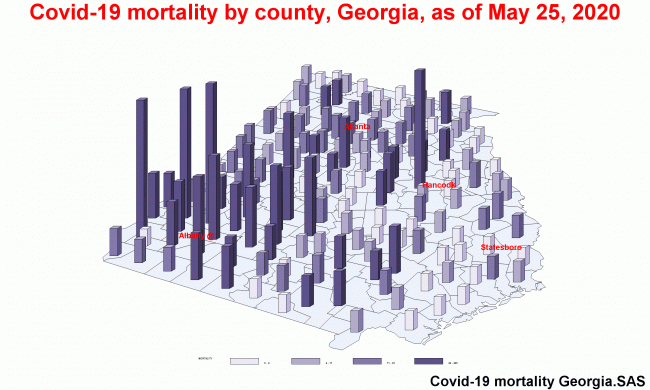
Graduate students in the Jiann-Ping Hsu College of Public Health at Georgia Southern University analyzed mortality data to reveal that a county in southwest Georgia is dealing with deaths from COVID-19 at a rate higher than most other counties in the country. The students found that the mortality rate of 305 per 100,000 residents (as of May 28, 2020) for Terrell County in southwestern Georgia, is 50% higher than that of New York state’s Nassau County, the documented highest rate in New York. The three other Georgia counties that are highest in terms of mortality rate are Hancock, Early and Dougherty counties. Three out of these four are in southwest Georgia, around the Albany area. That accounts for almost half of the 10 counties in the United States with the highest mortality rate, which is defined as a measure of the frequency of occurrence of death among a defined population. However, it’s interesting to note that none of Georgia counties reached the top 20 in terms of incidence and the death numbers per 100 confirmed Covid-19 cases, said professor Dr. Jian Zhang, a veteran medical epidemiologist. “Georgia is doing pretty well to stop the spread of the virus, and hospitals in Georgia are doing well to save hospitalized COVID-19 patients. The high mortality rate, in this case, may be deeply rooted in the historical burden of poverty in Georgia,” Zhang said. The findings are part of a service-learning project Zhang led. A six-student group formed the surveillance team that began running a real-time COVID-19 numbers in his Public Health Surveillance class. If you are a journalist covering COVID-19 and would like to learn more about this research taking place at Georgia Southern University – then let us help. Dr. Jian Zhang has worked with the Chinese Centers for Disease Control and Prevention, and the World Health Organization prior to moving to the United States.



And the award goes to … Georgia Southern University receives two Emmy nominations
The National Academy of Television Arts and Sciences Southeast Chapter has recognized Georgia Southern University’s Multimedia Development Center (MDC) with two professional Emmy award nominations. Nominated for the Emmy awards were Art Berger, Best Technical Director for Georgia Southern football, baseball and basketball, and Ben Powell, Best Technical Director for Georgia Southern basketball. Berger, director of the MDC, said the nominations are a result of a collaborative effort among the student and staff team. The MDC’s mission is to provide students with professional opportunities and deliver excellence in media programming. Students working at the MDC receive hands-on experience delivering more than 150 live streaming events a year including commencement and Georgia Southern football. “We are very proud of our collaboration with Georgia Southern Athletics and our two Technical Director 2019-2020 Emmy award nominations,” said Berger. “These awards reflect the quality and the outstanding dedication of our students and our staff in delivering high-quality ESPN programming. We are extremely proud of our continued excellence in bringing Emmy level ESPN programming to Georgia Southern University.” The MDC has previously received eighteen Emmy nominations as well as five professional wins including best director, best sports director, and best technical director, and two Emmy awards for best audio with the Georgia Southern Symphony. The National Academy of Television Arts and Sciences is a professional organization for individuals in the television and broadcasting industry. If you are journalist and would like to know more about this story - simply reach out to Georgia Southern Director of Communications Jennifer Wise at jwise@georgiasouthern.edu to arrange an interview.

Ask an Expert: How can you recognize false information about the virus?
Lisa K. Fazio, assistant professor of psychology at Vanderbilt Peabody College of education and human development, gives tips to social media consumers on how to recognize misleading information about COVID-19. For more information, read an essay about ways to identify misinformation written by Fazio for the Peabody Reflector. Vanderbilt University faculty are sharing their expertise on a range of topics related to COVID-19. Subscribe to Vanderbilt’s “Ask an Expert” series on YouTube to get the latest updates.


STORY: CAA named the most trusted brand in Canada in the annual Gustavson Brand Trust Index
The Canadian Automobile Association (CAA) has been named the most trusted brand in Canada in the annual Gustavson Brand Trust Index, released today. This is the fourth consecutive year that CAA is one of the top two most trusted brands in Canada, beating out several hundred other prominent international and Canadian brands. This year, CAA tied for first place with Mountain Equipment Coop (MEC), another Canadian, membership-based, not-for-profit organization. Further, CAA finished first, for the third year in a row, in the insurance category of this year’s Index. Conducted by the Peter B. Gustavson School of Business at the University of Victoria, the sixth annual Gustavson Brand Trust Index asked more than 7,800 consumers to score 342 prominent companies and brands, across 27 industry sectors, on a range of brand value measures.

Whistle stops or Zoom chats – What will a campaign for the 2020 election look like?
The race for 2020 is on. President Donald Trump has already scheduled his first rally in the very red-leaning Oklahoma whereas Joe Biden has been conducting digital town-halls and online events in his effort to reach voters. Campaigning for president is a billion-dollar ordeal. It usually means months and months on the road; a different message being brought to a different audience and usually in a different state each night from August until November. For President Trump, it seems he’s charging, head down – despite what many critics and officials have to say. Yet Trump has continued to travel — even to states that still have restrictions — and announced this week that he’ll resume his signature campaign rallies beginning next Friday in Tulsa, Oklahoma. The state, which was among the earliest to begin loosening coronavirus restrictions, has a relatively low rate of infection but has seen cases rising. “They’ve done a great job with COVID, as you know, the state of Oklahoma,” Trump said Wednesday. Campaign officials chose the location knowing Republican Gov. Kevin Stitt would raise no objections. Stitt’s most recent reopening phase places no limits on the size of group gatherings. The campaign hopes the location will all but guarantee a large crowd, since Oklahoma is one of the most Republican states in the nation and Trump has never held a rally there as president. Still, the reality could not be completely ignored. “By clicking register below, you are acknowledging that an inherent risk of exposure to COVID-19 exists in any public place where people are present,” Trump’s campaign advised those signing up for the rally. “By attending the Rally, you and any guests voluntarily assume all risks related to exposure to COVID-19 and agree not to hold Donald J. Trump for President, Inc.” liable for illness or injury. Trump is also planning events in Arizona and Florida — states where cases are on the upswing. In Arizona, hospitals have been told to prepare for the worst as hospitalizations have surged. Trump this month decided that he would no longer hold the marquee event of the Republican National Convention —- his acceptance speech — in North Carolina after the state refused to guarantee that he could fill an arena to capacity with maskless supporters. It’s being moved to Jacksonville, Florida. June 12 – Associated Press But as the Trump campaign seems to be sticking to the old school playbook – what will the Democrats do? Can campaigning on-line be effective? Do voters really need to see a person and shake a hand to make a decision who to vote for? Is it better to be safe or sorry when there is so much at stake? If you are covering – then let our experts help with your questions and stories. Mark Caleb Smith is the Director of the Center for Political Studies at Cedarville University. Mark is available to speak with media regarding the DNC Primary, running mates and the upcoming election. Simply click on his icon to arrange an interview.