
Experts Matter. Find Yours.
Connect for media, speaking, professional opportunities & more.

Georgia Southern student recognized for registering 300 bone marrow donors
Brianne Dollar (pictured center-right) receives the Steve Bochco Award at the Gift of Life gala in Los Angeles. She received the honor thanks to her being responsible for more than 30 fundraising drives and registering over 300 bone marrow donors. A Georgia Southern University student is saving lives, and is now receiving national recognition for her work. In May 2022, Dollar attended a gala in Los Angeles for Gift of Life, an organization supporting bone marrow transplants. Dollar has been an ambassador for the organization for years and is responsible for organizing events in the group’s name. While there, she was surprised with the Steve Bochco Award, named after the late television writer and producer, who had leukemia. The accomplishment is the culmination of hard work and passion for the cause. For Dollar, the journey was far from an easy one. Brianne Dollar's story is attached below - it's a great story and a must read: If you're a reporter looking to know more about Brianne or if you're looking to speak with her directly - then let us help. Simply reach out to Georgia Southern Director of Communications Jennifer Wise at jwise@georgiasouthern.edu to arrange an interview today.


MEDIA RELEASE: Hamilton's Barton Street East voted Ontario's Worst Road
The votes are in and the CAA Worst Road for 2022 is Barton Street East in Hamilton. After making its debut on the provincial top 10 list in 2019, Barton Street East has ranked fifth place (2019), third place (2021) and climbed to first place this year due to potholes and severe alligator cracking in the pavement. It has also taken the top spot as Hamilton’s worst road for the third year in a row. Taking the second and third place spots are Eglinton Avenue West in Toronto and Barker Street in Prince Edward County. “We know the campaign works. People vote in the annual CAA Worst Roads Campaign because it gives Ontarians a platform to continue putting pressure on various levels of government to understand what roads they believe are in urgent need of repair,” says Teresa Di Felice, assistant vice president, government and community relations, CAA SCO. “The campaign has been able to demonstrate that decision-makers are paying attention to the results, which has prompted municipal officials to move up infrastructure projects in their communities.” This year, four out of 10 of the province’s Worst Roads are in Toronto. They are, Eglinton Avenue West, Eglinton Avenue East, Lake Shore Boulevard East and Finch Avenue West. This is double the number of roads in Toronto that appeared on provincial list compared to last year. In 2021, Victoria Road in Prince Edward County made its debut on the provincial top 10 list and this year, it has completely dropped off the list. Other roads that have come off the provincial top 10 list include: Hunt Club Road and Innes Road in Ottawa and Algonquin Boulevard West in Timmins. "These campaign success stories are because governments are prioritizing infrastructure through multi-year capital investments," added Di Felice. “The results this year show us that Ontarians are relentless in using the campaign to advocate for roads they believe are in urgent need of repair, which is why we have seen Barton Street bubble up to the top spot and roads like Eglinton Avenue continue to garner attention." In Ontario, 182 municipalities had roads in their communities nominated. Drivers accounted for the majority of the votes being cast, with cyclists and pedestrians accounting for about a quarter of the votes. Voters shared their primary reasons for selecting a road, with 80 per cent citing potholes, followed by poor road maintenance (71 per cent) and no or poor cycling infrastructure (29 per cent). Ontario's top 10 list is verified by the Ontario Road Builders' Association (ORBA). “This year’s Worst Roads campaign once again solidified the fact that although much work has been done across the province to maintain and repair Ontario’s roads, greater investment is needed to tackle the staggering municipal infrastructure deficit in Ontario,” says Bryan Hocking, CEO, ORBA. “Building and maintaining infrastructure is a critical part of Ontario’s long-term economic plan, and even more important to our economic recovery from the COVID-19 pandemic. We must begin to build the necessary infrastructure today so we can be ready to meet the challenges of tomorrow.” Ontario's Top 10 Worst Roads for 2022 1. Barton Street East, Hamilton 2. Eglinton Avenue West, Toronto 3. Barker Street, Prince Edward County 4. County Road 49, Prince Edward County 5. Carling Avenue, Ottawa 6. Eglinton Avenue East, Toronto 7. Lake Shore Boulevard East, Toronto 8. Finch Avenue West, Toronto 9. Bronson Avenue, Ottawa 10. Queen Street, Kingston Worst Roads by Region • Central— Laclie Street, Orillia • Eastern— Barker Street, Prince Edward County • Halton-Peel-York-Durham— Hurontario Street, Mississauga • Niagara— Ontario Street, St. Catharines • North— Algonquin Boulevard East, Timmins • Southwest— Plank Road, Sarnia • Western— Speedvale Avenue West, Guelph • Ottawa— Carling Avenue, Ottawa The CAA Worst Roads campaign is a platform for Ontarians to make roads safer by helping municipal and provincial governments understand what roadway improvements are important to citizens and where they need to be made. Votes submitted to the CAA Worst Roads campaign are compiled and released as an annual provincial top 10 list along with a series on regional lists, all designed to spark a dialogue with governments and to help pave the way for safer roads across Ontario. For the full list of the 2022 Worst Roads, please visit www.caasco.com/worstroads



Georgia Southern launches Asian Studies Digital collection
Georgia Southern University Libraries and Nalanda Roy, Ph.D., recently launched a digital collection, “An Integral History: Asian Studies Digital Archive.” The archive provides a curated collection of multidisciplinary resources in support of the Asian American and Pacific Islander community in the United States. Contributions are curated from Digital Commons, the University’s open-access institutional repository, and highlight Georgia Southern’s scholarly and cultural assets related to the Asian Studies minor. The collection represents faculty and student research, books, videos, community resources and campus events. “The Asian Studies Digital Archive is an important addition to Georgia Southern’s collections because developing an understanding of other cultures will create a cultural awareness,” said Roy, an associate professor of international studies and Asian politics and coordinator of the University’s Asian Studies program. “It will also teach us to have more meaningful interactions with others around us, and celebrate our differences and similarities.” Each May, Asian American and Pacific Islander Heritage Month is observed to recognize the Asian Americans and Pacific Islanders who have contributed to American history, society and culture. The Asian Studies Digital Archive will carry that legacy forward, and continue to grow, as faculty are encouraged to participate in the initiative. “As the coordinator of the Asian Studies program at Georgia Southern University, creating the Digital Archive has been a dream project,” said Roy, who is a Certified Diversity Executive and a former Inclusive Excellence Faculty Fellow at Georgia Southern. “I am very happy to work with the Georgia Southern Libraries to create a resource that will be helpful to both the Georgia Southern and local communities.” For more information on the Asian Studies Digital Archive, visit: Facts about Asian American and Pacific Islander Heritage Month *U.S. Census Bureau 1978 — Congress passed a resolution creating Asian/Pacific American Heritage Week. 1992 — The observance expanded to a month (May), timed to coincide with two important milestones in Asian/Pacific American history: arrival of the first Japanese immigrants in the United States (May 7, 1843) and completion of the transcontinental railroad on May 10, 1869 (the majority of workers who laid the tracks were Chinese immigrants). 2020 — Total Asian population in the U.S. is roughly 6% or 20 million. 5.1 million — The estimated number of the Asian population of Chinese, except Taiwanese, descent in the U.S. in 2020. The Chinese (except Taiwanese) population was the largest Asian group in the U.S. 690,000 — The estimated number of total Native Hawaiian and Other Pacific Islander population in the U.S. 607,010 — Native Hawaiian residents make the largest NHPI group in the U.S If you're a reporter looking to know more about "An Integral History: Asian Studies Digital Archive" - then let us help with your coverage and stories. Nalanda Roy, Ph.D., is available to answer your questions - simply reach out to Georgia Southern Director of Communications Jennifer Wise at jwise@georgiasouthern.edu to arrange an interview today.

Georgia Southern students expand communication disorder awareness amidst Deaf Culture Renaissance
At Georgia Southern, a group of students is taking courses to grow the number of interpreters in their communities and their fields. Each student comes to class with their own motivations to learn ASL. “Most of the deaf people, myself included, feel kind of depressed,” signed Angellia Burnett, a volunteer assistant in Georgia Southern University’s American Sign Language (ASL) course. “We miss a lot of things in life, because it has always been a struggle with communication.” Burnett grew up deaf, and is the only person in her family who is deaf. Members of her family speak ASL, but she said many in the Deaf community continue to be left out of family conversations because not everyone will sign all of the time. This leaves Deaf family members feeling isolated even within their own homes. “Not everyone accepts my deafness,” Burnett signed. “They need to know Deaf culture. They need to accept that.” One of the most effective ways of accepting someone is by understanding the challenges they face. Over the past few years, the world has experienced a Deaf culture renaissance, where the inclusion of people who are deaf becomes more mainstream. Recently, the film “CODA,” which stands for “children of deaf adults,” won the 2022 Academy Award for Best Picture. This brought Deaf culture further into the spotlight, opening many eyes into the lives of those with hearing impairments. “What that means is it embraces the entire community,” said Dana Taylor, Ph.D., Georgia Southern adjunct professor and sign language interpreter. “It’s not isolating one group as being different. Individuals get to see the struggles and challenges and the triumphs that people experience.” At Georgia Southern, a group of students is taking courses to grow the number of interpreters in their communities and their fields. Each student comes to class with their own motivations to learn ASL. Some are learning sign language because they have people in their lives with hearing impairments or other communication disorders where sign can be advantageous. Others are there to develop their Sign skills as a professional tool. “If I had a client who spoke ASL, I’d be able to communicate with them better or make them feel more comfortable,” said Ricki Botsford, speech pathology student. “I’ve learned a lot about how broad communication can be, because there are so many ways to communicate outside of the verbal option.” When the students were asked if they had tried learning other languages like Spanish or French, every hand was raised. When asked if they stuck to learning them, all but a few went down. So what makes Sign different? “It’s a lot easier to integrate into every day,” said Adia Greer who’s studying to be an athletic trainer for Deaf athletes. “I can speak it verbally, but I can also sign it. I’ve picked up signing to my cat a lot. She doesn’t understand it, but it allows me to practice.” While the students practice Sign with their pets and favorite TV shows, Burnett continues to come to class to help show her students the world they share, but not the one they see. Georgia Southern has a network of Student Accessibility Resource Centers on the Statesboro and Savannah campuses providing interpreters for students who want to attend classes and interact with their environment, as well as many other resources for students who are hard of hearing. “The whole world needs to learn Sign,” Burnett signed. “I want to see people motivated to learn. I see a lot of Hearing people who are motivated to learn, and a lot of Deaf people that want to help make them successful. I’m really proud that I can help in that.” If you're a reporter looking to know more about this important topic - then let us help with your coverage and stories. Dana Taylor, Ph.D., is available to answer your questions - simply reach out to Georgia Southern Director of Communications Jennifer Wise at jwise@georgiasouthern.edu to arrange an interview today.
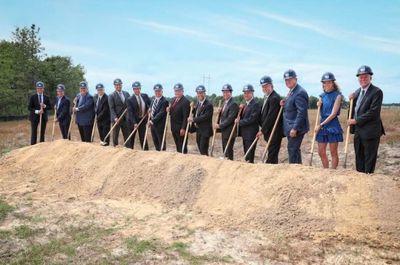
Dignitaries help University officials break ground on Jack and Ruth Ann Hill Convocation Center
State and local dignitaries help break ground on the new Jack and Ruth Ann Hill Convocation Center on Georgia Southern’s south campus in Statesboro. L-R: Georgia Southern Men’s Basketball Coach Brian Burg, Chair of the Georgia Southern Foundation Mike Sanders, University Foundation Board Member Leonard Bevill, University Provost Carl Reiber, Ph.D., Georgia Southern Athletics Director Jared Benko, Regent Everett Kennedy, Majority Leader Jon Burns, USG Chancellor Sonny Purdue, University President Kyle Marrero, Mr. Lance Hill, Congressman Buddy Carter, Chairman Terry England, Congressman Rick Allen, Student athlete Hannah Fuller, Waters College of Health Professions Dean Barry Joyner Ph.D. The opportunity to memorialize the late Sen. Jack Hill and wife Ruth Ann brought an impressive list of state and national leaders to Statesboro on Thursday to help break ground on a new Georgia Southern University Convocation Center that will bear their names. New University System of Georgia (USG) Chancellor Sonny Perdue, state legislators, congressmen and Georgia Southern University President Kyle Marrero – all of whom had worked extensively with Hill over the last several decades – headlined a team of speakers who lauded Hill and his impact on Georgia while helping to kick off a project that will change the face of Statesboro. “I’ve never known a more dedicated public servant than Jack Hill,” said Perdue, who shared an office with Hill and lived with him for a time while they both served in the Georgia Legislature. “It’s an honor to be here today to remember my best political friend in the world.” At 95,000 square feet, the Jack and Ruth Ann Hill Convocation Center will be the largest event venue space between Savannah and Macon and will serve as the signature building on Georgia Southern’s south campus, fronting Veterans Memorial Parkway (US 301 bypass). With an estimated total cost of $64.4 million, the center will be a multi-story complex that provides approximately 7,000 square feet of additional instructional space for the Waters College of Health Professions and provides more than a 50% increase in seating capacity in an arena that will be the new home court for Georgia Southern Eagles NCAA basketball games. The building is named for Jack Hill (‘66), who was the longest-serving Georgia senator when he died in April 2020. He was a senator for 30 years, serving as chairman of several crucial committees, including Appropriations, which has broad jurisdiction over legislation involving budgeting and spending state and federal funds. With Hill’s support, Georgia Southern reached new heights as an institution serving the southeast region and the state of Georgia. Hill was instrumental in helping the University expand its programs and build several new state-of-the-art facilities, including the Engineering and Research Building, which opened for classes in January 2021. His wife of 48 years, Ruth Ann, focused her life on public education and retired as principal of Reidsville Elementary School. She was a triple Eagle, earning degrees from Georgia Southern in 1973, 1990 and 1991. The media release announcing this historic event is attached here: If you're a journalist looking to know ore about this event or Georgia Southern University - simply reach out to Georgia Southern Director of Communications Jennifer Wise at jwise@georgiasouthern.edu to arrange an interview today.

Faculty from Georgia Southern University’s Jiann-Ping Hsu College of Public Health (JPHCOPH) have secured a federal grant totaling more than $1.8 million from the U.S. Department of Health and Human Services to promote inclusive excellence in health informatics and health equity. With the goal of empowering minority students through education, JPHCOPH’s Professor and Department Chair Gulzar Shah, Ph.D., as principal investigator, and Associate Dean for Academic Affairs Nandi Marshall, DrPH, as co-investigator, received the grant as part of the $7.98 million award for the TRIUMPH (Training in Informatics for Underrepresented Minorities in Public Health) consortium, which included three other universities and four public health organizations. “This initiative will help our college foster collaborations and community engagement involving influential public health agencies, academic institutions, community organizations and public health agencies,” stated Shah. “It will assist with paid practical experience for students and the practicum sites, and better prospects of job placements for the graduates. The grant will also involve health informatics capacity-building in the current public health workforce in Georgia.” In addition, the grant will help facilitate a new fully online concentration in public health informatics within the University’s existing Master of Public Health (MPH) program. This concentration will feature new courses focused on health information systems, data analytics and public health data visualization for evidenced-based practice. The courses will also be available as elective options for students in the Doctor of Public Health program. As well, the award also provides several graduate assistant opportunities to support students enrolled in the new MPH concentration. If you're a reporter looking to know more about this important topic - then let us help with your coverage and stories. JPHCOPH’s Professor and Department Chair Gulzar Shah, Ph.D, is available to answer your questions - simply reach out to Georgia Southern Director of Communications Jennifer Wise at jwise@georgiasouthern.edu to arrange an interview today.

Battleground Georgia: All eyes on the Peach State with midterms in sight
The US midterm elections are quickly approaching, and with key Senate seats and the governor's mansion up for grabs in Georgia, the Peach State will be low hanging fruit for anyone looking to see where the balance of power rests in the country. With reporters across America covering the latest developments, we asked Augusta University's Mary-Kate Lizotte to answer a few questions that are top of mind for reporters and political junkies alike. The strength of endorsements? Q: What kind of an impact could Mike Pence backing Gov. Brian Kemp have going forward? It could have an influence on the willingness of Republicans who are not former President Trump supporters to contribute to the Kemp campaign and be sure to show up to vote for Kemp. But, it will likely not have much of an influence. Research does not find a huge, lasting impact of endorsements. Ultimately, Trump supporters are unlikely to stay home and not vote for Kemp given that they likely are very against Stacey Abrams becoming governor. For Abrams supporters, she has already begun to use Indiana as a comparison with Georgia to say that Indiana under Pence was more moderate, including Medicaid expansion in comparison with Georgia under Kemp. I doubt this will influence Republican voters who like Pence to vote for Abrams, but it could influence some Independents/moderates to vote for Abrams. It is important to note, however, that most Independents/moderates tend to consistently vote for one party's candidates and thus may not be influenced by this either. A fractured right? Q: Could Pence's support also divide the Republican party somewhat after former President Trump backed David Perdue? Yes, but will likely not have a substantial impact on the election. It is unlikely that Trump supporters and/or Perdue voters will stay home on election day. They will likely vote for Kemp as their most preferred candidate who is running. Goal line stand? Q: Herschel Walker won the Republican primary by a large margin. How does he stack up against Sen. Raphael Warnock in the general election? Polling is currently showing a close race within the margin of error. Warnock has not been running against Walker up until now because Walker had not won the primary, but Walker and conservative groups have been able to run against Warnock because there was no reason to believe that he would not win his primary. In terms of experience, Warnock is the incumbent and thus has more experience. Walker is a complicated and controversial public figure but also is loved among University of Georgia football fans. Warnock has focused on putting out positive campaign advertisements up to this point. But, since there are already attack ads against Warnock, the Warnock campaign or groups supporting the Warnock campaign need to begin airing attack ads against Walker to improve the Warnock standing in the polls. The research indicates that it is best to go negative once you have been attacked. Follow the money? Q: Are we likely to see a record amount of cash flow for candidates in Georgia over the next several months knowing it will be a key swing state? Definitely. People from out of state who will be watching these elections closely will likely contribute. We saw that when Abrams and Kemp ran against one another in 2018 and in the special election that elected Warnock in 2020. If you are a journalist covering this topic, then let our experts help. Dr. Mary-Kate Lizotte is an expert in political and voter behavior. She is available to talk about the upcoming midterm and gubernatorial elections in Georgia. Click on her name to schedule an interview.


Dual dynamic of social media: connecting and stressing out
If social media platforms connect us, particularly during periods of isolation, they can also distress us and the people who moderate their streams of questionable content. In short, they appeal to our best and worst selves. Understanding that dual dynamic and its nuances across Facebook, Twitter, Reddit, Twitch and Clubhouse is NJIT’s Yvette Wohn, a behavioral scientist who researches how online abuse impacts mental health. Ultimately, Wohn aims to develop tools that combat bullying on the web. Explaining the problem, she says: “Some people simply don’t know what’s socially appropriate. What people don’t realize is that what people say online has a direct consequence offline. What happens online, doesn’t stay online.” Source: Yvette Wohn on Curating Safe Spaces Online To interview Wohn, whose research is backed by the National Science Foundation, simply click on the button below.


What big data tells us – in health care, cybersecurity, sustainability and elections
Every day sees more data created around the world than every day before, with a staggering 64 billion terabytes amassed in 2020 alone. Big data leaves large organizations wondering how to manage their share and individuals concerned about how to be heard. And both groups fret about information overload, privacy and security. NJIT’s David Bader is adept at discussing these issues as a nationally recognized data scientist who seeks new ways for companies to analyze massive data streams that arrive in real-time. He’s also a pioneer of Linux supercomputing who’s developing software to bring the power of supercomputers to regular people. Additionally, as director of NJIT's Institute for Data Science, Bader seeks powerful solutions to myriad global challenges. As he explains: “We personalized health and medicine. We look at cyber security applications. We look at urban sustainability. We even look at things like, how do we ensure trustworthy elections?” To interview him, simply click on the button below.


Meet the astrobiologist and her students who are searching for life on Mars
By Emma Richards, University of Florida From a young age, Amy Williams wondered if life existed beyond Earth amidst the dark abyss of space, stars and planets — a curiosity that years later landed her a career researching and exploring Mars. Williams, an assistant professor of geology and an astrobiologist at the University of Florida, works as a participating scientist on the Perseverance and Curiosity Rover Science Teams and previously served as a postdoctoral research associate at NASA’s Goddard Space Flight Center. As an astrobiologist and geobiologist, she uses techniques from geology, microbiology and chemistry to search for life beyond Earth. “Even as a little kid watching meteor showers with my family, I wondered if there was someone out there in the stars looking back at Earth.” “Even as a little kid watching meteor showers with my family, I wondered if there was someone out there in the stars looking back at Earth,” she said in an episode of the From Florida podcast. “It’s been a passion of mine my whole career and now it’s the most amazing opportunity to serve on both of the active Mars rover missions.” Williams’ journey to Mars began as a graduate student when a research professor gave her the opportunity to work on the NASA Curiosity mission. From there, Williams built her way up and is now a participating scientist working on day-to-day rover operations. Williams also is opening doors for graduate students at UF to work on Mars research, helping upcoming generation of scientists follow her path. She is specifically interested in involving women and underrepresented groups in her work. Based on her research, Williams said life on Mars, if found, will likely look less like Marvin the Martian and more like microbial life similar to bacteria on Earth. Curiosity landed on Mars in 2012 and Perseverance landed in 2021. The rovers are searching for potential life on Mars by going to habitable environments and searching for evidence of water and essential elements that could supported such life forms. Curiosity has spent nearly its entire mission exploring a large five-kilometer-tall mountain in Gale Crater known as Mount Sharp. The scientists can see Mars’ history and climate based on changes in the chemistry and sediments of the mountain. As for Perseverance, the rover is exploring Jezero Crater, with emphasis on its delta, a geologic deposit that is formed when water from a river flows into a lake. Perseverance will help collect rock and sediment samples from Mars that will be the first brought back to Earth. NASA is also working on a program to eventually send humans to Mars, which will likely take many decades; the first stage in the project will be returning humans to the Moon. “But in the meanwhile, these robots, these rovers that we send to the red planet, they are our proxy,” Williams said. “And looking through the robot rover’s eyes, the images that are returned to us, I recognize this is the closest I will ever be to standing on Mars and looking up at these beautiful geological units, looking up at an alien world that’s so familiar because the tenets of geology apply on Mars, the same as they do on Earth.” To hear more about the Amy Williams' Mars research, listen to the episode on From Florida at this link. Listen to other episodes in the "From Florida" series at this link. To learn more about her work, watch this video featuring Professor Williams:

