Experts Matter. Find Yours.
Connect for media, speaking, professional opportunities & more.
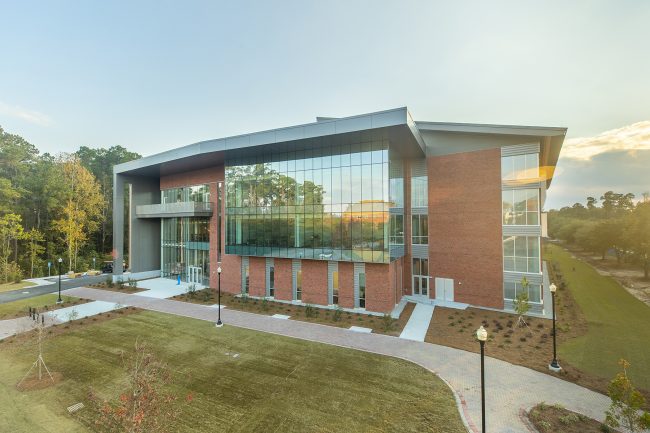
Last Friday, Georgia Southern officially opened its new Engineering and Research Building for students and researchers, a facility that will serve as the epicenter for engineering excellence and innovation in southeast Georgia. The building is designed to facilitate academic and institutional partnerships, inspire creative engineering and accelerate academic success for students in the College of Engineering and Computing. Through the instructional research labs and academic spaces that bridge theory and practice, students will be prepared to solve today’s challenges and to make tomorrow’s discoveries. “Today marks the culmination of years of forethought and investment from a number of state leaders, industry leaders and local advocates, who paved the way for us to be here,” said Georgia Southern President Kyle Marrero. “Leaders who, dating back to the 90s, could see the future of a growing industry, a state on the precipice of being a national leader in technology and innovation, and a critical need to develop talent in applied engineering across south Georgia.” The Engineering and Research Building’s sleek, contemporary environment defined by glass and natural light, soaring high-bay ceilings and modern, industrial feel is strengthened by new, industry-relevant equipment, instrumentation and technology that encourage active learning and sustainability. The highly efficient facility includes sustainable features that complements existing spaces on campus. The three-story building houses applied research spaces with a strong focus on manufacturing engineering, civil engineering, electrical and computer engineering, and mechanical engineering. The workspaces can be easily reconfigured for various uses, projects and applications and provide students with access to industry-grade equipment as well as expanded opportunities for undergraduate research. “The investment of the Engineering and Research Building solidifies Georgia Southern University’s commitment to students in providing a world-class education in the engineering field, while providing the space and resources necessary to facilitate such,” said student Kristifer Bell. “I am enthusiastic to continue my research work and look forward to the interdepartmental collaboration that will be encouraged through the housing of new student and faculty labs under one roof.” The full media release about this historic occasion is attached – and if you are a journalist looking to know more about this facility or Southern Georgia University -- simply reach out to Georgia Southern Director of Communications Jennifer Wise at jwise@georgiasouthern.edu to set and time and date.


Welcoming 2021: The Year of Resiliency
Happy New Year to all — may 2021 be a better and brighter year for everyone. It has been just over a year since I came to Japan Society as President and CEO, with a mandate to take the Society into the future while preserving its 113-year-old mission of building bridges between the U.S. and Japan. The pandemic has accelerated the pace of change for everyone, globally, nationally, locally, and within our own workplaces and households. Change is hard, but it is also necessary. In a recent email, my friend Parag Khanna wrote, “Our global system evolves the way humanity does, not through grand design or random accident but by adaptation to changing realities. The faster we react to an accelerating world, the better our chances of shaping the future to our benefit.” I’d like to speak to Parag’s point personally rather than geopolitically. The experience of leading a New York nonprofit during this time — an institution that is both deeply and historically embedded in onsite programming and tradition — has both clarified and strengthened my vision for Japan Society’s future. Bending Adversity If 2020 has forced us to prioritize, 2021 will be the year of resiliency. 2021 represents the year of the Ox in Japan, where the ox is considered an industrious, cautious, and faithful friend that is always glad to offer help. After the 2020 we’ve all had, we could use more faithful friends like the ox in 2021. We are looking toward 2021 as a year in which we as a society ultimately overcome COVID-19 through the efforts of scientists, frontline workers, and governments around the globe. We hope to see the world come together in a big way for the first time at the rescheduled Summer Olympics in Tokyo. In some ways, we have already seen the future in Japan and in Asia more broadly, with its successful response to the COVID pandemic. Japan also represents a recent example of how to bend adversity and bounce back, as it did from the Great East Japan Earthquake, tsunami and nuclear disaster of 3/11/2011. The entire country came together in solidarity to support the affected Tohoku region, including concrete measures such as limiting electricity usage at a national level to avoid rolling regional blackouts. A decade on, Japan still remembers, with the Olympic flame set to depart from Fukushima Prefecture in the torch relay that will cross the country before arriving in Tokyo for the Opening Ceremony. Out of Crisis: Opportunity Optimism and positivity are necessary to move forward. I’m optimistic not because I’m naïve about the challenges ahead as we continue to navigate these wild currents, but I am confident that we will find safe passage because of what we have learned collectively and adapted to over the past months. Japan Society’s Language Center had a record year in 2020 despite the pandemic as our teachers reached beyond our physical classrooms to virtual ones; more people joined us than ever before for our first-ever digital JAPAN CUTS, the largest festival of Japanese cinema in North America. We have opened possibilities far beyond our physical building, the original Japan House, designed by Japanese modernist architect Junzo Yoshimura 50 years ago, and named New York City’s youngest landmark in 2011. In crisis comes opportunity, and from opportunity come the possibilities for our collective future. While we are hurting without our physical programs and admissions revenue, we’ve literally been able to connect across the world, and even beyond — from Japanese astronaut Soichi Noguchi, who is currently on the International Space Station, to countless leading voices in Japan such as Olympics Director Nomura Mansai — to create unique experiences for our members. In this time, I return to the Japanese concept of kaizen (改善), continual self-improvement and change for the better. Regardless of the next challenges on the horizon, I’m committed to ensuring that we continuously improve and adapt in this spirit. I believe that our mission has never been more critical than in 2021 as we strengthen U.S.-Japan relations with new administrations in both capitals and seek opportunities to engage, explore, and educate our societies about our collective resiliency as we welcome the new year. Joshua Walker (@drjwalk) is president and CEO of Japan Society. Follow @japansociety. The views expressed in this article are the writer’s own.



The events that led to the storming of the Capitol buildings last week have garnered attention from just about every news organization across the planet. Pundits and politicians have weighed in on both sides regarding whether President Trump’s words and actions need to be held accountable for the damage to America’s democratic institutions as well as the five people who have since died as a result of the events that occurred on January 6, 2021. Recently, University of Connecticut’s Richard Ashby Wilson, the Gladstein Chair and Professor of Anthropology and Law and an expert on hate speech and incitement on social media shared his perspective in an Op-Ed published in the Los Angeles Times. It’s a thoughtful, methodical, and excellent piece outlining why he believes, in his expert legal opinion, that President Trump crossed the line and now deserves to be held accountable for his crimes. This is a burning topic, and if you are a journalist looking for objective and expert opinion on this topic – then let us help. Richard Ashby Wilson is available to speak with media about this issue – simply click on his icon now to arrange an interview today.


Are vaccine passports legal in a post-COVID-19 era? Let our experts explain
As America and the world look to slowly round the corner of the safety measures enacted during the COVID-19 pandemic, the new coronavirus vaccines are giving hope of an eventual return to normal. However, with an active anti-vaccination movement afoot and many still skeptical of getting that essential poke in the arm, the World Health Organization said some government officials are suggesting the idea of vaccine passports. A simple piece of identification would end the uncertainty that comes with travel, work and the much sought-after leisure that often means crowded places and smaller spaces. The idea has already caught on in countries in Europe and South America. It may be the safety blanket many seek, but are vaccine passports actually legal? It is a question that’s beginning to get serious coverage. “Having proof of vaccination can be essential for a number of sectors other than health, but we cannot overlook the potential discriminatory consequences that may arise,” said Dr. William Hatcher, an expert in public policy and interim chair of the Department of Social Sciences at Augusta University. Another idea being floated is immunity passports, but Hatcher suggests¬ allowing only people with immunity to work might disadvantage those who haven’t gotten sick or those without the antibodies to prove it. It’s as if, in the eyes of their employer, their lack of infection constitutes a disability. The inequality that immunity passports could foster in these situations may be illegal under the Americans with Disabilities Act. There are also other ethical, practical, and cultural aspects to consider as well. If you are covering this emerging topic and are looking to know more, our experts can help. Dr. Hatcher is a professor of political science and interim chair of Augusta University’s Department of Social Sciences. He is an expert in the areas of public administration and social, economic, and political institutions in local communities. Hatcher is available to speak with media regarding the concept of vaccination and immunity passports. To arrange an interview, simply click on his name.


Network Science Offers Key Insights into Polarization, Disinformation, and Minority Power
People tend to think of the arena of politics as being driven by human decision and emotions, and therefore unpredictable. But network scientists like Boleslaw Szymanski, a computer science professor at Rensselaer Polytechnic Institute, have found that the country’s political activity – from American society’s ever-growing partisan divide to its grappling with the spread of misinformation online – can be explained by abstract and elegant models. These models provide insights — and even answers — to a number of pressing questions: Is increasing access to information driving us apart? Can an entrenched minority ultimately prevail? Could structural changes be made that insulate us from misinformation and reduce the polarization that divides us? Szymanski studies the technical underpinnings of our choices, how we influence one another, and the impact of the algorithms we rely upon to navigate a growing ocean of information. His work has yielded fascinating insights, including research on how a committed minority will overcome less determined opposition and the development of a parameter to determine what drives polarization in Congress. Through his research on the influence of minority opinions, Szymanski found that when just 10 percent of the population holds an unshakable belief, it will ultimately be adopted by the majority of the society. “When the number of committed opinion holders is below 10 percent, there is no visible progress in the spread of ideas. It would literally take the amount of time comparable to the age of the universe for this size group to reach the majority,” said Szymanski, a computer science professor at Rensselaer Polytechnic Institute. “Once that number grows above 10 percent, the idea spreads like flame.” In his present work, Szymanski is researching tools for measuring the level of polarization in specific news sites, search engines, and social media services, and developing remedies, like algorithms that offer better data provenance, detect misinformation, and create internal consistency reasoning, background consistency reasoning, and intra-element consistency reasoning tools. “Informed citizens are the foundation of democracy, but the driving interest of big companies that supply information is to sell us a product,” Szymanski said. “The way they do that on the internet is to repeat what we showed interest in. They’re not interested in a reader’s growth — they’re interested in the reader’s continued attention.” With the political environment becoming increasingly bitter and dubious information becoming ever more prevalent, Szymanski is available to discuss his research on polarization, disinformation, and the power of a committed minority.



Is hospital advertising actually good for our health?
Hospitals and healthcare organizations in the U.S. spend $1.5 billion on advertising every year. It’s a topic that provokes lively debate and a certain amount of controversy. Medical bodies, policy makers, and scholars alike question the ethics and efficacy of using (constrained) budgets to promote hospitals to patients. Diwas KC, professor of information systems & operations management at Emory University’s Goizueta Business School, and Tongil Kim, an assistant professor of management at Naveen Jindal School of Management in Texas, conducted a large-scale study of hospitals and patients in the state of Massachusetts to better understand the impact of hospital advertising. What they found is striking: Not only does television advertising work, it significantly drives demand, attracting patients living far from the hospital and beyond its regular area. And that’s not all. KC and Kim discovered that limiting hospital advertising or imposing an outright ban, as some groups have called for, might actually have serious negative effects on patient healthcare. “There has been a lot of discussion about banning advertising over recent years because of uncertainties around wasting money and resources,” KC said. In the paper “Impact of hospital advertising on patient demand and outcomes,” KC shows that there is a correlation between the amount spent on TV advertising and the quality of the hospital in question. Healthcare facilities that invest more in advertising tend to be “better” hospitals, he adds; they offer higher caliber care and services and, as such, they see much lower patient readmission rates—a key quality metric in healthcare. To get to these insights, KC and Kim looked at more than 220,000 individual patient visits to hospitals in the state of Massachusetts over a 24-month period. Among the data they collected were things like hospital type, location, and dollars spent on advertising. Patients were documented in terms of medical conditions, insurance, zip codes (to determine residence), and median household income. They were able to contrast those hospitals that invested in television advertising and those that did not. With the former, they uncovered a significant uptick in patient visits, with people coming from far further afield. This was particularly true of wealthier patients. Then there’s the question of patient outcomes. Here the data showed unequivocally that it’s the high-quality, low-readmission hospitals that advertise more—something that KC attributes to the natural tendency to get “more bang for the advertising buck when the quality of your product or service is better.” As for banning advertising, this would negatively impact these hospitals, he argues, limiting their ability to attract patients. It could also lead to an increase in population-level readmission rates. “Patient readmission rates are one of the key metrics along with mortality rates that tell us how well a healthcare facility is working,” said KC. “If a patient gets discharged but has to come back to a hospital in, say, 30 days, unless it’s a chronic condition or ongoing treatment, it’s a good indication that the patient didn’t get the level of care they should have the first time.” Indeed, “when we looked at all of the data, we found that the hospitals where there were fewest revisit rates were those that advertised more,” he said. KC finds that a blanket ban on hospital advertising could lead to an extra 1.2 readmissions for every 100 patients discharged. It’s a significant and “surprising” finding. And one that should inform the debate around healthcare advertising spend in the U.S. “There’s also the idea that this is a zero-sum game because if a patient doesn’t go to hospital A, they’re just going to go to hospital B—the one that advertises more—splitting the pie in different ways but not increasing that pie,” KC said. “What our study finds is that yes, advertising does draw patients away from one facility and towards another, but that the latter generally delivers better patient outcomes,” he said. “So, there is a social welfare benefit right there that suggests that you should not ban hospital advertising. There are real health benefits in allowing [advertising] to happen.” If you are a journalist looking to cover this topic - then let our experts help. Diwas KC is a Professor of Information Systems & Operations Management at Emory University’s Goizueta Business School. He is an expert in the areas of Data Analytics, Operations, and Healthcare. If you are interesting in arranging an interview - simply click on his icon to set up a time today.



New York Times, Pornhub, Visa & Mastercard: The Debate
Yet another example of no one listening to sex workers Pornhub just made major changes to how their platform works, including expanded moderation and new guidelines for content uploads. Now, only verified users can upload videos to the platform – a decision which meant the total number of videos hosted on Pornhub were more than quartered overnight from 13.4 million to 2.9 million – and users can no longer download videos from the site. This comes after an expose on the New York Times, The Children of Pornhub, which investigated the number of rape videos being hosted on the site, including those of minors. The article, written by Nicholas Kristof, followed the lives of child sexual assault victims whose videos were uploaded onto the site. The op-ed launched a huge debate within the adult industry over censorship & moderation. People, rightfully so, do not trust Kristof because of his ties to anti-porn organisations and his reputation when it comes to reporting on sex work. In the past he has been accused of conflating sex work with sex trafficking, using misleading statistics, and was instrumental in the shutting down of Backpage, a vital safeguarding tool for sex workers, calling it “the pillar of sex trafficking”. He also quoted Laila Mickelwait in the op-ed, who is an activist and director of Traffickinghub, a campaign launched by Exodus Cry which has anti-sex work, anti-LGBTQ and anti-abortion links (it’s founder reportedly compared abortion to the holocaust). This week, two days after Pornhub announced their changes, Visa and Mastercard started an investigation and soon announced that their cards would no longer be accepted on the platform. This has left Pornhub with no way to process payments other than with cryptocurrencies. It goes without saying that the decision from Visa & Mastercard has panicked adult content creators who make their living from paid content on Pornhub. Because let’s be clear, Mastercard & Visa’s decision will not hurt Pornhub, who always have and always will continue to make money off of stolen content, this decision hurts sex workers – the people that Pornhub has never cared for. Adult performers, producers and directors have spent years speaking out about the exploitation within Pornhub and the tube site business model, yet no one has listened. MindGeek, the parent company of Pornhub, dominates online porn. It has completely demolished the industry and drained money out of the industry by stealing performers’ work and giving it away for free, and by monopolising the industry. MindGeek is an aggressive tech company through and through, it does not care about porn or adult content creators, it cares about traffic and advertising. It also owns production companies which means performers who may want to speak out about the system ultimately can’t for fear of being black listed from the production companies and therefore having less work and even less money. "Adult performers have spent years speaking out about the exploitation within Pornhub and the tube site business model, yet no one has listened" Pornhub does not care about performers and it’s clear that Kristof doesn’t either, but it wasn’t until the New York Times covered this issue that Pornhub did something. I wonder why? If properly implemented by Pornhub, their new regulations could have had a significant impact on illegal and stolen content, which would be a win for adult performers who have no choice but to use the platform. But with the new ban from Mastercard & Visa, they could now be in an even worse position than before. This is yet another example, just like SESTA/FOSTA, that shows that when it comes to making changes to the adult industry we must speak to sex workers & have their involvement in policy. Pornhub, Mastercard, & Visa, do not care about the issue of rape videos or of pirated material, these are policies that were brought in under pressure to “do something” out of fear of negative publicity. We know that Pornhub does not care about the content it hosts, the people it hurts or the lives it ruins – they have shown us this time and again. Just last year they demonstrated this with the Girls do Porn case. Despite 22 women coming forward to sue Girls Do Porn for uploading explicit videos of them to Pornhub without their consent, Pornhub refused to remove the videos from the platform, even promoting them, until Girls do Porn were finally charged with sex trafficking. Now is not a time to protect Pornhub, it’s time to protect and support the people who will actually be harmed by this. We must remember who have been talking about this for years whilst no one has listened; sex workers. Please go and find performers and indie producers that you want to support and pay them for their work. Whether it’s on Only Fans or through their personal websites, pay & support sex workers & adult content creators.


Finding Joy Through the Holiday Season - Ways for families to feel the familiar in unfamiliar times
Sandra M. Chafouleas, Ph.D. recently wrote a piece for Psychology Today that aims to help families as we enter the holiday season: The typical holiday season can bring forth any number of emotions, from anger and sadness to joy and awe. Family traditions – those repeated and symbolically meaningful holiday rituals – play a big role in shaping your feelings throughout the season. Families traditions can buffer conflicts, boost positive feelings, and bring people closer together. The pandemic is bringing an atypical holiday season this year, presenting change in the things we do, the way we do them, and who we do them with. We may miss out on getting together in person with family and friends, traveling to cherished places, or taking part in our traditional celebrations. Forced upon us, these unfamiliar changes can evoke feelings of loss and frustration. As a very unfamiliar holiday season approaches, we can still find ways to bring familiarity and predictability — and the sense of comfort that goes with that — with some adaptations to our family traditions. In her piece, Dr. Chafouleas, a licensed psychologist and Board of Trustees Distinguished Professor in the Neag School of Education at the University of Connecticut, offers advice for ways to adapt family traditions and help restore a sense of well-being while embracing the unfamiliar — and uncomfortable —differences in the holidays this year. Dr. Chafouleas is available to speak with media regarding this subject - simply click on her icon now to arrange an interview today.


Savannah is drenched in history, but many of the city’s stories often go untold. Four Georgia Southern University history students aim to shed light on these untold stories as a part of their project, Savannah History Remix. The project, developed by graduate students Lauren Della Piazza Hartke, R. Dalton Bryant, Noah Prince, and Dalton Blackmon, is a series of walking tours featuring lesser-known stories of Savannah’s history. “The walking tours seemed like the safest bet and a good opportunity to learn some digital skills,” said Assistant Professor of history Alena Pirok, Ph.D., who is overseeing the project. “The tours intend to bring new and useful historical information to the city, its residents and the historical tourism industry.” When the project began, the students identified subjects not found on commercial tours of Savannah, including modern immigration, laborers, common people of Savannah and the LGBTQ community. Hartke created the tour, “A Seat at the Table: A Social History of Savannah’s Foodways,” which revolves around the culinary history of the city. “My goal for this project was to show how Savannah’s food scene today is the product of many years of input and contribution from many different subgroups of peoples,” she said. “I want people to understand how our notion of southern food is the product of English, West African and Native American foodways, combined with regional practices unique to Savannah’s economy and ecology.” Pirok said the Savannah History Remix tours have more freedom than commercial tours. “A non-profit tour like ours does not have to worry about losing customers and money,” she said. “This gives us the freedom to take more risks and to offer new, but academically sound, historical narratives that people do not find familiar or ones that might challenge their vision of the world.” Despite COVID-19, students at Georgia Southern University are combining innovation, technology and creativity to see the projects they want to fulfill come to fruition. If you’re a journalist looking to know more about the Savannah History Remix or similar projects, simply reach out to Georgia Southern Director of Communications Jennifer Wise at jwise@georgiasouthern.edu to arrange an interview today.

COVID-19 has raised the stakes for boards, argues Brunswick’s Paddy McGuinness, former UK Deputy National Security Adviser. We now live with COVID-19. Fewer business leaders are making the mistake of talking about “post-COVID” or “when this is over.” The better of them have factored in COVID-19 related constraints to their medium-term plans and are even thinking about how the world may change in the long-term. They are building capacity to take advantage of an early recovery within months, yet they are modeling and encouraging grit for current and indeed harder conditions to last much longer. In the past, when health emergencies—say the Spanish Flu pandemic of a century ago—subsided, there was a greater return to economic normality than had been expected during the crisis. Extreme events often heighten or even distort our perception of wider risks. That old journalistic cliché “one thing is certain, nothing will be the same again” is rarely true. But the pandemic has created the expectation that businesses will be resilient—that they will be able to respond to an event and recover to the state prior to the event, incorporating the lessons learned into business practice. Many business leaders feel they have not done too badly responding to a once-in-a-hundred-years event. Business Continuity Plans (BCPs), which were understandably sketchy for pandemics, were pulled out of second-line risk management and owned and improved in real-time by executive committees. The transition to remote working and, at least in Asia and some of Europe, the gradual return to offices again, has been managed. Services and even vital production have been maintained. Leaders have absorbed the personal and collective strain of this. Good reason then for some satisfaction as they delegate certain COVID-19 responses and focus on the economic tsunami that follows the pandemic. The public seems to largely agree with business leaders’ assessments. While many national and scientific leaders find themselves beset by “blamestorming,” corporate executives have been given more slack. They weren’t expected to have foreseen a pandemic. Their sometimes scrabbling responses are understood. However, behind this lucky pass lurks an expectation that businesses will now be more prepared for crises and foreseeable risks. Resilience cannot be relegated to BCPs and traditional risk-management structures. It is categorically a board issue—regulators, lawyers, politicians and the public say so. The reputations of individual board members and the collective are at stake. Think how fast leaders have been expected to respond to the issues raised by the Black Lives Matter movement. Alacrity will be required. The speed and scale of decisions in response to the pandemic leaves board committees playing catch up to assure themselves that risks have been managed. The move to working from home has been rapid, so too the digitization of the business. Some see these as new, streamlined ways of working, yet the negative consequences are not yet fully apparent. Working from home, for instance, is attractive to some employees as well as chief financial officers, who may relish the chance to reduce fixed costs. Concerns about the impact on the coherence of the business’s culture, its productivity and innovation, the security of data held at home, hardships for those in difficult home conditions, and, indeed, the needs of the younger demographic who seem to favor a return to the office, need to be given due consideration. It may be a case of “decide in haste, repent at leisure.” Resilience is categorically a board issue—regulators, lawyers, politicians and the public say so. The reputations of individual board members and the collective are at stake. Boards also need assurance that the business has regained its balance and can manage parallel or interrelated crises. In recent weeks we have been helping several clients respond to major cyber events unrelated to the COVID-19 outbreak. They have probably needed more external support than otherwise because their leadership capacity was inevitably denuded by pandemic response. And they have benefitted from us already knowing each other and having experience of how to work together in crisis. After the Great Financial Crash there was a heavy focus on balance-sheet resilience and having the requisite finance skills on boards. Business leaders are now beset by advice on the heightened obligation to be resilient in much a broader sense of the word. Regulators, lawyers and risk consultants are sharing checklists of factors for executive committees to take into account when managing risks and for boards to oversee. The challenge here is defining what changes your specific business needs and how to actually bring those about. Shareholders will be expecting a judicious move away from “just in time” systems to ones that can endure foreseeable risks. This isn’t just about potential legal liability or reputational risk. This is about setting your business culture for success. Undermanage risks and the business is wide open to damage from foreseeable shocks with all the loss of confidence and capability that follows. Overmanage and the business losses its competitive edge just when there is opportunity in the recovery. In order to track broader resilience, boards and their committees will need access to a wider set of skills and insight. Board membership emerges as an obvious area of focus. Yet each board will take more time and belonging to too many—“over boarding”—may well be unacceptable. Risk methodology and information flows will also have to be reviewed, alongside how to strengthen board members’ awareness and skills. Before the pandemic, chairs and CEOs were already wrestling with this for their difficult-to-price risks, such as data, technology risks and cyber. Individual experts on boards created siloed responsibility for what should have been a shared risk. A focus on process and method often led to a focus on the management, rather than genuine oversight of, risks. External advice didn’t always help (as we have learned from the plethora of competing advice around COVID-19). No single intervention will meet the new standard for resilience. Nor will simple prescription. A broader and more articulated approach is required if governance is to maintain stakeholder confidence and corporate reputation.