
Experts Matter. Find Yours.
Connect for media, speaking, professional opportunities & more.

Researchers find mechanical stimulation could be used to help improve balance control The findings provide new information on whole-body vibration applications Paves the way for research on the interaction between the central nervous system and peripheral muscles. Mechanical vibrations could help improve our muscles and our balance control, according to research at Aston University. Researchers in the College of Engineering and Physical Sciences have examined the effect of stimulation on muscle spindles which ‘speak’ to the central nervous system to help keep us upright and walk straight. Their results provide new perspectives on whole-body vibration applications, paving the way for future research on the interaction between the central nervous system and the peripheral muscles. The research could in future be applied to improve balance in older people and help reduce falls, this could be applied through either wearable devices or with a daily session of stimulation. Hip fractures alone account for 1.8 million hospital bed days and £1.1 billion in hospital costs every year, excluding the high cost of social care. Another potential benefit of the research is that this type of stimulation could be applied to athletes to decrease their muscle reaction times. The goal of the study was to find out if mechanical vibrations can improve the way our bodies process and react to small body oscillations. Seventeen young male and female adult volunteers aged between 20 and 28 years old stood individually on platforms, similar to vibrating plates found in gyms, which caused leg muscle contractions. Calf muscles were targeted as the muscles whose action contribute the most to maintaining a stable upright posture. The researchers stimulated their calves with a frequency of 30Hz and recorded four one-minute trials of undisturbed balance to take a baseline measure and compared the readings to measurements taken after the stimulation. After conducting the experiment, they found that their balance seemed to have improved. The research, Sensorimotor recalibration of postural control strategies occurs after whole body vibration, was led by Dr Antonio Fratini, senior lecturer in mechanical, biomedical & design engineering, and PhD student Isotta Rigoni, and has been published in Scientific Reports – Nature. Dr Fratini said: “We’re excited by our results as they could have a beneficial effect on the health and quality of life of a large number of people. “Our results indicate that whole body vibration challenges balance at first, triggering a bigger effort to control the upright stance and shifting muscle modulation toward supraspinal control, resulting in a recalibration of muscle recruitment. The neuromuscular system seems to recover from such disruption and regain control over a longer time interval.” “Indeed, while muscle recruitment and cortical effort appear unaltered over the long term, the balance seems not only restored but also improved, besides the still clearly affected calf muscles.” For more information about our research or studying in the College of Engineering and Physical Sciences please visit our website.


Birmingham City Council Cabinet Member Cllr Majid Mahmood met with sustainability experts from across Aston University Cllr Mahmood is responsible for the city’s sustainable waste strategy Knowledge exchange projects between the city council and Aston University were discussed. Birmingham City Council’s Cabinet Member for Environment visited Aston University on 30 November to meet with academics working on sustainability challenges. Cllr Majid Mahmood is responsible for developing a financially and environmentally sustainable waste strategy for the city and engaging in citywide and national policy development to tackle the causes and consequences of climate change, among other accountabilities. Cllr Mahmood’s visit included seeing the chemical engineering and applied chemistry labs run by Dr Jiawei Wang and Dr Matthew Derry who are investigating methods for generating energy from waste and creating new, more sustainable materials. He also met with Professor Patricia Thornley, director of the Energy Bioproducts Research Institute (EBRI) along with other colleagues including Dr Katie Chong, who showcased EBRI’s world-leading research into bioenergy and bioproducts and heard from Dr Luciano Batista on the work he is leading at the Centre for Circular Economy and Advanced Sustainability which provides practical answers to tackle world-critical sustainability challenges. During the visit, Cllr Mahmood was able to share some of the challenges and opportunities facing Birmingham City Council, particularly around sustainability, the environment and waste management. He discussed with academics how Aston University’s research could feed into Birmingham City Council’s future waste and energy management plans and how the lived experience of the city should shape the direction of research. A number of knowledge exchange opportunities were also discussed, including using the city council’s experience to develop undergraduate student projects and academics being invited to visit Birmingham’s waste management depots. Cllr Majid Mahmood said: “It has been brilliant to visit Aston University today and to learn about the innovative ways that different academics are tackling the sustainability challenges facing the world. “As the largest metropolitan local authority in the UK, Birmingham is uniquely placed to develop sector leading waste and energy management processes. Working closely with universities like Aston University will help us to achieve this. “I look forward to developing our working relationship and combining our practical experience and research excellence to drive innovation in the sector.”


Georgia Southern University building ethical skills in military leaders
Georgia Southern University’s Department of Philosophy and Religious Studies recently partnered with key leaders of the U.S. Army‘s 188th Infantry Brigade from Fort Stewart for a Leadership and Professional Development session in Jenkins Hall Theater at the Armstrong Campus. Professor Leisa Schwab, a part-time member of the department and former military judge advocate, presented “Introduction to Moral Theory” to the unit’s officers and senior non-commissioned officers. The session focused on ethical leadership and communication techniques in the military. “Military leaders are people entrusted with authority in a really broad range of areas and they have difficult decisions to make,” Schwab said. “Whether in the heat of the moment or as an after-the- fact analysis, these ethical frameworks can be helpful for making sense of these decisions.” The members of the audience were introduced to three different ethical theories, which were then discussed in relation to difficult situations that leaders may encounter in the military. Schwab’s session focused on how an understanding of philosophical ethics could help leaders both make better decisions and communicate more effectively. The military is made up of countless personalities and backgrounds. Just like any other group, company or society, the leadership must find ways for everyone to work together effectively. “You may have two soldiers who have wildly different cultural backgrounds and they have deep disagreements about what is right or wrong in a certain situation,” Schwab said. “Being able to help them communicate effectively about that can help maintain that kind of functional sense of community. That’s so important.” Schwab said this was a fun opportunity to mix her love of teaching philosophy with her military background. Georgia Southern University’s Department of Philosophy and Religious Studies recently partnered with key leaders of the U.S. Army‘s 188th Infantry Brigade from Fort Stewart for a Leadership and Professional Development session in Jenkins Hall Theater at the Armstrong campus. Looking to know more - then let us help. Professor Leisa Schwab is available to speak to reporters about this important project. For more information or to arrange an interview - simply reach out to Georgia Southern Director of Communications Jennifer Wise at jwise@georgiasouthern.edu to arrange an interview today.


Approximately 30 University Police officers recognized for mental health training
Student mental health is a constant concern on a university campus. It is not uncommon for someone in distress to call 9-1-1. A police officer could be the first person to interact with a person who needs specialized attention. To help evaluate and properly handle such situations, every officer at Georgia Southern has completed Crisis Intervention Training (CIT), presented by the Georgia Public Safety Training Center in collaboration with the Georgia Department of Behavioral Health and Developmental Disabilities, and the Georgia Chapter of the National Alliance on Mental Illness. The training ensures that people with mental illnesses and other brain disorders will receive treatment in lieu of incarceration in most cases. On top of that training, the University System of Georgia offers two additional programs to law enforcement officers: QPR Suicide Prevention Training – QPR stands for Question, Persuade and Refer – the three simple steps anyone can learn to help save a life from suicide. Just as people trained in CPR and the Heimlich maneuver help save thousands of lives each year, people trained in QPR learn how to recognize the warning signs of a suicide crisis and how to question, persuade and refer someone to help. Adult Mental Health First Aid (MHFA) Training – MHFA is a skills-based training course that teaches people how to identify, understand and respond to signs of mental illness and substance use disorder. for police officers to help recognize and handle mental health issues and mental health disorders. So far, almost 30 police officers at Georgia Southern University have completed the three different training programs, earning each officer a Mental Health Initiative pin. “I am very proud of these officers, and appreciate them taking the time to better prepare for handling any situation they may encounter,” said Laura McCullough, chief of police at Georgia Southern. “The pins they now wear are a symbol of the care they invest in our community.” State and University officials lauded the officers’ achievements. “This law enforcement mental health certification program could not come at a better time for our university communities, given the state of mental health in our country and on our campuses,” said Jodi Caldwell, director of Georgia Southern’s Counseling Center. “Law enforcement personnel are increasingly the first responders to individuals experiencing mental health emergencies. It comes as no surprise to the staff of the Counseling Center that Georgia Southern’s University police department is leading the way in Georgia for law enforcement interest and willingness to become trained in recognizing and responding to individuals in mental health distress.” Caldwell spoke at a ceremony last month to present the pins and honor the officers. Also attending were Alexis Belvin, Georgia Southern’s SGA President and Chip Reese, Ed.D., former system project director for the University System of Georgia (USG) Mental Health Initiative. “The USG Mental Health Initiative was launched during COVID to allow us to focus more intentionally on the needs of our students,” Reese said. “We have expanded clinical counseling services and supported mental health and wellness resources and programming across the state. I’m particularly proud of the QPR and MHFA training and hope it will better equip the officers who are already on the first ones we call whenever someone needs help.” The following officers were awarded the Mental Health Initiative Pin: Tim Alderman, Josh Barker, Richard Bashlor, Charles Bowen, Ian Craig, Laurence Croy, Steven Cushner, Sam Derr, Christion Doyle, Bailey Dyches, Jonathan Finley, Danny Garrigus, Kenneth Glover, Clay Gracen, Sarah Grey, Lanier Griswold, Patrick Holloway, Tyrone McBride, Chris McBride, Erk McCurdy, BJ McKellar, Alex Morris, Todd Olsen, Kurt Purtee, Dexter Renfroe, Erick Riner, Lamar Stephens, and Crystal Thomas. Looking to know more - then let us help. Jodi Caldwell, director of Georgia Southern’s Counseling Center, is available to speak regarding this important topic - simply click on here icon here or simply reach out to Georgia Southern Director of Communications Jennifer Wise at jwise@georgiasouthern.edu to arrange an interview today.


Georgia Southern University’s College of Science and Mathematics has been awarded a six-year grant of $493,065 from the Howard Hughes Medical Institute (HHMI) Inclusive Excellence 3 (IE3) initiative. Georgia Southern is among a select group of 104 schools that have received an HHMI IE3 grant to support diversity, equity and inclusion. “Science is about building, witnessing and collaborating with each other, which is why Georgia Southern is so proud to receive this grant,” said Georgia Southern Provost and Vice President of Academic Affairs Carl Reiber, Ph.D. “Our inclusive initiatives are breaking down the walls that have separated science from interested students.” The HHMI IE3 initiative challenges U.S. colleges and universities to increase student participation in sciences, focusing especially on populations who have been historically underrepresented in the field. The Georgia Southern IE3 leadership team includes: Karelle Aiken, Ph.D, (program director), Tricia Muldoon Brown, Ph.D., (co-director) Sara Gremillion, Ph.D., (co-director), Checo Colón-Gaud, Ph.D., Issac Taylor and Delana Schartner, Ph.D. “The IE3 initiative is tapping into the transformative power of collaboration; the ability of a critical mass to drive cultural change. As such, an ingenious mandate of this grant is that its 104 institutional awardees work on their goals in teams of Learning Community Clusters (LCC),” said Aiken. Georgia Southern’s IE3 LCC hub, LCC4, includes 13 other institutions from across the U.S., all of whom are seeking to answer a specific challenge: How can an institution evaluate effective inclusive teaching, and then use the evaluation in the rewards system including faculty promotion and tenure? The IE3 initiative has been rolled out in two phases. The most recent award marks the beginning of the second phase and so, the work of the Georgia Southern team and their LCC4 colleagues is ongoing. At Georgia Southern, over the next six years the IE3 initiative will support training for faculty and student-leaders centered on inclusive teaching strategies and the effective evaluation of those strategies; an annual COSM IE3 Spring Speaker Series (established in 2022); the continued development of a new faculty mentorship program piloted in 2022 by Inclusive Excellence Faculty Fellows; student- and faculty-led initiatives geared toward cultivating inclusive learning environments; and more. Looking to know more - then let us help. For more information or to arrange an interview with Carl Reiber or anyone from the Georgia Southern IE3 leadership team - simply reach out to Georgia Southern Director of Communications Jennifer Wise at jwise@georgiasouthern.edu to arrange an interview today.
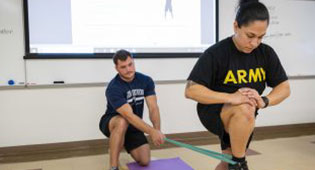
What began in 2016 as a partnership between Georgia Southern University and the Third Infantry Division at Fort Stewart has become a nationally recognized educational and research program with $5.68 million in federal funding to improve soldier health and performance to ensure force readiness. Now called the Soldier Performance and Readiness (SPAR) program, this Georgia Southern project aligns with the U.S. Army’s Holistic Health and Fitness (H2F) initiative and represents a multifaceted partnership with the Army to provide onsite training that decreases musculoskeletal injuries; deliver an online certificate program in tactical fitness for college credit; collaborate with the Army’s Research Institute for Environmental Medicine (USARIEM); and develop programs to enhance and assess cognitive performance in tactical situations. The initial partnership program to prevent musculoskeletal injuries was delivered at first to small cohorts to implement new practices in the physical training of their squads and platoons in a train-the-trainer model. Results were so encouraging, the program expanded at Fort Stewart and to training brigades at Fort Benning last year with the assistance of $1.5 million in Department of Defense funding. Studies show significant preparedness and financial benefits from reducing musculoskeletal injuries to soldiers during drilling and training exercises. In April 2020, officials determined that 58,000 soldiers (the equivalent of 13 Brigade Combat Teams) had injuries that classified them as non-deployable. In 2019, more than half of soldiers experienced a new injury, resulting in 10 million limited-duty days. Musculoskeletal injuries account for nearly 25% of all military injuries and approximately $557 million in acute patient care. Most of these injuries were associated with fitness training-related activities Georgia Southern’s online Tactical Athlete Certificate program was first offered in 2020 and is available exclusively to soldiers on active duty, in the National Guard or reserve. Through a series of three courses, the program teaches foundational exercise and biomechanical concepts, strength and conditioning principles, and rehabilitation. The coursework parallels the Army’s Master Fitness Trainer curriculum, with additional rehabilitation principles, and teaches soldiers how to develop evidence-based and well-rounded physical training programs while minimizing risk of musculoskeletal injury. Certificate completion provides soldiers with nine college credits with Georgia Southern, potential promotion opportunities in the Army, and preparation for the National Strength and Conditioning Association’s TSAC-F exam. “By sharing knowledge, expertise and experience between our faculty and doctoral students with soldiers, drill instructors, and brigade combat fitness teams to create aligned programs that improve tactical performance and force readiness, the SPAR program has become a national model of public-impact research,” said Christopher Curtis, Ph.D., Georgia Southern’s vice provost for research. “We are excited about the future of this partnership. We relish the significant support and encouragement we receive from the Army commands at Fort Stewart, Fort Benning, USARIEM, and the Training and Doctrine command (TRADOC), and we are grateful to Congressman Carter and his fellow members of the Georgia Congressional delegation who have advocated for the value of the partnership on our behalf.” The progress and continued success of this program would not have been possible without several years of support from the Georgia Congressional Delegation and especially the leadership and support of Congressman Buddy Carter, who represents Fort Stewart and the Armstrong Campus of Georgia Southern in Savannah. “Providing for our nation’s defense is the number one responsibility of the federal government. Innovation and research, which is what these dollars will fund at Georgia Southern, will improve working conditions for our brave servicemen and women by providing them with top-of-the-line training and resources,” said Rep. Buddy Carter (R-GA). “I am a proud supporter of Georgia’s military community and am happy that the federal government is investing in these necessary programs.” SPAR programming allocated in the FY23 federal budget will enable Georgia Southern to: Develop protocols and expand delivery of the onsite musculoskeletal injury prevention training and the Tactical Athlete Certificate to commands at Fort Gordon in Augusta and to the Georgia National Guard. Develop and deploy similar online certificate programs for soldiers in Cognitive Performance and Nutrition to further support the Army’s H2F program. Host a national conference on “Charting Future Readiness Needs” in partnership with the U.S. Army Training and Doctrine Command and U.S. Army Forces Command that will bring together other research universities who also work in partnership with the Army. Work with the Army commands to develop specific academic degree programs to meet the specific H2F professional workforce needs at the brigade level. Army officials estimate approximately 3,000 personnel will need graduate degrees or advanced certifications in the next six years. Develop a Tactical Performance Research Lab in Savannah to support the fundamental research and innovation activities of Georgia Southern’s Tactical Performance Group that supports the Army’s H2F program as well as translational research to apply the knowledge and practices broadly to law enforcement and other first responders. Looking to know more - then let us help. Christopher Curtis is available to speak to media - for more information simply click on his icon here or reach out to Georgia Southern Director of Communications Jennifer Wise at jwise@georgiasouthern.edu to arrange an interview today.


Looking to the skies over the next week or so, you may see something you will not see again for 50,000 years. This occasional visitor, C/2022 E3 (ZTF), also known the “green comet,” will make its closest approach to Earth Feb. 2. We asked Csaba Palotai, aerospace, physics and space sciences associate professor, and Amelia Brumfield, graduate research assistant, about the green comet, what we can learn from it, where to look for it and more. Q: Why is this comet green? Palotai: The composition of a particular comet determines what the color is. This one has most likely diatomic carbon in it, and then that carbon comes out and interacts with the sunlight. Certain photochemical processes take place and that gives it the green color. This is not for every comet. Q: Why haven’t we seen this comet in 50,000 years? Brumfield: It has a very eccentric orbit. Our orbit, we go around the sun every year, but this comet, its orbit is on a scale of thousands and thousands of years. There's a chance that no one's ever seen it. Dr. Palotai had mentioned that it might have come by during the ice age. It might not even have passed by Earth (to be visible) at that time, if it did. So, it won't be back and if it does even come back, we're going to be long gone. It's just a cool chance to see something that maybe no one's ever seen before and might never ever get to see again. What can we learn from this comet? Palotai: This comet has an interesting orbit and then people study this orbit after the discovery of the comet. They figure it out that this is coming from a part of the solar system called the Oort Cloud (named for the Dutch astronomer who first described it, Jan Oort). This region of the solar system is not well understood because it is very far from us, so actually we haven't seen any objects in this region. It is thought that there are about, give or take, a trillion icy objects in this region. Some of them are smaller ones, some of them are bigger ones. And the only way we know about these things is that whenever comets like this come from that region. Q: When is a good time to view this comet? Palotai: In the next few days, or maybe in the next couple of weeks or so is the greatest chance to observe it. You need several factors to have a comet to be visible with a naked eye, starting with clear, dark skies. Beyond the naked eye, if you have binoculars or a smaller telescope, you should also be able to see it. Q: Where can you view this comet? Brumfield: You can still see it between the Little Dipper and the Big Dipper, and then around Jan. 30 it should be closer to the North Star, so you can look for it in that area of the sky. And the best time to view it is very late at night, so between midnight and dawn. And then the closest approach is going to be Feb. 2, but that doesn't necessarily mean that's going to be the best time to view it. If you're a reporter covering the green comet, let us help with any of your questions about this rare celestial phenomenon. Csaba Palotai is available to speak with you. Simply click on his icon now to arrange an interview today.


• Researchers in the School of Biosciences partner with preclinical-stage biotechnology start-up company to develop drugs for fibrotic diseases • Professor Martin Griffin and team develop TG2 inhibitors to help treat a serious chronic lung disease called idiopathic pulmonary fibrosis. • Isterian Biotech is part of Cambrian BioPharma who have been working with Aston University since 2019. Aston University scientists are working with start-up company, Isterian Biotech, part of Cambrian BioPharma, to develop novel drugs to treat fibrotic diseases such as lung disease. The focus of preclinical-stage biotechnology company Isterian Biotech is on developing novel drugs to stop or reverse the pathological accumulation of crosslinked proteins commonly observed in all major organs with age. As we age a chronic increase of crosslinked proteins occurs in the extracellular matrix (ECM), that surround, support, and give structure to the cells and tissues in the body. These crosslinked proteins are difficult for the body to degrade and over time can make organs stiff and dysfunctional, ultimately resulting in fibrosis. Reversing the accumulation of these pathological crosslinks will greatly contribute to reducing fibrosis. The start-up is working to develop small molecule inhibitors of transglutaminase 2 also known as TG2, which is one of the major crosslinking enzymes in the human body, that becomes more active during ageing - thus resulting in fibrotic diseases such as a type of lung disease known as idiopathic pulmonary fibrosis (IPF). Isterian President and Chairman of the Board, Georg C Terstappen, PhD said: "Isterian's strategy of combining rational drug design with efficient multiparametric profiling of synthesized small molecules has been both impressive and highly productive. Notably, for one of our highly potent and selective TG2 inhibitors, we have recently demonstrated efficacy in a mouse model of lung fibrosis for the first time. "Using this state-of-the-art approach to drug discovery combined with an impressive team gives us great confidence in the future of this novel company." IPF is a progressive, irreversible disease that is characterized by pathological crosslinking of extracellular matrix (ECM) proteins (a large network of proteins and other molecules that surround, support, and give structure to the cells and tissues in the body) leading to excessive deposition of collagen. This means that in IPF scar tissue or fibrosis builds up around the air sacs (alveoli) in the lungs and reduces the ability to transfer oxygen that is breathed into the blood, resulting in severe restriction of lung capacity and function. IPF is the most common form of pulmonary fibrosis. The disease affects between 200,000 and 300,000 people globally. Statistics from the charity Action for Pulmonary Fibrosis suggest there are about 30,000 people living with IPF in the UK with an estimated 6,000 new cases of the condition each year. The disease usually develops in people aged 70 and older and is more common in men. But it can occur in younger individuals, particularly if there is a family history of idiopathic pulmonary fibrosis. The company was founded by capitalizing on over 35 years of scientific research from the laboratory of Professor Martin Griffin and his team Dr Dan Rathbone and Dr Vivian Wang at Aston University. Their work with small molecule inhibitors selective for TG2 has demonstrated reduction of fibrosis in multiple organs in a number of animal models. In 2019, Aston University partnered with Cambrian to form Isterian Biotech with a mission to develop safe and effective TG2 inhibitors to treat Idiopathic pulmonary fibrosis (IPF), a devastating fibrotic disease of the lung. Professor Martin Griffin, Biosciences Research Group, Aston University said: “We are delighted to continue our work with Isterian researching how we can further develop TG2 inhibitors to help tackle this awful disease.” CEO of Cambrian BioPharma, James Peyer, commented: "As Cambrian continues on its mission to build medicines that will redefine healthcare in the 21st century, we are very thankful to find brilliant scientists such as Martin and his team that are willing to break the mold. Isterian and its work to reduce fibrosis are a perfect fit alongside the other pipeline companies our team has announced in 2022." The company's current pipeline includes an advanced preclinical-stage TG2 inhibitor for inhaled administration and several structurally unrelated back-up compounds for the treatment of IPF. For more information about the School of Biosciences at Aston University, please visit our website.
Our plastic brains: the wonderful world of wiring, waves and wandering – livestreamed public lecture
Aston Institute of Health and Neurodevelopment to host fourth in a series of livestreamed public lectures Lecture to explore Dr Stuart Greenhill's research into how the making and breaking of connections in our brains leads us to learn new skills and new information and how it affects neurological conditions such as epilepsy and schizophrenia The one-hour livestream will be followed by a Q&A and round table discussion. Aston Institute for Health and Neurodevelopment (IHN) will host its next livestreamed public lecture in the series Molecules to Minds with Dr Stuart Greenhill on Aston University’s digital channel Aston Originals on Thursday 23 February. In the lecture ‘Our plastic brains – the wonderful world of wiring, waves and wandering’ Dr Greenhill will explore through his research how the natural process of making and breaking connections in our brains leads us to learn new skills and new information. He will explain how this process changes in neurological conditions such as epilepsy and schizophrenia. Dr Stuart Greenhill, senior lecturer in neuroscience, said: “Many of us will have heard of the concept of synaptic plasticity, but it’s something that is often misunderstood and underestimated at the same time. “By gaining a better understanding of how our changing synapses shape the activity of our brains, we can make new insights into how we develop as children and young adults, and how this process can differ in certain neurological conditions. “I hope you can join me and hear more about how our brains are built and why a good night’s sleep is the best revision technique.” After the livestreamed lecture, Dr Greenhill and his host Professor Gavin Woodhall, co-director of IHN, will hold a 15-minute Q&A discussion, where audience members can ask questions. The livestream will take place at 16:00 – 17:00 GMT on Thursday 23 February on the Aston Originals YouTube channel. To register for this event please visit our Eventbrite page.


A.I. and Higher Education: The Rise of ChatGPT
ChatGPT. Maybe you’ve heard of it. Colleges and universities certainly have. It’s the chatbot that uses artificial intelligence (A.I.) technology to generate sentences based only on a brief prompt, writing anything from college-level papers to fanfiction. And as one might expect, the popular chatbot is taking the academic world by storm, raising questions about trust, academic integrity and even the future of college admissions. We turned to Seth Matthew Fishman, PhD, Assistant Dean of Curriculum and Assessment and associate teaching professor in the Department of Education and Counseling at Villanova University, to get his thoughts. Q: What makes ChatGPT different and why is it causing such a stir? Dr. Fishman: The use of chatbots is not a new debate in higher education. But ChatGPT and other similar free software certainly add a complex layer that we are only just now starting to have conversations about. There will be an ongoing debate about trust—Who wrote the material we are reading? To what extent if any, will it impact faculty members? There are also A.I. digital images, graphics, and design—To what extent do these programs impact our creative arts and design programs? I think these fields will mostly embrace A.I., though I can see issues of copyright infringement and artist control/attribution. Q: How are other chatbots being used in academic settings? DF: A.I. use already impacts higher education. If you ask any faculty member teaching a foreign language that requires a translation, they will have tales of work submitted by students who use online translation software. But benefits do exist for students and faculty regardless—we’re able to interact a bit more with others, reducing some language barriers. I expect we will see hundreds of articles about ChatGPT’s impact on education; there are likely several dissertations underway, and I expect to see ChatGPT and similar software cited in papers and likely even in authorship groups. Q: What will the impact of ChatGPT be on the college application and admissions process? DF: I think we’ll see conversations from college admissions professionals on the impact of ChatGPT on higher education admissions. For example, key components of college applications such as essays and writing samples may be impacted. And ChatGPT may also be used to write some rather good letters of recommendation. Q: What does the future hold? Will ChatGPT and similar A.I. programs maintain popularity? DF: I’m curious if A.I. will be used to generate employment cover letters. Additionally, many corporations already use A.I. to sift through candidate applications to narrow down their applicant pools. It may continue to transcend academia. I also expect to hear more from our philosophy and ethics experts to help us better understand the societal and educational implications of using A.I. in these ways. And these kinds of conversations will be had with our students to engage them as partners in the learning experience. We will probably generate new ideas and different perspectives from doing just that.
