
Experts Matter. Find Yours.
Connect for media, speaking, professional opportunities & more.

The tug between protecting privacy and building brand loyalty
The coronavirus pandemic has put much of normal life on hold, but it hasn’t stopped hackers. According to Securityboulevard.com, in the first quarter of 2020, more than 8.4 billion records from healthcare institutions, technology, software, social media, and meal delivery companies were exposed — a 273 percent increase from Q1 2019. While data breaches are costly to companies — a recent Ponemon Institute data breach report found that data breaches cost organizations an average of $7 million in the U.S. — their frequency is enough to cause some consumers to wonder if their private information is safe with their favorite brands. The increase in data breaches is concerning, noted Jesse Bockstedt, associate professor of information systems & operations management, but several studies have found that the out-of-pocket expense to consumers due to identity theft is less than $1,000. “Which isn’t zero, but it’s not like a few years ago when [identity theft] ruined your life and destroyed your credit,” Bockstedt said. As for the companies, he added, “It’s not a brand killer anymore.” Yet despite consumers’ growing unease, Goizueta faculty say the relationship between privacy and brand loyalty is a bit more intricate. While a data breach can nick a firm’s reputation, it’s the data that is purposely collected beyond the name and vital statistics that worry consumers more. Our experts found the following key points were necessary when it comes to finding the safe ground between privacy and brand loyalty. In fact, we have an expert from Goizueta who can explain each one: Building digital trust “Companies are increasingly worried that people will buy less from their brand if they’re perceived to be fast and loose with customer data,” said Daniel McCarthy, assistant professor of marketing. For instance, after political data-analytics firm Cambridge Analytica secretly collected data on roughly 87 million Facebook users, back-lash followed. In an effort to regain users’ trust, Facebook founder and CEO Mark Zuckerberg laid out a “privacy-focused vision” for Facebook, but those efforts were widely criticized as not going far enough. Advertising boycotts followed. Trust: the key to customer loyalty Minus regulatory guardrails, the differentiating factor is trust, explained Jagdish Sheth, the Charles H. Kellstadt Chair in Marketing. “Trust is built over time by doing what you promise to do and by company behavior that is considered appropriate or right,” Sheth said. Loyalty programs such as those with airlines, hospitality companies and grocery stores are founded on a relationship between a consumer and a brand. “Loyalty programs mean relationships, and in all relationships, trust and commitment are key,” he added. Let’s make a deal “Brands that are able to deliver a personalized experience in a privacy-friendly manner will have a competitive advantage,” explained David Schweidel, professor of marketing, in a recent “Goizueta Effect” podcast. “Putting a premium on privacy means forgoing the benefits that come from allowing organizations to collect data they use to deliver a better experience. From a commercial standpoint, the onus is on the marketers to make the case that the benefits outweigh privacy concerns.” We’ve attached a full article with even more advice and helpful information from our experts – but if you are looking to learn more or cover this topic, we can help. All of our faculty are available to speak with media, simply click on either expert’s icon now – to book an interview today.




Businesses must have a strategy for a messy tomorrow
John Kim is a Senior Lecturer in Organization & Management at the Goizueta Business School at Emory University. He is a management consultant with more than 20 years of experience working with executives to make difficult decisions and implement sustainable change. Recently, John published a piece that details a ‘Strategy for a messy tomorrow’ where he outlines how businesses must have a strategy development and implementation for an unpredictable business world. The piece is attached and a must read, especially in these turbulent and unpredictable economic times. In the article, he focuses on three key points: 1.Beware of False Choices “One thing we try to teach here at the business school is to be careful of false choices. Business is incredibly dynamic. Every industry is now a technology business, and the corporate playbook that evolved to protect profits is quite outdated.” Kim notes that Thomas Friedman poetically described this new normal in his 2005 book The World is Flat, and over the last 15 years, competition has only accelerated because of the explosion of two resources: cheap money and data. Kim notes that it’s a great environment to start or fund a business because interest rates have been low for the last 10+ years. There are dozens of new entrants in all industries, and all parts of the value chain, who are often well-funded, flexible, and are not weighed down by legacy business models and assets. The big winners are the customers who have increasing choice, lower prices, and great value capture. 2.The Challenging Environment From his corporate experience, Kim sees two significant challenges to strategy implementation. First, senior leaders turn over quickly. “It’s hard to have consistency of vision and leadership and implementation when there is such a movement in the C-suite with someone moving in and someone moving out every 5–6 months. So, it’s not a surprise that a lot of strategies either don’t follow through or there are too many cooks in the kitchen, and strategy gets a little bit muddled as a result.” Secondly, when the strategy does eventually make it to the ground-floor and needs to be executed, things have often moved on, and the market responses are rarely the ones you expect. Riffing on Peter Drucker’s famous quote on uncertainty, Kim explains to his students that, “Instead of trying to think of something brilliant to do tomorrow, why don’t you think of something very actionable today that prepares us for what we know will be a totally messy, crazy, unpredictable tomorrow.” 3.A Business Executive’s Response The business executive’s job is to not only set the direction, build a climate of trust, and create the energy for change—but also to be willing to test the assumptions and constraints around a given problem. Increasingly the answers will lie outside of a given industry, and thus require leaders to be broader in their horizon-scanning and more open to alternative paths forward. If you are interested in learning more about why business do indeed need a a strategy for a messy tomorrow – the let us help. John Kim is available to speak regarding this topic – simply click on his icon now to arrange an interview today.


October is Disability Awareness Month - contact a UMW expert if you are covering
One in four Americans lives with a disability, according to the Centers for Disease Control and Prevention. At the University of Mary Washington, it’s one in eight. “With those sorts of numbers, it’s mind-boggling [that] disability doesn’t have more automatic inclusion when people think about diversity,” said UMW Professor of English Chris Foss. As the Americans with Disabilities Act’s 30th year and October’s Disability Awareness Month shine a light on one of the country’s most underrepresented groups, so does a new UMW course. Offered for the first time this fall, Intro to Disability Studies (IDS) delves into the 21st-century experience of a diverse population, exploring cognitive, sensory, mobility and other differences as just as essential to the human condition as gender and race. The 16-week course fans out across disciplines, examining disability throughout the lifespan in historical, political, social and other contexts. Years in the making, the class is team-taught by faculty and staff – from art history, education, English, historic preservation, psychology and the Office of Disability Resources (ODR) – who’ve poured their time and passion into the topic in hopes it gains traction. “It took a lot of meetings, discussion and work on Google Docs to pull this together,” said Professor of Art History Julia DeLancey, who borrows from her first-year seminar, “The Beauty Difference Gives Us,” to deliver an IDS session on how disabilities affect artists’ work. If you are a journalist looking to cover Disability Awareness Month and the Americans with Disabilities Act’s 30th year, then let the experts from the University of Mary Washington help with your story. Dr. Julia DeLancey and Dr. Chris Foss are available to speak with media about this important topic – simply click on either icon to arrange an interview today.




In the introduction to his new book, Greg Fisher and his co-authors note that strategy used to be the domain of only those at the very top of an organization. Many would attend management retreats and forget what was discussed soon afterward, much like unfulfilled New Year’s resolutions. “It used to be that strategy happened at off-site retreats, often coupled with golf, cigars and scotch. It used to be that strategy was only discussed as part of an annual planning cycle … was about grand, long-term plans that stretched way into the future,” they wrote. “Strategy was largely cerebral.” Fisher, the Larry and Barbara Sharpf Professor and an associate professor of entrepreneurship at the IU Kelley School of Business, says those days are over. Even before the Covid-19 pandemic began seemingly disrupting every aspect of life, including business processes, the rapid pace of social change meant that companies could no longer wait or slowly adjust. His book, “Strategy in 3D: Essential Tools to Diagnose, Decide & Deliver (Oxford University Press),” co-authored with two former Kelley School faculty members, presents insights into how companies can broaden and include more people in the strategic process. “Anyone with career ambition in the business world needs to become a strategist. We hope this book will serve as a useful resource for everyone willing to take that leap,” he wrote along with John Wisneski of Arizona State University’s W.P. Carrey School of Business and Rene Bakker of Rotterdam School of Management at Erasmus University. The first section of the book discusses strategic concepts and ideas and how they can be enacted in different ways and at different levels of an organization. Then they discuss the “three elements that are central to being strategic within a business – the 3Ds of diagnose, decide and deliver.” The second section outlines tools that should be part of any manager’s strategy toolbox. The authors see strategy as being about diagnosing a wide array of complex issues or opportunities facing organizations, deciding on solutions to address those challenges or opportunities and then taking action. But the process of forming such strategies is messy. “There are no hard-and-fast rules when it comes to applying tools in tandem,” they note in the book’s conclusion. “What does stand out, though, is that making combinations that ‘click’ with the specific problem in focus adds more value than simply adding tools in isolation.” The book’s 218 pages cover a great deal, but here are three important takeaways from Fisher, Wisneski and Bakker: Let the problem define the parameters – Preconceived preferences for certain tools or frameworks offer fewer useful insights than the application of tools developed to address specific issues. “In other words, start from the problem or question you face,” they said. Combine strategic tools that offer complementary insights – It makes sense to select tools that will investigate different sides of a problem, “making sure no stone is left unturned.” It makes sense to often include at least one external and internal strategic tool in tandem. “We want to know generally whether this new market is attractive, but the more important question is whether the market is also attractive for us,” they said. “Strategists are everywhere,” Fisher and his co-authors write. “We are aligned in our dismissal of the view of the chief executive as the almighty, all-knowing strategy designer.”


Paper ballots, risk-limiting audits can help defend elections and democracy, IU study finds
BLOOMINGTON, Ind. -- With just over two months before the 2020 election, three professors at the Indiana University Kelley School of Business offer a comprehensive review of how other nations are seeking to protect their democratic institutions and presents how a multifaceted, targeted approach is needed to achieve that goal in the U.S., where intelligence officials have warned that Russia and other rivals are again attempting to undermine our democracy. But these concerns over election security are not isolated to the United States and extend far beyond safeguarding insecure voting machines and questions about voting by mail. Based on an analysis of election reforms by Australia and European Union nations, they outline steps to address election infrastructure security -- such as requiring paper ballots and risk-limiting audits -- as well as deeper structural interventions to limit the spread of misinformation and combat digital repression. "In the United States, despite post-2016 funding, still more than two-thirds of U.S. counties report insufficient funding to replace outdated, vulnerable paperless voting machines; further help is needed," said Scott Shackelford, associate professor of business law and ethics in the Kelley School, executive director of the Ostrom Workshop and chair of IU's Cybersecurity Program. "No nation, however powerful, or tech firm, regardless of its ambitions, is able to safeguard democracies against the full range of threats they face in 2020 and beyond. Only a multifaceted, polycentric approach that makes necessary changes up and down the stack will be up to the task." For example, Australia -- which has faced threats from China -- has taken a distinct approach to protect its democratic institutions, including reclassifying its political parties as "critical infrastructure." This is a step that the U.S. government has yet to take despite repeated breaches at both the Democratic and Republican national committees. Based on an analysis of election reforms by Australia and European Union nations, they outline steps to address election infrastructure security -- such as requiring paper ballots and risk-limiting audits -- as well as deeper structural interventions to limit the spread of misinformation and combat digital repression. "In the United States, despite post-2016 funding, still more than two-thirds of U.S. counties report insufficient funding to replace outdated, vulnerable paperless voting machines; further help is needed," said Scott Shackelford, associate professor of business law and ethics in the Kelley School, executive director of the Ostrom Workshop and chair of IU's Cybersecurity Program. "No nation, however powerful, or tech firm, regardless of its ambitions, is able to safeguard democracies against the full range of threats they face in 2020 and beyond. Only a multifaceted, polycentric approach that makes necessary changes up and down the stack will be up to the task." For example, Australia -- which has faced threats from China -- has taken a distinct approach to protect its democratic institutions, including reclassifying its political parties as "critical infrastructure." This is a step that the U.S. government has yet to take despite repeated breaches at both the Democratic and Republican national committees. The article, "Defending Democracy: Taking Stock of the Global Fight Against Digital Repression, Disinformation and Election Insecurity," has been accepted by Washington and Lee Law Review. Other authors are Anjanette "Angie" Raymond, associate professor of business law and ethics, and Abbey Stemler, assistant professor of business law and ethics, both at Kelley; and Cyanne Loyle, associate professor of political science at Pennsylvania State University and a global fellow at the Peace Research Institute Oslo. Aside from appropriating sufficient funds to replace outdated voting machines and tabulation systems, the researchers said that Congress should encourage states to refuse to fund voting machines with paperless ballots. The researchers also suggest requiring risk-limiting audits, which use statistical samples of paper ballots to verify official election results. Other suggested steps include: Congress requiring the National Institute of Standards and Technology to update their voting machine standards, which state and county election officials rely on when deciding which machines to purchase. Australia undertook such a measure. Creating a National Cybersecurity Safety Board to investigate cyberattacks on U.S. election infrastructure and issue post-elections reports to ensure that vulnerabilities are addressed. Working with universities to develop training for election officials nationwide to prepare them for an array of possible scenarios, and creating a cybersecurity guidebook for use by newly elected and appointed election officials. "With regards to disinformation in particular, the U.S. government could work with the EU to globalize the self-regulatory Code of Practice on Disinformation for social media firms and thus avoiding thorny First Amendment concerns," Raymond said. "It could also work to create new forums for international information sharing and more effective rapid alert and joint sanctions regimes. "The international community has the tools to act and hold accountable those actors that would threaten democratic institutions," added Stemler, who also is a faculty associate at Harvard University's Berkman Klein Center for Internet and Society. "Failing the political will to act, pressure from consumer groups and civil society will continue to mount on tech firms, in particular Facebook, which may be sufficient for them to voluntarily expand their efforts in the EU globally, the same way that more firms are beginning to comply with its General Data Protection Regulation globally, as opposed to designing new information systems for each jurisdiction."

Georgia Southern University saw a significant increase in grant and contract funding awarded to its faculty for research in the 2020 fiscal year. Georgia Southern faculty and staff received 144 awards totaling $10.7 million, which represents nearly a 67% increase over the previous year. The University received $6.4 million in FY2019 and $5.6 million in FY2018. This year marks the first time that faculty-led research at Georgia Southern broke the $10 million threshold. Vice Provost for Research Christopher Curtis, Ph.D., praised the faculty for their achievements. “These are highly competitive awards from the state, the federal government and private enterprises,” he said. “To grow our research portfolio in a national environment of diminishing funding is truly remarkable and a testament to the intellectual firepower and creativity of our professors. Georgia Southern is a Public Impact Research university, which means that the success of these researchers will be felt well beyond the confines of the University and will extend across the region.” Faculty engage in research that contributes significantly to the University’s $1.4 billion economic impact on the coastal region and that makes Georgia Southern a leading Public Impact Research university in the Southeast. The Allen E. Paulson College of Engineering and Computing, the College of Science and Mathematics and the Jiann-Ping Hsu College of Public Health each received over $2 million in sponsored awards in FY2020. If you have any questions about the faculty research being conducted at Georgia Southern University, or if you are a journalist looking to cover this topic - let us help. Christopher Curtis is the Vice Provost for Research at Georgia Southern University. Simply click on his icon to arrange an interview today.


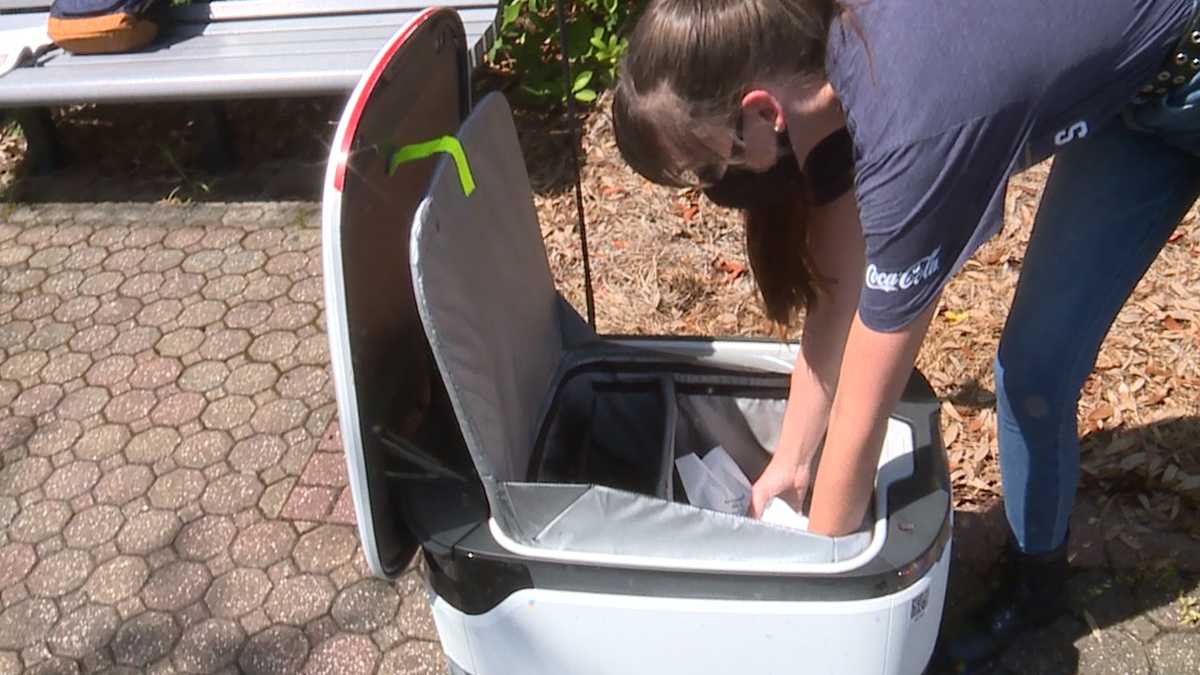
Six-wheeled robots independently navigating the streets and sidewalks on Georgia Southern’s Statesboro Campus may look a little strange. But it will soon be commonplace as these ground robots, which look like a cooler on wheels, have been mapping routes to campus locations in preparation for contactless food delivery this fall. Thanks to a partnership with Starship Technologies, Georgia Southern is the first university in the state to provide faculty, staff, and students with 20 autonomous delivery robots to deliver food from on-campus dining locations to designated pickup locations. Since August, Starship’s robots have been delivering food ordered on the Starship app from University dining facilities and places such as Starbucks, Market Street Deli and Sushi with Gusto to patrons around campus. The robots, which are energy efficient, can have their location and delivery time tracked by recipients through the app. They can also maneuver around obstacles such as pedestrians. “My hope is that it brings a sense of enhanced safety and convenience to our students,” said Clint Bridges, IT Business Owner at Georgia Southern University. “While we are all living through the COVID-19 pandemic, we are hoping that the robots will allow for easier social distancing. The fact that students can order a meal from their residence hall room and have it delivered by an automated delivery vehicle keeps them close to home where they can feel the most at ease and still enjoy a meal from one of our dining locations on campus.” Starship Technologies officials say the robots have been proven to be popular. “Students are looking for ways to get food delivered in the safest and most convenient way possible at the moment,” said Ryan Tuohy, senior vice president of Business Development at Starship Technologies. “Our robots are fast, friendly and help make life a little bit easier, especially in these challenging times.” If you are journalist and would like to know more about how Georgia Southern is constantly innovating and discovering new ways to safely enhance the on-campus experience for students - simply reach out to Georgia Southern Director of Communications Jennifer Wise at jwise@georgiasouthern.edu to learn more and arrange an interview today.

Georgia Southern University – is thinking BIG when it comes to entrepreneurs and small business
Through the CARES Act and the U.S. Department of Commerce, Georgia Southern University’s Business Innovation Group (BIG) has received $300,000 in grant funding to expand its services to the region in an effort to help communities and businesses respond to and recover from the economic impact of the coronavirus pandemic. “This will really allow us to help businesses and entrepreneurs throughout the entire state ideally get access to the skills, knowledge and services that Georgia Southern has to offer,” said Dominique Halaby, DPA, director of BIG. Over the next two years, BIG will use these funds to expand their services through the Georgia Enterprise Network for Innovation and Entrepreneurship (GENIE). “We’re hoping that we can demonstrate to budding entrepreneurs and small business owners that Georgia Southern can help them develop and grow,” Halaby said. “We are hopeful that in two years’ time people are going to have a heightened aerial view of awareness for Georgia Southern and our Business Innovation Group services, but more importantly, that they are going to get the type of resources to be able to launch the business that they’ve always wanted to launch.” Halaby said offering these resources to the region is important for economic growth. “Any time that we have an ability to do something, we have a responsibility to do it,” Halaby said. “The needs of our community are great. Our ability to service those needs by connecting those with the resources on our campus and with the skills that we have fostered within BIG puts us in a very unique position. This way, we are able to provide services to help as many entrepreneurs and to help as many people looking for jobs as we possibly can.” BIG will also use part of the grant funding to work with Georgia Southern faculty to strengthen patent and licensing activity. “We’re working with our intellectual property committee and through the University to let faculty know that if they’ve got a concept, that BIG can help them flesh that out. We can work with them to do an analysis to see the marketability for their concept and determine if it’s patentable or licensable,” Halaby said. If you’re a journalist looking to know more about how Georgia Southern University is assisting regional businesses or its Business Innovation Group (BIG) – then let our experts help with your coverage. Dominique Halaby, DPA, is the Director of the Business Innovation Group (BIG) at Georgia Southern University. In 2015, BIG was recognized as a Gold Award Winner in Entrepreneurship by the International Economic Development Council. Simply click on his icon now to arrange an interview today.

Georgia Southern University President Kyle Marrero delivered a virtual State of the University fall 2020 address to faculty and staff, broadcast live from the Performing Arts Center on the Statesboro Campus on Aug. 12. Maxing out with 1,507 viewers at one point, University members tuned in from remote locations to hear the president discuss how Georgia Southern is successfully adapting during extraordinarily difficult times and will continue to be nimble during the fall semester. “We are being asked to be innovative, flexible, nimble and willing to adapt and change,” Marrero said after welcoming all back to the three campuses. “And I want to thank you. You all have been tremendous, remarkable, heroic even, as we made it through these times and as we navigate through these uncertain times.” Marrero touted the herculean efforts of faculty and staff, who maintained the integrity of the University’s five pillars — student success, teaching and research, inclusive excellence, operational efficiency, effectiveness and sustainability, and community engagement, in the midst of a pandemic that caused the University to move fully online in March. He cited specific examples of performance excellence since March with the following collective efforts: Moved more than 5,000 classes to fully online to complete the Spring 2020 Semester; Delivered summer term fully online while seeing credit-hour generation move up by more than 4%, compared to the Summer 2019 Semester; Moved 4,600 students out of housing and provided support for more than 100 students who remained on campus; Refunded almost $11 million in housing, dining and fees to students; Held virtual Spring 2020 Commencement, viewed by more than 100,000 worldwide; Provided more than $11 million in CARES Act grant funding directly to students; Developed and began implementation of Initial Return to Campus and Return to Campus Plans, based on input from more than 130 faculty staff across campus and public health guidance from the Centers for Disease Control and Prevention and the Georgia Department of Public Health; Modeled a 14% state budget reduction for FY21, then completed a 10% realized reduction, totaling $14.2 million; Developed and implemented flexible and remote work processes; Assessed and modified almost 5,000 courses for fall 2020; Prepared campus with signage, cloth face coverings, face shields, PPE, hand sanitizer stations; Formed and implemented the CARES Service Center; Continued communication, coordination and monitoring of community health care providers, public/private schools, municipalities and agencies. Marrero also presented August figures showing that fall 2020 enrollment looks strong compared to this same time last year, however, he was quick to note that the figures may fluctuate based on various factors throughout the semester. Final fall enrollment figures will be released in October. “We can continue to move forward,” he said. “We can continue to elevate and live our mission and our vision and our values even in these times. We will adapt, we’ll be nimble and we’ll ensure that every day that the public health and safety of our faculty, staff, students and our community is of paramount importance. “I am confident that we are ready as we can be and together we’ll assess and navigate the entirety of the fall semester with the goal and outcome of our students being successful. As a whole Georgia Southern University can make it through this together.” If you are journalist and would like to know more about Georgia Southern university and how it is succeeding during COVID-19, simply reach out to Georgia Southern Director of Communications Jennifer Wise at jwise@georgiasouthern.edu to arrange an interview today.

Airing commercials after political ads actually helps sell nonpolitical products
About $7 billion reportedly will be spent this fall on television and digital commercials from political campaigns and political action committees, filling the airwaves with political ads many viewers dislike. Companies running ads immediately afterward have been concerned about the potential of a negative spillover effect on how they and their products and services are perceived. But new research from the Indiana University Kelley School of Business finds that the opposite is true. Contrary to mainstream thought, political ads instead yield positive spillover effects for nonpolitical advertisers. And this happens regardless of whether the political ad is an attack ad or not, who the ad supports, and whether it's sponsored by a candidate, political party or PAC. Political advertising accounts for nearly 10 percent of all U.S. television ad revenue. The findings are in the article "Impact of Political Television Advertisements on Viewers' Response to Subsequent Advertisements" -- accepted for publication in Marketing Science -- by Beth Fossen, assistant professor of marketing; Girish Mallapragada, associate professor of marketing and Weimer Faculty Fellow; and doctoral candidate Anwesha De, all from the Kelley School of Business. "Our investigations provide insights into the previously unexplored ad-to-ad spillover effects and, more broadly, provides insights into how political messages influence consumers," Fossen said. "Nonpolitical ads that follow political ads benefit through a reduction in audience decline and an increase in positive post-ad chatter." Using data for 849 national prime-time ads during the 2016 U.S. general election, the researchers found that ads airing after a political commercial saw an 89 percent reduction in audience decline and a 3 percent increase in post-ad chatter online. Their findings remained consistent when examining the effect by TV network and political party affiliation. "It seems reasonable to assume that Fox News viewers are more likely to be positively stimulated by pro-Republican ads than viewers of other channels," researchers wrote. "However, evidence from our data suggests that the positive spillover from pro-Republican ads is not higher and is nearly lower on Fox News viewership decline than when pro-Republican ads air on other channels." They found a similar trend when it came to advertising on MSNBC, whose viewers frequently identify with the Democratic Party and progressive causes. Mallapragada said the findings show that television networks and stations can leverage the positive spillover effects on subsequent ads by implementing differential pricing and systematic ad sequencing. Prevailing belief in the business industry has suggested that political ads on television hurt the effectiveness of subsequent ads. To illustrate this concern, during the 2020 Super Bowl, game broadcaster Fox isolated political ads from other paying advertisers in their own ad breaks, a decision that cost the network millions in ad revenue, because it ran nonpaid show promos alongside the political ads instead of commercials from paying advertisers. "The insights from this research enable advertisers to advocate for the inclusion of ad positioning in ad buys and, specifically, negotiate that their ads follow political ads," he said. "Our results may also encourage advertisers outside of the television context to experiment with advertising next to political content, an experimentation that may be especially beneficial for online advertisers given that they commonly blacklist political topics to avoid having their ads appear near political content." Editors: Contact George Vlahakis at vlahakis@iu.edu for a copy of the paper.