
Experts Matter. Find Yours.
Connect for media, speaking, professional opportunities & more.
FAU ‘Shark-Repellent’ Method Can Reform Fisheries by Curbing Bycatch
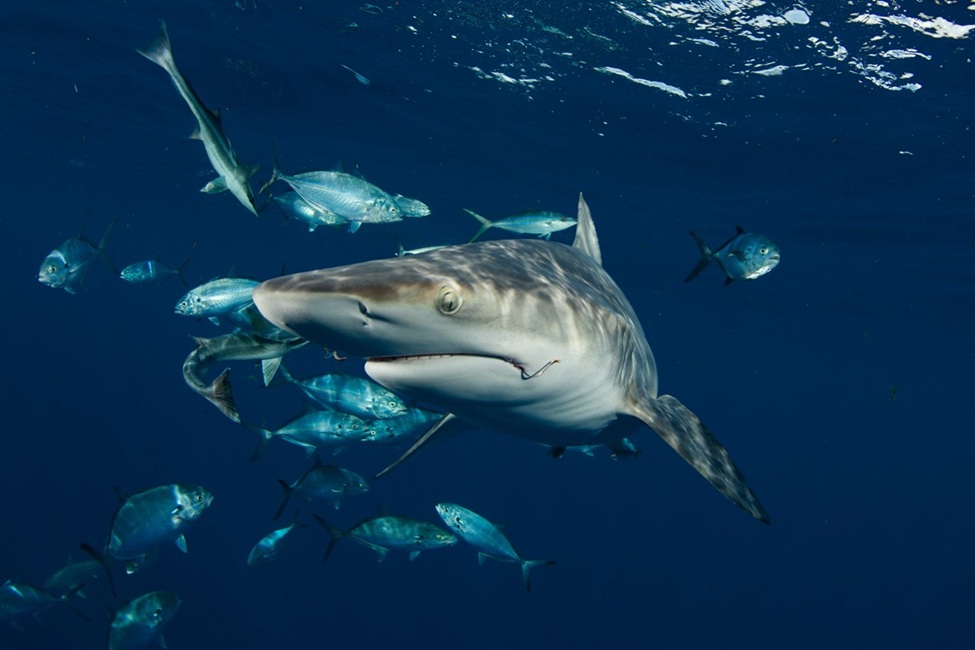
Study Snapshot: Shark bycatch is a major global problem, with millions of sharks caught unintentionally each year in fisheries targeting tuna, swordfish and other species. Even in U.S. waters, sharks are frequently caught on longlines, and many are discarded dead. Because sharks grow and reproduce slowly, these high bycatch rates threaten already vulnerable populations and disrupt marine ecosystems. Researchers at FAU’s Charles E. Schmidt College of Science have developed a patent-pending zinc-and-graphite device to address the problem. The metals generate a small electric field that repels sharks from baited hooks while leaving target species unaffected. In Florida field trials, the device reduced shark bycatch by more than 60%. Inexpensive, scalable and practical for fishers, this technology has the potential to dramatically reduce bycatch and support more sustainable fisheries. For decades, sharks have been the unintended victims of longline fisheries aimed at tuna and swordfish. Rising accidental catches have contributed to population declines and created serious challenges for both conservation and commercial fishing. And the impacts go beyond the sharks themselves – every time a shark takes the bait, hooks are lost to target species, gear gets damaged, costs climb, and crews face added risks when handling or releasing the animals. Although some gear modifications can reduce bycatch, they often also cut into catches of valuable species, making it hard to protect sharks without putting fisheries at a disadvantage. To tackle this challenge, researchers at Florida Atlantic University’s Charles E. Schmidt College of Science have developed an innovative, patent-pending shark deterrent. The device works by pairing zinc and graphite in seawater. The zinc reacts with the graphite to produce a small electric field in the surrounding seawater through a galvanic chemical reaction. This electric field can be detected by the sharks, repelling them from the bait without affecting target fish. To test the efficacy of the zinc/graphite treatment at deterring elasmobranch species, longline fishing gear was deployed to target demersal sharks (live and hunt near the sea floor) off the Florida panhandle and Massachusetts, and pelagic sharks (live and hunt in open water) in the Gulf of America. The results of the field trials, published in the Canadian Journal of Fisheries and Aquatic Sciences, delivered striking results. In Florida, the zinc/graphite treatment reduced the catch of coastal sharks on demersal longlines by 62% to 70% compared to untreated hooks. The effect was particularly strong for Atlantic sharpnose (Rhizoprionodon terraenovae) and blacktip sharks (Carcharhinus limbatus), two common coastal species. “Sharks have an incredible ability to sense even the smallest electric fields, and our tests show that this new approach can be used to keep them away from baited hooks,” said Stephen Kajiura, Ph.D., senior author, inventor and a professor in the FAU Department of Biological Sciences. “At the same time, important target species like tuna and swordfish are completely unaffected. What makes this approach so exciting is its practicality – zinc and graphite are inexpensive, widely available, and already familiar to fishers because zinc is commonly used to prevent corrosion on boats. This means it could be adopted quickly and cost-effectively, providing a real solution to reduce shark bycatch while supporting sustainable fisheries.” Importantly, the treatment did not reduce catches of commercially important fish species. Preliminary pelagic trials suggest swordfish and yellowfin tuna were caught at similar or slightly higher rates on treated hooks, showing the approach could protect sharks without hurting the catch of target species. The study also outlines practical considerations for real-world use. Because the electric field is strongest close to the hook, each line would need its own zinc-graphite device. The zinc anode slowly wears down, but it’s cheap and easy to swap out. Shark bycatch is a widespread and pressing problem, both in the United States and around the world. Globally, millions of sharks are caught unintentionally every year in fisheries targeting other species, and some estimates suggest tens of millions fall victim to bycatch annually. In U.S. waters, despite strict regulations, sharks are still caught incidentally on longlines and other gear. Because sharks reproduce slowly and have long lifespans, these high bycatch rates can push populations toward dangerously low levels. The scope of shark bycatch, from small coastal fisheries to large international fleets, makes it a global conservation challenge with serious ecological consequences. “Our approach could be scaled up to pelagic longline fisheries, where millions of sharks are caught as bycatch annually,” said Kajiura. “Even a 60% to 70% reduction in shark bycatch, like that observed in Florida demersal trials, could have a dramatic impact on global shark populations. The zinc/graphite treatment offers a practical, affordable and environmentally responsible tool for reducing shark bycatch while maintaining commercial catch rates.” Study co-authors are FAU graduate students Tanner H. Anderson and Kieran T. Smith; co-inventor on the patent application; Cheston T. Peterson, a Ph.D. student at Florida State University; Bryan A. Keller, Ph.D., a foreign affairs specialist at NOAA Fisheries; and Dean Grubbs, Ph.D., a full research faculty and associate director of research at FSU. This research was supported by the Florida SeaGrant awarded to Kajiura and Grubbs. The patent-pending device works by pairing zinc and graphite in seawater, creating an electric field that can be detected by the sharks, repelling them from the bait without affecting target fish.



Scientist’s cat, again, helps discover new virus
Pepper, the pet cat who made headlines last year for his role in the discovery of the first jeilongvirus found in the U.S., is at it again. This time, his hunting prowess contributed to the identification of a new strain of orthoreovirus. John Lednicky, Ph.D., Pepper’s owner and a University of Florida College of Public Health and Health Professions virologist, took Pepper’s catch — a dead Everglades short-tailed shrew — into the lab for testing as part of his ongoing work to understand transmission of the mule deerpox virus. Testing revealed the shrew had a previously unidentified strain of orthoreovirus. Viruses in this genus are known to infect humans, white-tailed deer, bats and other mammals. While orthoreoviruses’ effects on humans are not yet well understood, there have been rare reports of the virus being associated with cases of encephalitis, meningitis and gastroenteritis in children. “The bottom line is we need to pay attention to orthoreoviruses, and know how to rapidly detect them,” said Lednicky, a research professor in the PHHP Department of Environmental and Global Health and a member of UF’s Emerging Pathogens Institute. The UF team published the complete genomic coding sequences for the virus they named “Gainesville shrew mammalian orthoreovirus type 3 strain UF-1” in the journal Microbiology Resource Announcements. “There are many different mammalian orthoreoviruses and not enough is known about this recently identified virus to be concerned,” said the paper’s lead author Emily DeRuyter, a UF Ph.D. candidate in One Health. “Mammalian orthoreoviruses were originally considered to be ‘orphan’ viruses, present in mammals including humans, but not associated with diseases. More recently, they have been implicated in respiratory, central nervous system and gastrointestinal diseases.” The Lednicky lab’s jeilongvirus and orthoreovirus discoveries come on the heels of the team publishing their discovery of two other novel viruses found in farmed white-tailed deer. Given the propensity of viruses to constantly evolve, paired with the team’s sophisticated lab techniques, finding new viruses isn’t entirely surprising, Lednicky said. “I’m not the first one to say this, but essentially, if you look, you’ll find, and that’s why we keep finding all these new viruses,” Lednicky said. Like influenza virus, two different types of orthoreovirus can infect a host cell, causing the viruses’ genes to mix and match, in essence, creating a brand new virus, Lednicky said. In 2019, Lednicky and colleagues isolated the first orthoreovirus found in a deer. That strain’s genes were nearly identical to an orthoreovirus found in farmed mink in China and a deathly ill lion in Japan. How in the world, the scientific community wondered, could the same hybrid virus appear in a farmed deer in Florida and two species of carnivores across the globe? Some experts speculated that components of the animals’ feed could have come from the same manufacturer. With so many unanswered questions about orthoreoviruses and their modes of transmission, prevalence in human and animal hosts and just how sick they could make us, more research is needed, DeRuyter and Lednicky said. Next steps would include serology and immunology studies to understand the threat Gainesville shrew mammalian orthoreovirus type 3 strain UF-1 may hold for humans, wildlife and pets. For readers concerned about Pepper’s health, rest assured. He has shown no signs of illness from his outdoor adventures and will likely continue to contribute to scientific discovery through specimen collection. “This was an opportunistic study,” Lednicky said. “If you come across a dead animal, why not test it instead of just burying it? There is a lot of information that can be gained.”



ExpertSpotlight: The Surprising (and Slightly Dark) History of Valentine’s Day
Valentine’s Day may now be synonymous with chocolates, flowers, and heart-shaped everything, but its origins are far more complex, blending ancient Roman traditions, Christian martyrdom, and medieval storytelling. What began as a mid-winter festival tied to fertility and renewal eventually evolved into a celebration of romantic love - one shaped as much by poets and pop culture as by saints and religious history. Ancient Roots: Before Romance, There Was Ritual Long before Valentine’s cards, ancient Romans celebrated Lupercalia, a mid-February festival focused on fertility, purification, and the coming of spring. The event included symbolic rituals meant to ward off evil spirits and promote health and fertility, far removed from today’s candlelit dinners. As Christianity spread through the Roman Empire, many pagan festivals were re-interpreted or replaced with Christian observances, laying the groundwork for what would become Valentine’s Day. Who Was Valentine, Anyway? There isn’t just one Valentine. Historical records point to multiple early Christian martyrs named Valentine, the most famous being Saint Valentine, executed in the 3rd century CE. One popular legend claims he secretly performed marriages for young couples despite a Roman ban, acts that ultimately led to his execution. While historians debate the accuracy of these stories, they helped cement Valentine’s association with love, sacrifice, and devotion. Love Enters the Story: Medieval Poets Change Everything Valentine’s Day as a romantic holiday didn’t truly take shape until the Middle Ages. English poet Geoffrey Chaucer is often credited with linking February 14 to romantic love in his poetry, helping popularize the idea that it was the day birds chose their mates. From there, the connection between Valentine’s Day and courtly love spread across Europe, especially among the nobility, eventually giving rise to handwritten love notes and tokens of affection. From Handwritten Notes to Hallmark By the 18th and 19th centuries, Valentine’s Day had become a popular occasion for exchanging cards, flowers, and gifts. The Industrial Revolution made printed cards widely available, transforming a once-elite tradition into a mass-market celebration. Today, Valentine’s Day is a global cultural phenomenon, equal parts romance, commerce, and tradition, evolving to include friendships, self-love, and inclusive expressions of connection. It isn’t just about romance, it reflects how traditions evolve over time, absorbing layers of culture, religion, and storytelling. Understanding its history helps explain how societies redefine love, relationships, and celebration across generations. Our experts can help! Connect with more experts here: www.expertfile.com


The AI Journal: UF and other research universities will fuel AI. Here’s why
In the global AI race between small and major competitors, established companies versus new players, and ubiquitous versus niche uses, the next giant leap isn’t about faster chips or improved algorithms. Where AI agents have already vacuumed up so much of the information on the internet, the next great uncertainty is where they’ll find the next trove of big data. The answer is not in Silicon Valley. It’s all across the nation at our major research universities, which are key to maintaining global competitiveness against China. To teach an AI system to “think” requires it to draw on massive amounts of data to build models. At a recent conference, Ilya Sutskever, the former chief scientist at OpenAI — the creator of ChatGPT — called data the “fossil fuel of AI.” Just as we will use up fossil fuels because they are not renewable, he said we are running out of new data to mine to keep fueling the gains in AI. However, so much of this thinking assumes AI was created by private Silicon Valley start-ups and the like. AI’s history is actually deeply rooted in U.S. universities dating back to the 1940s, when early research laid the groundwork for the algorithms and tools used today. While the computing power to use those tools was created only recently, the foundation was laid after World War II, not in the private sector but at our universities. Contrary to a “fossil fuel problem,” I believe AI has its own renewable fuel source: the data and expertise generated from our comprehensive public academic institutions. In fact, at the major AI conferences driving the field, most papers come from academic institutions. Our AI systems learn about our world only from the data we offer them. Current AI models like ChatGPT are scraping information from some academic journal articles in open-access repositories, but there are enormous troves of untapped academic data that could be used to make all these models more meaningful. A way past data scarcity is to develop new AI methods that leverage all of our knowledge in all of its forms. Our research institutions have the varied expertise in all aspects of our society to do this. Here’s just one example: We are creating the next generation of “digital twin” technology. Digital twins are virtual recreations of places or systems in our world. Using AI, we can develop digital twins that gather all of our data and knowledge about a system — whether a city, a community or even a person — in one place and allow users to ask “what if” questions. The University of Florida, for example, is building a digital twin for the city of Jacksonville, which contains the profile of each building, elevation data throughout the city and even septic tank locations. The twin also embeds detailed state-of-the-art waterflow models. In that virtual world, we can test all sorts of ideas for improving Jacksonville’s hurricane evacuation planning and water quality before implementing them in the actual city. As we continue to layer more data into the twin — real-time traffic information, scans of road conditions and more — our ability to deploy city resources will be more informed and driven by real-time actionable data and modeling. Using an AI system backed by this digital twin, city leaders could ask, “How would a new road in downtown Jacksonville impact evacuation times? How would the added road modify water runoff?” and so on. The possibilities for this emerging area of AI are endless. We could create digital twins of humans to layer human biology knowledge with personalized medical histories and imaging scans to understand how individuals may respond to particular treatments. Universities are also acquiring increasingly powerful supercomputers that are supercharging their innovations, such as the University of Florida’s HiPerGator, recently acquired from NVIDIA, which is being used for problems across all disciplines. Oregon State University and the University of Missouri, for example, are using their own access to supercomputers to advance marine science discoveries and improve elder care. In short, to see the next big leap in AI, don’t immediately look to Silicon Valley. Start scanning the horizon for those research universities that have the computing horsepower and the unique ability to continually renew the data and knowledge that will supercharge the next big thing in AI. Read more...


Long proclaimed Italy’s “moral capital,” Milan is renowned worldwide for its significant contributions to fashion, design and the arts. Soon, another point of pride will be added to the city’s storied history, when the regional hub—and partnering town Cortina d’Ampezzo—plays host to the 2026 Winter Olympics in February. Luca Cottini, PhD, is a professor of Italian Studies and an expert on the evolution of Italian culture, particularly through the 19th and 20th centuries. Recently, he shared some thoughts concerning Milan and Cortina’s successful joint bid for the Olympics, the themes and iconography expected to define this year’s opening ceremony and the symbolic significance of Italy’s selection as a host nation. Question: What was the role of past major events in Milan and Cortina—like the 2015 World’s Fair and the 1956 Winter Olympics—in helping to elevate their appeal for these games? Luca Cottini: I’ll start by saying that although people notice world’s fairs less than the Olympics, they are more impactful to a city and country because they generate more revenue, business, political relationships and positive reputation. They are events in which all the world comes together and each country exposes its excellence, while the host nation brings a visibility that it would not carry otherwise. In 2015, Milan hosted the world’s fair, which generated a completely new fairgrounds area and a visibility of politics, industry, technology and modernity in a way that brings the city to a global stage. I would say that is when the ascent of Milan really started, especially as a desirable destination. With Cortina, after the 2015 World’s Fair—and especially after the COVID-19 pandemic—the Dolomites became really a popular region for travelers to visit. Cortina is also symbolic to Olympic history, because it's the site of the first Olympics that took place in Italy, in 1956 during the reconstruction era. That was the Dolce Vita period, in the middle of the 1950s economic boom, and those games were followed by Rome’s Summer Olympics in 1960. They both represented a way in which Italy, coming out of the war destroyed, was reaffirming its rebirth. Over the years, fewer cities have wanted to host the Olympics because they tend to carry a lot of economic burden, financial debt and little return on investment. In this sense, Milan and Cortina, helped by increased popularity after the world’s fair, sold themselves as a sustainable Olympics. Ninety percent of the buildings were refurbished from older buildings, and they will serve purposes after the Olympics. It’s difficult to tell whether it’s economically sound or not, but it is a way to promote two cities that are in big moments of growth. Q: These Olympic Games will be celebrating Milan’s contributions to fashion. What is the city’s significance to the fashion world? LC: Milan is certainly the capital of fashion in Italy, and is one of the capitals of fashion in the world, along with Paris, New York and London. The fashion heritage that the city carries now in iconic brands like Armani, Versace, Moschino and Dolce & Gabbana is the outcome of a process that took shape in the late 1970s. Until then, fashion in Italy was mainly related to Rome, through cinema, and Florence, as that city represented a new Renaissance in the postwar years. But in the 1970s, much of this fashion world moved from those cities to Milan, because there was a conglomeration of labor, skills, capital and creativity that generated a complex productive and cultural system, or the so-called “Sistema Moda.” This is a particular approach to the industry in Italy that coordinates management and creativity around the figures of a big creative director and a big manager who work together in creating not just nice styles, but also sustainable outlets and markets in and outside Italy. In turn, with its reputation, Milan gives the Olympics that seal of grandeur and coolness. The connection with fashion and promotion of uniqueness is part of the national rhetoric that surrounds what we call “Made in Italy,” this idea of luxury, styling, beauty, order and measure that is endowed in the Italian DNA. Q: Andrea Bocelli—who also appeared in Torino’s 2006 closing ceremony—is supposed to sing once again in this year’s opening ceremony. Aside from his popularity, what is the symbolic significance of his selection as a performer? LC: Bocelli is an interesting case. He is a prototypical Italian success story, which is born in the peninsula but is then ratified outside of Italy. As Bocelli became a global sensation in the U.S., he then came back to his roots in Italy, where his voice has become a symbol of national unity, as epitomized in his solo concerto of Milan, during the pandemic, when he sang in front of the empty Piazza del Duomo, facing the city’s cathedral. In his Catholic faith and secular operatic repertoire, he symbolizes Italian culture as a similar piazza or open space where different voices can converge in a temperate balance. When you put together Bocelli, Mariah Carey and whoever else will be part of the ceremony, that same Italian identity will give rise to a new synthesis, as the encounter of tradition and novelty, grounded-ness and openness. Q: The Olympic flames are supposed to be lit in two cauldrons—one in Milan and one in Cortina—each with a design inspired by Leonardo da Vinci. What was da Vinci’s importance to Milan, specifically? LC: Da Vinci is part of the fabric of Milan. He spent 20 years in the city, painting “The Last Supper” and working at Castello Sforzesco, as well as many other places. His footprint is all over Milan, in its design, walls, canal system and more. He is an archetype of the Italian mind in as much as it represents the combination of engineering and beauty. The word Ingenium in Latin, meaning “genius,” overflows in English into the word “engineering” and also “ingenuity,” which reflects the creative mind. Da Vinci represents the synthesis of Italian Ingenium as a combination of aesthetics and problem solving, which you still see in the city today.



Do Teens Secretly Want Phone Boundaries More Than Adults Think?
Ask a parent about phones and teens, and you’ll hear the same story: “They’re glued to that thing and don’t care.” But when you ask teens themselves, a different picture emerges. A recent Pew Research Center study found that about 95% of U.S. teens have access to a smartphone — and around 4 in 10 say they spend too much time on it. (Pew Research Center) Coverage of the same data notes that over 70% of teens say they feel happiness or peace when they’re not tethered to their device, even as they rely on it for social life. (KTUL) Psychotherapist Harshi Sritharan, MSW, RSW, who works with teens and young adults on digital dependency, sees that ambivalence every day. “I have 12- to 15-year-olds who come in and say, ‘I know I’m kind of addicted to my phone,’” she says. “When a teenager says that, I’m relieved — it means we have something to work with.” She stresses that most young people don’t actually want to be left alone with endless scrolling — they want help making sense of it. Teen Limits Work Better Than Parents Think New data suggests that reasonable limits can help and that many teens benefit when parents set them thoughtfully. A tool parents can use is collaborative problem solving. This involves parents and teens working together to come up with a plan for the best strategies that combat everyone’s concerns while compromising. A 2024 Springtide Research Institute survey of 1,112 13-year-olds found that teens whose parents limit their screen time are less likely to be heavy users: only 32% of those with limits use their phone 5+ hours a day, compared with 55%of those with unlimited time. Just 24% of teens with limits said they’d felt like they had a mental health problem, versus 32% with no limits.(Springtide Research Institute) In other words, boundaries are mildly protective, not cruel, especially when they’re explained instead of imposed. Sritharan cautions against “no phones ever” rules that ignore school and social realities: “We can’t make blanket statements of ‘no screens’,” she says. “We shape how kids use devices so they can still get things done and spend more time engaging with their family.” That might mean agreeing on tech-free windows (like family dinners or the hour before bed) and tech-friendly ones (like a 45-minute bus ride where a teen can listen to music or message friends). Teens Are Leading a Quiet “Cutback” Movement Parents often feel like the only ones craving less screen time, but surveys show Gen Z is already trying to dial things down. A global survey cited by Tech Times and ExpressVPN found that about 46% of Gen Z are actively taking steps to limit their screen time, more than older generations.(Tech Times) Another U.S. poll commissioned by ThriftBooks found half of respondents are cutting back on screens, with Gen Z and millennials leading — and 84% adopting analog habits like printed books, paper planners and board games.(New York Post) Reporting on the “board game revival” among Gen Z echoes the same trend: young people are consciously seeking offline, face-to-face ways to connect.(Woke Waves) For Offline.now experts, this adds up to a simple message: teens aren’t fighting all boundaries — they’re fighting feeling controlled or misunderstood. Parents as Co-Pilots, Not Phone Police Executive Function Coach Craig Selinger, M.S., CCC-SLP says the real leverage point isn’t just new rules; it’s how parents model and co-create them. “If you want behavior change in kids, start with the parent model,” he says. “A 12-year-old will not put their phone away at dinner if their parents won’t.” He encourages families to focus on “little moments” where phones quietly block connection — especially car rides and in-between times when kids might naturally open up: “In the car, your kid is trapped with you,” Selinger says. “That’s when they start talking. If they’re on their phone the whole time, you lose those big conversations hiding in the boring moments.” Both experts emphasize co-designing boundaries with teens: agreeing together on tech-free times and how late-night scrolling affects mood and school performance. When teens feel heard — and see adults following the same rules — boundaries feel less like punishment and more like shared protection. For journalists, the story isn’t “teens vs phones” or “parents vs teens.” It’s that both sides are quietly overwhelmed, and many young people are more open to limits than adults realize — if those limits are built with them, not against them. Featured Experts Harshi Sritharan, MSW, RSW – Psychotherapist specializing in ADHD, anxiety, insomnia and digital dependency. She helps teens and young adults understand dopamine cycles, distinguish passive vs active tech use, and build realistic phone boundaries that support sleep, school and mental health. Craig Selinger, M.S., CCC-SLP – Executive Function Coach and child development specialist (Brooklyn Letters). He focuses on how tech use shapes learning, attention and family dynamics, and how parents can model healthy habits and co-create screen rules that actually stick. (Expert interviews can be arranged through the Offline.now media team.)




As tensions escalate over the possibility of the United States seeking control of Greenland — including threats of annexation that have drawn international backlash — seasoned international relations expert Glen Duerr, Ph.D. offers critical context for journalists reporting on the diplomatic, legal, and geopolitical dimensions of this unfolding crisis. What's Happening In early 2026, high-level rhetoric from U.S. political figures has revived debates about Greenland’s status as a strategic territory. What began as discussions of acquisition has evolved into broad international concern over sovereignty, alliance cohesion, and Arctic security. Denmark and Greenland have reaffirmed their commitment to autonomy, while NATO allies and the European Union warn that any forceful move by the U.S. could undermine alliance unity and violate international norms — raising profound questions about territorial integrity, international law, and the politics of national interest. Dr. Glen Deurr's teaching and research interests include nationalism and secession, comparative politics, international relations theory, sports and politics, and Christianity and politics. View his profile here How Dr. Glen Duerr Can Help Journalists Cover This Story 1. Understanding Strategic National Interests Dr. Duerr’s expertise in international relations provides journalists with a framework to explain why Greenland has become such a focal point for U.S., European, and Arctic security policy — from its strategic location to its role in broader defense calculations. 2. Explaining Nationalism, Sovereignty & Self-Determination His research on nationalism and secession is especially relevant as Greenlanders and Danish authorities assert self-determination and reject external control, a central narrative in the current debate. 3. Contextualizing International Norms & Legal Constraints As commentators and policymakers discuss potential annexation, treaty obligations, and alliance commitments, Dr. Duerr can unpack how international law, treaties (such as NATO agreements), and norms against territorial conquest shape policy choices and diplomatic responses. 4. Making Sense of Geopolitical Fallout With European leaders labeling aggressive claims as a form of “new colonialism” and threatening economic countermeasures, Dr. Duerr can help journalists interpret how Greenland could become a flashpoint affecting transatlantic relations, alliance politics, and global perceptions of U.S. foreign policy. About Glen Duerr, Ph.D. Dr. Glen Duerr is a Professor of International Studies at Cedarville University with deep expertise in international relations theory, nationalism, secession, and comparative politics. He holds a Ph.D. in Political Science and Government and is widely available to speak with media on geopolitics, sovereignty disputes, and the intersection of national interest and international order. Why This Matters The evolving crisis over Greenland is not merely a diplomatic dispute — it touches on fundamental questions of sovereignty, global strategic balance, alliance credibility, and international legal norms. Dr. Duerr is positioned to help journalists go beyond headlines, offering analysis that clarifies motivations, stakes, and implications for audiences tracking one of the most talked-about international issues of 2026.



How corporate competition can spur collaborative solutions to the world's problems
Why can’t large competitive companies come together to work on or solve environmental challenges, AI regulation, polarization or other huge problems the world is facing? They can, says the University of Delaware’s Wendy Smith. While it's difficult, the key is to have these companies collaborate under the guise of competition. Smith, a professor of management and an expert on these types of paradoxes, co-authored a recent three-year study of one of the most profound collaborations. Her team looked at the unlikely alliance of 13 competitive oil and gas companies that eventually formed Canada’s Oil Sands Innovation Alliance (COSIA), which works with experts worldwide to find innovative solutions for environmental and technical challenges in the region. Smith and her co-authors found that those companies were willing to collaborate, but only when collaboration was cast in the language, practices and goals of competition. Given the scope of our global problems, companies must continually work together to offer solutions. Creating that collaboration becomes critical, Smith said. This research offers important insight about how these collaborations are possible. Among the study's key findings: Competition can drive cooperation — if leaders harness it. It would make sense to assume that competition undermines collaboration. But the study finds that those who championed alliances used competitive dynamics to strengthen cooperation among rival firms. Rather than suppressing rivalry, leaders leveraged competition as a mechanism to enable joint action toward shared environmental goals. This reframes how organizations can manage tensions between competition and cooperation in partnerships. For example, COSIA leaders created competition between partners to see who would contribute the most valuable environmental innovations. Partners could only gain as much benefit from other company’s innovations commensurate with what they shared. A “Paradox Mindset” is key to complex collaborative success. The research identifies the importance of what the authors call a paradox mindset, which sees competition and cooperation not as opposites to be balanced but as interrelated forces that can be used in tandem. Leaders in the study who adopted this mindset were more thoughtful and creative about how to engage both competitive and collaborative practices in the same alliance. Traditional balance isn’t the goal — process over stability. Instead of pursuing a simplistic “balance” between competing and cooperating, the study shows that effective alliances evolve through process, where competition remains visible and even useful throughout the lifecycle of the alliance. To connect with Smith directly and arrange an interview, visit her profile and click on the "contact" button. Interested journalists can also send an email to MediaRelations@udel.edu.



Venezuela: Why Regime Change Is Harder Than Removing A Leader
With global attention on Venezuela following the U.S. removal of Nicolás Maduro, one of the central questions is whether taking out a leader actually changes the political system that put him in power. Two University of Rochester political scientists — Hein Goemans and Gretchen Helmke — study different sides of this issue, and can shed light on why authoritarian regimes often survive even when leaders fall and what the U.S. intervention means for Venezuela and the world order. Goemans specializes in how wars begin and end, regime survival, and why so-called “decapitation strategies” — removing a leader without dismantling the broader power structure — so often fail to produce stable outcomes. His research draws on cases ranging from Iraq and Afghanistan to authoritarian regimes in Latin America. In a recent interview with WXXI Public Media, Goemans warned that removing Maduro does not resolve the underlying system of military and economic control that sustained his rule. Without changes to those institutions, he said, power is likely to remain concentrated among the same elite networks. “The problem isn’t just the leader,” Goemans explained. “It’s the structure that rewards loyalty and punishes defection. If that remains intact, the politics don’t fundamentally change.” Helmke, a leading scholar of democracy and authoritarianism in Latin America, emphasizes that legitimacy, not just force, determines whether democratic transitions take hold. Her research helps explain why democratic breakthroughs so often stall after moments of dramatic change, and why outside interventions can unintentionally weaken domestic opposition movements by shifting power toward regime insiders. “When the institutions and elites remain in place, uncertainty — not democratic transition — often becomes the dominant political reality,” she said. For journalists covering the fast-moving situation, Goemans and Helmke are available to discuss why removing leaders rarely brings the political transformation policymakers expect and what history suggests comes next. They can address: • Why regime-change operations so often backfire, even when dictators are deeply unpopular • What sidelining democratic opposition means for legitimacy • Whether U.S. claims that Maduro is illegitimate hold up under international and U.S. law • How prosecuting a foreign leader in U.S. courts could reshape norms of sovereignty • The risks the U.S. intervention poses to the rules-based international order and NATO • How interventions affect international norms, including sovereignty and the rule of law, and why short-term tactical successes can create long-term strategic risks. • Why treating global politics as a series of “one-off” power plays misunderstands how states actually enforce norms over time • How competing factions inside the U.S. administration may be driving incoherent foreign policy Geomans also brings rare insight into the internal dynamics of U.S. policymaking, having taught and observed Stephen Miller, one of President Donald Trump’s closest aides who is helping shape the administration’s worldview. (Goemans taught Miller at Duke University in 2003.) Click on the profiles for Goemans and Helmke to connect with them.




Why Greenland Matters: The History and Strategic Importance of the World’s Largest Island
Often viewed as remote and sparsely populated, Greenland has long played an outsized role in global strategy. Settled by Inuit peoples for thousands of years, Greenland later became part of the Danish realm in the 18th century and today exists as an autonomous territory within the Kingdom of Denmark. Its location—bridging North America and Europe—has consistently drawn the attention of major powers, especially during moments of geopolitical tension. That attention intensified during the Cold War, when Greenland became a critical asset in Arctic defense. The United States established military installations on the island, most notably what is now known as Pituffik Space Base, to support missile warning systems and transatlantic defense. Greenland’s position along the shortest air and missile routes between North America and Russia made it indispensable to early-warning networks—and that strategic logic has not faded with time. Today, Greenland’s importance is growing rather than shrinking. Climate change is reshaping the Arctic, opening new shipping routes and increasing access to natural resources such as rare earth minerals, hydrocarbons, and freshwater reserves locked in ice. These developments have renewed global interest in Greenland from NATO allies and rival powers alike, as control over Arctic infrastructure, data, and mobility becomes central to economic and security planning. At the same time, Greenland’s own political future—balancing autonomy, Indigenous priorities, and external pressure—adds another layer of complexity. Greenland’s story is ultimately one of geography shaping history. What once made the island strategically valuable for defense now places it at the center of debates about climate, security, energy, and sovereignty in the 21st century. As Arctic competition accelerates, Greenland is no longer a peripheral actor—it is a focal point where global interests converge. Journalists covering geopolitics, Arctic security, climate change, Indigenous governance, or global resource competition are encouraged to connect with experts who study Greenland’s past and its evolving strategic role. Expert insight can help explain why this vast island continues to matter—and why it is likely to play an even larger role in the years ahead. Our experts can help! Connect with more experts here: www.expertfile.com