
Experts Matter. Find Yours.
Connect for media, speaking, professional opportunities & more.

National Academy of Inventors welcomes five VCU College of Engineering researchers
The National Academy of Inventors (NAI) recently inducted five Virginia Commonwealth University (VCU) College of Engineering researchers as senior members. Chosen for their innovative engineering contributions, the honorees are recognized as visionary inventors whose groundbreaking research and patented technologies are driving meaningful societal and economic advancements across the national innovation landscape. “Invention represents the practical application of knowledge and stands as one of the many ways engineers can make a positive impact on their communities and the world,” said Azim Eskandarian, D.Sc, the Alice T. and William H. Goodwin Jr. Dean of the VCU College of Engineering. “This year’s honorees exemplify the interdisciplinary nature of our field, leveraging advanced concepts from mechanical, biomedical, chemical and pharmaceutical engineering to address today’s most pressing challenges. We are immensely proud that our dedicated researchers have earned recognition as members of the esteemed National Academy of Inventors.” The VCU College of Engineering NAI inductees are: Jayasimha Atulasimha, Ph.D. Engineering Foundation Professor Department of Mechanical & Nuclear Engineering An internationally recognized pioneer of straintronics, an approach to electrically control magnetism for ultra-low-energy computing, Atulasimha has made significant research contributions to next-generation memory, neuromorphic hardware and emerging quantum computing technologies. He holds four U.S. patents spanning energy-efficient magnetic memory, nanoscale computing architectures and medical tools. Atulasimha’s commercially viable inventions are funded by organizations like the Virginia Innovation Partnership Corporation and he leads multi-institutional collaborations that drive innovation in computing hardware, AI and quantum technologies with more than $10 million in funded research. Casey Grey, Ph.D. Postdoctoral Research Associate Department of Mechanical & Nuclear Engineering Bridging engineering and medicine, Grey’s work spans life‑saving stroke technologies, breakthrough respiratory and neurological care, and sustainable packaging. As a lead R&D scientist at WestRock, he helped create and commercialize the CanCollar® portfolio, a recyclable paperboard replacement for plastic beverage rings now used on five continents, eliminating thousands of tons of single‑use plastic annually. In medical device innovation, Grey’s patent and development work on a novel cyclic aspiration thrombectomy platform, currently in clinical trials, is advancing stroke treatment by enhancing clot removal efficiency and reducing long‑term disability. At the VCU College of engineering, Grey built a research and commercialization pipeline around neurological and respiratory technologies, securing eight provisional patents and leading multidisciplinary teams in neurology, neurosurgery, surgery, pharmacology and toxicology, internal medicine, and respiratory medicine. His work includes developing dry powder inhaler strategies for delivering life‑saving drugs to patients with acute respiratory distress syndrome (ARDS), a pediatric bubble CPAP system designed to protect brain development in premature infants, and non‑invasive, non‑pharmacological 40 Hz neuromodulation therapies to treat neurodegeneration and conditions with significant central nervous system complications, like sickle cell disease. In collaborations with the VCU Children’s Hospital and VCU Critical Care Hospital, Grey is leading two clinical studies that are translating these innovations to improve patient care. Ravi Hadimani, Ph.D. Associate Professor and Director of Biomagnetics Laboratory Department of Mechanical & Nuclear Engineering Hadimani founded RAM Phantoms LLC, a VCU startup company, commercializing anatomically accurate, MRI-derived brain phantoms for neuromodulation and neuroimaging applications. These brain phantoms help test and tune transcranial magnetic and deep brain stimulation technologies, improving clinical safety and enabling personalized therapy for patients. RAM Phantoms is also developing a highly-skilled workforce for employment in Virginia’s growing biomedical device industry. Beyond commercialization, Hadimani maintains a productive research program with more than $4.5 million in funding resulting in 125 original peer-reviewed publications, 17 current and pending patents, a book, and several book chapters. His biomagnetics lab serves as a training ground for undergraduate, graduate and Ph.D. students to hone their skills in innovation management, intellectual property strategy and startup development. Several students from Hadimani’s lab have engaged in translational research, patent co-authorship and start-up formation, cultivating a new generation of engineer-entrepreneurs equipped to drive future technological advances. Before joining VCU, Hadimani led the development of hybrid piezoelectric–photovoltaic materials that established FiberLec Inc., which commercialized multifunctional energy-harvesting fibers capable of converting solar, wind and vibrational energy into usable electricity. Worth Longest, Ph.D. Alice T. and William H. Goodwin, Jr. Distinguished Chair Department of Mechanical & Nuclear Engineering Uniting aerosol science, biomedical engineering and computational modeling, Longest is revolutionizing inhaled drug delivery. Working with collaborators, his lab has developed novel devices, formulations and delivery platforms that precisely target medications to the lungs, addressing conditions like cystic fibrosis, pneumonia, acute respiratory distress syndrome and neonatal respiratory distress syndrome. These innovations have resulted in multiple patents. Some of them have been licensed through commercial partnerships like Quench Medical, an organization advancing inhaled therapies for applications like lung cancer. Collaborating with the Gates Foundation and the lab of Michael Hindle, Ph.D., from the VCU Department of Pharmaceutics, Longest’s team developed a low-cost, high-efficacy aerosol surfactant therapy for pre-term infants based entirely on technology developed at VCU. The invention eliminates intubation, reduces dosage by a factor of 10, and cuts treatment costs. Over 9 million infant lives are projected to be saved by this technology between 2030 and 2050. Through a long-term collaboration with the U.S. Food and Drug Administration, Longest’s in vitro and computational methods provide federal regulatory guidance for generic inhaled medications. The VCU mouth-throat airway models developed under his leadership are used globally across the pharmaceutical industry and in government laboratories. Hong Zhao, Ph.D. Associate Professor Department of Mechanical & Nuclear Engineering Zhao holds 40 patents with innovations spanning additive manufacturing, stretchable electronics, inkjet printing technologies and superoleophobic materials that repel oils, greases, and low-surface-tension liquids. Her research has applications across health care, sustainable energy and advanced manufacturing. Prior to joining the College of Engineering, Zhao served as a senior research scientist and project leader at the Xerox Research Center, where she developed high-performance materials and printing technologies for commercial deployment. Her industry experience makes Zhao’s lab a hub for innovation and mentorship, with students engaging in innovative research and co-authoring publications. Zhao is an invited reviewer for more than 50 premier journals and grant agencies. “Working with distinguished researchers and innovators like those inducted into the National Academy of Inventors is a great honor for me,” said Arvind Agarwal, Ph.D., chair of the Department of Mechanical & Nuclear Engineering and NAI fellow. “They are an inspiration and showcase the kind of impact engineers can make. Having all five of these innovators as part of our department amplifies the scientific richness of our college and its societal impact. They advance the college’s mission of Engineering for Humanity, with research that brings a positive change to our world.” The 2026 NAI class of senior members, composed of 231 emerging inventors from NAI’s member institutions, is the largest to date. Hailing from 82 NAI member institutions across the globe, they hold over 2,000 U.S. patents.





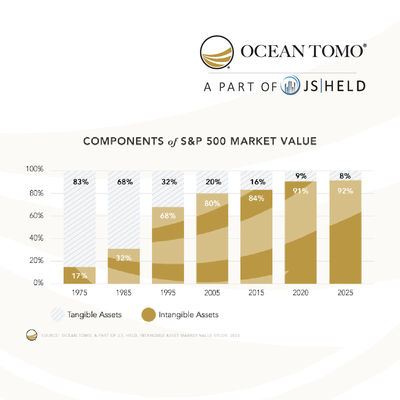
Ocean Tomo Releases 2025 Intangible Asset Market Value Study Results
Global consulting firm J.S. Held announces the release of the Ocean Tomo Intangible Asset Market Value (IAMV) study. With this release, the study now reflects a panel of 50 years of data in the US market and 20 years of data in foreign markets. The study examines the components of market value, specifically the role of intangible assets, across a range of global indexes. IAMV is shown as of calendar year end by subtracting net tangible asset value from market capitalization. Commenting on the Components of S&P 500® Market Value, economic expert and study author Matthew Johnson observes, “the composition of corporate value has undergone a fundamental transformation over the past five decades.” In 1975, tangible assets—property, plant, equipment, inventory, and other physical capital—represented 83% of the market value of companies comprising the S&P 500 index, with intangible assets accounting for only 17%. By the end of 2025, this relationship had completely inverted: intangible assets now constitute approximately 92% of S&P 500 market capitalization, while tangible assets have been reduced to a mere 8%. Johnson adds, “This 75 percentage point shift represents what Ocean Tomo has defined as ‘economic inversion’— a wholesale transformation in the nature of value creation whereby economic worth has migrated from what can be ‘touched’ to what can be ‘thought’." The magnitude and implications of this transformation are comparable to the Industrial Revolution of the 18th and 19th centuries. Just as the Industrial Revolution fundamentally restructured economic activity from agrarian and craft-based production to mechanized manufacturing, the intangible revolution has redefined the sources and measurement of corporate value in the 21st century. Ocean Tomo Co-founder and J.S. Held Chief Intellectual Property Officer, James E. Malackowski observes, “While the Industrial Revolution required a century to unfold fully, the intangible revolution has occurred within a single human lifespan, with particularly rapid acceleration occurring in the 1985-2005 period when intangible asset market value increased from 32% to 79%—a remarkable 47 percentage point surge in just two decades.” The 2020-2025 period deserves special attention: S&P 500 IAMV remained stable at approximately 90% despite the Federal Reserve implementing the most aggressive monetary tightening cycle in four decades. Dr. Nikki Tavasoli, PhD, shares, “Traditional financial theory predicts that intangible-intensive firms should be highly sensitive to interest rate changes due to their long-duration cash flows and limited collateral value.” She adds, “The observed stability challenges this prediction and requires explanation, which we address in a forthcoming paper.” In 2005, the IAMV study was expanded beyond the S&P 500 to explore the components of value in several key international markets. Stock market indexes from Europe, China, Japan, and South Korea were selected and analyzed to determine the comparable role of intangible assets. To learn more about the 2025 Intangible Asset Market Value Study, please visit: Media Contact Kristi L. Stathis, J.S. Held 1 786 833 4864 Kristi.Stathis@JSHeld.com JSHeld.com



Brian Levine, M.D., Named Chief Academic Officer and Intellectual Property Administrator
ChristianaCare announced Feb. 12 the promotion of Brian Levine, M.D., to chief academic officer, along with his appointment as intellectual property administrator. He will also continue in his role as designated institutional official. As chief academic officer and leader of ChristianaCare’s Department of Academic Affairs, Levine oversees 38 residency and fellowship programs encompassing 315 residents and fellows, along with the education and training of students across the continuum of medical education. He leads the continued growth and strengthening of ChristianaCare’s undergraduate and graduate medical education infrastructure, ensuring that ChristianaCare continues to prepare physicians to care for our community well into the future. In addition, Levine oversees physician assistant education and allied health educational programming, supporting workforce development and long-term community health needs. As the largest academic medical center between Philadelphia and Baltimore, ChristianaCare has been a hub of academic excellence for over a century. ChristianaCare is one of the largest community-based teaching hospital systems in the United States. ChristianaCare also serves as the Delaware Branch Campus for Sidney Kimmel Medical College and the Philadelphia College of Osteopathic Medicine. This unique program allows medical students to complete their third and fourth years of clinical rotations exclusively at ChristianaCare, providing a clear pathway to launch their medical careers in Delaware. Each year, 55 students participate in the Branch Campus program, with many continuing into ChristianaCare’s highly sought-after residency programs and remaining in Delaware to serve local communities. ChristianaCare is a destination of choice for medical students and residents because of its strong patient-centered culture, reputation for excellence, and diversity of clinical experiences that include urban and suburban campuses with a wide range of pathologies. In his newly expanded role as intellectual property administrator, Levine manages and enforces ChristianaCare’s intellectual property policy, ensuring fair and consistent application in alignment with applicable laws and regulations. He also leads the multidisciplinary committee responsible for guiding organizational decisions related to intellectual property valuation, commercialization strategies and revenue distribution. Levine brings deep experience in academic medicine, health system education and scholarly publishing to these responsibilities. An emergency physician, he led the development of widely used clinical reference guides published by the Emergency Medicine Residents’ Association. These pocket-sized tools — covering topics such as antibiotic stewardship, orthopedic injury management, and EKG interpretation — are used by thousands of emergency medicine residents worldwide. Levine has held leadership roles at ChristianaCare for nearly two decades. Since 2018, he has served as associate chief academic officer and designated institutional official. Previously, he was program director of the Emergency Medicine Residency program from 2012 to 2018 and associate program director from 2006 to 2012. Levine is a clinical professor of Emergency Medicine at Sidney Kimmel Medical College at Thomas Jefferson University and previously served as associate medical director for the LifeNet aeromedical transport program. He earned his medical degree from the University of Vermont Larner College of Medicine and completed his emergency medicine residency at ChristianaCare.



AI as IP™: A Framework for Boards, Executives, and Investors
Under current corporate accounting practices, artificial intelligence (AI) companies’ most valuable resources – large language models, training datasets, and algorithms – remain “off the books” or uncapitalized. As the importance of AI continues to grow in the global knowledge-based economy, financial statements are becoming less representative of a company’s true worth, creating a recognition gap. In this article, James E. Malackowski, Eric Carnick, and David Ngo present several conceptual frameworks to bridge this gap. They explain how the triangulation of three valuation approaches can reveal both the tangible investment base and the intangible, strategic upside of AI assets. In turn, these approaches provide board-level visibility into where AI capital resides and how it contributes to enterprise value. James E. Malackowski is the Chief Intellectual Property Officer (CIPO) of J.S. Held and Co-founder of Ocean Tomo, a part of J.S. Held. Mr. Malackowski has served as an expert on over one hundred occasions on intellectual property economics, including valuation, royalty, lost profits, price erosion, licensing terms, venture financing, copyright fair use, and injunction equities. He has substantial experience as a Board Director for leading technology corporations, research organizations, and companies with critical brand management issues. This article is the second installment in our three-part series, Artificial Intelligence as Intellectual Property or “AI as IP™”, which explores how artificial intelligence assets should be treated as a form of intellectual property and enterprise capital. The first article, “A Strategic Framework for the Legal Profession”, explored the legal foundations for recognizing and protecting AI assets. The upcoming third article, “Guide for SMEs to Classify, Protect, and Monetize AI Assets”, will provide practical steps for small and mid-sized enterprises to turn AI into measurable economic value. To explore the topic further, simply connect with James through his icon below.

Global Honors Highlight J.S. Held’s Unmatched Technical and Advisory Expertise
J.S. Held proudly celebrates the numerous industry and expert recognitions earned throughout 2025. As a global consulting firm, J.S. Held continues to be acknowledged for its deep financial, technical, and scientific expertise, with leading outlets highlighting the firm’s capabilities across investigations, risk advisory, forensics, turnaround and restructuring, business intelligence, and litigation support. The firm’s curated team of entrepreneurs — each with an unrivaled understanding of both tangible and intangible assets — reflects a collective strength that is recognized worldwide. Beyond organizational achievements, J.S. Held’s experts received individual distinctions that further demonstrate their standing as leaders within their respective fields. Industry publications and ranking bodies honoured these specialists for excellence in arbitration, construction and engineering, environmental consulting, forensic accounting, investigations, litigation support, intellectual property, specialty finance, and a wide range of other highly specialized domains. Together, these recognitions underscore J.S. Held’s commitment to delivering trusted insight and unparalleled expertise as clients navigate increasingly complex challenges. In a rapidly evolving business landscape, the firm remains dedicated to providing informed, innovative, and practical solutions that enable organizations to move forward with confidence. Click on the link below to learn more about our recognition and respective areas of expertise: Expert recognition by notable organizations serves as a further testament to J.S. Held's agile, collaborative, creative, and client-centric team, reflecting the trusted advisor role the firm has earned over the last 50 years. For any media inquiries, contact: Kristi L. Stathis, J.S. Held +1 786 833 4864 Kristi.Stathis@JSHeld.com

A popular on-the-go sandwich is now the subject of a mega trademark lawsuit between two food industry giants. The J.M. Smucker Company, more commonly known as Smucker's, recently filed a trademark lawsuit against grocery chain Trader Joe's over what it alleges is infringement upon its iconic billion-dollar investment: the Uncrustables sandwich. Smucker's seeks to obtain unspecified monetary damages from Trader Joe's, as well as profit from its similar product. But beyond the novelty of the sandwich suit lies a complex case built around a lesser-known morsel of trademark law, says Waseem Moorad, Esq., assistant professor of Law at Villanova University Charles Widger School of Law and director of the school's Intellectual Property Clinic. Professor Moorad, a former U.S. Patent and Trademark Office Patent (USPTO) examiner, recently discussed the actual claims of the lawsuit, and how both parties are preparing for a potential trial. Q: Since this lawsuit was filed, it has been a popular topic of public discourse, much of which has centered on the product—a crustless peanut butter and jelly sandwich—itself. Is that what this is truly about? Professor Moorad: Much of the commentary has been focused on the argument of whether Smucker's is permitted to have a monopoly of peanut butter and jelly sandwiches, or if Trader Joe's can actually infringe upon the Uncrustables product without necessarily using the actual trademarked name. While both discussions are legitimate conversations folks could have while munching on the delicious snack products, they are not necessarily the relevant legal claims at the crux of this lawsuit. Q: Before we get into what those relevant legal claims are, Smucker's has filed dozens of trademarks in its 128-year history. What sorts of intellectual property do these trademarks generally protect? PM: Most of their trademarks filed with the USPTO are registered to protect against competitors from using words, logos, slogans, symbols and other materials that are linked to the brand name of the company, its affiliates, or its respective products. Well-known examples include Smucker's, Folgers, Jif and, of course, Uncrustables. If a competing company has a brand or a product that has a similar sounding name or appearance, such as "Giff Peanut Butter," then Smucker's could sue that company for trademark infringement. That name is not only infringing upon a trademark that Smucker's has federal protection over, but also is in the same related industry (food products), within which Smucker's has protection. Q: But Trader Joe's did not necessarily infringe on any trademarked words, symbols, slogans or the like. What, then, is the basis for the claims of infringement? PM: The issue is related to a deeper subset of trademark law, specifically the concept of "trade dress." Trade dress is the intellectual property associated with the visual and aesthetic characteristics of a product or its related packaging that allows a consumer to know with whom that product or packaging is associated. For example, Coca-Cola's name, which is federally protected, is well known as a registered trademark; however, the Coca-Cola bottle, with the curvy appearance where it gets slimmer in the middle, is an example of a registered trade dress belonging to Coca-Cola. If there was no logo or word mark on the bottle, the average consumer would still be able to recognize it as a Coke bottle. There are several trademarks that Smucker's owns that are related to the trade dress of its products. Smucker's isn't alleging that Trader Joe's is copying any of the branding names of their products; they are accusing their competitor of mimicking the trade dress or aesthetic appearances, textures and characteristics of its Uncrustables products and packaging. Q: What specific trade dress trademarks are they claiming have been infringed upon? PM: There are at least two registered trademarks that Smucker's is drawing legal attention to. In 2002, Smucker's had trademarked the image of an Uncrustables sandwich that has pie-crimping indentations or marks along the circumference of the sandwich, and in 2019, the company trademarked the image of an Uncrustables sandwich with a bite taken out of it. Smucker's argument is that the Trader Joe's packaging for a similar crustless peanut butter and jelly shows an image of a sandwich with a bite taken out of it, as well as the crimping along the outer edges. Q: How does one make a legal case out of something like this? PM: In order to effectively file a trademark infringement lawsuit, the plaintiff must not only show that their federally-protected intellectual property rights are being infringed upon, but also demonstrate that as a result of this infringement, the customer or consumer is being confused. Smucker's alleges that as result of Trader Joe's actions, customers are now confused over the product and are purchasing Trader Joe's peanut butter and jelly sandwiches thinking they are actually Smucker's Uncrustables sandwiches. Smucker's is of the belief that if the Trader Joe's packaging did not show pie-like crimped edges and the image of the sandwich with a bite taken out of it, confused consumers would not have purchased the Trader Joe's products and would have instead purchased Smucker's Uncrustables. It is this argument that will be the crux of the court cases to follow. Q: Assuming this goes to trial, how will the two parties prepare and what are some of the challenges for Smucker's as plaintiff? PM: Part of the case on Smucker's end will be to gather customer feedback or testimony that demonstrates confusion in the marketplace as a result of the similar packaging and trade dress. Trader Joe's will focus on the fact that even though the packaging may be similar, there would be no reason or basis for a customer to be confused between a Trader Joe's-branded product and a Smucker's-branded product. As the plaintiff in this case, the burden shall be on Smucker's to prove the confusion element necessary to have trademark infringement. The Trader Joe's product clearly says Trader Joe's, and the chain has a marketplace reputation for selling its own products rather than other-branded products. The challenge in such a scenario will be to prove, despite this, that customers purchasing this product would still have gotten confused and either assumed that they were purchasing Uncrustables, or mistakenly believed that Uncrustables may now have a commercial relationship with Trader Joe's.


Intangible assets now make up more than 90% of S&P 500 market value — yet many organizations still lack a dedicated executive role to manage them strategically. This is where the Chief Intellectual Property Officer (CIPO) comes in. In this expert-backed piece, J.S. Held's Chief Intellectual Property Officer James E. Malackowski, CPA, CLP, and his colleague David Ngo unpack the economic forces shaping this role, the skills CIPOs bring to the table, and why forward-thinking companies are making IP leadership a boardroom priority. What you’ll learn: • The economic forces driving the rise of CIPO leadership • How CIPOs bridge legal, technical, and commercial priorities to unlock value • The growing relevance of CIPOs in consulting, insurance, and AI-driven industries • Practical strategies for integrating IP leadership into portfolio and risk management • Why the next decade will define the CIPO’s role in corporate success With deep expertise in IP strategy, valuation, and litigation, Malackowski and Ngo offer a clear, compelling case for elevating IP leadership to the C-suite. Looking to connect with the experts? Click on their profiles to arrange an interview or gain deeper insights into intellectual property strategy, risk, and valuation. James E. Malackowski, CPA, CLP Chief Intellectual Property Officer, J.S. Held | Co-founder and Senior Managing Director, Ocean Tomo Global leader in intellectual property valuation, strategic advisory, and expert testimony. Recognized among IAM’s “World’s Leading IP Strategists” and a pioneer in IP exchange models. David Ngo Senior Analyst, Intellectual Property Disputes Financial Expert Testimony, Ocean Tomo, a part of J.S. Held Specialist in quantifying economic damages in IP disputes and valuing intangible assets, with expertise in applying economic and financial analysis to complex litigation. For any other media inquiries, contact : Kristi L. Stathis, J.S. Held +1 786 833 4864 Kristi.Stathis@JSHeld.com.

Julian Ku Testifies in Foreign Abuse of U.S. Courts Hearing
On Tuesday, July 22, 2025, Professor Julian Ku testified at the Foreign Abuse of U.S. Courts hearing held by the House Judiciary Subcommittee on Courts, Intellectual Property, Artificial Intelligence, and the Internet. The hearing explored how the Chinese Communist Party (CCP) currently utilizes the U.S. Court system in a way that has been deemed inappropriate. It also covered targeted actions that can be taken to contest and prevent the CCP’s ability to use the court system in that manner in the future. Additionally, Professor Ku was recently awarded the Freedom and Opportunity Academic Prize. The prize recognizes higher education professionals whose innovative work advances conservative policy priorities.


The Impact of Counterfeit Goods in Global Commerce
Introduction Counterfeiting has been described as “the world’s second oldest profession.” In 2018, worldwide counterfeiting was estimated to cost the global economy between USD 1.7 trillion and USD 4.5 trillion annually, as well as resulting in more than 70 deaths and 350,000 serious injuries annually. It is estimated that more than a quarter of US consumers have purchased a counterfeit product. The counterfeiting problem is expected to be exacerbated by the unprecedented shift in tariff policy. Tariffs, designed as an import tax or duty on an imported product, are often a percentage of the price and can have different values for different products. Tariffs drive up the cost of imported brand name products but may not, or only to a lesser extent, impact the cost of counterfeit goods. In this article, we examine the extent of the global counterfeit dilemma, the role experts play in tracking and mitigating the problem, the use of anti-counterfeiting measures, and the potential impact that tariffs may have on the flow of counterfeit goods. Brand goods have always been a target of counterfeits due to their high price and associated prestige. These are often luxury goods and clothing, but can also be pharmaceuticals, cosmetics, and electronics. The brand name is an indication of quality materials, workmanship, and technology. People will pay more for the “real thing,” or decide to buy something cheaper that looks “just as good.” In many cases, “just as good” is a counterfeit of the brand name product. A tariff is an import tax or duty that is typically paid by the importer and can drive up the cost of imported brand name products. For example, a Yale study has shown that shoe prices may increase by 87% and apparel prices by 65%, due to tariffs. On the other hand, counterfeit products don’t play by the rules and can often avoid paying tariffs, such as the case of many smaller, online transactions, shipped individually. Therefore, we expect to see an increase in counterfeit products as well as a need to increase efforts to reduce the economic losses of counterfeiting. The Scale of the Counterfeit Problem In their 2025 report, the Organisation for Economic Co-operation and Development (OECD) and the European Union Intellectual Property Office (EUIPO), estimated that in 2021, “global trade in counterfeit goods was valued at approximately USD 467 billion, or 2.3% of total global imports. This absolute value represents an increase from 2019, when counterfeit trade was estimated at USD 464 billion, although its relative share decreased compared to 2019 when it accounted for 2.5% of world trade. For imports into the European Union, the value of counterfeit goods was estimated at USD 117 billion, or 4.7% of total EU imports.” In a 2020 report, the US Patent and Trademark Office (USPTO) estimated the size of the international counterfeit market as having a “range from a low of USD 200 billion in 2008 to a high of USD 509 billion in 2019.” According to the OEDC / EUIPO General Trade-Related Index of Counterfeiting for economies (GTRIC-e), China continues to be the primary source of counterfeit goods, as well as Bangladesh, Lebanon, Syrian Arab Republic, and Türkiye. Based on customs seizures in 2020-21, the most common items are clothing (21.6%), footwear (21.4%), and handbags, followed by electronics and watches. Based on the value of goods seized, watches (23%) and footwear (15%) had the highest value. However, it should be noted that items that are easier to detect and seize are likely to be overrepresented in the data. Although the share of watches declined, and electronics, toys, and games increased, it remains unclear whether this represents a long term trend or just a short term fluctuation. In general, high value products in high demand continue to be counterfeited. Data from the US Library of Congress indicates that 60% – 80% of counterfeit products are purchased by Americans. The US accounts for approximately 5% of the world’s consumers; however, it represents greater than 20% of the world’s purchasing power. Though it is still possible to find counterfeit products at local markets, a large number of counterfeit goods are obtained through online retailers and shipped directly to consumers as small parcels classified as de minimis trade. This allows for the duty-free import of products up to USD 800 in value. Counterfeit items may be knowingly or unknowingly purchased from online retailers and shipped directly to consumers, duty-free. Purchased products can be shipped via postal services, classified as de minimis trade. Approximately 79% of packages seized contained less than 10 items. Given the size and volume of the packages arriving daily, many or most will evade scrutiny by customs officials. This means of import is increasing over time. In 2017-19 it was 61% of seizures. By 2020-21, it was 79%. Economic Impact of Counterfeiting The scale of the counterfeiting problem has significant impacts on the US economy, US business interests, and US innovations in lost sales and lost jobs. Moreover, counterfeit products are often made quickly and cheaply, using materials that may be toxic. The companies producing these goods may not dispose of waste properly and may dump it into waterways, causing significant environmental consequences. Counterfeit products from electrical equipment and life jackets to batteries and smoke alarms may be made without adhering to safety standards or be properly tested. These products may fail to function when you need it and may lead to fire, electric shock, poisoning, and other accidents that can seriously injure and even kill consumers. Counterfeit cosmetics and pharmaceuticals can also lead to injuries by either including unsafe ingredients or by failing to provide the benefits of the real product. The Tariff Counterfeit Connection Tariffs may be seen as a tax on consumers and raise the price of imported products that are already the target of counterfeiters such as luxury leather products and apparel. It’s commonly understood that raising prices on genuine products can only drive up the demand for counterfeit goods. In general, consumers will have less disposable income and the brand goods they desire will cost more which is bound to increase the demand for counterfeit goods. Although recent changes removing the USD 800 tax exemption on de minimis shipments from China and Hong Kong will make it more expensive for counterfeiters to ship their goods internationally, tariffs are typically applied as a percentage of the cost of an object. This will cause the price of more expensive legitimate goods to increase even more than the cheaper counterfeit goods and likely make the counterfeit products even more attractive economically. Therefore, we expect to see an increase in counterfeit products as well as an increase in efforts to reduce the economic losses of counterfeiting. The Role of Technical Experts in Counterfeit Detection Technical experts play an important role in both the prevention and detection of counterfeits and helping to identify counterfeiting entities. Whether counterfeit money, clothing, shoes, electronics, cosmetics or pharmaceuticals, the first step in fighting counterfeits is detecting them. In some cases, the counterfeit product is obvious. A leather product may not be leather, a logo may be wrong, packaging may have a spelling mistake, or a holographic label may be missing. These products may be seized by customs. However, some counterfeit products are very difficult to detect. In the case of a counterfeit memory card with less than the stated capacity or a pharmaceutical that contains the wrong active ingredient, technical analysis may be needed to identify the parts. Technical analysis may also be used to try and identify the source of the counterfeit goods. For prevention measures, manufacturers may use radio frequency identification (RFID) or Near Field Communication (NFC) tags within their products. RFID tags are microscopic semiconductor chips attached to a metallic printed antenna. The tag itself may be flexible and easy to incorporate into packaging or into the product itself. A passive RFID requires no power and has sufficient storage to store information such as product name, stock keeping unit (SKU), place of manufacture, date of manufacture, as well as some sort of cryptographic information to attest to the authenticity of the tag. A simple scanner powers the tag using an electromagnetic field and reads the tag. If manufacturers include RFID tags in products, an X-ray to identify a product in a de minimis shipment (perhaps using artificial intelligence technology) and an RFID scanner to verify the authenticity of the product can be used to efficiently screen a large number of packages. Many products also may be marked with photo-luminescent dyes with unique properties that may be read by special scanners and allow authorities to detect legitimate products. Similarly, doped hybrid oxide particles with distinctive photo-responsive features may be printed on products. These particles, when exposed to laser light, experience a fast increase in temperature which may be quickly detected. For either of these examples, the ability to identify legitimate products, or – due to the absence of marking – track counterfeit products, allows authorities to map the flow of the counterfeit goods through the supply chain as they are manufactured, shipped, and are exported and imported to countries. For many years, electronic memory cards such as SD cards and USB sticks have been counterfeited. In many cases, the fake card will have a capacity much smaller than listed. For example, a 32GB memory card for a camera may only hold 1GB. Sometimes, these products may be identified by analyzing the packaging for discrepancies from the brand name products. In other cases, software must be used to verify the capacity and performance of each one, which is time-consuming when analyzing a large number of products. Forensic investigators, comprised of forensic accountants and forensic technologists, are heavily involved in efforts to combat this illicit trade. By analyzing financial records, supply-chain data, and transaction histories, they trace the origins and pathways of counterfeit products. Their work often involves identifying suspicious procurement patterns, shell companies, and irregular inventory flows that signal counterfeit activity. Forensic investigators often begin by mapping the counterfeit supply chain, an intricate web that often spans continents. Using data analytics, transaction tracing, and inventory audits, they identify anomalies in procurement, distribution, and sales records. These methodologies help pinpoint the origin of counterfeit goods, the intermediaries involved, and the final points of sale. By reconstructing the flow of goods and money, forensic investigators can begin to unmask activities. Cross-border partnerships are essential for tracking assets, sharing insights, and coordinating with financial regulators. Public-private partnerships further enhance the effectiveness of anti-counterfeiting efforts. Forensic investigators often serve as bridges between government agencies, brand owners, and financial institutions, facilitating the exchange of key information. These partnerships increase information-sharing, streamline investigations, and amplify the impact of enforcement actions. A promising development in this space is the World Customs Organization’s Smart Customs Project, which integrates artificial intelligence to detect and intercept counterfeit goods. Forensic investigators can leverage this initiative by analyzing AI-generated alerts and incorporating them into broader financial investigations, which allows for faster and more accurate identification of illicit networks. Jurisdictional complexity is a major hurdle in anti-counterfeiting efforts. Forensic investigators work closely with legal teams to navigate these challenges to ensure that investigations comply with local laws, and evidence is admissible and can withstand scrutiny in court, especially when dealing with offshore accounts and international money laundering schemes. Forensic investigators follow the money, tracing illicit profits through bank accounts, shell companies, and cryptocurrency transactions. Their findings not only help recover stolen assets but also support disputes by providing expert testimony that quantifies financial losses and identifies the bad actors. Conclusion Imitations of brand name products have become more convincing, harder to detect, and the sources of the counterfeit goods more difficult to identify. While counterfeiting clearly has evolved because of technological advancements, e-commerce, and the growing sophistication of bad actors, the process has now been complicated even further by the unpredictable tariff and trade policies that are affecting businesses worldwide. Consequently, companies need to take a multi-faceted approach to these new challenges introduced into the counterfeiting of products by tariffs. By engaging high-tech product authentication measures, utilizing technology-based alerts about counterfeits, and retaining the specialized skills of forensic investigators and other experts, companies will be able to navigate the risks posed by the complex and changing relationship between tariffs and counterfeit goods. To learn more about this topic and how it can impact your business or connect with James E. Malackowski simply click on his icon now to arrange an interview today. To connect with David Fraser or Matthew Brown - contact : Kristi L. Stathis, J.S. Held +1 786 833 4864 Kristi.Stathis@JSHeld.com

J.S. Held Announces the First Global Consulting Company Chief Intellectual Property Officer
Global consulting firm J.S. Held proudly announces the appointment of intellectual property (IP) expert James E. Malackowski as the first Chief Intellectual Property Officer (CIPO) of a global consulting company. J.S. Held Chief Executive Officer Lee Spirer observes, “In today's knowledge-based economy, the role of CIPO serves an important strategic and operational role both internally and in support of clients.” Protecting J.S. Held Intellectual Property and Other Intangible Assets J.S. Held experts have developed methodologies, frameworks, proprietary tools, and research that support client work. The CIPO partners across the business to ensure that these intangible assets are identified, protected, and leveraged to benefit the business. “Having dedicated IP leadership will help the company move faster in developing and deploying new methodologies, while ensuring reasonable measures of protecting our innovations,” noted James E. Malackowski. Managing J.S. Held Intellectual Property and Other Intangible Assets J.S. Held maintains a robust portfolio of patents including a “System and Method for Financing an Insurance Transaction”, trademarks, data, trade secrets, and other proprietary technologies that support client work. “As CIPO, I intend to partner with company leadership and our professional experts across the globe to manage and monetize the many patent, trademark, data, and other proprietary assets that set J.S. Held apart among our competitors, benefitting clients and our investors,” added James E. Malackowski. Industry’s Most Comprehensive Global Intellectual Property Consulting Group Ocean Tomo, a part of J.S. Held, is rooted in an expansive understanding of intellectual property (IP) value and risk, providing a foundation of Expertise for the Innovation Economy™. Built upon more than three decades of experience assessing IP in the most rigorous of venues - state, federal, and international courts, Ocean Tomo clients benefit from continuous feedback between litigation economic damage outcomes, transaction pricing, capital market valuations, debt financing terms, equity assessments, and deep technical insight. The team possesses the most comprehensive and market-tested understanding of IP value. Financial, market, and technical experts uniquely understand the contributory value of patented inventions, know-how, brands, and copyrights that permeate every business, viewing IP not simply as an isolated asset, but as an integral component of enterprise value. Multidimensional Intellectual Property-Informed Experts Benefit J.S. Held Clients Intellectual property expertise permeates the global organization. Beyond the expertise within J.S. Held’s dedicated IP practice Ocean Tomo, a part of J.S. Held, multidisciplinary experts across J.S. Held combine intellectual property expertise to core specializations, including: • Artificial Intelligence (AI) • Business Intelligence • Construction Advisory • Enterprise Risk Management • Fraud Investigations • Forensic Accounting • Insurance Claims Consulting • Restructuring, Turnaround, Receivership, and Bankruptcy Tangible and Intangible Asset Value Understanding The depth and breadth of J.S. Held’s work in the property and casualty insurance market and Ocean Tomo’s work across all forms of intellectual property and other intangible assets uniquely combine to create a strong foundation in risk assessment, data analysis, global awareness, regulatory compliance, technological adaptability, and risk mitigation. Collectively, these skills better equip J.S. Held experts to assess business risk across diverse geographies, geopolitical landscapes, regulatory frameworks, and technological advancements for the benefit of our clients. Learn more about the new J.S. Held Chief Intellectual Property Officer, James E. Malackowski: Looking to know more or connect with James E. Malackowski? Simply click on the expert's icon now to arrange an interview today. For any other media inquiries - contact : Kristi L. Stathis, J.S. Held +1 786 833 4864 Kristi.Stathis@JSHeld.com