
Experts Matter. Find Yours.
Connect for media, speaking, professional opportunities & more.

Why does Alabama have more gun deaths than New York? UConn expert explains.
Only five million people live in Alabama, but the state has the fourth highest firearms death rate in the country. In 2021, the state had 26.4 firearm deaths per 100,000 people, according to the Centers for Disease Control and Prevention. Compared to New York -- a state with about 20 million people and a rate of 5.4 gun deaths per 100,000 in 2021 -- the question becomes: Why does such a small state rank so high for gun violence? UConn expert Kerri Raissian offered perspective and insight on the causes and reasons why these tragic incidents occur in specific regions and states more often across America in an interview with the Alabama Reflector: A 2019 brief published by the Rockefeller Institute of Government, a nonprofit research center for the State University of New York (SUNY) system, said universal background checks, concealed carry permits and laws prohibiting people who have committed violent misdemeanors reduce gun homicides. “One policy that has come up against legal challenges recently has been not allowing people under the age of 21 years old to have certain guns or types of weapons,” Raissian said. “It is helpful. That age group has the highest risk of perpetuating homicides of any age group in the U.S.” Social policies can also deter gun violence. “It is laws, it is access to guns, it is also poverty,” Raissian said. “We have a lot of evidence that laws that you wouldn’t think have anything to do with gun violence, like Medicaid access, summer school for kids, employment opportunities for kids, are really good at reducing gun violence.” Raissian cited a randomized controlled trial of a youth summer employment program that was established in Chicago that had reduced incidents of gun violence compared to a control group. “It is not just about keeping them busy because these differences persist,” Raissian said. “It is also learning conflict resolution. It is also learning communication skills — all those things that come from employment and positive interactions tend to reduce violence of any form.” But Raissian and Grant Reeher, a professor of political science at Syracuse University, both said no single law will solve the issues of gun violence. The full article is attached above, and well worth the read. Kerri Raissian is an associate professor in the School of Public Policy at the University of Connecticut, director of the University of Connecticut's UConn’s Center for Advancing Research, Methods, and Scholarship (ARMS) in Gun Violence Prevention, and co-director of the Institute for Collaboration on Health, Intervention, and Policy (InCHIP) Gun Violence Prevention Research Interest Group. She is available to speak to media about this important topic - simply click on her icon now to arrange an interview today.


CAA South Central Ontario is excited to announce a partnership with HAAS Alert. The new partnership will send CAA-specific warnings to popular traffic and navigation apps. Through the CAA dispatch system, Safety Cloud© by HAAS Alert will send warning messages of “CAA Rescuer Ahead. Slow Down, Move Over” and “Vehicle Breakdown. Slow Down, Move Over” to the world’s largest navigation apps, including Waze and vehicles covered by the Stellantis Group OEM (Dodge, Jeep, RAM, Chrysler, and Alfa Romeo). The alerts are specific to CAA member rescue calls but will be visible to anyone who uses the alerting platforms. “As longtime advocates for road safety, CAA is always on the lookout for new and innovative ways to enhance safety on our roads. The new partnership with HAAS Alert helps drivers obey the law and provides an extra layer of safety to those who are stranded and to our Roadside Assistance Rescuers,” says Teresa Di Felice, assistant vice president of Government and Community Relations at CAA South Central Ontario. Every year CAA clubs across Canada mark the second Tuesday of May as National Slow Down Move Over Day. This year, National Slow Down Move Over Day is on May 9, 2023. Across North America, nearly 100 tow truck drivers are killed every year after being struck by oncoming traffic while helping stranded motorists with flat tires, breakdowns, and collisions. “As we approach the summer driving season, it is important for drivers to slow down and move over when approaching a roadside emergency rescue. By doing so, we can help protect the lives of those who work on our roads and highways and make our roads safer for everyone,” adds Di Felice. In Ontario, the SDMO law requires drivers to slow down, and if there is space and it's safe, move over one lane when approaching a stopped emergency vehicle, including tow trucks, with flashing lights. Fines could range from $400 to $2,000 and 3 demerit points if convicted and possible suspension of driver's licence for up to 2 years. By partnering with HAAS Alert and using this technology to warn drivers of stranded vehicles and tow trucks on the side of the road, CAA is working to make our roads safer for everyone. For more information about CAA’s advocacy for road safety and the Slow Down Move Over Law, please visit caasco.com/sdmo.



Researchers fight cybercrime with new digital forensic tools and techniques
Irfan Ahmed, Ph.D., associate professor of computer science, provides digital forensic tools — and the knowledge to use them — to the good guys fighting the never-ending cyber-security war. Ahmed is director of the Security and Forensics Engineering (SAFE) Lab within the Department of Computer Science and VCU Engineering. He leads a pair of interrelated projects funded by the U.S. Department of Homeland Security (DHS) aimed at keeping important industrial systems safe from the bad guys — and shows the same tools crafted for investigating cyber attacks can be used to probe other crimes. The goal of cyber attacks on physical infrastructure may be to cause chaos by disrupting systems and/or to hold systems for ransom. The SAFE lab focuses on protecting industrial control systems used in the operation of nuclear plants, dams, electricity delivery systems and a wide range of other elements of critical infrastructure in the U.S. The problem isn’t new: In 2010, the Stuxnet computer worm targeted centrifuges at Iranian nuclear facilities before getting loose and infecting “innocent” computers around the world. Cyber attacks often target a portion of the software architecture known as the control logic. Control logic is vulnerable in that one of its functions is to receive instructions from the user and hand them off to be executed by a programmable logic controller. For instance, the control logic monitoring a natural gas pipeline might be programmed to open a valve if the system detects pressure getting too high. Programmers can modify the control logic — but so can attackers. One of Ahmed’s DHS-supported projects, called “Digital Forensic Tools and Techniques for Investigating Control Logic Attacks in Industrial Control Systems,” allows him to craft devices and techniques that cyber detectives can use in their investigations of attacks on sensitive critical infrastructure. Their investigation capabilities, he explains, is an under-researched area, as most of the emphasis to date has been on the prevention and detection of their cyber attacks. “The best scenario is to prevent the attacks on industrial systems,” Ahmed said. “But if an attack does happen, then what? This is where we try to fill the gap at VCU. And the knowledge that we gain in a cyber attack investigation can further help us to detect or even prevent similar attacks.” In the cat-and-mouse world of cyber security, the way cybercriminals work is in constant evolution, and Ahmed’s SAFE lab pays close attention to the latest developments by malefactors. For instance, an attacker may go for a more subtle approach than modifying the original control logic. An attack method called return-oriented programming sees the malefactor using the existing control logic code, but artfully switching the execution sequence of the code. Other attackers might insert their malware into another area of the controller, programmed to run undetected until it can replace the function of the original control logic. Attackers are always coming up with new methods, but each attack leaves evidence behind. The SAFE lab examines possible attack scenarios through simulations. Scale models of physical systems, including an elevator and a belt conveyor system, are housed at the SAFE lab to help facilitate this. The elevator is a four-floor model with inside and outside buttons feeding into a programmable logic controller. The conveyor belt is more advanced, equipped with inductive, capacitive and photoelectric sensors and able to sort objects. The tools and methods applied in cybercrime can be useful in tracking down other malefactors. That’s where Ahmed’s second DHS-funded project comes in. It’s called “Data Science-integrated Experiential Digital Forensics Training based-on Real-world Case Studies of Cybercrime Artifacts.” Ahmed is the principal investigator, working with co-PI Kostadin Damevski, Ph.D., associate professor of computer science. The goal is to keep law enforcement personnel abreast of the latest trends in the field of cybercrime investigation and to equip them with the latest tools and techniques, including those developed in the SAFE lab. “For example, investigators often have to go through thousands of images, or emails or chats, looking for something very specific,” Ahmed said. “We believe the right data science tools can help them to narrow down that search.” The FBI and other law enforcement agencies already have dedicated cybersleuthing units; the Virginia State Police have a computer evidence recovery section in Richmond. Ahmed and Damevski are arranging sessions showing investigators how techniques from data science and machine learning can make investigations more efficient by sorting through the mounds of digital evidence that increasingly is a feature of modern crime.


Experts in the Media: Georgia Southern investing $1.2 million to upgrade campus security cameras
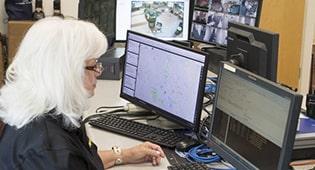
Georgia Southern University is planning a major upgrade to its campus security cameras and video technology. With approximately $1.2 million budgeted, the University will upgrade the cameras in the resident halls and other buildings in Statesboro, Savannah and Hinesville to bring the current cameras from analog to a digital platform. Additionally, new cameras will be placed at entrances to theirr campuses that can tie into those from other law enforcement agencies. The end result will be an interconnected network of cameras across the region. The new technology package includes state-of-the-art Flock cameras, which are motion-activated and record license plate numbers of any vehicle that comes into the hall parking lots. Flock Safety’s “Vehicle Fingerprint” technology lets police search the video by vehicle make, color, type, license plate, state of the license plate, missing plate, covered plate, paper plate, and unique vehicle details such as roof racks, bumper stickers, and more. The cameras can be used to look for a specific suspect or a vehicle that has been entered into law enforcement databases. Additionally, the University can use Flock for investigative purposes as well by going back and looking for any cars that fit a certain profile if it was associated with a crime or if there was a gunshot detected nearby. “This upgrade allows us to add more cameras, extend our reach, add storage and searching capabilities and better integrate our cameras into other video surveillance networks in use by local law enforcement,” said Georgia Southern University Police Chief Laura McCullough. “This is a major step forward in our ongoing work to keep our campus safe.” The new equipment will add to, and augment, Georgia Southern’s network of more than 1,800 video cameras on its three campuses. The project will begin in the coming weeks and is expected to be completed by the start of the fall 2023 semester. The announcement has garnered a lot of attention, especially with local media and publications covering security. If you're a journalist looking to know more about this announcement or speak to an expert about campus security and safety - then let us help with your coverage. Georgia Southern University Police Chief Laura McCullough is available - simply reach out to Georgia Southern Director of Communications Jennifer Wise at jwise@georgiasouthern.edu to arrange an interview today.


Approximately 30 University Police officers recognized for mental health training
Student mental health is a constant concern on a university campus. It is not uncommon for someone in distress to call 9-1-1. A police officer could be the first person to interact with a person who needs specialized attention. To help evaluate and properly handle such situations, every officer at Georgia Southern has completed Crisis Intervention Training (CIT), presented by the Georgia Public Safety Training Center in collaboration with the Georgia Department of Behavioral Health and Developmental Disabilities, and the Georgia Chapter of the National Alliance on Mental Illness. The training ensures that people with mental illnesses and other brain disorders will receive treatment in lieu of incarceration in most cases. On top of that training, the University System of Georgia offers two additional programs to law enforcement officers: QPR Suicide Prevention Training – QPR stands for Question, Persuade and Refer – the three simple steps anyone can learn to help save a life from suicide. Just as people trained in CPR and the Heimlich maneuver help save thousands of lives each year, people trained in QPR learn how to recognize the warning signs of a suicide crisis and how to question, persuade and refer someone to help. Adult Mental Health First Aid (MHFA) Training – MHFA is a skills-based training course that teaches people how to identify, understand and respond to signs of mental illness and substance use disorder. for police officers to help recognize and handle mental health issues and mental health disorders. So far, almost 30 police officers at Georgia Southern University have completed the three different training programs, earning each officer a Mental Health Initiative pin. “I am very proud of these officers, and appreciate them taking the time to better prepare for handling any situation they may encounter,” said Laura McCullough, chief of police at Georgia Southern. “The pins they now wear are a symbol of the care they invest in our community.” State and University officials lauded the officers’ achievements. “This law enforcement mental health certification program could not come at a better time for our university communities, given the state of mental health in our country and on our campuses,” said Jodi Caldwell, director of Georgia Southern’s Counseling Center. “Law enforcement personnel are increasingly the first responders to individuals experiencing mental health emergencies. It comes as no surprise to the staff of the Counseling Center that Georgia Southern’s University police department is leading the way in Georgia for law enforcement interest and willingness to become trained in recognizing and responding to individuals in mental health distress.” Caldwell spoke at a ceremony last month to present the pins and honor the officers. Also attending were Alexis Belvin, Georgia Southern’s SGA President and Chip Reese, Ed.D., former system project director for the University System of Georgia (USG) Mental Health Initiative. “The USG Mental Health Initiative was launched during COVID to allow us to focus more intentionally on the needs of our students,” Reese said. “We have expanded clinical counseling services and supported mental health and wellness resources and programming across the state. I’m particularly proud of the QPR and MHFA training and hope it will better equip the officers who are already on the first ones we call whenever someone needs help.” The following officers were awarded the Mental Health Initiative Pin: Tim Alderman, Josh Barker, Richard Bashlor, Charles Bowen, Ian Craig, Laurence Croy, Steven Cushner, Sam Derr, Christion Doyle, Bailey Dyches, Jonathan Finley, Danny Garrigus, Kenneth Glover, Clay Gracen, Sarah Grey, Lanier Griswold, Patrick Holloway, Tyrone McBride, Chris McBride, Erk McCurdy, BJ McKellar, Alex Morris, Todd Olsen, Kurt Purtee, Dexter Renfroe, Erick Riner, Lamar Stephens, and Crystal Thomas. Looking to know more - then let us help. Jodi Caldwell, director of Georgia Southern’s Counseling Center, is available to speak regarding this important topic - simply click on here icon here or simply reach out to Georgia Southern Director of Communications Jennifer Wise at jwise@georgiasouthern.edu to arrange an interview today.

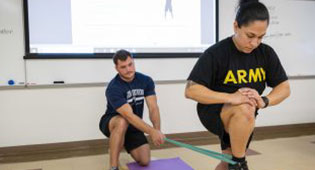
What began in 2016 as a partnership between Georgia Southern University and the Third Infantry Division at Fort Stewart has become a nationally recognized educational and research program with $5.68 million in federal funding to improve soldier health and performance to ensure force readiness. Now called the Soldier Performance and Readiness (SPAR) program, this Georgia Southern project aligns with the U.S. Army’s Holistic Health and Fitness (H2F) initiative and represents a multifaceted partnership with the Army to provide onsite training that decreases musculoskeletal injuries; deliver an online certificate program in tactical fitness for college credit; collaborate with the Army’s Research Institute for Environmental Medicine (USARIEM); and develop programs to enhance and assess cognitive performance in tactical situations. The initial partnership program to prevent musculoskeletal injuries was delivered at first to small cohorts to implement new practices in the physical training of their squads and platoons in a train-the-trainer model. Results were so encouraging, the program expanded at Fort Stewart and to training brigades at Fort Benning last year with the assistance of $1.5 million in Department of Defense funding. Studies show significant preparedness and financial benefits from reducing musculoskeletal injuries to soldiers during drilling and training exercises. In April 2020, officials determined that 58,000 soldiers (the equivalent of 13 Brigade Combat Teams) had injuries that classified them as non-deployable. In 2019, more than half of soldiers experienced a new injury, resulting in 10 million limited-duty days. Musculoskeletal injuries account for nearly 25% of all military injuries and approximately $557 million in acute patient care. Most of these injuries were associated with fitness training-related activities Georgia Southern’s online Tactical Athlete Certificate program was first offered in 2020 and is available exclusively to soldiers on active duty, in the National Guard or reserve. Through a series of three courses, the program teaches foundational exercise and biomechanical concepts, strength and conditioning principles, and rehabilitation. The coursework parallels the Army’s Master Fitness Trainer curriculum, with additional rehabilitation principles, and teaches soldiers how to develop evidence-based and well-rounded physical training programs while minimizing risk of musculoskeletal injury. Certificate completion provides soldiers with nine college credits with Georgia Southern, potential promotion opportunities in the Army, and preparation for the National Strength and Conditioning Association’s TSAC-F exam. “By sharing knowledge, expertise and experience between our faculty and doctoral students with soldiers, drill instructors, and brigade combat fitness teams to create aligned programs that improve tactical performance and force readiness, the SPAR program has become a national model of public-impact research,” said Christopher Curtis, Ph.D., Georgia Southern’s vice provost for research. “We are excited about the future of this partnership. We relish the significant support and encouragement we receive from the Army commands at Fort Stewart, Fort Benning, USARIEM, and the Training and Doctrine command (TRADOC), and we are grateful to Congressman Carter and his fellow members of the Georgia Congressional delegation who have advocated for the value of the partnership on our behalf.” The progress and continued success of this program would not have been possible without several years of support from the Georgia Congressional Delegation and especially the leadership and support of Congressman Buddy Carter, who represents Fort Stewart and the Armstrong Campus of Georgia Southern in Savannah. “Providing for our nation’s defense is the number one responsibility of the federal government. Innovation and research, which is what these dollars will fund at Georgia Southern, will improve working conditions for our brave servicemen and women by providing them with top-of-the-line training and resources,” said Rep. Buddy Carter (R-GA). “I am a proud supporter of Georgia’s military community and am happy that the federal government is investing in these necessary programs.” SPAR programming allocated in the FY23 federal budget will enable Georgia Southern to: Develop protocols and expand delivery of the onsite musculoskeletal injury prevention training and the Tactical Athlete Certificate to commands at Fort Gordon in Augusta and to the Georgia National Guard. Develop and deploy similar online certificate programs for soldiers in Cognitive Performance and Nutrition to further support the Army’s H2F program. Host a national conference on “Charting Future Readiness Needs” in partnership with the U.S. Army Training and Doctrine Command and U.S. Army Forces Command that will bring together other research universities who also work in partnership with the Army. Work with the Army commands to develop specific academic degree programs to meet the specific H2F professional workforce needs at the brigade level. Army officials estimate approximately 3,000 personnel will need graduate degrees or advanced certifications in the next six years. Develop a Tactical Performance Research Lab in Savannah to support the fundamental research and innovation activities of Georgia Southern’s Tactical Performance Group that supports the Army’s H2F program as well as translational research to apply the knowledge and practices broadly to law enforcement and other first responders. Looking to know more - then let us help. Christopher Curtis is available to speak to media - for more information simply click on his icon here or reach out to Georgia Southern Director of Communications Jennifer Wise at jwise@georgiasouthern.edu to arrange an interview today.


Aston University appoints new pro-vice-chancellor and executive dean of business and social sciences
Professor Zoe Radnor has been appointed as Pro-Vice-Chancellor and Executive Dean of the College of Business and Social Sciences She has had a successful career in higher education for over 25 years Professor Radnor will be joining Aston University in Spring 2023. Aston University has appointed Professor Zoe Radnor as the new Pro-Vice-Chancellor and Executive Dean of the College of Business and Social Sciences. Professor Radnor will succeed Professor George Feiger, who will be standing down after 10 years of leadership of Aston Business School and the College of Business and Social Sciences. With a successful career in higher education spanning over 25 years, Professor Radnor will be joining Aston University from The University of Law (ULaw), where she is currently Provost and Deputy Vice-Chancellor, specifically focused on leading the diversification of the academic portfolio, including building an academic model for the provision of high quality, innovative teaching and thought leadership. In addition, she is leading the TEF submission at the institution Prior to her executive role at ULaw, she was Vice-President for Strategy and Planning; Equality, Diversity and Inclusion and Professor of Service Operations Management at City, University of London, leading the development of the University EDI strategy. In this role she also led the creation of the new enabling Civic Strategy and established the new institution-wide Change Support Unit. Before City, Professor Radnor was the founding Dean of the School of Business at the University of Leicester, and prior to that, as Associate Dean Teaching and Learning, she led the development of new curriculum offerings for the Loughborough University campus in London. Professor Zoe Radnor is a Fellow of the Academy of Social Sciences (FAcSS) and the British Academy of Management (FBAM). She is also a member of the Athena Swan Governance Committee for Advance HE. Her main research interests are in performance, process improvement and service value within public sector organisations. She has led research projects for a number of Government and healthcare organisations, evaluating the use of ‘lean’ and associated techniques and continues to maintain a strong ongoing research profile. Professor Aleks Subic, Vice-Chancellor and Chief Executive of Aston University, said: “I am looking forward to welcoming Professor Radnor to the Executive Team at what is a hugely exciting period of development for the University and to working with her as we shape our Aston University 2030 Strategy. Zoe brings significant leadership experience to the team and ambition in line with our bold vision. “I would also like to take this opportunity to acknowledge the significant contribution made by Professor George Feiger during his leadership of Aston Business School and the College of Business and Social Sciences over the last 10 years.” Professor Radnor said: “I am delighted to be joining such a prestigious and forward-thinking University and College. “The reputations of the College of Business and Social Sciences and of Aston University generally and the strategic vision of the new Vice-Chancellor and University leadership are what attracted me to this exciting role. I can’t wait to get started working with so many talented and innovative new colleagues.” Professor Radnor will be taking up her post in Spring 2023.

New approach to help ease poor countries’ debt burden Many face having national credit rating downgraded Aston University expert coins the term the ‘credit rating impasse’ in new book. An Aston University financial regulation expert has suggested a new approach to help ease poor countries’ debt burden. Currently many poorer countries face having their credit rating downgraded if they ask private investors for loans. Dr Daniel Cash, senior lecturer in law and founder of the Credit Rating Research Initiative, has suggested that a temporary change to the way ratings are decided could help these countries avoid a damaging credit rating, which would prevent them borrowing money in the future. His theory is explored in his new book Sovereign Debt Sustainability: Multilateral Debt Treatment and the Credit Rating Impasse. The study details the history of multilateral debt treatment in Africa, whilst also looking at the impact of the pandemic. When vulnerable countries try to negotiate new lending terms with their lenders their credit rating is immediately downgraded, in some cases they could be labelled as in default - failing to repay a loan. Dr Cash calls this situation the ‘credit rating impasse’. To avoid this happening, he argues that other factors should be temporarily taken into account, making it easier for them to borrow money in the future to spend on improvements such as healthcare or infrastructure. The UN has identified 54 developing economies with severe debt problems. While accounting for little more than 3% of the global economy, they represent 18% of the world’s population, and more than 50% of people living in extreme poverty. The book sets out a new framework which could be used to overlie the existing credit rating system. The book suggests considering factors such as ESG (Environmental, Social and Governance) – which indicates a country’s impact on society, the environment, and how transparent and accountable it is. Taking ESG and sustainability factors into account indicates if a nation has the potential to grow while benefiting the environment and communities. Dr Cash said: “The credit rating impasse is a systemic problem, and a cure is needed to prevent the bankruptcy of countries around the world. “Lower-income states are being forced to prioritise debt payments over public spending on healthcare or access to food. “Instead, they should be offered help to enable borrowing to make vital improvements.” The book is free to read via Open Access Book and was funded by the Open Society Foundations (OSF).

MEDIA RELEASE: CAA urges drivers to protect lives on first national Slow Down Move Over Day
WINNIPEG, May 14, 2019 – CAA is urging motorists to make space for tow trucks providing service on the side of the road on Canada’s first national Slow Down Move Over day. The day promotes a safe working environment for tow truck operators across the country. CAA has long advocated for the protection of roadside assistance workers through Slow Down, Move Over legislation. CAA Clubs across Canada have designated May 14 as Slow Down Move Over day to bring attention to this important issue. “Lack of driver awareness is one of the largest threats to tow-truck operator safety on this day and all others,” said Raymond Chan, government relations, CAA. “Everyone should slow down and move over when they see a tow truck operator on the side of the road.” CAA’s eight Clubs across Canada will be launching public education campaigns and events today to draw attention to the safety risks tow truck operators face. There are approximately 24 million motorists and 15,000 tow truck operators on the road annually in Canada. This leads to thousands of near misses experienced by emergency roadside operators annually and, across North America, nearly 100 tow truck drivers are killed every year after being struck by oncoming traffic while helping stranded motorists with flat tires, breakdowns and collisions. Every tow truck driver knows the number of close calls they've experienced while pulled over on busy roadways. "I figured that was going to be the end, that I was going to be done," said one CAA tow-truck operator after a near-miss during a roadside assistance call. In 2011, the Slow Down Move Over law became part of Manitoba’s Highway Traffic Act. Most provinces and territories have Slow Down Move Over legislation that mandates motorists must slow down and change lanes, if it is safe to do so, to ensure the safety of emergency workers on the roadside, but it is often not observed. Learn more about the Slow Down Move Over Day here: caamanitoba.com/slowdown

Expertfile Spotlight on National Plan for Health Workforce Well-Being
ChristianaCare Participates in National Academy of Medicine National Plan for Health Workforce Well-Being and Calls for Collective Movement to Address Burnout Crisis The capacity and well-being of the U.S. health workforce has been under threat for years by an epidemic of burnout, and two years of the COVID-19 pandemic has further exacerbated this systems issue. Now at least 40% of nurses, 20% of physicians, and more than 25% of state and local public health department employees are considering leaving their professions. Recognizing that the function of the U.S. health system is at stake due to dangerously mounting health care system pressures, the National Plan for Health Workforce Well-Being by the National Academy of Medicine calls for immediate action to safeguard this precious national resource dedicated to protecting the country’s health. ChristianaCare is proud to have contributed this publication. “The NAM Clinician Well-Being Collaborative’s National Plan for Health Workforce Well-Being will drive urgently needed collective action to strengthen health workforce well-being and reverse existing alarming trends in burnout and turnover,” said ChristianaCare Chief Wellness Officer Heather Farley, M.D., MHCDS, FACEP. “ChristianaCare has served as a strategic network partner with the NAM to design this National Plan, which will coordinate action across several priority areas, including understanding the effects of COVID-19 on the health care workforce, recruiting of the next generation, and increasing access to much-needed mental health resources.” The National Plan calls on multiple actors to work together to drive policy and systems change to better support the health workforce and the health of all communities – including health care and public health leaders, government, payers, industry, educators, and leaders in other sectors. A draft of the National Plan was made available for public feedback and received nearly 2,000 constructive comments. To date the final Plan has received endorsements from over 25 organizations representing the diverse organizational membership of the Clinician Well-Being Collaborative and the various actors needed to collectively advance the practical strategies laid out in the Plan – including ChristianaCare. ChristianaCare has been engaged in all National Plan priority areas, such as: The creation and sustaining of positive work and learning environments and culture. Efforts in this priority area include development of the Center for WorkLife Wellbeing, which utilizes a comprehensive, multimodal approach to foster caregiver work-life meaning, connection, and joy. The Center offers multiple support services and culture change initiatives, including the implementation of resident well-being rounds, OASIS rooms for caregiver restoration, and opportunities for caregivers to develop long-standing mutual support systems. The support of mental health and reduction of mental health stigma, which included the championing of the physician mental health bill that became law this year. It also includes psychological first aid training that ChristianaCare has implemented for health system leaders and managers. Additionally, ChristianaCare offers free comprehensive behavioral health support services and an individual peer and group support program to help caregivers when they experience stress in the workplace. The commitment to well-being as a long-term value, which includes integration of caregiver collective well-being as a systemwide strategic goal. The National Plan visualizes that, when all actors take responsibility, we can create a health system in which care is delivered with joy and with meaning, by a committed care team, in partnership with engaged patients and communities. The National Plan identifies a range of actions for the near-, medium-, and long-term to achieve seven priority areas for health workforce well-being, clearly naming associated goals and responsible actors. Access the full National Plan here to learn more about the priority areas for action. For more information on the Action Collaborative on Clinician Well-Being and Resilience, of which ChristianaCare is a member, visit this site.
