
Experts Matter. Find Yours.
Connect for media, speaking, professional opportunities & more.

Anyone can experience PTSD – let our experts help answer questions about PTSD Awareness Month
June is PTSD Awareness Month. It’s not just an affliction that affects soldiers and first responders – it can also impact anyone who may have been in an accident, experienced abuse or witnessed a tragedy. According to the U.S. Department of Veterans Affairs, “Post-traumatic stress disorder (PTSD) can occur after you have been through a trauma. A trauma is a shocking and dangerous event that you see or that happens to you. During this type of event, you think that your life or others' lives are in danger.” According to Veteran’s Affairs: About 7 or 8 out of every 100 people (or 7-8% of the population) will have PTSD at some point in their lives. About 8 million adults have PTSD during a given year. This is only a small portion of those who have gone through a trauma. About 10 of every 100 women (or 10%) develop PTSD sometime in their lives compared with about 4 of every 100 men (or 4%). There is nothing new about PTSD, other than its terminology. In World War 1, it was labeled “shell shock” and many perceived it as a sign of weakness as opposed to an injury. Since then it has been called “combat fatigue” and in the 1970s, “post-Vietnam syndrome.” But what about now? With so many veterans returning from overseas and the public now being more informed of those who may have been afflicted domestically, questions include: Is acceptance of PTSD improving? Does the stigma still stick with those looking to return to their careers? Are there new and innovative ways to treat PTSD and how do they work? As we round out PTSD awareness month, let our experts help with your stories. Dr. Nagy Youssef is an associate professor of psychiatry at Augusta University and is a leading expert in PTSD and suicide prevention who treats civilians, active duty military and veterans. His research focuses on mechanistic and therapeutic innovation for treatment-resistant psychiatric disorders and suicide prevention. Dr. Youssef is also in the early stages of forming a study to better detect genetic markers associated with PTSD and resilience to trauma. Participation in this study is voluntary. Learn how to participate in “Epigenomics Association Study of PTSD and Resilience” at https://www.augusta.edu/research/studies/list.php.

:no_upscale()/cdn.vox-cdn.com/uploads/chorus_image/image/63865958/1145120928.jpg.0.jpg)
Polling is always a big part of any political campaign, debate or election strategy. And as pollsters and market researchers dig down, one thing that’s being revealed is that the often-promoted divide among women and men might not be as dramatic as some think. In fact, when it comes to some key issues, it is usually a lot more about being blue or red than male or female. Just recently, a Vox article revealed that women and men were usually more aligned on topics like abortion not just in America, but also in most parts of the western world. Where they differed was often on matters of the size of government and the military. It’s an interesting finding and one that will certainly play a factor as the race toward 2020 shifts into high gear. Augusta University’s Mary-Kate Lizotte is an expert in public opinion and the origins and implications of gender differences or "gender gaps” and was contacted by Vox to contribute to that article. If you are covering topics about gender and how it may play an influential role in the upcoming elections and would like to speak with Dr. Lizotte, simply click on her icon to arrange an interview.

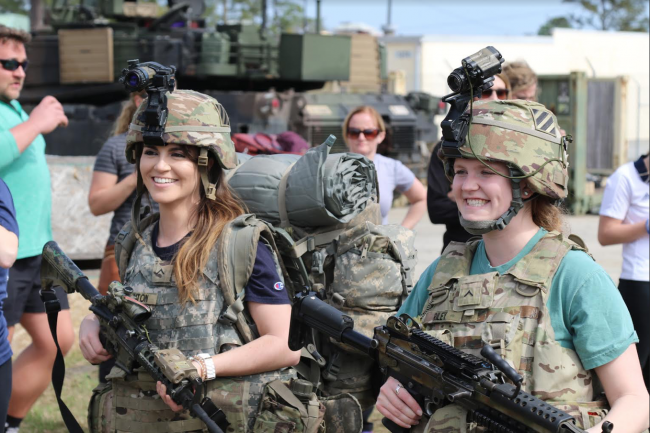
Musculoskeletal disorders are the number one reason for soldier evacuation and account for almost 25 percent of all military injuries compared to combat injuries, which account for 14 percent in the armed forces. It was with that knowledge that students from Georgia Southern University’s Department of Rehabilitation Sciences met up with soldiers from the Army’s 3rd Infantry Division at Fort Stewart-Hunter Army Airfield in Georgia to gear up and better understand soldiers’ unique physical challenges and how they can help better prepare them for combat. “The event provided our students with a much better insight as to the physical demands of soldiers at Fort Stewart,” said Nancy Henderson, DPT, assistant professor of rehabilitation sciences on Georgia Southern’s Armstrong Campus in Savannah . “This added knowledge will help them to better tailor their education while working with soldiers.” As technology and equipment change and adjust between each theatre of operation it is imperative that the America’s soldiers stay fit and have all the knowledge and resources, they require to achieve their assigned task. But why were so many soldiers suffering from musculoskeletal disorders? Is the issue easily solved? And how can every branch of the armed forces adopt and adapt how they’re operating on the ground to avoid these issues? There are a lot of questions to be answered and that’s where our experts can help. Dr. Nancy Henderson is an assistant professor in the Department of Rehabilitation Sciences at Georgia Southern University. She is an expert in injury prevention, running form and assessing meaningful change of interventions. Nancy is available to speak with media regarding this topic – simply click on her icon to arrange an interview.



Goizueta information systems and operations management professor Benn Konsynski on the 30th birthday of WWW: "... Many of us were on the internet before WWW -- researchers, academic, military, libraries, etc. The operating protocols on top of the basic Internet protocols were useful, but often specialized. The world of commerce and social interchange needed a simple standard to offer creative outlet beyond specific applications and closed systems. "Sir Tim Berners-Lee brought that with common protocols for describing content (HTML), moving/referencing content (HTTP) and browser technologies for viewing and manipulating content. Over the next few years, commerce and social exchange exploded after these protocols took root. By 1995 the internet world opened to business and the general market with expectations and promise."



Is there a storm coming in the South China Sea?
There’s trouble brewing in the South China Sea and there doesn’t seem to be a any way to calm the waters. Taiwan, the small island country that has been persistently seeking independence is pushing toward that goal at a fevered pace. Meanwhile China disagrees, wants Taiwan back in the fold and has stated that the country is seeking one unified China - and soon. At a recent speech, Chinese President Xi threatening to use force to bring Taiwan under its control, though said China would strive to achieve this peacefully. And with a military budget this year of 177 billion dollars (US), China will be able to dictate its definition of the term ‘peacefully’ to suit any of its likely goals. So, what’s next? Can international intervention or pressure call China off its mission to absorb Taiwan? Can China be stopped? Does Taiwan have the political capital at the UN to find actual support or protection and from who? And what would the consequences be in China took Taiwan with force? There are a lot of questions to be asked and that’s where we can help. Professor Elizabeth Larus was recently featured on CNBC Asia and updated their audience on the most recent developments and outlined what seems to be China’s next steps. Professor Larus teaches political science at the University of Mary Washington and is an #expert on China and the field of Asian studies. She is available to speak to other media pursuing this this subject – simply click on her icon to arrange an interview.


Cybersecurity expert offers holiday shopping tips for protecting identity
Amid the many warnings this holiday season about protecting your identity while shopping online comes advice from Scott Shackelford, associate professor of business law and ethics in the Indiana University Kelley School of Businessand one of the nation's leading cybersecurity experts. "In some ways shopping online is getting safer," said Shackelford, also chair of the Kelley School's Cybersecurity Program in Risk Management and director of the Ostrom Workshop Program on Cybersecurity and Internet Governance. "For example, a few years ago it was relatively uncommon for many sites to use encrypted https technology, but that's become the norm. However, as may be seen by a quick scan of the news, data breaches continue. "The good news is that the cost of those breaches is going up with Federal Trade Commission and European Commission investigations ongoing into firms like Equifax and Facebook, and consumer patience is also wearing thin," he added. "One recent survey, for example, found that 20 percent of consumers would not shop again at a firm that experienced a data breach." Shackelford offers practical advice for holiday shoppers. In essence, there's a lot you can do to become harder targets for cyber criminals, including: Consider freezing your credit. You don't need it open unless you open a new credit card or loan, and even then you can unfreeze it for a short window to allow for the credit check. Install antivirus and antispyware software, use auto-update, and always enable multifactor authentication on all of your accounts. When using public Wi-Fi, use browsers like Tor to make it more difficult for hackers to spy on you. Keep all software up to date -- especially Windows, but also programs like Adobe Reader, Flash and Java, which are often convenient backdoors that can be closed through frequent updates. Use strong passwords of at least 14 characters, keep them secret, and change them often. Consider starting with a favorite sentence, and then just take the first letter of each word. Add numbers, punctuation or symbols for complexity. And be sure to change any default passwords on your new smart devices. Never turn off your firewall; it's an important software program that helps stop viruses and worms. Use flash drives cautiously; they are easily infected. In fact, one of the biggest breaches of U.S. military systems to date was due to a flash drive. Encrypt sensitive information on your computer. Be conscious of what you click on, both in emails and on the web. When in doubt, double check before accessing new files. Look for sites with "https" in the URL. Do not use banks or other sensitive websites that do not have the "s."


Fundamental research hailed as new horizon in hypersonic flight
PHOTO Cutline: Mohamed Gad-el-Hak, Ph.D., professor emeritus in Virginia Commonwealth University’s Department of Mechanical and Nuclear Engineering. (Photo courtesy of the VCU College of Engineering) Mohamed Gad-el-Hak, Ph.D., Professor Emeritus in VCU’s Department of Mechanical and Nuclear Engineering, together with investigators at the University of Peking, China, has revealed an aerodynamic heating mechanism that sheds new light on the behavior of ultra-high-speed aircraft. Their discovery comes as news outlets including CBS, CNN and the Washington Post are reporting on the tightening race among China, the U.S. and Russia for dominance in hypersonic systems, aircraft and weapons that travel more than five times the speed of sound. Researchers previously thought sudden heat spikes, which make hypersonic flight impractical for many applications, occur when air flows reach maximum turbulence. However, Gad-el-Hak and his collaborators have demonstrated through theory, experiments and numerical simulations that temperatures actually jump just before turbulence sets in. The National Science Review has called their achievement “a major progression in hypersonic transition.” The American Institute of Physics said this investigation denotes “a new horizon” for future studies of hypersonic heating phenomena. The discovery is expected to accelerate applied military and commercial hypersonic research for the design of future spacecraft, intercontinental ballistic missiles and hypersonic vehicles. Gad-el-Hak emphasizes that such applications result from fundamental research. Unlike applied investigations, which set out to solve practical problems, fundamental research seeks to improve scientific understanding of the natural world. “I have two unflinching scholarly beliefs,” Gad-el-Hak said. “Fundamental science eventually, albeit in fits and starts, leads to a nation’s health, happiness and prosperity, and ‘walls’ between nations hinder that progress.”


The next threat to election meddling? Brain Hacking
Almost 15 percent of Americans have reported changing their opinion on political or social issues because of a social media post, according to a recent Pew Research Center survey. “What if, immediately before spreading polarizing social media posts, our adversaries flashed subliminal images known to induce a type of anxiety called state anxiety? Evidence suggests people would perceive those posts in a more emotional way. Those images could, in turn, influence their voting behavior,” said Dr. Jay Heslen, an expert in intelligence and cybersecurity policy and assistant professor of political science with a joint appointment in the Katherine Reese Pamplin College of Arts, Humanities, and Social Sciences and the School of Computer and Cyber Sciences at Augusta University. “Successfully manipulating the cognition of a few thousand people in order to influence their perception of events could be enough to change the result of an election.” Heslen’s current research project focuses on whether exposure to certain visuals or sounds, including subliminal prompts, can induce a negative emotional arousal on people. He’s interested in learning whether that emotional state, called state anxiety, can then influence behavior in a specific, predefined way – a concept he calls neurocognitive hacking. Although research using subliminal prompts is not new and has had mixed results, Heslen’s approach is novel. He uses a specific kind of visuals previously shown to trigger people’s unconscious discriminatory behaviors toward outsiders. “Neurocognitive hacking could potentially be used as a weapon in cyberwarfare,” said Heslen, who worked as an intelligence officer with the Defense Intelligence Agency and the United States Air Force for more than 20 years, specializing in combatting terrorism, counterintelligence and strategic cyber intelligence. “We need to study these capabilities not only for our own understanding but to create sound policies and countermeasures to defend ourselves against others who may use them on us.” With 68 percent of Americans on Facebook and 73 percent on YouTube, according to another Pew Research Center survey, neurocognitive hacking could be a national security problem, Heslen said. “As we advance our understanding of the brain and its processes, including how to manipulate it, we will need to provide neurocognitive cybersecurity to people who use information and communication technologies,” Heslen said. “This will be especially true as we spend more time in virtual worlds.” Heslen is available to discuss: · How neurocognitive hacking can influence people’s behavior · Why neurocognitive hacking is a powerful weapon of cyberwar · What kinds of policies should the government create to protect itself and its citizens from neurocognitive hacking Heslen is a Lieutenant Colonel in the United States Air Force Reserve and has served in military operations on four continents to include humanitarian relief operations in Mozambique and South Africa as well as an operational tour in Afghanistan. In his capacity as a reservist, he is currently assigned to the National Intelligence University pursuing an advanced degree in strategic intelligence. Contact us to schedule an interview with Dr. Heslen or learn more about his expertise.


This is not honoring military service -- it is disgracing it.
“The dismissal of service members from the Armed Forces because of their immigration status is an insult to everyone who has worn the uniform. Those who have worn the uniform know the sacrifices that serving in the military involves. To callously dismiss those very few who have chosen to serve is an act of moral cowardice. Every veteran and service member should be outraged. This is not honoring service, it is disgracing it.” Source:


In his letter to Kim Jong Un and related statements, President Trump made not-so-veiled threats regarding U.S. military capabilities. Thus, many are asking: Is the Trump Administration, staffed with former military officers in prominent cabinet positions, chomping at the bit to unleash America’s military might? International security scholar Peter Campbell, Ph.D., is watching the situation. “Trump's cancellation gives both sides opportunity to claim that they pursued all diplomatic means. The conflict now enters a more dangerous phase because an opportunity to step back from the brink has been lost and diplomatic efforts have been somewhat discredited,” he said. “Trump’s comments regarding superior U.S. nuclear capability might be interpreted as a precursor to escalation, although the letter's tone was much less inflammatory than his earlier rhetoric.” Campbell said history – and, ironically, Trump’s staff of former U.S. military leaders in key positions – sides with those who prefer diplomacy over force. “The prominent role of former military officers has caused some to worry that the Administration is anxious to go to battle. This idea is problematic because it does not take into account that U.S. military leaders have often been more hesitant than their civilian superiors to use force,” he said. “As former Secretary of Defense Robert Gates wrote of his Cold War experiences under Presidents Reagan and George H. W. Bush: ‘In more than 20 years of attending meetings in the Situation Room, my experience was that the biggest doves in Washington wear uniforms.’ This makes sense because military officers often have an intimate understanding of how the decision to use force leads to major uncertainty and is plagued with often insurmountable friction and the fog of war. Gates observed: ‘Our military leaders have seen too many half-baked ideas for the use of military force advanced in the Situation Room by hairy-chested civilians who have never seen combat or fired a gun in anger.’ Thus, the fact that Trump has former military officers in his inner circle should decrease, rather than increase, fears of an ill-conceived use of military force to resolve this crisis. Secretary of Defense James Mattis made explicit mention of the key role diplomats are playing in the unfolding crisis. Numerous commentators have pointed out the immense influence that Mattis has in the current administration. This should calm rather than incite fears of a military solution." Source:

