
Experts Matter. Find Yours.
Connect for media, speaking, professional opportunities & more.

The role of the economy on individualism
Past work has shown that as countries become wealthier, people often become more individualistic. In new research, Emily Bianchi, assistant professor of organization & management, takes the investigation a step further and finds that even subtle fluctuations in the economy are associated with changes in individualism. She finds that during good economic times, Americans are more likely to seek out ways to signal their uniqueness and individuality. For instance, during boom times, Americans tend to give their children more uncommon names and are more likely to prize autonomy and independence in child-rearing. They are also more likely to favor music featuring self-oriented lyrics. Conversely, during recessions, Americans tend to focus more on fitting in and tend to give their children more common names, listen to more relationally oriented music, and encourage their children to get along with others. Additionally, Bianchi discovered that recessions engender uncertainty, which, in turn, decreases individualism and encourages interdependence. The study results indicated that the “link between wealth and individualism is driven not only by differences in how people live, work, and learn but also by their sense of the predictability, orderliness, and certainty of the surrounding environment.” Source:



Order for Racism. Racism Anyone?
When I think of Starbucks, I think of fair trade and “ethnically sourced” secured coffee beans, wonderfully laid out desserts and treats that my waist line dislikes, and cool stripped down funky folky alternative music playing in the background while I drink a hot delicacy I can barely pronounce. I think of people conversing, while others around them are seeping the juices of the Internet to fuel their apple laptop latest reality game apps. I think of people completing school or professional work away from their homes and offices. Starbucks has the ability in a sense to serve as an escape. But as a person of color, especially a historically marginalized people, there is no quarter given. Two Black men in Philadelphia discussing possible business ventures in a Starbuck were reminded that within the 21st century two separate worlds for Blacks and everyone else continues to exist within our world. The denial of bathroom rights to potential paying customers, an automatic response to call the police, and consequential police engagement and arrest without legitimate legal cause are representations of 21st racism. A similar incident has recently surfaced on video caught in a Los Angles area store where onlookers observed white non-paying patrons getting access to the bathroom while Blacks were denied. These discussed incidences are the simple echoes of a system of oppression that has existed for Blacks since the first Dutch flagged slave ship arrived in Jamestown in 1619. Source:


Baylor Black Gospel Music Expert Pens Dallas Morning News Column Remembering MLK
Robert Darden, professor of journalism, PR and new media at Baylor University, is a gospel music expert. He penned this column to commemorate the death of Martin Luther King, Jr. and to remember the music that carried people through the grief of the time. He writes: "In the days of rage and grief that followed the assassination of the Rev. Martin Luther King Jr. in Memphis on April 4, 1968, many Americans found, at least for a time, relief in music. Rosa Parks, whose brave stand on a Montgomery, Ala., bus just 13 years earlier was the inciting incident in the slow build of the civil rights movement after World War II, watched as Detroit erupted in violence. She sat in her room playing Sam Cooke's "A Change is Gonna Come" over and over. She said the song 'saved her sanity.'" Darden is the author of two dozen books, most recently: Nothing But Love in God’s Water, Volume II: Black Sacred Music from Sit-In to Resurrection City (Penn State University Press, 2016); Nothing But Love in God’s Water, Volume I: Black Sacred Music from the Civil War to the Civil Rights Movement (Penn State University Press, 2014); Jesus Laughed: The Redemptive Power of Humor (Abingdon Press, 2008); Reluctant Prophets and Clueless Disciples: Understanding the Bible by Telling Its Stories (Abingdon Press, 2006); and People Get Ready! A New History of Black Gospel Music (Continuum/Bloomsbury, 2004). He founded the Black Gospel Music Restoration Project, the world’s largest initiative to identify, acquire, digitize, categorize and make accessible gospel music from gospel’s Golden Age (1945-1970). The BGMRP provides the gospel music for the Smithsonian’s new National Museum of African American History & Culture. Source:


Robert F. Darden, professor of journalism and founder of Baylor’s Black Gospel Music Restoration Project, treasures the rich sounds of Christmas spirituals, which differ from Christmas carols. “So many of the spirituals are written in what has been performed as and what scholars call the ‘eternal now,’” Darden said. “If you read the lyrics as they were transcribed, many of them are in the present tense.” To illustrate his point, Darden referenced the spiritual “Were You There?” in which the lyrics read, “It causes me to tremble.” Darden said that since slaves in America were not book-educated and struggled with the concept of time, the Bible was a contemporary account of what was going on for them. In their minds, they conflated Abraham in the Bible with Father Abraham Lincoln who was going to free them, and associated Harriett Tubman with Moses and the Ohio River with the Jordan River. Darden said the powerful resonance in these spirituals is unmatched because of the passion of the people who sang them. “When you hear the Christmas spirituals, you’re hearing people who (believe) this is a real live event,” Darden said. “Go tell it on the mountain that Jesus Christ is born, not was born. That gives them more of an immediacy and a power than songs that are in the past tense.” Darden also said that slaves had a more intimate understanding of the nativity story because they identified with the conditions into which Christ was born. They understood what it was like to come from a foreign land to a place where they were despised and enslaved in the same way that Christ was born as a refugee child with people seeking to kill him. “The spirituals reflect a people who believe they’re in the middle of the Bible story. I think that gives them a power that’s hard for others to match and why the Gospel artists, who would later record these songs, tried to capture that and keep that immediacy and intimacy that I think a lot of Christmas carols don’t have,” Darden said. Darden said the modern world still needs Christmas spirituals. While commercialism gets people excited and inspired for the holidays, people in 2017 need something that will help them reflect on what truly matters about the season. They need something that will not only remind them of history but will also evoke the sensation of gratitude for a needed savior. “By noticing and listening to the words of the spirituals, you see how they focused on what really matters," he said. Source:
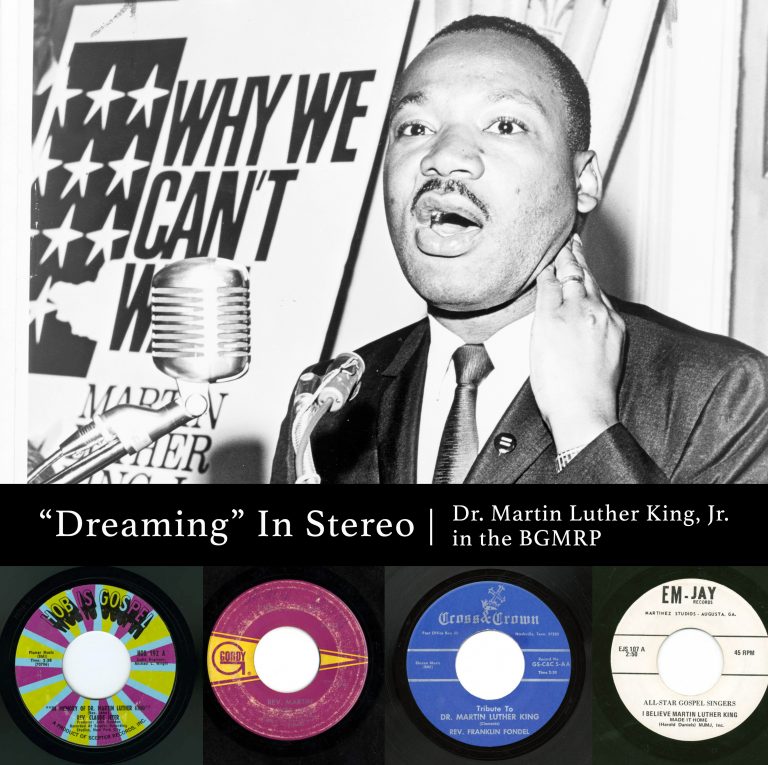
Baylor Gospel Expert: MLK’s ‘I Have a Dream’ Inspired Response from Black Gospel Artists
Fifty-four years ago this week. On Aug. 28, 1963, from the steps of the Lincoln Memorial in Washington, D.C., Dr. Martin Luther King Jr. delivered “I Have a Dream” – one of the most iconic speeches in American history and a defining moment of the Civil Rights Movement. For black gospel artists recording in the years after 1963, King’s speech was fertile ground for creative expression, said Robert Darden, professor of journalism and founder and director of Baylor’s Black Gospel Music Restoration Project (BGMRP). “These artists responded by creating songs that sampled portions of Dr. King’s recorded audio, drew inspiration from his words or supported the Civil Rights Movement in the wake of its delivery,” Darden said. Darden founded Baylor’s Black Gospel Music Restoration Project more than a decade ago in an effort to identify, acquire, preserve, digitize and catalog recordings from the black gospel music tradition. This music, from the Golden Age of Gospel from 1945 to 1975, was quickly vanishing as albums made the transition to CDs. Through the work of the Baylor Libraries’ Digital Projects Group, recordings from the BGMRP are available online in the Baylor Libraries Digital Collection, and in some cases includes other materials, such as taped interviews, photographs, press packets, tour books and programs, newspaper and magazine clippings, and sheet music. Music from the BGMRP also has been included in a permanent exhibit featuring African-American musical history at the Smithsonian Institution’s National Museum of African American History and Culture. Source: