
Experts Matter. Find Yours.
Connect for media, speaking, professional opportunities & more.

What can America expect as supply chain issues leave the auto industry stuck in park?
America’s auto industry is slowing down – and this time the main source is not a matter of labor issues or a lack of customers. This time this crisis, like those plaguing so many other industries lies in the tangled web of supply chain issues that is challenging manufacturing, industries and economies across America and the continent. In the United States, the auto industry has been hit particularly hard. The nation’s largest automaker and the rest of the global auto industry have been sporadically shutting down plants since late last year due to the semiconductor shortage, which has cut supplies on dealer lots and driven new vehicle prices to record levels. To be sure, production still isn’t back to normal because some of the factories will only run on one shift per day. Phil Amsrud, senior principal analyst for IHS Markit who studies the chip market, said GM’s move is a good sign, but doesn’t signal the end of the chip shortage. “It’s just not a sign that the patient is through all the rough spots and it’s a matter of weeks before they’re released from the hospital,” he said. October 22 - Associated Press There has been a lot of coverage, and a lot of questions asked as to how this happened and what it will take to untangle the mess. And that’s where experts from Augusta can help with coverage. "There are several factors but the main themes are suppliers inability to react to the increased demand, and governmental policies and responses,” explains Dr. Mark Thompson an economist and expert regarding the industrial issues facing America. “When COVID initially hit, demand dropped considerably. As it relates to the shortage of computer chips, what do you think consumers were demanding during the early phase of COVID...computers, laptops, handheld devices, etc. Technology companies responded and chip manufacturers switch to produce these items. Now, as consumers demand for new cars pick up, there is a shortage of the chips necessary for new cars. As it relates to government intervention, the stimulus has also increased demand for various goods and services furthering the shortage." As for how long will it take for America to see the supply chain replenished? "Good guess,” says Thompson. "I would say that we should expect to continue to see these shortages through the rest of 2021 and part of the way in 2022." If you’re a journalist covering the ongoing supply-chain issues – then let our experts help with your stories. Dr. Mark Thompson is an economist with highly accomplished work in business conditions, risk analysis, energy and the healthcare industry. Dr. Thompson is available to speak with media regarding the economic and industrial issues facing America during this supply chain crisis - simply click on his icon now to arrange an interview today.


MEDIA RELEASE: Ten things Ontarians need to know prior to booking travel abroad
CAA South Central Ontario (CAA SCO) has compiled a list of ten things that Ontarians should be aware of if they are considering travelling abroad. “Now that the Canadian government is no longer advising against non-essential travel due to COVID-19, those who are considering booking a trip should make sure they understand the scope of what travel looks like at the moment,” said Kaitlynn Furse, director, corporate communications, CAA Club Group. “The checklist for planning a trip has changed and we want to help people navigate this new environment.” Through consultation with its top travel agents, CAA SCO has identified ten key considerations that potential travellers may not be aware of. Anyone who is considering travel in the current environment should make sure they have looked into the following and remember that travel requirements and regulations are continually changing. 1. Confirm the COVID-19 situation at destination prior to booking. Understand the risk level associated with travel to a particular destination by checking the Government of Canada Travel Advice and Advisories website. While the Global Affairs Canada Level 3 Travel Advisory to avoid all non-essential travel has been lifted, individual travel advisories do remain on a country-by-country basis. It is important that Canadians understand the ongoing uncertainty associated with international travel, whether that be related to the continued community transmission of COVID-19, or state of health care systems in destinations hit hard by the pandemic. 2. Understand the type, timing, cost and accessibility of required COVID testing. Every country has different requirements when it comes to the COVID tests that are needed prior to travel, and every country has different testing capacities once you are there. There are also requirements in order to return to Canada. Make sure you understand the difference between molecular PCR and rapid antigen tests, in what time period tests must be taken, the associated costs and locations where these tests are available. 3. Confirm change and cancellation flexibility with your travel service provider. Many airlines and hotels have been providing more flexibility when it comes to refunds and changes to bookings. Make sure you understand any key dates related to cancellation and changes and whether you are entitled to a refund or a future travel voucher or credit at the time of booking. 4. Buy travel insurance and understand what is covered. Make sure you have $5 million in coverage for emergency medical situations and that illness related to COVID-19 is included. Understand your entitlements for things like denied boarding in the event of a positive test and coverage related to isolation expenses. 5. Prepare required travel documentation and the format it must be presented in, for both Canada and your destination. Canadians returning home should have all required documentation loaded onto the ArriveCAN App or website. Each destination has varying requirements, so make sure you fully understand what information you need to have ready and in what format. Make sure you also take into consideration connections and any requirements in the connecting destination due to lay over or delays. 6. Take note of local public health rules prior to departure. Many destinations have measures in place such as curfews and quarantine requirements. You should also understand what the regulations are if you happen to test positive for COVID-19 in the country you are visiting. 7. Be aware of changes between booking and departure. Make sure you reconfirm all the details that were researched prior to booking, to ensure they are still accurate prior to departure. What was true when a trip was booked may not be the case by the time you are ready to travel. 8. Double check all research with the appropriate embassy or consulate. Travel at this time is complex and many factors can change quickly, so ensuring you have the most up to date and accurate information is essential. 9. Plan for extra time. From disembarkment and customs to retrieving luggage and exiting the airport, most things on the travel journey are taking longer than during pre-COVID travel times. Also note the check-in and baggage drop off deadline for your flight as it may require you to arrive earlier than anticipated. 10. Stay connected. Fully unplugging while travelling is likely a thing of the past. It is important to have access to trusted, up-to-date information while travelling so you can monitor changing conditions and requirements and adapt accordingly. Bookmark the Global Affairs Canada website prior to departure and check it regularly while abroad. It is also a good idea to sign up for Registration of Canadians Abroad and stay in touch with a family or friend that has knowledge of your travel plans.



Supply Chain Disruption Continues Due to the Pandemic
During the pandemic, the global supply chain began experiencing major disruptions. Kathleen Iacocca, PhD, an associate professor of management and operations in the Villanova School of Business, says that this issue is currently more severe than at the beginning of COVID's spread. Per the professor, the supply chain relies on effective forecasting, inventory control and logistics of supply and demand. At the start of the pandemic, the supply and demand scale became off-balance due to panic purchasing. Today, one reason it's much worse is that the supply went down. "You can try and push supply back up, which is what President Biden is doing with having ports operating 24/7. [But] Costco or Target can make as many phone calls as they want to Hasbro asking for Barbies, and if they don't have them, they can't just wave a wand and get them," says Dr. Iacocca. One option, if there's an imbalance, is to push demand down. "As a retailer, you can raise prices. That will help bring the supply and demand into a balance until the logistics part can catch up," says Dr. Iacocca. "But that can lead to dangerous issues. The people that can afford things are going to continue buying product, and it will exaggerate the differences in socioeconomic status." Dr. Iacocca predicts, with the upcoming holiday season, supply will simply not be able to meet demand. "In a normal world, retailers can forecast and build up inventory. In the future, demand will continue to go up while the supply doesn't get any larger and will just increase the gap between the two." In the meantime, small businesses can expect challenges. "If there's a short supply of lumber, Home Depot can afford it more than Mom and Pop's Lumberyard. Raising prices are a risk for those that can't necessarily afford things, but also the small businesses," says Dr. Iacocca. Ultimately, Dr. Iacocca predicts that supply could catch up with demand by March (at the earliest), depending on two things: "First, that the labor force doesn't remain as is. If you're playing the game of catchup, you’re working overtime. Second, you’re counting on factories not shutting down again because of COVID. March is the assumption that you have the means—and you just need the time and a period where demand does not continue to go up."



Covering the death of Colin Powell? UMW's foreign policy expert can help
Colin Powell, the first Black US secretary of state whose leadership in several Republican administrations helped shape American foreign policy in the last years of the 20th century and the early years of the 21st, has died from complications from Covid-19, his family said on Facebook. He was 84. "General Colin L. Powell, former U.S. Secretary of State and Chairman of the Joint Chiefs of Staff, passed away this morning due to complications from Covid 19," the Powell family wrote on Facebook, noting he was fully vaccinated. A source familiar with the matter said Powell had multiple myeloma, a cancer of plasma cells that suppresses the body's immune response. Even if fully vaccinated against Covid-19, those who are immunocompromised are at greater risk from the virus. "We have lost a remarkable and loving husband, father, grandfather and a great American," the family said. October 18 - CNN If you are covering the life and legacy of Colin Powell - then let our experts help with your questions and coverage. University of Mary Washington Political Science and International Affairs Professor Jason Davidson is an expert in American foreign and security policy, and international security. He is also the author of the commissioned study, "The Costs of War to United States Allies Since 9/11," which focuses extensively on the human and monetary sacrifices made by America's allies in these conflicts. Davidson, and the document, made waves this spring, landing in the likes of Forbes, The Guardian and The Daily Mail. If you’re looking to arrange an interview with Dr. Davidson, simply click on his icon.



Could Vitamin-A bring back your sense of smell after Covid?
Researchers at the University of East Anglia and James Paget University Hospital are launching a new project to see whether Vitamin A could help people regain their sense of smell after viral infections including Covid-19. Smell loss is a common symptom of Covid-19, but even before Covid, many viruses had been causing smell loss and distortion and while most people naturally regain their sense of smell within a couple of weeks, many have been left with on-going smell disorders. Previous research from Germany has shown the potential benefit of Vitamin-A, and the UEA team will explore how this treatment works to help repair tissues in the nose damaged by viruses. They hope that the study, which has been funded by the National Institute for Health Research (NIHR), could one-day help improve the lives of millions around the world who suffer from smell loss, by returning their fifth sense. Smell loss expert Prof Carl Philpott from UEA’s Norwich Medical School and James Paget University Hospitals NHS Trust, said: “The huge rise in smell loss caused by Covid-19 has created an unprecedented worldwide demand for treatment. “Even before the Covid-19 pandemic hit, smell loss was thought to affect an estimated five per cent of people, with viruses accounting for 1 in 10 of those. “And around one in ten people who experience smell loss as a result of Covid-19 report that their sense of smell has not returned to normal four weeks after falling ill. “It’s a big problem, and our previous research has shown the impact of smell loss – including depression, anxiety and isolation, as well as risk of danger from hazards such as gas and spoiled food, and changes in weight due to reduced appetite. “A key problem for patients and their clinicians is the lack of proven effective treatments. “A recent study from Germany showed that people treated with vitamin A nasal drops improved twice as much as those in the untreated group. “We want to find out whether there is an increase in the size and activity of damaged smell pathways in patients’ brains when they are treated with vitamin A nasal drops. “This would show recovery of the damage caused by common viral infections, including Covid-19, in the nose.” The research team will work with patients who have lost their sense of smell due to a viral infection. They will either receive a 12-week course of nasal vitamin A drops or inactive equivalent drops, and have their brains scanned before and after the treatment. The scans will be compared to those of a control group who have not been treated with vitamin A drops. Prof Philpott said: “The patients will be smelling distinctive odours - roses and rotten eggs - while special MRI brain scans are taken. “We will look for changes in the size of the olfactory bulb - an area above the nose where the smell nerves join together and connect to the brain. “We will also look at activity in areas of the brain linked to recognising smells,” he added. Duncan Boak, Founder and Chair of Fifth Sense, said: “At Fifth Sense we have engaged with thousands of people who have experienced changes in their ability to smell or taste as a result of the Covid 19 virus. They join an already large community of people with a smell disorder that pre-dates the pandemic. “The question we are most often asked is about available treatments to support recovery. Not being able to smell is not only physically distressing but can affect the enjoyment of social occasions and present hazards and risks that might never have been previously considered such as not being able to detect gas leaks or spoiled food. “Research into potentially successful interventions is vital to help people feeling the impact of smell disorders that affects the quality and enjoyment of their life.” To take part in this trial, patients need to be referred to The Smell and Taste Clinic at the James Paget University Hospital by their GP. Recruitment is expected to begin in December 2021. To find out more visit https://rhinology-group.uea.ac.uk/apollo-trial or contact apollo.trial@uea.ac.uk. The NIHR is the largest funder of research in the country, and is the research partner of the NHS and social care. To find out more about other NIHR research happening near you, visit www.bepartofresearch.uk.


How rabbits help restore unique habitats for rare species
European wild rabbits are a ‘keystone species’ that hold together entire ecosystems – according to researchers at the University of East Anglia. Our campus is home to hundreds of rabbits and Prof Diana Bell, from our School of Biological Sciences, has been researching them for more than 30 years. Now, she is one of the lead researchers on a new report which aims to restore and protect at-risk wildlife habitats which are rabbit dependent. The report shows how their grazing and digging activity keeps the ground in a condition that is perfect for sustaining other species that would otherwise move on – or die out. But their numbers are declining regionally, nationally and globally. And they are even being classed as endangered in their native region, the Iberian Peninsula. The findings come as efforts to save England’s most threatened species from extinction are turning the tide for wildlife in Norfolk and Suffolk thanks to the Shifting Sands project. Shifting Sands is one of 19 projects across England that make up the national Back from the Brink initiative. Together, these projects aim to save 20 species from extinction and benefit over 200 more. Lead partner of the rabbit work-stream and rabbit expert Prof Diana Bell, from UEA’ School of Biology, said: “The Breckland-based Shifting Sands project was set up to save some of the region’s rarest wildlife. “After several years of hard work by this multi-partner project, the fortunes of species classed as declining, rare, near-threatened or endangered are now improving in the Brecks. “The project has seen species recover in record numbers – including endangered beetle and plants, one of which is found nowhere else in the world. “Rabbits are incredibly important because their grazing and digging activity keeps the ground in a condition that is perfect for sustaining other species. “Sadly, rabbit populations have declined dramatically in the UK and across Europe, and the European wild rabbit is now listed as endangered in its ancestral Iberian Peninsula range. Their decline is largely due to a spill-over of new viruses from commercially bred rabbits. “The Shifting Sands project has shown us how important rabbits are to entire ecosystems, and it is vital that these habitats are conserved and protected. “We encouraged a rabbit revolution in the Brecks and we have produced a toolkit in partnership with Natural England to help landowners of similar rabbit-dependent habitats to do the same.” “Simple cost-effective ways of encouraging rabbits include creating piles of felled branches, known as brush piles, and banks of soil.” Monitoring over the past three years has shown the interventions are working, with evidence of significantly higher amounts of rabbit activity. Prof Bell said: “Our work resulted in evidence of rabbit activity in significantly higher numbers. 91 per cent of brush piles showed paw scrapes and 41 per cent contained burrows. Even when burrows did not form, the brush piles helped expand the range of rabbit activity.” The UEA research team worked in collaboration with Natural England, Forestry England, Plantlife, Breckland Flora Group, Norfolk Wildlife Trust, Suffolk Wildlife Trust, Butterfly Conservation, Buglife, the Elveden Estate and the RSPB to deliver this ambitious partnership project. It has seen five kilometres of ‘wildlife highways’ created, more than 100 specimens of rare plants re-introduced, habitat created and restored across 12 sites, species encouraged, and landscape-management practices improved. As a result, seven species of plant, bird and insect are increasing in number and many more are benefiting in turn. Among those species recovering are rare plants such as the prostrate perennial knawel that is unique to the Brecks, basil thyme and field wormwood. The endangered wormwood moonshiner beetle, lunar yellow underwing moth and five-banded digger tailed wasp are also increasing. All these species are identified in the UK’s Biodiversity Action Plan as being priorities for conservation. The open habitat maintained by rabbits supports two rare plants: the prostrate perennial knawel – found nowhere else in the world – and field wormwood. Pip Mountjoy, Shifting Sands project manager at Natural England, said: “The Brecks were described by Charles Dickens as “barren”. They are anything but. Their 370 square miles of sandy heathland, open grassland and forest support almost 13,000 species, making it one of the UK’s most important areas for wildlife. “That wildlife is under threat. Felling trees and encouraging a species that is often considered a pest may seem a strange solution. But in this instance, carefully managed ‘disturbance’ is exactly what this landscape and its biodiversity needs.” “The project’s interventions have provided a lifeline for this unique landscape, and shown how biodiversity can be promoted by ‘disturbing’ places – not just by leaving them alone. “ “These rare habitats are becoming overgrown and species are declining as a result of changing land management practices and human impacts. It’s our responsibility to restore and maintain these spaces for nature. Some of these species exist only here and, if lost, will be lost forever.” Established in 2017 with £4.7m from the Heritage Lottery Fund and £2.1m from other bodies, Back from the Brink was the first nationwide co-ordinated effort to bring together charities, conservation organisations and government bodies to save threatened species. More information about the Brecks, Shifting Sands, Back from the Brink and a toolkit to help rabbit conservation is available via www.naturebftb.co.uk.

Aston University’s Dr Ozlem Arikan looked at the impact of the style of corporate information on investor decisions Companies arguably avoid being specific by using ‘boilerplate language’ to avoid negative reactions of the investors Dr Arikan’s research suggests that boilerplate information is not useful for investment decisions and investors lose trust in managers who use boilerplate language New research from Aston University has found boilerplate language used by managers is preventing their non-professional investors from making sound decisions. Dr Ozlem Arikan examined the impact of the style of corporate information on non-professional investor decisions. The term ‘boilerplate’ refers to standardised text, copy, documents, methods or procedures that may be used over again without making major changes to the original. In the context of risk disclosures as studied by Dr Arikan, boilerplate description of risks entails a generic list of risks that are common to all industry, rather than including details relating to risks specific to that entity. Regulators are concerned about generic disclosures which they label as boilerplate; they warn that disclosures which do not have enough details do not help investors to make sound decisions. An example of a boilerplate can be found in Google’s risk disclosure which cites social media companies as its main competitors without specifying Facebook, an obvious competitor to Google in terms of generating online advertising revenues. Dr Arikan found that although some investors are less likely to invest in a company when its disclosure is specific, this only happens when they had some knowledge about the issue disclosed. However, when the disclosed risk materialises, investors rate boilerplate managers as less credible than specific managers and are less likely to invest in these companies. Dr Ozlem Arikan, senior lecturer in accounting at Aston Business School, said: “My research suggests the Financial Reporting Council has been right all along about ‘boilerplate language’ preventing non-professional investors from making sound decisions, and it is not good for companies either. “When companies are evasive about their risks, they neither help themselves nor their investors. “Companies arguably avoid being specific to avoid negative reactions of the investors. For example, Google presumably avoids mentioning Facebook as it does not want to make Facebook’s threat to its business too explicit. However, my research suggests that companies do not necessarily avoid negative reactions by being boilerplate. “Regulators may wish to guide companies in how to make more specific disclosures, which are more useful to investors in their decision-making than their boilerplate counterparts. “Importantly boilerplate language does not give enough warnings to investors as those who read a boilerplate risk warning are more surprised when the risk materialises and they correct their previous decisions to a greater extent than investors who read the specific information” You can read the full paper, The effect of boilerplate language on nonprofessional investors’ judgments, HERE. You can find out more about Dr Arikan’s previous research HERE.


Corporate Social Responsibility Builds Investor Trust
There’s little doubt that corporate social responsibility (CSR) is a good thing for businesses. Whether it’s taking positive action on society, communities, the climate, or the planet, strong corporate citizenship tends to play well with the public, the media, and consumers alike. And that can translate into wins in terms of brand equity and reputation. What is perhaps less clear are the concrete business returns that ethical business practices may or may not generate. Or, whether doing the right thing can create value for firms beyond image, brand, and customer or employee engagement. To shed light on this, Goizueta Assistant Professor of Accounting Suhas A. Sridharan, has taken a rather novel approach. Together with colleagues from the universities of LUISS Guido Carli, Nazarbayev University, and IDC Herzliya, Sridharan has published a new study using measures of disclosure credibility to understand whether CSR builds investor trust and drives tangible benefits for corporations. Corporate Social Responsibility Does Reap Rewards “Disclosure credulity refers to how much your investors trust the information your organization provides – how much faith they have in your company’s ability to accurately convey opportunities for growth, and perhaps more critically, to navigate risk and uncertainty,” says Sridharan. “Because CSR and responsible business practices have a role in addressing a range of risks–from climate change and environmental factors to socio-economic or political uncertainty and the impact on supply chains, talent and so on–we reasoned CSR can impact investor trust and disclosure credibility. And disclosure credibility, in turn, can impact investor decision-making and business outcomes.” To study disclosure credibility, and capture shifts in investor sentiment towards firms, Sridharan and her colleagues decided to use the link between share prices and company earnings announcements–the public statements on profitability that firms are obliged to make over different periods. “Earnings announcements are among the most salient and recurring areas of corporate disclosure, and managers and investors pay very close attention to them,” Sridharan says. “Because of the nature of the information they contain, they have a direct link to security price discovery – the price that firms and investors will agree to buy and sell shares in the company. Simply put, earnings announcements can be used to examine how much investors value a firm.” As reports, earnings announcements are also highly complex and typically time-consuming to process. Because of this, Sridharan and her colleagues opted to look at just how quickly or slowly investors were reading announcements and responding to them – and how quickly or slowly stock prices were adjusting to reflect earnings news within a five-day window after earnings announcements, as well as a longer period to allow for potential overreaction or error. More Disclosure Credibility Equals Faster Results Sridharan explains, “The intuition we brought to the study was that the more investors trust a firm’s disclosures, the more efficient or faster they will be to process its earnings report; in other words, the more they will be likely to take the report on face value and less inclined to dig into the finer minutiae or question its findings.” Adopting this approach, she and her colleagues then compared and contrasted investor response to earnings reports from different firms, with greater or less involvement in CSR activities. In total, they looked at a large-scale sample of more than 19,000 annual earnings announcements from just under 3,000 U.S. firms over a 25-year period, between 1992 and 2017. Using Morgan Stanley Capital International environmental, social, and governance ratings, they were also able to determine the degree of firm-level CSR across their dataset during this period. Crunching the numbers, Sridharan and fellow researchers were able to arrive at a concrete conclusion: CSR measurably increases investor trust and disclosure credibility. “When we estimated our regression models, we found clear evidence that corporate social responsibility does indeed contribute to the average speed of price discovery around earnings announcements; and it does so positively. Our results reveal that CSR increases the speed with which stock prices incorporate earnings news. Breaking it right down, we see that a one unit increase in CSR activities corresponds to 1.96 percent increase in the average timeliness or efficiency of reported earnings.” In other words, investors are reacting more quickly and favorably to performance reports made by organizations with more demonstrated social responsibility. “We know that these types of announcements are lengthy and dense; they take time to process,” Sridharan says. “So, the intuition here is that when your firm plants a flag on responsibility and accountability, investors are more likely to take your disclosures at face value – they’re more likely to trust what you’re saying.” Organizations would do well to take this finding on board, says Sridharan; especially in today’s climate of high volatility and uncertainty. Having investors on board is critical in weathering the bad times along with the good, she adds, and CSR can be a game-changing tool in building that necessary trust. The Wild West of the Regulatory Landscape Sridharan’s paper also informs the regulatory landscape around corporate responsibility which is still in its infancy and which she likens to something of a “Wild West.” “The U.S. Securities and Exchange Commission (SEC) and other regulators are increasingly focused on improving the functioning of capital markets and understanding the role of CSR,” she says. “The SEC has included an examination of climate and ESG-related risks among its 2021 examination priorities which also underscores a growing investor interest in these issues. At the same time, research is showing that CSR can be misused or simply deployed to benefit managers looking to score reputational points with stakeholders–at the expense of shareholders. By demonstrating that investor perceptions of firms are materially shaped by firms’ CSR activities, our study highlights the importance of–and helps build the case for–monitoring and regulating firms’ CSR activities.” Suhas A. Sridharan is an Assistant Professor of Accounting at Emory University's Goizueta Business School. Sridharan studies investors' use of information to assess risk and resolve uncertainty, particularly around issues of political economy. She is available to speak with media about the importantance of CSR - simply click on her icon now to arrange an interview today.


Indebted Chinese Real Estate Developer Could Become Systemic Risk
Recent speculation surrounding the property developer China Evergrande Group caused the S&P 500 to have its worst day since May. But what we should look out for is systemic risk, according to John Sedunov, PhD, associate professor of finance at Villanova University. Evergrande currently has the biggest debt out of all publicly traded real-estate management or development companies. “The big issue seems to be Evergrande’s ability to repay its debt. The bigger issue is a potential for systemic crises or contagion to unfold,” said Dr. Sedunov. Another possibility is that Beijing could allow Evergrande to default. “Evergrande is a large Chinese developer, and the Chinese government may allow it to fail. It owes a lot of money to financial institutions and other market participants,” says Dr. Sedunov. With these risks, assets were moved from stocks, oil and Bitcoin to much safer options. “What’s potentially at stake is a contagion event where institutions with large exposure to Evergrande experience distress or fail as a result of lost cash flows they are expecting from Evergrande. This scenario is exacerbated if the company is allowed to fail,” said Dr. Sedunov. Does this present any other future concerns? Per Dr. Sedunov, Evergrande’s collapse could also impact the housing market. “More at issue is also that the real estate sector in China looks to be quite overheated (and it may be here as well), and this could be a signal of a collapse in real estate values, which again can bleed back into the financial system,” he said.

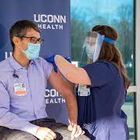
Experts in the Media – UConn’s Dr. David Banach is the go-to voice on COVID boosters
As COVID continues to wreak havoc across the globe, health systems in America are overwhelmed. And as the debate about a third shot continues, the FDA is prepared to allow Pfizer vaccine boosters as early as this week to those over 65 and to people at a higher health risk if exposed to the virus. UConn epidemiologist Dr. David Banach offered his expert perspective and insight on the need and effectiveness for those looking to learn more about booster shots and COVID vaccines: Booster shots of Pfizer’s COVID-19 vaccine may be administered as early as Friday, but who will get one is still up for discussion. “What the FDA review showed was in the general population, at this date and time, there wasn’t sufficient data to support booster doses,” said Dr. David Banach, hospital epidemiologist at UConn Health. Last week, the FDA’s advisory committee voted overwhelmingly not to recommend a third shot for people 16 and up. However, they did vote to authorize a booster dose at least six months after full vaccination for people who are 65 and older as well as individuals who are at high risk for severe COVID. “In older populations, there seems to be some potential benefit to giving a third dose within the Pfizer group,” said Dr. Banach. Dr. Banach said more information is expected in the days to come as this matter heads to the CDC’s independent advisory panel this week. “It’s going to provide more granular recommendations on how to proceed with that 65 and older group and potentially other groups as well,” said Dr. Banach. He added one of the groups up for discussion is healthcare workers. There continues to be an enormous amount of coverage and questions about vaccines and COVID-19, and if you are a journalist looking to know more and include an expert in your story, then let us help. Dr. David Banach is one of the lead experts on COVID-19 in America. He is available to speak with media regarding vaccination and what the future holds with COVID-19. To book an interview, simply click on his icon today.

