
Experts Matter. Find Yours.
Connect for media, speaking, professional opportunities & more.

China Employs Mass Surveillance as Authoritarian Tool in Xinjiang Province
China has been engaged in high-tech surveillance of citizens in its Xinjiang province, according to a New York Times report, creating “an incubator for increasingly intrusive policing systems” that could expand automated authoritarianism across the country and abroad. One of the prime motivators, ostensibly, is to monitor and subdue minority religious and ethnic groups. This practice presents obvious, multi-faceted ethical issues, says Benjamin R. Mitchell, PhD, an assistant professor in Villanova’s Department of Computing Sciences with expertise in computer ethics. “The Chinese government surveillance project in Xinjiang is a perfect example of why we must be cautious and thoughtful about the deployment of technology. Most of the basic technologies being deployed were not originally developed for this application, and many of them have alternative uses which are potentially beneficial, or at the very least less clearly harmful to human rights. But applying these technologies to the surveillance and oppression of large groups of citizens still requires a large, intentional effort, making this as much a social and moral problem as it is a technological one.” Modern technologies, constantly being refined and developed, have brought us closer to the potential spread of totalitarian states, Dr. Mitchell says. “George Orwell’s 1984 was intended as a cautionary tale, but there have always been authoritarian regimes that have viewed it as a how-to manual. In the past, however, the manpower requirements for implementing such a system made it impractical to scale up to very large target groups. Modern technologies like automatic facial recognition and machine learning are now beginning to make widespread deployment of such systems possible.” Decreasing costs of technological surveillance systems will make their misuse even more likely, and those that employ them are justly open to criticism and opposition, Dr. Mitchell noted. “While the cost and manpower requirements are still likely too high to deploy such a system nationwide, the costs are steadily being driven down through research and development, meaning the development of a totalitarian information state is easier than ever before. It is entirely appropriate to critique governments, companies, or individuals who knowingly contribute to the construction and deployment of systems intended to oppress.” Although technology plays a key role in the Chinese attempt to oppress or eliminate targeted groups within its own borders, it is certainly not the first of its kind to do so through authoritarian surveillance, says Dr. Mitchell. “We can look at examples like Nazi Germany or Soviet East Berlin to see how this type of surveillance and suppression has been used in the past; the technological sophistication may have been less, but the risks to human dignity and freedom were broadly the same. The technology is certainly an enabling factor, but the fundamental problems presented here are not new ones. Security is important for human flourishing, but we must remember that the targets of pervasive surveillance can never feel secure; in pursuing security thoughtlessly, we can destroy it. If we are to be moral, we must consider the security of all people, not just those in a position of power,” he concluded.


Expert perspective on a trade war with China and how it could impact a Trump presidency
Trade negotiations between the United States and China have continued to deteriorate over the last few weeks. In efforts to pressure the Chinese to make reforms to trade-related issues such as forced technology transfer and intellectual property rights, the United States has raised tariffs on nearly all Chinese exports. While there is a consensus among experts that these trade issues harm U.S. producers and must be dealt with, there is not universal agreement that a trade war is the best way to make it happen. Who will feel the effects? It is apparent that both consumers and producers in the U.S. will feel the effects of the trade war. Producers will not be able to absorb the increased costs from the raising tariffs and will need to pass them along to consumers. Consumers will begin to see the prices increase on a host of retail goods, such as clothing and apparel, toys, and home goods. Partners replaced? In addition, as the Chinese retaliate with increased tariffs on U.S. exports, such as agricultural goods, producers from other countries with lower tariffs are stepping in to take the place of the U.S. exporters. For example, Brazilian soybean producers are more than happy to sell their product to China at a lower cost. Once lost, it may be difficult for U.S. farmers to regain these important Chinese markets. A political price to pay? It appears that the effects of the trade war may hit the Trump administrations base, in agricultural and manufacturing regions, disproportionately. However, the administration may see the trade war as beneficial to Trump’s 2020 reelection campaign, as Trump is being perceived as being tough with the Chinese and holding them accountable to unfair trade practices. That appears to resonate with his base. However, it remains to be seen how long his base will continue to support this approach as both producers and consumers continue to feel the economic pinch of the growing trade war with China. There’s a lot to know about the short and long-term impacts of a trade war with China and that’s where or experts can help. Matt has taught business and marketing courses at Saint Mary’s University of Minnesota since 2008. Prior to Saint Mary’s, he worked in both the banking and the non-profit sectors, most recently with a non-governmental organization (NGO) with operations in more than a dozen countries. Matt is an expert in political and economic development and is available to speak with media. Simply click on his icon to arrange an interview.

Cybersecurity – Is it finally getting the attention it deserves? Ask our experts!
It’s been talked about, dominated the news and has cost some companies billions – but it seems like finally America’s leaders are taking the issue of cybersecurity seriously. With an election looming and non-stop threats coming from enemies near and afar, it seems like America’s leaders are now on side in the battle against cybersecurity. Last week President Trump signed an executive order directing the creation of programs to grow and strengthen our cybersecurity workforce to meet the challenges of the 21st century. “America built the internet and shared it with the world; now we will do our part to secure and preserve cyberspace for future generations.” President Donald J. Trump It’s a lofty goal – and odds are an expensive one, but will it work? Who are the chief actors behind potential cyber-attacks? What are the key targets? What are the costs to secure America’s cyber-territory? And more importantly, what are the consequences if we do not? There are a lot of questions out there and that’s where out experts can help. Dr. Seth Hamman earned his Ph.D. in computer science with an emphasis in cybersecurity at the Air Force's graduate school, the Air Force Institute of Technology, located at Wright-Patterson Air Force Base. As a researcher he is interested in helping to shape the young and growing discipline of cybersecurity education. Contact him today for your story! Simply click on his icon to arrange an interview.


Essays for sale – our experts weigh in with ABC news
As the college admissions scandal is becoming the story that just won’t end for some of the leading schools in the country – recently Good Morning America opened another chapter in the book that revealed just how easily college entrance essays are being offered and acquired by prospective students. From ghost writing, to essays up for grabs online at a steep price - It’s a multi-million-dollar industry and it’s growing. A leading expert from UMW was recently interviews by Good Morning America about the problem. “Contract cheating has grown a great deal over the past ten years, “said Professor David Rettinger of the University of Mary Washington in Fredericksburg, Virginia. Rettinger is president of the International Center for Academic Integrity, an organization that promotes integrity in academia throughout the world. "Students are willing to use internet sites, family members, friends and other technology to get contractors to do their work.” Are you covering this topic? We can help. Dr. David Rettinger is available to speak with media regarding this scandal as well as the importance of education in America. Simply click on his icon to arrange an interview.

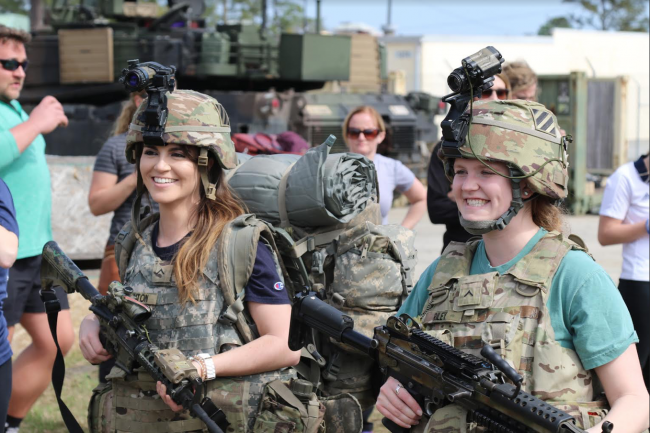
Musculoskeletal disorders are the number one reason for soldier evacuation and account for almost 25 percent of all military injuries compared to combat injuries, which account for 14 percent in the armed forces. It was with that knowledge that students from Georgia Southern University’s Department of Rehabilitation Sciences met up with soldiers from the Army’s 3rd Infantry Division at Fort Stewart-Hunter Army Airfield in Georgia to gear up and better understand soldiers’ unique physical challenges and how they can help better prepare them for combat. “The event provided our students with a much better insight as to the physical demands of soldiers at Fort Stewart,” said Nancy Henderson, DPT, assistant professor of rehabilitation sciences on Georgia Southern’s Armstrong Campus in Savannah . “This added knowledge will help them to better tailor their education while working with soldiers.” As technology and equipment change and adjust between each theatre of operation it is imperative that the America’s soldiers stay fit and have all the knowledge and resources, they require to achieve their assigned task. But why were so many soldiers suffering from musculoskeletal disorders? Is the issue easily solved? And how can every branch of the armed forces adopt and adapt how they’re operating on the ground to avoid these issues? There are a lot of questions to be answered and that’s where our experts can help. Dr. Nancy Henderson is an assistant professor in the Department of Rehabilitation Sciences at Georgia Southern University. She is an expert in injury prevention, running form and assessing meaningful change of interventions. Nancy is available to speak with media regarding this topic – simply click on her icon to arrange an interview.


Call to Action for Looming Caregiving Crisis in the U.S.
Experts in the field of unpaid and paid caregiving for chronically ill or disabled adults are warning of a looming caregiving crisis in the United States—and say that innovation and entrepreneurship are desperately needed to avert that crisis. “We are calling for federal and state legislation for greater innovation and technology to avert unnecessary hospital admissions and visits to the emergency room, payment for family care givers, education and training for family caregivers and greater awareness and support among employers for workers who are also family caregivers—estimated to be between 15 percent and 20 percent of any employee population,” says Melissa O'Connor, PhD, MBA, RN, an associate professor at the M. Louise Fitzpatrick College of Nursing at Villanova. Dr. O'Connor specializes in geriatric nursing and home health care. An American Association of Retired Persons study showed that, in 2010, the caregiver support ratio was seven potential family caregivers for every person in the high-risk 80-plus cohort. In contrast, by 2030, the ratio is projected to be four to one. And by 2050, a sharp decline to fewer than three to one. Based on her years of research, Dr. O'Connor says more reimbursement for telehealth and other technologies that are proving to be very effective are needed. As a nurse educator, she also called for more training of clinical staff in caring for older adults. At a recent meeting of the Philadelphia Chapter of Aging 2.0, Dr. O'Connor and fellow panelists shared key points: Men and millennials are overtaking women as family caregivers; employers are often unaware of the economic consequences employee caregivers face and usually underestimate the percentage of employees with caregiving responsibilities; nearly 35 percent of employee caregivers have chosen or been forced by circumstances to leave the workforce because of caregiving responsibilities; and healthcare benefit costs for employees with caregiving responsibilities are eight percent higher than the rest of the employee population.

Record freezing temperatures and global warming – let our experts explain
This week has seen temperatures drop to record lows. Across the mid-west, a polar vortex coupled with biting winds saw temperatures plunge below minus 50 degrees Fahrenheit. As the word has been focusing on climate change, its causes and effects – this week stands as a stellar example of the impacts of global warming. Despite the tweets and trolls of prominent politicians somehow aligning a deep freeze as a counter argument for climate change the evidence is becoming more clear - with global warming, comes warnings far more worrisome. Dr. Pamela Grothe, an Assistant Professor in the Department of Earth and Environmental Sciences at the University of Mary Washington, was recently quoted in the Guardian about how global warming is forecasting a grim future at the rate we are going. “Warmer temperatures and associated lower oxygen levels in the ocean are sufficient to explain the observed extinctions we see in the fossil record”, she says. “We are already seeing warming ocean temperatures and lower oxygen in many regions, currently affecting marine ecosystems. If we continue in the trajectory, we are on with current emission rates, this study highlights the potential that we may see similar rates of extinction in marine species as in the end of the Permian.” And is this just the beginning? What other extremes can we expect to see in our weather? Can that trajectory Dr. Grothe reference be turned around or slowed down? And what species are the most vulnerable and what ripple effect will that have on our oceans? There are a lot of questions to be asked – and that’s where the experts from the University of Mary Washington can help. Dr. Pamela Grothe is an assistant professor in the Department of Earth and Environmental Sciences as the University of Mary Washington. She recently completed a Ph.D. in the Paleoclimatology Lab at the Earth and Atmospheric Sciences department at Georgia Institute of Technology. Her current research involves a study of the central Pacific climate and El Niño Southern Oscillation (ENSO) variability over the past 6000 years through the analysis of coral fossil records. She’s an #expert in climate change and is available to speak with media – simply click on her icon to arrange an interview.


Is Washington playing Russian roulette with airline safety?
The government shutdown that is finally over had some worrying near the end and for good reason. Air traffic controllers, the very professionals who keep planes in the air and at a safe distance from each other had gone for more than four weeks without getting paid. Exhausted, demoralized and depleting ranks were probably the near-perfect storm for an imminent accident or disaster. Luckily, and thankfully, these dedicated professionals rose to the occasion and ensured safety was still the priority. Often, working even while the very equipment and technology they rely on was not being serviced. But as the shutdown takes a break for three weeks and everyone is made whole with back-wages and paychecks – does America need to rethink the potential risks and consequences to having the staff who are essential to safety across the entire country go without pay and benefits during a political dispute? The consequences of a major airline crash are huge economically and in terms of lives lost. So, can the nation’s air traffic controllers be exempt form the impacts of a government shutdown? Who would have been liable if an accident did occur? Are aviation, customs and our nation’s airports not considered essential and therefore worthy of being paid during a shutdown? And how close did we come to a disaster? While we wait and watch for a solution in Washington over the coming weeks, there are still a lot of questions to be answered, and that’s where the experts from the University of Rochester can help. David M. Primo is the Ani and Mark Gabrellian Professor and an associate professor of political science and business administration at the University of Rochester. He is an expert in airport safety and security and a professor at the University of Rochester in Rochester, New York, and can comment on airline safety and passenger impacts amid airports such as Laguardia International restricting air travel due to the government shutdown. David is available to speak with media regarding the economic effects of the shutdown – simply click on his icon to arrange an interview.



How Technology is Changing Work as We Know It? Let Industry Experts Answer that Question
Are you interested in what the Future of Work is and how technology will impact your business and industry? Hear how the future of work will impact organizations’ culture, required skills, the way talent will be sourced and how the workspace and makeup of the workforce itself will change. Join IDC Canada and ITAC on January 30th for our annual Tech Trends Breakfast Series event to learn how technology is and will continue changing work as we know it. At this Tech Trends Breakfast event, IDC analysts, partners and industry experts from Tata Consultancy Services, Zoom.AI and ServiceNow will examine how enterprises can adapt to rapidly changing technologies and workforce ecosystems to build a competitive edge. The interactive panel will be moderated by Tony Olvet, Group Vice President of the research analyst team at IDC Canada. While there will be opportunities throughout the panel discussion to ask questions, attendees will have the opportunity to submit questions in advance to help us shape the discussion. Attendees will also have access to presentation materials following the event. The Future of Work Tech Trend Breakfast event will be on January 30th at Twenty Street, Toronto. To see full event details or to register click here. If you have any questions about this event, please contact Cristina Santander at csantander@idc.com.


Declaring a New Year's Resolution for 2019? Baylor Experts Can Help
WACO, Texas (Dec. 17, 2018) – As 2019 approaches, many Americans are considering ways to improve themselves via New Year’s resolutions. Whether it’s personal, like losing weight or clearing clutter, or it’s professional, such as being a better manager or breaking away from smartphones, the options are wide-ranging. Here is a listing of Baylor University research that might help advise those seeking positive change in the coming year. First and Foremost, Resolve not to Over-resolve Only 10 to 20 percent of people keep their resolutions, says Sara Dolan, Ph.D., associate professor and graduate program director of clinical psychology. She advises setting “bite-sized goals instead of a massive behavior change.” Rather than giving up sugar completely or going all out at the gym, she advises achieving small successes before moving on. Ask Yourself: “Do I really want to work from home?” Many U.S. employees believe working from home – or at least away from the office – can bring freedom and stress-free job satisfaction. A 2018 Baylor University study says, “Not so fast.” The research, led by Sara Perry, Ph.D., assistant professor of management in Baylor University’s Hankamer School of Business, found that: Autonomy is critical to protecting remote employees’ well-being and helping them avoid strain. Employees reporting high levels of autonomy and emotional stability appear to be the most able to thrive in remote-work positions. Employees reporting high levels of job autonomy with lower levels of emotional stability appear to be more susceptible to strain. “Any organization, regardless of the extent to which people work remotely, needs to consider well-being of their employees as they implement more flexible working practices,” the researchers wrote. Read more here. Save Money by being a Better Negotiator In today’s retail climate, where stores struggle to keep up with online competition and customers can compare prices with the ease of their smartphones, the price tag is just a starting point for negotiations, said negotiation expert Emily Hunter, Ph.D., associate professor of management in Baylor’s Hankamer School of Business. “No longer do you need to pay sticker price for everything you buy. The customer is now empowered to have a say in pricing, and even hourly retail workers are often empowered to give price discounts when requested,” Hunter said. Hunter said negotiations – whether in a retail setting or in the workplace – require confidence. “Many people are hesitant to negotiate because they don’t know how or they are worried about the other person’s reaction (Will they think I’m greedy?),” she said. “But practice can increase your confidence in your ability to negotiate. Rejection is less common than you fear, and retail stores especially are often willing to work with you.” She offered the following tips to increase the chances of greater deals at the check-out counter. Resolving to Be More Generous in the New Year Many Americans already have enough “stuff,” and the gift-giving season sometimes adds to that collection of things we really don’t need. Instead of always receiving, how can we resolve to be more generous in the New Year? “Whatever our station, however much money or resources we have, we all have something to share and something to give,” says Andy Hogue, Ph.D., senior lecturer in Baylor’s Honors College who teaches a course on philanthropy and the public good. “I like the idea of thinking in terms of a New Year’s resolution, sort of resolving to be more generous and helping people to think in those ways.” Hogue offers individuals and families four ways to develop a spirit of generosity in the New Year. Home Cooking Saves Money, Encourages Better Diet The more home-prepared foods used, the less risk there is of eating too many calories and fat calories, says Baylor University nutrition expert Janelle Walter, Ph.D., professor of family and consumer sciences and Nutrition Sciences Program coordinator. Home cooking also saves money and allows for more fruits, vegetables and dairy products — which often are missing when pre-prepared products are used — as well as less fat, sugar and salt. Some tips for prepping at home are making a precise list, lining up recipes and lists of ingredients, shopping when you aren’t hungry and preparing five main dishes at a time to see you through a few days. Involve your family in choosing foods, shopping and preparing foods, Walter says. Many simple and quick recipes are on online sites, she said, referencing these from Southern Living. Consider a New Approach to Dieting Meredith David, Ph.D., assistant professor of marketing in Baylor’s Hankamer School of Business, researched successful dieters and how they were different from others. Her research results have received national attention. “Our research shows that instead of creating rules to avoid one’s favorite treats, dieters should focus on eating healthy foods that they enjoy,” David said. “Dieters who restrict themselves from consuming the foods they love most may be setting themselves up for failure. Instead, they may be better off by allowing occasional ‘treats’ and focusing attention on healthy foods that they enjoy and making it a point to include those tasty but healthy foods in their diet.” Read the full article. Be Humble and Helpful In hard times, you know how much a helping hand means — and how humbling those times can be. So it might be good to resolve to look for opportunities to assist in 2019, while remembering not to pat yourself on the back for doing so. A decision to help someone else is influenced by time pressure, number of bystanders, empathy or a person's own distress — but that’s not all, says Baylor researcher Wade Rowatt, Ph.D., professor of psychology and neuroscience. “While several factors influence whether people will volunteer to help, it appears that humble people, on average, are more helpful than individuals who are egotistical or conceited.” Cultivate Patience — and Better Mental Health People who are more patient toward others also tend to be more hopeful, grateful and satisfied with life, says Sara Schnitker, Ph.D., associate professor of psychology and neuroscience. And there is more than one type of patience, including interpersonal patience — dealing with annoying people without losing your cool; handling life hardships — such as illness or unemployment — without frustration or despair; and coping with such daily hassles as traffic jams, computer woes and long lines. In her research, Schnitker invited undergraduates to two weeks of patience training, where they learned to identify feelings and their triggers, regulate their emotions, empathize and meditate. If you want to build your own patience, she recommends following three steps: identify, imagine and sync. First, take a moment to slow down an identify how you are feeling and why you might be feeling that way. Second, try to imagine or reappraise the situation from a different perspective or in a new way that helps you to be calm. Finally, sync with your purpose. Try to connect how what you are doing or enduring helps you pursue larger goals or your life purpose. When Ailing, Talk to A Doctor Instead of Searching the Internet for Answers Rather than heading to the doctor — or even the medicine cabinet — some people turn first to the Internet when they are ailing , according to a Baylor University researcher. Especially for folks who have trouble handling uncertainty, "cyberchondria" — the online counterpart to hypochondria — worsens as they seek answers, says Thomas Fergus, Ph.D., an associate professor of psychology and neuroscience in Baylor's College of Arts & Sciences. “They may become more anxious. And the more they search, the more they consider the possibilities,” he says. Doubts about health also can trigger worries about medical bills, disability and job loss, he said. And that can lead to a Catch-22 of more Googling (sometimes of questionable sources). Rather than giving in to cyberchondria, resolve to call your doctor — and take what you read with a grain of salt. In Conflicts with your Significant Other, Relinquish Power During spats with your spouse or significant other, the most common thing people want is not an apology, but a willingness to relinquish power, says Keith Sanford, Ph.D., professor of psychology and neuroscience in Baylor University's College of Arts & Sciences. That comes in many forms, among them giving a partner more independence, admitting faults, showing respect and being willing to compromise. Following closely behind the desire for shared control was the wish for the partner to show more of an investment in the relationship by such ways as sharing intimate thoughts or feelings, listening and sharing chores and activities, Sanford said. Sleep Better in the New Year Writing a “to-do” list at bedtime may aid in falling asleep, according to a Baylor University study by Michael K. Scullin, Ph.D., director of Baylor’s Sleep Neuroscience and Cognition Laboratory and assistant professor of psychology and neuroscience. Scullin's 2018 research compared sleep patterns of participants who took five minutes to write down upcoming duties versus participants who chronicled completed activities. Scullin suggests that writing a list may allow the brain to “offload” them instead of cycling through them repeatedly. Other hints: Use the bed for sleep rather than studying or entertainment; keep a regular sleep schedule; avoid electronics near bedtime; don’t take long day naps; and stay away from stimulants at least six hours before bedtime. Clear Out Clutter Without Getting Frazzled “Don’t try to organize the entire house in one weekend,” said Elise King, assistant professor in the department of family and consumer sciences. “You are much more likely to complete a task, especially one that you’ve probably been avoiding, if you break it into small goals. Don’t try to clean out an entire room over a weekend; instead, focus on the desk one week, the closet the next, and so forth.” Finally, involve your family, strive to make organization a routine — and reward yourself for your efforts. Break Away from the Smartphone Baylor marketing researchers James Roberts and Meredith David, Ph.D. have conducted numerous studies on the effects of smartphone technology on relationships. Their studies on “phubbing” – phone snubbing – have garnered national and international interest, given the pervasiveness of smartphone technology and its impact on relationships. Their studies have found: Bosses Who “Phone Snub” Their Employees Risk Losing Trust and Engagement “Phubbing” can damage romantic relationships and lead to higher levels of depression People who are phone snubbed by others are, themselves, often turning to their smartphones and social media to find acceptance “Although the stated purpose of technology like smartphones is to help us connect with others, in this particular instance, it does not,” David said. “Ironically, the very technology that was designed to bring humans closer together has isolated us from these very same people.”


