
Experts Matter. Find Yours.
Connect for media, speaking, professional opportunities & more.

Ready or not, winter weather has decided to make an early cameo! So, the question is: are you actually ready for winter driving? CAA South Central Ontario (CAA SCO), Ministry of Transportation of Ontario (MTO), Ontario Provincial Police (OPP), and Toronto Police Service (TPS) have joined forces to encourage Ontario drivers to get ready now for the cold and snowy weather, before the next unexpected snow event hits. “Now is the ideal time for motorists to install winter tires, check their car battery, and ensure they have an emergency car kit packed,” says Nadia Matos, manager of external communications, CAA SCO. “These simple steps can help motorists confidently navigate winter roads. Ontario weather can be unpredictable, and snowstorms can hit without much notice, so it’s always best to ensure your vehicle is prepared beforehand.” Besides vehicle preparedness, driver behaviour is just as critical in ensuring safe driving operations in winter weather. “Road safety is everyone’s responsibility,” says Sergeant Murray Campbell of the Toronto Police Service. “As daylight hours shorten and visibility decreases, we encourage all road users to stay alert, watch out for one another, adjust their driving to match weather conditions, keep their vehicle lights on, and plan ahead to accommodate longer travel times.” This year, the organizations are focused on protecting motorists who may be caught in unexpected winter weather. “We always encourage motorists to drive according to the road and weather conditions,” says Sergeant Kerry Schmidt of the Ontario Provincial Police. “Drivers should also slow down and move over when approaching stopped emergency vehicles and tow trucks with their emergency lights flashing while they are assisting vehicles and motorists in need of help. It is also unsafe and illegal to try to pass a full echelon of snowplows that are clearing all lanes of a highway during winter events.” Before heading out on the road this winter, MTO encourages motorists to download and use the 511 app to check the weather and road conditions before they leave home. The 511 app can be found at 511on.ca or in the app store on their mobile devices. For a safer trip this winter, motorists can also follow these additional safety tips: • Install winter tires for better traction. On cold and snowy roads, winter tires can help reduce your braking distance by up to 25 per cent. Members can call CAA before Dec. 20 to have our mobile tire service change them at home for a fee. • Test your car battery. If necessary, replace it before it fails. CAA SCO will test Members’ batteries free of cost during a service call. • Pack a fully stocked emergency car kit. The kit should include a flashlight, extra batteries, warning devices (e.g., flares, reflective vests/strips), a first aid kit, blankets, jumper cables, non-perishable food and water, and a phone charger. Be sure to always keep an ice scraper, small shovel, and snow brush handy in your car. • Service your vehicle. Have your brakes checked, oil changed, and top up your windshield washer fluid and any other fluids that are getting low. • Always keep your gas tank at least half full. Cold weather causes condensation in the system, which can lead to a fuel line freeze-up and prevent the car from starting. • Check your lighting system. Ensuring you have full lighting is very important in the winter months. Check your headlights and signal lights to ensure they work correctly.



12 Days of Holiday Experts - Goizueta Business School Sources for the Season
It's that time of the year again! And as Americans get ready for another journey into the festive season, there are always opportunities for stories to be told about shopping, travelling, buying, returning, and making sure you don't get ripped off or scammed during all the hustle and bustle, Here's a stocking full of topics and expert sources who are here to help with your coverage this holiday! Gifts, Giving, and all the Costs That Come With It Economics of the Holiday Season A successful Q4 makes the difference between annual profitability and loss for many businesses. Professor Tom Smith is available to discuss seasonal hiring, retail expectations, the impact of tariffs, and the importance of the holiday season to retailers. View his profile here Black Friday & Using AI to find the Perfect Gift Professor Doug Bowman expects to see more Shoppers (esp. Gen Z) experimenting with GenAI for personalization, inspiration, product discovery, summarizing reviews, generating lists, and finding deals. Results may be mixed, depending on the data the AI was trained on. He also expects more purposeful and complex shopping, with fewer impulse purchases and more searching (both online and in brick-and-mortar stores), due to lower inventory levels/assortments at some retailers. View his profile here Food and Travel Pricing Professor Saloni Firasta Vastani can discuss the cost of this year’s holiday dinners. What’s gone up and what’s gone down? She can also discuss the cost of travel this holiday season and offer tips on how consumers can secure a better deal. View her profile here Avoiding Holiday Overspend Professor Usha Rackliffe can discuss how holiday shopping can expose consumers to credit products, such as store credit cards, that offer various incentives and often result in overspending. She can discuss the pros and cons of the buy now, pay later offers and how interest rates will play into this year’s holiday shopping and spending. View her profile here Gift Giving Professor Ira Bedzow says there are three ways gift-giving can promote both personal growth and professional development. View his profile here Gifts Express Relationship, Not Reciprocity. Contracts and transactions are about keeping score—I give, you give back. Gifts are about connection. A thoughtful gift doesn’t close a deal; it opens a door. Personally, it reframes love and friendship as ongoing commitments rather than conditional exchanges. Professionally, treating interactions as opportunities to build trust creates loyalty, sparks creativity, and builds a culture no contract can guarantee. The Art of Perspective-Taking in Choosing Gifts: The best gifts come from stepping outside yourself and asking: What would this person really want? This act of empathy is a skill worth practicing. Personally, it pulls us beyond ego; professionally, it sharpens our ability to anticipate needs, see through others’ eyes, and make decisions aligned with their values—a foundation for real leadership. Gifts as Lessons in Friendship and Human Connection: True friendship isn’t built on ideology, convenience, or self-interest. It’s rooted in caring for someone simply for who they are. Gift-giving is a rehearsal for that kind of connection. Personally, it reminds us that what we truly want typically comes through relationships, not rivalry. Professionally, it shows that lasting success rests less on shared advantage and more on genuine respect and human connection. Shopping for Sustainability Consumers are increasingly seeking eco-friendly products, and brands that emphasize sustainability are likely to see higher sales. Nearly 69% of shoppers prefer to buy from companies committed to ethical practices, such as those that use carbon-neutral shipping and offer recyclable packaging. Professor Dionne Nickerson focuses on how companies can integrate sustainability in their products and why it matters to consumers. View her profile here Pressure Purchasing As the days inch closer to the holidays, shoppers feel the pressure to find a gift. Professor Max Gaerth can discuss how stress, scarcity, and time pressure shape purchasing decisions. View his profile here Online Shopping and Influencing AI Changing How We Shop Professor David Schweidel examines how new AI tools are transforming the shopping experience and the ways brands utilize AI to engage with prospective customers and personalize product recommendations. He can also discuss OpenAI’s Atlas and how it puts ChatGPT directly into your browser. View his profile here Influencers Influencing Our Purchases How are creators impacting the economy, and are influencers impacting our purchasing decisions? Professor Marina Cooley looks at the creator economy and how TikTok and Instagram are impacting our holiday wish lists, and what it takes for a product to go from unknown to trending. She can also discuss TikTok Shop (something Instagram has struggled to execute). View her profile here How to Attract Customers to the Store this Holiday: Shopping looks different, and it is up to retailers to stand out not just in the brick-and-mortar world but also online. The success of a business can balance on the customer experience. Professor Reshma Shah can discuss the policies that brick-and-mortar retailers need to have in place to successfully merge online shopping and the in-person shopping experience. View her profile here Holiday Scams Tis The Season for Scams Bad actors are using AI to scam consumers. From phone calls to emails, Professor Tucker Balch can tell us how to spot a scam and what we can do to protect ourselves. View his profile here Holiday Returns Product Returns Professor Doug Bowman can discuss the retail strategy and the impact of holiday gift returns, comparing online returns to those in brick-and-mortar stores. View his profile here He can also weigh in on: Why are returns so expensive for retailers? Online returns vs. brick and mortar returns Predicting online returns - helping retailers understand how likely it is that a product will be returned. As well: Are retailers still offering free returns? What’s this costing them? Is this likely to continue? What will they do differently? If you’re a journalist covering the holiday season, our experts can help shape your story. Use the “Connect” button on any expert’s profile to send an inquiry — all inquiries are monitored by our media team to ensure a quick, timely response.


Avoiding the Reverse Mortgage Reflex
Every once in a while, an industry article really hits the mark. Recently, one did just that—Canadian Mortgage Trends' "Who Uses Mortgage Brokers Today and Why? (Part 2)" gave seniors their own category, not as an afterthought, but as a client segment worthy of attention. Bravo. It's about time someone acknowledged that older Canadians aren't just "another niche." But then… came the reverse mortgage section. Don't get me wrong—it's refreshing to see financial professionals finally acknowledge that Canada's aging population presents both opportunities and complexities. But suggesting that "helping seniors" automatically means "offering a reverse mortgage" is like telling everyone who's thirsty to drink espresso. Some will love it. Others will lie awake at 3 a.m. with regrets. Let's call it what it is: type-casting seniors into a product. The Reverse Mortgage Reflex There's a curious habit in our industry. Mention the word "senior" and watch what happens: eyes light up, marketing decks shuffle, and—as if on cue—the term "reverse mortgage" materializes like a pop-up ad from 2007. It's as if the entire profession has agreed that every retiree with a pulse and property must be yearning to re-mortgage their home. Except… most aren't. Most seniors spent decades teaching their kids to avoid debt and pay off mortgages as quickly as possible CBC Radio. Suggesting they should now joyfully jump back into one to "solve retirement" isn't just unappealing—it's borderline insulting. Here's the truth: no one dreams of retiring into debt. And the numbers bear this out. Debt Levels: While only about a quarter of people over 65 had debt in the late 1990s, that figure has climbed to more than 40% today (Source: CBC News). Anxiety Levels: Nearly 50% of retirees now worry about their debt, according to the Credit Counselling Society. Reverse mortgages can absolutely be valuable tools. The reverse mortgage market has exploded, with over $8.2 billion in outstanding debt as of June 2024—an 18.3% increase from the previous year (Source: MoneySense). But offering one before understanding the client's full picture isn't being a trusted advisor—it's running on sales autopilot. Brokers, You're Better Than This Brokers pride themselves on being client advocates—the ones who shop the market, decode fine print, and find creative solutions when banks can't. The very definition of a broker is someone who matches the right solution to the customer's needs. So why, when it comes to seniors, do many skip the most important part—the needs assessment—and leap straight to the product? It's backwards. While it may seem very simple, a proper financial conversation starts with identifying the problem, then illustrating a solution, and finally defining the intended outcome. • Why does this person need to access equity? • What problem are they really solving? • How do they define "financial comfort" The first step of solution selling isn't talking—it's listening. Start With the Need, Not the Product Before reaching for any rate sheet, it's critical to understand the client's true priorities. According to research from HomeEquity Bank, 9 in 10 Canadians want to age in place and live out their retirement years in the comfort of their home (Source: Canadian Mortgage Trends). But their financial needs are as diverse as their travel insurance policies. The reality is stark: A 2024 survey by the Healthcare of Ontario Pension Plan (HOOPP) found that 39% of Canadians aged 55-64 have less than $5,000 in savings, and 73% have $100,000 or less. More than half of Canadians over 60 who remain in the workforce do so out of financial necessity, not choice (Source: CBC Radio). Ask the right questions: • Do they need to eliminate high-interest debt? • Do they need cash flow to cover rising expenses? • Are they struggling to afford in-home care or medical support? • Do they want income stability—that pension-like feeling—rather than a lump sum? • Do they want to downsize, relocate, or age in place with dignity? Only after understanding the full financial picture can you propose the best, most robust solution. That's not just good practice. That's respectful advising. Solution Selling: Connecting the Dots Here's a classic example: A client walks in with a paid-off home and a stack of monthly bills that feel heavier than the Sunday paper. They're anxious about cash flow but debt-averse. The reflex answer? "Reverse mortgage!" Not so fast. Solution sellers focus on understanding customers' challenges and delivering ideas that address their daily needs, rather than pushing products. When clients can see exactly what they're getting, they make better decisions and advisors earn lasting trust through transparency, not sales pressure. Maybe downsizing to a more manageable property makes sense. Perhaps a small secured line of credit covers the gap without interest compounding as quickly. Maybe an annuity provides steady income with less long-term cost. Or maybe—just maybe—they don't need a mortgage at all. Consider that a $100,000 reverse mortgage balance can grow to $150,000 in just 5 years at current rates, with interest compounding annually. When you solve the real problem (not just the balance sheet), you build lasting trust and genuine loyalty. The Psychology of the Senior Client It's not just about the math; it's about the mindset. Here's where most brokers stumble: they treat all seniors as if they're cut from the same cloth. They're not. Let's get real: seniors aren't a monolithic group. A 55-year-old and an 85-year-old? They're separated by 30+ years of life experience, different communication styles, varying financial literacy, and completely different emotional triggers around money. Cookie-cutter advice doesn't cut it. The best advisors listen first. They ask questions. They assess each client's actual financial situation—not what they assume it is—and then deliver advice that fits that person's life, not some generic "senior strategy." Respect Is the Real Differentiator Understanding a client's lifestyle, fears, and goals isn't just good ethics—it's good business. Seniors have finely tuned radar for sincerity. They can smell a sales pitch faster than a Labrador finds bacon. Want to stand out? Lead with curiosity, not a contract A holistic, solution-based approach positions you as a trusted advisor—not a product pusher. Once you earn that trust, referrals flow like coffee at a church social. From Product Pushing to Purpose Selling Here's the shift our industry needs: Stop viewing seniors as a market. Start viewing them as individuals with layered needs. Solution selling isn't anti-reverse mortgage—it's anti-assumption. It ensures the whole problem gets solved, not just the one that fits your product lineup. Yes, over 25% of Canadians aged 55 and older are considering a reverse mortgage (Source: Canadian Mortgage Trends), and it might eliminate a monthly payment—but if it doesn't solve for cash flow, health costs, or income stability, you've only done half the job. The real opportunity? Elevate the conversation from product placement to purpose-driven advising. Advisors, Reset Your Lens Seniors don't need to be sold. They need to be understood. Give them the dignity of choice, the respect of time, and the power of informed decision-making. When advisors show prospective clients detailed solutions, it allows clients to properly assess the quality of advice and make fully informed decisions, supporting healthy long-term relationships The best brokers—the ones shaping the next chapter of this industry—don't just sell mortgages. They sell confidence, clarity, and control. And that, my friends, is how you truly help Canadians retire hip, fit, and financially free. Want to become an expert on serving the senior demographic? Just message me to be notified about the next opportunity to become a "Certified Equity Advocate" — mastering solution-based advising that transforms how you work with Canada's fastest-growing client segment.


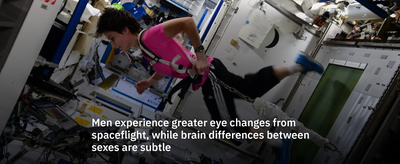
A new study into how spaceflight impacts the human brain and eyes revealed notable sex differences in brain fluid shifts, with female astronauts showing a greater reduction in fluid around the uppermost part of the brain than their male counterparts. Led by Rachael D. Seidler, Ph.D., director of the University of Florida’s Astraeus Space Institute and professor of applied physiology and kinesiology, the study analyzed data from astronauts to determine how factors such as sex, age and body metrics relate to structural brain and eye changes after space travel. The findings, published in August in npj Microgravity, provide key information for protecting astronaut health on long-duration missions to the moon and Mars. This is one of the first studies to look at sex differences in the physiological response to spaceflight. “The data on sex differences in response to spaceflight are scant, given the historically low number of female astronauts.” — Rachael D. Seidler, Ph.D., director of the University of Florida’s Astraeus Space Institute In addition to changes in fluid around the brain, the team also found that a form of eye compression, a hallmark of Spaceflight Associated Neuro-ocular Syndrome known as globe flattening, was the most consistent eye change among crew members. “By far the most prevalent sign of eye changes that we observed was globe flattening, suggesting that this should be the primary monitoring target for ocular health,” Seidler said. “Interestingly, eye changes were more prevalent in males than females.” Globe flattening, when the back of the eyeball becomes slightly indented or pushed inward, might sound minor, but it can have significant effects on vision and raise concerns for long-duration space missions. Surprisingly, there was no strong link between brain structural changes and eye changes, suggesting that the effects on the eyes and brain may arise from distinct mechanisms rather than shared physiological causes. The research underscores UF’s growing leadership in space health science. Through the Astraeus Space Institute, Seidler leads multidisciplinary collaborations that connect neuroscience, physiology and space research to advance human performance and safety in spaceflight. “We used UF's HiPerGator computing cluster for our analyses in this study, enabling us to analyze our data at high speeds,” Seidler said. Read the full study in npj Microgravity.



Lighting the Fires of Memory: The History, Meaning and Modern Significance of Memorial Observances
In the United States, United Kingdom and Canada, special annual days of remembrance bring into focus a simple yet profound truth: societies mark the sacrifice of those who died in military service so that past and future generations will not forget. These observances are layered with history, symbolism and evolving practice. Origins & Historical Development United States – Memorial Day Memorial Day began in the aftermath of the American Civil War. One of the earliest national observances took place on May 30, 1868, when John A. Logan, Commander-in-Chief of the Grand Army of the Republic, proclaimed “Decoration Day” to honour the Union dead by decorating their graves. The date was chosen because spring flowers would be in bloom across much of the country. Over time, as the United States engaged in further conflicts, Decoration Day evolved into a broader day of honouring all U.S. military personnel who died in service. In 1971, Congress made Memorial Day a federal holiday observed on the last Monday of May. United Kingdom and the Commonwealth – Remembrance Day Remembrance Day, also known as Armistice Day, originated from the end of the First World War and is observed on November 11. It commemorates the armistice signed at the 11th hour of the 11th day of the 11th month in 1918. In Britain and the Commonwealth, the red poppy became the enduring symbol of remembrance, inspired by the poppies of Flanders fields and popularized in the years following the war. Canada – Remembrance Day Canada also observes Remembrance Day on November 11. The observance dates back to post-WWI traditions and was officially adopted by Parliament in 1931. It honours the more than 118,000 Canadians who have made the ultimate sacrifice among the 2.3 million who have served in uniform. Meaning and Symbolism At their core, Memorial Day and Remembrance Day are about memory, sacrifice, duty, and gratitude. They serve as communal rituals: visiting cemeteries and memorials, placing flowers or wreaths, holding moments of silence, and wearing symbols like the poppy. In the United States, the act of decorating graves carried not only personal remembrance but also civic pride—honouring those who laid down their lives for their country. In the United Kingdom and Canada, the poppy remains a powerful visual reminder of both the human cost of war and the enduring hope for peace. Modern Significance These observances offer societies a chance to pause, reflect, and connect past sacrifice with present freedoms and responsibilities. In the United States, Memorial Day has also come to mark the unofficial start of summer. Still, national initiatives such as the National Moment of Remembrance invite Americans to refocus on solemn reflection. In Canada and the United Kingdom, Remembrance Day remains deeply ceremonial, marked by two-minute silences, wreath-layings, and public education about the sacrifices of war. For all three nations, these days foster inter-generational understanding—educating younger people about service, sacrifice, and the peace that followed—while reminding governments and citizens alike of ongoing obligations to veterans. Why It Matters to U.S., British, and Canadian Peoples For Americans, Memorial Day symbolizes how unity, freedom, and democracy have been defended and preserved at great cost. For Britons and Canadians, Remembrance Day binds their shared histories of service in global conflicts, linking national identity with sacrifice and resilience. In Canada especially, the day has evolved into a moment not just of military remembrance, but of reflection on what it means to serve a country and commit to peace. Across all three nations, these observances allow public acknowledgment of loss and courage, while anchoring civic values of duty, freedom, and gratitude. Key Themes and Story Angles Continuity and Change: From Decoration Day to Memorial Day, from Armistice Day to Remembrance Day—how the meaning endures through time. Symbols and Rituals: Poppies, wreaths, silences, and ceremonies as expressions of collective memory. Commercialization vs. Solemnity: Balancing commemoration with modern traditions such as travel and leisure. Generational Awareness: Passing remembrance to younger audiences through schools, media, and veterans’ stories. Veterans and Contemporary Service: Linking remembrance with ongoing commitments to those who serve. Community Connection: How towns and cities mark remembrance through local parades, services, and shared stories. Memorial Day and Remembrance Day are more than calendar observances—they are living rituals of collective gratitude. They invite reflection on what has been given and what must be preserved. For the United States, the United Kingdom, and Canada, these days stand as enduring reminders of courage, unity, and the price of peace. Connect with our experts about the history, meaning and modern significance of memorial observances: Check out our experts here : www.expertfile.com


Humanities play integral role in the UF Astraeus Space Institute
The ability to imagine has given the human species the power to create, problem solve, empathize, and theorize. In fact, creative imagination can be found at the origin of every modern development throughout time. From medical advancements and the formation of governments to the establishment of the internet and the creation of Beethoven’s Symphony No. 3 — all at first were simply imagined. So, it is not a leap to think that in establishing a space institute at the University of Florida, collaborators would continue to anchor the institution in the human element of imagination. That’s where space exploration began. Ancient Greek philosopher Thales, later known as the father of Greek science and mathematics, questioned the true origins of the universe. Introducing deductive reasoning, Thales sought answers beyond the stories of gods and heroes. Three hundred years later, Aristotle theorized the geocentric layout of the universe with Earth at its stationery core and celestial bodies revolving around it. In the early 14th century, the Italian poet Dante told the story of a vertical journey through the universe, reaching the stars in what he described as paradise. And in the fall of 1609, Galileo began observing the heavens with instruments he created to magnify his view up to 20 times beyond what the natural eye could see. Through his telescope, Galileo observed mountains on the moon, rings around Saturn, and the moons of Jupiter, all evidence that the universe did not revolve around the Earth, but the sun. Inspired by words written in 1865 by Jules Verne in his novel, “De la Terre à la Lune” (From the Earth to the Moon), a 10-year-old Russian boy questioned, could travel be possible beyond the Earth’s atmosphere? Could Verne’s 900-foot-long space gun propel humans — or anything for that matter — through the bonds of gravity and into outer space? Read more here: Looking to know more about the UF Astraeus Space Institute or connect with Rob Ferl, Amy J. Williams or Stephen Elardo? Simply click on either expert's icon now to arrange an interview today.




Batty pathogens: Why do bats spread so many diseases?
Let’s face it — bats get a bad rap. Their links to disease outbreaks and their spooky association with vampires influence their notoriety. In reality, bats are truly remarkable. Bats support our agricultural industries as vital members of food webs. And, contrary to their portrayal in popular Halloween blockbusters, they are gentle and tidy creatures that groom themselves like cats. So why is it that when we hear of disease outbreaks, it always seems to be bats? According to University of Florida Emerging Pathogens Institute member Jim Wellehan, D.V.M., what sets bats apart isn’t black magic at all. But rather, it’s their long history of co-existing with viruses, the unique tradeoffs of flight and, perhaps most of all, a history of adapting to new pathogens. “(Infectious disease) has been the biggest factor in all of evolution,” said Wellehan, who is also a professor at the UF College of Veterinary Medicine. “People are always looking for an excuse (as to) why bats are magic, and the truth is bats have just been exposed to a lot of stuff and selected for those genes accordingly.” While humans are the most populous mammals on Earth, bats are a massive group of animals. Behind rodents, they represent the second-largest group of mammalian biodiversity, accounting for a whopping 20% of all mammal species. With over 1,400 species, it’s no surprise that pathogen diversity in bats is just as extensive and complex. Jim Wellehan's research focuses on comparative infectious disease, pathogen evolution, molecular diagnostics and pathogen discovery. View his profile here Bats, as we know them, have been on Earth for over 50 million years. This extensive period has given pathogens plenty of time to evolve alongside the winged mammals. Bats carry viruses like Ebola, Hendra virus, Nipah virus and SARS-CoV-2, which causes COVID-19. One factor that is important in this viral diversity is flight. Flight provides bats with many evolutionary advantages, such as predator evasion, access to new food sources and the ability to exploit diverse habitats. Flight also dramatically increases the chance of rapid pathogen transmission, as they can travel long distances and past many geographic barriers. Many species are highly social, which increases transmission rates as they live in close proximity and groom one another. “When I first learned about Darwin and evolution, ‘survival of the fittest,’ I assumed, meant ‘smartest and fastest and strongest,’ but if you look at our genomes, turns out that's wrong,” said Wellehan. “The genes that are selected for are mostly immune-related. The most important thing is to have enough genetic diversity in your population so that someone has immunity genes that are effective against the next pathogen that doesn't even exist yet. With their increased mixing and contact rates, bats have done this more often than most animals.” Generally, pathogens are most likely to cause disease when they first infect a new host species, as the susceptible animals have not yet developed the necessary defenses. Pathogens, along with their hosts, have no choice but to evolve to survive. With such a wide variety of species, it is not surprising that bats also carry a large proportion of mammal-associated viruses. This is not to say that bats are immune to all pathogens. As the most rapidly evolving factor in life, infectious disease is an incredibly dynamic part of medicine. Bats can get sick from lyssaviruses, including rabies. Additionally, white nose disease, a fungal infection that targets hibernating bats, has been a growing concern in the United States for the past decade. Though bat pathogens are a significant concern, habitat disturbance plays a larger role in bat population pathogen emergence, ultimately affecting humans as the dominoes fall. “Pathogen transmission to humans and conservation efforts go hand in hand,” Wellehan said. “When populations get under stress, that's when ecological balances get shifted, and zoonotic jumps occur. ... It turns out that if we think of ourselves as something separate from nature, it doesn't work so well.” So, while bats may embody the spirit of Halloween, their “magic” lies in evolution and resilience, shaped by millions of years of flying in the face of viruses, not spooky legends. Looking to know more? We can help. Jim Wellehan is available to speak with reporters about bats - simply click on his icon now to arrange an interview today.


Who Decided 50 Means Beige Pants?
Recently, I was invited to my friend Paul's 80th birthday party. To his credit, he did it up right. We all dressed in an '80s theme, danced to '80s music, and he even hired a Michael Jackson impersonator. It was a blast—and it got me thinking. Why do we treat milestone birthdays as such big moments? And what flashes in your head when you read "80th birthday"? A rocking dance floor—or a rocking chair? The Big Deal About Big Birthday Numbers Somewhere along the way, we decided that birthdays ending in zero were cosmic mile-markers. Turn 50? Buy beige pants. Turn 70? Slow down. Turn 80? Put away your passport. Really? Who wrote this memo—and why weren't we asked to edit it? Here's the truth: age is a marker, not a mandate. You don't "have to" start coasting at 50. You might actually be hitting your stride. At 70, maybe you're still climbing mountains (literal or metaphorical). At 80, maybe it's not about stopping travel but upgrading to business class—because you've earned the legroom. The Year Before: A Release Valve Melissa Kirsch recently pointed out something fascinating in her recent New York Times article, "Banner Year: The Year Before a Milestone (39, 59, 79) Often Carries More Anticipation and Anxiety Than the Milestone Itself. You're approaching the summit," full of pent-up energy and maybe even dread. And then you get there—and it's oddly a relief. You've crested the hill. The anticipation is gone. You're not nearing 70 anymore—you are 70. Sometimes naming the number feels like releasing a pressure valve. The Psychology of Birthday Milestones Humans love structure. We love mental reset buttons—New Year's Day, Mondays, and yes, milestone birthdays. Psychologists refer to it as the "fresh start effect." It's why we so often decide to start new habits after birthdays or holidays. But here's where it gets tricky: we often judge our progress against societal norms we've internalized without question. Be married by 30. Have kids by 40—career set by 50. Start winding work down by 60. Head to the bleachers by 70—health issues by 80. You get the point. These invisible benchmarks can make milestone birthdays feel less like celebrations and more like report cards. Instead of asking "What awed me this decade?" we ask "Why haven't I achieved X by now?" UC Berkley, Psychologist Dacher Keltner, in his book titled Awe: The New Science of Everyday Wonder, reminds us that awe is a muscle we can develop through experiences such as music, nature, crowds, or small acts of gratitude. What if we countered our harsh self-judgments with awe instead? What if milestone birthdays became moments to marvel at what we've experienced rather than tally what we haven't accomplished? Instead of seeing milestones as end points, why not use them as launchpads? At 50, instead of coasting, maybe you finally train for that half-marathon—or half-marathon Netflix binge—both count. At 70, you don't have to slow down—you might adjust the pace. Hike the mountain, but pack the good snacks. At 80, don't stop travelling—travel better. Upgrade your flight, book the tour guide, or better yet, let your grandkids carry the luggage. Milestones are invitations, not limitations. The Self-Fulfilling Prophecy of Age What we whisper to ourselves about aging matters. A lot! Psychologist Robert Merton coined the now infamous term "self-fulfilling prophecy": hold an expectation, behave as though it's true, and—voilà—it becomes true. Becca Levy's Stereotype Embodiment Theory at Yale demonstrates how cultural age stereotypes become internalized, ultimately affecting our physical, cognitive, and psychological well-being. Decades of research confirm it: people who view aging positively live 7.5 years longer on average than those who don't. Your expectations are literally a health factor. So when we tell ourselves "70 means slowing down," guess what? We often slow down. But if we say, "70 means redirecting my energy," the body and mind rise to meet it. Real-Life Icons Who Didn't Get the Memo Need proof? Could you just look around? Barbara Walters retired at 84 and lived to 93. Andy Rooney continued to share his witty commentaries on 60 Minutes until the age of 92. Grandma Moses began painting in her 70s and built an entire art career. Laura Ingalls Wilder published her first Little House book in her 60s. Benjamin Franklin produced much of his most famous work after the age of 50. These aren't exceptions. They're reminders that energy, purpose, and influence aren't tied to the number of candles. Beyond Decades: Other Ways of Marking Time Why are we so obsessed with zero-ending birthdays? Some ancient Greek philosophers suggested dividing life into seven-year stages. Other traditions slice life into "seasons" or chapters. Victor Hugo famously quipped: "Forty is the old age of youth; fifty the youth of old age." I'd add: "Seventy is the mischievous middle age of wisdom, and eighty the encore tour." We may need to stop seeing decades as finish lines and start seeing them as chapters. The real story isn't the number—it's how you're writing the next page. Routines, Rituals, Traditions As I reflected on Paul's 80th birthday, I realized that birthdays are part of a bigger theme: how we structure our lives. We often use "routine," "ritual," and "tradition" interchangeably—but they aren't the same. Routines ground us—morning coffee, workouts, journaling. They stabilize our health and cater to every age group. These predictable patterns provide comfort, calmness, and a sense of direction. They're the scaffolding that holds our days together, especially during times of uncertainty or transition. And here's something beautiful: the best way to support someone older in your life is to make connection a routine. Tuesdays on the telephone with Toonie. Jeopardy on Wednesday with Gram. Sunday brunch with Dad. These aren't just nice gestures—they're anchors. They say "you matter" in the most reliable way possible: showing up, predictably, with love. Rituals connect us to meaning—lighting a candle, walking at dusk. They remind us of our values and create moments of intention in our lives. Rituals transform ordinary acts into sacred pauses. Traditions connect us to community—holiday dinners, family reunions. But some age as well as polyester leisure suits—time to remix them. Traditions connect us to community—holiday dinners, family reunions. But some age as well as polyester leisure suits—time to remix them. The key is to keep what serves us: comfort, connection, and a sense of continuity. However, we should abandon the "I should have accomplished X by now" narrative and replace it with one of celebration and gratitude. Ask not "Am I where society says I should be?" but rather "Am I building a life that feels meaningful to me?" One of my favourite traditions comes from Denmark: on birthdays, the Danish flag is placed at the celebrant's place setting. It's a small gesture, but it turns an ordinary meal into a moment of honour. Sometimes it's the little flags, not the giant balloons, that matter most. Practical Tips (With a Wink) Write Your Own Script: Stop asking, "What should I be doing at this age?" Ask instead, "What do I want to be doing?" Shrink the Feast, Keep the Fun: Big productions can be scaled down into smaller, more frequent micro-celebrations. Take a page from Frank Sinatra and do it "my way." Invest in Memories, Not More Stuff: Hot-air balloon ride VS another knick-knack. Say Yes First, Edit Later: Pickleball at 75? Say yes. Forget your shoes later. Celebrate in Advance: Start the party a month early. Stretch the milestone like an all-inclusive buffet. Here's a thought: the older we get—whether it's 80, 90, or more—the more we should celebrate. Why restrict joy to just one day? Turn it into a birthday week. Or even better, a birthday month. We've earned it. A Toast to Us Milestone birthdays aren't warnings to slow down; they're reminders to cherish the present. They're reminders to double down. They're invitations to rewrite rituals, remix goals, and re-ignite purpose. If younger generations can say "live your best life," then let's steal that line and run with it (but don't break a hip). At every age, every stage, we can choose growth over decline, curiosity over fear, and why over why not. So the next time you're invited to an 80th birthday, picture the dance floor, not the rocking chair. Paul sure did. When I asked what's next, he smiled and said: "Finding ways to make it to 90!" Raise a glass and repeat after me: "If not now…when?" Because we're not over the hill—we're still building trails on it, with snacks. Sue Don't Retire... ReWire!

Some interesting areas that I’ve seen in the press: "Consumer Sentiment was measured at the 7th lowest point (55.1) since its inception in 1952, yet we’re not seeing a huge decrease in spending (CNN). Part of the argument is the spending is an average measure and really wealthy consumers are not feeling the pinch and spending like normal or moreso, while less financially-well-off-individuals are pulling back their spending (Spectrum Local News). Presumably, the shutdown doesn’t help that figure. In terms of consumer groups affected, let’s look at government workers first. An article by the BBC claimed roughly 750,000 “non-essential” federal workers could be furloughed without pay. This means that many to most of those are going to struggle with paying for the necessities and this becomes more and more of a strain the longer the shutdown wears on. Furloughed Workers: Most furloughed workers are required to be paid back pay when the shutdown is over by law. That could in some ways create more purchases in the future if they can’t be bought currently, but could also lead to things like more credit card debt as people can put charges on a credit card to pay back later. While from a consumer psychology standpoint that might make sense, but it’s a very risky practical strategy. Gov’t contractors don’t get the same guarantee. Businesses that rely heavily on such groups (e.g., in a town where many fall into those segments) might suffer or shutter. This means other consumers that frequent those establishments have their routines disrupted , and force them to find other providers. Essential Workers: Then we have the group of “essential” workers that must go to work and still not be paid, Air Traffic Controllers, The military, TSA Agents, certain law enforcement groups, etc. that all might draw back spending with no immediate income. That can cause major issues for retailers and producers, which could lead to more layoffs in the private sector, putting more consumers into financial straits. If you’re someone that likes to visit national parks or zoo’s like the National Zoo, or the Smithsonian Museums (which has claimed they’ll have funding at least through October 6th), you could be disappointed to have reduced accessibility or outright closures due to the shutdown, again according to the BBC. Healthcare: Healthcare could definitely be affected, particularly for those on Medicaid and medicare (i.e., the elderly and poor). So if you view medical services as consumer good, then there will be issues there as well (increased wait times, decreased satisfaction, etc.), which is likely to add apprehension and anxiety to many consumers. Travel: If you’re a traveler, staffing shortages in the TSA and Air Traffic Controllers could lead to significant travel delays, which could disrupt leisure or business plans, or force people to cancel plans altogether. If you’re traveling abroad getting your passport updated could take longer. All these things (and many more) may happen or not depending on the length of the shutdown and the severity of the furloughs. Those in better financial positions will suffer less, while those already in less desirable financial situations might find that delays in some of their normally federally funded services (e.g., SNAP, WIC, etc.) create even bigger issues."



First in Delaware to Offer Breakthrough Tricuspid Valve Disease Treatments
For the first time in Delaware, patients with tricuspid valve disease have access to two new FDA-approved, minimally invasive procedures that can repair or replace a failing heart valve without the need for open-heart surgery. The tricuspid valve helps keep blood moving in the right direction through the heart. When it doesn’t close properly — a condition known as tricuspid valve regurgitation — blood leaks backward, forcing the heart to work harder. Over time, patients can experience fatigue, shortness of breath and swelling in the legs and ankles. ChristianaCare’s Center for Heart & Vascular Health is among the first in the nation and the first in the state to offer these advanced procedures, which can restore valve function and improve quality of life. “ChristianaCare continues to innovate in the area of non-surgical valve procedures,” said Kirk Garratt, M.D., MSc, medical director of the Center for Heart & Vascular Health. “We now offer every FDA-approved therapy for tricuspid valve disease, which means we can tailor treatment to each patient and choose the option that best fits their condition.” New Procedures Offer Hope for Patients ChristianaCare offers these minimally invasive procedures to treat tricuspid valve regurgitation: TriClip, which repairs a leaky tricuspid valve. A staple-like clip is attached to the flaps of the valve that don’t close properly, which stops the valve from leaking. EVOQUE, which replaces a faulty tricuspid valve. When the new valve is placed, it uses the patient’s own tricuspid valve as an anchoring system. The new valve takes over for the leaky valve, correcting the problem. “Most of our patients with tricuspid valve disease are older adults, and they really do not desire to travel to Philadelphia for treatment,” said Erin Fender, M.D., an interventional cardiologist at the Center for Heart & Vascular Health. ChristianaCare’s tricuspid valve disease program enables patients to stay in Delaware for treatment and receive this leading-edge care. Fender and interventional cardiologist James Hopkins, M.D., performed ChristianaCare’s first TriClip procedure in August. In September, they performed ChristianaCare’s first EVOQUE procedure. Minimally Invasive, Maximum Impact During both procedures, an IV catheter is inserted into a vein at the top of the leg. A hollow tube is threaded through the IV and into the heart, allowing the clip or replacement valve to access the tricuspid valve. The entire procedure is guided by echocardiogram and generally takes one to two hours. “Patients are usually up and walking later that evening or the next morning, depending on what time of day the procedure was done,” Fender said. “They’re typically discharged the following day.” In the past, open-heart surgery was the only treatment for tricuspid valve disease, but patients with severe symptoms usually weren’t good surgical candidates. “When I was a fellow, I did research focused on tricuspid regurgitation at a time when patients really had no therapeutic options,” Fender said. “Now, being able to offer people therapy that’s so safe and effective, with minimal downtime afterwards, is absolutely transformative to our patients. It’s delightful to see the evolution.” Expanding the Toolbox of Innovation The TriClip and EVOQUE are two of the most recent minimally invasive procedures performed at the Center for Heart & Vascular Health. Other recent innovative, minimally invasive heart and vascular procedures include: Pulsed field ablation for atrial fibrillation. A-fib arises when abnormal heart tissue mistakenly prompts electrical impulses, causing heart palpitations, chest pain and shortness of breath. Pulsed field ablation safely destroys the abnormal tissue quicker and more consistently than other treatments, such as freezing (cryoablation) or heating (radiofrequency ablation). Genicular artery embolization for mild to moderate knee pain. Osteoarthritis can cause inflammation and pain within the knee, which can limit a patient’s mobility. Genicular artery embolization pinpoints areas of inflammation within the knee, and tiny bead-like particles are placed within the blood vessels to block blood flow to those areas. The procedure reduces pain and improves mobility. National Recognition for Excellence ChristianaCare’s Center for Heart & Vascular Health continues to earn national recognition as one of the nation’s premier destinations for cardiovascular care. Most recently, the Center received the HeartCare National Distinction of Excellence award from the American College of Cardiology for the 6th consecutive year. This award honors hospitals that consistently deliver superior medical, surgical and radiologic care aligned with the most rigorous standards of the American College of Cardiology. The award reflects ChristianaCare’s commitment to ensuring patients receive the best, evidence-based care for every cardiovascular need. That excellence is further affirmed by U.S. News & World Report, which named ChristianaCare a High Performing hospital in its 2025—2026 Best Hospitals rankings for aortic valve surgery, heart bypass surgery and heart failure. The Center for Heart & Vascular Health is among the largest and most advanced programs on the East Coast, uniquely integrating cardiac surgery, vascular surgery, vascular interventional radiology, cardiology and interventional nephrology in one location. In 2024, its expert clinical teams performed nearly 200,000 patient procedures, underscoring the depth of experience and patient-centered care that set ChristianaCare apart.
