
Experts Matter. Find Yours.
Connect for media, speaking, professional opportunities & more.

Understanding Trump’s ‘transition tax’ and who wins and who could lose (a lot)
Last December President Donald Trump signed into law sweeping tax reforms – some which had a purpose of discouraging multi-billion-dollar corporations from parking their money outside of the United States. The goal was to incentivise or encourage American-based companies like Apple and Amazon to keep profits local and ideally taxable in the United States. But the impact of these new laws is trickling down and hurting a lot of people. It seems anyone with dual citizenship or any American with interests in Canada may be vulnerable. And for some it is costing a lot of money that’s due very soon. So how much are companies expected to pay? Who is expected to pay and who will be impacted the most? As well, when it comes to taxes – that often means a windfall of new revenue for governments. Is it just Washington that will benefit or will the coffers in Ottawa see some money too? Tax laws are not an easy topic to understand. There are loopholes, complexities and levels of accounting that are beyond most people’s grasp. But that’s where the experts from Freelandt Caldwell Reilly LLP can help. Ed Reilly, Managing Partner and co-founder of Freelandt Caldwell Reilly LLP practices in the areas of tax and owner-managed businesses. To contact Ed directly, simply click on his icon to arrange an appointment regarding this topic. Source:


America needs a million more nurses – Cedar Crest College is working to fill the void
The United States is facing a critical nursing shortage. According to the American Nurses Association, the U.S. will need to produce more than one million new registered nurses by 2022 to fulfill its health care needs. Cedar Crest College believes its upcoming Nursing Orientation Bootcamp is a critical step on the path to creating nursing leaders, which is the goal of the School of Nursing. This Thursday, Cedar Crest College’s School of Nursing will welcome dozens of students to campus for Nursing Orientation Bootcamp. The purpose of the bootcamp is to prepare students and get them excited about starting the undergraduate nursing program at Cedar Crest College. Nursing faculty and staff will host a number of activities, from exam prep to a scavenger hunt. Approximately 60 students entering their junior year are expected to attend and will be wearing their nursing uniforms for the first time. “If we can start these students off on the right foot, they will have a better chance of succeeding in the program,” said Dr. Wendy Robb, Dean of the Cedar Crest College School of Nursing. “We are confident that in two years, these students will be prepared to enter the workforce to help combat the nursing shortage.” Nursing Orientation Bootcamp Hamilton Boulevard Building Cedar Crest College 100 College Drive, Allentown, Pa. 18104 Thursday, August 16 8:30 a.m.-2 p.m. *The best opportunity for photos and video will be during the scavenger hunt and handwashing demonstration from 12:30-1:45 p.m. Media Contact: Katie Kennedy, 610-740-3790 or katie.kennedy@cedarcrest.edu Source:

Economic Inequality Later in Life
Levels of economic inequality—encompassing inequality in the distribution of income and wealth—have hit unprecedented heights and appear to be rising. In 2014, the average income for adults in the United States was $64,600. However, this average obscures a great deal of heterogeneity (Piketty, Saez, and Zucman, 2018). The bottom 50 percent of adults earned on average $16,200 per year, while the middle 40 percent earned roughly the same income as the U.S. average. In stark contrast, the top 10 percent received 47 percent of all U.S. income—$304,000, which is 4.7 times the national average, while the top 1 percent of adults earned $1,300,000—twenty times the national average income. Today, the top 1 percent takes home more than 20 percent of all income in the United States. Source:


The impact of corporate vs. independent foundations
Debate continues as to whether corporate or independent foundations are more impactful, despite the shared interest in supporting charitable services. In research from Justin Koushyar, doctoral candidate in organization and management (2017), Wesley Longhofer, assistant professor of organization and management, and Peter Roberts, professor of organization and management, the trio determines that the answer is mixed. They used data from a matched random sample of corporate and independent foundations that operated across the United States in 2005 and 2009. With deeper pockets, corporate foundations were able to raise more funds than their nonprofit counterparts. Company sponsorship of a philanthropic foundation also meant that they could operate with lower overhead. However, Koushyar, Longhofer, and Roberts found that corporate foundations are “more dispersed and less relational, and they tend to be governed by more ephemeral groups of officers and trustees.” Simply put, corporate foundations have fewer longterm attachments to the charitable organizations they support. Additionally, “market-based motivations” may influence how they give. Corporate foundations do tend to provide smaller individual grant amounts than independent foundations. These “stakeholder effects” are even more dramatic for the foundations linked to larger publicly traded companies. Source:




Today, US President Donald Trump and Russian President Vladimir Putin met at the presidential palace in Helsinki to discuss the relationship between their respective countries. Prior to the meeting, Trump cited national security concerns and trade as agenda items. Since the start of the meeting, the two presidents have also discussed the tension between the two countries and accused election meddling. At Augusta University, our experts have been following the historic meeting, and made the following observations: • Trump is correct in asserting the importance of having Russia as an ally. • The US is currently facing Russian cyberaggression, so how Trump addresses this issue has immediate concerns. • US posture in Syria is at stake. • It is important to keep this meeting in the context of “America First.” Trump will push messages at the summit that fall in line with his national security interests. What are the implications of this summit for every-day Americans? Will this meeting improve the relationship between the United States and Russia? How will this meeting effect the United States’ relationship with other European allies? There are a lot of questions to answer – and that’s where our experts can help. Dr. Craig Albert is an expert on American politics and political philosophy. He was recently appointed director of Augusta University’s new Masters of Arts in Intelligence and Security Studies. Dr. Albert has experience with all forms of national and local news organizations and is available to speak to media regarding the Helsinki Summit. Simply click on his icon to arrange an interview. Source:


6 Facts We Learned Working with Migrants and Refugees Around the World Working with migrants and refugees is our business at Catholic Relief Services. CRS was founded in 1943 to assist refugees during World War II. Seventy-five years later, we are still coming to the aid of people escaping conflict, violence and natural disasters. While CRS doesn’t resettle refugees in the United States (these programs are run by the Catholic Church’s Migration and Refugee Service and Catholic Charities), our rich history has taught us valuable lessons on how to best help families fleeing crisis. 5. Adults Need Work and Income. We know from experience that people find pride and purpose in helping earn an income for their families, no matter how small. Refugees and migrants are looking for a hand-up, not a handout and being integrated with their host communities benefits everyone. Caroline Brennan is the Emergency Communications Director for Catholic Relief Services. In her role, she travels to and/or works in areas facing natural or man-made emergencies. See her contact information at the bottom. 6. The Poorest Countries House the Most Refugees and Migrants. Although media stories can give the impression that the U.S. is swamped with migrants, the reality is that 85% of the world’s refugees are in the developing world. The country with the largest refugee population is Turkey, with almost 3 million. One in 3 people in Lebanon is a refugee. The Bidi Bidi Refugee Camp in Uganda alone is home to 229,000 South Sudanese who have fled civil unrest. Richer nations like the U.S. should look at the lessons of how these countries with far fewer resources welcome and host refugees. Caroline Brennan is the Emergency Communications Director for Catholic Relief Services. In her role, she travels to and/or works in areas facing natural or man-made emergencies. See her contact information at the bottom. The experts at Catholic Relief Services are available to help with any media coverage or insight that is required regarding this ongoing news story and issue that is continuing in America. Simply click on any of their icons to arrange a time for an interview. Source:

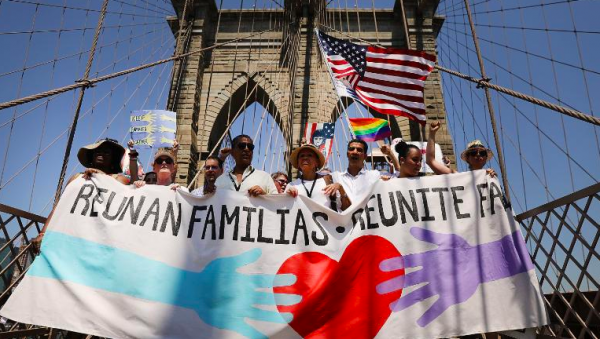
6 Facts We Learned Working with Migrants and Refugees Around the World - Facts 3 and 4 Working with migrants and refugees is our business at Catholic Relief Services. CRS was founded in 1943 to assist refugees during World War II. Seventy-five years later, we are still coming to the aid of people escaping conflict, violence and natural disasters. While CRS doesn’t resettle refugees in the United States (these programs are run by the Catholic Church’s Migration and Refugee Service and Catholic Charities), our rich history has taught us valuable lessons on how to best help families fleeing crisis. 3. Support the Family. The family unit provides the primary support for children during the traumatic refugee experience -- whether it is witnessing violence or crossing a desert on foot. CRS focuses on keeping families together. This means housing a family together and using any services provided – from trauma counseling to income generation – to boost family cohesion. Shannon Senefeld is a global development expert at CRS. She has published and presented extensively on international children’s issues and the importance of strengthened family care for children’s development. See her contact information at the bottom. 4. Kids Need School and Play. CRS is dedicated to keeping up children’s education, to provide stability and normality and give them hope for the future so they can be productive citizens wherever they end up. Kids need to be kids, too. Whether they are in a camp or any sort of migrant or refugee holding center they need a space to play. Caroline Brennan is the Emergency Communications Director for Catholic Relief Services. In her role, she travels to and/or works in areas facing natural or man-made emergencies. See her contact information at the bottom. The experts at Catholic Relief Services are available to help with any media coverage or insight that is required regarding this ongoing news story and issue that is continuing in America. Simply click on any of their icons to arrange a time for an interview. Source:
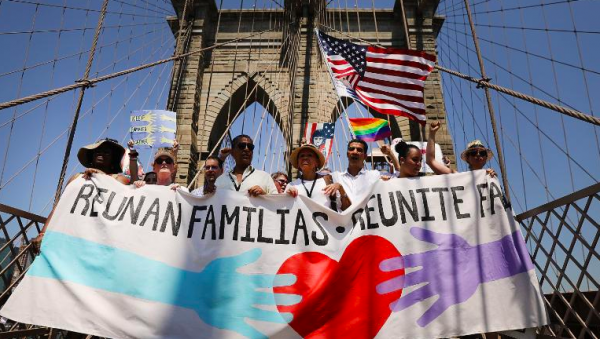
6 Facts We Learned Working with Migrants and Refugees Around the World: Facts 1 and 2 Working with migrants and refugees is our business at Catholic Relief Services. CRS was founded in 1943 to assist refugees during World War II. Seventy-five years later, we are still coming to the aid of people escaping conflict, violence and natural disasters. While CRS doesn’t resettle refugees in the United States (these programs are run by the Catholic Church’s Migration and Refugee Service and Catholic Charities), our rich history has taught us valuable lessons on how to best help families fleeing crisis. 1. People Do Not Want to Leave Their Homes. An astonishing 1 in 110 people have been forced to flee their home (UNHCR). They only do that when they feel they have no other choice. Most people the world over give the same reason for starting their perilous journey across borders -- violence. That’s true for millions fleeing conflict in South Sudan and for tens of thousands fleeing gang violence in Central America. Most often, people flee to other parts within their country first. Only when they see no other option do people leave their country. Rick Jones is the agency's Youth and Migration Advisor in Latin America and the Caribbean. He also specializes in issues affecting Central American migration, including gang violence, poverty, and internal displacement. See his contact information at the bottom. 2. Don’t Separate Families. Based on extensive experience with refugees and migrants, CRS agrees with the criticism of the former U.S. policy of separating children from their parents. Decades of research shows that this is so traumatic for children it can lead to long-term psychological, and even physical damage. Shannon Senefeld is a global development expert at CRS. She has published and presented extensively on international children’s issues and the importance of strengthened family care for children’s development. See her contact information at the bottom. The experts at Catholic Relief Services are available to help with any media coverage or insight that is required regarding this ongoing news story and issue that is continuing in America. Simply click on any of their icons to arrange a time for an interview. Source:

Definitely …Maybe? Donald Trump’s planned sit-down with Kim Jun Un
It was diplomacy that was almost out of a movie. Two bitter leaders, both unpredictable and avowed enemies who seemed on the brink of war … until suddenly they are friends, complimenting each other and arranging a meeting of historic proportions. There was even talk of a Nobel Prize. It seemed too good to be true. And now the world is back to reality. The surprisingly insta-warm relationship between American and North Korea seems to have once again chilled. And now it’s a battle of statements over who has upset who and why. According to North Korean media, Choe Son Hui, a vice-minister in the North Korean Foreign Ministry, said the summit is being reconsidered. And annihilation may follow. "Whether the US will meet us at a meeting room or encounter us at nuclear-to-nuclear showdown is entirely dependent upon the decision and behavior of the United States," Choe said. Vice President Pence responded in the media with a veiled threat of his own. "There was some talk about the Libya model," Pence told Fox News "As the President made clear, this will only end like the Libya model ended if Kim Jong Un doesn't make a deal." So where are we now? What’s next? Is this relationship over before it even started? Experts from the University of Connecticut may have some insight and deeper understanding of this issue. Alexis Dudden is a Professor of History specializing in modern Japan and Korea, and international history at the University of Connecticut. Dudden stresses the importance of understanding the complexity of modern Korea-Japan relations to better appreciate Korean resistance to U.S. demands. South Korea is a country where one in six families is directly affected by the North-South divide. It is “imperative that Washington planners take seriously South Korean desires for renewed engagement,” Dudden says. Professor Dudden is available to speak with media regarding the ongoing talks and threats between North Korea and America. Simply click on her icon to arrange an interview. Source:



New Star Wars, Same Political Landscape?
There’s been an enormous amount of hype leading into this Friday’s release of Solo: A Star Wars Story. Will the 10th installment of what is the most valuable franchise in film history live up to the lofty expectations of both fans and film executives? What does this latest epic tell us about current events here on Earth? The politics of Star Wars has proved to be an enduring fascination to many throughout the past 40 years. Equating current political events to the Star Wars saga is where the experts From the University of Connecticut can help. Stephen Dyson has dissected the politics of the "Game of Thrones," "Star Trek" and previous editions of "Star Wars." He can "read between the lines" of the movie dialogue and equate on-screen dialogue to what's happening now in the United States. Source:
