
Experts Matter. Find Yours.
Connect for media, speaking, professional opportunities & more.
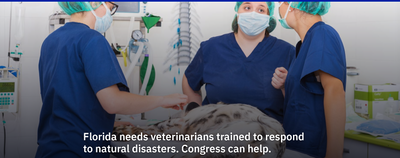
Florida needs veterinarians trained to respond to natural disasters. Congress can help.
When Hurricane Helene struck, we were on the frontlines in Florida’s Big Bend region, racing against time to support the Humane Society as they rescued animals displaced by the most powerful storm ever to hit this part of the state. Two weeks later, we were back in action, facing the devastating flooding from Hurricane Milton. These back-to-back disasters showcased the urgency and critical need for emergency-response veterinarians who can act fast to save lives. We lead one of the nation’s only three emergency veterinary response teams — the University of Florida Veterinary Emergency Treatment Service (UF VETS). Founded after the 2004 hurricane season and operating under the UF College of Veterinary Medicine, the UF VETS program hosts two distinct, yet complementary, branches: a medical response unit for disaster-affected animals and an animal technical rescue branch, which manages complex operations like overturned livestock trailers. Larry Garcia specializes in veterinary disaster preparedness and response, animal technical rescue/training and shelter medicine operations. View his profile here Our team is on call whenever disaster strikes, working alongside local and state veterinary organizations, animal rescues and law enforcement to save animals in crisis. But here’s the problem: Without a nationwide system for coordinating these efforts, it’s often chaotic, and animals suffer because of it. Now Congress has a golden opportunity to change that. As they return to Washington, they have the chance to make a game-changing impact by including funding in the final FY 2025 Homeland Security Appropriations bill to create a nationwide network of veterinary emergency teams. This funding could revolutionize how the U.S. handles animal care during national disasters — and it needs to happen, fast. Read more ... Looking to know more about this important topic or connect with Lawrence Garcia - simply click on his icon now to arrange an interview today.


Batty pathogens: Why do bats spread so many diseases?
Let’s face it — bats get a bad rap. Their links to disease outbreaks and their spooky association with vampires influence their notoriety. In reality, bats are truly remarkable. Bats support our agricultural industries as vital members of food webs. And, contrary to their portrayal in popular Halloween blockbusters, they are gentle and tidy creatures that groom themselves like cats. So why is it that when we hear of disease outbreaks, it always seems to be bats? According to University of Florida Emerging Pathogens Institute member Jim Wellehan, D.V.M., what sets bats apart isn’t black magic at all. But rather, it’s their long history of co-existing with viruses, the unique tradeoffs of flight and, perhaps most of all, a history of adapting to new pathogens. “(Infectious disease) has been the biggest factor in all of evolution,” said Wellehan, who is also a professor at the UF College of Veterinary Medicine. “People are always looking for an excuse (as to) why bats are magic, and the truth is bats have just been exposed to a lot of stuff and selected for those genes accordingly.” While humans are the most populous mammals on Earth, bats are a massive group of animals. Behind rodents, they represent the second-largest group of mammalian biodiversity, accounting for a whopping 20% of all mammal species. With over 1,400 species, it’s no surprise that pathogen diversity in bats is just as extensive and complex. Jim Wellehan's research focuses on comparative infectious disease, pathogen evolution, molecular diagnostics and pathogen discovery. View his profile here Bats, as we know them, have been on Earth for over 50 million years. This extensive period has given pathogens plenty of time to evolve alongside the winged mammals. Bats carry viruses like Ebola, Hendra virus, Nipah virus and SARS-CoV-2, which causes COVID-19. One factor that is important in this viral diversity is flight. Flight provides bats with many evolutionary advantages, such as predator evasion, access to new food sources and the ability to exploit diverse habitats. Flight also dramatically increases the chance of rapid pathogen transmission, as they can travel long distances and past many geographic barriers. Many species are highly social, which increases transmission rates as they live in close proximity and groom one another. “When I first learned about Darwin and evolution, ‘survival of the fittest,’ I assumed, meant ‘smartest and fastest and strongest,’ but if you look at our genomes, turns out that's wrong,” said Wellehan. “The genes that are selected for are mostly immune-related. The most important thing is to have enough genetic diversity in your population so that someone has immunity genes that are effective against the next pathogen that doesn't even exist yet. With their increased mixing and contact rates, bats have done this more often than most animals.” Generally, pathogens are most likely to cause disease when they first infect a new host species, as the susceptible animals have not yet developed the necessary defenses. Pathogens, along with their hosts, have no choice but to evolve to survive. With such a wide variety of species, it is not surprising that bats also carry a large proportion of mammal-associated viruses. This is not to say that bats are immune to all pathogens. As the most rapidly evolving factor in life, infectious disease is an incredibly dynamic part of medicine. Bats can get sick from lyssaviruses, including rabies. Additionally, white nose disease, a fungal infection that targets hibernating bats, has been a growing concern in the United States for the past decade. Though bat pathogens are a significant concern, habitat disturbance plays a larger role in bat population pathogen emergence, ultimately affecting humans as the dominoes fall. “Pathogen transmission to humans and conservation efforts go hand in hand,” Wellehan said. “When populations get under stress, that's when ecological balances get shifted, and zoonotic jumps occur. ... It turns out that if we think of ourselves as something separate from nature, it doesn't work so well.” So, while bats may embody the spirit of Halloween, their “magic” lies in evolution and resilience, shaped by millions of years of flying in the face of viruses, not spooky legends. Looking to know more? We can help. Jim Wellehan is available to speak with reporters about bats - simply click on his icon now to arrange an interview today.

LSU Expert Christine Navarre on the Threat of New World Screwworms
The New World screwworm (NWS), also known as the primary screwworm, is the larvae of the fly Cochliomyia hominivorax. Unlike the larvae (maggots) of other flies that only feed on dead tissue, the NWS feeds on live tissue. This leads to more severe and potentially deadly consequences which threatens livestock and wildlife populations. Prior to their eradication form the United States, NWS were a major economic burden to the production of livestock, especially in the in the southwestern U.S. and Florida. The U.S. Department of Agriculture estimates that the U.S. livestock industry saves approximately $900 million a year as a result of NWS eradication. Other benefits of eradication and control are enhanced human and animal health and welfare and increased survival of endangered wild animal species. The NWS fly was eradicated from the U.S. in 1966 with the release of sterile male flies to control the population. This status is maintained through the Panama-U.S. Commission for the Eradication and Prevention of the Cattle Borer Worm (COPEG) which releases millions of sterile flies weekly along the Panama-Colombia border to create a barrier preventing the northward spread of screwworms. Due to these efforts, it is now found primarily in tropical areas of South America and some Caribbean Islands, including Cuba. In 2016 NWS were found in Key Deer in the Florida Keys. The source of the outbreak was never determined. Rapid recognition of the problem and response with the release of sterile flies quickly eradicated the problem but this incident illustrates the importance of remaining vigilant. In November, NWS was detected in Mexico near the Guatemala border. The USDA Animal and Plant Health Inspection Service (APHIS) has imposed immediate import restrictions on animal commodities from Mexico. They are also intensifying efforts to prevent the northward spread of NWS by collaborating with Mexican and Central American authorities and urging livestock producers along the southern U.S. border to monitor their livestock and pets for signs of NWS. Any suspected cases should be reported immediately. Clinical Signs NWS can infest any warm-blooded animal including livestock, pets, wildlife, birds and occasionally humans. Common sites of infestation are any fresh or old wounds, warts, tumors, tick bites and antlers in shedding. Wounds left from management procedures, such as dehorning, branding, ear tagging, tail docking and shearing, can become infested. The eyes, nose, vulva and prepuce are also vulnerable, as well as the umbilicus in newborn mammals. Animals infested with NWS may show the following signs: Presence of maggots in wounds or body openings Wounds with a foul odor, bloody drainage or white/cream-colored drainage (eggs) Depression, reduced appetite, weight loss Isolation and/or signs of discomfort, head shaking Fever and other signs of secondary infection Diagnosis and Reporting Maggots found on animals showing the above clinical signs should be sent to a veterinarian or veterinary diagnostic lab for identification to distinguish NWS larvae from other more common fly larvae. In Louisiana larvae can be sent to the Louisiana Animal Disease Diagnostic Laboratory (www.lsu.edu/vetmed/laddl). Larvae should be placed in 70% alcohol for submission to the diagnostic laboratory. It is very important to immediately report any NWS infestations to the Louisiana Department of Agriculture and Forestry. A reported case will not result in herd depopulation but will allow animal health officials to take steps to help you manage your animals and prevent spread. Early detection and rapid response are critical to controlling this parasite. Treatment Immediate veterinary care should be sought to remove larvae and properly treat with insecticides. Wound care is also important to speed healing and prevent reinfestation. Prevention Treatment of NWS can be difficult, and eradication is very costly, so prevention of infestations is essential. Adult NWS flies can travel up to 12 miles to lay eggs, and eggs can be transported by animals and people traveling from infested areas. This necessitates constant vigilance to ensure that reintroduction into the U.S. does not occur. Preventative steps include: Regularly inspect livestock and pets for cuts, wounds, scabs and tick infestations. Closely monitor the umbilicus of newborn livestock, vulva of females and prepuce of males. Use insect repellant and wound dressings to prevent fly strike. Report any unusual wildlife or bird deaths to the Louisiana Wildlife and Fisheries. Pay close attention to nasal passages and eyes for signs of larvae (maggot) infestation. Seek veterinary advice for immediate treatment of open wounds, including dehorning and castration sites and preventive use of topical and systemic insecticides. Review biosecurity plans with the farm or ranch veterinarian. Original article by the LSU AgCenter here.

LSU Veterinary Teams Recall Courage, Loss, and Lasting Change from Hurricane Katrina Animal Rescues
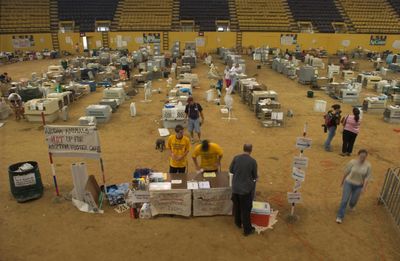
From that tragedy came transformative change, with new animal evacuation protocols and policies, including the creation of the federal Pet Evacuation and Transportation Standards (PETS) Act, which requires state and local disaster plans to include provisions for pets and service animals. LSU School of Veterinary Medicine played a pivotal role in this evolution. In the days and months after Katrina, LSU Vet Med faculty, staff, and students worked alongside state officials, military units, and volunteers from across the nation to rescue, treat, and shelter thousands of animals. Two decades later, Katrina’s scars remain, but so does the resilience of the people and animals who lived through it. Their stories serve as a reminder that in even the darkest moments, compassion can spark lasting change. Rescue in a War Zone Dr. Jenny Sones (then veterinary student): I had been working at LSU Vet Med for five years when Katrina hit. LSU Vet Med put out an ‘all hands on deck’ call to employees. All of our hospital wards were turned into an ER. We opened our homes to complete strangers who came to help. It was organized chaos. Many animals came to us looking like corpses with a heartbeat because they’d been in the flood waters so long. I worked all day at LSU Vet Med, where we saw the sickest, most injured patients, and worked at Lamar Dixon evenings and weekends. Twenty years later, the images are so vivid in my mind. I took a horse trailer on a rescue mission into New Orleans with two students and a state veterinarian escort one week after Katrina hit. The scene looked like a war zone, helicopters everywhere, buildings burning, gunshot sounds. Every area we saw was looted. The stench was awful. There were people on the overpasses who had been there for a week. We were there to rescue animals. Military, Louisiana National Guard, and police brought the animals to us where our trailer was parked on an overpass. We picked up a few strays on our way out. The animals we rescued were so scared. Some had been in the flood waters a long time and were soaking wet and foul smelling. Their skin was sloughing off and they were emaciated. Amazingly, none of the dogs, cats, or horses were aggressive—maybe because they were in shock or they were grateful. We treated them all at Lamar Dixon, washed them with Dawn dishwashing soap and applied betadine. Sick ones were transported by trailer to LSU Vet Med. They were very dark times and very good times too. We were able to get the New Orleans French Quarter mules out to Lamar Dixon. Their caretaker crew stayed with them. They hooked up the mules, still in good shape because they weren’t in the flood waters, and they gave workers short rides around the Lamar Dixon grounds. It was such rewarding work. We were exhausted but in the best way. It would have been easy to get caught up in the devastation if we didn’t focus on our purpose to help animals. You can’t fix everything, but you can fix what’s in front of you. If you can survive the devastation of Katrina, you can survive anything. From Classroom to Crisis Dr. Jenny Sones (then veterinary student): In August 2005, I was starting my second year of veterinary school at LSU. I had no idea that life was about to change so drastically. School was cancelled, and electricity was out most places except at the vet school. My colleagues set up temporary housing in our study rooms and other places throughout the vet school. We then began to learn of the effects of Katrina on our veterinary species—dogs, cats, horses, and more. These precious creatures were the reason why we studied, crammed, and signed up to endure the rigors of veterinary school. It was time to close the books and help! Although we were not licensed veterinarians yet, we were keen to provide aid in any way we could. I, along with lots of my classmates, volunteered at Parker Coliseum on the LSU campus, where displaced small animals were seeking refuge, and at Lamar Dixon, which became the shelter for large animals and small animals. We spend many hours doing anything we could, cleaning litter boxes, refilling water bowls, changing bedding, administering medications, and assisting the heroic volunteer veterinarians working tirelessly to treat the injured, sick, and rescued. Lots of important lessons were learned during Katrina. Many animals were not reunited with their owners. That's when I learned the value of microchipping to permanently identify animals, gained an appreciation for animal search and rescue, and the value of quick response. (Sones is now CSU Equine Reproduction Laboratory reproduction specialist.) Mapping Rescues by Hand Ashley Stokes (former faculty member): It was unlike anything I’ve ever experienced. I was researching and teaching at LSU Vet Med in 2005. LSU Vet Med stepped up in so many ways. We started receiving calls from citizens and local authorities at the vet school almost immediately after the storm. They needed help with resources—animal rescue, food, and water. They had to leave New Orleans quickly. I particularly remember a call from someone from south of Belle Chase, La., who had left horses, cattle, and two dogs in the house and needed help. It was surreal to see the devastation, houses floating, there in the Delta. We were making real-time decisions to help their animals. They’d lost so much, and for some, their animals were all they had left. We put a paper map of Louisiana on the wall and put pins in the locations that called for assistance. We covered all of New Orleans and surrounding areas, including the north shore and extending west to Baton Rouge. We took the callers’ information and sent teams of staff, students, and volunteers to different locations with donated trailers, hay, water, and other resources for rescue. We continued rescues for months after the storm. We were there for people for the long haul. The whole experience was transformational in my life. What I learned from Katrina became part of my own career and what I continue to do. There were beautiful moments, especially seeing how resilient and helpful people could be. I saw every day how the community came together and were absolute bright lights. Positive came from tragedy. (Stokes is now dean of UC Davis College of Agricultural & Environmental Sciences.) The Boxer on the Third Floor Dr. Neil Henderson (alumnus): When Katrina hit, the Louisiana Veterinary Medical Association sent out a request for help from veterinarians. I got to the Lamar Dixon Center on Day 5 after Katrina hit. St. Bernard Parish was where I spent most of my time helping. It was literally destroyed. One day, while we were making our rounds, a man came running up to me and said that he just remembered that while the storm was coming through—he was on the third story of a building looking out of the window—he noticed a dog swimming around frantically with nowhere to go. He opened a window for it with the hopes that it would swim inside the building to safety. Seven or eight days later, with the temperature well into the upper 90s, the man came up to me and asked me to go into the building to see if I could find the dog. I did not have much hope but went anyway. There, on the third floor of the building, I found the dog, a boxer, alive. She was in surprisingly good shape. The man was ecstatic to see the dog and could not believe that it made it inside the building to safety. I stayed for five days helping animals, and my late father (Dr. Robert Henderson, class of 1977) came after that for five more days. (Henderson is the owner of the Pine Ridge Veterinary Center in Stonewall, La.) Article originally posted here.

Veterinary deal would increase UK agrifood exports to EU by more than a fifth, research shows
A veterinary deal would increase agri-food exports from the UK to the EU by at least 22.5%, say researchers Agri-food exports overall are worth £25 billion to the UK economy, but the two years since the new trading rules were put in place have seen a fall of 5% in exports to the EU from 2019 levels, during a period where the sector has otherwise grown. Team from Aston University and University of Bristol have analysed trade deals and export figures worldwide to estimate impact of a new veterinary deal on UK–EU exports A veterinary deal with the European Union could increase UK agricultural and food exports by over a fifth, according to new research. The team, from Aston University’s Centre for Business Prosperity and the University of Bristol, analysed the agricultural and veterinary aspects of trade deals around the world to estimate their impact on exports. They then modelled the potential impact of different types of agreement on UK exports to the EU. Veterinary Agreements specifically focus on regulations and standards related to animal health and welfare, as well as to the safety of animal-derived products such as meat, dairy, and seafood. They aim to align, harmonise, or recognise veterinary requirements and certifications, and reduce the number of inspections between countries to facilitate the safe and efficient trade of live animals and animal products. The EU–UK Trade and Cooperation Agreement (TCA), implemented in January 2021, eliminates tariffs and quotas but does not remove non-tariff barriers to trade. These can be particularly burdensome for agricultural and animal-derived food (agri-food) exports, involving complex rules and requirements, production of extensive documentation and veterinary checks. The UK agri-food sector is a cornerstone of the UK economy, with exports worth £25 billion and employing 4.2million people. Although the sector is growing overall, exports to the EU shrank in 2022 by 5% compared to 2019, in part due to the new trade arrangements. This has led to calls for an EU–UK veterinary agreement from business and agri-food organisations, including the Confederation of British Industry, British Chambers of Commerce, UK Food and Drink Federation, Chartered Institute of Environmental Health and British Veterinary Association. Analysing data from the World Bank on 279 trade agreements and export statistics from over 200 countries, the researchers found that shallow agreements, that went little further than provisions already covered by World Trade Organisation (WTO) rules, had significant negative impacts on agri-food exports. However, where trade agreements went beyond WTO provisions to include more commitments on sanitary and phytosanitary (SPS) measures (which aim to protect countries against risks relating to pests, diseases and food safety) and were legally enforceable, they had a robust, positive impact on exports, particularly exports of animal products and food. Applying this to the UK–EU relationship, the team estimate that a veterinary agreement that went beyond the existing TCA provisions would increase agri-food exports from the UK to the EU by at least 22.5%. Imports from the EU would also increase by 5.6%. In the 203 countries studied for the research, positive effects of deep trade deals that included provisions on agriculture took between 10 and 15 years to manifest. But the UK might not have to wait so long, according to report co-author Professor Jun Du, Director of Aston University’s Centre for Business Prosperity. “There is no blueprint out there that mirrors the UK–EU relationship. Most veterinary agreements are agreed as part of a trade deal between countries that haven’t previously had close alignment and it takes a while for the benefits to take effect. “Until recently, the UK had frictionless agri-food exports to the EU, so it’s possible that a supplementary veterinary agreement to reduce some of the frictions created by Brexit could allow trade that previously existed to pick up again quite quickly.” However clear the economic arguments, the legal and political barriers to a veterinary agreement still remain. The researchers address these in their report, suggesting that the best format for the additional measures would be as a supplementary agreement to the TCA. The key question for the UK government in negotiating such an agreement would be what the EU demanded in return. “The closest model is the EU-Swiss relationship, which sees Switzerland largely follow EU law,” said report co-author from the University of Bristol, Dr Greg Messenger. “That’s unlikely to be an option for the UK. As we wouldn’t expect to eliminate all paperwork, we could both agree that our rules meet each other’s standard for phytosanitary protection. As most of our rules are still essentially the same as the EU, that wouldn’t require any major change, though we’d have to agree a greater level of coordination in relation to the development of new rules.” The report was written jointly by Professor Du, Dr Messenger and Dr Oleksandr Shepotylo, senior lecturer in economics, finance and entrepreneurship at the Centre for Business Prosperity, Aston Business School.


National Puppy Day | Media Advisory
National Puppy Day celebrates the joy and companionship that puppies bring into our lives, while also raising awareness about the importance of adoption and the welfare of our canine friends. This day is an opportunity to advocate for responsible pet ownership, highlight the plight of dogs in shelters, and encourage adoption over purchasing from breeders. With millions of homeless dogs worldwide, National Puppy Day also serves as a reminder of the human-animal bond and our responsibility to protect and care for pets. Key sub-topics include: Adoption and Rescue Stories: Heartwarming tales of puppies finding their forever homes. The Importance of Spaying and Neutering: How these practices help reduce the number of homeless pets. Puppy Care and Training Tips: Expert advice on raising a healthy, well-behaved dog. The Role of Pets in Mental Health: Exploring how pets contribute to emotional and psychological well-being. Advocacy and Animal Welfare Legislation: Updates on laws and policies promoting the protection of dogs. Celebrating the Bond Between Humans and Dogs: The myriad ways puppies enrich our lives and communities. Connect with an Expert about Puppies and Pets For journalists seeking research or insights for their coverage about National Puppy Day, here is a select list of experts from our database. To search our full list of experts, visit www.expertfile.com Jennifer Applebaum Assistant Professor · University of Florida Meghan Herron Clinical Associate Professor I College of Veterinary Medicine · The Ohio State University Julie Levy Distinguished Professor · University of Florida Nicole Dorey Lecturer · University of Florida To search our full list of experts visit www.expertfile.com Photo by Jametlene Reskp


Experts available to comment on G7 summit discussions
A range of experts from the University of Bristol are available to comment on the upcoming G7 summit taking place in Cornwall, UK. Professor Simon Tormey, Professor of Politics and Dean of Social Sciences and Law at the University of Bristol can speak about what G7 means for UK, reboot of US-China relations, climate change, and taxes on large corporations. Simon can also do interviews in French. Dr David Matthews, Reader in Virology in the School of Cellular and Molecular Medicine at the University of Bristol and a member of the 'G2P-UK' National Virology Consortium, can discuss vaccines and global health security. Dr Kate Hendry, Associate Professor of Geochemistry at the University of Bristol can discuss ocean action including net zero oceanographic capability. Dr Tommaso Jucker, Research Fellow at the University of Bristol’s Cabot Institute for the Environment, can cover: supporting the transition to a low carbon economy – the role of forest conservation and reforestation in mitigating climate change, and action to halt and reverse biodiversity loss – ecosystem restoration. Dr Kristen Reyher, Reader in Veterinary Epidemiology and Population Health at the University of Bristol, is able to discuss antimicrobial resistance, antimicrobial stewardship, antimicrobial use, and epidemiology. And Professor Awais Rashid, Professor of Cyber Security at the University of Bristol, is available for the following topics: Internet safety including protecting children and online fraud, darknet markets, privacy issues and data exploitation.


UConn Researcher Develops Successful Zika Virus Vaccine in Preclinical Studies
UConn researcher Paulo Verardi, associate professor of pathobiology and veterinary science in the College of Agriculture, Health and Natural Resources, has demonstrated the success of a vaccine against Zika virus and recently published his findings in Scientific Reports, a Nature Research publication. He has also filed provisional patents with UConn’s Technology Commercialization Services for the novel vaccine platform technology used to generate the vaccine, as well as genetic modifications made to the vaccine that significantly enhance expression of the vaccine antigen. Verardi, a Brazilian native, was in Brazil visiting family in the summer of 2015 when the Zika outbreak first began to make waves and soon reached epidemic status. Back in the United States, Verardi kept tabs on the Zika epidemic and its emerging connection to microcephaly, a serious birth defect that causes babies to be born with small heads and underdeveloped brains. In October of that year, Verardi called then-Ph.D.-student Brittany Jasperse (CAHNR ‘19) into his office and told her he wanted to apply their newly developed vaccine platform and start developing a vaccine for Zika virus. It’s an impressive achievement and there’s a full article attached for those looking to know more. Verardi emphasizes that developing vaccines for viruses, in this case Zika, help the world be better prepared for outbreaks of novel and emerging viruses by having vaccine development frameworks in place. “Emerging viruses are not going to stop popping up any time soon, so we need to be prepared,” Verardi says. “Part of being prepared is to continue the development of these platforms.” If you’re a journalist looking to know more about Zika virus and this emerging news about a vaccine – then let us help. Dr. Paulo Verardi is a virologist who specializes in vaccine research and development. He is an Associate Professor at UConn and a member of the Center of Excellence for Vaccine Research. Dr. Verardi is available to speak with media regarding this emerging development – simply click on his icon now to arrange an interview today.

