
Experts Matter. Find Yours.
Connect for media, speaking, professional opportunities & more.

Politics, policy and public safety: Experts explain why a popular Atlanta festival was canceled
A sad tune is being hummed in Atlanta, where it was announced the popular annual Music Midtown festival is not happening, possibly in part due to the state’s laws surrounding guns in public parks. The event's cancellation, which brought tens of thousands of music lovers to the city -- along with the tourism dollars they spend -- has caused disappointment and drawn local and national media coverage. Calling it a “sad day” for the city, Atlanta City Council President Doug Shipman wrote on Twitter that: “Public policy has real impacts and, in this case, economic and social implications on a great tradition.” And state Democrats chastised Republicans for adopting a raft of pro-gun legislation, including a 2022 law that allows Georgians to carry concealed handguns without first getting a license from the state. The governor, who is seeking a second term, did not immediately comment on the festival’s decision. But state Rep. Rick Jasperse, a Jasper Republican who sponsored the 2014 law, said the measure is designed with public safety in mind. He said those intent on “causing chaos and crime in Georgia” won’t care if the festival bans firearms and would try to bring them in regardless. “Good Georgians who can qualify for a permit and carry a weapon do so to protect themselves from that element in our society,” he said. -- The Atlanta Journal Constitution, Aug. 1, 2022 Organizers of events like Music Midtown could look at Georgia’s gun laws and regulation of firearms as a potential legal liability. If there is a firearms incident, organizers may fear being held legally accountable and sued for any potential damages. The companies and their risk management advisors might think twice about holding large events in Georgia. Augusta University's Dr. William Hatcher, an expert when it comes to public administration and social, economic and political institutions in local communities, agrees that event organizers might be rethinking their plans in the state. "Yes. I think so. These types of laws have an impact on the economy and the business decisions of firms. We may see future effects on the economic behavior of individuals and firms." This topic could have further economic impact beyond canceled events, including affecting property values and home prices. If you're a journalist looking to know more, then let us help with your stories. Dr. William Hatcher is a professor of political science and chair of Augusta University’s Department of Social Sciences. He is an expert in the areas of public administration and social, economic and political institutions. Hatcher is available to speak with media regarding this topic. To arrange an interview today, simply click on his icon now.


Unattainably Perfect: Idealized Images of Influencers Negatively Affect Users’ Mental Health
Filters, Adobe Photoshop, and other digital tools are commonly used by social media “influencers.” These celebrities or individuals have a large follower base and “influence” or hold sway over online audiences. This digital enhancement of images is well-documented anecdotally. Instagram, in particular, has come under growing scrutiny by the media in recent years for promoting and popularizing unattainably perfect or unrealistic representations of its influencers. What’s less understood is the appeal and the actual effect that these digitally enhanced images have on followers–particularly in terms of people’s feelings of self-worth and their mental wellbeing. A ground-breaking study by Goizueta Business School’s David Schweidel and Morgan Ward sheds new light on the real-world impact of digital enhancement, and what they find should be cause for significant concern. Downstream Consequences: Impressions Have Lasting Impact Across a series of five studies with a broad sample of participants and using AI-powered deep learning data analysis to parse individuals’ responses, Schweidel and Ward have unearthed a series of insights around the lure of these kinds of idealized images, and the negative “downstream consequences” that they have on other users’ self-esteem. “Going into the research, we hypothesized that micro-influencers who digitally manipulate their images, offering unrealistic versions of themselves, would be more successful at engaging with other users–getting more follows, likes, and comments from them. And we do find this to be the case, but that’s not all,” says Schweidel. He and Ward also discover that when users are exposed to these kinds of images, they make comparisons between themselves and the enhanced influencers; comparisons that leave them feeling lacking, envious, and often inadequate in some way. In terms of mental health and wellbeing, this is alarming, says Ward. Our research shows unequivocally that when followers consume idealized versions of popular figures on social media there is a social comparison process that results in these users experiencing negative feelings and a substantial decline in their state of self-esteem. On the basis of these insights, is Meta–the owner of Facebook and Instagram–likely to take action to limit the use of digital enhancement on its platforms and apps any time soon? Unlikely, say Schweidel and Ward. “Meta seems to be fully aware of the deleterious effects that Instagram has on its users. However, the success of Instagram–and that of the brands and influencers that appear on the app–is fueled by increased consumer engagement: the very engagement that this kind of digital enhancement of images drives. So the incentive is there to maintain the practices that keep users engaged, even if there’s a trade-off in their emotional and mental health.” This is a fascinating and important topic - and if you're a reporter looking to know, then let us help. David A. Schweidel is professor of marketing at Emory University’s Goizueta Business School. He is an expert in the areas of customer relationship management and social media analytics. Morgan Ward is an assistant professor of marketing at Emory University’s Goizueta Business School and is an expert in consumer behavior. Both experts are available to speak with media - simply click on an icon to arrange a discussion today.



Has your cell phone data ever inexplicably slowed down? Worse still, perhaps you’ve had a mobile bill come in way higher than you expected. Keeping track of your data usage can be tough, especially when the billing mechanisms routinely deployed by digital service providers are often more complex than they seem. Things like three-part tariffs bundle a certain amount of “free” data or services into a fixed monthly fee, with an excess charge payable whenever you go over your allocation. These packages are usually marketed to consumers as being simple as well as attractive (who after all doesn’t love the sound of “free data?”) but in reality, they can be hard for people to manage—and failing to do so, punitive. Exceed your allotted data and you end up with subpar services or unwanted costs. Underutilize your allocation and you’re leaving money on the table. Meanwhile, in a world where we use digital services to do any number of things—from scrolling to streaming to storing and beyond—how can we accurately track just how much of our allowance we’re getting through? To address this, service providers are increasingly sending usage notifications to customers at different points of the billing cycle. These nudges are designed to help us to act in our own best interest: to take stock and modify our usage accordingly. But do they work? It depends, says Anandhi Bharadwaj, Vice-Dean for Faculty and Research at Goizueta. She and her colleagues have published a study that looks at the impact of these nudges, and they’ve found that they do help all customers adjust their behavior to stay within their allowance, irrespective of how attentive or inattentive they might be to their consumption speed in general. But there are provisos. First off, these consumption nudges seem to be significantly more effective with customers who have purchased higher data allowance than those who opt for low-capped packages. Then, the timing of nudges matters. When notifications arrive later in the billing cycle—right before a bill is due, say—they have significantly more impact across the board, says Bharadwaj. Companies should take note. “Ours is the first study to really unpack the efficacy of nudges in the digital services space, and it shows that who and when are important factors that service providers will need to take into account if they want to improve customer experiences.” Interested in knowing more - let us help. Anandhi Bharadwaj is an information systems expert bringing a wide range of development and executive training experience to the classroom. Her research examines the adoption, use, and impact patterns associated with technological change. Anandhi is available to speak with reporters - simply click on her icon now to arrange an interview today.


Battleground Georgia: All eyes on the Peach State with midterms in sight
The US midterm elections are quickly approaching, and with key Senate seats and the governor's mansion up for grabs in Georgia, the Peach State will be low hanging fruit for anyone looking to see where the balance of power rests in the country. With reporters across America covering the latest developments, we asked Augusta University's Mary-Kate Lizotte to answer a few questions that are top of mind for reporters and political junkies alike. The strength of endorsements? Q: What kind of an impact could Mike Pence backing Gov. Brian Kemp have going forward? It could have an influence on the willingness of Republicans who are not former President Trump supporters to contribute to the Kemp campaign and be sure to show up to vote for Kemp. But, it will likely not have much of an influence. Research does not find a huge, lasting impact of endorsements. Ultimately, Trump supporters are unlikely to stay home and not vote for Kemp given that they likely are very against Stacey Abrams becoming governor. For Abrams supporters, she has already begun to use Indiana as a comparison with Georgia to say that Indiana under Pence was more moderate, including Medicaid expansion in comparison with Georgia under Kemp. I doubt this will influence Republican voters who like Pence to vote for Abrams, but it could influence some Independents/moderates to vote for Abrams. It is important to note, however, that most Independents/moderates tend to consistently vote for one party's candidates and thus may not be influenced by this either. A fractured right? Q: Could Pence's support also divide the Republican party somewhat after former President Trump backed David Perdue? Yes, but will likely not have a substantial impact on the election. It is unlikely that Trump supporters and/or Perdue voters will stay home on election day. They will likely vote for Kemp as their most preferred candidate who is running. Goal line stand? Q: Herschel Walker won the Republican primary by a large margin. How does he stack up against Sen. Raphael Warnock in the general election? Polling is currently showing a close race within the margin of error. Warnock has not been running against Walker up until now because Walker had not won the primary, but Walker and conservative groups have been able to run against Warnock because there was no reason to believe that he would not win his primary. In terms of experience, Warnock is the incumbent and thus has more experience. Walker is a complicated and controversial public figure but also is loved among University of Georgia football fans. Warnock has focused on putting out positive campaign advertisements up to this point. But, since there are already attack ads against Warnock, the Warnock campaign or groups supporting the Warnock campaign need to begin airing attack ads against Walker to improve the Warnock standing in the polls. The research indicates that it is best to go negative once you have been attacked. Follow the money? Q: Are we likely to see a record amount of cash flow for candidates in Georgia over the next several months knowing it will be a key swing state? Definitely. People from out of state who will be watching these elections closely will likely contribute. We saw that when Abrams and Kemp ran against one another in 2018 and in the special election that elected Warnock in 2020. If you are a journalist covering this topic, then let our experts help. Dr. Mary-Kate Lizotte is an expert in political and voter behavior. She is available to talk about the upcoming midterm and gubernatorial elections in Georgia. Click on her name to schedule an interview.


School to provide increased access to preventative health services for young students so they can learn, grow and thrive To address health issues at the earliest and most preventable stages, provide whole child health, and advance health equity in the community, ChristianaCare opened a new school-based health center at Kuumba Academy Charter School in Wilmington on Friday, May 6th. The creation of the center, made possible through ChristianaCare’s partnership with the Community Education Building (CEB), which houses Kuumba Academy, means that students at the kindergarten-through-8th grade school will have increased access to an array of health services. “At ChristianaCare, we recognize the comprehensive health needs of adolescents in our community and are committed to partnering and using our resources wisely and effectively to expand our school-based health centers,” said Bettina Tweardy Riveros, J.D., chief health equity officer and senior vice president of Government Affairs and Community Engagement at ChristianaCare. “We know that childhood trauma adversely affects the ability of children to learn and build healthy relationships and it increases their risk of mental health issues and lifelong chronic disease. The opening of our school-based health center at Kuumba Academy means that ChristianaCare can support medical and behavioral health services and wraparound social care our children need, so we can positively influence their health, their education and their futures.” With the latest opening, ChristianaCare now operates 21 school-based health centers throughout the First State, in partnership with the Delaware Department of Health & Social Services, the Delaware Division of Public Health and several school districts. Kuumba Academy students, who spoke at an event Friday to celebrate the grand opening, will have access through its school-based health center to the following: Comprehensive behavioral health services. Crisis intervention and suicide prevention. Substance use disorder treatment. Tobacco cessation. Nutrition and weight management. Physical examinations. Health screenings. Treatment for minor illnesses and injuries. Reproductive health. In addition, Kuumba Academy students also will have access to resources that help their families surmount obstacles such as transportation, challenging appointment times, and worries about cost and confidentiality. “Kuumba Academy remains committed to meeting the needs of the whole child and family,” said Sally Maldonado, head of school at Kuumba Academy, the mission of which is to provide an innovative learning environment for the whole child from kindergarten through eighth grade. “The opening of this school-based health center means that our students and families will have daily access to the high-quality behavior and health services that they deserve, and we are grateful to ChristianaCare and CEB for their partnership. We are beginning to see ourselves on the other side of this pandemic and we are energized to emerge with these newfound partnerships focused on health and wellness for our village.” ChristianaCare has partnered with CEB and Kuumba Academy on community-focused health initiatives in the past. In February 2021, ChristianaCare provided more than 800 vaccinations to community members and staff at CEB. On February 7th of this year, ChristianaCare vaccinated 38 people, including 19 children, against COVID-19. This added to the more than 6,000 vaccinations that ChristianaCare Community Health has administered since 2021. “At CEB, we understand the importance that health plays on a child’s ability to learn and succeed,” said Linda Jennings, CEO at CEB. “We are beyond excited to partner with Kuumba and ChristianaCare to launch the Kuumba Academy School-Based Health Center at CEB and add to the list of holistic and integrated support we provide to students and their families.” Today’s event coincides with Better World Day, an annual, national event on the first Friday in May. During Better World Day, students showcase their learning about initiatives that they believe will have a positive impact on their community and the world. Through collaboration and acts of service, students learn the power of their voice to make change. About ChristianaCare Headquartered in Wilmington, Delaware, ChristianaCare is one of the country’s most dynamic health care organizations, centered on improving health outcomes, making high-quality care more accessible and lowering health care costs. ChristianaCare includes an extensive network of primary care and outpatient services, home health care, urgent care centers, three hospitals (1,299 beds), a freestanding emergency department, a Level I trauma center and a Level III neonatal intensive care unit, a comprehensive stroke center and regional centers of excellence in heart and vascular care, cancer care and women’s health. It also includes the pioneering Gene Editing Institute. ChristianaCare is nationally recognized as a great place to work, rated by Forbes as the 2nd best health system for diversity and inclusion, and the 29th best health system to work for in the United States, and by IDG Computerworld as one of the nation’s Best Places to Work in IT. ChristianaCare is rated by Healthgrades as one of America’s 50 Best Hospitals and continually ranked among the nation’s best by U.S. News & World Report, Newsweek and other national quality ratings. ChristianaCare is a nonprofit teaching health system with more than 260 residents and fellows. With its groundbreaking Center for Virtual Health and a focus on population health and value-based care, ChristianaCare is shaping the future of health care. About Kuumba Academy Charter School Kuumba Academy Charter School’s mission is to provide an innovative learning environment for the whole child from kindergarten through eighth grade. Our directors, staff, and families share the core belief that parents are children’s primary educators. KACS parents, in partnership with teachers and administrators, believe that every child can maximize his or her learning potential given the opportunity to do so. In response to the outcry from Wilmington parents looking for a high-quality public education and increased access to arts education for their children, Christina Cultural Arts Center leaders, parents, and community supporters took action and were granted a Department of Education charter to create Kuumba Academy Charter School (KACS) in 2001. KACS was the first school model in the state that partnered a public charter school with a nonprofit community organization. Christina Cultural Arts Center (CCAC) and KACS form a unique nonprofit/public school partnership committed to educational excellence. Through the innovative union of academics, arts, technology, and family engagement, each KACS student’s individual learning style is nurtured—resulting in creative learners who are agents of positive change in the community. The CCAC/KACS model is regarded by many as the single most significant achievement in Wilmington’s post public school desegregation history. About the Community Education Building (CEB) CEB was established in 2012 after Bank of America donated the former MBNA Bracebridge IV building to The Longwood Foundation. Living up to its commitment of increasing access to education, the Longwood Foundation created CEB as an independent entity, and transformed the space into an ecosystem to support the social, emotional, physical, and academic development of Wilmington’s youth. CEB is an innovative co-location and shared services model. Focused on supporting the entire family, CEB offers vibrant programs and support systems that provide a sound foundation for each student. It serves as a hub for families by offering services such as healthy meals, life coaches, and mental health services. This model leads to deeper family engagement in their child’s learning and allows schools to focus on teaching and learning, not operations and overhead. CEB is an educational ecosystem that holistically integrates programs and resources for students and their families, ensuring that every student has an equitable opportunity to succeed.



An Opening Day Predicament—Will Baseball Fans Side with Billionaire Owners or Millionaire Players?
A percolating labor showdown between well-heeled Major League Baseball team owners and well-paid baseball players threatens spring training and Opening Day. For the time being, it is an amicable negotiation to carve a new Collective Bargaining Agreement in time for the 2022 season, but it could turn sour, as these things tend to do. As usual, the fans are in that empty, helpless space between billionaire owners and millionaire players. “There’s still a little bit of time here before panic and pressure set in,” said Mike Lewis, Goizueta professor of marketing and a national expert on fandom who also serves as the faculty director of the Emory Marketing Analytics Center (EmoryMAC). “If we get to Opening Day and there is no baseball that is going to be a major shock to the system, and it is going to have major ramifications.” Lewis explains, “Fandom is built by the epic moment, the walk-off home run and the spectacular catch, but fandom is also hurt by the epic failure, such as canceling Opening Day. You might not see it in the data for this season, but it is going to be a hit on the fans’ long-term appreciation for their team.” So, whose side should fandom be on? The billionaire owners or the many millionaire players? The Baseball Collective Bargaining Agreement, Explained Lewis spells out the current baseball dilemma. Players want to reduce the time they have to wait to enter full free agency, which is currently six seasons. The players also want teams to be able to spend at least $245 million a season, per team, on salaries before MLB hits the clubs with a luxury tax, which is a way to keep rich teams from buying all the talent. The luxury tax ceiling is currently $210 million. Players are not happy with the luxury tax because it resembles a “soft” salary cap, or a limit on their pay. “A lot of what the players are looking for is the freedom for the owners to spend,” Lewis says. “And more freedom for the owners to spend is going to make the competitive balance issues in Major League Baseball worse.” Do the fans really want that the players to win this labor fight? Major League Baseball instituted a luxury tax system in 2002 with a new Collective Bargaining Agreement that charged a fee to teams whose payrolls passed a certain threshold. It was done to keep clubs like the Yankees, Red Sox, Dodgers, and Cubs with their massive local television revenues from stockpiling all the stars, Lewis explains. He goes on to say that the luxury tax penalty has slowly lost its effectiveness because revenues have grown in MLB. The rich teams shrug at the tax and the results have been awful for competitive balance in the game. Fans of less wealthy teams despair in this state of oligopoly in baseball. There have been as many 100-loss teams in the past three full seasons (2018, 2019, 2021) as there were from 2007-2017 combined (11). Good players flee the less wealthy teams, losses pile up, and fans are put off. If we move back to the wild west with the market it is going to be harder to keep the franchise superstar in town. “We know what the system’s going to look like with a more open market. It’s going to look like the New York Yankees dominating, as they did in the late 90s and early 2000s. It’s going to look like Alabama in college football.” If the players have their way in this latest bargaining, they will be “stuck” for just three or four years with the team that drafts them, not six, before they hit free agency. Morgan Ward, Goizueta assistant professor of marketing with a research focus on consumer behavior, said the labor tussle between wealthy owners and wealthy players is a “rich people problem” that threatens the “folklore” of the game. “I think it could have a really alienating effect overall on the general public just because it changes the focus of the game, it takes something very communal and familial and makes it very transactional,” Ward says. “It can be very distancing for the fans and, if anything, illustrates the schism between the fans and these players. These are not your friends or neighbors. They are in a very different place in life.” So, Will Fans Side with the Owners? It’s more complicated than that. “The fans have an emotional attachment with the players and no real emotional attachment with the owners,” Ward says. What the Major League Baseball Players Association, or the union, better not count on, Ward notes, is the fandom rallying to the players just because we have seen a national shift toward worker’s rights that arrived with the COVID-19 pandemic. One of those shifts was college athletes, at last, being able to make money off their name, image, and likeness. Labor has been humanized on a certain level, but even though the baseball players are “labor” and in a “union,” Ward says there is no comparison between the fight for college athletes against the majordomo NCAA, the governing body of college athletics, and baseball players against baseball owners. “The public is sympathetic with people in low-wage, high-service industries that finally have the ability to negotiate,” Ward says. “But it’s hard for me to see the same victimization of baseball players that happened with college athletes.” The last time there was a prolonged labor dispute between the owners and players, which was in 1994, it was disastrous for baseball. The players went on strike in August that season, which canceled the World Series. Average attendance per game that season was a then-record of 31,256. It took 10 years for baseball to average more than 30,000 fans to a game because fans became disgusted with the owners and players. “How much should we expect fans to endure this time?” Lewis asks. “They just came off Covid when there were restrictions on attendance and a shortened season,” Lewis said. “This stuff adds up. The fan is going to say, ‘Why am I loyal to these guys?’” If you're a reporter looking to know more - then let us help. Professor Mike Lewis is an Associate Professor of Marketing at Emory University’s Goizueta Business School and is an expert in sports analytics and marketing. Morgan Ward is an Assistant Professor of Marketing at Emory University’s Goizueta Business School and is an expert in consumer behavior. Both experts are available to speak with media - simply click on an icon to arrange a discussion today.


Tune In and Learn from our Experts - The Science of Decision Making
Did you know the average adult makes more than 35,000 decisions each day? The Science of Decision Making is the most recent episode available on The Goizueta Effect podcast. Emory University's Goizueta Business School Professor Ryan Hamilton shares how a better understanding of the human mind can help you make the best decisions in your own life – and position your products, services, and teams for growth. On the podcast you’ll find out more about: Grounding Tenets: The 4R’s of Decision Making How Cognitive Resources Impact the Decision-Making Process The Mental Load of COVID Importance of Reference Points for Businesses Halo Effects: Impact on Perceived Prices and Satisfaction Levels Impact on Satisfaction Levels Impact on Individual Perception Does Hamilton’s Research Influence His Behavior? The link to the podcast is attached below and if you are a reporter interested in learning more about Ryan Hamilton’s research – we’re here to help. Ryan Hamilton, associate professor of marketing at Emory’s Goizueta Business School. He is available to speak with media regarding brands and brand reputation – simply click on his icon to arrange an interview.

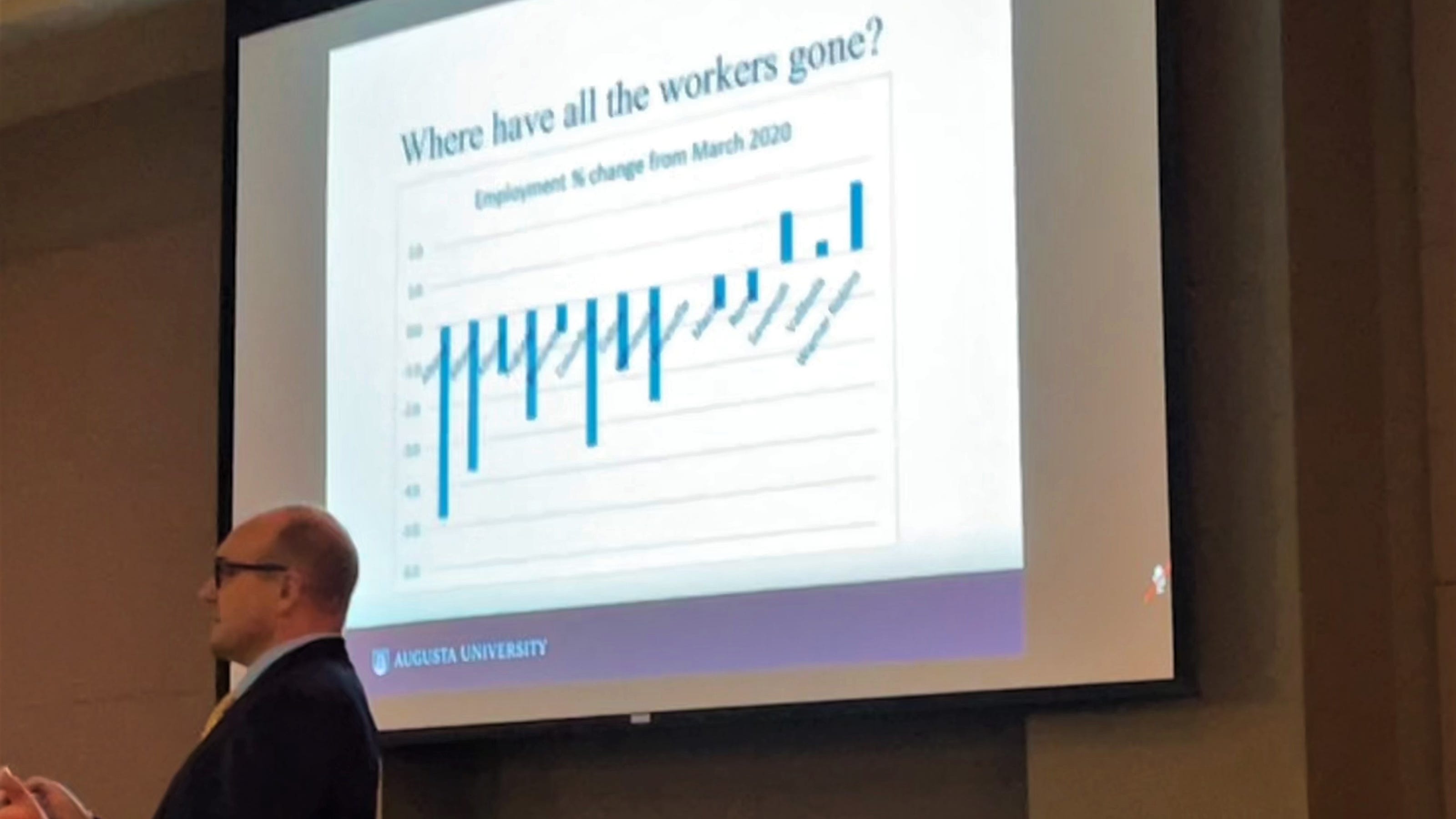
As the legendary political guru James Carville used to say, "It’s the economy, stupid." And these days with housing prices, inflation and the cost of living all pointing up in a very steep trajectory – the state of the economy is front and center for a lot of politicians, Americans and families as the year comes to a close. There’s a lot to be considered, and that’s where experts like Augusta’s Dr. Simon Medcalfe are being sought out to explain economic trends what is behind them. “U.S. retail sales are high,” explains Medcalfe “We had a lot of stimulus checks coming through the door and that’s really spurred extra spending and it’s across a whole range of retail sectors.” According to Medcalfe, household items are also seeing double-digit price increases. “What we’ve seen over the last 18 months during the pandemic, is a shift in our consumer preferences and consumer behavior.” • Furniture sales are up 29% • Used cars and cars in general are up 25-26% • Gardening and building supplies are up 14% • Electronics have seen an almost 30% increase • Clothing sales are up a whopping 50% But it’s not all good news - as the price of everything as we know is going up. “Inflation is running about 6.8% nationally,” Medcalfe explains. “It’s running about 7.2% in the south and it’s certainly a concern of policymakers and economists.” But theirs is sunshine behind those clouds as Medcalfe believes 2022 will see a return to normal. “I think next year inflation will come down. I know it won’t be at these high levels, but I still think it’ll be above the Feds target level of inflation, so look for those interest rate increases next year.” The economy and what to expect locally and nationally are hot topics – and if you are a reporter covering this topic – that’s where we can help. Dr. Simon Medcalfe is a highly regarded economics expert and the Cree Walker Chair in the Hull College of Business at Augusta University. Medcalfe is available to speak with media regarding the economy and its outlook – simply click on his icon now to arrange an interview today.


Consumer behavior expert and former "Survivor" contestant on holiday deals and scarcity
Kelly Goldsmith, professor of marketing, is available for commentary on holiday deals and anticipated scarcity due to supply chain issues. Kelly is a former Survivor contestant, which influenced her research into consumer behavior in the wake of scarcity. She is an expert in how people think and act when faced with limited availability of what they need and how they perceive competition when it comes to purchasing items that are in limited supply. Topics she can discuss include: How and why the combination of sales and perceived scarcity prompts consumers to behave selfishly (such as buying out entire stock) and other anticipated consumer behaviors and attitudes this holiday season How to plan ahead and find the best deals well in advance and stick to a budget when there are too many good deals to pass up How to keep your cool in the demanding, stressful environment


Emory Experts - Ad-blockers Shave $14.2 Billion Off Consumer Spending, Says New Research
Digital advertising is big business. So big, in fact, that it is well on track to become the most dominant form of advertising. Estimates suggest that spending on digital ads in the U.S. alone will reach a staggering $201 billion by 2023 – more than two-thirds of total spend. And it makes sense. With consumers increasingly shopping online, advertisers continue to ramp up their use of data and technologies to find innovative new ways to reach target audiences. The Flip Side to Digital Advertising Success The sheer ubiquity of online advertisements is driving a corollary upswing in the use of another digital technology. Ad blockers are easy-to-install and free-to-use software that consumers can deploy to hide unwanted ads on their screens, and they are gaining huge popularity worldwide. The numbers are hard to determine, but some evidence points to anywhere from 600 million to two billion Internet users having downloaded some form of ad-blocking in the last three years or so – well over 11% of the global internet population. Also hard to gauge is the impact on advertising revenue that ad-blockers are having – that is, until now. A new paper by Vilma Todri, assistant professor of information systems and operations management at Goizueta, sheds stunning light on the effect of ad-blocking on online search and purchasing behaviors among internet users. And what she has found should give advertisers serious pause for thought. According to her analysis, ad-blockers decrease consumer online spending by an average of 1.45%. Now, assuming that around 615 million internet users have downloaded some kind of ad-blocking software in recent years, the actual impact puts the loss in revenue from digital advertising around the $14.2 billion mark, year over year. And that’s not all. Todri also finds that ad-blocking seems to have the effect of limiting consumer spending disproportionally on certain brands over others. Users who opt out of seeing digital ads tend to continue to purchase mostly those products or services they are already familiar with, and not engage with new brands; they are less likely to use different search channels or visit new e-commerce websites as a result of ad-blocking. Analyzing Customer Engagement from 300 Million Internet Visits To get at these insights, Todri analyzed data from a U.S. web behavior dataset spanning a three-year period, from January 2015 to December 2018. She looked at web-wide visits, transaction behaviors and demographic identifiers across a total of 92,000+ users and more than 300 million internet visits. To measure the effect of ad-blocking, Todri matched all of this data with an ad-blocker dataset from the same source – a well-known U.S. measurement and analytics company – which shows that around 10% of users had installed an ad-blocker at some point during this three-year window. Crunching the numbers, Todri finds that the effect of using ad-blocking software on these users is to reduce their online search engine sessions by 5.6%. They also spend 5.5% less time visiting e-commerce websites. In other words, consumers who opt out of seeing ads end up browsing and shopping significantly less than others. And in terms of what these users are buying, the data shows that they are much less likely to spend on brands they don’t know or have not experienced before (and conversely, more likely to stick to familiar brands.) Digging even deeper, Todri also finds that this negative effect penalizes the brands that invest most heavily in advertising online more that those that don’t. In other words, ad-blockers are hurting those who advertise online most. Todri’s paper is the first to expose the quantitative, negative impact of ad-blocking on consumer spending. And her findings should be on the radar of any company looking to market its products and services online, she says. “The data clearly shows that ad-blockers reduce online spending by 1.45%, which amounts to something in the order of $14.2 billion in lost revenue given that about 600 million people around the world have installed this kind of software,” she says. “And the figures suggest that it’s the brands that heavily invest on online advertising who are bearing the brunt of this drop-off in consumer spending.” Search Behaviors, Interrupted “Advertisers also need to look at the fact that ad-blockers inhibit search behaviors,” adds Todri. “The figures point to a drop of around 5% when users have installed ad-blockers, which in turn means that they are not discovering and spending on new brands. They’re sticking with what they already know.” There’s an imperative here for companies to interpret these findings and reflect on what they say about ad-blocking, and also about what constitutes “acceptable advertising practices,” she says. “It’s reasonable to assume that people who use ad-blockers simply don’t like ads and aren’t influenced by them. Yet the data points to a different conclusion: if consumer purchasing falls after installing ad-blockers, it would suggest that advertising does work – seeing advertisements does drive searching and purchasing behaviors. So taken together, there’s a likely imperative here for advertisers to find new formats in terms of reaching their targets, and to strengthen their organic channels and social presence online.” Digital advertising clearly does impact search and purchasing behaviors, says Todri, so firms need to get creative while being cognizant of the fact that some consumers find current advertising practices annoying. Vilma Todri is an Assistant Professor of Information Systems & Operations Management at Emory University’s Goizueta Business School. Previously, she worked for Google where she was developing integrated cross-platform advertising strategies for large business clients that partnered with tech giant. Vilma is available to speak with media about this subject – simply click on her icon now to arrange an interview today.
