
Experts Matter. Find Yours.
Connect for media, speaking, professional opportunities & more.

Black Friday Shoppers Seek Deals on Electronics, Early Sales and Convenience in a Competitive Market
This year’s Black Friday shopping will bring a fresh wave of trends for both consumers and retailers. With electronics, online convenience and competitive pricing at the forefront, the landscape of Black Friday is evolving to match the shifting shopping habits of today’s consumers, said Baylor University consumer behavior expert James A. Roberts, Ph.D. Roberts – who serves as The Ben H. Williams Professor of Marketing at Baylor’s Hankamer School of Business – keeps a close watch on Black Friday, including what he sees as the Top 5 trends for holiday shopping in 2024. Top Trends for Black Friday 2024 The Shift in Shopping Habits: The balance between online and in-store sales remains steady, with consumers enjoying a 50/50 split in shopping preference, Robert said. While COVID-19 accelerated a surge in online shopping, this year, both are expected to perform equally as shoppers appreciate the flexibility of both options. Holiday Deals Start Early: As the competitive landscape has grown, Black Friday sales now launch weeks in advance. This early kickoff benefits consumers who are eager to lock in discounts and spreads out the typical holiday rush, providing retailers a longer window to capture consumer interest, Roberts noted. Electronics Dominate Sales: As in previous years, electronics will be the driving force of Black Friday 2024, accounting for nearly half of all sales. Roberts said that shoppers are especially focused on deals for televisions, laptops, smartwatches and gaming consoles – underscoring the lasting demand for high-quality technology at competitive prices. Gen Z and Millennials Drive Online Growth: Digital natives like Gen Z and Millennials continue to shape holiday shopping habits. Roberts said their comfort with online shopping – coupled with their mobile-first approach – makes them a powerful force in the online retail space. Retailers can expect these younger consumers to leverage social media, mobile apps and seamless e-commerce platforms for their holiday purchases. Rising Categories: Beyond electronics, Roberts predicts that other sectors will see strong sales this season, particularly in clothing, cosmetics and home appliances. As consumer preferences expand, brands in these categories should prepare for increased demand. Factors shaping consumer choices For Black Friday in 2024, competitive pricing and convenience remain top priorities, Roberts said. “Retailers who offer the best deals alongside quick and reliable delivery options stand out among consumers,” he said. Additionally, low-cost brands – such as Shein – have set consumer expectations for affordable pricing, even as “Buy Now, Pay Later” options have increased in popularity – though Roberts said retailers and consumers alike should be cautious when using this financing option at the risk of overspending. Future of Black Friday Looking ahead, Roberts said Black Friday’s trajectory appears geared more towards online channels, with each year seeing a slight shift away from brick-and-mortar shopping. Retailers are encouraged to keep an eye on pricing expectations and financing trends, as they’ll play an increasingly influential role in the holiday season. ABOUT JAMES A. ROBERTS, PH.D. James A. Roberts, Ph.D., is The Ben H. Williams Professor of Marketing at Baylor University’s Hankamer School of Business. A noted consumer behavior expert, he is among the "World's Top 2%" most-cited scientists in a database compiled by Stanford University. In addition to journal citations, Roberts has often been called upon by national media outlets for his consumer expertise and latest research. He has appeared on the CBS Early Show, ABC World News Tonight, ABC Good Morning America, NBC’s TODAY Show and NPR’s Morning Edition, as well as in articles in The New York Times, USA TODAY, The Wall Street Journal, TIME and many others. Roberts’ research has focused on how individual consumer attitudes and behavior impact personal and collective well-being. His research has investigated the factors that drive ecologically and socially conscious consumer behavior, the impact of materialism and compulsive buying on well-being and the impact of smartphone and social media use on personal well-being. He is the author of “Shiny Objects: Why We Spend Money We Don’t Have in Search of Happiness We Can’t Buy” and “Too Much of a Good Thing: Are You Addicted to Your Smartphone?”


A future with one plug: how universal EV outlets simplify charging for electric vehicle owners
Have you ever found yourself frustrated with the numerous types of charging plugs for electric vehicles when going to charge your car? Picture this: a future where every charging station supports a universal outlet. No more worrying about whether your plug will fit or if you need an adapter. Sounds like a dream, right? Well that dream is now real. University of Delaware professor Willett Kempton and his coauthors have recently released a new paper outlining a new universal EV outlet standard in World Electric Vehicle Journal. His coauthors include University of Delaware PhD graduates Rodney McGee and Garrett Ejzak. There are three standard EV charging connectors – the part you hold in your hand that plugs into EVs with matching inlets – in North America. Rather than requiring three charging stations at each location, Willett and his team proposed to have a universal EV outlet on the charging station, and cars would come with a cable with a universal plug to plug into the station. The solution for EV charging is similar to what has already evolved for charging cell phones and other portable electronics. Cell phones and laptops have many different types of power inlet connections on the device, incompatible with each other. This solution was deliberately designed so that todays’ EVs and charging stations do not need to be replaced. Because these new standards have resulted from a consensus of more than 150 participants from the automotive, charger, and power industries, new innovations will also be coming with the adoption of the new standards. These include lower-cost and lower-maintenance charging stations, higher energy efficiency. Kempton, McGee and Ejzak can be reached by clicking Kempton's contact button.


Optical research illuminates a possible future for computing technology
Nathaniel Kinsey, Ph.D., Engineering Foundation Professor in the Department of Electrical and Computer Engineering (ECE), is leading a group to bring new relevance to a decades-old computing concept called a perceptron. Emulating biological neuron functions of the messenger cells within the body’s central nervous system, perceptrons are an algorithmic model for classifying binary input. When combined within a neural network, perceptrons become a powerful component for machine learning. However, instead of using traditional digital processing, Kinsey seeks to create this system using light with funding from the Air Force Office of Scientific Research. This “nonlinear optical perceptron” is an ambitious undertaking that blends advanced optics, machine learning and nanotechnology. “If you put a black sheet outside on a sunny day, it heats up, causing properties such as its refractive index to change,” Kinsey said. “That’s because the object is absorbing various wavelengths of light. Now, if you design a material that is orders of magnitude more complex than a sheet of black plastic, we can use this change in refractive index to modify the reflection or transmission of individual colors – controlling the flow of light with light.” Refractive index is an expression of a material’s ability to bend light. Researchers can harness those refractive qualities to create a switch similar to the binary 1-0 base of digital silicon chip computing. Kinsey and collaborators from the U.S. National Institute of Standards and Technology, including his former VCU Ph.D. student Dhruv Fomra, are currently working to design a new kind of optically sensitive material. Their goal is to engineer and produce a device combining a unique nonlinear material, called epsilon-near-zero, and a nanostructured surface to offer improved control over transmission and reflection of light. Kinsey’s prior research has demonstrated that epsilon-near-zero materials combine unique features that allow their refractive index to be modified quite radically – from 0.3 to 1.3 under optical illumination – which is roughly equivalent to the difference between a reflective metal and transparent water. While an effective binary switch, the large change in index requires a lot of energy (~1 milli-Joules per square centimeter). By combining epsilon-near-zero with a specifically designed nanostructure exhibiting surface lattice resonance, Kinsey hopes to achieve a reduction in the required energy to activate the response. The unique response of a nanostructure exhibiting surface lattice resonance allows light to effectively be bent 90 degrees, arriving perpendicular to the surface while being split into two waves that travel along the surface. When a large area of the nanostructure is illuminated, the waves traveling along the surface mix, where they interfere constructively or destructively with each other. This interference can produce strong modification to reflection and transmission that is very sensitive to the geometry of the nanostructure, the wavelength of the incident light and the refractive index of the surrounding materials. The mixing of optical signals along the surface can also selectively switch regions of the epsilon-near-zero material thereby performing processing operations. A key aspect of Kinsey’s work is to build nonlinear components, like diodes and transistors, that use optical signals instead of electrical ones. Transistors and other traditional electronic components are nonlinear by default because electrical charges strongly interact with each other (for example, two electrons will tend to repel each other). Creating optical nonlinear components is challenging because photons do not strongly interact, they just pass through each other. To correct for this, Kinsey employs materials whose properties change in response to incident light, but the interaction is weak and thus requires large energies to utilize. Kinsey’s device aims to reduce that energy requirement while simultaneously shaping light to perform useful operations through the use of the nanostructured surface and lightwave interference. The United States Department of Defense sees optical computing as the next step in military imaging. Kinsey’s work, while challenging, has potential to yield an enormous payoff. “Let’s say you want to find a tank within an image,” Kinsey said, “Using a camera to capture the scene, translate that image into an electrical signal and run it through a traditional, silicon-circuit-based computer processor takes a lot of processing power. Especially when you try to detect, transfer, and process higher pixel resolutions. With the nonlinear optical perceptron, we’re trying to discover if we can perform the same kinds of operations purely in the optical domain without having to translate anything into electrical signals.” Linear optical systems, like metasurfaces and photonic integrated circuits, can already process information using only a fraction of the power of traditional tools. Building nonlinear optical systems would expand the functionality of these existing linear systems, making them ideal for remote sensing platforms on drones and satellites. Initially, the resolution would not be as sharp as traditional cameras, but optical processing built into the device would translate an image into a notification of tanks, troops on the move, for example. Kinsey suggests optical-computing surveillance would make an ideal early warning system to supplement traditional technology. “Elimination or minimization of electronics has been a kind of engineering holy grail for a number of years,” Kinsey said, “For situations where information naturally exists in the form of light, why not have an optical-in and optical-out system without electronics in the middle?” Linear optical computing uses minimal power, but is not capable of complex image processing. Kinsey’s research seeks to answer if the additional power requirement of nonlinear optical computing is worthwhile given its ability to handle more complex processing tasks. Nonlinear optical computing could be applied to a number of non-military applications. In driverless cars, optical computing could make better light detection and ranging equipment (better known as LIDAR). Dark field microscopy already uses related optical processing techniques for ‘edge detection’ that allows researchers to directly view details without the electronic processing of an image. Telecommunications could also benefit from optical processing, using optical neural networks to read address labels and send data packets without having to do an optical to electrical conversion. The concept of optical computing is not new, but interest (and funding) in theory and development waned in the 1980s and 1990s when silicon chip processing proved to be more cost effective. Recent years have seen many advancements in computing, but the more recent slowdown in scaling of silicon-based technologies have opened the door to new data processing technologies. “Optical computing could be the next big thing in computing technology,” Kinsey said. “But there are plenty of other contenders — such as quantum computing — for the next new presence in the computational ecosystem. Whatever comes up, I think that photonics and optics are going to be more and more prevalent in these new ways of computation, even if it doesn’t look like a processor that does optical computing.” Kinsey and other researchers working in the field are in the early stages of scientific exploration into these optical computing devices. Consumer applications are still decades away, but with silicon-based systems reaching the limit of their potential, the future for this light-based technology is bright.


Permanent magnets play an indispensable role in renewable energy technologies, including wind turbines, hydroelectric power generators and electric vehicles. Ironically, the magnets used in these “clean energy” technologies are made from rare earth elements such as neodymium, dysprosium and samarium that entail environmentally hazardous mining practices and energy-intensive manufacturing processes, according to Radhika Barua, Ph.D., mechanical and nuclear engineering assistant professor. Access to these rare earth magnets is also heavily reliant on China and demand for them is expected to grow as the U.S. seeks to meet net-zero carbon emissions by 2050. “That anticipated demand poses a challenge to U.S. decarbonization goals as the rare earth elements are characterized by substantial market volatility and geopolitical sensitivity,” Barua says. “This is where our project comes in.” Barua and fellow VCU professors Afroditi Filippas, Ph.D., and Everett Carpenter, Ph.D., are part of a team of VCU researchers working to create new types of magnets. By using additive manufacturing, more commonly known as 3D printing, they hope to create replacements for those permanent magnets composed of rare earth elements that are made from materials readily available in the U.S. China mines 58 percent of the global supply of rare earth elements used to make neodymium magnets that are widely used in consumer and industrial electronics, the U.S. Department of Energy (DOE) noted in a February 2022 report. That dominance grows throughout the manufacturing process with China accounting for 92 percent of global magnet production, the DOE estimates. “It would be ideal if we could manufacture the same magnets with the same characteristics without using rare earth elements,” says Filippas, who teaches electromagnetics at VCU. “It would be even better if we could make these magnets using additive manufacturing techniques.” VCU researchers are trying to do that in collaboration with the Commonwealth Center for Advanced Manufacturing (CCAM), which brings university, industry and government officials together to tackle manufacturing challenges. The professors are conducting much of their work at CCAM’s lab in Disputanta, Virginia. “We have access to equipment that we would not have access to at VCU,” Filippas says of the benefits of the CCAM partnership. “They provide that level of expertise using the equipment and understanding the process.” The project is funded by the VCU Breakthroughs Fund and CCAM. Barua is working with Carpenter, a chemistry professor, on the materials science part of the project. Filippas is focusing on data analytics and is helping develop a monitoring process to ensure the newly-crafted replacement magnets are viable. In addition to providing a more stable source of supply, Barua says the replacement magnets could also bring environmental benefits. Providing an alternative to rare earth magnets would involve less hazardous mining techniques while also reducing emissions and energy consumption. The replacement magnets are made by filtering particles of iron, cobalt, nickel and manganese through a nozzle where a laser fuses them together through a process known as direct energy deposition. That metal 3D printing approach can make complex shapes while minimizing raw material use and manufacturing costs, Barua says. “Right now, we’re printing straight lines just to see what we’re going to get and see if we can even print them,” Filippas says. “Are we getting the composition of the materials that we want? It’s a slow painstaking process towards freedom from reliance on rare earth materials.” Barua says using additive manufacturing allows researchers to create a unique microstructure layer-by-layer instead of simply making magnets from a cast. Researchers do not expect their replacements to mimic the full strength of rare earth magnets, but they hope to produce mid-tier magnets that are as close as possible to current magnets. Carpenter adds their new magnets could potentially be smaller and weigh less than rare earth magnets, which could lead to numerous benefits. “This reduction would be a big savings to the automobile manufacturing industry, for example, where every ounce matters,” Carpenter says. “In an S-Class Mercedes, there are over 130 magnets used in sensors, actuators or motors. This approach could save pounds of weight which translates into fuel efficiency.” Barua says the team is working to establish the feasibility of their new magnet-making process. They are trying to get the microstructure of the new magnets just right and are using additive manufacturing to fine-tune their magnetic properties, Barua says. “When artificial diamonds, cubic zirconia, was synthetically produced in the lab, it changed the entire diamond industry,” Barua says. “That’s exactly what we’re trying to do. We’re trying to make synthetic magnets.”



MEDIA RELEASE: Winter weather looming: CAA Manitoba advising motorists to prepare for the unexpected
Winnipeg, MB, November 04, 2021 – As temperatures drop and winter approaches, it’s a reminder that unpredictable driving conditions often come when we least expect it. CAA Manitoba (CAA MB) is advising motorists to get their vehicles ready now before wintry weather hits. “It’s time to prepare your vehicle by installing winter tires and getting your battery checked by a professional,” says Heather Mack, manager of government and community relations at CAA MB. “We are encouraging motorists to be winter wise and plan ahead for heavy snowfalls, slippery road conditions and frigid temperatures before they happen.” Winter tires take on all the challenges brought on by cold weather including snow, ice, slush, wet and dry roads, but to fully optimize your vehicle’s handling, stability and braking it’s important to install four matching tires once the temperature consistently dips below 7°C. “Compared to all-season tires, winter tires stay flexible in cold temperatures—whether or not there’s snow on the ground—giving you better traction,” says Mack. “This may reduce your stopping distance by a few feet which can be the reason for preventing a collision.” Save time by getting your tires changed right in your driveway by booking CAA’s Mobile Tire Change service and enjoy convenient, safe and reliable at-home assistance performed by expert technicians. While installing your winter tires, CAA recommends also asking your mechanic to check your car battery. “Even a fully charged battery can lose power when the temperature dips below 0° Celsius,” says Mack. “It’s important to have your car battery tested in the fall to ensure it’s ready for the winter.” If your battery is giving you problems or you are unsure if it’s time to replace it, you can call CAA’s Mobile Battery Service at *222 to have a trained CAA MB Battery Service Representative come test your battery and provide a helping hand. Not sure if your car battery will make it through the winter months? Watch for the following warning signs that a battery may need to be replaced: Your vehicle cranks slowly when trying to start. It takes 175 to 250 amps of battery power to get a car going. If your car is slow to start, you might be dealing with an insufficient charge. Your headlights dim while idling. When idle, a car may draw more power than the alternator alone can produce, so your battery kicks in. If your headlights dim when you are idling but brighten when you rev the engine, it could mean a drained battery. Your digital systems power down quickly. Electronics like the radio, GPS, dash cams and other accessories, especially in modern cars, use battery power when the engine is off. If they stop functioning properly, it could suggest a weak battery. You hear a grinding, clicking or buzzing noise when you turn on the ignition. It’s important to be able to distinguish the reason why your vehicle may be making noises, usually, these sounds mean your battery has lost its charge but if you’re still unsure, get your vehicle checked by a professional. Your vehicle has stalled. The stored energy in your car battery is essential for starting the engine, without its juice, you won’t be going very far.


Aston University and Partnership Medical shortlisted for knowledge transfer partnership award
Aston University and Partnership Medical (PML) have been shortlisted for an award at the KTP Awards 2022. The partnership has been shortlisted in the category of Best Knowledge Transfer Partnership for its work on a revolutionary automated cleaning system which uses synthetic chemistry to sterilise endoscopes, reducing risks of contamination to patients and lowering rates of mortality. A knowledge transfer partnership (KTP) is a three-way collaboration between a business, an academic partner and a highly qualified researcher , known as a KTP associate. The UK-wide programme helps businesses to improve their competitiveness and productivity through the better use of knowledge, technology and skills. Aston University is the leading KTP provider within the Midlands. The KTP Awards recognise the people and partnerships behind the UK’s most inspiring and successful KTP projects. At present there are more than 800 inspiring collaborations happening across the country. Endoscopes are long, thin tubes with a light and camera at one end. Due to the sensitivity of the materials and electronics they cannot be sterilised, opening up high potential for cross infection. Through their automated cleaning system, Aston University and PML achieved industry-leading levels of disinfection, reducing risks of contamination to patients and lowering rates of mortality. The automated prototype and new cleaning materials developed in the KTP produced astonishing results in clinical trials, with a simple five-minute treatment offering deep cleaning levels 1,000 times better than anticipated, providing hygiene levels far superior to those currently possible using conventional manual procedures Mark Smith, executive director of business and regional engagement at Aston University, said: "It’s truly wonderful that Aston University has been formally recognised as a sector leader for knowledge transfer programmes, reflecting the scale and quality of our work with business. Making the shortlist is a recognition of our continued growth and sustained achievements in the knowledge exchange area. “The Aston University and Partnership Medical project has resulted in a far more effective medical cleaning system that ensures that endoscopes are truly sterile, which will ultimately save lives. This is just one example of the University’s real-world support for businesses and their customers. “It is an honour to be considered for best KTP at such a prestigious event, especially when knowledge exchange activity is at a high, with over 800 collaborations happening across the UK.” Partnership Medical Ltd (PML), based in Stoke-on-Trent, are specialists in supplying cleaning equipment and consumables for flexible endoscopes with over 20 years of distributor experience. The company aims to become a leading manufacturer/provider for endoscopic departments in clinics and hospitals worldwide. The Aston University team who worked on the KTP included Dr Andy Sutherland, reader in organic chemistry and member of the Aston Institute of Materials Research, Dr Tony Worthington, associate professor in clinical microbiology and infectious diseases and member of the Biosciences Research Group together with KTP associate, Dr Thien Duong, an expert in synthetic chemistry. The awards ceremony will take place on Wednesday 12 October in Liverpool and will be streamed online for those unable to attend in person.


How to move to Canada: A checklist for newcomers
Moving to Canada from another country is no easy task. Whether you plan to settle in Canada permanently or relocate for better career or study options, it takes a lot of time and organization to ensure a smooth transition into life in a new country. We’ve created a handy moving to Canada checklist, which will provide you with a step-by-step guide of all the things you need to do, from deciding which immigration program to apply for to preparing for your life in Canada. In this article: Determine the best immigration pathway for you Get ready to apply for Permanent Residence (PR) Start your PR application process Wait for your PR application to be processed Get ready to travel Determine the best immigration pathway for you Choose between temporary and permanent residence When you’re first considering a move to Canada, you’ll have to choose between several immigration pathways. Many newcomers apply for Permanent Residence (PR) directly, which allows them to live and work in Canada permanently and even become Canadian citizens down the line. The other option is to apply for temporary residence, either in the form of a study permit or work permit, so you can experience life in Canada before deciding whether you want to stay permanently or return to your home country. Due to ongoing delays in the immigration process, many newcomers who were originally planning to apply for PR (or were awaiting a response on their application) are now exploring temporary ways of moving to Canada. However, it’s important to evaluate the pros and cons of each pathway before making a decision. For instance, while it’s easier and faster to get a study permit, it’s a longer road to PR. Also, the cost of education for international students is quite high, and even though you may be allowed to work part-time while studying in Canada, you’ll still have to rely on your savings to cover living expenses during your study period. Having Canadian work experience or educational credentials makes it easier to qualify for PR, so if your estimated Comprehensive Ranking System score is low, it may be better to try for a study permit or work permit first. Get ready to apply for Permanent Residence (PR) Decide which province you want to live in The province you choose to settle in will determine the job opportunities that’ll be available to you, the quality of life you’ll have, the cost of living, schooling options for your children, and the cultural environment. Many provinces also have Provincial Nominee Programs through which they invite newcomers whose skills are needed to fill in-demand jobs in the region. Do some research to learn about Canada’s provinces and territories, the major cities that newcomers prefer to live in, and the job market. This will help you decide which province you want to live in before you apply for PR. Identify the right PR program for you Canada has several immigration programs for PR, both at the federal and provincial levels. The Express Entry program is the most popular among newcomers and includes streams for foreign skilled workers, skilled tradespeople, and foreign nationals with Canadian work experience who want to settle in Canada permanently. The Express Entry program uses a point-based system known as the Comprehensive Ranking System (CRS) to rank and evaluate individual immigration applications based on factors such as skills, education, language ability, work experience, age, and more. Immigration, Refugees, and Citizenship Canada (IRCC) conducts periodic draws to determine the CRS cut-off and, if your score is higher than the cut-off, you’ll receive an Invitation to Apply (ITA) for PR. If you’re certain about the province you want to live in, you can apply through the Provincial Nominee Program instead. Securing a provincial nomination adds 600 points to your CRS score, significantly increasing your chances of qualifying for PR. Start your PR application process Gather essential documents for your application As you start filling in your PR application, you’ll be asked to upload various documents, including: Education credentials assessment (ECA): An ECA verifies that your foreign educational degree, diploma, or certification is valid and equal to a Canadian one. The ECA process takes time, so start the process at least two months before you plan to submit your PR application. Language proficiency test scores: If your first language isn’t English or French, you’ll need to take an English and/or French language test. For English, the IRCC accepts IELTS and CELPIP test scores, while for French, you’ll need to take the TEC Canada or the TEF Canada test. Passport: Your PR application will be linked to your passport number, so be sure to check the validity of your passport and get it reissued if it’s scheduled to expire soon. Fill in and submit your Express Entry or PNP profile Once you gather all the essential documents, you’re ready to create your application. For Express Entry, you’ll need to create an account on IRCC and create a profile under one of the three streams. You’ll also need to pay an application fee, which includes the fee for a biometrics test. Once your profile is submitted, you’ll be entered into the Express Entry pool of candidates to await the next CRS draw. Your Express Entry profile will be active for 12 months or until you receive an Invitation to Apply (ITA), whichever is sooner. Some PNP programs may require a separate application. You can find more information on the application process for these programs in our Provincial Nominee Program series. Respond to the Invitation to Apply (ITA) Depending on the immigration program you apply to, you’ll typically have 30 to 60 days to respond once you receive an ITA. At this time, you’ll be asked to provide documentation to support the information you provided in your profile. Some of this paperwork can take time to source, so we recommend gathering these essential documents well in advance. Proof of settlement funds: You’ll require bank statements and letters from your financial institution to prove you have sufficient funds to cover living expenses for your first few months in Canada. Police certification: Your local police authorities will need to certify that you don’t have a criminal background in your country. Work experience letters: Depending on your professional history, you may be required to submit letters from your past and current employers verifying your employment history, including the dates of your employment, working hours, job title and responsibilities, and salary. Birth and marriage certificates: If you’re applying for PR as a family. Job offer letter: If you already secured a job offer in Canada. Medical exam: You’re only required to take a medical test if you receive communication from the IRCC or province asking you to do so. Wait for your PR application to be processed How long does it take for your PR to be processed? The processing time for permanent residence applications varies based on the program you apply under. In most cases, it takes at least six months, but due to ongoing COVID-19 related delays, there’s a significant backlog and you may have to wait over a year to get your Confirmation of Permanent Residence (COPR). However, there are some things you can work on while you wait to make your transition into life in Canada easier. Prepare for the Canadian job market Finding your first job in Canada takes time. Use this extra time to prepare for your job search. Explore the job market in the city you’re planning to settle in and look at job descriptions posted for employment opportunities in your field. You can also start building a professional network in Canada through LinkedIn, virtual coffee chats, and online networking events. Before you start applying to jobs, create a Canadian-style resume and cover letter and customize it for each role. Since most companies now conduct interviews remotely, you should also start interview preparation, so you’re ready to start actively applying for jobs as soon as you get your COPR. Work on your language skills English and French are the two official languages in Canada, although English is more common everywhere except Quebec. If you need to work on your communication skills, this wait period is the perfect opportunity to sign up for language classes or practice at home. Research the basics of living in Canada Life in Canada may be very different from what you’re used to back home. As part of your preparation, be sure to research the types of accommodation available in Canada and use Arrive’s monthly expenses calculator to estimate the cost of living in your target city. Find out about provincial health coverage, the process of getting a driver’s licence, the public transportation system, and, if you have children, the school system in your future province. Familiarize yourself with the financial system, including the role of credit scores, and research banking options that are best-suited to your situation. Many newcomers also experience culture shock when they first arrive in Canada, so spend some time learning about cultural differences you can expect and connect with any friends and family in Canada to learn from their experiences. Prepare to move to Canada Get your visa stamped Once you receive your COPR, you’re all set to prepare for your move. The first step is to submit your passport for a visa stamp and give your biometrics at the authorized agency in your country. The communication you receive from IRCC along with your COPR will have detailed instructions on these steps. Get ready to travel With your visa and COPR in hand, you’re ready to book your flight tickets to Canada. Since it usually takes some time to find long-term rental accommodation, most newcomers book temporary accommodation, such as a hotel, B&B, or hostel for their first few weeks. Next, you’ll need to start packing the belongings you intend to bring with you. As you do that, you can also fill out the personal effects documentation, or forms B4 and B4A (BSF186 and BSF186A), which you’ll need to present to border officials at your port of entry. While you only need these forms at the airport, it’s much easier to fill them out as you pack. You may also have belongings you won’t bring with you to Canada, such as your furniture, vehicle, large electronics, and other items. If you intend to sell these goods before you leave, make sure you allocate enough time to do so. Start applying to jobs in Canada Now that you have a landing date planned, it’s time to start actively applying for jobs. Keep in mind you’re only allowed to start working for a Canadian employer after you receive your PR, but if your initial interviews go well, you can always explain your situation to the employer and negotiate a joining date that’s after you land. Get your documents in order In addition to the documents you submitted along with your PR application, you’ll also need the following during your travel or for your life in Canada: Driver’s licence and extract: If you have prior driving experience in your country, getting a driver’s licence extract from your local authority can help you get a full Canadian licence faster. Travel insurance: In some provinces, the provincial health coverage has a wait period and you’ll need travel insurance to cover you during that time. Medical records, prescriptions, and any ongoing medication References from past employers Quarantine plan: If you’re travelling to Canada during the COVID-19 pandemic, you also need a quarantine plan for your first few weeks after you land. At present, fully-vaccinated travellers are exempt from the mandatory quarantine, but the final decision is up to officials at your port of entry. Passport and tickets Start the process to open a Canadian bank account A Canadian bank account will be foundational for your financial success in Canada. You’ll need access to your funds during your first few weeks in Canada, so, if possible, you should start the process of opening a bank account before you arrive. Some financial institutions, like RBC, allow you to start the bank account opening process virtually from your home country. Once you’re in Canada, you can visit your local bank branch or set up a virtual appointment to open your account. You’ll also need to apply for a credit card, so you can start building your credit history in Canada. Prepare for your first few days in Canada There are several things you’ll need to get done in your first few days in Canada and, with a little advance preparation, you can arrive all set to accomplish everything on your list. Bring some Canadian currency, ideally in small bills, to cover your expenses until you get a debit or credit card. If you arrive in the winter, pack some warm winter clothes in your carry-on luggage (winter temperatures in Canada are often below freezing!). Look at public transit maps in your city and make note of the bus stops or subway stations close to your temporary accommodation. Carry a travel adapter for your electronics (standard voltage in Canada is 120 V). Buy an international calling card or purchase a Canadian SIM card online and have it delivered to your temporary address. Note: you may be able to purchase a Canadian SIM card upon arrival at certain airports in Canada. Many newcomers from across the world come to Canada with the goal of working and settling here. If you’re exploring immigration pathways to Canada, this moving to Canada checklist will provide you with the information you need to choose a suitable immigration program, apply for permanent residence, and plan your move to Canada. Original article located here, published by Arrive. About Arrive Arrive is powered by RBC Ventures Inc, a subsidiary of Royal Bank of Canada. In collaboration with RBC, Arrive is dedicated to helping newcomers achieve their life, career, and financial goals in Canada. An important part of establishing your financial life in Canada is finding the right partner to invest in your financial success. RBC is the largest bank in Canada* and here to be your partner in all of your financial needs. RBC supports Arrive, and with a 150-year commitment to newcomer success in Canada, RBC goes the extra mile in support and funding to ensure that the Arrive newcomer platform is FREE to all.


Most in-demand jobs in Ontario for newcomers
Ontario is one of the most popular provinces among newcomers. Its cultural diversity, economic prosperity, and ever-growing job market are just some of the reasons newcomers from across the world choose to settle in Ontario. The government of Ontario periodically invites newcomers with the skills and experience to meet the province’s growing labour requirements to work and settle in Ontario as Permanent Residents (PR) through the Ontario Immigrant Nominee Program. This article provides information on Ontario’s job market. This includes the top industries that contribute to its economy, the most in-demand occupations for newcomers in the region, NOC codes, and median wage estimates, so you can arrive prepared to kick-start your career in Canada. What are the top industries in Ontario? Services industry: The services sector is the largest contributor to the province’s economy and employs nearly 79 per cent of the people living in Ontario. Some of the key service industries include banking and financial services, professional, scientific and technical services, and arts and culture. Manufacturing industry: Ontario’s manufacturing industry is one of the biggest in North America. Some of the most prominent manufacturing industries are automotive, information and communication technologies, biotechnology, pharmaceuticals, and medical devices. Agriculture: Ontario’s farming sector contributes nearly 25 per cent of Canada’s farm revenue. Mining industry: In addition to being one of the world’s top 10 producers of nickel and platinum, Ontario is also rich in gold, silver, copper, zinc, cobalt, and non-metallic minerals. Southern Ontario also has a sizeable oil and gas industry. Forestry industry: The forestry industry in the province creates nearly 200,000 direct and indirect jobs. Which cities have the most job opportunities in Ontario? Toronto and the Greater Toronto Area (GTA): This is the most populous region in the province, and Toronto is the financial hub of Canada. Other large industries in Toronto and the GTA include technology, real estate, trade, and manufacturing. Ottawa: As the capital of Canada, Ottawa offers significant job opportunities in administration. It is also a major centre for the high technology and finance industries. Brantford: This city is a manufacturing hub and offers job opportunities in food and beverage manufacturing, advanced manufacturing, rubber and plastic production, and warehousing and distribution. In addition, Brantford also has a growing media and entertainment sector. Hamilton: Another manufacturing centre, Hamilton has a large job market in the food processing and agribusiness industry, as well as in advanced manufacturing. Waterloo: The Toronto-Waterloo region is often referred to as the ‘Silicon Valley of the North’ and presents significant opportunities in the technology sector. Which jobs are in demand in Ontario? Health care jobs in Ontario Managers in health care (NOC 0311): Managerial positions in health care typically require a degree in management and pay around $48.21 CAD per hour. • Registered nurses and psychiatric nurses (NOC 3012): You’ll need a nursing degree and a provincial nursing licence to qualify. The median hourly pay for registered nurses in Ontario is $36 CAD. • Medical laboratory technologists (NOC 3211): As a lab technologist in Ontario, you can earn a median income of $38 CAD per hour. • Opticians (NOC 3231): Opticians make between $27 CAD and $34 CAD in Ontario. • Licensed practical nurses (NOC 3233): Licensed nurses make a median hourly wage of $27 CAD. • Nurse aides, orderlies, home support workers, and patient service associates (NOC 3413, 4412): For these occupations, the hourly wage ranges between $17.50 CAD and $20 CAD. Service sector jobs in Ontario To qualify for service sector jobs, you’ll usually require at least an undergraduate or graduate degree from a university. Administrative services managers (NOC 0114): Managerial positions in administration typically pay a median salary of $41 CAD per hour. Banking, credit and other investment managers (NOC 0122): Managers in the finance sector earn a median income of $50 CAD per hour. You’ll usually need a degree in management or finance to qualify. Advertising, marketing, and public relations managers (NOC 0124): These roles require a degree in marketing or management and pay a median income of $40 CAD per hour. Business services managers (NOC 0125): These roles pay an average hourly salary of $43 CAD. Corporate sales managers (NOC 0601): Sales manager roles in Ontario can be fairly high paying, with a median hourly wage of $52 CAD per hour. Restaurant and food services managers (0631): Compared to other managerial positions, restaurant and food services managers have the lowest median wage at $19.23 CAD per hour. Construction managers and managers in transportation (NOC 0711, 0731): Employees in these roles earn a median hourly wage between $38 CAD and $40 CAD. Human resources professionals (NOC 1121): HR professionals make an average income of $35 CAD per hour. Professional occupations in business management consulting (NOC 1122): In Ontario, business consultants make a median hourly salary of $41 CAD. Mathematicians, statisticians, and actuaries (NOC 2161): As a mathematician, you can earn an average of $45 CAD per hour. However, you’ll need an advanced degree in mathematics, statistics, or a related subject. Technology sector jobs in Ontario To work as an engineer in Ontario, newcomers require a licence from the province in addition to an engineering degree. Engineering managers, computer and information systems managers (NOC 0211, 0213): Managerial level in-demand jobs in Ontario pay a median hourly wage between $52 CAD and $53 CAD. To qualify, you may require a degree in engineering, management, or both. Computer engineers (NOC 2147): As a computer engineer, you can earn a median income of $44 CAD per hour. Database analysts, software engineers and designers, computer programmers and interactive media developers (NOC 2172, 2173, 2174): These technology sector roles pay between $40 CAD and $46 CAD per hour in Ontario. While many such positions require an engineering degree, some roles may also be open to applicants with a degree in computer science. Web designers and developers (NOC 2175): Web designers in Ontario can earn a median hourly wage of $31 CAD. Manufacturing jobs in Ontario Manufacturing managers (NOC 0911): Managers in manufacturing make a median income of $43 CAD per hour in Ontario. Machine operators in the mining and processing, chemicals, plastics, woodworking, and food and beverage industries (NOC 9411, 9416, 9417, 9418, 9421, 9422, 9437, 9446, 9461): Machine operators and process control workers typically earn a median hourly wage between $15 CAD and $23 CAD, depending on the industry they are in. Assemblers, fabricators, inspectors, and testers in the electronics and mechanical industries (NOC 9523, 9526, 9536, 9537): The median hourly wage for these jobs is between $16 CAD and $22 CAD. Agriculture jobs in Ontario The median hourly wage for in-demand agriculture jobs is between $14.35 CAD and $20 CAD. General farm workers (NOC 8431) Nursery and greenhouse workers (NOC 8432) Harvesting labourers (NOC 8611) Industrial butchers, meat cutters, poultry workers (NOC 9462) What is the minimum wage in Ontario? The general minimum wage in Ontario as of October 1, 2021, is $14.35 CAD per hour. For student workers, the minimum wage is $13.50 per hour. What is the unemployment rate in Ontario? The unemployment rate in Ontario in September 2021 was 7.3 per cent. However, the province’s economy is still recovering from the impact of the COVID-19 pandemic and, with each quarter, the unemployment rate is inching back towards the pre-pandemic level of under six per cent. How can I move to Ontario? In addition to the federal Express Entry program, the province also invites permanent residents through the Ontario Immigrant Nominee Program. If you’re planning to work in Ontario temporarily, you may be able to qualify for a work permit if your skills align with the province’s in-demand occupations. Ontario also boasts of some of the best universities in Canada and, each year, thousands of students come to Canada on study permits, with the aim of receiving a world-class education and settling permanently in Canada. Original article located here, published by Arrive. About Arrive Arrive is powered by RBC Ventures Inc, a subsidiary of Royal Bank of Canada. In collaboration with RBC, Arrive is dedicated to helping newcomers achieve their life, career, and financial goals in Canada. An important part of establishing your financial life in Canada is finding the right partner to invest in your financial success. RBC is the largest bank in Canada* and here to be your partner in all of your financial needs. RBC supports Arrive, and with a 150-year commitment to newcomer success in Canada, RBC goes the extra mile in support and funding to ensure that the Arrive newcomer platform is FREE to all. Working with RBC, Arrive can help you get your financial life in Canada started – right now.
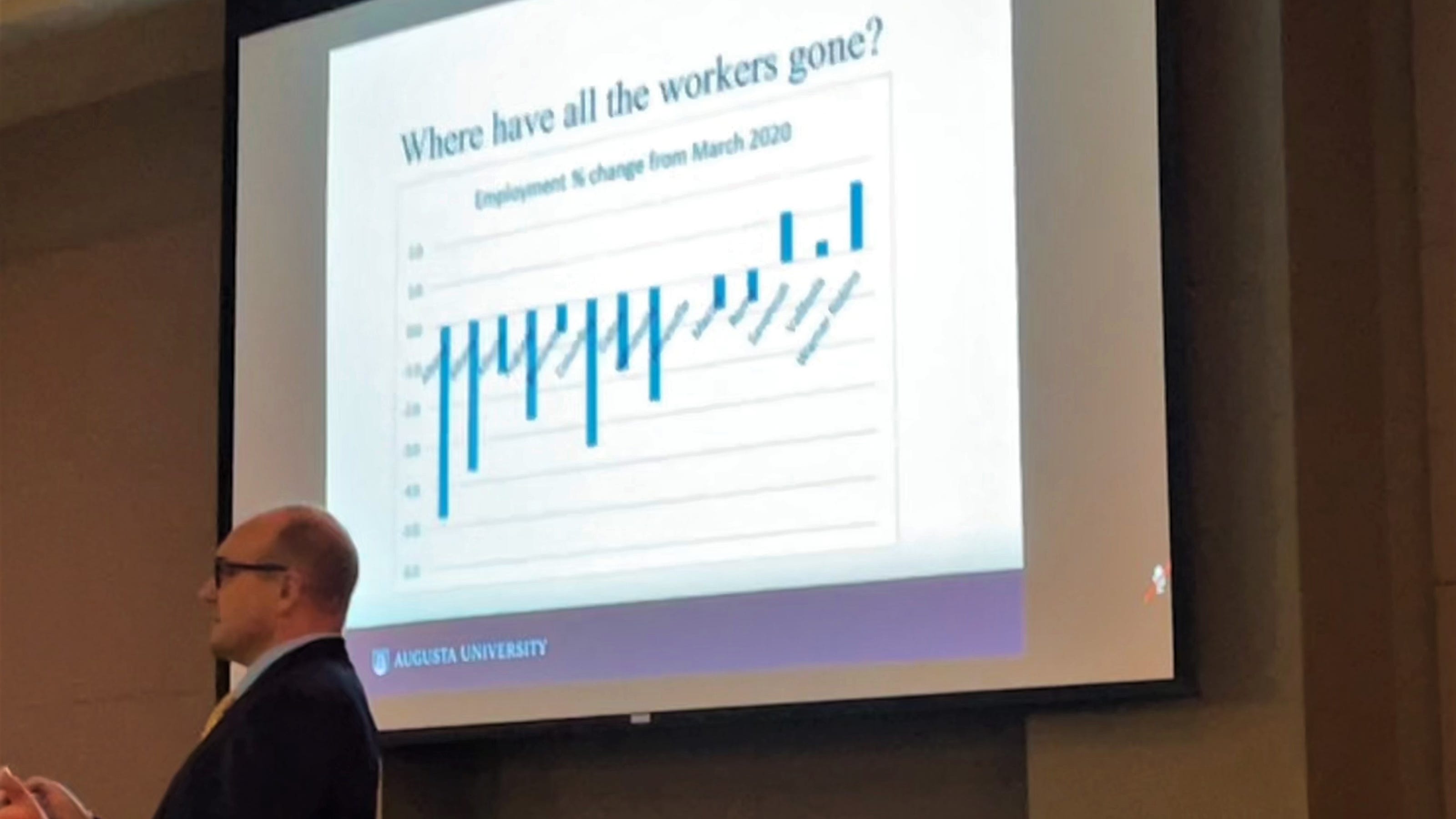
As the legendary political guru James Carville used to say, "It’s the economy, stupid." And these days with housing prices, inflation and the cost of living all pointing up in a very steep trajectory – the state of the economy is front and center for a lot of politicians, Americans and families as the year comes to a close. There’s a lot to be considered, and that’s where experts like Augusta’s Dr. Simon Medcalfe are being sought out to explain economic trends what is behind them. “U.S. retail sales are high,” explains Medcalfe “We had a lot of stimulus checks coming through the door and that’s really spurred extra spending and it’s across a whole range of retail sectors.” According to Medcalfe, household items are also seeing double-digit price increases. “What we’ve seen over the last 18 months during the pandemic, is a shift in our consumer preferences and consumer behavior.” • Furniture sales are up 29% • Used cars and cars in general are up 25-26% • Gardening and building supplies are up 14% • Electronics have seen an almost 30% increase • Clothing sales are up a whopping 50% But it’s not all good news - as the price of everything as we know is going up. “Inflation is running about 6.8% nationally,” Medcalfe explains. “It’s running about 7.2% in the south and it’s certainly a concern of policymakers and economists.” But theirs is sunshine behind those clouds as Medcalfe believes 2022 will see a return to normal. “I think next year inflation will come down. I know it won’t be at these high levels, but I still think it’ll be above the Feds target level of inflation, so look for those interest rate increases next year.” The economy and what to expect locally and nationally are hot topics – and if you are a reporter covering this topic – that’s where we can help. Dr. Simon Medcalfe is a highly regarded economics expert and the Cree Walker Chair in the Hull College of Business at Augusta University. Medcalfe is available to speak with media regarding the economy and its outlook – simply click on his icon now to arrange an interview today.



MEDIA RELEASE: Is your vehicle ready for winter? What you need to do to prepare for the season ahead
Temperatures are getting colder, Ontarians are bundling up, and CAA South Central Ontario (CAA SCO) is recommending that now is the right time to get your vehicle winter ready. “Preparing for unpredictable driving conditions will help ease the frustration and anxiety that comes with colder weather,” says Kaitlynn Furse, director, corporate communications, CAA Club Group. “Before the winter season starts ensure your car is in tip top shape.” If you’re uncertain of when or how to get ready for winter driving, the top three things you can do right now are: packing an emergency roadside kit, installing your winter tires, and checking your car battery. CAA recommends packing a fully stocked emergency roadside kit so in case something does happen while on the road, you have everything to stay safe until help arrives. The kit should include a flashlight and extra batteries, warning devices (e.g., flares, reflective vests/strips), a first aid kit, blankets, jumper cables, non-perishable food and water plus a phone charger. Be sure to also keep an ice scraper, small shovel and snow brush handy in your car at all times. With the temperature consistently hovering around 7° Celsius, it’s important to install four matching winter tires to fully optimize your vehicle’s handling, stability and braking. “Compared to all-season tires, winter tires stay flexible in cold temperatures giving you better traction, whether or not there’s snow on the ground,” says Furse. “This may reduce your stopping distance by a few feet which can be the reason for preventing a collision.” While installing your winter tires, CAA recommends also asking your mechanic to check your car battery. “Even a fully charged battery can lose power when the temperature dips below 0° Celsius,” says Furse. “It’s important to have your car battery tested in the fall to ensure it’s ready for the winter.” Are you unsure if your car battery will make it through the winter months? Watch for the following warning signs that a battery may need to be replaced: Your vehicle cranks slowly when trying to start. It takes 175 to 250 amps of battery power to get a car going. If your car is slow to start, you might be dealing with an insufficient charge. Your headlights dim while idling. When idle, a car may draw more power than the alternator alone can produce, so your battery kicks in. If your headlights dim when you are idling but brighten when you rev the engine, it could mean a drained battery. Your digital systems power down quickly. Electronics like the radio, GPS, dash cams and other accessories, especially in modern cars, use battery power when the engine is off. If they stop functioning properly, it could suggest a weak battery. You hear a grinding, clicking or buzzing noise when you turn on the ignition. It’s important to be able to distinguish the reason your vehicle may be making noises, usually these sounds mean your battery has lost its charge but if you’re still unsure, get your vehicle checked by a professional. Your vehicle has stalled. The stored energy in your car battery is essential for starting the engine, without its juice, you won’t be going far. If your battery is giving you problems or you are unsure if it’s time to replace it, you can call CAA’s Mobile Battery Service at *222 to have a trained CAA SCO Battery Service Representative come test your battery and provide a helping hand.
