Experts Matter. Find Yours.
Connect for media, speaking, professional opportunities & more.

Expert Insight: The Hidden Costs of Staying Neutral
Considering the number of hot-button issues and divisiveness in American culture, choosing a middle-of-the-road attitude might be seen as the best way to navigate an often volatile environment. But what about those individuals who choose neutrality as a means of staying below the radar and, thereby, avoiding the need to take any action? This is the question that Laura Wallace, assistant professor of organization and management at Emory’s Goizueta Business School, and coauthors ask in their new paper, The Preference for Attitude Neutrality. Published in the Journal of Experimental Psychology: General, the researchers explore individuals with a preference for neutrality and how their uncompromising commitment to neutral opinions, not only discourages rigorous debate but could have a deleterious impact on society. Emory Business recently caught up with Wallace to discuss her research. Emory Business: What sparked your interest in the preference for neutrality? Wallace: When we think about the problems in the world, often people point to too many extreme opinions as the source of much social ill, and, of course, they can be. But, when I thought about a lot of the issues that I cared about, like addressing climate change or gun violence, I felt that sometimes the issue was too much neutrality in the face of issues that were themselves pretty extreme. When I talk about this work, people can often picture someone who seems like a “Pref Neutral,” as we have affectionately nick-named them, that is someone who in the face of information suggesting that there is an extreme problem is not moved to address the issue. I could think of people in my life who had these reactions, and I was interested in understanding more about them. Emory Business: How did you identify these individuals? Wallace: We developed a scale to assess the extent to which people view neutrality as truer, more socially desirable, and more moral. For example, we ask people how much they agree with items like, “If you have all the facts about a topic, your opinion will generally end up somewhere neutral” and “There is something noble about remaining in the middle about controversial topics.” The more someone agrees with these items, the more we would say they have a preference for neutrality. Emory Business: How does this study fit in with your larger body of work? Wallace: I generally think of my program of research as studying the “psychology of social change.” Within that broad category, I study 1) how to change minds and build trust and 2) how to address societal disadvantage. I view this work as fitting in the first bucket about how we change people’s minds. What interests me about people who are high in the preference for neutrality is the fact that they seem to NOT change their minds in the face of extreme information suggesting that they should. These individuals represent a significant barrier to our ability to address pressing issues, so I view this work as very much tied into the overarching goal of my research program to understand social change (or the lack thereof). Laura Wallace is an assistant professor of organization and management at Emory University’s Goizueta Business School. Wallace studies how to build trust with implications for addressing societal disadvantage, changing minds, and fostering growth. View her profile Emory Business: Would you describe a preference for neutrality to be a mindset, strategy, or attitude/value? Wallace: I think of the preference for neutrality like an ideology or value system that guides people’s reactions across many issues and situations. Emory Business: Talk about the study design. It’s quite detailed and multilayered, with eight hypotheses and six different measures to account for potential bias that were then randomized to create different questionnaires given to a large pool of individuals. How did the coauthors agree on the structure? Wallace: First, I should take the opportunity to shout out Thomas Vaughan-Johnston, who led this work. He is a faculty member at Cardiff University and is just a very thoughtful, interesting researcher, and he’s great to work with. Second, there are a number of studies in the paper. For each, our research team worked together to design and interpret the studies. The paper paints a relatively negative view of Pref Neutrals. We did take measures to resist bias in our design. For instance, we didn’t just ask people how much they dislike extremists (which would have been biased towards making those with a preference for neutrality look bad), but also asked about attitudes towards neutrals (where those with a preference for neutrality may seem like “the nice people”). We are now starting research on contexts where a preference for neutrality can offer some advantages, hopefully without artificially striking a false balance. For instance, we are considering whether they can help reduce group polarization effects, especially where groups drift towards radicalism in conversation. Also, we have some preliminary data where they seem to be a bit more accurate when detecting neutral emotions and attitudes in others, which is a remarkable plus side. Basically, we think the preference for neutrality is a social concern, but we are trying to be fair-minded when considering why they think this about neutrality and when this trait is useful for the world. Emory Business: In the study, you note that preference for neutrality can be a sign of arrogance and that Pref Neutrals are uninterested in learning more or changing their stance. How is this arrogance exhibited? Wallace: I would say that they are more close-minded than arrogant and that they don’t seem to be particularly thoughtful. One way we have assessed this is by measuring their “intellectual humility,” which essentially captures how much people recognize the limits of their own perspectives and are open to changing their minds. Pref Neutrals tend to score low on intellectual humility. They also score a little low on the “need for cognition,” which captures how much people like to think. Emory Business: In one section it reads: “preference for neutrality (preference for extremity) should relate to seeing other people as moral, competent, and likeable, when those individuals have generally neutral (extreme) opinions.” Does this mean that they align with people who have their same opinion structure? Wallace: We find that people who score high on the preference for neutrality scale tend to have more favorable impressions of others who are more neutral and tend to be more persuaded by others who are labeled as holding neutral attitude positions. Emory Business: How would one identify this trait in a person, particularly, when the research shows they tend to self-censor? Wallace: In general, they are really hesitant to take stances on issues or they tend to avoid taking sides or expressing strong positions. And yes, they tend to self-censor, meaning they often avoid sharing their opinion at all. Emory Business: How does this preference for neutrality play out in a political sense? Specifically, if they are averse to extremes would they vote based on their values? Wallace: We have a lot of evidence that Pref Neutrals tend to be political centrists. We don’t have evidence for this, but I suspect that they sit out a lot of elections, and to the extent that they do vote, they favor more moderate candidates. They probably would not vote for a position or individual with an extreme view unless it was framed as neutral. This may sound like a silly, cerebral point, but I actually think it’s critical to the point we are making, as what is viewed as “extreme” in a given time is often socially determined. For example, now it would be viewed as an extreme stance to support slavery. However, in the early 1800s in the U.S., it would have been viewed as an extreme stance to oppose slavery. I imagine at the time, many Pref Neutrals were supportive of slavery as a means of being politically moderate. Emory Business: What was the most interesting result in this study for you? Wallace: We find that if you give Pref Neutrals the exact same information but label it as extreme or neutral, they are more persuaded by the exact same information when it is labeled as neutral. This results in a kind of ironic effect where they actually end up with a more extreme opinion when information has been labeled as neutral. Emory Business: Research wise, what’s next for you? Wallace: There are a few ways that we are following up on our work that I am excited about: First, we’re trying to understand more about how Pref Neutrals maintain neutral opinions in the face of extreme information. So, we are giving Pref Neutrals true, extreme facts, and then examining their thoughts to determine how they resist taking the extreme positions information would suggest that they should. Second, we thought that Pref Neutrals would be particularly likely to trivialize social issues, to say they are unimportant. We are actually finding that they rate all social issues as extremely important, which we are trying to understand more about. We suspect they might do this as a strategy to avoid taking action on social issues. If stubbed toes and human trafficking are both “extremely” important, then there are just too many issues to take action on, and so they are able to justify a lack of action. Third, we are interested in understanding what it is like to make decisions in a group with a Pref Neutral. There is a lot of evidence that groups tend to make bad decisions because people want to agree with each other. This might actually be an area where Pref Neutrals would shine – the fact that they don’t want to take a stance may force groups they are a part of to really think things through and make better decisions. This is all super preliminary, but it reflects the exciting work ahead and that there is much more to understand about these folks!



University of Delaware biomedical engineer helps develop first immune-capable cervix-on-a-chip
A major breakthrough in biomedical engineering is changing how scientists study sexually transmitted infections (STIs) – and a researcher from the University of Delaware is at the forefront. Published in Science Advances, the study introduces the first immune-capable “cervix-on-a-chip,” a cutting-edge microphysiological system that replicates the human cervical environment. The platform allows researchers to observe how infections, the immune system and the vaginal microbiome interact in real time – something not previously possible with traditional lab models. Co-lead author Jason Gleghorn, associate professor in the College of Engineering, led the development of the model. His work highlights how engineering-driven approaches are advancing critical research in women’s health. By integrating engineering with biology, we can now simulate complex human systems more accurately and make these tools accessible to a wider range of researchers, Gleghorn said. The model recreates key features of the cervix using human cells, immune components and naturally occurring microbiomes within a dynamic system that mimics physiological conditions. When tested with infections such as chlamydia and gonorrhea, the platform revealed how protective bacteria can reduce infection risk – while imbalanced microbiomes can worsen outcomes. These findings could help accelerate the development of new therapies, including probiotics and other preventative strategies aimed at strengthening the body’s natural defenses. The research underscores the growing impact of the College of Engineering, where interdisciplinary collaboration is driving innovation across biomedical engineering and beyond. By combining expertise in engineering, microbiology and immunology, the team has created a powerful new tool that could reshape how STIs – and other complex diseases – are studied. To speak with Gleghorn further about this advancement, email mediarelations@udel.edu.


The Impacts of Stronger El Niño Conditions on LI
Jase Bernhardt, Hofstra University associate professor of geology, environment, and sustainability and director of meteorology, spoke to Newsday to explain how strong El Niño weather conditions could impact the region. “It often leads to the earth’s atmosphere warming,” said Dr. Bernhardt. “It could be expected that this year could be the warmest on record, if El Niño pans out.” He added that El Niño also “plants the seeds for more coastal storms in the late fall and winter.”



Using AI tools empowers and burdens users in online Q&A communities
Whether you’ve searched for cooking tips on Reddit, troubleshooted tech problems on community forums or asked questions on platforms like Quora, you’ve benefited from online help communities. These digital spaces rely on people across the world to contribute their knowledge for free, and have become an essential tool for solving problems and learning new skills. New research reveals that generative artificial intelligence tools like ChatGPT are creating a double-edge effect on users in these communities, simultaneously making them more helpful while potentially overwhelming them to the point of decreasing their responses. “On the positive side, AI helps users learn to write more organized and readable answers, leading to a noticeable increase in the number of responses,” explained Liangfei Qiu, Ph.D., study coauthor and PricewaterhouseCoopers Professor at the University of Florida Warrington College of Business. “However, when users rely too heavily on AI, the mental effort required to process and refine AI outputs can actually reduce participation. In other words, AI both empowers and burdens contributors: it enables more engagement and better readability, but too much reliance can slow people down.” The study examined Stack Overflow, one of the world’s largest question-and-answer coding platforms for computer programmers, to investigate the impact of generative AI on both the quality and quantity of user contributions. Qiu and his coauthor Guohou Shan of Northeastern University’s D’Amore-McKim School of Business measured the impact of AI on users’ number of answers generated per day, answer length and readability. Specifically, they found that users who used AI tools to generate their responses contributed almost 17% more answers per day compared to those who didn’t use AI. The answers generated with AI were both shorter by about 23% and easier to read. However, when people relied too heavily on AI tools, their participation decreased. Qiu and Shan noted that the additional cognitive burden associated with heavier AI usage negatively affected the impact on a user’s answer quality. For online help communities grappling with AI policies, this research provides valuable insight into how these policies can be updated in the current AI environment. While some communities, like Stack Overflow, have banned AI tools, this research suggests that a more nuanced approach could be a better solution. Instead of banning AI entirely, the researchers suggest striking a balance between allowing AI usage while promoting responsible and moderated use. This approach, they argue, would enable users to benefit from efficiency and learning opportunities, while not compromising quality content and user cognition. “For platform leaders, the takeaway is clear: AI can boost participation if thoughtfully integrated, but its cognitive demands must be managed to sustain long-term user contributions,” Qiu said.


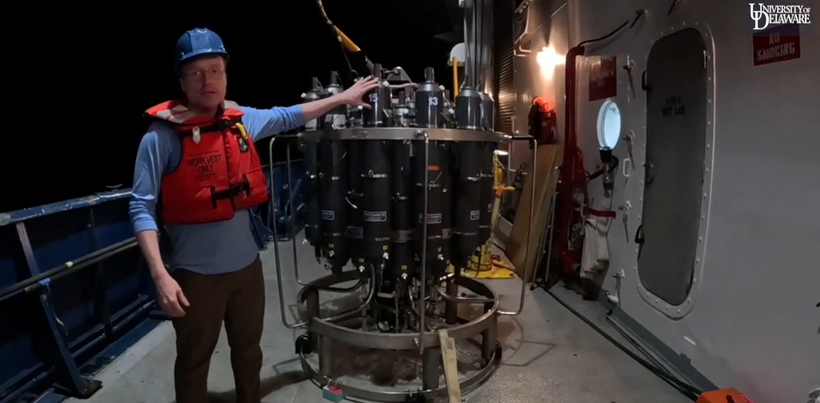
Robotics help solve deep Sea Mysteries
UD's College of Earth, Ocean and Environment uses robotics currently operated by the National Deep Submergence Facility (NDSF) to study the depths of the ocean. These expeditions ranged from the East Pacific Rise to the Mid-Atlantic Ridge. The vehicles include the Human Occupied Vehicle (HOV) Alvin, the Remotely Operated Vehicle (ROV) Jason and the Autonomous Underwater Vehicle (AUV) Sentry. What it is: A CTD (Conductivity, Temperature, Depth) instrument is a key oceanography tool that collects deep-water samples using remotely triggered Niskin bottles at specific depths. How it helps: These measurements help scientists understand ocean processes, including carbon cycling and life systems, which are essential to understanding Earth’s overall functioning. To find out more or to speak with speak associate professor Andrew Wozniak about this deep-sea technology, reach out to MediaRelations@udel.edu.

Rip Current Simulations Save Lives
Jase Bernhardt, Hofstra University associate professor of geology, environment, and sustainability and director of meteorology, was referenced in a USA Today article about simulations that teach the public about rip current safety. For years, Dr. Bernhardt has been leading research that offers a virtual reality simulation of being caught in a rip current and teaches ways swimmers can navigate to safety. The development of this technology is supported in part by New York Sea Grant (NYSG).

Finding joy in learning: How lighthearted moments transform English as a Foreign Language classrooms
In classrooms, not every meaningful learning moment can be planned. At the University of Delaware, educator and researcher Chad Davidson is exploring how spontaneous, lighthearted interactions between teachers and students can open the door to deeper understanding in real time. His recent paper in Language Teaching and Educational Research, "Exploring Spontaneous Acts of Lightheartedness in EFL Classrooms: A Reflective Duoethnography", examines how these unscripted moments – rooted in trust, positivity and a willingness to embrace the unexpected – help create environments where students feel comfortable taking the risks essential to learning. In this Q&A, Davidson discusses the inspiration behind his research, what he’s discovered about these classroom dynamics and how they could shape teaching practices moving forward. Q: What is the focus of this research, and why is it important? Davidson: Spontaneous acts of lightheartedness promote real-time learning because it's being open to the unknown in positive ways since the true dynamic of every classroom brings continuous unknowns: A teacher never knows 100% how the students will react (these students, in these moods, on this day, etc.), how quickly they will learn or pick up on something or not. A teacher, hence, spontaneously responds in real-time to the until-then-unknown student reactions in order for those particular students best to then grasp the concept or skill that is the present goal (or “learning objective”) that those students grasp. The hope is that the teacher's spontaneous response (as it often is with many teachers) is positive and lighthearted in order to foster students to also be open to such unpredictability in the classroom and to foster students' comfortability with the vulnerability to be open to taking spontaneous risks that are necessary for that transformation that we call learning – transforming from lack of knowledge to knowledge, from lack of understanding to understanding, from lack of mastery to further mastery. Q: What are some key findings or developments? Davidson: Realizing the essential features that make up spontaneous lighthearted classroom acts; for example, these acts must include trust of the student(s) and from the student(s), and the acts must have good-intentions of creating or maintaining a relaxed environment conducive to safely taking risks for potential learning. Q: How could this work potentially impact the field or the wider public? Davidson: This could foster this act type in classrooms. That is, hopefully more teacher-practitioners will allow themselves and their students to freely enact these in their daily in-class teaching/learning-attempts. Q: What are the next steps or upcoming milestones in your research? Davidson: We incorporated some valuable insights of Mexican philosopher Jorge Portilla. While there is a glut of usage of German, French, British and American philosophers, there is almost no usage of Hispanic or Latin American philosophers in education literature. It would be great to do more work that makes use of the profound thought in the works of Latin/Hispanic philosophers. For me, this would be continuing to go more deeply in applying Jorge Portilla's thought to philosophy of education, such as to classroom management. ABOUT CHAD DAVIDSON Instructor Chad C. Davidson has a Ph.D. in curriculum and instruction with an emphasis in philosophy of language education. He has 17 years of language teaching experience, primarily in teaching and curriculum creation for English for Academic Purposes at various colleges and universities across America (University of Delaware, Kansas State University, Georgia Tech, North Orange County Community College, Johnson County Community College), in Russia (Udmurt State University), and in Turkey (Mus Alparslan University). Moreover, he has studied languages at the following universities abroad: Universidad Autónoma de Guadalajara in Mexico, Universidade do Porto in Portugal, and Aristotle University of Thessaloniki in Greece. To speak with Davidson about his work and the importance of spontaneous acts of lightheartedness, reach out to MediaRelations@udel.edu.
One year after his pioneering flight aboard Blue Origin’s New Shepard rocket, University of Florida space biologist Rob Ferl, Ph.D., is still processing what it meant — not just for his career, but for science itself. “What stands out the most is just the overwhelming gratitude,” Ferl said. “It was such an amazing opportunity for a scientist to go to space and actually do science.” Ferl, a professor in UF’s Horticultural Sciences Department, Director of the Astraeus Space Institute, and Assistant Vice President of Research, became one of the first space biologists to fly alongside his own experiment — a moment that marked a new era in researcher-led missions. His suborbital journey provided a rare opportunity to study how terrestrial biology responds to the very first moments of spaceflight. “For decades, space biology has relied on professional astronauts to carry out experiments designed by scientists on Earth,” Ferl explained. “But to truly understand how biology works in space, I believe you - as the scientist - have to be there. You have to feel the environment.” This September, Ferl and longtime collaborator Anna-Lisa Paul, Ph.D., will be back at Blue Origin’s West Texas launch site, continuing their work with a new series of plant experiments. Ferl and Paul, who directs UF’s Interdisciplinary Center for Biotechnology Research and is a professor in Horticultural Sciences, are tracking fluorescently tagged genes in Arabidopsis plants to study how gene expression changes during the rapid shift from Earth’s gravity to the microgravity of spaceflight and back again. It’s a full-circle moment for Ferl, who remains deeply engaged in the same questions that sent him to space a year ago. Unpacking the Transition from Earth to Space Ferl’s experiment focused on the early metabolic responses of plants during the critical transition from Earth’s gravity to the weightlessness of space. “The scientific community has accumulated plenty of data comparing biology in orbit with that on Earth,” he said. “But we’ve known almost nothing about what happens in those first few minutes as organisms enter space and are exposed to microgravity.” Initial results from the flight reveal intense metabolic changes in the early moments of spaceflight. These changes are distinct from, but connected to, the long-term adaptations seen in orbit. Early Findings, Future Impact While the data from Ferl’s experiment are still on the way to being published, the findings are already shaping the direction of ongoing research. The work contributes to a growing understanding of how terrestrial life, from plants to humans, shares fundamental pathways in responding to the space environment. “This has real implications for the future of space missions,” Ferl noted. “As we send more people and more biology into space in support of exploration, we need a comprehensive understanding of how living systems adapt — right from the start.” Ferl and his team will return to Blue Origin’s launch site in Texas in September to continue their research, sending an uncrewed payload of plants into suborbital space. The flight carries no humans—but it does carry an automated experiment designed to advance their understanding of plant biology in space. It’s part of a broader effort to refine what Ferl calls “researcher-tended missions.” A New Course for UF Space Science The mission has not only shaped the trajectory of Ferl’s research, it has also energized Astraeus and the university’s space biology efforts. “This is about building a new kind of science culture,” Ferl said. “One where the scientists are embedded in every part of the mission, from experiment design to the moment of launch.” As the one-year anniversary of his flight approaches, Ferl remains focused on pushing the boundaries of what science in space can be. But he hasn’t forgotten the magnitude of the moment. “Even a year later,” he said, “the most powerful thing I feel is just: thank you. Thank you for the chance to go, to see it for myself, and to bring that knowledge back to Earth.”



Workplace jargon hurts employee morale, collaboration, study finds
You’ve probably heard it before in a meeting: “Let’s touch base offline to align our bandwidth on this workflow.” Corporate jargon like this is easy to laugh at — but its negative impact in the office can be serious. According to a new study, using too much jargon in the workplace can hurt employees’ ability to process messages, leading them to experience negative feelings and making them feel less confident. In turn, they’re less likely to reach out and ask for or share information with their colleagues. “You need people to be willing to collaborate, share ideas and look for more information if they don't understand something at work,” said Olivia Bullock, Ph.D., an assistant professor of advertising at the University of Florida and co-author of the new study. “And jargon might actually be impeding that information flow across teams.” Age made a difference, though. Older workers had a harder time processing jargon, but were more likely to intend to ask for more information to clarify the message. Younger employees were less likely to seek and share information when confused by jargon. “It gives credence to the idea that younger people are more vulnerable to these workplace dynamics,” Bullock said. “If you're onboarding younger employees, explain everything clearly.” Bullock and her co-author, Tiffany Bisbey, Ph.D., an assistant professor at George Washington University, published their findings Aug. 25 in the International Journal of Business Communication. An expert in communication research, Bullock has long studied jargon’s negative effects for talking about health and science. Then, faced with jargon in her own work, she started to ask how these arcane, technical words might get in the way of a smooth workplace. To find out, Bullock surveyed nearly 2,000 people who were told to imagine they had just started a new job and received an email with important directions. Half had to navigate a jargon-filled message about “intranets” and “EFT” payments. The other half had that jargon translated back into plainer language. The message packed with jargon, not surprisingly, made it harder for people to process the information, which can throw off an entire workday. “It doesn't just make them feel bad about the information they've been given. It makes them feel bad about themselves,” Bullock said. The study then asked people how they would respond to the jargon. The impenetrable language made them feel insecure and less likely to ask for help right when they needed it the most. “They weren’t as willing to collaborate,” Bullock said. “If you can’t ask for more information or share that information downstream, you’re creating silos, and that’s disrupting your workflow and environment.” Having studied jargon for so long, Bullock has one piece of advice for employers and employees alike. “Always reduce jargon,” she said. “The benefit of using jargon doesn’t outweigh the cost.”


With lasers, smoke and a wind tunnel, UF helps federal agency investigate deadly Hurricane Maria
As Floridians brace for hurricanes amid the wild weather of 2025, some University of Florida researchers have their eyes on 2017’s Hurricane Maria, the deadly Category 4 storm that pummeled Puerto Rico. Engineering professor and natural hazards researcher Brian Phillips, Ph.D., is leading UF’s efforts in a Hurricane Maria investigation conducted by the National Institute of Standards and Technology, known as NIST. The goal is increased safety and resilience amid deadly conditions. Maria killed nearly 3,000 people and caused more than $90 billion in damage. Most of the island’s wind sensors and weather stations failed as the storm raged, leaving responders and investigators with few reliable weather measurements. What went wrong? Phillips and UF storm researchers are helping answer that question — and provide safety and structural recommendations — as part of NIST’s Hurricane Maria investigation. The full report will be released in 2026, but NIST recently published preliminary findings; some of the hazard and structural load data was derived from wind tunnel tests at UF's NHERI Experimental Facility in the Powell Family Structure and Materials Laboratory on UF’s East Campus in Gainesville. “Our wind tunnel has a strong reputation in the wind-engineering community for its unique flow control and measurement capabilities We worked with NIST to develop a test campaign to study the wind conditions Puerto Rico’s mountainous terrain and the resulting loads of critical infrastructure,” said Phillips, a civil and coastal engineering professor with UF’s Engineering School of Sustainable Infrastructure & Environment. “UF,” he added, “has one of the premier research wind tunnels in the country and it enables us to pursue impactful research like this.” As part of the NIST investigation, Phillips and his team created 1-to-3100 scale topographic models of regions in Puerto Rico — about 12 kilometers shrunk down to four meters, Phillips said. They set up those models in the wind tunnel and replicated wind flow over the topography. “These initial tests were designed to understand the influence of the complex topography had on the wind,” Phillips said. Flow was measured using velocity probes and particle image velocimetry (PIV). These topographic model tests were followed by 1-to-100 scale tests on models of two hospitals in Puerto Rico. In addition to surface pressure measurements, the team conducted qualitative flow visualization tests using smoke, lasers, and high-speed cameras. “The capabilities of the UF wind tunnel enabled us to investigate the hurricane winds at two different scales,” said NIST’s lead Hurricane Maria investigator, Joseph Main, “so we could measure how the winds were accelerated by Puerto Rico’s mountainous topography and then how those winds translated into loads on critical buildings.” Maria’s flooding blocked roads to hospitals and shelters. The hospitals themselves were heavily damaged by the storm, NIST reported. Reduced access to healthcare was a major factor in the death toll. “It's good to take a step back,” Phillips said about the overall investigation. “Researchers are approaching the disaster from multiple angles, including the better understanding of the hazard, the performance of critical infrastructure, public response and recovery. “This holistic approach is needed to capture the complete picture and maximize what we can learn from the event. UF's primary contribution was understanding the hurricane wind field and the resulting structural loads, which is a critical piece of that puzzle.” In finding infrastructure vulnerabilities, researchers contend the goal is integrating their findings into design standards for Puerto Rico’s unique topography and building codes. The findings also could be valuable to other storm-prone regions with complex topography. NIST launched the investigation in 2018, noting Hurricane Maria “set off a cascade of building and infrastructure failures across Puerto Rico that had lasting impacts on society, including health care, business and education.” “Our goal is to learn from that event to recommend improvements to building codes, standards and practices that will make communities more resilient to hurricanes and other hazards, not just in Puerto Rico but across the United States,” Main said. The complete report is scheduled to be released in 2026, and NIST noted some findings may change before its release. But in July, NIST released some preliminary findings. They include: Peak wind speeds over flat terrain reached 140 mph. They accelerated to over 200 mph in some areas due to the steep hills and mountains. The mountains also intensified the rainfall, which reached 30 inches in some areas. Only three out of 22 weather stations were fully functional during the hurricane. 95.3% of schools on the island lost power for an average of over 100 days. “One important preliminary finding from the study is that emergency preparations work,” NIST reported. “Businesses, schools and hospitals that took specific measures to prepare before Hurricane Maria were able to resume operations more quickly” said Maria Dillard, NIST’s associate lead Hurricane Maria investigator. Preparations included pre-established emergency plans, designated risk mitigation funds and backup power sources.