
Experts Matter. Find Yours.
Connect for media, speaking, professional opportunities & more.

Using AI tools empowers and burdens users in online Q&A communities
Whether you’ve searched for cooking tips on Reddit, troubleshooted tech problems on community forums or asked questions on platforms like Quora, you’ve benefited from online help communities. These digital spaces rely on people across the world to contribute their knowledge for free, and have become an essential tool for solving problems and learning new skills. New research reveals that generative artificial intelligence tools like ChatGPT are creating a double-edge effect on users in these communities, simultaneously making them more helpful while potentially overwhelming them to the point of decreasing their responses. “On the positive side, AI helps users learn to write more organized and readable answers, leading to a noticeable increase in the number of responses,” explained Liangfei Qiu, Ph.D., study coauthor and PricewaterhouseCoopers Professor at the University of Florida Warrington College of Business. “However, when users rely too heavily on AI, the mental effort required to process and refine AI outputs can actually reduce participation. In other words, AI both empowers and burdens contributors: it enables more engagement and better readability, but too much reliance can slow people down.” The study examined Stack Overflow, one of the world’s largest question-and-answer coding platforms for computer programmers, to investigate the impact of generative AI on both the quality and quantity of user contributions. Qiu and his coauthor Guohou Shan of Northeastern University’s D’Amore-McKim School of Business measured the impact of AI on users’ number of answers generated per day, answer length and readability. Specifically, they found that users who used AI tools to generate their responses contributed almost 17% more answers per day compared to those who didn’t use AI. The answers generated with AI were both shorter by about 23% and easier to read. However, when people relied too heavily on AI tools, their participation decreased. Qiu and Shan noted that the additional cognitive burden associated with heavier AI usage negatively affected the impact on a user’s answer quality. For online help communities grappling with AI policies, this research provides valuable insight into how these policies can be updated in the current AI environment. While some communities, like Stack Overflow, have banned AI tools, this research suggests that a more nuanced approach could be a better solution. Instead of banning AI entirely, the researchers suggest striking a balance between allowing AI usage while promoting responsible and moderated use. This approach, they argue, would enable users to benefit from efficiency and learning opportunities, while not compromising quality content and user cognition. “For platform leaders, the takeaway is clear: AI can boost participation if thoughtfully integrated, but its cognitive demands must be managed to sustain long-term user contributions,” Qiu said.


Robotics help solve deep Sea Mysteries
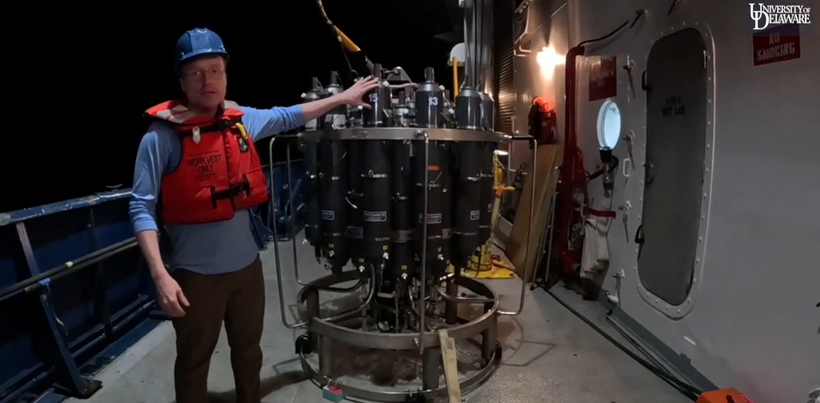
UD's College of Earth, Ocean and Environment uses robotics currently operated by the National Deep Submergence Facility (NDSF) to study the depths of the ocean. These expeditions ranged from the East Pacific Rise to the Mid-Atlantic Ridge. The vehicles include the Human Occupied Vehicle (HOV) Alvin, the Remotely Operated Vehicle (ROV) Jason and the Autonomous Underwater Vehicle (AUV) Sentry. What it is: A CTD (Conductivity, Temperature, Depth) instrument is a key oceanography tool that collects deep-water samples using remotely triggered Niskin bottles at specific depths. How it helps: These measurements help scientists understand ocean processes, including carbon cycling and life systems, which are essential to understanding Earth’s overall functioning. To find out more or to speak with speak associate professor Andrew Wozniak about this deep-sea technology, reach out to MediaRelations@udel.edu.


Rip Current Simulations Save Lives
Jase Bernhardt, Hofstra University associate professor of geology, environment, and sustainability and director of meteorology, was referenced in a USA Today article about simulations that teach the public about rip current safety. For years, Dr. Bernhardt has been leading research that offers a virtual reality simulation of being caught in a rip current and teaches ways swimmers can navigate to safety. The development of this technology is supported in part by New York Sea Grant (NYSG).



Finding joy in learning: How lighthearted moments transform English as a Foreign Language classrooms
In classrooms, not every meaningful learning moment can be planned. At the University of Delaware, educator and researcher Chad Davidson is exploring how spontaneous, lighthearted interactions between teachers and students can open the door to deeper understanding in real time. His recent paper in Language Teaching and Educational Research, "Exploring Spontaneous Acts of Lightheartedness in EFL Classrooms: A Reflective Duoethnography", examines how these unscripted moments – rooted in trust, positivity and a willingness to embrace the unexpected – help create environments where students feel comfortable taking the risks essential to learning. In this Q&A, Davidson discusses the inspiration behind his research, what he’s discovered about these classroom dynamics and how they could shape teaching practices moving forward. Q: What is the focus of this research, and why is it important? Davidson: Spontaneous acts of lightheartedness promote real-time learning because it's being open to the unknown in positive ways since the true dynamic of every classroom brings continuous unknowns: A teacher never knows 100% how the students will react (these students, in these moods, on this day, etc.), how quickly they will learn or pick up on something or not. A teacher, hence, spontaneously responds in real-time to the until-then-unknown student reactions in order for those particular students best to then grasp the concept or skill that is the present goal (or “learning objective”) that those students grasp. The hope is that the teacher's spontaneous response (as it often is with many teachers) is positive and lighthearted in order to foster students to also be open to such unpredictability in the classroom and to foster students' comfortability with the vulnerability to be open to taking spontaneous risks that are necessary for that transformation that we call learning – transforming from lack of knowledge to knowledge, from lack of understanding to understanding, from lack of mastery to further mastery. Q: What are some key findings or developments? Davidson: Realizing the essential features that make up spontaneous lighthearted classroom acts; for example, these acts must include trust of the student(s) and from the student(s), and the acts must have good-intentions of creating or maintaining a relaxed environment conducive to safely taking risks for potential learning. Q: How could this work potentially impact the field or the wider public? Davidson: This could foster this act type in classrooms. That is, hopefully more teacher-practitioners will allow themselves and their students to freely enact these in their daily in-class teaching/learning-attempts. Q: What are the next steps or upcoming milestones in your research? Davidson: We incorporated some valuable insights of Mexican philosopher Jorge Portilla. While there is a glut of usage of German, French, British and American philosophers, there is almost no usage of Hispanic or Latin American philosophers in education literature. It would be great to do more work that makes use of the profound thought in the works of Latin/Hispanic philosophers. For me, this would be continuing to go more deeply in applying Jorge Portilla's thought to philosophy of education, such as to classroom management. ABOUT CHAD DAVIDSON Instructor Chad C. Davidson has a Ph.D. in curriculum and instruction with an emphasis in philosophy of language education. He has 17 years of language teaching experience, primarily in teaching and curriculum creation for English for Academic Purposes at various colleges and universities across America (University of Delaware, Kansas State University, Georgia Tech, North Orange County Community College, Johnson County Community College), in Russia (Udmurt State University), and in Turkey (Mus Alparslan University). Moreover, he has studied languages at the following universities abroad: Universidad Autónoma de Guadalajara in Mexico, Universidade do Porto in Portugal, and Aristotle University of Thessaloniki in Greece. To speak with Davidson about his work and the importance of spontaneous acts of lightheartedness, reach out to MediaRelations@udel.edu.
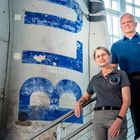
One year after his pioneering flight aboard Blue Origin’s New Shepard rocket, University of Florida space biologist Rob Ferl, Ph.D., is still processing what it meant — not just for his career, but for science itself. “What stands out the most is just the overwhelming gratitude,” Ferl said. “It was such an amazing opportunity for a scientist to go to space and actually do science.” Ferl, a professor in UF’s Horticultural Sciences Department, Director of the Astraeus Space Institute, and Assistant Vice President of Research, became one of the first space biologists to fly alongside his own experiment — a moment that marked a new era in researcher-led missions. His suborbital journey provided a rare opportunity to study how terrestrial biology responds to the very first moments of spaceflight. “For decades, space biology has relied on professional astronauts to carry out experiments designed by scientists on Earth,” Ferl explained. “But to truly understand how biology works in space, I believe you - as the scientist - have to be there. You have to feel the environment.” This September, Ferl and longtime collaborator Anna-Lisa Paul, Ph.D., will be back at Blue Origin’s West Texas launch site, continuing their work with a new series of plant experiments. Ferl and Paul, who directs UF’s Interdisciplinary Center for Biotechnology Research and is a professor in Horticultural Sciences, are tracking fluorescently tagged genes in Arabidopsis plants to study how gene expression changes during the rapid shift from Earth’s gravity to the microgravity of spaceflight and back again. It’s a full-circle moment for Ferl, who remains deeply engaged in the same questions that sent him to space a year ago. Unpacking the Transition from Earth to Space Ferl’s experiment focused on the early metabolic responses of plants during the critical transition from Earth’s gravity to the weightlessness of space. “The scientific community has accumulated plenty of data comparing biology in orbit with that on Earth,” he said. “But we’ve known almost nothing about what happens in those first few minutes as organisms enter space and are exposed to microgravity.” Initial results from the flight reveal intense metabolic changes in the early moments of spaceflight. These changes are distinct from, but connected to, the long-term adaptations seen in orbit. Early Findings, Future Impact While the data from Ferl’s experiment are still on the way to being published, the findings are already shaping the direction of ongoing research. The work contributes to a growing understanding of how terrestrial life, from plants to humans, shares fundamental pathways in responding to the space environment. “This has real implications for the future of space missions,” Ferl noted. “As we send more people and more biology into space in support of exploration, we need a comprehensive understanding of how living systems adapt — right from the start.” Ferl and his team will return to Blue Origin’s launch site in Texas in September to continue their research, sending an uncrewed payload of plants into suborbital space. The flight carries no humans—but it does carry an automated experiment designed to advance their understanding of plant biology in space. It’s part of a broader effort to refine what Ferl calls “researcher-tended missions.” A New Course for UF Space Science The mission has not only shaped the trajectory of Ferl’s research, it has also energized Astraeus and the university’s space biology efforts. “This is about building a new kind of science culture,” Ferl said. “One where the scientists are embedded in every part of the mission, from experiment design to the moment of launch.” As the one-year anniversary of his flight approaches, Ferl remains focused on pushing the boundaries of what science in space can be. But he hasn’t forgotten the magnitude of the moment. “Even a year later,” he said, “the most powerful thing I feel is just: thank you. Thank you for the chance to go, to see it for myself, and to bring that knowledge back to Earth.”


Workplace jargon hurts employee morale, collaboration, study finds
You’ve probably heard it before in a meeting: “Let’s touch base offline to align our bandwidth on this workflow.” Corporate jargon like this is easy to laugh at — but its negative impact in the office can be serious. According to a new study, using too much jargon in the workplace can hurt employees’ ability to process messages, leading them to experience negative feelings and making them feel less confident. In turn, they’re less likely to reach out and ask for or share information with their colleagues. “You need people to be willing to collaborate, share ideas and look for more information if they don't understand something at work,” said Olivia Bullock, Ph.D., an assistant professor of advertising at the University of Florida and co-author of the new study. “And jargon might actually be impeding that information flow across teams.” Age made a difference, though. Older workers had a harder time processing jargon, but were more likely to intend to ask for more information to clarify the message. Younger employees were less likely to seek and share information when confused by jargon. “It gives credence to the idea that younger people are more vulnerable to these workplace dynamics,” Bullock said. “If you're onboarding younger employees, explain everything clearly.” Bullock and her co-author, Tiffany Bisbey, Ph.D., an assistant professor at George Washington University, published their findings Aug. 25 in the International Journal of Business Communication. An expert in communication research, Bullock has long studied jargon’s negative effects for talking about health and science. Then, faced with jargon in her own work, she started to ask how these arcane, technical words might get in the way of a smooth workplace. To find out, Bullock surveyed nearly 2,000 people who were told to imagine they had just started a new job and received an email with important directions. Half had to navigate a jargon-filled message about “intranets” and “EFT” payments. The other half had that jargon translated back into plainer language. The message packed with jargon, not surprisingly, made it harder for people to process the information, which can throw off an entire workday. “It doesn't just make them feel bad about the information they've been given. It makes them feel bad about themselves,” Bullock said. The study then asked people how they would respond to the jargon. The impenetrable language made them feel insecure and less likely to ask for help right when they needed it the most. “They weren’t as willing to collaborate,” Bullock said. “If you can’t ask for more information or share that information downstream, you’re creating silos, and that’s disrupting your workflow and environment.” Having studied jargon for so long, Bullock has one piece of advice for employers and employees alike. “Always reduce jargon,” she said. “The benefit of using jargon doesn’t outweigh the cost.”


With lasers, smoke and a wind tunnel, UF helps federal agency investigate deadly Hurricane Maria
As Floridians brace for hurricanes amid the wild weather of 2025, some University of Florida researchers have their eyes on 2017’s Hurricane Maria, the deadly Category 4 storm that pummeled Puerto Rico. Engineering professor and natural hazards researcher Brian Phillips, Ph.D., is leading UF’s efforts in a Hurricane Maria investigation conducted by the National Institute of Standards and Technology, known as NIST. The goal is increased safety and resilience amid deadly conditions. Maria killed nearly 3,000 people and caused more than $90 billion in damage. Most of the island’s wind sensors and weather stations failed as the storm raged, leaving responders and investigators with few reliable weather measurements. What went wrong? Phillips and UF storm researchers are helping answer that question — and provide safety and structural recommendations — as part of NIST’s Hurricane Maria investigation. The full report will be released in 2026, but NIST recently published preliminary findings; some of the hazard and structural load data was derived from wind tunnel tests at UF's NHERI Experimental Facility in the Powell Family Structure and Materials Laboratory on UF’s East Campus in Gainesville. “Our wind tunnel has a strong reputation in the wind-engineering community for its unique flow control and measurement capabilities We worked with NIST to develop a test campaign to study the wind conditions Puerto Rico’s mountainous terrain and the resulting loads of critical infrastructure,” said Phillips, a civil and coastal engineering professor with UF’s Engineering School of Sustainable Infrastructure & Environment. “UF,” he added, “has one of the premier research wind tunnels in the country and it enables us to pursue impactful research like this.” As part of the NIST investigation, Phillips and his team created 1-to-3100 scale topographic models of regions in Puerto Rico — about 12 kilometers shrunk down to four meters, Phillips said. They set up those models in the wind tunnel and replicated wind flow over the topography. “These initial tests were designed to understand the influence of the complex topography had on the wind,” Phillips said. Flow was measured using velocity probes and particle image velocimetry (PIV). These topographic model tests were followed by 1-to-100 scale tests on models of two hospitals in Puerto Rico. In addition to surface pressure measurements, the team conducted qualitative flow visualization tests using smoke, lasers, and high-speed cameras. “The capabilities of the UF wind tunnel enabled us to investigate the hurricane winds at two different scales,” said NIST’s lead Hurricane Maria investigator, Joseph Main, “so we could measure how the winds were accelerated by Puerto Rico’s mountainous topography and then how those winds translated into loads on critical buildings.” Maria’s flooding blocked roads to hospitals and shelters. The hospitals themselves were heavily damaged by the storm, NIST reported. Reduced access to healthcare was a major factor in the death toll. “It's good to take a step back,” Phillips said about the overall investigation. “Researchers are approaching the disaster from multiple angles, including the better understanding of the hazard, the performance of critical infrastructure, public response and recovery. “This holistic approach is needed to capture the complete picture and maximize what we can learn from the event. UF's primary contribution was understanding the hurricane wind field and the resulting structural loads, which is a critical piece of that puzzle.” In finding infrastructure vulnerabilities, researchers contend the goal is integrating their findings into design standards for Puerto Rico’s unique topography and building codes. The findings also could be valuable to other storm-prone regions with complex topography. NIST launched the investigation in 2018, noting Hurricane Maria “set off a cascade of building and infrastructure failures across Puerto Rico that had lasting impacts on society, including health care, business and education.” “Our goal is to learn from that event to recommend improvements to building codes, standards and practices that will make communities more resilient to hurricanes and other hazards, not just in Puerto Rico but across the United States,” Main said. The complete report is scheduled to be released in 2026, and NIST noted some findings may change before its release. But in July, NIST released some preliminary findings. They include: Peak wind speeds over flat terrain reached 140 mph. They accelerated to over 200 mph in some areas due to the steep hills and mountains. The mountains also intensified the rainfall, which reached 30 inches in some areas. Only three out of 22 weather stations were fully functional during the hurricane. 95.3% of schools on the island lost power for an average of over 100 days. “One important preliminary finding from the study is that emergency preparations work,” NIST reported. “Businesses, schools and hospitals that took specific measures to prepare before Hurricane Maria were able to resume operations more quickly” said Maria Dillard, NIST’s associate lead Hurricane Maria investigator. Preparations included pre-established emergency plans, designated risk mitigation funds and backup power sources.


AI gives rise to the cut and paste employee
Although AI tools can improve productivity, recent studies show that they too often intensify workloads instead of reducing them, in many cases even leading to cognitive overload and burnout. The University of Delaware's Saleem Mistry says this is creating employees who work harder, not smarter. Mistry, an associate professor of management in UD's Lerner College of Business & Economics, says his research confirms findings found in this Feb. 9, 2026 article in the Harvard Business Review. Driven by the misconception that AI is an accurate search engine rather than a predictive text tool, these "cut and paste" employees are using the applications to pump out deliverables in seconds just to keep up with increasing workloads. Mistry notes that this prioritization of speed over accuracy is happening at every level of the organization: • Junior staff: Blast out polished looking but unverified drafts. • Managers: Outsource their ability to deeply learn and critically think in order to summarize data, letting their analytical skills atrophy. • Power users: Build hidden, unapproved systems that bypass company oversight. A management problem, not a tech problem "When discussing this issue, I often hear leaders blame the technology. However, I believe that blaming the tech is missing the point; I see it as a failure of leadership," Mistry said. "When already overburdened employees who are constantly having to do more with less are handed vague mandates to just use AI without any training, they use it to look busy and produce volume-based work. Because many companies still reward the volume of work produced rather than the actual impact, employees naturally use these tools to generate slick but empty deliverables." "I believe that blaming the tech is missing the point; I see it as a failure of leadership. Because many companies still reward the volume of work produced rather than the actual impact, employees naturally use these tools to generate slick but empty deliverables." The real costs to organizations and incoming employees Mistry outlines three risks organizations face if they don’t intervene: 1. The workslop epidemic "These programs allow people to generate massive amounts of workslop, which is low-effort fluff that looks good but lacks substance. It takes seconds to create, but hours for someone else to decipher, fact-check, and fix," Mistry notes. "This drains money (up to $9 million annually for large companies) and destroys morale. As an educator, researcher, and a person brought into organizations to help fix problems, I for one do not want to be on the receiving end of a thoughtless, automated data dump, especially on tasks that require real skill and deep thinking." 2. Legal disaster He also states, "When the cut and paste mentality makes its way into professional submissions, the risks to the organization are real and oftentimes catastrophic. Courts have made it perfectly clear: ignorance is no excuse. If your name is on the document, you own the liability. Recently, attorneys have faced severe sanctions, hefty fines, and case dismissals for blindly submitting fake legal citations made up by computers." Click here for a list of cases. 3. A warning for incoming talent For new graduates entering this environment, Mistry offers a warning: Do not rely on AI to do your deep thinking. "If you simply use AI to blast out polished but unverified drafts, you become a replaceable 'cut and paste' employee," he says. “To truly stand out, new grads must prove they have the discernment to review, tweak, and challenge what the computer writes. The hiring edge is no longer just saying, 'I can do this task,' but 'I know how to leverage and correct AI to help me perform it.'" Four ideas to fix it To survive and indeed thrive with these new tools and avoid the unintended consequences of untrained staff, organizations should: 1. Reinforce the importance of fact-checking and editing: Adopt frameworks that teach employees how to show their work and log how they verified computer-generated facts. 2. Change the incentives: Stop rewarding busy work, useless reports, and massive slide decks. Evaluate employees on accuracy and results. 3. Eradicate superficial work: Don’t use automation to speed up ineffective legacy processes. Instead, use it to identify and eliminate them entirely. 4. Make time for editing: Give yourself and your employees the breathing room to actually review, tweak, and challenge what the computer writes instead of accepting the first draft. Mistry is available to discuss: Why AI is causing an epidemic of corporate "workslop" (and how to spot it). The leadership failure behind the "cut and paste" employee. How to rewrite corporate incentives to measure impact instead of volume in the AI era. Strategies for implementing safe, effective AI policies at work. How new college graduates can avoid the "workslop" trap in their first jobs. To reach Mistry directly and arrange an interview, visit his profile and click on the "contact" button. Interested reporters can also send an email to MediaRelations@udel.edu.
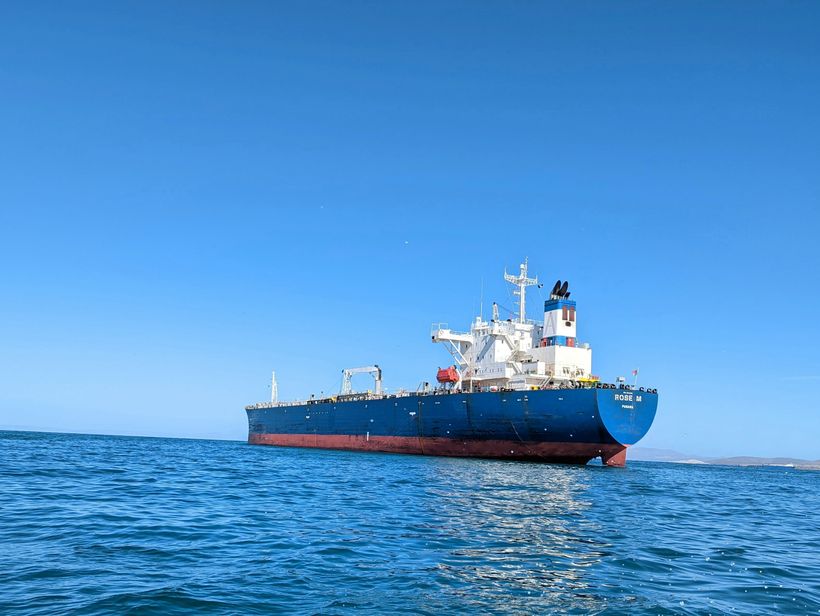
Strategic Closure of Strait of Hormuz Puts Pressure on U.S., Threatens Global Oil Trade Stability
Less than a week after the onset of the war in Iran, and amid escalating conflict in the region, Iran effectively closed the Strait of Hormuz to shipping tankers moving oil from the Middle East by threatening attacks against any vessel who entered the waterway. Thus, the small body of water, which moves a large percentage of the world’s crude oil, has become one of the most discussed places in the world in recent days. Frank Galgano, PhD, is a professor of Geography and the Environment at Villanova University. He is an expert in military and Middle East geography and has also studied global maritime shipping and access to natural resources. Dr. Galgano says there geographic, geopolitical, military and economic factors at play, along with widespread potential consequences, as Iran holds steady on their closure of the strait and the U.S. considers how, or if, it will attempt to help escort oil ships through. Geography and Significance of Strait of Hormuz Situated between Iran to the north and Oman and the United Arab Emirates to the south, the Strait of Hormuz is a narrow shipping lane that connects the Persian Gulf to the Gulf of Oman and, further out, the Arabian Sea. It is one of the most vital chokepoints in the Middle East, along with the Suez Canal, Straits of Tiran, Bab al-Mandab and the Turkish Straits. “Right now, because of oil, it is the most important,” Dr. Galgano said. “Every day, roughly 20 percent of global petrochemical use goes through Hormuz.” The strait itself is barely over 20 nautical miles at its narrowest, but only a small portion of that is shipping lanes. Depth constraints limit shipping to two lanes, each two miles wide, with a two-mile buffer between. “You’re essentially looking at all of that shipping constrained to six nautical miles, and the ships are relatively slow,” Dr. Galgano said. “There are usually about 14-25 tankers every 24 hours transiting the Gulf, so there is always a ship in line." By Iran threatening military action against any oil-carrying ships in Hormuz—and by shipping companies refusing to attempt to traverse it— one-fifth of the global oil trade is essentially cut off indefinitely. That is concerning, given that it takes very little to send global oil prices skyrocketing. Dr. Galgano referenced the 2010-11 Somali pirate issue that caused supertankers—which cost upward of $50,000 a day to operate—to be rerouted. “That alone caused gas prices to raise 10 cents per gallon,” he said. In this case, the biggest impact will be felt throughout Asia, which relies more heavily on oil imports. But the U.S., despite being the second-biggest producer of crude oil last year, will still feel significant effects, since oil is traded globally. “It takes these supertankers eight or 12 days to reach the East Coast from Hormuz,” Dr. Galgano said. “So, a few days later you might see diminished supplies, but there is a critical point where we would face a real shortage.” Attempting to Move Ships Through Hormuz Poses Huge Danger Unlike the Iranian-backed Houthi rebels attacks on Israeli ships and those belonging to its allies in the Red Sea last year, Iran itself has far more sophisticated weapons, along with a strong motive to do whatever it can to put pressure on the U.S. and involved allies. In addition to drones designed for attacking ships—like the ones used by Houthis—Iran also possesses Chinese and Russian anti-ship missiles, according to the professor. “Ships are very vulnerable,” he said, then referencing the 2000 bombing of the USS Cole by Al Qaeda operatives. “That was just two guys in a rubber boat with an explosive device, and it almost sunk the whole ship. If one is carrying oil, it becomes almost like a large fuel bomb.” The United States has weighed the idea of sending a convoy to help escort and protect these ships. They did as much in the late 1980s in Operation Earnest Will, in which President Reagan ordered Kuwaiti supertankers—which were being fired at—to reflag under the U.S. flag so the Navy could legally escort them. But weapons technology has changed, and while U.S. naval ships could certainly defend themselves, “supertankers are slow and it is still an incredibly dangerous operation,” Dr. Galgano said. “The convoy would have to be lucky 100 percent of the time. Iran would only have to be lucky once to hit a ship and cause an immediate fiasco, both physically and in the media.” Global Dependance on Shipped Goods According to Dr. Galgano, between 75 and 90 percent of all items you handle on a day-to-day basis come from inside the hull of a ship: shocks on your car, clothes on your back, or components of your computer. When shipment is disrupted, it can cause supply chain and cost issues. “During the pandemic, Ford was waiting on chips for F-150s, and HP was waiting in chemicals to make ink,” Dr. Galgano said. “Even the ship that got stuck in the Suez Canal a few years ago caused $10 billion in losses per day due to the backup.” For commodities like oil, the indefinite inability to utilize perhaps the most important shipping lanes in the world due to large scale conflict quickly raises the economic stakes to even greater levels. “Iran absolutely knows that, and they see this as a bargaining chip,” Dr. Galgano said. “Cause economic pain to force cessation of the attacks.”


Blizzard of ’26 – One for the History Books
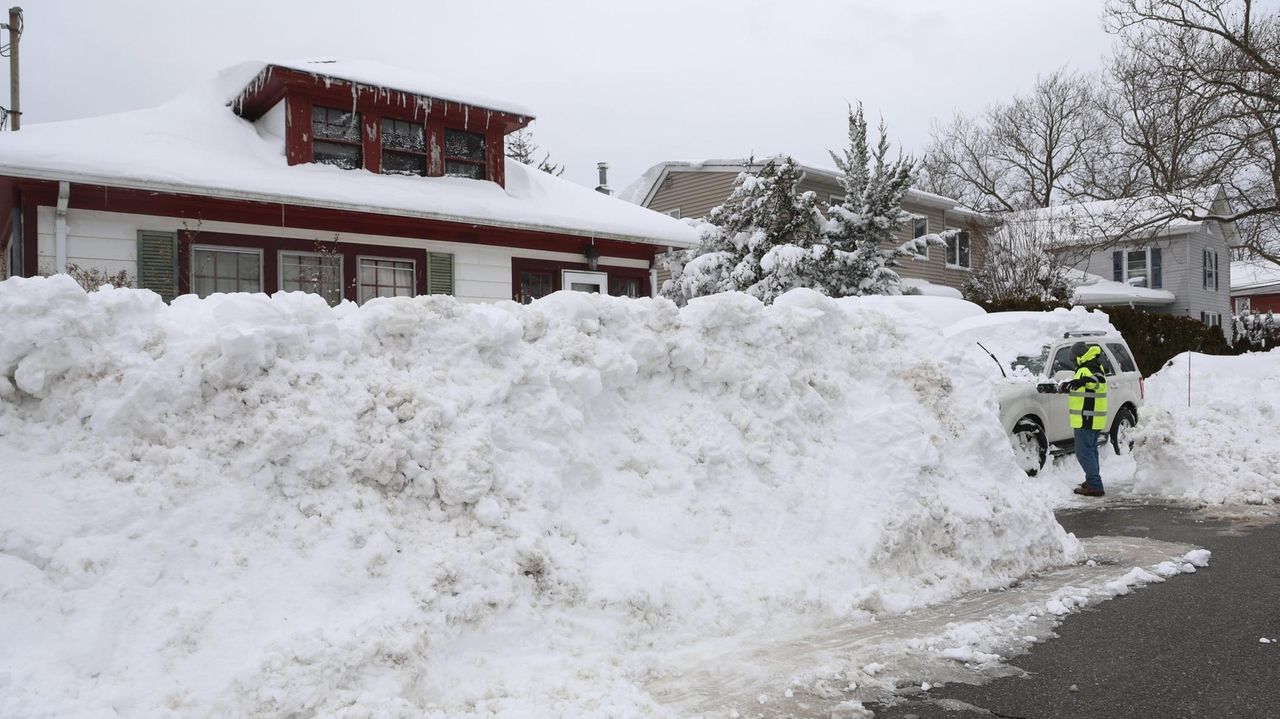
“The blizzard of ‘26 will be remembered in meteorology circles,” Dr. Jase Bernhardt told Newsday about the historic storm this week that dropped approximately 30 inches of snow on parts of Long Island. The Hofstra University associate professor of geology, environment, and sustainability and director of meteorology explained the blizzard hit what’s known as the “70/40 benchmark." That’s 40 degrees north latitude and 70 degrees west longitude, geographic coordinates for a spot over the Atlantic Ocean: “That’s the sweet spot,” said Dr. Bernhardt. “Say it tracks 50 miles south and east, that means the heaviest snow shifts farther away. If it tracks closer, oftentimes, it’s bringing in warm air closer to the center [of the storm], and if it tracks too close, it might yield heavy precipitation, but it’s going to be too warm for all snow.”