
Experts Matter. Find Yours.
Connect for media, speaking, professional opportunities & more.

Corporate Social Responsibility Builds Investor Trust
There’s little doubt that corporate social responsibility (CSR) is a good thing for businesses. Whether it’s taking positive action on society, communities, the climate, or the planet, strong corporate citizenship tends to play well with the public, the media, and consumers alike. And that can translate into wins in terms of brand equity and reputation. What is perhaps less clear are the concrete business returns that ethical business practices may or may not generate. Or, whether doing the right thing can create value for firms beyond image, brand, and customer or employee engagement. To shed light on this, Goizueta Assistant Professor of Accounting Suhas A. Sridharan, has taken a rather novel approach. Together with colleagues from the universities of LUISS Guido Carli, Nazarbayev University, and IDC Herzliya, Sridharan has published a new study using measures of disclosure credibility to understand whether CSR builds investor trust and drives tangible benefits for corporations. Corporate Social Responsibility Does Reap Rewards “Disclosure credulity refers to how much your investors trust the information your organization provides – how much faith they have in your company’s ability to accurately convey opportunities for growth, and perhaps more critically, to navigate risk and uncertainty,” says Sridharan. “Because CSR and responsible business practices have a role in addressing a range of risks–from climate change and environmental factors to socio-economic or political uncertainty and the impact on supply chains, talent and so on–we reasoned CSR can impact investor trust and disclosure credibility. And disclosure credibility, in turn, can impact investor decision-making and business outcomes.” To study disclosure credibility, and capture shifts in investor sentiment towards firms, Sridharan and her colleagues decided to use the link between share prices and company earnings announcements–the public statements on profitability that firms are obliged to make over different periods. “Earnings announcements are among the most salient and recurring areas of corporate disclosure, and managers and investors pay very close attention to them,” Sridharan says. “Because of the nature of the information they contain, they have a direct link to security price discovery – the price that firms and investors will agree to buy and sell shares in the company. Simply put, earnings announcements can be used to examine how much investors value a firm.” As reports, earnings announcements are also highly complex and typically time-consuming to process. Because of this, Sridharan and her colleagues opted to look at just how quickly or slowly investors were reading announcements and responding to them – and how quickly or slowly stock prices were adjusting to reflect earnings news within a five-day window after earnings announcements, as well as a longer period to allow for potential overreaction or error. More Disclosure Credibility Equals Faster Results Sridharan explains, “The intuition we brought to the study was that the more investors trust a firm’s disclosures, the more efficient or faster they will be to process its earnings report; in other words, the more they will be likely to take the report on face value and less inclined to dig into the finer minutiae or question its findings.” Adopting this approach, she and her colleagues then compared and contrasted investor response to earnings reports from different firms, with greater or less involvement in CSR activities. In total, they looked at a large-scale sample of more than 19,000 annual earnings announcements from just under 3,000 U.S. firms over a 25-year period, between 1992 and 2017. Using Morgan Stanley Capital International environmental, social, and governance ratings, they were also able to determine the degree of firm-level CSR across their dataset during this period. Crunching the numbers, Sridharan and fellow researchers were able to arrive at a concrete conclusion: CSR measurably increases investor trust and disclosure credibility. “When we estimated our regression models, we found clear evidence that corporate social responsibility does indeed contribute to the average speed of price discovery around earnings announcements; and it does so positively. Our results reveal that CSR increases the speed with which stock prices incorporate earnings news. Breaking it right down, we see that a one unit increase in CSR activities corresponds to 1.96 percent increase in the average timeliness or efficiency of reported earnings.” In other words, investors are reacting more quickly and favorably to performance reports made by organizations with more demonstrated social responsibility. “We know that these types of announcements are lengthy and dense; they take time to process,” Sridharan says. “So, the intuition here is that when your firm plants a flag on responsibility and accountability, investors are more likely to take your disclosures at face value – they’re more likely to trust what you’re saying.” Organizations would do well to take this finding on board, says Sridharan; especially in today’s climate of high volatility and uncertainty. Having investors on board is critical in weathering the bad times along with the good, she adds, and CSR can be a game-changing tool in building that necessary trust. The Wild West of the Regulatory Landscape Sridharan’s paper also informs the regulatory landscape around corporate responsibility which is still in its infancy and which she likens to something of a “Wild West.” “The U.S. Securities and Exchange Commission (SEC) and other regulators are increasingly focused on improving the functioning of capital markets and understanding the role of CSR,” she says. “The SEC has included an examination of climate and ESG-related risks among its 2021 examination priorities which also underscores a growing investor interest in these issues. At the same time, research is showing that CSR can be misused or simply deployed to benefit managers looking to score reputational points with stakeholders–at the expense of shareholders. By demonstrating that investor perceptions of firms are materially shaped by firms’ CSR activities, our study highlights the importance of–and helps build the case for–monitoring and regulating firms’ CSR activities.” Suhas A. Sridharan is an Assistant Professor of Accounting at Emory University's Goizueta Business School. Sridharan studies investors' use of information to assess risk and resolve uncertainty, particularly around issues of political economy. She is available to speak with media about the importantance of CSR - simply click on her icon now to arrange an interview today.


Early-stage entrepreneurial activity in 2020 had fallen sharply from its pre-pandemic high in the UK as the economy was essentially shut down for long periods due to COVID-19 This decline was due to fewer nascent entrepreneurs than normal – that is, individuals in the first three months of starting their new business venture Nevertheless, around two-thirds of working-age adults looking to set up a business within three years said the pandemic had influenced their decision to re-assess their future engagement with the labour market As in previous economic downturns it is the small business community that drives the recovery across all sectors of the economy. UK entrepreneurs once again stand ready to rise to the challenges and opportunities created by the Coronavirus pandemic and the economic fallout from Brexit, a new report says. The latest Global Entrepreneurship Team (GEM) UK report found that although around of half budding entrepreneurs said that the UK government had so far dealt effectively with the economic consequences of the pandemic, there must be improved programmes, financial support and advice to start-ups and scale-ups through different stages of the business life cycle. GEM is the world’s largest survey of entrepreneurship and is the only global research source that collects data on entrepreneurship directly from individual entrepreneurs. It measures various rates of entrepreneurship in 43 countries in 2020. GEM’s UK team – which is led by Professor Mark Hart of Aston University – compared attitudes, activity and aspirations in the UK, Germany and the United States as well as the four home nations of the UK. Access to finance remained one of the major obstacles to entrepreneurial activity in the UK. Enhanced tax benefits for entrepreneurs, such as tax breaks for start-ups and businesses in difficulty to reduce early exits and better tax incentives for recruitment, investment in managerial and digital practices and skills were also highlighted1. The report also called for more entrepreneurial education, especially at school age as well as improved technical education and improved links between the educational system and industry to boost growth post-COVID and post-Brexit. It found that the UK still lags behind many comparable economies in this respect. Mark Hart, professor of small business and entrepreneurship at Aston Business School and deputy director of the UK’s Enterprise Research Centre, said: “The GEM survey undertaken in the last few months of 2020 showed a sharp fall in the number of individuals in the early stages of setting up a new business compared to the pre-pandemic high in 2019. “This is hardly surprising, but the analysis has also shown that the entrepreneurial foundations of the economy and society are still strong and these will be crucial for the recovery after the pandemic and in dealing with the ongoing economic fallout from Brexit. “Those ethnic-minority communities that have borne the brunt of the pandemic in terms of infection, hospitalisation and sadly deaths demonstrated their resilience by maintaining their previous levels of early-stage entrepreneurial activity (TEA rate) which were significantly higher than for the non-ethnic minority population. “Clearly, the pandemic has had no damaging impact on the level of entrepreneurial activity by immigrants and ethnic-minorities although it has depressed it for life-long residents and the non-ethnic population. “There is undoubtedly an appetite for people to start their own businesses in the next three years and many report new opportunities because of the pandemic but they are delaying the actual decision to get the business operational.” The full GEM UK impact report, sponsored by NatWest, is available for download here.


Clinical trials to combat short sightedness in children underway at Aston University
Clinical trials to treat myopia - or short sightedness - in children are now underway. They are being conducted by researchers from Aston University in partnership with industry and in collaboration with the Universities of Queens, Ulster, Glasgow Caledonian, Anglia Ruskin, Waterloo and TU Dublin, with one of the trials funded by the National Institute for Health Research (NIHR). The myopia research team in the College of Health and Life Sciences at Aston University is recruiting children between the ages of six to 15 years old, to take part in the clinical studies, which involve a range of different interventions that aim to slow the progression of myopia in children. The interventions under trial include low dose atropine eye drops, contact lenses and spectacle lenses. Myopia is an eye condition where distant objects appear blurry. It typically occurs in childhood and progresses through the teenage years. It can lead to eye disease in later life, as the eye grows longer with myopia, it causes stretching in parts of the eye. Myopia is becoming increasingly prevalent throughout the world and it has been predicted to affect approximately 50 per cent of the world's population by 2050, based on trending myopia prevalence figures. Myopia is an overlooked but leading cause of blindness, particularly among the working age population. At present, different designs of soft contact lenses, orthokeratology contact lenses (lenses worn overnight to correct the myopia), novel spectacle lenses and eye drops are all being used to slow eye growth and myopia progression in children. The aim in this trial is to manage myopia with an intervention at a young age in order to maximise the impact on slowing down the progression of myopia. Lead researcher professor, Nicola Logan, said: “Myopia is often considered benign because the blurred vision is easily corrected with glasses, contact lenses or refractive surgery. Higher levels of myopia are associated with increased risk of pathological complications, but it is important to note that there is no safe level of myopia. Even low levels of myopia increase the risk of sight-threatening eye conditions. “We are at an exciting time whereby we now have interventions based on research evidence that can be used in clinical practice that will help to slow down the rate of progression of myopia. “In these trials we want to find out the impact of different interventions on myopia progression in UK children, as well as look at why myopia develops and how it progresses in children, to see if we can enhance the current interventions. New information may be used to make the myopia control interventions more effective.” The researchers are aiming to recruit around 200 children aged between six and 15 years old across the three trials by 2021. If you are a parent or guardian of children who have myopia and feel this may be suitable for your children, then you can contact the research team at myopia@aston.ac.uk or (+44)121 204 4100 for further information.


Covering World Breastfeeding Week? Our experts are here to help
August 1-7 is World Breastfeeding Week, and the University of Mary Washington has the ideal expert for any journalist looking to learn more or cover this important topic. Did you know that breastfeeding is one of the top maternal priorities for many organizations, including the World Health Organization (WHO), the American Academy of Pediatrics (AAP) and the Centers for Disease Control and Prevention (CDC)? Assistant Professor of Communication Elizabeth Johnson-Young has done extensive research on women’s intentions to breastfeed and how the communication they receive during pregnancy and postpartum from various sources such as doctors, lactation consultants, friends and family, magazines, books and parenting groups can impact the decision to breastfeed. She's also explored the connections between breastfeeding and body satisfaction. Dr. Elizabeth Johnson-Young is a published expert on health communication, especially maternal and family health. She is ready to help if you are looking to cover this topic - simply click on her icon now to arrange an interview today.


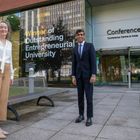
Rishi Sunak kickstarts Help to Grow scheme at Aston Business School
"It was a pleasure to host the chancellor at Aston Business School today. As a small business leader you have to know about all the key business functions and how to optimise them to drive high performance in your business." Paula Whitehouse, Aston Business School Paula Whitehouse (L) & Rishi Sunak (R) The Chancellor of the Exchequer met with Aston University’s deputy vice-chancellor engagement and associate dean enterprise of the College of Business and Social Sciences to launch Help to Grow: Management The scheme will support senior managers of small and medium-sized businesses to boost performance, resilience, and long-term growth The 12-week programme is 90% funded by the Government and participants can complete it alongside full-time work. The Chancellor has called on the leaders of small and medium-sized businesses to sign up to a new programme designed to hone their expertise as he attended one of the first courses in the UK today (August 2). Rishi Sunak joined a class taking part in the government-funded Help to Grow: Management scheme at Aston Business School, Aston University, alongside small business owners, to see first-hand how it is giving them the tools they need to innovate, grow and help drive the recovery from the pandemic. The Chancellor delivered a talk to participants at Aston Business School on the critical role small businesses can play in boosting UK productivity. He then took part in a group activity and led a discussion about their own business models and opportunities for growth. The scheme, which was announced at the March Budget and opened for applications in May, will give 30,000 SMEs access to world-class business expertise on everything from financial management to marketing and is a pivotal part of the government’s Plan for Jobs. Rishi Sunak, the chancellor of the exchequer, said: “Small businesses are key to our innovation and economy and will therefore be an essential part to our recovery from the pandemic, which is why we are levelling up their skills through the Help to Grow schemes. “I want to bring some of the best bits of management training from around the world to help boost productivity here in the UK. “Help to Grow: Management will ensure our brilliant SMEs seize every opportunity to grow, fuelling our Plan for Jobs by boosting productivity in all corners of the UK.” Experts in small business and entrepreneurship from Aston University have played a significant role in developing the programme. Paula Whitehouse, curriculum director for Help to Grow: Management and associate dean enterprise of the College of Business and Social Sciences, said: "It was a pleasure to host the chancellor at Aston Business School today. As a small business leader you have to know about all the key business functions and how to optimise them to drive high performance in your business. “Help to Grow: Management will combine this essential business education with the creation of a like-minded business network and support for the practical application of the learning to ensure businesses get immediate results. “I am excited to be working with Small Business Charter business school colleagues all over the country to roll out the Help to Grow: Management curriculum and ultimately to be introducing many more business leaders from the West Midlands into Aston's vibrant entrepreneurial community." Mark Hart, professor of small business and entrepreneurship at Aston University and associate director of Aston Centre for Growth, said: “The launch of the Government’s Help to Grow: Management programme for SMEs is a welcome addition at a critical time to the range of support available to small business leaders across the UK. “Small firms will drive the recovery as they have always done in previous economic downturns and equipping their leaders with the leadership and management skills from the UK’s leading business schools will ensure that they will build even more resilient, innovative and sustainable businesses capable of responding to the emerging opportunities in their chosen markets. “This is a practical, intensive 12-week programme designed by some of our top academics to provide the skills required to improve the performance and productivity of small firms across all sectors of the economy”. Mark Hart (L) & Rishi Sunak (R) take part in a class at Aston Business School

Brexit: UK services are losing out to EU rivals – but Asia could be big winner
"Seven months after Britain’s exit from the EU, the chilly effects on UK trade are being felt. Total exports of UK goods and services were down by 13% (£36 billion) and imports down 22% (£66 billion) for January to May 2021 compared to the same period in 2019." Professor Jun Du, Aston Business School Singapore looks like one of the big winners from Brexit. joyfull In a separate new ONS report into UK services, exports and imports fell 12% and 24% in the first quarter of 2021 compared to the same period in 2019. To some extent this is due to the pandemic, but the decline with EU countries was more severe (exports down 15% and imports by 39%), which suggests Brexit was relevant too. The difference between services exports to EU and non-EU countries was particularly marked in sectors like construction (-43% vs +24%), maintenance and repair (-62% vs +11%), and manufacturing services (-40% vs -12%). It seems to confirm that the UK’s services offering has been made less competitive by the EU-UK Trade and Cooperation Agreement hardly covering such business. This has left EU members free to decide whether to allow different UK providers into their markets. But as we shall see, other services exporting countries outside the EU may also benefit as a result. In our recent paper, Ireland looked like the big winner. It has probably benefited from firms relocating and business being re-routed from the UK, not to mention low corporation tax and a young well-educated workforce. Between 2016 and 2019, Ireland’s services exports rose 24% (that’s €144 billion or £123 billion), driven by financial services, IT and transport. Speculation still abounds about which other EU cities will benefit in the medium term. Amsterdam surpassed London as Europe’s largest share-trading centre in January by absorbing much trade in euro-denominated assets, though London has been back on top recently. Other potential winners include Frankfurt (banking), Luxembourg (banking and asset management) and Paris (financial, professional and business services). Even a less serious contender like Berlin can attract tech talents thanks to its culture clusters and affordability. On the other hand, most financial traders have so far remained in London. The city is still strong in hosting stock market flotations and other forms of capital raising. And the flow of financial jobs out of London has been a fraction of what remainers predicted. A four-year regulatory transition period for areas like data protection and electronic trade will undoubtedly be helping. London vs EU rivals is only half the story. James Padolsey/Unsplash, CC BY-SA Yet all this misses a bigger picture, namely that Europe’s ability to provide services may have been weakened overall. Imagine a group of US investors wants to invest £1 billion in European shares and other financial assets. In the past it might have set up a fund in London, making use of the city’s network of lawyers, accountants, bankers and other finance professionals, while filtering some of the work to specialists in, say, Paris and Frankfurt for issues related to France and Germany. But now Brexit means the fund can’t invest in certain EU securities from London. The investors would have to set up a second fund in, say, Dublin to get exposure to all the EU assets they want. The additional expense and time involved makes them decide it will be more lucrative to set up an Asia-focused fund in Singapore instead. When you multiply this effect across every sector, it is potentially huge. Certainly some investors will decide to either switch attention from the UK to EU countries, or to live with the extra cost of doing business across both the UK and EU. But others are deciding that an opportunity somewhere else in the world now looks more attractive. The danger is that this adds up to a global shift in economic weight over time. In fact, we could be seeing signs of this already. Winners and losers In follow-on research that we have yet to publish, we have been analysing the services exports of the major service providers in Europe and globally, using trade data jointly collected by the World Trade Organization (WTO) and the Organisation for Economic Cooperation and Development (OECD). The data shows the UK was and is the biggest services exporter in Europe and second only to the US worldwide, but appears to have been losing ground since Brexit. Ireland and the Netherlands are the major growth stories in Europe, while China, India and Singapore are leading the way elsewhere. Services exports by country, 2019 vs 2015 Trends in services exports. Left: 2015 data in solid coloured bars; 2019 change in yellow markers. Right: Green bars represent accelerating service growth; red bars represent decelerating growth. BaTIS The UK’s services growth trend fell 11% in the 2016-2019 period compared to 2010-15. This backs up our recent published research finding that the UK’s global share of exported services fell from 8.9% in 2005 to 7% in 2019. Meanwhile, France, Spain, Italy and Belgium’s growth has also been declining, while Germany, the Netherlands, Switzerland, Luxembourg, Austria and also the US were static. Ireland was the fastest growing services exporter among all, but Singapore and India gained momentum too. Strikingly, we see increasing growth in Asia between 2016 and 2019 in sectors like travel, financial, IT and creative services. This includes extraordinary growth in Singapore in finance, business, insurance and pension provision, and also in China in numerous segments. It looks like nothing short of a boom. Shanghai has been on the up and up. Krzystsztof Kotkowicz, CC BY-SA This may partly reflect the industrial transformation taking place in the Asian developing world from manufacturing to services. It may also capture a long-term shift of services centres from the west to the east – a reshuffle on a truly global scale. But at the same time, it’s evidence that Brexit has weakened the UK as the European centre for services. Yes, business shifted to Ireland (and Luxembourg) to some extent, but that could be hiding a wider collective setback. The question for the years ahead, for the UK and its European services peers, is whether they can come up with arrangements that help maintain their collective strengths – and to what extent they can exploit opportunities elsewhere, particularly on developing countries, where US services providers have traditionally been far ahead. This article was co-written by Professor Jun Du and Dr Oleksandr Shepotylo.


Ask the Expert: How to make agriculture more sustainable
MSU’s Bruno Basso outlines key steps the grain industry can take — with public support — to reduce its greenhouse gas emissions by more than 70% over the next decade Michigan State University Foundation Professor Bruno Basso has long been a believer in the power of digital agriculture. For years, he’s worked to show how emerging digital tools and technologies — things like drones, robotics, satellite imagery and computer models of soil and plant growth — can help farmers promote sustainability without sacrificing profits. Now, in addition to belief, he also has concrete numbers. Basso, an ecosystems scientist in the College of Natural Science and the W.K. Kellogg Biological Station, has helped outline how America’s grain industry can shrink its carbon footprint by 71% by 2030. The team — which included researchers at Duke University, the U.S. Department of Energy’s Argonne National Laboratory and Benson Hill, a sustainable food technology company — published its findings online on June 21 in the journal the Proceedings of the National Academy of Sciences. Basso, who recently won a $250,000 award for sustainability innovations, sat down with MSUToday to talk about how farmers can achieve those reductions and how the public can help. The full article is attached and well worth the read. Basso tackles tough questions such as: How big is this problem? How much of our greenhouse gas emissions come from agriculture? Your new paper focuses on grains in particular. How big of an emitter is grain production, especially compared to other ag sectors such as livestock, which tends to get more attention? You talked about getting a 23% reduction by better management of fertilizer. How do we get to a 70% reduction by 2030? What are the obstacles that we need to overcome by 2030? Are you a journalist looking to cover this topic - then let us help. Bruno Basso is available to speak with media, simply click on his icon now to arrange an interview today.


Aston University celebrates launch of first wave of Institutes of Technology
"There remains a significant national skills shortage for engineering and we are pleased to be helping to address this through the provision of courses for young people wanting to progress to higher technical education, adult learners and people who want to develop their engineering skills." Professor Sarah Hainsworth Pro-Vice Chancellor and Executive Dean of the College of Engineering & Physical Sciences Aston University Institutes of Technology (IoTs) are collaborations between further education (FE) providers, universities and employers IoTs focus on the specific technical skills needs required in their local area They provide employers with a skilled workforce and students with a clear route to technical employment Aston University is joining in a nationwide celebration to mark the launch of the first wave of 12 Institutes of Technology on Thursday 8 July. Institutes of Technology (IoTs) are collaborations between further education (FE) providers, universities and employers. They specialise in delivering higher technical education (at Levels 4 and 5 – equivalent to the first and second year of a degree) with a focus on STEM (science, technology, engineering and mathematics) subjects, such as engineering, digital and construction. IoTs focus on the specific technical skills required in their local area. They will provide employers with a skilled workforce and students with a clear route to technical employment. By bridging skills gaps, these new institutions will drive growth and widen opportunity. Gillian Keegan, minister for apprenticeships and skills, said: “Institutes of Technology are the pinnacle of technical education, helping to develop the highly-skilled talent pipeline employers will need for the future. “By bringing together Further Education colleges, universities and businesses, Institutes of Technology are unique partnerships which will help to tackle skills shortages in vital sectors, from marine engineering to healthcare, cyber security to agri-tech. “Institutes of Technology are also playing a vital role in our multi-billion Plan for Jobs, which is helping to level up opportunities and support people to get the skills they need to get good jobs as we recover from the pandemic.” The Greater Birmingham and Solihull IoT has brought together the most innovative education providers within the Greater Birmingham and Solihull Local Enterprise Partnership area with leading industry stakeholders to create a powerhouse for advanced manufacturing and engineering. The consortium is led by Solihull College & University Centre, Aston University and Birmingham City University, working alongside South and City College Birmingham as a core partner and supported by BMET College, University College Birmingham and the University of Birmingham. The partnership will jointly design, develop and widen education and training opportunities aligned to the latest skills needs of leading-edge employers and the local, regional and national economy. The group will target under-represented learners, facilitating clear opportunities for progression from school to high-level occupations. In this new video, partners and employers explain what the IoT means to them: The following passage was included in the recent Government Skills for Jobs white paper, with the GBS Institute of Technology highlighted as an example of good practice: Government Skills for Jobs white paper Building work has started on the GBSIoT Hub at Aston University. It will be completed at the end of 2021 and will be an innovative hub, providing a fabulous resource for students and learners from across the region. Andy Street, mayor of the West Midlands, said: “The Greater Birmingham and Solihull Institute of Technology is all about two things: economic growth and prosperity. The Greater Birmingham and Solihull Institute of Technology is going to give us wonderful new skills in the sectors of the economy that are really growing fast here.” Professor Sarah Hainsworth, pro-vice chancellor and executive dean of the College of Engineering & Physical Sciences at Aston University, said: “We are delighted to be working with our partners on the Greater Birmingham and Solihull IOT for Advanced Manufacturing. It has been really exciting to see the work progressing on delivering the new Hub for students and learners on the campus at Aston University. "There remains a significant national skills shortage for engineering and we are pleased to be helping to address this through the provision of courses for young people wanting to progress to higher technical education, adult learners and people who want to develop their engineering skills. "The Hub will be home to a new cyber physical manufacturing rig which will create a simulated working environment linked to advancing Industry 4.0 technology and state of the art digital facilities and I really look forward to when it becomes the new home for our IoT students.” Find out more about the Greater Birmingham and Solihull Institute of Technology at www.gbsiot.ac.uk

Experts explore the gap between research and practice in disaster management
The COVID-19 pandemic has attracted public attention to crisis management globally, writes Aston University's Oscar Rodriguez-Espindola. Although authorities and international organisations are still actively and diligently trying to mitigate the impact of the pandemic, some of the attention is shifting towards understanding the decisions made and learning from our experience. Indeed, this experience has inadvertently shown different areas for improvement for emergency management systems. The experience gained during the pandemic should lead governments and organisations to refine crisis management processes to prepare for challenges ahead. Leveraging research and specialist groups have been essential to support and inform decisions, as these can provide key insights guiding policy decisions. However, the integration of research and practice should not take place at the response stage only, but as part of the core crisis management system at every stage. It is crucial to maintain and strengthen the relationships between research and practice forged during the pandemic for different emergencies in the future. With the increasing number of different disasters happening and the threats stemming from climate change, it is not surprising that between 1994 and 2013 around 1.35 million lives have been claimed annually by natural disasters. Therefore, the value of partnerships between research and practice needs to be strengthened and implemented globally. Academics from Aston University in the UK and the Universidad Autónoma de Occidente in Mexico have investigated the current status of the integration of research and practice for crisis management. A systematic literature review of decision models for humanitarian logistics has been used to understand the way these models have reflected the real conditions experienced by decision-makers and catered to their priorities. Afterwards, interviews with two civil protection authorities of the state of Sinaloa, Mexico, have been undertaken to understand the conditions faced by them for crisis management, their processes and their view of decision models to support crisis management in the country. Next, a multicriteria decision analysis was used to capture their preferences regarding the objectives set for humanitarian operations to develop an analysis of their priorities. Practice needs to be informed by research, but for that guidance to be impactful, research needs to have a thorough understanding of the conditions and challenges faced by practice. The literature focused on models for humanitarian logistics has shown that the engagement of academics with practitioners in the design of solutions to support decision-making has been declared in less than a quarter of the contributions, as shown in Table 1. That means the design of solutions is based on prior secondary information or founded on a theoretical basis, which is not necessarily reflecting the current reality faced by authorities. It is noteworthy that there is an increasing trend in the number of articles involving practitioners in recent years, with more than half of them published in the previous three years. Despite that growth, however, the relative percentage of contributions incorporating practitioners has never been beyond 40% of all the models published in any year, which highlights that there is still a long way to go to support research development. Table 1: Involvement of practitioners in the design of models for humanitarian logistics Our interviews highlighted that authorities perceive the potential of systems to improve information management forecasting and decision-making, but they also unveiled the concerns about these systems providing unrealistic or unfeasible solutions. Optimisation models are formulations in which a metric is maximised or minimised subject to a series of constraints. If the objective does not reflect the objectives and priorities of decision-makers, then results can be less relevant for decision-makers. For instance, models solely aiming to minimise cost would struggle to give useful solutions to authorities focused primarily on providing support to all the victims equally. Therefore, the lack of involvement from decision-makers can lead practitioners to be cautious about using decision-making models. To examine the link between contributions in the literature and the objectives and priorities of authorities, data about them was gathered and analysed using a technique known as Fuzzy-TOPSIS. The purpose was to identify the importance given to different objectives by authorities for different activities in order to rank them based on importance as shown in Table 2. Although humanitarian logistics are characterised by a focus on the overarching ideas of saving lives and reducing suffering, it is still surprising to note that cost was the least important objective for authorities. Conversely, more than three-quarters of the models surveyed are using cost as the main objective function, which makes it the most prominent objective in humanitarian logistics. As preferences from authorities seem considerably more focused on maintaining a reliable flow of support, with high levels of service and ensuring to reach the most affected population, our findings suggest a misalignment between research and practice. Hence, neglecting to incorporate practitioners in decision-making models for humanitarian logistics can lead to omitting their needs and priorities, rendering the models less effective to provide workable solutions. Table 2: Ranking of objectives from civil protection authorities Additionally, it is important that research guides and influences practice in relevant aspects for further development. For instance, understandably, the chaotic and urgent conditions faced by authorities in humanitarian logistics force them to prioritise response over any other considerations. Our interviews confirmed this, as they mentioned that even though sustainability is becoming a crucial element in regular times, it is undermined by the urgency of the response and only included in recovery activities. This is an aspect worth looking into because research has shown that sustainability can be integrated into crisis management, even with the potential to provide improvements in terms of efficiency. Hence, a more thorough integration between research and practice would allow to positively influence activities on the field based on findings and results proposed and tested by cutting-edge investigations. Overall, our findings suggest that despite the increasing remarks about the intention of joining research and practice, there is still a significant divide between them. Reducing that divide can be beneficial for both sides. More practice-informed research can allow to development of feasible solutions that can enhance the support provided to disaster victims in practice, whereas more research-informed practice can provide stronger foundations for effective decision-making and guide research to focus on key aspects to make it more impactful. Therefore, it is essential to put more emphasis on integrating research and practice from the roots, to make their interaction more fruitful. Current trends seem to be going towards that direction, especially with the current focus on the impact on research, but further efforts are required to motivate researchers and practitioners to work together to improve crisis management. This article was co-written by Oscar Rodriguez-Espindola, Pavel Albores, Hossein Ahmadi, Soumyadeb Chowdhury, Prasanta Dey from Aston University and Diego Chavira and Omar Ahumanda from the Universidad Autónoma de Occidente. This work was supported by an Institutional Links grant, ID 527666998, under the Newton UK-Mexico partnership. The grant is funded by the UK Department for Business, Energy and Industrial Strategy and delivered by the British Council. For further information, please visit www.newtonfund.ac.uk

Even with a drastic reduction in driving due to the COVID-19 pandemic, Black Americans saw the largest increase in traffic-related deaths in 2020 when compared to other racial groups. An estimated 38,680 people died in motor vehicle traffic crashes in 2020 — the largest projected number of deaths since 2007 — and the number of Black people who died in such crashes was up 23 percent from 2019, according to the U.S. Department of Transportation’s National Highway Traffic Safety Administration. UConn’s Dr. Norman Garrick spoke with NBC News about the new report: Norman Garrick, a civil and environmental engineering professor at the University of Connecticut, said the numbers are saddening, but not surprising. “Black people tend to be overrepresented as walkers in this country,” Garrick said. “This is not by choice. In many cases, Black folks cannot afford motor vehicles. And people that walk in this country tend to experience a much, much higher rate of traffic fatality. We’re talking eight to 10 times more. It’s a perfect storm of a lot of horrible forces.” This most likely represents yet another way the health crisis has had an outsize effect on Black people. Even in the early days of the pandemic, the National Safety Council found that the emptier roads were proving to be more deadly, with a 14 percent jump in roadway deaths per miles driven in March. And Black people are more likely to face traffic injuries in general; from 2010-2019, Black pedestrians were 82 percent more likely to be hit by drivers, according to a 2021 report from Smart Growth America, a Washington, D.C.-based advocacy group focused on urban development. June 22 - NBC News Dr. Garrick is a professor in the UConn School of Engineering's Department of Civil Engineering and is co-director of the Sustainable Cities Research Group. He is an expert in the areas of transportation behaviors, parking, public transit, and bicycle lanes. Dr. Garrick is available to speak with media – simply click on his icon now to arrange an interview today.

