
Experts Matter. Find Yours.
Connect for media, speaking, professional opportunities & more.

Free masks are coming - here's what you need to know
As stores across America prepare to receive "the largest deployment of personal protective equipment in U.S. history," UConn epidemiologist Dr. David Banach is answering the questions about N95 respirators, how they work, and how to use them properly in a new interview with Buzzfeed news: There are several different types and shapes of N95s; some look like duck bills, others like domes, and several have three panels. The main difference between nonsurgical and surgical N95s is that the latter are also fluid resistant to protect doctors and nurses from blood and other bodily fluid sprays, Dr. David Banach, an infectious disease physician and hospital epidemiologist at UConn Health of the University of Connecticut, told BuzzFeed News. ****** N95 respirators are regulated by the US with standards set by the National Institute for Occupational Safety and Health (NIOSH), while KN95s (and KF94s and others) follow international standards, meaning they also should screen out about 95% of germs and particles, but their effectiveness can vary between brands sold in the US. That’s why Banach advises extra caution if you choose to wear these masks. ****** N95 respirators do expire, Banach said, but it’s usually several years after they are made. As long as you store your N95s according to its box instructions, you’ll be fine — unless you’re saving them for the next inevitable pandemic. Dr. David Banach is an expert on infectious diseases and epidemiology and is a leading expert on COVID-19 in America. To book an interview with Dr. Banach, click on his icon today.



Tension are rising in Eastern Europe as troops, tanks and weapons are piling up on both sides of the border separating Russia and Ukraine. And with each passing day, the invasion of Ukraine and the possibility of outright war seems to be increasing. Is war inevitable? How did this situation escalate so quickly? Is this a power-play but Vladimir Putin? Should other neighboring countries be worried? And what is the strategic and historical significance of Ukraine when it comes to Russia wanting to invade? How could this affect the U.S.? There's a lot of questions to be answered - and if you are a reporter covering this escalating news story, then let our experts help. Jacek Lubecki, Ph.D., is an associate professor of political science and international studies at Georgia Southern University. He is also expert in Polish and European military history. Lubecki is available to speak with media regarding this topic - simply click on his icon now to arrange an interview today.


Aston University and Alpharmaxim unite to revolutionise healthcare communications campaigns
Aston University has teamed up with Alpharmaxim Healthcare Communications to apply the latest behavioural psychology research to develop a unique prescribing behaviour tool for healthcare professionals. At present there is a growing recognition in the healthcare sector that measuring belief change and/or intent to change behaviour can determine the effectiveness of marketing campaigns. The Healthcare Belief-Barrier Identification Tool (H-BIT)will identify beliefs and barriers in prescribing behaviour of EU healthcare professionals in specific disease areas, enabling targeted communication strategies that maximise the reach of treatments. Alpharmaxim is a long-established specialist marketing communications agency in the healthcare sector that helps pharmaceutical companies create effective communication plans for their products or services. A Knowledge Transfer Partnership (KTP) is a three-way collaboration between a business, an academic partner and a highly qualified graduate, known as a KTP associate. The UK-wide programme helps businesses to improve their competitiveness and productivity through the better use of knowledge, technology and skills. Aston University is the leading KTP provider within the Midlands. This KTP will combine Alpharmaxim’s rich history of harnessing behavioural psychology through their Belief Continuum® (BC) model with Aston University’s expertise in Nominal Group Technique (NGT), a structured method for group brainstorming that encourages contributions from everyone and facilitates quick agreement on the relative importance of issues, problems, or solutions. Applying NGT to objectively evaluate beliefs and behaviours that underpin behavioural change in a defined disease area will be unique in this field. The academic team from Aston University will be led by Dr Carl Senior, reader in psychology at Aston University. Dr Senior is a behavioural scientist with 20 years’ experience working at the interface between social psychology and organisational behaviour and was one of the first to develop a framework for applying NGT to understanding effective behaviour change. Commenting on the project, Dr Senior said: “We are delighted to have this opportunity to work with Alpharmaxim in this strategic relationship to lead change that is both focused and relevant to modern day health care.” Dr Senior will be joined by Dr Jason Thomas, senior lecturer in psychology at Aston University. Dr Thomas has spent the last ten years investigating novel approaches to encourage behavioural change, working with companies such as Direct Line and Starbucks to encourage their employees and customers to eat more healthily. William Hind, founder, controlling director and agency principal at Alpharmaxim, said: “We are delighted to be involved with this innovative KTP and hope the partnership will change the face of healthcare communications, ultimately improving the lives of patients with hard-to-treat diseases.”


University chaplaincy celebrates 50th anniversary
Aston University chaplaincy marks 50 years of delivering pastoral care 12 months of celebration activities and events to be launched on Martin Luther King Day (MLK Day) MLK Day is a federal holiday in the USA to mark the birthday of Martin Luther King The chaplaincy team at Aston University is celebrating 50 years of delivering pastoral care with a series of celebration events and activities being launched on Monday 17 January to coincide with Martin Luther King (MLK) Day. Martin Luther King Day is a federal holiday in the United States to mark the birthday and honour the achievements of Martin Luther King Jr who advocated the use of non-violent means to end racial segregation. The Aston University chaplaincy team, based at the Martin Luther King Multi-Faith Centre on the University campus, offers pastoral and spiritual guidance, prayer, support and friendship to all – regardless of background. Chaplains are also available to any group concerned with issues of a religious, international, social or political dimension which wishes to explore - like Martin Luther King - the great themes of justice, peace, mutual understanding and the search for the meaning of life. The chaplains, drawn from different religions and denominations, work together in an atmosphere of inter-religious understanding and cooperation. Alongside other support services in the University, their purpose is to assist all staff and students whether they profess a religious belief or not. Jan Scott, Christian chaplain and spokesperson for the team, said: “The next few months are intended to celebrate the 50th anniversary, looking back on the history of the chaplaincy and how it has developed over the last 50 years. “We want to use it as an opportunity to connect and reconnect with individuals, groups and organisations who have links to the chaplaincy, as a chance for reflection on how to continue to support staff and students of any and all faiths and no faith, and to look forward and set a vision for the chaplaincy for 2022 and beyond.”

Aston University to host livestream event with Holocaust survivor ahead of Holocaust Memorial Day
Aston University’s Department of Politics, History and International Relations will host the livestream on 20 January It is a collaboration with the Holocaust Educational Trust Holocaust survivor, Dorit Oliver-Wolff, will share her experiences as part of the panel discussion. Aston University will host a livestreamed event with a holocaust survivor ahead of Holocaust Memorial Day. The event will see 86 year old holocaust survivor Dorit Oliver-Wolff talk about her traumatic experiences as a child under the Nazi regime. The University’s history experts and students have organised the panel discussion which will take place on 20 January, one week before Holocaust Memorial Day (27 January). Holocaust Memorial Day is an annual reminder of one of the biggest crimes against humanity in the twentieth century. Between 1941 and 1945, Nazi Germany and its collaborators systematically murdered some six million Jews across German-occupied Europe, around two-thirds of Europe's Jewish population. Dorit Oliver-Wolff was given a British Empire Medal for services to Holocaust education and awareness in 2020. She has been giving talks to schools, community groups and businesses about her experiences for more than a decade. Ms Oliver-Wolff was born in Novi Sad in Serbia - formerly Yugoslavia. In 1941, she and her mother fled and travelled from place to place within Hungary, creating new identities before hiding in a cellar, from where her mother would sneak out at night to look for food in bombed-out shops. Her talk will be followed by questions from British and German students, as well as the general public, who can submit questions by 17 January. Dr Brian Sudlow, lecturer in history at Aston University, said: “We like to think of the perpetrators of the Holocaust as completely different from ourselves. Yet this is not true. “Today, in commemorating these events, we are not only listening to history. We are trying to ensure humanity never sinks so low again.” You can sign up to the free event and submit a question for consideration HERE. Subscribe to the Aston Originals YouTube Channel and follow on Twitter.

Georgia leaders to speak as part of Georgia Southern’s 2022 MLK Jr. commemorative events
Rev. Francys Johnson, J.D., (‘01) and Amir-Jamal Touré, J.D., will serve as speakers during Georgia Southern’s 2022 Martin Luther King (MLK) Jr. Celebration Dinners on Jan. 25 in Statesboro and Jan. 26 on the Armstrong Campus in Savannah, respectively. Johnson is a civil rights attorney, public theologian, educator and advocate who succeeded Stacey Abrams and Raphael Warnock as chair of the New Georgia Project. Johnson will speak at the MLK Celebration Dinner on Jan. 25 at 6 p.m. in the Nessmith-Lane Center Ballroom on the Statesboro Campus. Touré is the resident scholar for Geechee Kunda Cultural Center and Museum in Riceboro, Georgia, and a Djeli (chronicler of Gullah Geechee history). He has performed internationally in sharing history and culture and is known for his work in socioeconomic, politics and social justice areas. Touré will speak on Jan. 26 at 6 p.m. in the Student Union Ballroom on the Armstrong Campus in Savannah. During the celebration dinners, the Office of Multicultural Affairs (OMA) will hand out inaugural Drum Major of Justice Awards, which will be given to student leaders and student organizations that OMA leadership determine best exemplify MLK’s commitment to social justice. In addition to the evening events, student, faculty and staff volunteers will join OMA and Office of Leadership and Community Engagement for a weekend of community service from Jan. 15 through Jan. 17 as part of the Eagles in Action: MLK’s Legacy of Service initiative.
Striking a chord! New Savannah museum tells the storied history of Gretsch instruments
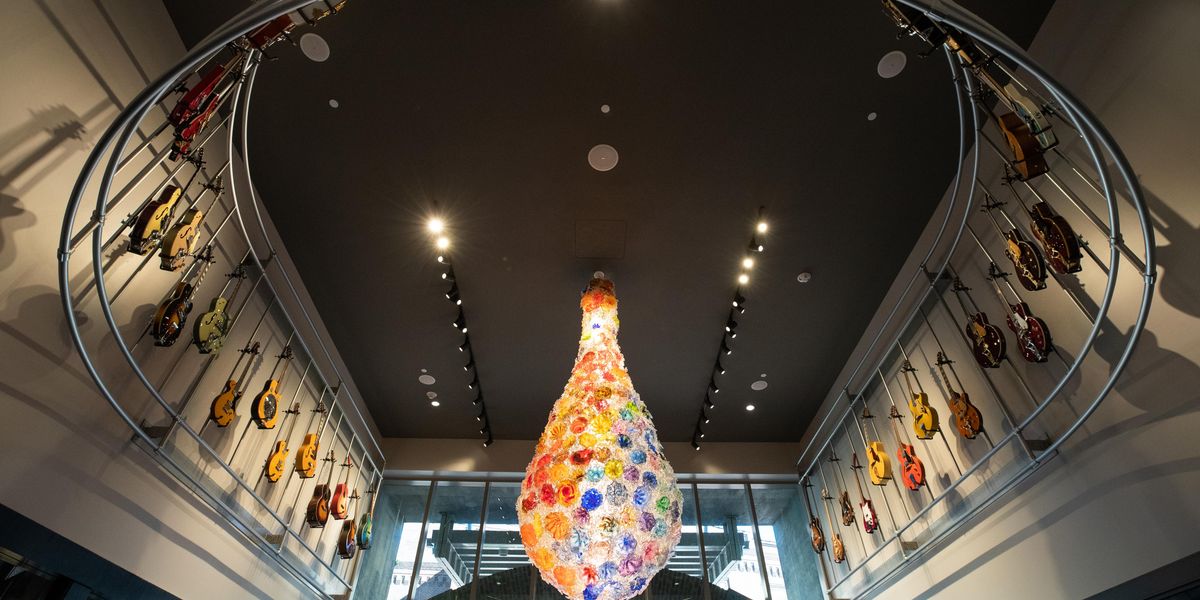
Drums, guitars, history, business and education have come together in a spectacular new interactive museum and exhibit in downtown Savannah that will pique the interest of any music lover. That Great Gretsch Sound! museum is a new destination where Georgia Southern University helps tell the story of a family-owned company that is still regarded as one of the music industry’s most influential and innovative instrument manufacturers. The permanent display of music memorabilia, highlighting more than 135 years of Gretsch instruments, is featured in District Live’s new lobby and performance space on the banks of the Savannah River. The museum is the latest addition to the Plant Riverside District. The museum’s opening was recently featured in Premium Guitar : The exhibit space highlights some of the most popular and unique pieces of Gretsch's historic catalog. The museum lobby features some of the most iconic instruments the company has produced, including the White Falcon™, the Chet Atkins® Country Gentleman®, a Brian Setzer Signature G6120, and a vintage 1963 Jet™ Firebird popularized by AC/DC's Malcolm Young. In the District Live performance hall, visitors will be treated to a visual timeline that will allow them to explore the evolution of Gretsch instruments dating back to the 1920s. Approximately 100 guitars are on display in the exhibit, 48 of which were recently on display in Nashville's Country Music Hall of Fame. The museum was developed through a special partnership between the Fred and Dinah Gretsch School of Music at Georgia Southern University and The Kessler Collection. In addition to the instruments that line the performance hall and upper section of the lobby, the museum features three sound dome displays with original videos that highlight Gretsch history, instrument production, the worldwide community of past and present Gretsch artists from Chet Atkins and George Harrison to Phil Collins, and the family's storied commitment to music education. Several other display cases take guests on a visual journey from Gretsch's beginnings as a local manufacturer of calf-skin drums, banjos, and accordions to one of the most popular and sought-after producers of guitars and drums during the height of the Rock & Roll era. Downtown Savannah is now helping tell that Gretsch story. The Gretsch museum includes Gretsch instruments and storyboards with QR code links to detailed narratives. "We hope this new museum will preserve the long history and legacy of the Gretsch Family and the Gretsch Brand," Dinah Gretsch said. "It is wonderful to share our history with the city of Savannah, the loyal Gretsch fans and all the tourists that will visit the museum." The museum's artifacts were curated and installed by Aaron Phillips, Georgia Southern's project curator for the Fred and Dinah Gretsch Artifacts Collection. Through his research to prepare the museum, he is confident that the Gretsch Museum will provide a unique musical experience. "My goal was to create a space that is expressive, inspirational, and true to the roots of the Gretsch family and community," Phillips said. "I am in awe of how this turned out!" To learn more – the full media release from Georgia Southern is attached below: If you’re a journalist looking to cover That Great Gretsch Sound! – then let us help. Aaron Phillips, Georgia Southern's project curator for the Fred and Dinah Gretsch Artifacts Collection is available, simply reach out to Georgia Southern Director of Communications Jennifer Wise at jwise@georgiasouthern.edu to arrange an interview today.

Experts in the Media – Learn how UMW is doing its part to preserve Indigenous history
The members of Virginia’s Rappahannock and Patawomeck tribes can trace their roots back to the times before the first European contact. For hundreds of years, their people fished the rivers and inhabited the area near the Potomac and Rappahannock rivers. It was a rich history and today the efforts to preserve the stories and records of those times are being bolstered by UMW students and faculty. The work was recently featured in a piece by NBC-4 in Washington, D.C. Professor Lauren McMillan and her students are helping with that mission. King George County economic development officials approached her with an idea to create a Native American heritage trail, hopeful that it would drive ecotourism and draw visitors to public access points. “The first step that we did was say we need to consult with the tribes whose stories we’d be telling," McMillan said. Then the class did a deep dive. "We then started diving into the archives, the historical records, oral histories and the archaeological record as well,” McMillan said. They’ve created signs that will go up in seven different locations in King George. Each one tells a different story about the local tribes, spotlighting the past and present. “When you learn Virginia history, you learn about a lot of stuff that happened in Jamestown and that’s kind of the last place you learn about Indians in Virginia history, but we've been here all along,” Brad Hatch, a member of the Patawomeck Tribe, said. “We’ve been preserving our own culture and heritage and it's here for everybody to see." The students worked hard to put that heritage and culture on full display. They also envision their project inspiring others to do some research of their own about Virginia’s first residents. December 07 - NBC News Indigenous history is a fascinating topic – and one being covered more and more by media. And if you’re a reporter looking to know about the work UMW is doing with of the Rappahannock and Patawomeck tribes or other topics – then let us help. Lauren McMillan is the University of Mary Washington's resident historical archaeologist and an expert on middle-Atlantic American history. Dr. McMillan is available to speak with media – simply click on her icon now to arrange an interview today.


UConn expert weighs in on controversial statue debate at the Connecticut Capitol
What should be the fate of the large statue commemorating John Mason that adorns the Connecticut State Capitol Building? He’s a historic figure and founder of the Connecticut Colony. He also left a legacy of violence and murder, with more than 400 Indigenous people, including 175 women and children, killed under his command. And whether to let his statue stand or remove it has engaged a debate from leading experts, historians, relatives of Mason, and the Indigenous community across the state. UConn’s Manisha Sinha was asked to lend her expertise to the situation: Manisha Sinha, a University of Connecticut professor of 19th century U.S. history, said she is a veteran of debates about the fate of statues memorializing Confederate leaders as well as founding fathers who owned slaves. “I have advocated for the taking down of statues that commemorate Confederate leaders and generals, who I see as traitors to the American republic, fighting for the worst cause in American history, as General Grant put it, in the cause of human bondage,” Sinha said. “On the other hand, I have opposed the taking down of statues of some of our founding fathers, revolutionary figures who did not defend slavery as a positive good.” Sinha said history can be complex, and great men of history can be flawed. “The Mason massacre is not a complex story,” she said. “It was a sheer massacre of non-combatants and of women, children and elders. We cannot excuse this by pointing to internecine warfare among Native Americans.” Mason’s statue is not necessary to teach history, she said. “I think it is high time that you think of removing John Mason’s statue,” Sinha said. “It cannot be contextualized. We do not remember history by statues, especially not in the monumental 19th century forms. We actually end up commemorating people, making them heroic.” November 18 – The CT Mirror This is a sensitive and very important topic as America reconciles with its past and moves forward as a country. And, if you are a journalist covering this topic, then let our experts help with your in-depth coverage and questions. Manisha Sinha is the Draper Chair in American History at the University of Connecticut and the author of "The Slave's Cause: A History of Abolition." She is an expert in the era of America during the 19th Century and available to speak with media regarding this topic – simply click on her icon now to arrange an interview today.


'Tangled Up' reveals science and history of Alzheimer's
A new book from leading University of East Anglia dementia expert Prof Michael Hornberger investigates the science and history of Alzheimer's disease. 'Tangled Up - The science and history of Alzheimer's disease' is available as a paperback or e-book. Prof Hornberger researches groups that are at higher risk of developing dementia (because of genetics, lifestyle or their other health condition) and works to help reduce this risk or delay the symptoms of dementia. He also explores the nature of support for those who have been diagnosed with dementia and helping the patients and their families and carers prepare for the future. His background is as a neuroscientist and his work involves using innovative techniques (such as online games and driver behaviour) to identify the spatial or navigation issues that can occur long before before diagnosis of dementia and before the traditional impacts on memory arise. He developed the mobile game Sea Hero Quest that can detect people at risk of Alzheimer's. His work enables early prediction of the likelihood of dementia (sometimes a decade ahead) and the opportunity to manage the onset and reduce risk by as much as 30 per cent. Prof Michael Hornberger, from UEA’s Norwich Medical School, said: “Alzheimer's disease is the most common cause of dementia in the UK. It affects around one in 14 people over the age of 65 and one in every six people over the age or 80 – and it can affect memory, thinking skills and other mental abilities. “I wanted to write a book to help people better understand the science and history of Alzheimer’s disease. “It covers everything from the causes of Alzheimer’s, through to why people with Alzheimer’s ‘live in the past’ and practical advice for how people can reduce the risk of developing it. “At the end of the book, you will have become an Alzheimer’s disease science expert and can use your newfound knowledge to untangle this devastating disease,” he added.
