
Experts Matter. Find Yours.
Connect for media, speaking, professional opportunities & more.

UMW Professor Wrote the Book on Trump’s Relationship With Twitter
The Twitter Presidency of Donald Trump – that’s chapter five of a book by Stephen J. Farnsworth. As the freshly fueled fire between Twitter and Trump burns hotter, Farnsworth, a professor of political science at the University of Mary Washington, is perfectly poised to fan the flames. In fact, he wrote the book on it. Presidential Communication and Character, White House News Management From Clinton and Cable to Twitter and Trump, traces the means used by our commanders in chief to herald their policies, and specifically targets the Trump administration, which Farnsworth calls “the first true Twitter presidency.” Dr. Stephen Farnsworth is a sought-after political commentator on subjects ranging from presidential politics to the local Virginia congressional races. He has been widely featured in national media, including The Washington Post, Reuters, The Chicago Tribune and MSNBC. He is author or co-author of six books on presidential communication. Dr. Farnsworth is available to speak with media and help with your coverage – simply click on his icon to arrange an interview today.



TORONTO, ON., May 29, 2020 — International Data Corporation (IDC) Canada announced today the release of 20 new research reports to help vendors understand the impact of COVID-19 on the Canadian ICT market, including five new forecast documents. In addition, most analysts have created an additional report analyzing the impact of COVID-19 on their specific technology patch, providing our clients with additional details on the impact and guidance for vendors in that market. IDC Market Forecasts help technology suppliers identify market drivers and size, measure current performance, analyze leading market indicators, as well as plan for future opportunities and growth. The five forecast reports are listed below: Canadian Communications Services Forecast, 2020–2024: COVID-19 Turns Telecom Inside Out (IDC# CA45063520 ). This IDC study presents IDC Canada's five-year forecasts for communications services spending by market and customer segments, company size, industry sector, and region for 2020–2024 based on the annual update of IDC Canada's Communications Market Model and replaces our previous comprehensive spring and fall 2019 forecasts. "Communications providers are largely recession proof and fortunately investments in next-gen network technologies and architectures are allowing communications service providers to cope with unrivalled demand," says study coauthor Lawrence Surtees, vice president of Communications Research and principal analyst at IDC Canada. "But the duration of the COVID-19 pandemic is still a great unknown and its associated economic shocks could dramatically impact the current forecast." Canadian IT Professional Services Forecast, 2020–2024 (IDC# CA45064220 ). This IDC study provides the spring 2020 market size and forecasts for the Canadian IT professional services market. The professional services market is made up of four submarkets: Custom application development, IS consulting, Network consulting & integration, and Systems integration. "The Canadian IT professional services market relies on discretionary capital spending budgets, which are typically suspended or curtailed in times of economic uncertainty. 2020 will be a challenging year for professional services firms due to the COVID-19 pandemic, but the market is expected to recover as the Canadian and global economies recover and businesses reinstate capital spending for IT projects," says Jim Westcott, research manager, Professional Services, IDC Canada. Canadian Infrastructure Outsourcing Services Forecast, 2020–2024 (IDC#CA45058420). This IDC study provides IDC's forecast for the Canadian infrastructure outsourcing services market for 2020–2024. It is an update of the previous forecast published in Canadian Infrastructure Outsourcing Services Forecast, 2019–2023 (IDC #CA43804019, May 2019). "The infrastructure outsourcing market continues to change, and COVID-19 will likely accelerate change. The decline in 1st and 2nd Platform technologies is leading to slow outsourcing spending on these areas, while the growth in 3rd Platform technologies to support digital transformation are increasingly incorporated into outsourcing and managed service engagements," says Jason Bremner, research vice president, Industry and Business Solutions. Canadian Consumer Wireless, Internet, and Wireline Voice Services Forecast, 2020–2024 (IDC# CA45059520). "In an already-competitive consumer market in the middle of great technological change, the global Coronavirus pandemic and the precautionary restrictions it has placed on Canadians has not only caused drastic socioeconomic changes but has forced consumers to weigh out the value proposition of each consumer service," says coauthor Manish Nargas, senior analyst for Consumer Services and Mobility. "Survival of the fittest is the call of the hour, and it seems that some consumer services will fare better than others after the dust has settled. While easier said than done, service providers need to think beyond the today's losses in order to plan for tomorrow's win." Canadian Consumer TV Services Forecast, 2020-2024 (IDC#CA45059620). This IDC study examines the forecast for Canadian consumer TV services subscribers and revenue. It also addresses the factors shaping the market as well as the key drivers and inhibitors underlying the forecast. "TV service providers will have to bring out their A game as they look to harness their next-gen TV service capabilities and create symbiotic, seemingly 'complementary' partnerships with OTT video providers to keep consumer eyeballs on their TV service platforms all the while combating economic ill effects of COVID-19 restrictions in the short term," says coauthor Manish Nargas, senior analyst, Consumer Services and Mobility at IDC Canada. "Based on our forecasts from May 1, 2020, we’re looking at an unprecedented 5.4 per cent decline for the year for the combination of telecom and IT spending in Canada. The cumulative impact of trade restrictions, supply chain impairments, commodity price declines, significant lay-offs and freefalling consumer and business confidence has led to a more dramatic impact on the overall ICT market than we had predicted in early April," says Nigel Wallis, vice president, IoT & Industries at IDC Canada. IDC develops detailed forecasting reports and analysis for major technology markets in Canada, which are published annually during the month of May. IDC's Forecast Scenario Assumptions for the Canadian ICT Market, 2020 and Beyond (IDC# CA46217620 , May 20 20 ) supports the underlying macroeconomic assumptions for each of the ICT market forecast reports. We also recently released a new interactive Canadian COVID-19 IT Impact Dashboard tool to help our clients visualize the impacts, in partnership with Rel8ed.to, which is available for everyone to use. For our clients that need to know the impact of the pandemic on ICT Spending beyond Canada’s borders, IDC created our global COVID-19 Resources microsite which contains more research reports, webinars, press releases and blog posts from around the world. We’ve also done a series of free webcasts for our clients with the first one on April 2 and the second one on May 6. Our third webcast in this series will occur on June 4th. Register today for COVID-19 Impact: Preparing for Recovery in the Canadian Tech Market. Here’s the list of our recently published Canadian-based COVID-19 research reports to help our clients meet the challenges from the pandemic, anticipate market changes and keep business moving: COVID-19 Impact on the Canadian ICT Market (IDC#CA46134820) Canadian Datacenter Infrastructure Action Item, Q2 2020: The Impact of COVID-19 (IDC#CA45057420) Impact of COVID-19: Canadian IT Services Market (IDC#CA46166120) All Priorities Aside: The Canadian Government's Singular Response to COVID-19 (IDC#CA46166920) The Impact of COVID-19: Canadian Security Solutions Market (IDC#CA46166520) Canadian Communications Service Provider Capex Spending, 2019–2020 (IDC#CA45063820) Canadian Government Wireless Price Policy - Ill-conceived and Horribly Timed (IDC# CA45663920) COVID-19 Business Impact: Hierarchy of Needs; Moving from Pandemic Risk Management to Organizational Agility (IDC# CA46228420) How is the Pandemic Crisis Impacting Digital Transformation in Canada? (IDC# CA46235620) Impact of COVID-19: Canadian Software as a Service Market (IDC# CA46166620) COVID-19 Impact: What’s Next for the Canadian Tech Market (IDC# CA46281820) COVID-19 Impact: Canadian Retail & Wholesale Market (IDC# CA45674020) COVID-19 Leadership: Canadian CIOs Strategize on Responses to COVID-19 (forthcoming) Critical Networks Provide Critical Care: Role of Communication Networks to Treat and Prevent COVID-19 (forthcoming) COVID-19 Impact: Canadian Vertical Markets Overview (forthcoming) For more information about the market forecast reports, the COVID-19 related reports, or to arrange a one on one interview with any of the report authors, please contact Cristina Santander at AskIDC@IDCcanada.com.


Twelve students in the Doctor of Physical Therapy (DPT) program at Georgia Southern University were awarded scholarships totaling more than $17,000 from the Savannah American Business Clubs (AMBUCS). “This is a recognition of the dedication we have to AMBUCS and helping others in our community,” said scholarship recipient and AMBUCS student leader Alexandra Adams. “Most of us are paying for our education with loans, and the scholarship helps relieve some of the financial burden that comes with pursuing a graduate degree. I am very thankful that AMBUCS has considered me for this scholarship the past two years.” The organization has hosted a League of Exceptional Bowlers on Saturdays for more than 50 years. The DPT students join the Savannah AMBUCS league to assist bowlers with physical and intellectual disabilities to promote an inclusive and competitive environment. In addition to the hands-on experiences, DPT students have the opportunity to interact with different members of the community. “It shows our commitment to the inclusion of our community and our passion for encouraging movement for everyone, despite their limitations, to increase their quality of life,” Adams said. “The program reinforces our classroom training, as well as, enhances our communication skills with others. Each member of our DPT program gets as much of a benefit from attending AMBUCS as the bowlers do.” A century-old membership organization dedicated to helping people with disabilities, the Savannah AMBUCS awards scholarships to students pursuing careers in the allied health professions and who volunteer with AMBUCs. If you’re a journalist looking to cover this story or would like to learn more about the physical therapy and other programs at Georgia Southern University – then let us help. Barry Joyner is the dean of Georgia Southern University’s Waters College of Health Professions - simply click on his icon to arrange an interview today.


Are China and America set to face off in a warmed-up version of the cold war?
Tensions and temperatures are rising between the United Stated and China. The straws on the camel’s back have been adding up in recent years, and the recent rhetoric about the origins of COVID-19 and the reaction to China’s further pursuit of the ‘One-China’ policy may be seeing both countries crossing the political Rubicon and headed toward a stand-off. The first shot fired may be China sending two air raft carriers to the Yellow Sea. This will be the first time China's new aircraft carriers deploy together for the first time and the move has sparked fears in Taiwan of a possible invasion of its Pratas islands - which could then be used as a staging point for an attack on the mainland. It comes after Beijing threatened to "reunify" Taiwan in response to Donald Trump saying he could "cut off the whole relationship" with China. Tensions have been growing between the US and China over the origins of Covid-19. The US said on Friday it is set to ban trade with 33 Chinese companies. But China's foreign minister Wang Yi said yesterday this would risk "a new Cold War" as he rejected Washington's "lies" over its handling of coronavirus while saying Beijing was open to an international effort to find its source. Wang said the United States had been infected by a "political virus" compelling figures there to continually attack China. He said: “It has come to our attention that some political forces in the US are taking China-US relations hostage and pushing our two countries to the brink of a new Cold War." May 25 – The Sun It is a concerning development given the current state of global affairs. And there are a lot of questions to be asked: What will it take to de-escalate the issue? What would a 21st Century cold war look like? And at what cost will this come to both countries who are dealing with serious economic pressures at home? If you are a journalist covering this topic – then let our experts help. Dr. Glen Duerr's research interests include comparative politics and international relations theory. Glen is an expert on this subject and is available to speak to media regarding this topic– simply click on his icon to arrange an interview.


Is your job killing you? Stress, lack of autonomy and ability can lead to depression and death
FOR IMMEDIATE RELEASE BLOOMINGTON, Ind. -- As millions continue working from home during the pandemic or are required to report to jobs as essential employees, many have raised questions about how these work conditions impact our health -- and not just as they relate to COVID-19. A new study from the Indiana University Kelley School of Business finds that our mental health and mortality have a strong correlation with the amount of autonomy we have at our job, our workload and job demands, and our cognitive ability to deal with those demands. "When job demands are greater than the control afforded by the job or an individual's ability to deal with those demands, there is a deterioration of their mental health and, accordingly, an increased likelihood of death," said Erik Gonzalez-Mulé, assistant professor of organizational behavior and human resources at the Kelley School and the paper's lead author. "We examined how job control -- or the amount of autonomy employees have at work -- and cognitive ability -- or people's ability to learn and solve problems -- influence how work stressors such as time pressure or workload affect mental and physical health and, ultimately, death," he said. "We found that work stressors are more likely to cause depression and death as a result of jobs in which workers have little control or for people with lower cognitive ability." On the other hand, Gonzalez-Mulé and his co-author, Bethany Cockburn, assistant professor of management at Northern Illinois University, found that job demands resulted in better physical health and lower likelihood of death when paired with more control of work responsibilities. "We believe that this is because job control and cognitive ability act as resources that help people cope with work stressors," Gonzalez-Mulé said. "Job control allows people to set their own schedules and prioritize work in a way that helps them achieve their work goals, while people that are smarter are better able to adapt to the demands of a stressful job and figure out ways to deal with stress." The study, "This Job Is (Literally) Killing Me: A Moderated-Mediated Model Linking Work Characteristics to Mortality," appears in the current issue of the Journal of Applied Psychology. It is a follow-up toprevious research the pair published in 2017, which was the first study in the management and applied psychology fields to examine the relationship between job characteristics and mortality. The researchers used data from 3,148 Wisconsin residents who participated in the nationally representative, longitudinal Midlife in the United States survey. Of those in their sample, 211 participants died during the 20-year study. "Managers should provide employees working in demanding jobs more control, and in jobs where it is unfeasible to do so, a commensurate reduction in demands. For example, allowing employees to set their own goals or decide how to do their work, or reducing employees' work hours, could improve health," Gonzalez-Mulé said. "Organizations should select people high on cognitive ability for demanding jobs. By doing this, they will benefit from the increased job performance associated with more intelligent employees, while having a healthier workforce. "COVID-19 might be causing more mental health issues, so it's particularly important that work not exacerbate those problems," Gonzalez-Mulé said. "This includes managing and perhaps reducing employee demands, being aware of employees' cognitive capability to handle demands and providing employees with autonomy are even more important than before the pandemic began."

According to some, the election is pretty much already over. There is no way Joe Biden can lose and there is absolutely no way Donald Trump can win. The thing is a lot of people said that four years ago about Hillary Clinton. There is a path to victory for Joe Biden, but unseating a sitting president is no easy task. It will take swinging several red states blue and not focusing on areas where President Trump may have fallen out of favor. What to watch Rust Belt's traditional battlegrounds: Trump’s chance of winning Michigan, which he carried by 11,000 votes in 2016, has been significantly reduced by the impact of COVID-19 in the state, which has suffered the fourth most deaths in the country. Pennsylvania has almost been as hard hit as Michigan (fifth most deaths). Of the three Rust Belt states, Trump is best positioned in Wisconsin, where his job approval has remained higher than the national average. West and South emerge as new Democratic base: Seven western states — California, Colorado, Hawaii, Nevada, New Mexico, Oregon and Washington — are firmly in the Democratic column. Six states in the South and Southwest — Arizona, Florida, Georgia, North Carolina, Texas and Virginia — are in various stages of becoming blue states. Outside of Virginia, which has already become a blue state, Arizona is the state most likely to transition to a Democratic base state as early as November. May 17 – Axios But as much as the playbook seems obvious – there will be pitfalls, landmines and barriers along the way. It is expected that this upcoming election will be divisive, expensive, and close. And President Trump has proven to be an effective and relentless campaigner. If you are covering – then let our experts help with your questions and stories. Mark Caleb Smith is the Director of the Center for Political Studies at Cedarville University. Mark is available to speak with media regarding the DNC Primary, running mates and the upcoming election. Simply click on his icon to arrange an interview.


As the COVID-19 pandemic unfolded and healthcare organizations began experiencing shortages of personal protective equipment (PPE), faculty, staff and students at Georgia Southern University stepped up to fulfill a need. Making use of the 3D printers on the Statesboro and Armstrong campuses, as well as at the FabLab at the Business Innovation Group’s (BIG) downtown Statesboro location, the campus communities quickly began production of protective face shields and respirators. “We can’t afford to sit back and wait for things to happen,” said Dominique Halaby, DPA, director of the BIG. “We have to make them happen. We have this responsibility to make a difference, to be a part of that front line, whether it’s immediately in our community, our state or our respective area.” To date, the Department of Manufacturing Engineering has sent 200 3D-printed protective face shields with headbands to Augusta, Georgia, for healthcare workers at Augusta Medical Center, while the BIG has sent 100 face shields and 10 “Montana Masks,” a 3D-printable respirator filtration mask that can be fitted to a healthcare provider’s face and sanitized between uses, to Atlanta-area hospitals. The Department of Mechanical Engineering on the Armstrong Campus has also printed Montana Masks that will be delivered to workers in the St. Joseph’s/Candler Hospital System (SJCHS) in Savannah, Georgia, while the Respiratory Therapy Program in the Waters College of Health Professions donated 10 ventilators to the Georgia Emergency Management Agency. “I am unbelievably proud of our faculty, staff and students who have their own families to take care of, but are putting themselves on the line to help our medical professionals in this time of critical need,” said Mohammad Davoud, Ph.D., dean of the Allen E. Paulson College of Engineering and Computing. Wayne Johnson, Ph.D., professor of mechanical engineering, believes providing these materials to the Savannah community during a time of critical need is reinforcing a longtime commitment to the region. “The Armstrong Campus of Georgia Southern has a long history of working within the Savannah community, and during this pandemic, it was especially important for mechanical engineering faculty and students at the Armstrong Campus to step up during a time of great need,” said Johnson. “ Our work with SJCHS to develop, test and donate 3D-printed respirators may also lead to other research and development collaborations in the post-COVID-19 future.” In addition to benefiting area healthcare workers, Johnson believes this project is a great way for students to put their classroom skills into practice. If you would like to learn more about how the students, staff and faculty at Georgia Southern University are helping out during the COVID-19 crisis – the let our experts help. Wayne Johnson is an expert in additive manufacturing, mechatronics, biomechanics and engineering education. He is available to speak with media about this great initiative, simply click on his icon to arrange an interview today.
Leaping lizards! Let our experts tell you about the latest invasive species to be found in Georgia
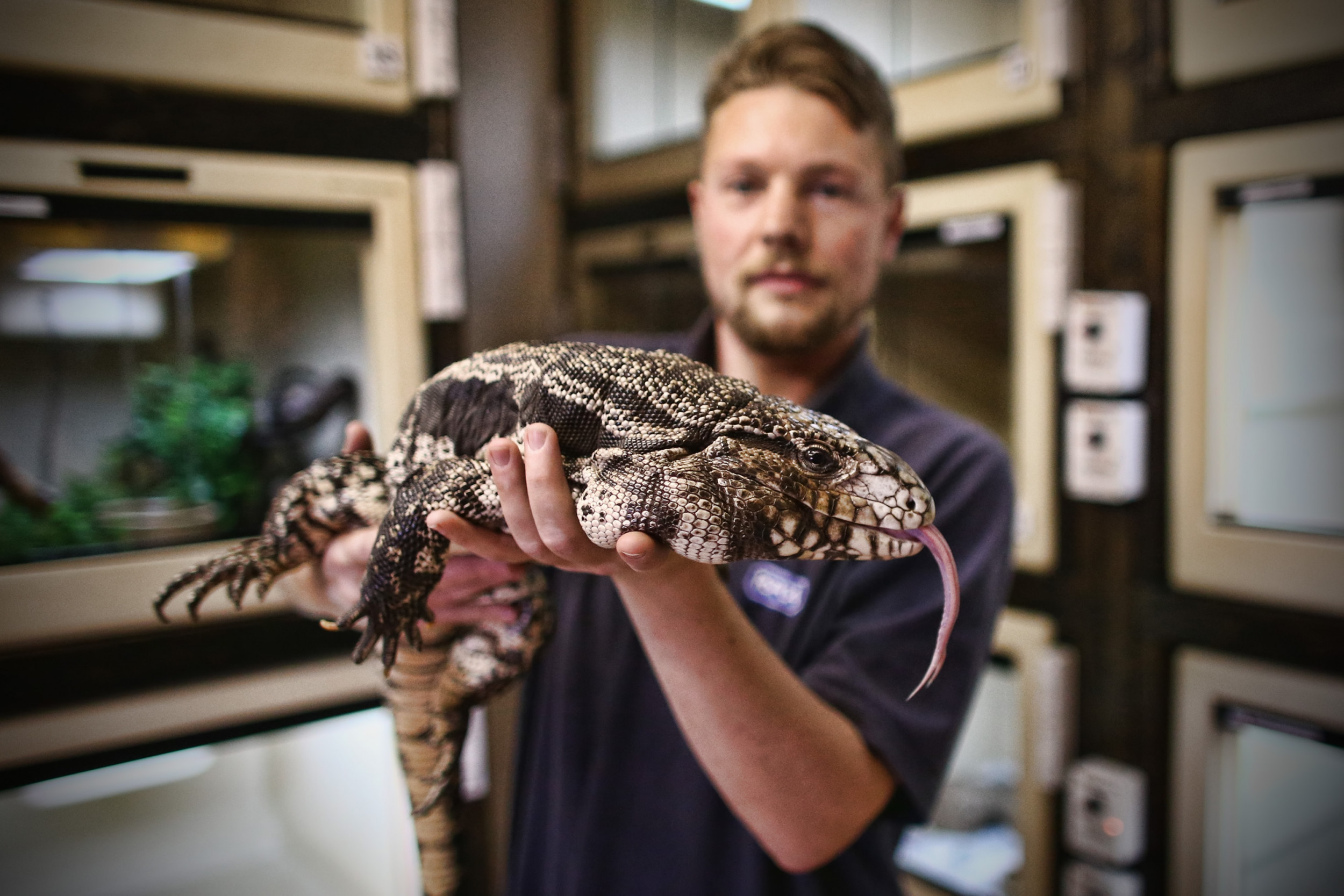
What’s four feet long, weighs ten pounds and is eating its way across two Georgia counties? If you guessed the Argentine black and white tegu – you’d be right. "It has become established as an exotic invasive species in several sites in South Florida and we now believe in the Toombs and Tattnall counties of Georgia," said Georgia Department of Natural Resources biologist John Jenson. "We're trying to remove them from the wild, because they can have a negative impact on our native species." The Argentine black and white tegu can grow to be up to 4 feet long and weigh 10 pounds or more. The species can be identified by its mottled black-and-white coloring, which is arranged in a banded pattern across its back and tail. Hatchlings also display a bright green color on their heads. This tends to disappear around the time they reach a month old. While the species is known to lash out if threatened, it is not considered aggressive toward people. The biggest problem it presents is towards existing wildlife. The species is notorious for stealing burrows. Tegus also possess an indiscriminate and edacious appetite that can include the eggs and young of other species. "They eat just about anything they want, plant and animal matter, and one of their favorite foods are eggs from ground-nesting animals such as gopher tortoises—our protected state reptile—birds, including turkeys and quails," said Jenson. May 14 - Newsweek Invasive species are not new to Georgia or the southern states, but there are a lot of questions still to be asked: What endangered species are threatened by the presence of these lizards? What can be done to remove them? How quickly will they breed and spread? And are there any natural predators that can assist DNR authorities naturally? If you are a journalist covering this subject – then let our experts help. Steve Hein is the director of the Center for Wildlife Education at Georgia Southern University. He’s an expert in Georgia wildlife and is available to speak with media about invasive species in the state – simply click on his icon to arrange an interview.


Will an ‘Innovation Renaissance’ be part of a post-COVID America?
If there is one thing that comes out of a crisis or emergency – it is opportunity and innovation. And as COIVID-19 has held the country in its grip for nearly two months, America has had to adjust and adapt almost every aspect of life. From how we work, educate, shop, socialize, stay fit and interact, just about everything has had to change. With those changes comes ingenuity and innovation. And it is expected that from COVID-19 will come inspiration and a new wave of innovation. The coronavirus outbreak has altered not just how people connect, but also how consumers shop. Online grocery shopping, for instance, had never really taken off, accounting for only a fraction of total sales. That trend, of course, has now reversed, with all supermarkets scrambling to meet the surge in online sales. Even Amazon, which had bought U.S. grocery group Whole Foods in 2017, was caught flat-footed in delivering fresh food amid the endless demand for home delivery. Just how we will shop, eat, connect with one another and travel in the future remains to be seen. It may well be that a year or two after the health crisis, the world will resume interacting as it had before the pandemic. For Japan, though, this should be a golden opportunity to think outside the box and re-evaluate how to innovate to meet its changing needs and be a global leader in the services industries, including logistics as well as health care. After all, enhancing the stay-at-home experience through improved connectivity and enhanced distribution mechanisms would be a boon to an aging society as well as to people who are hesitant to venture out as much as they once had. At the same time, discerning consumers can choose their online experiences from across the world, in which Japanese retailers’ attention to detail is particularly attractive. If you are a journalist looking to cover the role innovation will play in a post-pandemic era, then let our experts help with your stories. Dr. Ashely Gess, a leading expert in innovation and an associate professor of STEAM education at Augusta University, is available for interviews. Click on her name to schedule a time to speak with her.


Is working remotely finally the new normal?
For years, it was touted by consultants as the more efficient option for maximizing work and allowing life balance for employees, but few industries actually allowed or embraced the idea of people working remotely. There were always exceptions – but seldom was it is policy. Until COVID-19 came, and now just about every office, institution or administration has had to adapt to remote working to stay operational. And for the most part, it works. Furthermore, employers must brace themselves for the initial fluctuation in work productivity as their employees adjust to the challenges of the pandemic while working from home, according to Dr. Melissa Furman, a lecturer of management in the James M. Hull College of Business at Augusta University. “As the pandemic carries on, it seems like more employers are noticing how working remotely is becoming the new trend and industries are getting used to the idea,” said Furman. “The latest technologies, such as online meeting platforms, will help ease the transition and keep a sense of cohesiveness outside the workplace.” So once the dust has settled from COVID-19 and the new normal sets in across America, what will workplaces look like? Will remote working be accepted and encouraged? What risks are there to offices slipping back into the old and traditional ways? There are a lot of questions to consider, and if you are a journalist covering this topic, that’s where Augusta University can help. Furman is a respected leader in management with over 30 years of business coaching, mentoring and higher education administration. Click on her name to schedule an interview.