
Experts Matter. Find Yours.
Connect for media, speaking, professional opportunities & more.

The spotted lanternfly, an invasive species native to China, India and Vietnam, arrived in Pennsylvania in 2014. It is only over the past couple years, however, that the insect has gained particular notoriety. This year, the presence of spotted lanternflies has drastically increased in eastern Pennsylvania, and these pesky bugs can have dangerous effects. According to Villanova University professor of biology Vikram Iyengar, PhD, "The spotted lanternflies are back and showing no signs of going away. In fact, 12 new counties in Pennsylvania were added to the quarantine zone in 2020, which indicates that the invasive insects are spreading westward within the state." This quarantine prevents the travel of any spotted lanternflies through landscaping waste, firewood, plants and more. Reducing the spread via quarantine is vital to minimize agricultural harm, including damage to fruit-bearing trees. (Spotted lanternflies pose a considerable threat to grape and wine production throughout the country.) Per Dr. Iyengar, "The state of Pennsylvania is devoting a lot of resources to figure this out, and there have been some successes—for example, New York still has not reported spotted lanternflies, which indicates that the Pennsylvania quarantine has been somewhat effective. But there is still no solution yet." So, what's the answer? Dr. Iyengar notes that the possibility of a predator species will not combat the issue. Instead, "they will need to find some special pheromone or chemical that selectively lures spotted lanternflies into traps." Having a harsh winter this year is also key. "The fact that we had such a mild winter last year probably meant that more eggs were able to withstand the winter," said Dr. Iyengar. "A harsh winter may be our best hope, so the persistence of the spotted lanternfly may be yet another negative consequence of climate change." Another invasive species currently being tracked in Pennsylvania is the emerald ash borer. Villanova's R. Kelman Wieder, PhD, studies plant biology and believes these insects, which kill ash trees, are the next big threat to plant life in Pennsylvania. "I have lots of ash trees in my woods and they all are dead or dying," said Dr. Wieder. "My house was built in the 1830s and the huge ash tree was as old as my house." But Dr. Wieder isn't too worried. "Are we doomed? Well, yes and no. Eastern deciduous forests have been radically changed in the past by the chestnut blight and Dutch elm disease, yet we still have forests." That said, he still has some concerns for the future. "On top of this, deer munch on young trees," added Dr. Wieder. "So many Pennsylvania forests are deficient in young trees. So, in 50 to 100 years, what will happen?"


The Legacy of Ruth Bader Ginsburg, Associate Justice of the U.S. Supreme Court
"With her passing, feminist icon and jurist Ruth Bader Ginsburg leaves a legacy in both her formal role as a Supreme Court justice and author of some of the most important legal opinions during her service as well as her advocacy for gender equity," says Teresa Boyer, EdD, founding director of Villanova University's Anne Welsh McNulty Institute for Women's Leadership. In her personal and professional life, Ginsburg created a map for women to be the equals of the most powerful leaders in our nation. "By all accounts she was a brilliant legal mind, and from the start of her career she leveraged that mind to fight for the rights of those she felt were denied them, especially women," says Dr. Boyer. "Despite her decidedly liberal stance, she held a close personal friendship with her strongest conservative opposition on the Supreme Court, Antonin Scalia. Even with their intellectual differences, they held each other as equals, respecting each other's work. In a time when cross-gender friendships were rare, especially where a woman was as powerful as a man, Ginsburg once again showed that gender needn't dictate one's status in life." "Although Sandra Day O'Connor was the first woman to sit on the nation's highest court, Ruth Bader Ginsburg was the one that became a literal feminist icon," notes Dr. Boyer. "Ginsburg was unapologetically fierce in her opinions, both legal and otherwise. It is this ferocity which earned her the status 'Notorious RBG.' Especially in the early days of Ginsburg's career (and some would argue even today), women could hold opinions, but to be fierce and unapologetic about them was distinctly unfeminine." The images of Ginsburg wearing her lace collar, lipstick and jewelry were a deliberate contrast, owning her femininity at the same time she owned her power. "That iconic image will be upheld for decades to come—and I suspect a run on black robes and lace collars for Halloween this year," says Dr. Boyer.


As battle-weary Americans struggle to emerge from the anxiety and worry of COVID-19, there might be even more bad news around the corner this fall for parents of young children. The U.S. Centers for Disease Control and Prevention (CDC) is sounding the alarm now about increased cases of acute flaccid myelitis (AFM) in the coming fall. It is of a rare but serious polio-like condition that surfaces every two years and children under five are its main target. On average, patients during the last outbreak in 2018 were aged 5 years old. Limb weakness and paralysis is the most common symptom of the condition which affects the nerve cells in the gray matter of the spinal cord. Others include a fever, pain, or numbness in one or more limbs, problems walking normally, a headache, back or neck pain, issues with swallowing or talking, and weakness in the face or neck. Patients may also have had a recent or current respiratory illness. August 05 - Newsweek In what has already been a harrowing year, it looks like there may be another serious health concern on the horizon. And if you are an expert covering children’s health the potential for acute flaccid myelitis to peak in 2020 – then let our experts help. Dr. Elizabeth Sekul is a highly acclaimed pediatric neurologist specializing in electrodiagnostic medicine and neuromuscular diseases. She also works as an associate professor at the Medical College of Georgia's Department of Neurology and the Department of Pediatrics and Child Neurology. If you are a journalist looking to book an interview – simply click on Dr. Sekul’s icon and arrange a time today.


Air Flow Expert Working to Make Sure New Jet Fighters Take Flight — and Land — Safely
The next generation of jet fighters are being designed to be both stealthy and high-speed and, as part of this makeover, their geometry will be unique and won’t include a vertical tail. The new design will improve the aircraft’s maneuvering, minimalize its visibility, and improve its overall performance — but it will also decrease the aircraft’s performance during takeoff and landing. Miki Amitay, an endowed professor of mechanical, aerospace, and nuclear engineering at Rensselaer and the director of the Center for Flow Physics and Control (CeFPaC), is an expert in this type of problem. With the support of a new grant from the Office of Naval Research, Amitay and his team will use their extensive knowledge of flow physics to determine how air flow will affect these new jet fighters and how that flow can be manipulated or changed for optimal operation. More specifically, the team will use state-of-the-art wind and water tunnels within CeFPaC to research the flow physics associated with this new plane geometry and then explore options for mitigating difficult flow conditions during takeoff and landing. Those options can’t include changing the shape of the plane itself, so the researchers will employ active flow techniques they have developed. For example, Amitay has developed almost weightless actuators that can electrically generate a strong jet — called a synthetic jet — that pushes out puffs of air in such a way that it helps control the flow of air around various parts of the aircraft at specific and optimal times. Amitay is available to talk about the flow physics associated with aircraft flight and new technologies — like his synthetic jet — that can improve performance, efficiency, and safety.


Paper ballots, risk-limiting audits can help defend elections and democracy, IU study finds
BLOOMINGTON, Ind. -- With just over two months before the 2020 election, three professors at the Indiana University Kelley School of Business offer a comprehensive review of how other nations are seeking to protect their democratic institutions and presents how a multifaceted, targeted approach is needed to achieve that goal in the U.S., where intelligence officials have warned that Russia and other rivals are again attempting to undermine our democracy. But these concerns over election security are not isolated to the United States and extend far beyond safeguarding insecure voting machines and questions about voting by mail. Based on an analysis of election reforms by Australia and European Union nations, they outline steps to address election infrastructure security -- such as requiring paper ballots and risk-limiting audits -- as well as deeper structural interventions to limit the spread of misinformation and combat digital repression. "In the United States, despite post-2016 funding, still more than two-thirds of U.S. counties report insufficient funding to replace outdated, vulnerable paperless voting machines; further help is needed," said Scott Shackelford, associate professor of business law and ethics in the Kelley School, executive director of the Ostrom Workshop and chair of IU's Cybersecurity Program. "No nation, however powerful, or tech firm, regardless of its ambitions, is able to safeguard democracies against the full range of threats they face in 2020 and beyond. Only a multifaceted, polycentric approach that makes necessary changes up and down the stack will be up to the task." For example, Australia -- which has faced threats from China -- has taken a distinct approach to protect its democratic institutions, including reclassifying its political parties as "critical infrastructure." This is a step that the U.S. government has yet to take despite repeated breaches at both the Democratic and Republican national committees. Based on an analysis of election reforms by Australia and European Union nations, they outline steps to address election infrastructure security -- such as requiring paper ballots and risk-limiting audits -- as well as deeper structural interventions to limit the spread of misinformation and combat digital repression. "In the United States, despite post-2016 funding, still more than two-thirds of U.S. counties report insufficient funding to replace outdated, vulnerable paperless voting machines; further help is needed," said Scott Shackelford, associate professor of business law and ethics in the Kelley School, executive director of the Ostrom Workshop and chair of IU's Cybersecurity Program. "No nation, however powerful, or tech firm, regardless of its ambitions, is able to safeguard democracies against the full range of threats they face in 2020 and beyond. Only a multifaceted, polycentric approach that makes necessary changes up and down the stack will be up to the task." For example, Australia -- which has faced threats from China -- has taken a distinct approach to protect its democratic institutions, including reclassifying its political parties as "critical infrastructure." This is a step that the U.S. government has yet to take despite repeated breaches at both the Democratic and Republican national committees. The article, "Defending Democracy: Taking Stock of the Global Fight Against Digital Repression, Disinformation and Election Insecurity," has been accepted by Washington and Lee Law Review. Other authors are Anjanette "Angie" Raymond, associate professor of business law and ethics, and Abbey Stemler, assistant professor of business law and ethics, both at Kelley; and Cyanne Loyle, associate professor of political science at Pennsylvania State University and a global fellow at the Peace Research Institute Oslo. Aside from appropriating sufficient funds to replace outdated voting machines and tabulation systems, the researchers said that Congress should encourage states to refuse to fund voting machines with paperless ballots. The researchers also suggest requiring risk-limiting audits, which use statistical samples of paper ballots to verify official election results. Other suggested steps include: Congress requiring the National Institute of Standards and Technology to update their voting machine standards, which state and county election officials rely on when deciding which machines to purchase. Australia undertook such a measure. Creating a National Cybersecurity Safety Board to investigate cyberattacks on U.S. election infrastructure and issue post-elections reports to ensure that vulnerabilities are addressed. Working with universities to develop training for election officials nationwide to prepare them for an array of possible scenarios, and creating a cybersecurity guidebook for use by newly elected and appointed election officials. "With regards to disinformation in particular, the U.S. government could work with the EU to globalize the self-regulatory Code of Practice on Disinformation for social media firms and thus avoiding thorny First Amendment concerns," Raymond said. "It could also work to create new forums for international information sharing and more effective rapid alert and joint sanctions regimes. "The international community has the tools to act and hold accountable those actors that would threaten democratic institutions," added Stemler, who also is a faculty associate at Harvard University's Berkman Klein Center for Internet and Society. "Failing the political will to act, pressure from consumer groups and civil society will continue to mount on tech firms, in particular Facebook, which may be sufficient for them to voluntarily expand their efforts in the EU globally, the same way that more firms are beginning to comply with its General Data Protection Regulation globally, as opposed to designing new information systems for each jurisdiction."


VCU Engineering researchers are working to make clean energy easier and cheaper
Lane Carasik, Ph.D., assistant professor in VCU’s Department of Mechanical and Nuclear Engineering, is developing methods to make clean energy more cost-effective. He’s motivated by a simple principle. “The cheaper we make renewable and clean energy, the easier it is to implement it,” he said. With $100,000 in seed funding from the Jeffress Trust Awards Program, Carasik and his Fluids in Advanced Systems and Technology (FAST) research group are designing efficient, low-cost enhancements to equipment used in solar, nuclear and geothermal energy systems. Jeffress Trust awards support high-impact, one-year projects that integrate computational and quantitative scientific methodologies across a broad range of scientific disciplines. These energy systems use heat exchangers, which take energy from heat generation components and convert it to electricity. Heat exchangers usually comprise two working substances such as water, steam or air separated by tubes or plates. The FAST research group is optimizing a specialty insert that can be placed inside a heat exchanger’s tubes to improve performance. To visualize the insert’s form, imagine holding a piece of metal tape in both hands and gently twisting it. See the FAST Lab and examples of the heat transfer enhancements being designed there. “A liquid running through a tube is relatively undisrupted by the geometry of the tube or the shape of the fluid,” Carasik said. “But this twisted tape component spins the fluid. This increases turbulence, which increases heat transfer.” While “twisted tape” inserts are already in use in some advanced energy systems, the process of fabricating them has been limited by mechanical constraints. Typically, the inserts are placed inside a tube and tack welded at either end. But because of the metal’s limited tensile strength, these inserts can only be twisted a little before they break down and cause manufacturing defects. 3D printing, on the other hand, allows for a more complex — and effective — insert that can be used to characterize heat transfer performance. “With additive manufacturing, you can actually print tighter, ‘twistier’ versions of them,” Carasik said. “You can also add your own intentional defects to find out how to make the heat transfer better and improve the performance of the whole system.” Each geometric form the research group prints and tests starts with a world of calculations: thermal-hydraulics design calculations, solid geometry, material properties and more. From there, components are computer-designed, then printed in the Mechanical and Nuclear Engineering Innovation Lab. Finally, they are tested in the FAST research group’s Modular Separation Effects Testing Facility (MSEFT), a scaled testing loop that emulates the operating conditions experienced by these components. Undergraduates — even first-year students — participate in each step of the process, alongside Carasik, postdoctoral research associate Cody Wiggins, Ph.D., and doctoral student Arturo Cabral. “I really like getting students into research early on, Carasik said. “By the time they’re three years in, they’re working at a level I would expect from bachelor’s level engineers in industry.” Senior Meryem Murphy was curious about undergraduate research but had never really participated. “One day, I was arguing with Arturo about something and Dr. Carasik said, ‘If you’re like this all the time, you should work for the lab.’” She took him up on it and spent her junior year working on an MSEFT redesign and running an experiment to see if 3D-prototyped concepts can be replicated with test metals. Over the summer, Murphy interned with Atomic Alchemy, a medical radioisotope startup in Boise, Idaho. She said the position built on the hard, and soft, skills she gained in the lab. “Sometimes in class, you’re required to collaborate,” she said. “But in research, it’s just ‘what you do’ to get it done.” Rising sophomore Ryan McGuire is also looking forward to starting his second year in the lab. During his freshman year, McGuire helped develop a 3D printing technology to duplicate sequences of 3D-printed parts for the FAST research group. It’s called Retrospective Additive Manufacturing Sequencing — RAMS for short. McGuire said the thrill of solving problems in the lab has made him reassess his own goals. “When I was younger, I wanted to be [famous],” he said. “But now I no longer want to be famous. Research seems like more fun.” Upon hearing about McGuire’s change in priorities, Carasik said, “Researchers can be famous too, and for good reason.”



MEDIA RELEASE: Drivers asked to stay alert and slow down as students prepare to return to school
COVID-19 has changed the way we do many things and, the return to school is no different. This year, children are being encouraged to walk and bike to school to support social distancing. In some parts of Ontario, the start of school is even being staggered, and some children may be doing a combination of in-person and distance learning. In addition, many children will be using masks that may obstruct their line of sight. For these reasons, CAA South Central Ontario (CAA SCO) is reminding everyone to take extra caution this year while travelling through school zones. “As students prepare to reunite with friends and classmates after a six-month hiatus, many might forget to take the extra precautions needed to stay safe. This means there is an even bigger responsibility to watch for children travelling to and from school,” says Raymond Chan, manager of government relations for CAA SCO. Keeping our kids and neighbourhoods safe is a shared responsibility. That’s why this year, we are providing FREE “Slow Down Please” lawn signs to anyone living in South Central Ontario. When well-placed, these signs aim to make roads safer for children and those living in the community. Remember to check local bylaws before installing signs on private property. Anyone can pick up a maximum of two signs at any CAA Store, while quantities last. Drivers can also use the following CAA tips to ensure they are staying safe in school zones. Make eye contact with children: With the excitement of back to school, anticipate that children may not easily see or hear your moving vehicle. Make eye contact with passing pedestrians and cyclists. Reduce traffic by walking: Incorporate a short walk into your commute to school. CAA encourages parents to park a block away and walk to school, if possible, to reduce congestion and make school zones safer. Slow down: Know the speed limit in your neighbourhood’s school zones and respect them. Watch for more school buses: Always stop for the buses’ flashing lights and wait for children to get safely on or off. Stay alert and watch for children or parents crossing the road when the bus moves on. Choose a safe spot to drop off and pick up your children from school: Follow your school’s rules and don’t park illegally, it can put your child’s safety at risk. Instead, use the designated drop off areas or consider a spot a bit farther away from school that is easily accessible and safe. The above tips are crucial in maintaining a safe school zone. According to a CAA poll, nearly 25 per cent of drivers reported witnessing a near miss or collision in a school zone, more than half of which involved a child. The poll also revealed 70 per cent of Canadians said they have witnessed someone speeding in a school zone. CAA also supports safety in school zones through the CAA School Safety Patrol program. CAA designed this program to protect, educate, and empower elementary school children on safe road-crossing practices. Our Ontario Road Safety Resource is a toolkit for teachers to educate Ontario youth about road safety.

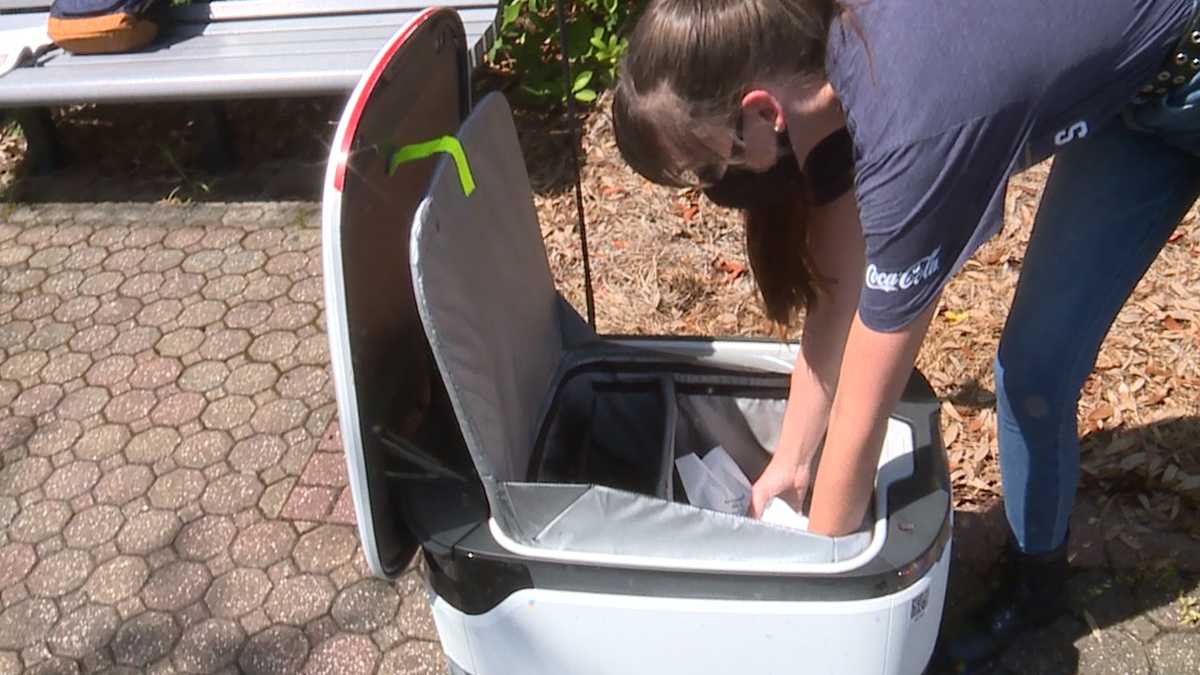
Six-wheeled robots independently navigating the streets and sidewalks on Georgia Southern’s Statesboro Campus may look a little strange. But it will soon be commonplace as these ground robots, which look like a cooler on wheels, have been mapping routes to campus locations in preparation for contactless food delivery this fall. Thanks to a partnership with Starship Technologies, Georgia Southern is the first university in the state to provide faculty, staff, and students with 20 autonomous delivery robots to deliver food from on-campus dining locations to designated pickup locations. Since August, Starship’s robots have been delivering food ordered on the Starship app from University dining facilities and places such as Starbucks, Market Street Deli and Sushi with Gusto to patrons around campus. The robots, which are energy efficient, can have their location and delivery time tracked by recipients through the app. They can also maneuver around obstacles such as pedestrians. “My hope is that it brings a sense of enhanced safety and convenience to our students,” said Clint Bridges, IT Business Owner at Georgia Southern University. “While we are all living through the COVID-19 pandemic, we are hoping that the robots will allow for easier social distancing. The fact that students can order a meal from their residence hall room and have it delivered by an automated delivery vehicle keeps them close to home where they can feel the most at ease and still enjoy a meal from one of our dining locations on campus.” Starship Technologies officials say the robots have been proven to be popular. “Students are looking for ways to get food delivered in the safest and most convenient way possible at the moment,” said Ryan Tuohy, senior vice president of Business Development at Starship Technologies. “Our robots are fast, friendly and help make life a little bit easier, especially in these challenging times.” If you are journalist and would like to know more about how Georgia Southern is constantly innovating and discovering new ways to safely enhance the on-campus experience for students - simply reach out to Georgia Southern Director of Communications Jennifer Wise at jwise@georgiasouthern.edu to learn more and arrange an interview today.


Georgia Southern University – is thinking BIG when it comes to entrepreneurs and small business
Through the CARES Act and the U.S. Department of Commerce, Georgia Southern University’s Business Innovation Group (BIG) has received $300,000 in grant funding to expand its services to the region in an effort to help communities and businesses respond to and recover from the economic impact of the coronavirus pandemic. “This will really allow us to help businesses and entrepreneurs throughout the entire state ideally get access to the skills, knowledge and services that Georgia Southern has to offer,” said Dominique Halaby, DPA, director of BIG. Over the next two years, BIG will use these funds to expand their services through the Georgia Enterprise Network for Innovation and Entrepreneurship (GENIE). “We’re hoping that we can demonstrate to budding entrepreneurs and small business owners that Georgia Southern can help them develop and grow,” Halaby said. “We are hopeful that in two years’ time people are going to have a heightened aerial view of awareness for Georgia Southern and our Business Innovation Group services, but more importantly, that they are going to get the type of resources to be able to launch the business that they’ve always wanted to launch.” Halaby said offering these resources to the region is important for economic growth. “Any time that we have an ability to do something, we have a responsibility to do it,” Halaby said. “The needs of our community are great. Our ability to service those needs by connecting those with the resources on our campus and with the skills that we have fostered within BIG puts us in a very unique position. This way, we are able to provide services to help as many entrepreneurs and to help as many people looking for jobs as we possibly can.” BIG will also use part of the grant funding to work with Georgia Southern faculty to strengthen patent and licensing activity. “We’re working with our intellectual property committee and through the University to let faculty know that if they’ve got a concept, that BIG can help them flesh that out. We can work with them to do an analysis to see the marketability for their concept and determine if it’s patentable or licensable,” Halaby said. If you’re a journalist looking to know more about how Georgia Southern University is assisting regional businesses or its Business Innovation Group (BIG) – then let our experts help with your coverage. Dominique Halaby, DPA, is the Director of the Business Innovation Group (BIG) at Georgia Southern University. In 2015, BIG was recognized as a Gold Award Winner in Entrepreneurship by the International Economic Development Council. Simply click on his icon now to arrange an interview today.


Georgia Southern University President Kyle Marrero delivered a virtual State of the University fall 2020 address to faculty and staff, broadcast live from the Performing Arts Center on the Statesboro Campus on Aug. 12. Maxing out with 1,507 viewers at one point, University members tuned in from remote locations to hear the president discuss how Georgia Southern is successfully adapting during extraordinarily difficult times and will continue to be nimble during the fall semester. “We are being asked to be innovative, flexible, nimble and willing to adapt and change,” Marrero said after welcoming all back to the three campuses. “And I want to thank you. You all have been tremendous, remarkable, heroic even, as we made it through these times and as we navigate through these uncertain times.” Marrero touted the herculean efforts of faculty and staff, who maintained the integrity of the University’s five pillars — student success, teaching and research, inclusive excellence, operational efficiency, effectiveness and sustainability, and community engagement, in the midst of a pandemic that caused the University to move fully online in March. He cited specific examples of performance excellence since March with the following collective efforts: Moved more than 5,000 classes to fully online to complete the Spring 2020 Semester; Delivered summer term fully online while seeing credit-hour generation move up by more than 4%, compared to the Summer 2019 Semester; Moved 4,600 students out of housing and provided support for more than 100 students who remained on campus; Refunded almost $11 million in housing, dining and fees to students; Held virtual Spring 2020 Commencement, viewed by more than 100,000 worldwide; Provided more than $11 million in CARES Act grant funding directly to students; Developed and began implementation of Initial Return to Campus and Return to Campus Plans, based on input from more than 130 faculty staff across campus and public health guidance from the Centers for Disease Control and Prevention and the Georgia Department of Public Health; Modeled a 14% state budget reduction for FY21, then completed a 10% realized reduction, totaling $14.2 million; Developed and implemented flexible and remote work processes; Assessed and modified almost 5,000 courses for fall 2020; Prepared campus with signage, cloth face coverings, face shields, PPE, hand sanitizer stations; Formed and implemented the CARES Service Center; Continued communication, coordination and monitoring of community health care providers, public/private schools, municipalities and agencies. Marrero also presented August figures showing that fall 2020 enrollment looks strong compared to this same time last year, however, he was quick to note that the figures may fluctuate based on various factors throughout the semester. Final fall enrollment figures will be released in October. “We can continue to move forward,” he said. “We can continue to elevate and live our mission and our vision and our values even in these times. We will adapt, we’ll be nimble and we’ll ensure that every day that the public health and safety of our faculty, staff, students and our community is of paramount importance. “I am confident that we are ready as we can be and together we’ll assess and navigate the entirety of the fall semester with the goal and outcome of our students being successful. As a whole Georgia Southern University can make it through this together.” If you are journalist and would like to know more about Georgia Southern university and how it is succeeding during COVID-19, simply reach out to Georgia Southern Director of Communications Jennifer Wise at jwise@georgiasouthern.edu to arrange an interview today.