
Experts Matter. Find Yours.
Connect for media, speaking, professional opportunities & more.
Aston University to launch Aston Centre for Applied Linguistics
The Centre is an interdisciplinary, multilingual group of researchers made up of academic staff and research students It aims to build on Aston University’s longstanding expertise in research into language education, languages, and applied linguistics The hybrid launch event will take place at the University on 14 September Aston University is launching a new research centre within its College of Business and Social Sciences. The Aston Centre for Applied Linguistics (ACAL), formerly known as the Centre for Language Research at Aston (CLaRA), aims to build on Aston University’s longstanding expertise in research into language education, languages, and applied linguistics by promoting interdisciplinary collaboration and establishing national and international networks and partnerships. ACAL is an interdisciplinary, multilingual group of researchers – academic staff and research students – who work in the field of language and language education research. The Centre will officially be launched through a hybrid event at the University on 14 September 2022. There will be talks by Aston University’s Dr Lucia Busso & Dr Marton Petyko, Dr Marcello Giovanelli, Dr Megan Mansworth and Dr Emmanuelle Labeau as well as guest lectures from Professor Zhu Hua (IOE faculty of education and society, UCL) and Terry Lamb (professor of languages and interdisciplinary pedagogy, University of Westminster and Aston University language graduate). The event will conclude with a celebration of the major publications of ACAL members in 2021-22. Dr Emmanuelle Labeau, director of ACAL, said: “Language actually is all around us: we use it to articulate all our human activities. “Languages actually are all around us: over 100 languages are spoken in Birmingham “My recent AHRC-funded project BRUM (Birmingham Research for Upholding Multilingualism) has shown that research in language(s) is needed in local schools, businesses, public services and culture. “ACAL wants to put the ‘applied’ into linguistics to serve the University, the city, region and beyond. Our researchers are a great asset to the University’s ambitions, and we cannot wait informing and helping shape the Aston University 2030 Strategy.”


Researchers in Georgia Southern University’s Tactical Athlete Readiness and Preparedness Program (TARP) have teamed up with the Georgia Public Safety Training Center (GPSTC) to ensure the readiness and resilience of Georgia’s public safety officials. Members of the TARP in the Waters College of Health Professions have worked to revise the fitness training standards for Georgia’s police cadets with a focus on functional fitness, mental resilience and injury prevention. In addition, the program has formed a partnership with the GPSTC, Georgia’s premier training facility for all state and local public safety related units to include police, fire and communication. Bridget Melton, Ed.D., professor of exercise science and lead faculty member of TARP, said that due to high stress and health concerns, some police and public safety officials are at high risk for cardiovascular disease or other fatal illnesses. “Our program provides state academies with fitness exercises that increase overall cadet fitness and focuses on injury prevention,” said Melton. “Our program focuses on occupational focused fitness to hopefully encourage a more positive view of exercise that will stick with cadets even after their academy training is done.” Richard Cleveland, Ed.D., associate professor of leadership, technology and human development, heads resilience and mental health for the TARP team, and has created a Mindfulness-Based Tactical Instruction curriculum for the state of Georgia. “Tactical athletes need training and support for resilience and mental health, but too often it’s only presented as a one-time workshop or seminar,” said Cleveland. “Our program dovetails into the state’s resilience curriculum for officers, but provides ‘bite-sized’ mindfulness practices within the fitness program. This gives cadets repeated practice at using mindfulness and embeds it within their context using police language, actions and behaviors.” The partnership was made possible due to a subgrant GPSTC was awarded from the Criminal Justice Coordinating Council to fund TARP at their facilities due to the program’s comprehensive view of officer wellness, which is aimed at improving de-escalation skills among recruits through mental and physical training. “We are pleased to form a partnership with the GPSTC and the Tactical Athlete Readiness and Preparedness Program,” stated Chris Wigginton, director of GPSTC. “This partnership will allow public safety professionals to be better prepared in their personal and professional lives. Some of the many benefits will be a reduction in injuries, being better prepared to use needed skills in rapidly evolving situations, and the resiliency and mental health component. As word has gotten out of the possibility of the GPSTC implementing this program we have already been contacted by several states regarding the initiative.” Additionally, graduate students in the Department of Health Sciences and Kinesiology participate in the program and gain firsthand and practical experience by performing training and assessment for state instructors. TARP is part of Georgia Southern’s Tactical Athlete Initiative, which aims to reduce the number of injuries and increase readiness and preparedness of tactical athletes. The interdisciplinary team consists of the following Georgia Southern faculty members: • Bridget Melton, Ed.D., Professor • Richard Cleveland, Ed.D., Associate Professor • Greg Grosicki, Ph.D., Assistant Professor • Haresh Rochani, DrPH, Associate Professor • Mary Beth Yarbrough, Lecturer • Sarah Davis, Lecturer TARP is just one example of the work coming from Georgia Southern University’s Tactical Athlete Initiative. The Tactical Athlete Initiative is a multi-discipline collaboration providing research, training and support for military, police, fire and EMS workers. The Tactical Athlete Initiative has partnered with multiple agencies including the Statesboro Police Department, Statesboro Fire Department, Bulloch County Sheriff’s Office, Forsyth County Sheriff’s Office, Waycross Fire Department, Georgia Public Safety Training Centers, Federal Law Enforcement Training Centers and the United States Army. If you're a reporter looking to know more about this partnership at Georgia Southern University - the let us help. Richard Cleveland, Ph.D., is an assistant professor in the Department of Leadership, Technology & Human Development at Georgia Southern - simply click on his icon to get in touch or contact Georgia Southern Director of Communications Jennifer Wise at jwise@georgiasouthern.edu to arrange an interview today.


Georgia Southern students expand communication disorder awareness amidst Deaf Culture Renaissance
At Georgia Southern, a group of students is taking courses to grow the number of interpreters in their communities and their fields. Each student comes to class with their own motivations to learn ASL. “Most of the deaf people, myself included, feel kind of depressed,” signed Angellia Burnett, a volunteer assistant in Georgia Southern University’s American Sign Language (ASL) course. “We miss a lot of things in life, because it has always been a struggle with communication.” Burnett grew up deaf, and is the only person in her family who is deaf. Members of her family speak ASL, but she said many in the Deaf community continue to be left out of family conversations because not everyone will sign all of the time. This leaves Deaf family members feeling isolated even within their own homes. “Not everyone accepts my deafness,” Burnett signed. “They need to know Deaf culture. They need to accept that.” One of the most effective ways of accepting someone is by understanding the challenges they face. Over the past few years, the world has experienced a Deaf culture renaissance, where the inclusion of people who are deaf becomes more mainstream. Recently, the film “CODA,” which stands for “children of deaf adults,” won the 2022 Academy Award for Best Picture. This brought Deaf culture further into the spotlight, opening many eyes into the lives of those with hearing impairments. “What that means is it embraces the entire community,” said Dana Taylor, Ph.D., Georgia Southern adjunct professor and sign language interpreter. “It’s not isolating one group as being different. Individuals get to see the struggles and challenges and the triumphs that people experience.” At Georgia Southern, a group of students is taking courses to grow the number of interpreters in their communities and their fields. Each student comes to class with their own motivations to learn ASL. Some are learning sign language because they have people in their lives with hearing impairments or other communication disorders where sign can be advantageous. Others are there to develop their Sign skills as a professional tool. “If I had a client who spoke ASL, I’d be able to communicate with them better or make them feel more comfortable,” said Ricki Botsford, speech pathology student. “I’ve learned a lot about how broad communication can be, because there are so many ways to communicate outside of the verbal option.” When the students were asked if they had tried learning other languages like Spanish or French, every hand was raised. When asked if they stuck to learning them, all but a few went down. So what makes Sign different? “It’s a lot easier to integrate into every day,” said Adia Greer who’s studying to be an athletic trainer for Deaf athletes. “I can speak it verbally, but I can also sign it. I’ve picked up signing to my cat a lot. She doesn’t understand it, but it allows me to practice.” While the students practice Sign with their pets and favorite TV shows, Burnett continues to come to class to help show her students the world they share, but not the one they see. Georgia Southern has a network of Student Accessibility Resource Centers on the Statesboro and Savannah campuses providing interpreters for students who want to attend classes and interact with their environment, as well as many other resources for students who are hard of hearing. “The whole world needs to learn Sign,” Burnett signed. “I want to see people motivated to learn. I see a lot of Hearing people who are motivated to learn, and a lot of Deaf people that want to help make them successful. I’m really proud that I can help in that.” If you're a reporter looking to know more about this important topic - then let us help with your coverage and stories. Dana Taylor, Ph.D., is available to answer your questions - simply reach out to Georgia Southern Director of Communications Jennifer Wise at jwise@georgiasouthern.edu to arrange an interview today.

Up to four scholarships are being offered to students who have sought refuge in the UK The donor, Matthew Crummack, is CEO of Domestic & General, former CEO of GoCompare and lastminute.com and an alumnus of Aston University The Scholarships are named after the donor’s grandfather, Ernest Edward, who left school at 12 to work in a coal mine. Aston University is launching a new sanctuary scholarship scheme for students who have sought refuge in the UK. Up to four sanctuary scholarships are on offer, due to a generous donation by prominent businessperson Matthew Crummack, currently chief executive of Domestic & General. They will be known as The Ernest Edward Scholarships in memory of the donor’s grandfather, Ernest Edward Crummack, who left school aged 12 to work in a coal mine. Matthew graduated with a BSc in International Business and French at Aston University in 1993. His career to date has taken him into well-known companies such as GoCompare, lastminute.com, Expedia, Nestlé and Procter & Gamble. He was awarded an honorary doctorate by Aston University in 2016, in recognition of his professional achievements and service to the University. Ernest Edward Scholars will receive a full tuition fee waiver and up to £25,000 throughout their course to help with living costs. Language assistance will also be offered if required, as well as support from Aston University Students’ Union and professional mentoring support. To be eligible for an Ernest Edward Scholarship, applicants must be an asylum seeker, the partner or dependant of an asylum seeker or an asylum seeker/refugee/partner/dependant who has been granted Discretionary Leave to Remain (DLR) or some other form of temporary status. Applicants need to apply for an eligible Aston University course - any three-year undergraduate or one-year postgraduate programme - before applying for a scholarship. Applications will close on 12 June for the 2022 round. Speaking about his motivation for funding the scholarships, Matthew said: “My grandfather, whom I sadly never met, had little choice but to leave school at 12 to work in a coal mine. “100 years on, so many young people and especially young refugees, still find themselves challenged to grow and fulfil their potential. I hope that these scholarships will create that opportunity and pave the way for some of tomorrow’s leaders. “I strongly value my Aston University education and believe that business and individuals can take a leadership role in giving back to those facing challenge.” Saskia Loer Hansen, Interim Vice-Chancellor of Aston University, said: “Young people seeking asylum in the UK are likely to have experienced trauma and will have lost much which cannot be replaced. The Ernest Edward Scholarship can contribute to a brighter future, made possible by education. It offers hope and an opportunity for respite. “On behalf of Aston University, I would like to express my deep gratitude to Matthew for his generous and compassionate support in helping to make Aston University a safe haven. It is an act of kindness which will have a profound effect on those young lives.” More information about The Ernest Edward Scholarships is available here.

Music in nature: from birds and cicadas to whales
When Henry Wadsworth Longfellow described music as the “universal language of mankind,” he was only partially right. Why? Because the roots of music trace all the way back to nature, specifically the animal kingdom, which uses it to communicate or simply commune. Author Michael Spitzer goes even further, describing music as our “umbilical cord” to Mother Nature, noting, “The very simple answer to where music begins is in animals, because birds sing and whales sing.” NJIT’s David Rothenberg knows this first-hand, as a composer and jazz clarinetist who jams with fish large and small and hordes of whirring cicadas – insects that spark both his heart and brain. As he explains, “Playing along with these guys is like joining into a fantastic trove with millions of singers.” As a researcher who investigates the musicality of animals, Rothenberg speaks authoritatively and animatedly about the music of fish, birds and yes, cicadas, identifying three distinct sounds they make during their massive mating call every 17 years. In short, if you want to know what makes nature sing, why and how, he’s your source. To interview him, simply click on the button below.


Aston University offers emergency interpreter training for Ukrainian speakers to support refugees
Dr Emmanuelle Labeau and Dr Yvonne Fowler are running Emergency Interpreting Training for Ukrainian Speakers to introduce them to the basics of interpreting The 10-hour training (10 x one hour) will take place on Tuesday and Thursday evenings online for five weeks It is part of an Arts and Humanities Research Council (AHRC) project with support from Aston University’s College of Business and Social Sciences. Aston University has kicked off a five-week introduction to interpreting course for Ukrainian speakers to enable emergency interpreters to support Ukrainian refugees arriving in the UK. It is part of an Arts and Humanities Research Council (AHRC) project called BRUM (Birmingham Research for Upholding Multilingualism) with support from Aston University’s College of Business and Social Sciences. Dr Emmanuelle Labeau (AHRC fellow for the Future of Language Research) and Dr Yvonne Fowler are running Emergency Interpreting Training for Ukrainian Speakers. The 10-hour training scheme (10 one-hour sessions) started on 28 April 2022 and will take place every Tuesday and Thursday evening online for five weeks. It has been devised to enable emergency interpreters to deliver a better service to traumatised Ukrainian refugees whose English is limited and who may require interpreting help in every aspect of their lives to access housing, physical and mental healthcare, educational facilities and welfare benefits. Dr Emmanuelle Labeau, co-director of Aston Centre for Applied Linguistics (ACAL) at Aston University, said: “Ukrainian refugees are arriving in the UK and there are few trained qualified Ukrainian interpreters to support those refugees with limited or no English in their dealings with public services. “We have had a fantastic response to our offer of free emergency training in interpreting for Ukrainian speakers in the West Midlands, as part of the AHRC-funded BRUM project. “I am thrilled that we have been able to pull this together and I am really pleased with how the first session went. We have people of all walks of life such as social services, healthcare, education and even a refugee who are so committed to help in any way they can, and it is lovely to empower them to do so!” Dr Yvonne Fowler said: “I am really proud to see this project get off the ground and help people in need. “I have been a public service interpreter trainer for the last 25 years. “My work has mostly involved preparing interpreters for the Diploma In Public Service, Interpreting Law and Healthcare options. “But during this period, I delivered emergency interpreter training to support various waves of refugees who have come to Birmingham over the last 20 years: the Vietnamese boat refugees, the Bosnian refugees in the aftermath of the Bosnian war, and a month in Kosovo after the war there to train Albanian and Serbian interpreters at the Organisation for Security and Cooperation in Europe.”

Aston University appoints translator in residence to inspire future literary translators
Aston University and Writing West Midlands have appointed Sarah Letza, a professional translator from the region to the role She will be working on community engagement activities at Aston University and with the West Midlands community The project is funded by Arts Council England. Aston University has appointed a translator in residence as part of a project developed by the translators Daniel Hahn and Ros Schwartz, a new one-off literary translation residency for 2022 based in Birmingham. Sarah Letza, a professional translator from the region, has been appointed to the position until March 2023. The project is funded by Arts Council England and will be run in partnership with Aston University and Writing West Midlands. Sarah’s residency will encourage an interest in literary translation and translated literature, and the valuing of languages, among communities in and around Birmingham through workshops, talks and other public engagement and collaborative participation projects. Sarah Letza, translator in residence at Aston University, said: “I hope to draw attention to the opportunities that translation and language learning can lead to and capitalise on the wealth of talent that can be drawn from Midlands schools and universities. “There is the potential to be involved with the many translation research projects already under development at Aston University as well as promoting and supporting languages and translation pathways. “I want to showcase Birmingham as a city that has been built on cultural crossings, intellectual exchange and creativity, all of which are the bedrock of both translation and language learning.” Dr David Orrego-Carmona, a lecturer in English, languages and applied linguistics at Aston University, said: “Birmingham is an incredibly multilingual city and Aston University is particularly well-placed to raise awareness and showcase the value of languages, translation and intercultural exchanges. “We are certain the programme will provide inspiring experiences for our beneficiaries in Birmingham and the region, and we are looking forward to the engaging activities that Sarah is already planning.” For more information about our courses in translation click here.

12 tips to help you build your networking skills in Canada
Your professional network will be one of your most valuable assets in the Canadian job market. Whether you’re trying to land your first job or are looking for a mentor, your network can play an important role in helping you achieve professional success in Canada. As a newcomer to Canada, you’ll have to work harder and refine your networking skills to build connections from scratch in your new country. This article will provide you with tips to help you build your networking skills, so you can start nurturing meaningful professional relationships. 1. Understand that communication is two-sided One of the many advantages of networking is that it’s as much about promoting your personal brand as it is about learning from the experience of others. When someone takes time to speak with you, give them a chance to talk. Active, attentive listening is an essential networking skill that ensures you absorb the information being shared with you. You can then ask intelligent, relevant questions and get insights that might be useful for your professional success in Canada. Keep distractions away and focus on the conversation. It is rude to interrupt when someone is talking, so save your questions until they’ve finished speaking. 2. Improve your public speaking skills Many newcomers avoid networking or public speaking as they lack confidence in their English language or interpersonal skills. However, practice is the best way to overcome the fear of speaking in public. Take the time to work on your language skills. There are many English as a Second Language (ESL) resources and community groups available across the country to help newcomers improve their speaking and listening skills. Practice speaking in front of a mirror or with your friends. Don’t feel insecure if you have an accent or have trouble understanding some words. Remember, Canada is a diverse, multicultural country, and most people are accepting of the fact that English may not be your first language. 3. Practice both verbal and non-verbal communication What you say is only half the image you present—non-verbal communication is just as important. Your body language conveys a lot about your personality and how engaged you are in a meeting. Avoid crossing your arms, closing your fists tightly, or hunching your shoulders, as this can make you seem unfriendly. Practice smiling and gesturing with your hands as you talk in front of a mirror. Be aware of your posture and make eye contact with the people you are talking to. While networking in-person, speak confidently. Respect people’s personal space and avoid standing too close to them. 4. Learn the art of small talk Small talk is culturally important in Canada. It serves as an icebreaker before you get to the actual topic of conversation. Since small talk is meant to create a safe, comfortable environment, be sure to choose non-controversial, light topics. Some common small talk topics include the weather, sports, arts, entertainment, hobbies, and current events. Stay away from topics like politics, personal or family matters, income, and religion. As a newcomer, you can build your small talk skills by staying up-to-date on the news, developing an interest in Canadian arts, culture, and, of course, sports. 5. Ask for constructive feedback An easy way to build your networking skills is to get an honest opinion on what you maybe doing wrong or need to improve. Before an important networking meeting, do a practice run with some friends and ask them for feedback on your small talk, elevator pitch, questions, and overall communication skills. You can also ask for constructive feedback towards the end of your networking meetings. Be open and humble when you ask for tips to help you build your networking skills. In most cases, people are willing to offer guidance and insights that you can leverage in future meetings. 6. Give before you get One mistake many newcomers make is to only think about what they can get out of a connection, without considering what they may be able to offer in return. Networking is not one-sided, so be sure to make a list of your unique skills and strengths before you start. Even if you are new to the Canadian job market, review the LinkedIn profile of the person you’re going to meet to understand their role and see where you can contribute. During your meeting, convey your willingness to help and ask if there’s anything you can support them with. By offering to give before you get, you can build meaningful connections and also prove your value to your network. Once they’ve seen your skills in action, they’ll be more likely to offer guidance, connect you to others, or refer you to job opportunities. 7. Attend networking events and workshops One way to build your networking skills is to jump right in and start networking. Look for both virtual and in-person networking events on industry association websites or on platforms like Eventbrite and Meetup, and attend as many as you can. In addition to making connections, this will also give you a chance to observe the way other people network. You’ll be able to pick up best practices related to small talk, ways to introduce yourself, verbal and non-verbal communication, and questions to ask. If you meet someone particularly impressive, don’t hesitate to follow up and ask if they would be willing to share some tips to help you network better. 8. Prepare, prepare, prepare When it comes to networking meetings, preparation can make all the difference. Put your research skills to good use and learn as much as you can about the background, role, and career path of the individual you’re going to meet. Know what you want to get from your networking meetings—further connections, guidance, or referrals. Prepare a list of questions accordingly, and customize your list based on each person’s industry, skills, and position. Finally, spend some time creating an engaging, authentic elevator pitch. Remember that an elevator pitch is not a sales pitch, but a chance to tell your story and highlight your skills in an impactful way. 9. Ask for recommendations and introductions In Canada, every professional you meet will likely have their own network. As a newcomer, it might not be easy to ask the people you meet to connect you with others. This is a networking skill that you’ll need to build as you start to grow and nurture your network. Before you meet someone for a coffee chat, go through their LinkedIn network and see if they know someone you’d like to be introduced to. If you’re looking for specific information or trying to build a particular skill, it is a good idea to ask your connections if they can recommend someone in their industry or organization who might be able to help. If you’ve cultivated a meaningful relationship, you might also be able to get an introduction to someone in their network. When you are introduced to a person by someone they know and trust, they are more likely to take out time to speak with you. 10. Keep track of your networking meetings For most newcomers, the first few months of networking can be overwhelming. Since you’re building your network from scratch in Canada, you might be meeting as many as four or five people each week. This makes it hard to keep track of who you’ve met and what you discussed. As a result, you might forget valuable insights or miss out on following up with some people. Keeping track of your meetings is an important networking skill. Create a list with names of people you meet, meeting dates, their designations and organization, discussion points, and follow-up actions. When you set up follow-up meetings, you’ll be able to refer to your list to review points that you had discussed with them earlier. This list can also help you identify connections who might be useful when you’re applying for a job. You’ll also be able to clearly see gaps in your network, such as industries you don’t have connections in, so you can focus on those in the future. 11. Follow up and follow through Building meaningful professional relationships takes time and in most cases, the first meeting is only an introduction. The value you can leverage from your connections often depends on how much time and effort you invest in maintaining them. You can start by sending a personalized thank you note within 24 hours of your meeting. If you’ve agreed upon any action items during your meetings, don’t forget to deliver on them. After your initial meeting, you can keep the conversation going by regularly sharing relevant developments and insights, engaging on their social media posts, or asking for their opinion on topics related to the ones you discussed. 12. Don’t give up Finally, patience is another skill you’ll need as you start building your network in Canada. It’s easy to become demotivated when your LinkedIn connection requests go unanswered or when the people you connect with online are unwilling to meet you. Even after the initial coffee chats, some of your connections may not be able or willing to offer you the advice, guidance, or contacts you need. It takes time to nurture relationships and identify how and where someone might be able to add value. You might also have to demonstrate your own willingness to help before someone agrees to support you. Even if some meetings don’t go as well as you had hoped, don’t give up. Each new meeting is a learning opportunity, so keep an open mind. Remember that it only takes one connection or referral to land your dream job in Canada. Networking plays a crucial role in the Canadian job market. However, networking may not come naturally to everyone. As a newcomer to Canada, improving your networking skills will help you build meaningful relationships with people who can bring you closer to achieving your career goals. Original article located here, published by Arrive. About Arrive Arrive is powered by RBC Ventures Inc, a subsidiary of Royal Bank of Canada. In collaboration with RBC, Arrive is dedicated to helping newcomers achieve their life, career, and financial goals in Canada. An important part of establishing your financial life in Canada is finding the right partner to invest in your financial success. RBC is the largest bank in Canada* and here to be your partner in all of your financial needs.

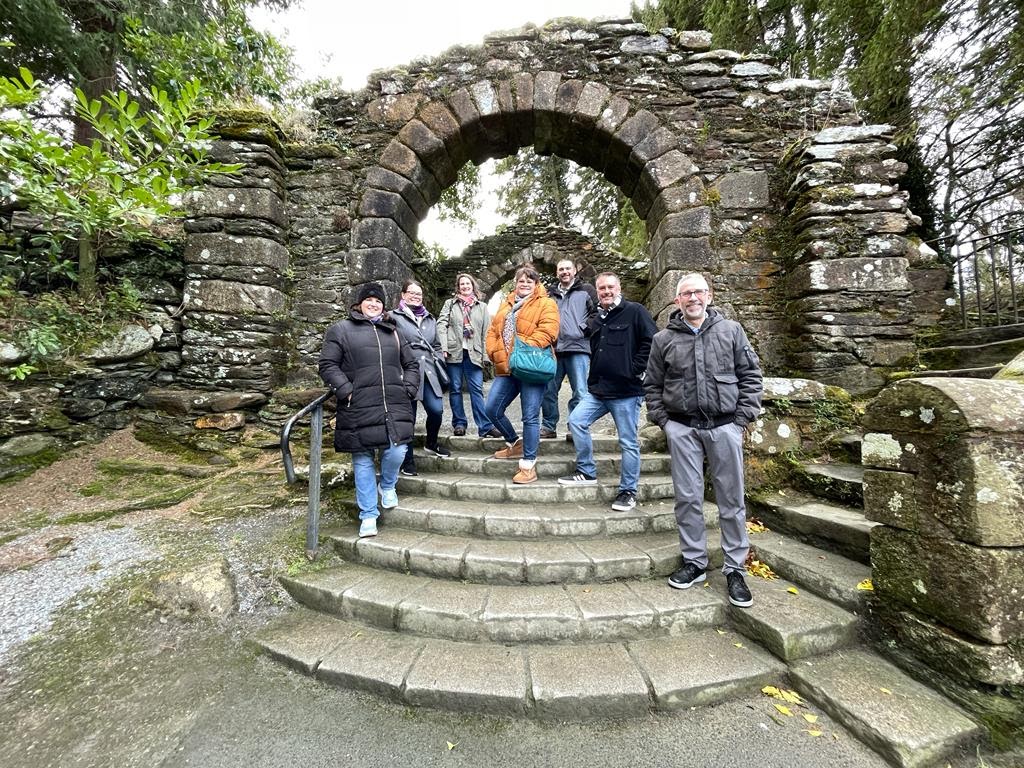
$100K student scholarship pool available for 2022 summer courses in Ireland Six professors from Georgia Southern University’s College of Education (COE) recently broadened their horizons during a trip to Ireland as they learned from and shared insight with instructors and educational leaders in the Wexford County community. Led by Howard Keeley, Ph.D., director of the University’s Center for Irish Research and Teaching, COE faculty traveled to Georgia Southern’s learning center in Wexford, Ireland, to observe Irish educational settings and exchange ideas with local leaders just ahead of a summer study abroad program opportunity for Georgia Southern students in which $100,000 of scholarship funding is available. “The main thing we did was get in front of leaders in the education space in Ireland,” stated Keeley. “We spoke to a number of folks who are either principals or vice principals or, in some way, senior administrators in a variety of schools including all-boys, all-girls, religious, secular and mixed schools.” The group included Catherine Howerter, Ph.D., associate professor of elementary and special education; Kip Sorgen, Ph.D., assistant professor of leadership, technology and human development; Alex Reyes, Ph.D., assistant professor of middle grades and secondary education; Amanda Wall, Ph.D., associate professor of middle grades and secondary education; Betsy Barrow, Ed.D., assistant professor of middle grades and secondary education; and Dan Calhoun, Ph.D., professor of leadership, technology and human development. Reyes, who trains pre-service and in-service teachers to work with culturally and linguistically diverse students, was excited to travel to Wexford after a study abroad program in Czech Republic she spearheaded with Wall was canceled in March 2020 due to the pandemic. Intrigued by Ireland, a plurilingual country, she was curious to see how Wexford’s environment might benefit students culturally. “I thought it was really exciting,” said Reyes. “All of the street signs are in Irish, even though English is the main language spoken. That prioritizing of that cultural heritage is fascinating. It was great to learn that the students in their primary and secondary schools take Irish language and culture as a subject every year.” She was especially motivated by a field trip to an Irish-language school, Meanscoil Gharman, which serves middle and high school students. With the exception of one daily class in English, teachers and students conducted all lessons in Irish. “It was really interesting to see that perspective,” she said. “There has been a revitalization of that culture. I thought that was fascinating to see how that can be handled in school.” In addition, Reyes was duly impressed with the country’s prioritization of social and emotional literacy for children, and the mandated well-being hours that are incorporated into daily school routines as a result of the pandemic. A program that promotes hygiene and an anti-bullying campaign also fit into the wellness curriculum. “It really impressed me that as a nation they prioritize the wellness of students, and how language and cultures can really be supported in a meaningful way,” Reyes said. “It’s affirming to see a proactive approach that has positive outcomes. Now, thinking ahead, we can look at how we can create opportunities for our students to experience this kind of approach.” Sorgen, who teaches in the educational leadership program at Georgia Southern, was interested in Ireland’s professional preparation. “None of them had advanced degrees, like what we offer at Georgia Southern,” noted Sorgen. “Learning about how to be a principal in Ireland is on-the-job training. In Georgia, there are specific educational requirements for our school administrators guided by professional standards. In Ireland, they generally ascend through the ranks, which makes professional mentoring essential to their success. We are exploring ways our educational leadership students could learn from Irish administrators about their experience, specifically with mentoring.” He also foresees the international partnership as a two-way exchange. “Given educational leadership programs are not common in Ireland, our faculty are considering ways in which we could use our expertise to foster leadership development of principals and teachers in Wexford,” said Sorgen. “We would utilize the Georgia Southern Wexford campus to host some of these sessions, furthering Georgia Southern’s relationship within the Wexford community.” Keeley also arranged meetings with education policy makers, including an extended meeting with an Irish congressman who is a representative for the County of Wexford in the Irish national parliament and chairs the joint committee for the Irish equivalent of the House and Senate Committee on education and higher education. “That was a tremendous opportunity for our faculty to talk to somebody at the highest level of government in Ireland, creating Irish state policy on education,” said Keeley. “And I know from the feedback we got from our College of Education colleagues that particularly for those in higher education, that to them was a really useful, next-step experience.” The trip exceeded expectations. “It was a fantastic learning experience for everyone,” said Keeley. “We had lots of high-level and also very practical experiences, and I could see our College of Education team thinking, ‘How can I bring what I’m learning, what I’m experiencing in this moment, into my classroom, into my curriculum, into my prospective study abroad courses in a way to build student success for our Georgia Southern folks.’ I think it was a great visit.” Complementing the faculty’s trip, a COE Irish study abroad program on diverse education in Ireland was recently approved for Summer 2022 and will give education students the opportunity to take one or two courses with the study abroad component. This will be a part of a broader study abroad program in Wexford, presented by the Honors College and the Center for Irish Research and Teaching, with assistance from the Office of the Provost and the Office of Global Engagement. The costs for undergraduate students at Georgia Southern’s Wexford campus will be offset by a $100,000 scholarship fund with awards of $1,000 for each student accepted into the program. “For students traveling to Wexford, Ireland, this summer, we will be able to defray the cost of the program through a generous travel scholarship through the Georgia Southern University Foundation,” said Dustin Anderson, Ph.D., associate provost for Student Success. “The donation makes these the most affordable multi-week programs that we ever have been able to offer.” Keeley is thrilled the gifts from generous donors will enable a number of students to earn valuable global experiences. “For students to have an opportunity to have international lives is powerful, and it’s powerful in ways that sometimes we can’t even predict,” he said. “Just the very fact of being abroad is going to change any of us, right? It can have a really transformative effect to feel a sense that, you know, as a student, ‘I can do this,’ and then a sense after the fact, ‘I did this,’ and just that in itself is educational. Giving students a safe space in Wexford, Ireland, to grow and feel that they are in a sense global citizens and bring the best of America, bring the best of Georgia, bring the best of the states from Savannah to Ireland, and learn to be an ambassador. That’s wonderful.” In addition to the education courses, students will also be able to choose from a Wexford-Savannah honors inquiry and an interdisciplinary program open to all students on human migration with courses in geography, religious studies, public health and a CORE study abroad course. Students interested can learn more about the program by clicking here and can email Kristin Karam in the Office of Global Engagement for more information about the scholarships. Georgia Southern University-Wexford is a global hub for learning housed in a historic building constructed in 1812. The space now features state-of-the-art classrooms and student apartments. Georgia Southern is the first public university in the United States to open an outreach learning facility in Ireland. If you're a reporter looking to know more about this initiative, then let our experts help. Howard Keeley, Ph.D., is the director of the Center for Irish Research and Teaching at Georgia Southern University. He is available - simply click on his icon now to arrange an interview today.


Journalism, Libel, and Political Messaging in America - UConn's Expert Weighs in
Former Alaska governor and vice presidential candidate Sarah Palin didn't cause the deadly 2011 shooting in Tuscon, Arizona, that injured Congresswoman Gabrielle Giffords, says former journalist and UConn expert Amanda Crawford in a new essay for Nieman Reports. Palin is asking for a new trial after a jury in February rejected her libel lawsuit against the New York Times. Palin sued the newspaper after it published a 2017 editorial that erroneously claimed she was responsible for the shooting. The Times quickly issued a correction. But Crawford says that, in her opinion, Palin has contributed to increased vitriol in American politics today, and that libel laws protecting freedom of the press need to be guarded: Palin, the 2008 Republican vice presidential nominee known for her gun-toting right-wing invective, is now asking for a new trial in the case that hinges on an error in a 2017 Times editorial, “America’s Lethal Politics.” The piece, which bemoaned the viciousness of political discourse and pondered links to acts of violence, was published after a man who had supported Sen. Bernie Sanders opened fire at congressional Republicans’ baseball practice, injuring House Majority Whip Steve Scalise. The Times editorial noted that Palin’s political action committee published a campaign map in 2010 that used a graphic resembling the crosshairs of a rifle’s scope to mark targeted districts. It incorrectly drew a link between the map and the shooting of Rep. Gabrielle Giffords, the Democratic incumbent in one of those districts, while she was at a constituent event in a grocery store parking lot in Tucson less than a year later. I was a political reporter in Arizona at the time, and I remember how Giffords herself had warned that the map could incite violence. “We’re on Sarah Palin’s targeted list,” she said in a 2010 interview, according to The Washington Post, “but the thing is that the way that she has it depicted has the crosshairs of a gun sight over our district, and when people do that, they’ve got to realize there are consequences to that action.” In the wake of the mass shooting in Tucson, some officials and members of the media suggested that political rhetoric, including Palin’s, may be to blame. In fact, no link between the campaign map and the shooting was ever established. As the judge said, the shooter’s own mental illness was to blame. That is where the Times blundered. An editor inserted language that said, “the link to political incitement was clear.” (The Times promptly issued a correction.) This was an egregious mistake and the product of sloppy journalism, but both the judge and the jury agreed that it was not done with actual malice or reckless disregard for the truth. That’s the standard that a public figure like Palin must meet because of the precedent set in the Sullivan case and subsequent decisions. Even if Palin is granted a new trial and loses again, she is likely to appeal. Her lawsuit is part of a concerted effort by critics of the “lamestream media,” including former President Donald Trump, to change the libel standard to make it easier for political figures to sue journalists and win judgments for unintentional mistakes. They want to inhibit free debate and make it harder for journalists to hold them accountable. -- Nieman Reports, March 14, 2022 If you are a reporter who is interested in covering this topic, or who would like to discuss the intersection between politics and media, let us help. Amanda Crawford is a veteran political reporter, literary journalist, and expert in journalism ethics, misinformation, conspiracy theories, and the First Amendment. Click on her icon now to arrange an interview today.

