
Experts Matter. Find Yours.
Connect for media, speaking, professional opportunities & more.

MEDIA RELEASE: The CAA Worst Road in Ontario is Hamilton's Aberdeen Avenue
The nominations are in, and Aberdeen Avenue in Hamilton is the CAA Worst Road for 2024. This is the first year Aberdeen Avenue has claimed the top spot on the provincial list due to potholes, poor road maintenance, and traffic congestion. It first debuted on the top regional list for Hamilton 2021 and has since climbed to the top. Taking the second and third place spots are Eglinton Avenue West in Toronto, due to traffic congestion, potholes and poor road maintenance and Barton Street East in Hamilton, due to potholes and poor road maintenance. "We know that the campaign works; time and time again, we see roads and infrastructure projects being moved up and budgets prioritized after the road has appeared on the list," says Teresa Di Felice, assistant vice president of government and community relations, CAA South Central Ontario. "For the last 21 years, the campaign has given Ontarians a voice to help them nominate the roads they believe are in need of urgent repair." CAA Worst Roads lists provide decision-makers with an important citizen perspective on which roadway repairs need to be expedited and key priorities for infrastructure funding and investments moving forward. In Ontario, 145 municipalities nominated over 2,000 different roads in their communities. Municipalities are responsible for approximately 140,000 kilometres of roads across the province. "Roads, sidewalks, and bike paths are only some of the things municipal governments fund with limited revenue sources," says Di Felice. "It's important for communities to share their view on what and where investments should be made. CAA Worst Roads is a forum to do that." Drivers accounted for most of the nominations, while cyclists and pedestrians accounted for about a quarter. Ontarians shared their primary reasons for selecting a road, with 53 per cent citing potholes, followed by poor road maintenance (52 per cent), traffic congestion (13 per cent) and poor cycling infrastructure, or lack thereof (8 per cent). Ontario's top 10 list is verified by the Residential and Civil Construction Alliance of Ontario (RCCAO). "For the second consecutive year, RCCAO is proud to be the technical partner of the CAA Worst Roads advocacy campaign," says Nadia Todorova, Executive Director of RCCAO. "This year's campaign revealed growing competition on Ontario's deteriorating infrastructure amidst a growing state of good repair backlog. Long-term, sustainable funding is needed to build and maintain critical infrastructure." Ontario's Top 10 Worst Roads for 2024 1. Aberdeen Avenue, Hamilton 2. Eglinton Avenue West, Toronto 3. Barton Street East, Hamilton 4. County Road 49, Prince Edward County 5. Hurontario Street, Mississauga 6. Bloor Street West, Toronto 7. Cedar Street North, Uxbridge 8. Finch Avenue West, Toronto 9. Lake Shore Boulevard East, Toronto 10. Laclie Street, Orillia Worst Roads by Region Central— Laclie Street, Orillia Eastern— County Road 49, Prince Edward County Halton-Peel-York-Durham— Hurontario Street, Mississauga Niagara— Portage Road, Niagara Falls North— Widdifield Station Road, North Bay Southwest— Plank Road, Sarnia Western— York Road, Guelph Ottawa— Carling Avenue, Ottawa For the complete list of the 2024 Worst Roads, please visit https://www.caasco.com/advocacy/worst-roads/2024-results



Presidential debates in America have played a crucial role in shaping the democratic process, providing a platform for candidates to present their policies and engage with voters. This topic is not only newsworthy because of its impact on electoral outcomes but also due to its role in fostering political discourse and transparency. Furthermore, the evolution of presidential debates highlights broader societal changes in media, communication, and public engagement. Key story angles that journalists might explore include: The historical development and milestones of presidential debates in America Memorable moments and turning points in debate history that influenced election results The role of media in shaping the narrative and perception of presidential debates Analyzing the effectiveness and influence of debate formats on voter decision-making The impact of presidential debates on political strategy and campaign dynamics The future of presidential debates in the digital age and their relevance in modern elections As we reflect on the history of presidential debates in America, journalists have the opportunity to delve into these multifaceted narratives, shedding light on the evolution and significance of this democratic tradition. Connect with an Expert about the History of Presidential Debates in America: John Koch Senior Lecturer and Director of Debate · Vanderbilt University Juliana Fernandes Assistant Professor · University of Florida Carolyn Dudek Professor of Political Science · Hofstra University Mark C. Alexander, JD Arthur J. Kania Dean and Professor of Law | Charles Widger School of Law · Villanova University To search our full list of experts visit www.expertfile.com Photo Credit: JFK Library


New COVID variant: Uptick expected, but cases should be mild
Talk of a new COVID-19 variant can lead to a feeling of shell shock and fears that another wave is approaching. But a University of Delaware epidemiologist says the FLiRT strain will likely cause more of a ripple marked by mild cases as opposed to the waves we became accustomed to four years ago. Jennifer Horney, professor and founding director of UD's epidemiology program, said that although the number of cases will rise during the summer due to travel, weddings and other large gatherings, the health impact won't be as dire thanks in large part to our existing public immunity. "What we can expect later in 2024 will likely depend on how well the vaccine advisors are able to anticipate changes to the virus and make recommendations about a vaccine that will become available in Fall 2024," she said. Horney has been one of the leading sources for media outlets on COVID-19 and served as a member of the Board of Scientific Counselors for the Centers for Disease Control and Prevention’s (CDC) Center for Preparedness and Response during the pandemic. She has led interdisciplinary research projects funded by many federal agencies and was part of the public health response to Hurricanes Isabel, Charley, Katrina, Wilma, Irene and Harvey where she conducted rapid assessments of disaster impacts on individual and community health. Reporters interested in setting up an interview can visit Horney's profile and click on the contact button. The message will reach her directly.



MEDIA RELEASE: 18th Street in Brandon Named CAA's Worst Road in Manitoba
Potholes and Crumbling Pavement Along 18th Street in Brandon, Manitoba. (Submitted: March 27, 2024) The nominations have been tallied, and the 2024 CAA Worst Road is 18th Street in Brandon. 18th Street's issues with potholes and severe alligator cracking in the pavement have led to this dubious distinction. The road first appeared on the top 10 list in 2022 and has steadily climbed its way to the top. The second and third place spots are also taken by repeat offenders on the top 10 list are Leila Avenue in Winnipeg and Provincial Road 307 in Whiteshell. According to the voter insights, Leila Avenue's unavoidable potholes have damaged many vehicles, costing local drivers thousands of dollars in repairs. Voters also expressed concern over Provincial Road 307 regarding poor pedestrian infrastructure and road maintenance. "The 2024 CAA Worst Roads campaign provides a valuable snapshot of the roads that the public perceives as pain points," says Ewald Friesen, manager of government and community relations for CAA Manitoba, "For 13 years, this campaign has served as a powerful advocacy tool, initiating dialogue with decision-makers and driving positive change for safer roads across the province." CAA's most recent survey data shows that while 78 per cent of Manitobans do not appreciate road maintenance efforts, however, 88 per cent are willing to put up with the inconvenience of construction if that means they get a good road at the end of the repairs. The campaign received 486 road nominations from thousands of local voters across 71 municipalities. "Manitobans' frustration about the state of our roads is clear," says Friesen. “We know they voice their concerns to neighbours, friends, or mechanics; this campaign helps bring awareness to decision-makers, providing valuable insights on our preferences for how to prioritize road repair and maintenance." Half of the roads on the top 10 list have debuted this year. These include Highway 26, Pandora Avenue, Richmond Avenue, Grant Avenue, and Munroe Avenue, which are tied for ninth place. Manitoba's Top 10 Worst Roads for 2024 1. 18th Street, Brandon 2. Leila Avenue, Winnipeg 3. Provincial Road 307, Whiteshell 4. Kenaston Boulevard, Winnipeg 5. Provincial Highway 26, Saint François Xavier 6. Empress Street, Winnipeg 7. Pandora Avenue, Winnipeg 8. Saskatchewan Avenue, Winnipeg 9. Grant Avenue and Munroe Avenue, Winnipeg 10. Inkster Boulevard, Winnipeg and Richmond Avenue, Brandon "Municipalities are responsible for thousands of kilometres of roads across the province. Roads, sidewalks, and bike paths are only some of the things that municipal governments fund with limited revenue sources," adds Friesen. "It's important for communities to share their view on what and where investments should be made. CAA Worst Roads is a forum to do that." For more information and historical results, please visit: https://www.caamanitoba.com/advocacy/government-relations/worst-roads


MEDIA RELEASE: CAA Manitoba Urges Drivers to Slow Down and Move Over
A recent study conducted by CAA Manitoba revealed a knowledge gap in how drivers understand and comply with Slow Down Move Over (SDMO) laws. According to the study, 85 per cent of drivers claim they are aware of the SDMO law – however, only 41 per cent have a clear understanding of its definition. The survey also found that a third of drivers (30 per cent) confuse the SDMO law with the one that requires drivers to give emergency vehicles the right of way and clear passage when stopped on the side of the road. “This data shows us that there is a big divide and misunderstanding between the law in theory and the law in practice,” says Ewald Friesen, manager of government and community relations CAA Manitoba. “Lack of understanding of the Slow Down Move Over law poses a significant safety risk for tow truck operators and emergency vehicles on the province's roads." To help keep tow operators safe, CAA Manitoba is using National Slow Down Move Over Day to remind drivers of the law, its purpose and penalties for non-compliance. On May 14, all CAA Clubs across Canada are coordinating a National Slow Down Move Over Day, part of a broader campaign to remind motorists to be mindful and cautious around truck operators assisting others on the roadside. Across North America, more than 100 tow truck drivers have been killed in the last decade after being struck by oncoming traffic while helping stranded motorists with flat tires, breakdowns, and collisions. Given the lack of data collection on these types of deaths, this number is very conservative. Add to that the significant number of injuries and near misses demonstrates just how important it is to educate the public about the Slow Down Move Over law. “Tow truck operators face a high risk of injury when on the side of the road or in a live lane helping stranded drivers. “These are real people with friends, families and loved ones,” says Friesen. “CAA Manitoba will always advocate for their safety to create safer roads across Manitoba for everyone, including those working alongside it.” In Manitoba, the SDMO law requires drivers to slow down when a vehicle is working along the roadside. If the posted speed limit is less than 80 km/h, drivers are required to slow down to 40 km/h. If the posted speed limit is 80 km/h or higher, drivers are required to slow down to 60 km/h. Drivers are not as concerned for the safety of tow truck operators as they should be. The survey also found that when compared to other types of emergency vehicles, Manitoban drivers tend to slow down less for tow truck operators. While motorists say they will reduce their speed and fully change lanes when they encounter emergency vehicles like police (95 per cent), ambulances (93 per cent) and fire trucks (89 per cent) only 70 per cent will slow down and move over for a tow operator. “Everyone deserves a safe place to work, including tow truck operators who are working in extremely unsafe conditions, "says Friesen. “ CAA Manitoba will continue to educate the public on road safety, and bring awareness to the laws that have been put in place to protect tow operators along with other emergency roadside assistance.” CAA Manitoba is encouraging motorists to get informed on the laws put in place to protect tow operators and other emergency roadside assistance on National Slow Down, Move Over Day. To learn more about Slow Down, Move Over, visit: https://www.caamanitoba.com/advocacy/government-relations/slow-down DIG Insights conducted an online survey on behalf of CAA Manitoba between October 26th –November 6th, 2023, of 758 Manitoba drivers aged 18-75 years. Based on the sample size and the confidence level (95 per cent), the margin of error for this study was +/- 3 per cent

Aston University scientist to help make crop monitoring easier and cheaper
Photonics expert Dr Sergey Sergeyev to help make crop monitoring easier and cheaper with remote sensing The technology can be placed on drones and flown over crop fields to provide real-time information about crop health Remote sensing is an essential tool to provide real-time information about crops to estimate yields. An Aston University photonics expert has received a Royal Society Industry Fellowship grant to help make crop monitoring easier and cheaper with remote sensing technology. Dr Sergey Sergeyev of Aston Institute of Photonic Technologies (AIPT) has received £174,000 to improve polarimetric LIDAR, a technology that uses light to remotely observe plants. LiDAR, an acronym for Light Detection and Ranging, involves light sent from a transmitter which is reflected from objects. Devices with this technology can be placed on drones and flown over crop fields to provide real-time information about crop health to help farmers forecast the success of their crops. Polarimetric synthetic-aperture radars (SARs) and polarimetric LiDARs are the most advanced, cost-effective sensors for crop monitoring. They are often used onboard aircraft and satellites and have been in use for three decades. However, current polarimetric LIDAR systems have low spatial resolution, a slow measurement speed and use expensive components that limit their cost effectiveness. Dr Sergeyev will be working in collaboration with Salford-based digital and AI farming company Fotenix to meet farmers' need for a cost-effective solution to check if their plants are adequately watered and disease-free. The team will aim to advance recently patented AIPT technology of the polarimetric LIDAR, making it affordable for farmers in the UK and worldwide. The project, called POLIDAR, will run from 2024 to 2025. Dr Sergeyev said: “Aston University’s patented technique will be modified by using a laser emitting four time-delayed pulse trains with different states of polarisation. By comparing the input states of polarisation and states of polarisation of light reflected from plants, it will reveal information about the distance to plants and plants' leaf texture, such as water stress and pathogen infection. Unlike state-of-the-art solutions we suggest an all-fibre design with a minimum number of bulk components that reduces the footprint, cost and weight. Dr Sergeyev added: “My project's motivation is driven by the global and UK agenda on increased food production, requiring novel remote sensing approaches towards ICT farming. “As declared at the World Summit on Food Security in 2017, the growth in the world's population requires increased and more efficient agricultural production. “Remote sensing is an essential tool to systematically address the challenging task of enhanced agricultural efficiency by providing real-time information about crop traits for yield estimation.” The announcement coincides with UNESCO Day of Light which marks the role light plays in science, culture and art, education and sustainable development. It is held on 16 May every year, the anniversary of the first successful operation of a laser. ENDS World Summit on Food Security in 2017 The future of food and agriculture: Trends and challenges (fao.org) https://www.fao.org/3/i6583e/i6583e.pdf UNESCO Day of Light The International Day of Light is a global initiative that provides an annual focal point for the continued appreciation of light and the role it plays in science, culture and art, education, and sustainable development, and in fields as diverse as medicine, communications, and energy. The broad theme of light will allow many different sectors of society worldwide to participate in activities that demonstrates how science, technology, art and culture can help achieve the goals of UNESCO – education, equality, and peace. The International Day of Light is held on May 16th every year, the anniversary of the first successful operation of the laser in 1960 by physicist and engineer, Theodore Maiman. The laser is a perfect example of how a scientific discovery can yield revolutionary benefits to society in communications, healthcare and many other fields. About Aston University For over a century, Aston University’s enduring purpose has been to make our world a better place through education, research and innovation, by enabling our students to succeed in work and life, and by supporting our communities to thrive economically, socially and culturally. Aston University’s history has been intertwined with the history of Birmingham, a remarkable city that once was the heartland of the Industrial Revolution and the manufacturing powerhouse of the world. Born out of the First Industrial Revolution, Aston University has a proud and distinct heritage dating back to our formation as the School of Metallurgy in 1875, the first UK College of Technology in 1951, gaining university status by Royal Charter in 1966, and becoming The Guardian University of the Year in 2020. Building on our outstanding past, we are now defining our place and role in the Fourth Industrial Revolution (and beyond) within a rapidly changing world. For media inquiries in relation to this release, contact Nicola Jones, Press and Communications Manager, on (+44) 7825 342091 or email: n.jones6@aston.ac.uk


300 million tonnes of rice straw are burned after harvest in Asia every year Aston University will be contributing to new international project to unlock renewable energy potential Its researchers will lead on calculating the greenhouse gas emissions savings of new systems. Aston University researchers are helping to make rice straw processing in India and the Philippines less environmentally damaging. The University will be contributing to a new international collaboration, the Renewable, Inclusive Carbon-negative Energy (RICE) project, funded by Innovate UK Energy Catalyst programme to unlock renewable energy for rice farmers. Already the University has worked with UK company Straw Innovations in the Philippines and now the two are expanding their collaboration to benefit more of the continent. Aston University working with UK company Straw Innovations and Indian enterprise, Takachar Rice straw is a crop waste byproduct and each year across Asia 300 million tonnes of it go up in smoke when burnt after harvest. This releases emissions and air pollutants that triple risks of increased respiratory diseases and accelerate climate change. India and the Philippines are the world’s second and eighth largest rice producers respectively and together they produce 130 million tonnes of both rice and straw per year. Aston University and Straw Innovations and will be collaborating with an Indian award winning small and medium sized enterprise, Takachar. The firm has developed small scale, low-cost, portable equipment which can convert agricultural waste on-site into higher value bioproducts such as fertilizer blends, chemicals and biofuels. "The company will develop a super-sized version which is 10 times bigger than their current device, make it adaptable to rice mills, and will send it to Straw Innovations, so the two firms can test out different business models for farmer adoption/benefit. Straw Innovations will also send their machines from the Philippines to India mid-project and the two countries will test out different business models for farmer adoption/benefit. And for the first time they will tap into the heat produced in the waste process to dry rice, instead of using diesel or kerosene. University researchers will lead on assessing the sustainability of the project, calculating the greenhouse gas emissions savings of the new systems introduced by Straw Innovations and Takachar. Sustainability expert Dr Mirjam Röder will also engage with the farming community and rural stakeholders to quantify how the systems can increase farmer incomes, equality of opportunity, food security and decarbonisation benefits, whilst highlighting any trade-offs. Dr Röder who is based at Aston University’s Energy & Bioproducts Research Institute (EBRI) said: “Environmentally, rice produces 48% of all global crop emissions, due to methane from flooded fields. This is halved when the straw is removed and reduced further when its carbon is stored in biochar. We are aiming for carbon negative which means removing carbon dioxide (CO₂) from the atmosphere or sequestering more CO₂ than is emitted. “Our new research leads on from our rice straw bio gas hub project with Straw Innovations, SEARCA and Koolmill and we’re pleased to be building further relationships with new partners in India. In January Biomass and Bioenergy published a paper about the topic written by Dr Röder, the director of EBRI Professor Patricia Thornley and Craig Jamieson of Straw Innovations called The greenhouse gas performance and climate change mitigation potential from rice straw biogas as a pathway to the UN sustainable development goals. Craig Jamieson from Straw Innovations said "We’ve been pioneering rice straw work with the team at Aston University for the past seven years. We're delighted to continue that strong partnership and widen it to include Takachar in this new project. “Takachar is a leader in making biochar from crop residues and our partnership with them is very strategic. We look forward to combining our new improved straw harvesting technology with their scaled-up biochar production. It will be a step change, creating a new, more efficient system for carbon negative energy and soil improvement for rural communities across Asia." Vidyut Mohan who founded Takachar said: “We are excited to partner with Aston University and Straw Innovations. “Our combined solutions can significantly move the needle in reducing crop residue collection costs and biochar production costs for carbon removal." Notes to Editors Rice straw is a crop waste byproduct and each year across Asia 300 million tonnes of it go up in smoke when burnt after harvest https://tinyurl.com/2afjhhsj To read The greenhouse gas performance and climate change mitigation potential from rice straw biogas as a pathway to the UN sustainable development goals visit https://www.sciencedirect.com/science/article/pii/S0961953424000254, Biomass and Bioenergy Volume 182, March 2024, 107072 Mirjam Röder and Patricia Thornley Energy & Bioproducts Research Institute (EBRI), College of Engineering and Physical Sciences, Aston University, Aston Triangle, Birmingham, B4 7ET, United Kingdom Craig Jamieson Straw Innovations Ltd., Lawes Open Innovation Hub, Rothamsted Research, West Common, Harpenden, HERTS, AL5 2JQ, United Kingdom https://doi.org/10.1016/j.biombioe.2024.107072 About Aston University For over a century, Aston University’s enduring purpose has been to make our world a better place through education, research and innovation, by enabling our students to succeed in work and life, and by supporting our communities to thrive economically, socially and culturally. Aston University’s history has been intertwined with the history of Birmingham, a remarkable city that once was the heartland of the Industrial Revolution and the manufacturing powerhouse of the world. Born out of the First Industrial Revolution, Aston University has a proud and distinct heritage dating back to our formation as the School of Metallurgy in 1875, the first UK College of Technology in 1951, gaining university status by Royal Charter in 1966, and becoming The Guardian University of the Year in 2020. Building on our outstanding past, we are now defining our place and role in the Fourth Industrial Revolution (and beyond) within a rapidly changing world. For media inquiries in relation to this release, contact Nicola Jones, Press and Communications Manager, on (+44) 7825 342091 or email: n.jones6@aston.ac.uk


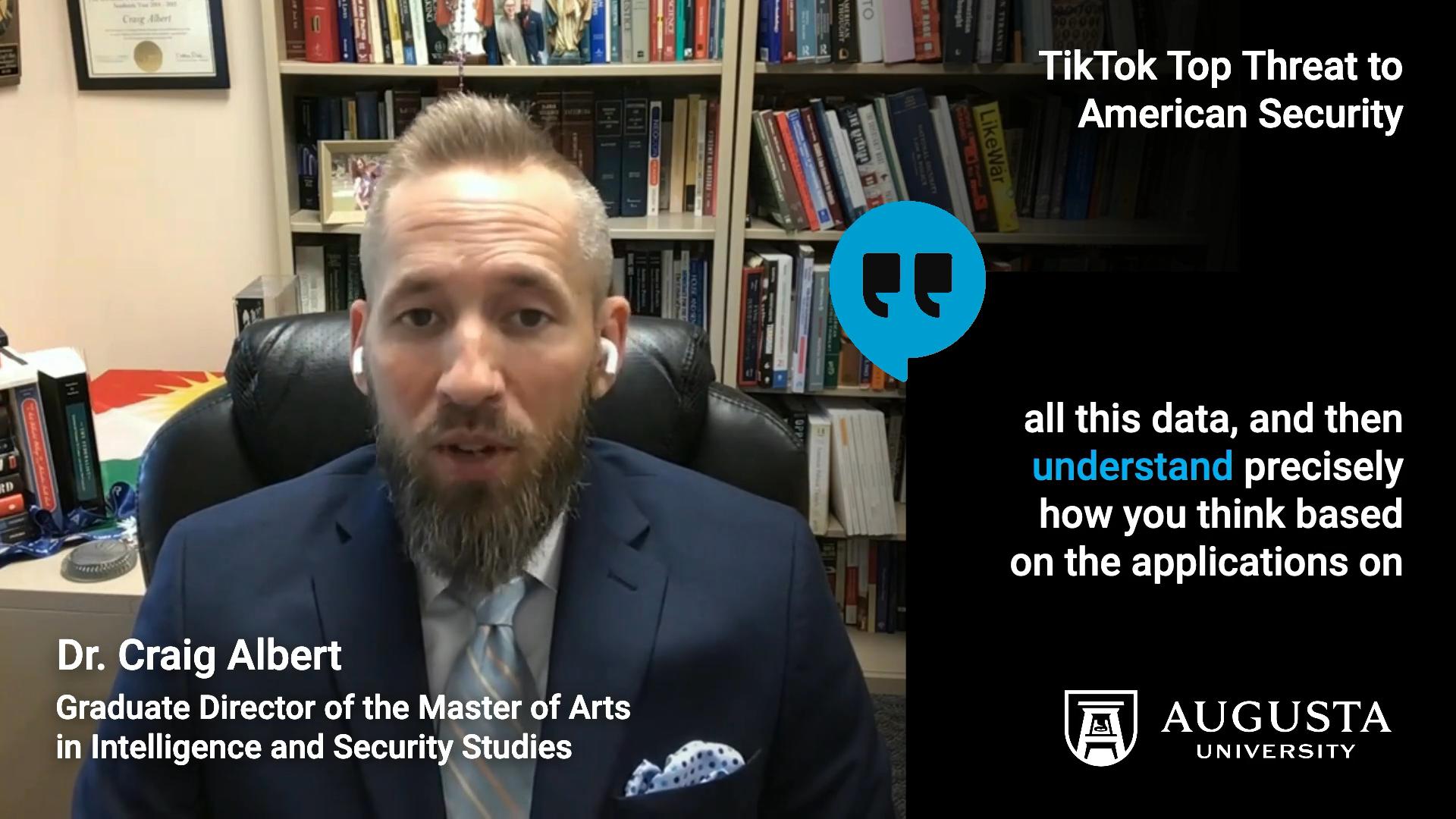
Time to talk about Tik Tok? Dr. Craig Albert explains the reasons we need to know more about the app
Earlier this week, TikTok said they were suing the U.S. government to stop a bill passed last month seeking to force ByteDance, TikTok’s Chinese to sell the app or have it banned. The lawsuit, filed in the U.S. Circuit Court of Appeals for Washington, D.C., argues that the bill violates constitutional protections of free speech. The suit calls the law an “unprecedented violation” of the First Amendment. Lawsuits and rhetoric aside - there are serious concerns about TikTok and Dr. Craig Albert is lending his expertise to explain what is going on behind the screens of the popular app. Read more about the dangers of TikTok here Read more from Albert about Informational Warfare here Read more from Albert about deepfakes here Craig Albert, PhD, is director of the Master of Arts in Intelligence and Security Studies at Augusta University. He is a leading expert on war, terrorism and American politics. AI and the upcoming election is a serious topic. Albert is available to speak with media – simply click on his name to arrange an interview today.


Homes heated by human sewage could be a reality thanks to Aston University
Project to transform sewage sludge into clean water and energy awarded a share of £4.5 million by Ofwat Involves extracting energy from the waste produced during sewage and water treatment Gases obtained can be used to power engines or heat people’s homes. An Aston University project that could transform sewage sludge into clean water and energy has been awarded a share of £4.5 million by Ofwat. The University project with engineering consultancy ICMEA-UK involves extracting energy from the waste produced during sewage and water treatment and transforming it into hydrogen and/or methane. The gases can then be used to power engines or heat people’s homes. The aim is to create a sustainable and cost-efficiently run wastewater processes, plus extra energy. The initiative was one of ten winners of Ofwat’s Water Discovery Challenge, of which the Aston University scientists and two industrial partners have been awarded £427,000. Dr Jude Onwudili based at Aston University’s Energy and Bioproducts Research Institute (EBRI) is leading the team of scientists who will work with the partners to develop a trial rig to transform solid residues from wastewater treatment plants to hydrogen and/or methane. The two-stage process will involve the initial transformation of organic components in the sludge into liquid intermediates, which will then be converted to the fuel gases in a second stage. The project is called REvAR (Renewable Energy via Aqueous-phase Reforming), and Dr Onwudili will be working with lead partner and engineering consultancy company ICMEA-UK Limited and sustainable infrastructure company Costain. REVAR combines the use of hot-pressurised water or hydrothermal conditions with catalysts to achieve high conversion efficiency. The technique can treat sewage sludge in just minutes, and it is hoped that it will replace existing processes. In 2013, a Chartered Institution of Water and Environmental Management report stated that the sector is the fourth most energy intensive industry in the UK. Dr Onwudili said: “This project is important because millions of tonnes of sewage sludge are generated in the UK each year and the water industry is struggling with how to effectively manage them as waste. “Instead, they can be converted into valuable feedstocks which are used for producing renewable fuel gases, thereby increasing the availability of feedstocks to meet UK decarbonisation targets through bioenergy. “We will be taking a waste product and recovering two important products from it: clean water and renewable energy. Overall, the novel technology will contribute towards meeting UK Net Zero obligations by 2050 and ties in with the University’s purpose to make our world a better place through education, research and innovation.” The Water Discovery Challenge aims to accelerate the development and adoption of promising new innovations for the water sector. Over the next six months, winners will also receive non-financial support and will be able to pitch their projects to potential water company partners and/or investors. The 10 winning teams are from outside the water industry and were chosen because of their projects’ potential to help solve the biggest challenges facing the sector. The competition is part of the Ofwat Innovation Fund, run by the water regulator Ofwat, with Challenge Works, Arup and Isle Utilities and is the first in the water sector to invite ideas from innovators across industries. Helen Campbell, senior director for sector performance at Ofwat, said: “This competition was about reaching new innovators from outside the sector with different approaches and new ideas, and that’s exactly what the winners are doing. “The products and ideas recognised in this cross-sector challenge will equip water companies to better face challenges of the future – including achieving sustainability goals and meeting net zero targets – all while providing the highest-quality product for consumers.” ENDS A Blueprint For Carbon Emissions Reduction in the UK Water Industry The Chartered Institution of Water and Environmental Management https://www.ciwem.org/assets/pdf/Policy/Reports/A-Blueprint-for-carbon-emissions-reductions-in-the-water-industry.pdf Ofwat Innovation Fund Ofwat, the Water Services Regulation Authority for England and Wales, has established a £200 million Innovation Fund to grow the water sector’s capacity to innovate, enabling it to better meet the evolving needs of customers, society and the environment. The Innovation Fund, delivered in partnership with Challenge Works (formerly known as Nesta Challenges) and supported by Arup and Isle Utilities, is designed to complement Ofwat’s existing approach to innovation and to help deliver against Ofwat’s strategy which highlights the role of innovation in meeting many of the challenges the sector faces. About ICMEA-UK Based in Sheffield, in the North of England, ICMEA-UK is the UK arm of an established Italian innovative engineering company - ICMEA SRL. They are an innovative Engineering consultancy company, and work in partnership with a range of other organisations to provide innovative, bespoke solutions to problems where an Engineering solution is required. About Costain Costain helps to improve people’s lives by creating connected, sustainable infrastructure that enables people and the planet thrive. They shape, create, and deliver pioneering solutions that transform the performance of the infrastructure ecosystem across the UK’s energy, water, transportation, and defence markets. They are organised around their customers anticipating and solving challenges and helping to improve performance. By bringing together their unique mix of construction, consulting, and digital experts they engineer and deliver sustainable, efficient, and practical solutions. About Aston University For over a century, Aston University’s enduring purpose has been to make our world a better place through education, research and innovation, by enabling our students to succeed in work and life, and by supporting our communities to thrive economically, socially and culturally. Aston University’s history has been intertwined with the history of Birmingham, a remarkable city that once was the heartland of the Industrial Revolution and the manufacturing powerhouse of the world. Born out of the First Industrial Revolution, Aston University has a proud and distinct heritage dating back to our formation as the School of Metallurgy in 1875, the first UK College of Technology in 1951, gaining university status by Royal Charter in 1966, and becoming The Guardian University of the Year in 2020. Building on our outstanding past, we are now defining our place and role in the Fourth Industrial Revolution (and beyond) within a rapidly changing world. For media inquiries in relation to this release, contact Nicola Jones, Press and Communications Manager, on (+44) 7825 342091 or email: n.jones6@aston.ac.uk


Covering the Anniversary of the Coronation of King Charles today? Our experts can help
As we mark the anniversary of the coronation of King Charles, we delve into a pivotal moment in history that shaped the trajectory of a nation and its monarchy. This event not only carries historical significance but also holds relevance in contemporary discourse, shedding light on themes of continuity, tradition, and the evolving role of monarchy in modern society. Key story angles that may pique public interest include: Historical Reflections: Exploring the coronation ceremony's historical context, significance, and its enduring impact on the British monarchy. Monarchy in the Modern Age: Analyzing the role and relevance of monarchy in contemporary Britain amidst calls for reform and debates surrounding constitutional monarchy. Cultural Heritage and Identity: Examining how the coronation anniversary fosters a sense of national identity and pride, celebrating traditions and customs that define British heritage. Royal Legacy and Public Perception: Investigating public sentiment towards King Charles's reign, his accomplishments, challenges, and the monarchy's portrayal in the media. Societal Implications: Discussing the monarchy's influence on governance, diplomacy, and national unity, and its role in shaping perceptions of leadership and authority. Global Perspectives: Considering international reactions to the coronation anniversary, its resonance beyond British shores, and its implications for global monarchies and ceremonial traditions. Connect with an Expert about King Charles: Carolyn Harris Historian, Author, Royal Commentator, Instructor, University of Toronto School of Continuing Studies · Helen Wood Professor in Media and Cultural Studies · Aston University Rachel C. Boyle Dean of School · Leeds Beckett University Ruth McClelland-Nugent, PhD Chair History, Anthropology & Philosophy · Augusta University To search our full list of experts visit www.expertfile.com Photo Credit: Samuel Regan-Asante