
Experts Matter. Find Yours.
Connect for media, speaking, professional opportunities & more.
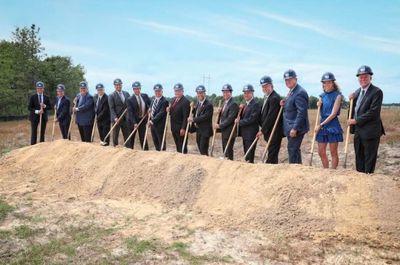
Dignitaries help University officials break ground on Jack and Ruth Ann Hill Convocation Center
State and local dignitaries help break ground on the new Jack and Ruth Ann Hill Convocation Center on Georgia Southern’s south campus in Statesboro. L-R: Georgia Southern Men’s Basketball Coach Brian Burg, Chair of the Georgia Southern Foundation Mike Sanders, University Foundation Board Member Leonard Bevill, University Provost Carl Reiber, Ph.D., Georgia Southern Athletics Director Jared Benko, Regent Everett Kennedy, Majority Leader Jon Burns, USG Chancellor Sonny Purdue, University President Kyle Marrero, Mr. Lance Hill, Congressman Buddy Carter, Chairman Terry England, Congressman Rick Allen, Student athlete Hannah Fuller, Waters College of Health Professions Dean Barry Joyner Ph.D. The opportunity to memorialize the late Sen. Jack Hill and wife Ruth Ann brought an impressive list of state and national leaders to Statesboro on Thursday to help break ground on a new Georgia Southern University Convocation Center that will bear their names. New University System of Georgia (USG) Chancellor Sonny Perdue, state legislators, congressmen and Georgia Southern University President Kyle Marrero – all of whom had worked extensively with Hill over the last several decades – headlined a team of speakers who lauded Hill and his impact on Georgia while helping to kick off a project that will change the face of Statesboro. “I’ve never known a more dedicated public servant than Jack Hill,” said Perdue, who shared an office with Hill and lived with him for a time while they both served in the Georgia Legislature. “It’s an honor to be here today to remember my best political friend in the world.” At 95,000 square feet, the Jack and Ruth Ann Hill Convocation Center will be the largest event venue space between Savannah and Macon and will serve as the signature building on Georgia Southern’s south campus, fronting Veterans Memorial Parkway (US 301 bypass). With an estimated total cost of $64.4 million, the center will be a multi-story complex that provides approximately 7,000 square feet of additional instructional space for the Waters College of Health Professions and provides more than a 50% increase in seating capacity in an arena that will be the new home court for Georgia Southern Eagles NCAA basketball games. The building is named for Jack Hill (‘66), who was the longest-serving Georgia senator when he died in April 2020. He was a senator for 30 years, serving as chairman of several crucial committees, including Appropriations, which has broad jurisdiction over legislation involving budgeting and spending state and federal funds. With Hill’s support, Georgia Southern reached new heights as an institution serving the southeast region and the state of Georgia. Hill was instrumental in helping the University expand its programs and build several new state-of-the-art facilities, including the Engineering and Research Building, which opened for classes in January 2021. His wife of 48 years, Ruth Ann, focused her life on public education and retired as principal of Reidsville Elementary School. She was a triple Eagle, earning degrees from Georgia Southern in 1973, 1990 and 1991. The media release announcing this historic event is attached here: If you're a journalist looking to know ore about this event or Georgia Southern University - simply reach out to Georgia Southern Director of Communications Jennifer Wise at jwise@georgiasouthern.edu to arrange an interview today.


Expert Insight: Properties on Confederate-named U.S. Streets Sell for Less
Houses on streets that are named after Confederate figures or themes sell for 3% less than similar properties in neighboring areas, says a new study led by John W. McIntyre Professor of Finance, Clifton Green. For an average property worth $240,000, the mean discount works out to around $7,000. Not only that, these homes take considerably longer to sell than comparable houses on streets that are named for secessionists. Green and his co-authors reviewed data from home sales across 35 states in the U.S., analyzing nearly 6,000 transactions between 2001 and 2020. Their data set looked at properties located on streets named after Jefferson Davis, Robert E. Lee, and Thomas “Stonewall” Jackson, as well as the more generic options of “Confederate” and “Dixie.” The majority of these streets are located in former Confederate states, though some are also found in California and Massachusetts, as well as a number of Midwestern and Western states that had not been created before the U.S. Civil War. To be certain of their findings, Green et al looked at homes with similar features and characteristics such as lot size, age, building type, and the number of bedrooms and bathrooms. The findings are unequivocal, says Green, although the effect is not equally distributed across states. What is the Confederate Discount? “The discount in prices for homes of Confederate-named streets is geographically variable. In those states that make up the former Confederacy, the effect is more muted at around two percent,” he notes. “And in some states where you find the most Lost Cause memorials, there may even be a fraction of a percentage point boost in sales for properties on streets with secessionist names.” Beyond the South, the “Confederate discount” effect is notably more visible. The debate around changing street names in the U.S. has gathered momentum in recent years, with some 1,400 streets still named after Confederate figures. Much of the discussion, however, has focused on what Green calls the “principled reasons” for name changes–arguments that may or may not stack up favorably against the cost of changing signs. This new study lends more economic clout to the cause of revising street names in the U.S.–albeit that the effect is more pronounced in Democratic-voting areas or areas with a higher share of Black or highly-educated residents. “In these places, sales on streets with Confederate names dipped even further, going for eight percent less on average, and this is particularly noticeable after events that have shone a spotlight on race inequity or white supremacy in the U.S.” Interested in knowing more? Get in touch today. T. Clifton Green is a Professor of Finance at the Goizueta Business School. He is an expert in the areas of market microstructure, with an emphasis on behavioral finance and his research has been featured in the Wall Street Journal, Barrons, Financial Times, and on CNBC.



Battleground Georgia: All eyes on the Peach State with midterms in sight
The US midterm elections are quickly approaching, and with key Senate seats and the governor's mansion up for grabs in Georgia, the Peach State will be low hanging fruit for anyone looking to see where the balance of power rests in the country. With reporters across America covering the latest developments, we asked Augusta University's Mary-Kate Lizotte to answer a few questions that are top of mind for reporters and political junkies alike. The strength of endorsements? Q: What kind of an impact could Mike Pence backing Gov. Brian Kemp have going forward? It could have an influence on the willingness of Republicans who are not former President Trump supporters to contribute to the Kemp campaign and be sure to show up to vote for Kemp. But, it will likely not have much of an influence. Research does not find a huge, lasting impact of endorsements. Ultimately, Trump supporters are unlikely to stay home and not vote for Kemp given that they likely are very against Stacey Abrams becoming governor. For Abrams supporters, she has already begun to use Indiana as a comparison with Georgia to say that Indiana under Pence was more moderate, including Medicaid expansion in comparison with Georgia under Kemp. I doubt this will influence Republican voters who like Pence to vote for Abrams, but it could influence some Independents/moderates to vote for Abrams. It is important to note, however, that most Independents/moderates tend to consistently vote for one party's candidates and thus may not be influenced by this either. A fractured right? Q: Could Pence's support also divide the Republican party somewhat after former President Trump backed David Perdue? Yes, but will likely not have a substantial impact on the election. It is unlikely that Trump supporters and/or Perdue voters will stay home on election day. They will likely vote for Kemp as their most preferred candidate who is running. Goal line stand? Q: Herschel Walker won the Republican primary by a large margin. How does he stack up against Sen. Raphael Warnock in the general election? Polling is currently showing a close race within the margin of error. Warnock has not been running against Walker up until now because Walker had not won the primary, but Walker and conservative groups have been able to run against Warnock because there was no reason to believe that he would not win his primary. In terms of experience, Warnock is the incumbent and thus has more experience. Walker is a complicated and controversial public figure but also is loved among University of Georgia football fans. Warnock has focused on putting out positive campaign advertisements up to this point. But, since there are already attack ads against Warnock, the Warnock campaign or groups supporting the Warnock campaign need to begin airing attack ads against Walker to improve the Warnock standing in the polls. The research indicates that it is best to go negative once you have been attacked. Follow the money? Q: Are we likely to see a record amount of cash flow for candidates in Georgia over the next several months knowing it will be a key swing state? Definitely. People from out of state who will be watching these elections closely will likely contribute. We saw that when Abrams and Kemp ran against one another in 2018 and in the special election that elected Warnock in 2020. If you are a journalist covering this topic, then let our experts help. Dr. Mary-Kate Lizotte is an expert in political and voter behavior. She is available to talk about the upcoming midterm and gubernatorial elections in Georgia. Click on her name to schedule an interview.


Housing bubbles, student debt, stagnant salaries – America need a reset?
There’s an old saying we all know about those who don’t pay attention to history … they’re doomed to repeat it. Over and over and over sometimes. One would think after the 2008 housing crisis that nearly decimated the American and global economy – that we’d all be somewhat wiser. According to some, that may not be the case. America is once again approaching the same cliff it took a decade to climb up from. The measures that were put in place to prevent massive amounts of foreclosures a decade ago are now coming home to roost. “This massive problem of underwater homeowners could not be resolved only by shutting off the spigot of foreclosures. That is why a total of 25 million permanent mortgage modifications and other so-called 'workout plans' were put in place from 2008 until June 2018 according to data provider Hope Now. Modifying mortgages as an alternative to foreclosure just kicked the can down the road. It succeeded in bringing these delinquent homeowners into current status. Yet millions of them are re-defaulting on these modified mortgages. The number of re-defaults is increasing relentlessly around the U.S. Worse yet, many re-defaulters are on their second- or third mortgage modification.” - MarketWatch Mortgages once again are vulnerable as the housing market remains painfully out of sync with the rest of the economy. As well, with millennials facing massive student debt, a shortage of new builds means fewer people can enter the market nor can they afford to. Combine that with salaries flatlining and not keeping pace with the rising price of goods – it’s not a sunny forecast. Are you covering this potential financial crisis? What will America have to do to course correct and ensure we don’t have a repeat of the 2008 meltdown? And how did the country’s leaders allow this to happen? Did no one see this coming? There are a lot of questions and that’s where an expert from New Jersey Institute of Technology can help. Professor Michael Ehrlich's research focuses on financial markets and institutions, with an emphasis on market failures. He has written about the unintended consequences of financial market innovation and is Associate Director of the Leir Center for Financial Bubble Research. To reach Michael, simply click on the button below.



Social media interaction and well-being during a public health crisis
Yvette Wohn, assistant professor at New Jersey Institute of Technology, examines how social media and mobile technologies are used for social support, which includes emotional, informational and financial support — managing both personal and professional relationships. Wohn‘s research area is in human-computer interaction (HCI) and computer-mediated communication. She studies the role of algorithms and social interactions in livestreaming, esports and social media and how they influence well-being. Wohn is conducting research on how physical and social space influences the well-being and productivity of people living or working in enclosed spaces. Some of her experiments look at the effects of simulated nature via digital windows. As Wohn notes, "Seeing nature is important to maintain well-being. In a nutshell, seeing nature on a big screen, even if you know it is fake, can help elevate mood." Wohn is also the principal investigator of two NSF-funded projects examining the role of content moderators on social media, whose role is to keep online spaces positive and factual. Wohn is available to speak with media on topics related to how people use different technologies and social media to connect during these times. To request an interview, click on the button below.


Dual dynamic of social media: connecting and stressing out
If social media platforms connect us, particularly during periods of isolation, they can also distress us and the people who moderate their streams of questionable content. In short, they appeal to our best and worst selves. Understanding that dual dynamic and its nuances across Facebook, Twitter, Reddit, Twitch and Clubhouse is NJIT’s Yvette Wohn, a behavioral scientist who researches how online abuse impacts mental health. Ultimately, Wohn aims to develop tools that combat bullying on the web. Explaining the problem, she says: “Some people simply don’t know what’s socially appropriate. What people don’t realize is that what people say online has a direct consequence offline. What happens online, doesn’t stay online.” Source: Yvette Wohn on Curating Safe Spaces Online To interview Wohn, whose research is backed by the National Science Foundation, simply click on the button below.

Sustainable consumption in the age of CO2
Experts like NJIT’s Maurie Cohen are looking beyond electric cars and alternative sources of energy to combat the rapid rise of carbon dioxide emissions. Their approach is more fundamental and societal, touching everything from the size of our homes to where we work and what we buy. The global pandemic sparked new ways of living and working, bringing previously niche approaches into the mainstream, including: Working from home Tiny houses Local swap meets Live nomadically, work digitally Cohen, co-founder of the international Sustainable Consumption Research and Action Initiative and author of “The Future of Consumer Society,” is no newcomer to such ideas. He has studied sustainable consumption and its relationship to environmental policy for 20+ years, bringing a long-term perspective to addressing the carbon crisis. As seen in stories from Fortune, Fast Company, Vice and Yahoo News, Cohen can speak cogently about the implications of behavioral trends such as Facebook “no buy” groups, digital nomads and the shift toward working from home. To reach Cohen, simply click on the button below.


The demands of fast fulfillment
Consumers now expect packages to arrive in hours, perhaps days but not weeks. Amazon fueled this demand with the promise of speedy delivery of nearly everything you can buy online. Indeed, your doorstep now rivals the loading dock as the main destination for goods. Supply chains are the key to such quick turnarounds: in short, how items move from manufacturers to distributors to consumers. Any hiccups along the way exasperates our increasingly demanding consumers. In short, they want fulfillment to be as easy as clicking to buy something online. Through years of research and experience, NJIT’s Sanchoy Das has become an expert on fast fulfillment, even writing a book on it. It continues to evolve, however, with the prospect of drone deliveries on the horizon. He’s versed on that as well, making him an ideal source for stories that explain how goods and services are delivered in our on-demand economy. Specifically, Sanchoy can explain Logistics Breakdowns in supply chains Industrial engineering Business operations management Data-driven technology To interview him, simply click on the button below.


Enabling the disabled through technology
Technology represents new hope for people disabled by everything from cerebral palsy to injuries sustained in combat or car accidents, and NJIT’s Saikat Pal investigates the possibilities. At the university’s Life Sciences Motion Capture Lab, Pal fits disabled veterans with the latest exoskeletons, which get them upright again and moving across the room. All the while, Pal measures their range of motion to determine the strengths and weaknesses of the latest tech. Similarly, the biomedical engineer uses monitoring and recording equipment to measure the gaits of children with cerebral palsy. In short, he’s an expert on the limits of human movement, and how tech can extend those limits. And his experience is varied, having also worked as a research associate at Stanford University and biomedical engineering at the U.S. Department of Veterans Affairs. To interview Saikat, just click on the button below.


Dissecting market failures: from root to fallout
From mining coal to mining Bitcoin, a market is always prone to collapse, triggering all types of questions, including: What were the warning signs? How will you know when it has hit bottom? At what point will investors look to capitalize? Is a subsequent upswing temporary or sustainable long-term? NJIT’s Michael Ehrlich speaks authoritatively on market failures, as director of the university’s Henry J. and Erna D. Leir Research Institute for Business, Technology and Society. He also brings real-world expertise, having run his own business and managed units of Salomon Brothers and Bear Stearns. Moreover, Ehrlich excels at explaining the most complex financial issues in plain English. To interview him, simply click on the button below.