
Experts Matter. Find Yours.
Connect for media, speaking, professional opportunities & more.

Humanities play integral role in the UF Astraeus Space Institute
The ability to imagine has given the human species the power to create, problem solve, empathize, and theorize. In fact, creative imagination can be found at the origin of every modern development throughout time. From medical advancements and the formation of governments to the establishment of the internet and the creation of Beethoven’s Symphony No. 3 — all at first were simply imagined. So, it is not a leap to think that in establishing a space institute at the University of Florida, collaborators would continue to anchor the institution in the human element of imagination. That’s where space exploration began. Ancient Greek philosopher Thales, later known as the father of Greek science and mathematics, questioned the true origins of the universe. Introducing deductive reasoning, Thales sought answers beyond the stories of gods and heroes. Three hundred years later, Aristotle theorized the geocentric layout of the universe with Earth at its stationery core and celestial bodies revolving around it. In the early 14th century, the Italian poet Dante told the story of a vertical journey through the universe, reaching the stars in what he described as paradise. And in the fall of 1609, Galileo began observing the heavens with instruments he created to magnify his view up to 20 times beyond what the natural eye could see. Through his telescope, Galileo observed mountains on the moon, rings around Saturn, and the moons of Jupiter, all evidence that the universe did not revolve around the Earth, but the sun. Inspired by words written in 1865 by Jules Verne in his novel, “De la Terre à la Lune” (From the Earth to the Moon), a 10-year-old Russian boy questioned, could travel be possible beyond the Earth’s atmosphere? Could Verne’s 900-foot-long space gun propel humans — or anything for that matter — through the bonds of gravity and into outer space? Read more here: Looking to know more about the UF Astraeus Space Institute or connect with Rob Ferl, Amy J. Williams or Stephen Elardo? Simply click on either expert's icon now to arrange an interview today.


Adam Frank: New Peer-reviewed Studies Change the Conversation on UFOs
For decades, talk of UFOs has thrived on fuzzy photos and personal anecdotes—never the kind of hard data scientists can actually test. But new peer-reviewed studies have changed the conversation, says Adam Frank, a University of Rochester astrophysicist who studies life in the universe and the nature of scientific discovery. Two recent papers, published in reputable astronomy journals, claim to have found evidence of “non-terrestrial artifacts” in astronomical photographs from the 1950s — objects that appear to be orbiting Earth before the Space Age began. “That’s an extraordinary claim,” Frank says, “and, as Carl Sagan famously said, 'Extraordinary claims require extraordinary proof.' “The good news is that, finally, there’s something associated with UFOs that science can work with.” Led by astronomer Beatriz Villarroel and her VASCO project (Vanishing and Appearing Sources during a Century of Observations), the studies passed the first test of scientific credibility: rigorous peer review. Now, Frank says, comes the harder part — the “call-and-response” that defines real science. “Getting a paper published doesn’t make the claim right,” he explains. “It just means the debate can begin. Other scientists will now dig into the data, test the methods, and try to tear the claim apart. That’s how science works.” Frank is a frequent on-air commentator for live interviews and segments in national media outlets and the author of The Little Book of Aliens (Harper Collins, 2023). He also regularly contributes to written publications, including The Washington Post, The Atlantic, The New York Times, and Scientific American. In 2021 he received the Carl Sagan Medal, which recognizes and honors outstanding communication by an active planetary scientist to the general public. It is awarded to scientists whose efforts have significantly contributed to a public understanding of, and enthusiasm for, planetary science. Connect with him by clicking on his profile.


UF scientist studies muscle loss in space to benefit astronauts and patients on Earth
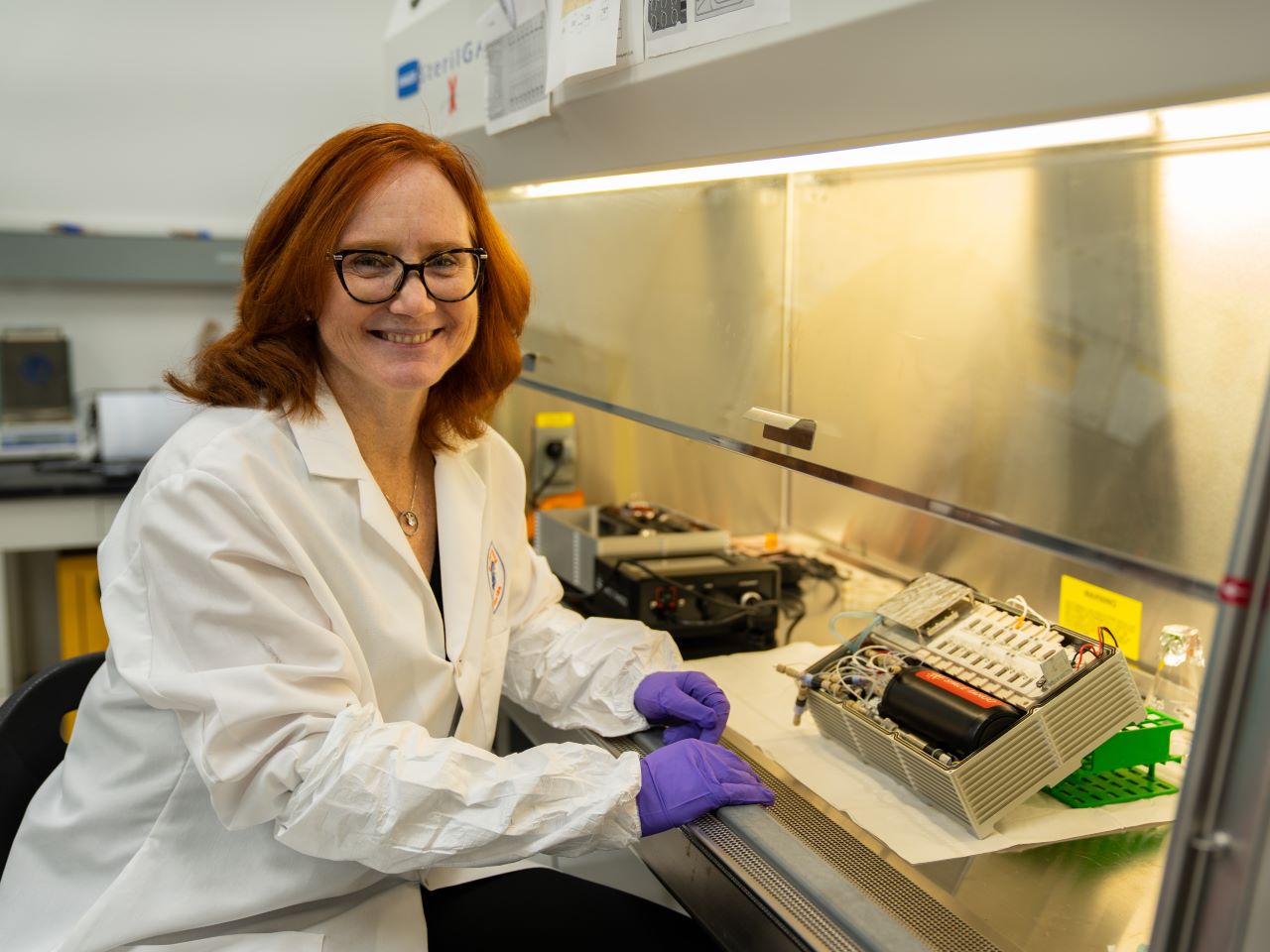
Astronauts traveling to Mars will face many challenges, but one of the most serious is muscle loss during long space missions. A new study led by University of Florida researcher Siobhan Malany, Ph.D., sheds light on how human biology changes in microgravity and could help protect astronaut health while also offering hope for patients with muscle-wasting diseases on Earth. Malany, an associate professor in the College of Pharmacy, a member of UF’s Astraeus Space Institute, and director of the in-space Biomanufacturing Innovation Hub, recently published findings showing how muscle cells adapt in space. Her team studied bioengineered three-dimensional muscle tissues derived from biopsy cells from both younger and older individuals and observed how they responded to electrical stimulation in microgravity. These micro-scale tissues called “tissue chips” were given nutrients and electric pulses autonomously in a miniature laboratory the size of a shoe box called a CubeLab.x. A camera system inside the box recorded the rate of muscle contraction. “This research is about more than just space,” Malany said. “By understanding how muscle tissue deteriorates much faster in microgravity, we can uncover new strategies to address muscle loss that occurs naturally with aging and with age-related diseases here on Earth.” Siobhan Malany studies the effects of microgravity on human muscle biology using an automated tissue chip system. View her profile here The study found that younger muscle tissue showed more pronounced changes in mitochondrial pathways — cellular systems that produce energy — than older tissue did when exposed to microgravity. Researchers also discovered that, on Earth, older muscle tissue responds less to electrical stimulation than younger tissue. But in space, the younger tissue showed a noticeable drop in its ability to contract, suggesting that younger muscle may experience a greater change when exposed to the space environment. These insights may help researchers design new treatments to protect muscles in astronauts during long missions, as well as develop therapies for people experiencing age-related muscle loss on Earth. The project was part of UF’s broader efforts to advance space biology. Through the Astraeus Space Institute, UF brings together experts across disciplines, from medicine and pharmacy to engineering and plant science, to address the unique challenges of space exploration. “UF researchers are helping lay the groundwork for humanity’s next giant leap,” Malany said. “It’s exciting to see our work contribute to both the health of astronauts and the lives of patients back home.” UF’s leadership in space biology is strengthened through collaboration with partners including the Kennedy Space Center Consortium and the Center for Science, Technology and Advanced Research in Space), both initiatives bringing together universities in Florida’s high-tech corridor, government agencies and industry leaders. Malany’s work also builds on long-term collaborations with AdventHealth, using donated tissue samples to model age-related muscle changes in space. Her team also works with SpaceTango, a NASA-certified aerospace company, to design the CubeLab that flew to the International Space Station on multiple SpaceX missions. Looking ahead, Malany and her team are developing new ways to study astronaut-derived cells, including both skeletal and heart muscle, generated from blood samples. These “avatars” could help researchers track changes before, during and after space missions, providing an unprecedented window into how microgravity affects the human body. “Now we can study cells from individual astronauts and see how they respond over time,” Malany said. “This helps us understand the risks of long-term spaceflight and also gives us a platform for testing potential treatments for muscle-wasting conditions on Earth.” By using tissue chips, small, bioengineered devices that mimic the structure and function of human organs, scientists in space can gather data more quickly and accurately than with traditional animal studies, potentially accelerating the discovery of therapies for aging-related muscle loss. Looking to know more about this amazing research or connect with Siobhan Malany - simply click on her icon now to arrange an interview today.

Why Brokers Are Canada’s New Mortgage Rockstars
There’s a quiet revolution happening in Canadian mortgage lending—well, as “quiet” as anything can be when two-thirds of Canadians are shouting, “We’d rather deal with a broker than a bank!” According to the most recent Mortgage Professionals Canada (MPC) Consumer Survey, 67% of Canadians now say they’d rather work with a mortgage broker than a bank. Among those who already have? A whopping 81% would do it again. That’s not just a statistic. That’s a standing ovation. The Great Mortgage Broker Boom According to recent MPC data, broker market share reached 33% in 2024—a four-point increase in just two years. Nearly half of all borrowers now choose brokers. The message is clear: Canadians are tired of sales reps; they want advocates who speak human, not policy manual. And who can blame them? With 1.2 million mortgages renewing in 2025 and average payments increasing by $513 a month, people aren’t just rate-shopping anymore—they’re seeking guidance, reassurance, and maybe a bit of hope. Let’s face it: they want their cake and still be able to heat their home too. Why This Matters—Especially for Seniors I work with Canadians aged 55+ every day, and about three-quarters of them are homeowners. They’ve done everything right: worked hard, paid off debt, raised families, and built wealth through their homes. But now, many feel… trapped by them. Here’s the reality: Mortgage renewals are costing hundreds more monthly (some facing 15–20% jumps) Inflation is eating into fixed incomes; and downsizing, aging in place, or tapping into home equity all feel like high-stakes decisions. Almost 80% of Canadians over 55 say their savings and pensions aren’t enough. (Source: Home Equity Bank Ipsos Survey) According to this same survey, half of respondents believe home equity is crucial for retirement—yet 76% feel pressured to downsize even if they’d rather not trade their garden for a balcony (or their favourite hairdresser for whoever’s closest to the condo). What they don’t need: A one-size-fits-all sales pitch from someone who thinks “retirement” means early-bird specials and Sudoku marathons. What they do need: A mortgage broker who listens, educates, compares options, and helps them sleep at night—not just sign on the dotted line. The Missing Link: Transactional vs. Conversion Sales Traditional mortgages are what we call commodities, sold using a transactional method. In this approach, the need is obvious—the customer wants a mortgage—and the focus is on competing for the best price and terms. It’s fast, efficient, and, let’s be honest, a little impersonal. It’s the classic hammer-and-nail approach: every client looks like a nail, and the broker just keeps swinging rates and terms until something sticks. That may work for a first-time buyer chasing the cheapest five-year fix—but for seniors? It’s about as effective as putting a Band-Aid on a broken arm. The 55+ demographic doesn’t want a hammer. They want a conversation. They want to understand how to stretch their pension income, cover rising expenses, and prepare for life’s curveballs—like healthcare costs or home repairs—without feeling like they’re going backwards financially. That’s why this is not a transactional sale; it’s a conversion sale. A transactional sale happens when someone already wants what you’re selling—you’re just facilitating the purchase. A conversion sale, however, is when the client doesn’t yet believe they need or want what you’re offering. You’re not closing a deal; you’re changing a mindset. And that’s the secret sauce for brokers working with older Canadians. You’re not selling debt—you’re offering financial flexibility. You’re helping people reframe home equity from a “last resort” into a retirement resource. How Brokers Can Shift the Conversation Lead with empathy, not economics. Ask about life goals, not loan size. Do they want to age in place, help kids, or reduce financial stress? Start with why, then move to how. Rebrand the conversation. Words matter. “Mortgage” can feel like failure. Try “home-equity strategy” or “retirement cash-flow plan.” You’re not adding debt—you’re unlocking options. Talk cash flow, not contracts. Focus on income versus expenses, inflation resilience, and emergencies. Discuss how home equity can supplement pensions, create predictable, guaranteed income (like our parents had), and—most importantly—boost that all-important sleep score. Include the family. Adult children often play a major role. Involve them early—these are emotional, multi-generational conversations, not just financial ones. Educate, don’t sell. Show examples, calculators, and real-life case studies. Transparency earns trust—and trust is the true currency in a conversion sale. When brokers shift from “rate pitching” to “retirement planning,” they go from hammer-swingers to problem-solvers—and that’s where the real magic (and business growth) happens. What Mortgage Brokers Bring to the Table The broker market is projected to grow at a 5% CAGR through 2030, driven by consumers demanding personalization over cookie-cutter lending. And the reverse-mortgage space just got a serious glow-up. Home Trust Bank has just entered the market, announcing its new Equity Access Reverse Mortgage product at this week's Mortgage Professionals Conference in Ottawa. That brings the total to four active lenders in Canada’s reverse-mortgage space: HomeEquity Bank, Equitable Bank, Home Trust Bank, and Bloom Finance Company. More lenders mean more credibility—or, as I like to call it, street cred for seniors. The kind that lets retirees walk down the street (or the fairway) with a little swagger, knowing their financial toolkit has options. With more players in the mix comes more choice, sharper pricing, and—most importantly—a sense that reverse mortgage products have finally crossed over from “fringe” to financially fashionable. Reverse mortgages are no longer the “we-don’t-talk-about-that” cousin at the financial family dinner—they’re sitting proudly at the adult table. The product is being normalized—treated as the legitimate, strategic retirement tool it has always been. So, brokers—be honest. Isn’t it time you caught up to the trend? Reverse mortgages have gone from taboo to totally credible. And if your clients still say, “We’re just not reverse-mortgage people,” that’s your cue to help them unpack that posture of financial marginalization. Because what they often mean is, “We don’t want to feel old, desperate, or dependent.” That’s not who they are—and that’s not what this product is. It’s not about retreating; it’s about reframing. Helping them see home equity as strength, not surrender. Because empowering clients to live comfortably, confidently, and cash-flow secure isn’t just good business—it’s the kind of advocacy that gives everyone involved a little swagger. Older Canadians Need Advocates—Not Just Advisors As a spokesperson for this group, I urge brokers to master Equity Literacy—the ability to explain complex tools like reverse mortgages and HELOCs in plain language. It’s about helping retirees access equity wisely, preserve benefits, and create peace of mind. Canadian reverse-mortgage debt reached $8.2 billion in mid-2024—an 18.3% year-over-year increase. (Source: Office of the Superintendent of Financial Institutions - OSFI). Canadians are catching on: their house can help them, not haunt them (could not resist the Halloween joke). Help seniors understand the range of uses for Reverse Mortgages like paying off high-interest debt, helping family through early inheritance or gifting, and supplementing retirement income to maintain independence. And here’s where brokers can really shine—by guiding family conversations about inheritance, housing, and aging in place. According to CMHC’s 2025 Mortgage Consumer Survey, 41% of first-time buyers used a gift or inheritance to cover mortgage costs. That's up from 30% the year before. Those gifts averaged nearly $80,000. The Bank of Mom & Dad just got promoted to Wealth Management HQ. To the Canadian mortgage broker industry You’re not just in the mortgage business—you’re in the dignity business. You help Canadians stay in their homes, reduce stress, and live comfortably in retirement. With home sales slowing and fewer purchase deals, this is your moment. Building expertise in the 55+ market isn’t just good karma—it’s good business. How to start: educate your database about equity-release benefits and tax-free cash flow; host workshops on “Aging in Place with Equity”; partner with financial planners, lawyers, healthcare providers—and yes, Realtors—to build a holistic approach to retirement housing. Involve adult children in every conversation; they’re tomorrow’s clients. The data says Canadians need you more than ever. And I’ll say it louder: so do I. Let’s make retirement planning better, smarter, and more human—one conversation at a time. So here’s the truth: the 55+ crowd doesn’t need rescuing—they need respect. They’re not clinging to the past; they’re funding their future. They don’t want pity; they want power—and they’ve earned it. This generation built Canada’s equity base—literally—and now it’s time they get to use it wisely, proudly, and on their own terms. Whether that means a new roof, a family gift, or finally taking that long-postponed trip to Italy, it’s not about borrowing money—it’s about buying freedom. So, brokers, financial pros, and anyone guiding retirees—remember: your role isn’t to sell products. It’s to spark possibilities. To help older Canadians move from fear to freedom, from “we’re not those people” to “why didn’t we do this sooner?” Because the real revolution in retirement isn’t about rates or renewals. It’s about reclaiming confidence, creating financially viable futures, and knowing you’ve made a real difference—something your clients will remember long after the ink dries. Trust me, that’s far more gratifying than handing out a 4.99% five-year fixed. I want to know what you think. Send me your feedback. Want more insights like this? Subscribe to my free newsletter here, where I share practical strategies, real-world stories, and straight talk about navigating retirement with confidence—not confusion. Plus, all subscribers get exclusive early access to advance chapters from my upcoming book. For Canadians 55+: Get actionable advice on making your home equity work for you, understanding your options, and living retirement on your terms. For Mortgage Brokers and Financial Professionals: Learn how to become the trusted advisor your 55+ clients desperately need (and will refer to everyone they know). This isn't just another revenue stream—it's your opportunity to build lasting relationships in Canada's fastest-growing demographic. Sue Don’t Retire…Re-Wire!


Inside the Classroom: LSU Psychologist Shares Insight on Student Attention Spans
What large changes have schools seen over the past few years regarding attention spans? "Being distracted by something in nature when trying to do a task may have been the first type of distraction, along with internal distractions, such as thinking about something else when you are trying to complete a task. Thus, distraction is not new. What’s new today is that the types of distractions are more complex and can even be individually tailored to capture someone’s attention, which can lead to more temptations to shift our attention off of one task and over to something else." What are innocuous ways students can harm their attention spans? What effect do phones have on retention ability? "One way I think that students can harm their own task progress is to believe that they can truly multitask or do more than one thing at one time. If you are completing a homework assignment and you are tempted to check your social media feed, you are causing a switch of your attentional focus. It may seem quick and somewhat harmless, but numerous studies have indicated that trying to switch back and forth between two tasks results in more errors and has the overall effect of taking longer to complete the main task. Thus, put simply, do not multitask. Set aside a time limit, say 20 or 30 minutes, to solely focus on one assignment or one study guide. Then take a break." How can a depleted attention span affect general physical and mental health in children? "Mental effort can be as tiring as physical efforts. As a field, we now understand the importance of sleep and overall health for our cognitive systems. To support the efforts of sustained attention, it is important to recognize that learning takes time and it takes energy. In terms of young children, the many processes involved in the development of the body and the mind require more sleep than older children and adults. How may fixing a memory deficit look different in a teen versus a child? "Younger children need more breaks than older children, as well as needing more sleep. However, younger children are able to maintain their focus of attention. They may need more guidance and something we call “scaffolding." This term is used to indicate that the older learners may already have a framework to use to build their knowledge, whereas younger learners are starting from scratch. Providing extra support that is relative to their age and ability helps children to perform at their maximum level." Are schools set up to most efficiently stimulate students' minds? "When I think about the classrooms of early childhood settings, such as pre-K and lower elementary schools, the classrooms are set up to encourage learning. There are brightly colored pictures and words on the walls; there are reading nooks that are comfortable and easy to reach for smaller learners; there are spaces to move the desks around the room to allow for different configurations of the space; and so forth. As children get older, the classroom spaces start to reflect these changes and allow for different interactions between the students and the material. I think about a high school science lab with tables and equipment, as compared to a history classroom with classical book titles and historical figures displayed on the walls. I believe the physical spaces of many classrooms are well-suited to match the skills and capabilities of the children as they grow, because they are designed to meet the children where they are." What tools would you recommend teachers use to help students strengthen their learning skills? "As I mentioned earlier, learning new material takes time and effort. It is important for children and adults to realize this and to allow time and space for learning. Sometimes adults can forget what it was like to learn something new for the first time, because they already have a foundation for their knowledge. Children are acquiring new information, new skills, and making new connections in their neural networks every day. We learn by associating information with things we already know, and also by making new connections. I mean this in a figurative sense, such as thinking about how one vocabulary word may relate to another one, as well as in a literal neural sense. Our brains work by making connections between neurons to create neural networks." Does knowing what kind of learner you are (audio, visual, or descriptive) help you improve your memory? "In terms of learning styles, this has been a pervasive but misleading concept. I believe it has stuck around because it is also intuitive. People have preferences. We know this, and it is very apparent in almost all aspects of life (our fashion, our food choices, etc). However, having a preference is not the same thing as being limited to learning in only one modality. In fact, research has shown that teaching new information in more than one modality is the most effective way." What has been the most surprising result from your research? "Children are incredibly capable of vast amounts of learning. I do not think we give children enough credit for the acquisition of so many skills in a relatively short amount of time. As just one example, if an adult learner has ever tried to become proficient in a second language, they will realize that it is a difficult task. However, young children can pick up a second language in a manner that seems almost effortless. This is just one example of the fantastic capabilities and flexibilities of the young mind."


Taking discoveries to the real world for the benefit of human health
It takes about a decade and a lot of money to bring a new drug to market—between $1 billion to $2 billion, in fact. University of Delaware inventor Jason Gleghorn wants to change that. At UD, Gleghorn is developing leading-edge microfluidic tissue models. The devices are about the size of two postage stamps, and they offer a faster, less-expensive way to study disease and to develop pharmaceutical targets. These aren’t tools he wants to keep just for himself. No, Gleghorn wants to put the patented technology he’s developing in the hands of other experts, to advance clinical solutions in women’s health, maternal-fetal health and pre-term birth. His work also has the potential to improve understanding of drug transport in the female reproductive tract, placenta, lung and lymph nodes. Gleghorn, an associate professor of biomedical engineering, was named to the first cohort of Innovation Ambassadors at UD, as part of the University’s effort to foster and support an innovation culture on campus. Below, he shares some of what he’s learned about translating research to society. Q: What is the problem that you are trying to address? Gleghorn: A lot of disease has to do with disorganization in the body’s normal tissue structure. My lab makes microfluidic tissue models, called organ-on-a-chip models, that have super-tiny channels about the thickness of a human hair, where we can introduce very small amounts of liquid, including cells, to represent an organ in the human body. This can help us study and understand the mechanism of how things work in the body (the biology) or help us do things like drug screening to test therapeutic compounds for treating disease. And while these little microfluidic devices can do promising things, the infrastructure required to make the system work often restricts their use to high-end labs. We want to democratize the techniques and technology so that nonexperts can use it. To achieve this, we changed the way we make these devices, so that they are compatible with standard manufacturing, which means we can scale them and create them much easier. Gleghorn: One of the problems with drug screening, in general, is that animal model studies don’t always represent human biology. So, when we’re using animal models to test new drugs — which have been the best tool we have available — the results are not always apples to apples. Fundamentally, our microfluidic devices can model what happens in humans … we can plug in the relevant human components to understand how the mechanism is working and then ask questions about what drives those processes and identify targets for therapies to prevent the dysfunction. Q: What is innovative about this device? Gleghorn: The innovation part is this modularity — no one makes these devices this way. The science happens on the tiny tissue model insert, which is sandwiched between two pieces of clear acrylic. This allows us to watch what’s happening on the tissue model insert in real time. Meanwhile, the outer shell’s clamshell design provides flexibility: if we’re studying lung tissue and we want to study the female reproductive tract, all we do is unscrew the outer shell and insert the proper tissue model that mimics the female reproductive tract and we’re off. We’ve done a lot of the engineering to make it very simple to operate and use, and adaptable to common lab tools that everyone has, to eliminate the need for financial investment in things like specialized clean rooms, incubators and pumps, etc., so the technology can be useful in regular labs or easily deployable to far-flung locations or countries. With a laser cutter and $500 worth of equipment, you could conceivably mass manufacture these things for maternal medicine in Africa, for example. Democratizing the technology so it is compatible and useful for even an inexperienced user aligns with the mission of my lab, which focuses on scaling the science and the innovation faster, instead of only a few specialized labs being a bottleneck to uncovering new mechanisms of disease and the development of therapies. We patented this modularity, the way to build these tiny microfluidic devices and the simplicity of how it's used as a tool set, through UD’s Office of Economic Innovation and Partnerships (OEIP). Q: How have you translated this work so far? Gleghorn: To date, we've taken this microfluidic system to nine different research labs across seven countries and four continents — including the United States, the United Kingdom, Australia, France, Belgium and South Africa. These labs are using our technology to study problems in women’s health and collecting data with it. We’re developing boot camps where researchers can come for two or three days to the University of Delaware, where we teach them how to use this device and they take some back with them. From a basic science perspective, there is high enthusiasm for the power of what it can tell you and its ease of use. As engineers, we think it's pretty cool that many other people are using our innovations for new discoveries. Q: What support and guidance have you received from the UD innovation ecosystem? Gleghorn: To do any of this work, you need partners that have various expertise and backgrounds. UD’s Office of Economic Innovation and Partnerships has built a strong team of professionals with expertise in different areas, such as how do you license or take something to patent, how do you make connections with the business community? OEIP is home to Delaware’s Small Business Development Center, which can help you think about business visibility in terms of startups. Horn Entrepreneurship has built out impressive programs for teaching students and faculty to think entrepreneurially and build mentor networks, while programs like the Institute for Engineering Driven Health and the NSF Accelerating Research Translation at UD provide gap funding to be able to do product development and to take the work from basic prototype to something that is more marketable. More broadly in Delaware is the Small Business Administration, the Delaware Innovation Space and regional grant programs and small accelerators to help Delaware innovators. Q: How have students in your lab benefited from engaging in innovation? Gleghorn: Undergraduate students in my lab have made hundreds of these devices at scale. We basically built a little manufacturing facility, so we have ways to sterilize them, track batches, etc. We call it “the foundry.” In other work, graduate students are engineering different components or working on specific system designs for various studies. The students see collaborators use these devices to discover new science and new discoveries. That's very rewarding as an engineer. Additionally, my lab focuses on building solutions that are useful in the clinic and commercially viable. As a result, we've had two grad students spin out companies related to the work we've been doing in the lab. Q: How has research translation positively impacted your work? Gleghorn: I started down this road maybe five years ago, seriously trying to think about how to translate our research findings. Being an entrepreneur, translating technology — it's a very different way to think about your work. And so that framework has really permeated most of the research that I do now and changed the way I think about problems. It has opened new opportunities for collaboration and for alternate sources of funding with companies. This has value in terms of taking the research that you're doing fundamentally and creating a measurable impact in the community, but it also diversifies your funding streams to work on important problems. And different viewpoints help you look at the work you do in new ways, challenging you to define the value proposition, the impact of your work.


(Because “surviving” retirement is like saying you survived a salad bar—aim higher, my friend. Nobody hands out medals for dodging the croutons.) Retirement isn’t about hunkering down as if you’re waiting out a storm, counting your Werther’s Originals like gold coins until the grandkids arrive. It’s about creating Act Two—the remix of your life—that’s lively, connected, and wildly fulfilling. Think less “retirement home” and more “retirement launchpad.” The good news? You don’t need to be at any specific stage to benefit. Whether your pre-retirement and plotting your escape from the 9-to-5, mid-retirement and still adjusting your sails, post-retirement and wondering “what now?”, or simply looking for inspiration to “accidentally” leave on your spouse’s pillow, this guide is your playbook. So buckle up. Here are my "10 Commandments of Retirement Thrival"— think of them as your cheat codes for aging fabulously, with style, sass, and maybe even a standing ovation at the end of the show. 1. Thou Shalt Keep Moving Motion is lotion, darling. I’ve said this before, and I’ll keep saying it until it’s tattooed on your sneakers: your body doesn’t rust—it negotiates early retirement if you stop using it. Movement isn’t optional; it’s oxygen for your joints, muscles, and mood. Don’t ignore this commandment or file it under “tomorrow’s problem.” Tomorrow never squats, stretches, or gets 10,000 steps—you do. Start early and make it a routine. Walk, stretch, lift soup cans during commercials. If you feel daring, dance in the kitchen and startle the cat (extra points if the cat looks personally offended). The trick isn’t big gestures; it’s the small moves that add up to a second act full of energy instead of tired excuses. Fact check: The World Health Organization reports that inactivity causes 2–5 million preventable deaths annually. Translation: move it, or lose it. Maxim: Thou Shalt Keep Moving... lest ye creak louder than your old floorboards. And yes, jumping counts. Take it from someone who teaches four to five Zumba, Body Pump, RPM, Flex, and Flow, and yes, Kick Boxing to people of all ages. As a certified fitness instructor, I've seen the transformation that even the tiniest efforts can have. 2. Thou Shalt Guard Thy Health Hydrate, sleep, take your meds, and eat real food (and no, ketchup still doesn’t qualify as a vegetable, even if you put it on kale). Think of these as deposits into your “health account.” Skip too many deposits, and guess what? Your body’s cheques will bounce—hard. Let’s get specific: Water: Most of us aren't drinking enough of it. In fact, a 2024 Canadian study by Liquid I.V. reported that 63 per cent of respondents reported feeling regularly dehydrated. Yet, 74 percent of respondents were aware of the recommended daily amount of water they should drink (6-8 glasses of water per day). Yes, coffee helps a little, but wine doesn’t count. Also, keep in mind that as cooler weather approaches, dehydration can often become less noticeable. However, through skiing, snowboarding, skating, or simply the regular course of daily activity, hydration must be monitored just as much in the winter as in the summer. Hydration isn’t optional — it fuels your energy, digestion, and even cognitive sharpness. Forgetting to drink water? That's no excuse. Just download an app for your phone. The "Water Reminder" App is great and it's free! Sleep: Aim for 7–9 hours of sleep per night (CDC, 2024). Less than that doesn’t make you a hero; it makes you a cranky health risk. Chronic sleep deprivation is linked to heart disease, diabetes, obesity, and depression. Translation: bedtime is self-care, not surrender. Meds: Here’s the reality—According to the WHO, about 50% of people don’t take their medications as prescribed. Missing doses isn’t “oops, I forgot”—it’s a slow-motion sabotage of your health. Non-adherence leads to unnecessary hospital stays, complications, and yes, premature exits from the party. The solution? Create a system: use pill organizers, set alarms, download apps, or keep sticky notes on the fridge—whatever helps you stay consistent. Fact check: According to Harvard, good health routines can reduce the risk of chronic disease by up to 40%. That’s not a suggestion; that’s a bargain. Maxim: Guard thy health… lest thy golden years turn into waiting-room marathons 3. Thou Shalt Simplify Thy Finances Paper statements from 1983? Cute. But clutter isn’t just untidy—it’s risky. Scammers thrive on confusion nearly as much as raccoons love your green bin. Automate what you can, consolidate what you must, and shred the rest. Remember this fact: how we handle one aspect reflects how we handle everything. If your finances are a chaotic jumble of forgotten accounts and mysterious charges, you’re likely bringing that chaos into other areas of your life. Money can be daunting for many, but don’t make it worse by spreading it across multiple banks, credit cards, and half-finished spreadsheets. We want to engage with our finances, not withdraw from them because of overwhelm. And let’s be honest—leaving a financial mess for your heirs isn’t just uncool, it’s the opposite of building a legacy. Don’t be the reason your kids fight over who has to sift through shoeboxes of bank statements and expired loyalty cards. Make a pot of coffee, hold your nose, and simplify. If it feels too overwhelming, hire a trusted professional—yes, it’s an investment, but peace of mind pays dividends. Also, don’t wait. Tomorrow is not guaranteed, and too many people run out of tomorrows before they ever get around to cleaning up their finances. Here’s a simple formula: Simple = Automate, Consolidate, Eliminate, Delegate. (If it doesn’t fit one of those buckets, it’s clutter.) Fact check: Canadians aged 65 and older lose more than $500 million annually to fraud (Source: RCMP). A streamlined financial life makes you a smaller target. Maxim: Simplify thy finances… lest ye become the star of Scam-baiters: Seniors Edition. 4. Thou Shalt Build Emotional Resilience Retirement can be joyful or lonely. The key often lies in how you build your emotional toolkit. Start by finding a “third place” (somewhere outside of home or work): a coffee shop, gym, church, pickleball club, or karaoke night. Bonus points if it includes cake. But resilience isn’t just about where you go; it’s about what happens in your mind. Your self-talk is the constant soundtrack of your life. If there are many ways to get downtown, there must also be many ways to reframe what just occurred. Did you forget your keys? Maybe it’s an opportunity to practice your steps. Reframing is a vital life skill—it can turn setbacks into stepping stones, boost your confidence, and protect your self-image from unnecessary harm. Practicing resilience also involves enhancing your self-esteem. Read thinkers like Mel Robbins (famous for the “5 Second Rule”) who promote simple, actionable mindset shifts. Mental health pioneers such as Carl Rogers and Nathaniel Branden highlight self-compassion, strengths-based approaches, and Cognitive Behavioural Therapy (CBT) techniques as effective ways to reshape one’s self-image. Even parents and teachers have long recognized that positive reinforcement in childhood helps establish resilient adults. The good news? You can still re-parent yourself today by practicing gentler self-talk and focusing on your strengths. And remember: loneliness has a cost. According to the U.S. Surgeon General, chronic loneliness is as damaging as smoking 15 cigarettes a day. Emotional resilience isn’t optional—it’s a form of preventative health. Maxim: Build resilience... or you'll find yourself yelling at the weather forecast all alone. 5. Thou Shalt Know Thy Values Your values are your North Star. They guide your choices, shape your relationships, and keep you grounded when life gets messy. Forgive quickly, return Tupperware (with cookies, if you’re classy), and keep your promises—especially when caffeine is involved. As Teddy Roosevelt once said, “If you don’t stand for something, you will fall for everything.” And let’s be honest, falling gets riskier with age. For many of us, values become a cornerstone in later years—a kind of personal compass that points not just to what we do, but who we are. Passing on a good set of values is one of the greatest legacies you can leave. It’s something to be proud of, but here’s the trick: don’t hand them down like stone tablets from a mountaintop. Instead, offer them like an irresistible invitation—guidelines that inspire, not commandments that suffocate. Leave room for others to adapt, remix, and make them their own. That way, your values live on not as rigid rules, but as living gifts. Maxim: Know your values... lest you drift like a Costco cart with a broken wheel. 6. Thou Shalt Not Retire Without Purpose Purpose doesn’t have to mean curing cancer. It could be as simple as baking banana bread that makes your neighbours swoon, mentoring a younger colleague, painting watercolours, or volunteering at the food bank. What matters isn’t the scale—it’s the spark. Without purpose, retirement can feel like a never-ending long weekend, with Monday never arriving. That might sound good for a while, but trust me: eternal Saturdays get old fast. Here’s why this matters: Studies consistently show that purpose literally adds years to your life. A landmark 2002 Yale University study, led by psychologist Becca Levy, found that people with a positive outlook on aging lived an average of 7.5 years longer than those without. And Dan Buettner, author of The Blue Zones, has documented how centenarians around the globe credit purpose (or ikigai, as the Okinawans call it) as a key factor in their longevity. Purpose isn’t just a nice bonus; it’s a life extender. Finding your purpose can seem overwhelming, but start by taking small steps. Begin by removing what you don’t want—that’s often the most straightforward way forward. Purpose is also about creating a legacy. It’s not just about how you live, but how you’ll be remembered. You have the power to craft a story that outlives you, whether through relationships, creativity, community impact, or simple acts of kindness. This is why my personal mantra is: Don’t retire… rewire. Retirement isn’t an ending—it’s your opportunity to craft the most meaningful chapter yet. Maxim: Have purpose… lest ye binge more shows than Netflix can fund. 7. Thou Shalt Create Joy and Laughter Adults laugh about four times a day. Kids? Closer to 400. There is something drastically wrong with this statistic. Somewhere between filing taxes and misplacing our bifocals, we’ve lost our bearings—time to take them back. Joy and laughter aren’t luxuries—they’re vital for our survival. Here’s how to get your daily dose: watch I Love Lucy reruns (Lucy never fails), subscribe to a “joke-a-day” email, or better yet, send a funny joke to a friend or grandchild via text. Join a laughter yoga class, stream a comedy special, or dust off those “dad jokes” that make you roll your eyes. The goal isn’t polished comedy—it’s allowing yourself to be silly. And don’t overlook this: Laughter is both contagious and magnetic. People (yes, even your relatives) want to be around joy, not another monologue about your lumbago. Laughter is also a clever rebranding tactic. Instead of being “that cranky retiree,” you can update your image to “the one who brings the fun.” Need more on this? Check out my blog: What’s Your Brand, Boomer? Boomer?https://expertfile.com/spotlight/10790 Maxim: Create joy… lest ye petrify into a cranky old codger. 8. Thou Shalt Always Have Hope on the Calendar Hope is a date with tomorrow. It’s the promise of Taco Tuesday, a small road trip, or lunch with friends. It doesn’t need to be Paris—unless you’re offering, then yes, Paris (and I’ll pack light). Here’s why it matters: hope isn’t just feel-good fluff—it’s fuel. Research indicates that hope enhances resilience, reduces stress, and even strengthens the immune system. Viktor Frankl, a psychiatrist and Holocaust survivor, famously noted that prisoners in concentration camps who clung to hope—even a flicker—did better than those who gave up. Hope literally helps us survive, but more importantly, it allows us to thrive. Your mindset is the driving force behind how you present yourself to the world. A hopeful outlook radiates within you, affecting your energy, healing, and how you handle daily challenges. And here’s the surprise: hope is contagious. Surround yourself with hopeful people, read inspiring stories or books, and intentionally plan activities to look forward to. Pair it with gratitude—it’s the ideal companion—and you’ll cultivate a daily practice that enhances your mindful well-being. Remember: you have nothing to lose. Being “right” about your ailments, family drama, or the world’s troubles won’t help. But choosing happiness? That just might. I dare you. Maxim: Always have hope… lest thy days blur into “laundry o’clock.” 9. Thou Shalt Find Thy Person Everyone needs someone they can call at 8 p.m. who will actually answer (sorry, Siri doesn’t count—and Alexa is a terrible listener). Pick your person, and just as importantly, be theirs too. This isn’t about being needy — it’s about being human. Decades of research show that strong social connections aren’t just warm fuzzies; they’re lifelines. Harvard’s landmark Study of Adult Development — the longest-running study on happiness — found that close relationships are the single most significant predictor of long-term health and well-being, even more than wealth or fame. Meanwhile, the U.S. National Institute on Aging notes that loneliness is as harmful to physical health as smoking 15 cigarettes a day. Yes, fifteen. Your support system safeguards both your body and mind, resulting in lower blood pressure, enhanced immune function, sharper cognition, less depression, and a longer life. Friendship acts as preventive medicine. So don’t overlook this one. Arrange that coffee, send the silly meme, answer the late-night call. Your health relies on it. Maxim: Find thy person… lest ye end up pouring your heart out to Alexa, Alana or whatever her name is. 10. Thou Shalt Declutter Thy Life Decluttering isn’t just for closets—it’s for your mind, your finances, and your garage full of “vintage” ski poles that last saw snow in 1987. Think of it as spring cleaning for your soul. Bonus: Swedish Death Cleaning (döstädning, if you want to impress your friends at dinner parties) saves your kids from having to rent a dumpster in your honour. The Guardian popularized this movement, reminding us that downsizing possessions while we’re alive is the ultimate gift to loved ones—practical, compassionate, and oddly liberating. Here’s the flip side: hoarding—or its younger cousin, “not throwing anything out”—becomes more common as we age. It clutter not only our homes but also our minds, increasing stress, fall risks, and social isolation. The Mayo Clinic notes that hoarding is linked to depression and anxiety, and in older adults, it can seriously impact safety. Awareness is your first defence—don’t become a statistic. Follow the simple 1 item in, 1 item out” rule. When you bring home a new sweater, let go of an old one. If you buy a fancy gadget, put aside the bread maker that’s been collecting dust since 2002. Respect your space and maintain cleanliness, and you’ll enjoy more clarity, peace, and perhaps even more visits from relatives—who might stay for a cup of tea instead of rushing for the door. Maxim: Declutter your life... lest you become the star on Hoarders: Golden Years Edition. The Final Scroll As my friend Lottie often says, “Looking after yourself is a full-time job.” Authentic—but unlike your old 9-to-5, the boss is fantastic (you), the hours are flexible, and the benefits are, quite literally, life-extending—no HR paperwork needed. So live it. Share it. Laugh through it. Retirement isn’t about shrinking back — it’s about thriving forward. This is your encore, your second act, your chance to rewrite the script. You’ve got the commandments, the cheat codes, and hopefully, a few good jokes left in your pocket. Remember: joy, purpose, resilience, health, hope, and laughter aren’t extras—they’re essential. Add them daily like vitamins, and watch the years become richer, not just longer. And if all else fails? Put on some music, dance in your kitchen, and scare the cat or the neighbours if the curtains are open. Because retirement isn’t the end of the book—it’s the chapter where the hero (that’s you) finally gets to write their own plot twist. Don’t Retire—Rewire. Sue p.s. Want more retirement hacks (and a few laughs)? I share them weekly on my new Substack — with special offers and early invites to upcoming events. You can subscribe here: #RetirementReset #HealthyAging #FinancialWellness #PositiveAging #SecondActSuccess
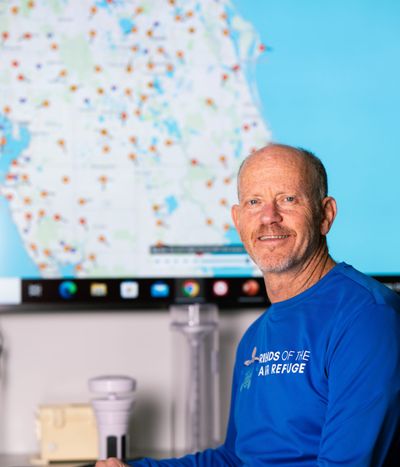
By Steven Lazarus Like many coastal regions, Florida’s Space Coast faces significant climate resilience challenges and risks. According to the National Oceanic and Atmospheric Administration (NOAA), Florida has over 8,000 miles of shoreline, more than any other state in the contiguous U.S. In addition, the 2020 census indicates that that there are 21 million Florida residents, 75-80% of which live in coastal counties. This makes our state particularly vulnerable to rising sea levels, which are directly responsible for a host of coastal impacts, such as saltwater intrusion, sunny-day (high-tide) flooding, worsening surge, etc. There is growing evidence that storms are becoming wetter as the atmosphere warms— increasing the threat associated with compound flooding, which involves the combined effects of storm surge, rainfall, tides and river flow. Inland flooding events are also increasing due to overdevelopment, heavy precipitation and aging and/or inadequate infrastructure. The economic ramifications of these problems are quite evident, as area residents are confronted with the rising costs of their homeowners and flood insurance policies. As the principal investigator on a recently funded Department of Energy grant, Space Coast ReSCUE (Resilience Solutions for Climate, Urbanization, and Environment), I am working with Argonne National Laboratory, Florida Tech colleagues, community organizations and local government to improve our climate resilience in East Central Florida. It is remarkable that, despite its importance for risk management, urban planning and evaluating the environmental impacts of runoff, official data regarding local flooding is virtually nonexistent! Working alongside a local nonprofit, we have installed 10 automated weather stations and manual rain gauges in what was previously a “data desert” east of the Florida Tech campus: one at Stone Magnet Middle School and others at local homes. “We think that a ‘best methods’ approach is proactive, informed and cost-effective. The foundation of good decision-making, assessment and planning is built on data (model and observations), which are critical to adequately addressing the impact of climate on our communities.” – steven lazarus, meteorology professor, ocean engineering and marine sciences Data from these stations are available, in real-time, from two national networks: CoCoRaHS and Weather Underground. The citizen science initiative involving the rain gauge measurements is designed to document flooding in a neighborhood with limited resources. In addition to helping residents make informed choices, these data will also provide a means by which we can evaluate our flood models that will be used to create highly detailed flood maps of the neighborhood. We are working with two historic extreme-precipitation events: Hurricane Irma (2017) and Tropical Storm Fay (2008)—both of which produced excessive flooding in the area. What might the local flooding look like, in the future, as storms become wetter? To find out, we plan to simulate these two storms in both present-day and future climate conditions. What will heat stress, a combination of temperature and humidity, feel like in the future? What impact will this have on energy consumption? The station data will also be used develop and test building energy-efficiency tools designed to help the community identify affordable ways to reduce energy consumption, as well as to produce high-precision urban heat island (heat stress) maps that account for the impact of individual buildings. The heat island and building energy modeling will be complemented by a drone equipped with an infrared camera, which will provide an observation baseline. We think that a “best methods” approach is proactive, informed and cost-effective. The foundation of good decision-making, assessment and planning is built on data (model and observations), which are critical to adequately addressing the impact of climate on our communities.


Simulations of Exoplanet Formation May Help Inform Search for Extraterrestrial Life
Florida Tech astrophysicist Howard Chen is offering new insights to help aid NASA’s search for life beyond Earth. His latest theoretical work investigates the TRAPPIST-1 planetary system, one of the most widely studied exoplanetary systems in the galaxy. It has captured scientists’ attention for its potential to host water, and thus possibly life, on its planets. Now, he’s offering an explanation for why telescopes have yet to find definitive signs of either. The paper “Born Dry or Born Wet? A Palette of Water Growth Histories in TRAPPIST-1 Analogs and Compact Planetary Systems” was authored by Chen, an assistant professor of space sciences, and researchers from NASA, Johns Hopkins University and Harvard University, was published in The Astrophysical Journal Letters in September. It explores the likelihood that TRAPPIST-1’s three innermost exoplanets contained no water when they formed, despite existing in a zone where water is viable. TRAPPIST-1 is a red dwarf star located about 40 light-years away from us. (One light year is about 6 trillion miles.) It is thought to be about 7.6 billion years old, or 3 billion years older than our Sun. Astronomers are captivated by the TRAPPIST-1 system because its seven known planets are rocky and Earth-like. They also fall within the star’s habitable zone: the distance range from a star at which temperatures are not too hot or cold to support liquid water. Researchers are searching for any evidence of water on these planets, but have yet to detect anything. Some think a lack of gas in the atmosphere is disrupting the light needed to pick up detailed visuals. Others predict water could have escaped the planets’ atmospheres throughout their evolution. Chen and his team, however, decided to research a different theory: that there was no water to begin with because there was no gas to contain it. He would test it not from an observational perspective, but with mathematical modeling of the planets’ initial formation. “You have astronomers who are using telescopes to see what’s out there. I come from a different perspective,” Chen said. “I’m both trying to explain what we’re seeing while trying to make predictions about what we can’t.” The researchers created models that examined the composition and growth of these planets starting when they were as small as one kilometer wide. They simulated how material aggregated during collisions with other celestial objects until they reached their final planetary formations. There are several key factors in collision events that heavily influence a planet’s final composition. Chen’s models incorporated impact delivery, which is the transfer of materials like water and gases during a celestial collision; impact erosion, which refers to the removal of materials in a planet’s atmosphere due to impact; and mantle-atmosphere exchange, which is the transfer of water and gases between a planet’s atmosphere and mantle to maintain its conditions. The team ran hundreds of collision simulations, which returned thousands of different possibilities for how TRAPPIST-1’s planets might have formed. They varied several components, such as the amount of water available to the system, the profile of the initial planet formation environment, the planets’ density profiles and the initial system conditions. For the inner worlds, specifically the first three planets, most of the simulations came back dry. “Whatever we did, we couldn’t get much water in these inner planets,” Chen said. He believes that the main reason the planets couldn’t acquire water is due to the nature of the collision events. Compact planet collisions are higher velocity, so they are more aggressive and energetic, Chen said. This means that instead of acquiring material for a gaseous atmosphere, planets’ atmospheres were completely cleared out by the power of the collisions. With no gas in the atmosphere to contain water, it’s possible that any previously existing water escaped back into space during these collision events. Understanding a planet’s earliest characteristics, its water, air and carbon content, builds the foundation for how they evolve. That way, when researchers identify a planet that seems viable for life at the surface level, they can use Chen’s model to simulate what these distant worlds might be like on the inside, on the surface and in the air. Combining the theoretical context of a planet’s formation with the state in which it was discovered can help researchers – and NASA – make informed, efficient decisions on which planets are worth investigating and when it’s time to move on to the next. If you're interested in connecting with Howard Chen about the search for life beyond Earth, let us help. Contact Adam Lowenstein, Assistant Vice President for External Affairs at Florida Institute of Technology, at adam@fit.edu to arrange an interview today.

First scientific paper on 3I/ATLAS interstellar object
When the news started to spread on July 1, 2025, about a new object that was spotted from outside our solar system, only the third of its kind ever known, astronomers at Michigan State University — along with a team of international researchers — turned their telescopes to capture data on the new celestial sighting. The team rushed to write a scientific paper on what they know so far about the object, now called 3I/ATLAS, after NASA’s Asteroid Terrestrial-impact Last Alert System, or ATLAS. ATLAS consists of four telescopes — two in Hawaii, one in Chile and one in South Africa — which automatically scans the whole sky several times every night looking for moving objects. MSU’s Darryl Seligman, a member of the scientific team and an assistant professor in the College of Natural Science, took the lead on writing the paper. “I heard something about the object before I went to bed, but we didn’t have a lot of information yet,” Seligman said. “By the time I woke up around 1 a.m., my colleagues, Marco Micheli from the European Space Agency and Davide Farnocchia from NASA’s Jet Propulsion Laboratory, were emailing me that this was likely for real. I started sending messages telling everyone to turn their telescopes to look at this object and started writing the paper to document what we know to date. We have data coming in from across the globe about this object.” The discovery Larry Denneau, a member of the ATLAS team reviewed and submitted the observations from the European Southern Observatory's Very Large Telescope in Chile shortly after it was observed on the night of July 1. Denneau said that he was cautiously excited. “We have had false alarms in the past about interesting objects, so we know not to get too excited on the first day. But the incoming observations were all consistent, and late that night it looked like we had the real thing. “It is especially gratifying that we found it in the Milky Way in the direction of the galactic center, which is a very challenging place to survey for asteroids because of all the stars in the background,” Denneau said. “Most other surveys don't look there.” John Tonry, another member of ATLAS and professor at the University of Hawaii, was instrumental in design and construction of ATLAS, the survey that discovered 3I. Tonry said, “It's really gratifying every time our hard work surveying the sky discovers something new, and this comet that has been traveling for millions of years from another star system is particularly interesting.” Once 3I/ATLAS was confirmed, Seligman and Karen Meech, faculty chair for the Institute for Astronomy at the University of Hawaii, both managed the communications flow and worked on getting the data pulled together for submitting the paper. “Once 3I/ATLAS was identified as likely interstellar, we mobilized rapidly,” Meech said. “We activated observing time on major facilities like the Southern Astrophysical Research Telescope and the Gemini Observatory to capture early, high-quality data and build a foundation for detailed follow-up studies.” After confirmation of the interstellar object, institutions from around the world began sharing information about 3I/ATLAS with Seligman. What scientists know about 3I/ATLAS so far Though data is pouring in about the discovery, it’s still so far away from Earth, which leaves many unanswered questions. Here’s what the scientific team knows at this point: It is only the third interstellar (meaning from outside our solar system) object to be detected passing through our solar system. It’s potentially giving off gas like other comets do, but that needs to be confirmed. It’s moving really fast at 60 kilometers per second, or 134,000 miles per hour, relative to the sun. It’s on an orbital path that is shaped like a boomerang or hyperbola. It’s very bright. It’s on a path that will leave our solar system and not return, but scientists will be able to study it for several months before it leaves. The James Webb Space Telescope and the Hubble Space Telescope are expected to reveal more information about its size, composition, spin and how it reacts to being heated over the next few months. “We have these images of 3I/ATLAS where it’s not entirely clear and it looks fuzzier than the other stars in the same image,” said James Wray, a professor at Georgia Tech. “But the object is pretty far away and, so, we just don’t know.” Seligman and his team are specifically interested in 3I/ATLAS’s brightness because it informs us about the evolution of the coma, a cloud of dust and gas. They’ve been tracking it to see if it has been changing over time as the object moves and turns in space. They also want to monitor for sudden outburst events in which the object gets much brighter. “3I/ATLAS likely contains ices, especially below the surface, and those ices may start to activate as it nears the sun,” Seligman said. “But until we detect specific gas emissions, like H₂O, CO or CO₂, we can’t say for sure what kinds of ice or how much are there.” The discovery of 3I/ATLAS is just the beginning. For Tessa Frincke, who came to MSU in late June to begin her career as a doctoral student with Seligman, having the opportunity to analyze data from 3I/ATLAS to predict its future path could lead to her publishing a scientific paper of her own. “I’ve had to learn a lot quickly, and I was shocked at how many people were involved,” said Frincke. “Discoveries like this have a domino effect that inspires novel engineering and mission planning.” For Atsuhiro Yaginuma, a fourth-year undergraduate student on Seligman’s team, this discovery has inspired him to apply his current research to see if it is possible to launch a spacecraft from Earth to get it within hundreds of miles or kilometers to 3I/ATLAS to capture some images and learn more about the object. “The closest approach to Earth will be in December,” said Yaginuma. “It would require a lot of fuel and a lot of rapid mobilization from people here on Earth. But getting close to an interstellar object could be a once-in-a-lifetime opportunity.” “We can’t continue to do this research and experiment with new ideas from Frincke and Yaginuma without federal funding,” said Seligman, who also is a postdoctoral fellow of the National Science Foundation. Seligman and Aster Taylor, who is a former student of Seligman’s and now a doctoral candidate in astronomy and astrophysics and a 2023 Fannie and John Hertz Foundation Fellow, wrote the following: “At a critical moment, given the current congressional discussions on science funding, 3I/ATLAS also reminds us of the broader impact of astronomical research. An example like 3I is particularly important to astronomy — as a science, we are supported almost entirely by government and philanthropic funding. The fact that this science is not funded by commercial enterprise indicates that our field does not provide a financial return on investment, but instead responds to the public’s curiosity about the deep questions of the universe: Where did we come from? Are we alone? What else is out there? The curiosity of the public, as expressed by the will of the U.S. Congress and made manifest in the federal budget, is the reason that astronomy exists.” In addition to MSU, contributors to this research and paper include European Space Agency Near-Earth Objects Coordination Centre (Italy), NASA Jet Propulsion Laboratory/Caltech (USA), University of Hawaii (USA), Auburn University (USA), Universidad de Alicante (Spain), Universitat de Barcelona (Spain), European Southern Observatory (Germany), Villanova University (USA), Lowell Observatory (USA), University of Maryland (USA), Las Cumbres Observatory (USA), University of Belgrade (Serbia), Politecnico di Milano (Italy), University of Michigan (USA), University of Western Ontario (Canada), Georgia Institute of Technology (USA), Universidad Diego Portales, Santiago (Chile) and Boston University (USA).
