
Experts Matter. Find Yours.
Connect for media, speaking, professional opportunities & more.

Aston University launches community project to promote healthy lives in East Birmingham
The Knowledge Exchange project is led by Aston University with Birmingham Community Healthcare NHS Foundation Trust, in partnership with Citizens UK It aims to identify local barriers that lead to poor health outcomes A total of £6,390 has been awarded to five projects to support local residents. Aston University and Birmingham Community Healthcare NHS Foundation Trust, in partnership with Citizens UK, have launched a community project to identify local barriers that lead to poor health outcomes. Dr Céline Benoit (Sociology and Policy), Dr Alexis Paton (Sociology and Policy), Dr Angela Jeffery (RKE) and Aisha Masood (RKE) have been leading on the Knowledge Exchange project in East Birmingham to help improve health and wellbeing. On 17 March, the team hosted the first community sandpit at Aston University, where a number of community-led organisations and charities came together to identify small-scale projects to support local residents and promote healthy lives. A total of £6,390 was awarded to five projects which will submit a report by 31 July 2022 and meet again in the autumn to share their journeys with each other as well as representatives from the NHS and Birmingham City Council. Dr Céline Benoit, associate dean for public engagement for the College of Business and Social Sciences at Aston University, said: “It was such a privilege to host a community sandpit at Aston University and have the NHS and local organisations talk to one another and come up with joint projects to help promote health and wellbeing in East Birmingham. “It was truly inspiring to see how many brilliant projects were put forward. “It not only helped us get a better understanding of the challenges local residents face when it comes to health and accessing healthcare services, but it was also a great reminder of how much we can achieve when we work collaboratively”.


What the CDC's Updated Developmental Guidelines Mean for Parents
The Centers for Disease Control and Prevention (CDC) recently revamped their developmental guidelines for children for the first time in years, allowing parents to know earlier if their kids may be experiencing any delays. Villanova University nursing professor Michelle Kelly, PhD, CRNP, CNE, recently commented on the new guidelines: "The CDC and American Academy of Pediatrics (AAP), in response to birth provider and parent input, took a critical look at existing developmental milestones tools and handouts. Surveillance and handouts are typically parent facing items that can be used to determine if a child is meeting age-expected developmental targets." "That is in contrast to screening which is more structured, based on the surveillance but done by a primary care provider and used for referral for services, and evaluation which is done by a developmental specialist with the intent to diagnosis." "The CDC and AAP have done a thorough overhaul of developmental milestone surveillance (as opposed to screening and evaluation) to attempt to make the milestones 'evidence-based' and where possible norm-referenced." "Another major change is that the milestones are set for greater than 75%, rather than 50%. This means they are targets that 75% of children that age would have met. This eliminates phrases in the previous milestones that were confusing, such as a child 'may begin' a task at one age, but also should be doing it at the next age." "Perhaps the biggest win for children born preterm and others at risk for developmental delays is the 75% expectation virtually eliminates the 'wait and see' that occurred when the expectation was that 50% of children would exhibit a skill at that age. This means that families who have concerns, or whose children are not meeting the age-appropriate milestones, should be more readily referred for evaluation and intervention." "Additionally, an increased emphasis is placed, compared to the previous version, on open-ended questions to elicit parent concerns and ways for families to promote age-appropriate development."


Aston University experts to co-chair The Spring Servitization Conference 2022
The Conference is dedicated to understanding how organisations can develop and adapt their business models through servitization and advances services The theme is Achieving Net-Zero through Servitization and it will be held in Florence, Italy on 9 and 10 May Professor Tim Baines and Dr Ali Z. Bigdeli, from the Advanced Services Group at Aston University, will be co-chairs. Two Aston University experts are set to co-chair a major conference around servitization in Italy in May. Professor Tim Baines and Dr Ali Z. Bigdeli, from the Advanced Services Group (ASG) at Aston University, will be co-chairs alongside Professor Mario Rapaccini (University of Florence), Professor Nicola Saccani and Dr Federico Adrodegari (both University of Brescia) while Jill Forrest (also ASG) will be conference administrator. The Spring Servitization Conference (SSC) was first launched more than 10 years ago at Aston University in Birmingham. It was created to build and formalise a research community around the topic of servitization, and to understand how organisations can develop and adapt their business models through servitization and advances services. Servitization is a term used to describe the process through which a business transitions from selling products alone to selling a combination of product and service, and ultimately outcomes. The theme of the 2022 edition of the conference will be Achieving Net-Zero through Servitization and will be held at Istituto degli Innocenti in Florence on Monday 9 and Tuesday 10 May. The event will bring together the world’s leading researchers, practitioners and doctoral students to debate and engage with the theory and practice of servitization. Professor Tim Baines, executive director of The Advanced Services Group at Aston University and co-chair The Spring Servitization Conference 2022, said: “Servitization has already helped to transform the fortunes of many UK manufacturing businesses and I am looking forward to showcasing what it can do for businesses abroad too. “SSC2022 will follow the now established format of a single stream where all contributors have an opportunity to present to the whole conference audience and engage in both structured and semi-structured panel sessions to discuss their work. “The programme is designed to encourage extensive debate and bridge research theory and industrial practice. “We have some fantastic keynote speeches from senior executives at leading manufacturing businesses including Tim Foreman, European R&D manager, OMRON Europe and Paolo Mauri, Electrolux Professional.” You can find out more about The Spring Servitization Conference 2022 here.



The research looked into the means for achieving higher sustainability performance through circular economy adoption The project was led by Professor Prasanta Dey and Professor Pawan Budhwar from Aston Business School Data was gathered from around 100 SMEs from Greece, France, Spain and the UK. New findings from an Aston University-led study have found Small and Medium Sized Enterprises (SMEs) are likely to achieve higher environmental performance through circular economy (CE) adoption. CE is a systemic approach to economic development designed to benefit businesses, society, and the environment. In contrast to the 'take-make-waste' linear model, a circular economy is regenerative by design and aims to gradually decouple growth from the consumption of finite resources. The project was led by Professor Prasanta Dey and Professor Pawan Budhwar from Aston Business School along with Soumyadeb Chowdhury (Toulouse Business School), Krishnendu Saha (Birmingham City University), Debashree De (University of Essex) and Chrysovalantis Malesios (Agricultural University of Athens). Data was gathered from around 100 SMEs from each of the four selected countries – Greece, France, Spain and the UK using a survey to study the current state of CE adoption, and subsequently, focus groups were organised which involved SMEs owners and managers, policymakers, SMEs' customers and suppliers, in each country to derive means for improving sustainability performance. The study reveals that SMEs in all the participating countries are likely to achieve higher environmental performance through CE adoption. SMEs in France were likely to achieve higher overall sustainability performance than other participating countries. It also found products, processes and facilities design is likely to help SMEs most in all the participating countries to adopt CE, while their waste management all needed improvement. Professor Budhwar, head of Aston Business School, said: “Although from prior research there is evidence of SMEs achieving superior environmental performance by adopting CE, economic and social performances are not assured. This motivated us to undertake empirical research to reveal the means for achieving higher sustainability performance (economic, environmental, and social) through CE adoption”. “The findings of this research enable us to continue CE adoption not only in other European countries but also in India, Thailand, Vietnam and Kenya”. Professor Dey, a professor in operations and information management at Aston Business School, said: “SMEs in the EU countries are likely to have sustainable design practices aligned with the CE philosophy. On the contrary, SMEs in the participating countries are likely to have worst recover function. “This implies that customers' pressure works for SMEs to adopt CE principles as design function in most of the SMEs' businesses is governed by SMEs' customers. Whereas effective recover function depends on SMEs' self-motivation and policymakers’ pressure.” “CE adoption needs a structured approach of analysing current state of CE through analysing correlation of organisational value functions with sustainability performance, identifying issues and challenges, and suggesting means for improvement across value functions.” You can read the full report here.

Aston University experts to take part in Pint of Science 2022
Pint of Science, the world’s largest festival of public science talks, will run from 9 – 11 May Experts from universities, including Aston University, will take part across 32 UK cities Aston University academics will appear in front of audiences at Birmingham venues: The Woodman, Grain & Glass and Café Artum at Hockley Social Club. Tickets have gone on sale for Pint of Science 2022 which is returning on its 10th anniversary. The festival will bring thousands of scientists and their research out of the lab and into our pubs, cafes and community halls from 9 to 11 May 2022. Experts from universities in Birmingham including Aston University, Birmingham City University and University of Birmingham, will take part in 16 events across the city. The festival will take place in 32 UK cities, with events in hundreds of cities across 25 countries. Each event will provide a unique line up of talks, demonstrations and live experiments, held in a relaxed and informal environment. Aston University academics taking part in Pint of Science will appear in front of audiences at a number of Birmingham venues, including, The Woodman, Grain & Glass and Café Artum at Hockley Social Club. They will host talks on topics around the Pint of Science themes of: Beautiful Mind; Atoms to Galaxies; Our Body; Planet Earth; Tech me out; Our Society. Seven Aston University experts are leading talks including ‘The science of swearing’, ‘How much microplastic is in your pint: does it matter?’ and ‘How facial expressions guide our eating behaviour’. Dr Robbie Love, a lecturer in English at Aston University, who is taking part in Pint of Science 2022 and who is hosting a talk about the science of swearing said: “I am really looking forward to an evening of linguistic libations at Café Artum for Pint of Science 2022. “Swearing might seem like a bit of fun, but the science behind swearing shows us that it plays a really important role in human communication. Plus, I’m looking forward to hearing everyone’s favourite swear words!” Katie Edwards, a PhD student at Aston University who is taking part in Pint of Science 2022 said: “I am really looking forward for this year’s Pint of Science festival to chat about eating behaviour. “I will be talking about how other people's food enjoyment can impact our eating. “It is a great opportunity to hear about current scientific research whilst relaxing with a drink.” You can find out more about full line up of events in Birmingham, which includes experts from the University of Birmingham and Birmingham City University, here.
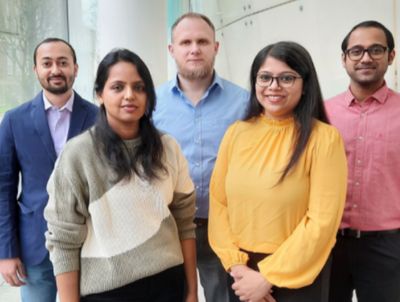
Aston MBA students take top prize at Universities Business Challenge Global Masters 2022
The competition helps develop the skills needed to move into corporate/public sector life The Grand Final took place in Liverpool where 10 teams from different universities competed for the title They were assessed on their team strengths and presented a one-minute pitch on a creative social business idea to an entrepreneur. A team of Aston MBA students has taken the top prize at the Universities Business Challenge (UBC) Global Masters 2022. Team GE7, which included Aishwarya Nagath Menon, Nashit Khalifa, Vasilijs Garbacevics, Divya Krisitipati led by Mithun Joy and mentored by Aston Business School’s Dr Julius Stephan, will receive a trophy on campus on 12 May. The competition offers postgraduate students a unique opportunity to develop the skills that you will need when moving into the working world and consists of 80 teams, drawn from a wide range of UK and Irish universities. The UBC Global Masters is a team-based business simulation event that provides participants with the opportunity to act as a board of directors, who have taken responsibility for improving the performance of a company. The finals took place in Liverpool where 10 teams from different universities, including two from Aston University, competed against each other tasked to run a simulated business under difficult trading conditions and also introduce an innovative idea to link the business to a social or environmental cause. The teams were assessed on their team strengths and presented a one-minute pitch on a creative social business idea to an entrepreneur. Mithun Joy, an Aston MBA student and team winner, said: “I am really proud to be part of the first Aston Business School team to win this competition. “It was a really competitive event against other universities, including the UBC's defending champion.” Clive Kerridge, course director at Aston Business School, said: “Although an Aston University MSc team made the podium in 2022, we are delighted to have our first ever winners of this excellent competition. “Taking part in the UBC Global Masters Challenge has been a great opportunity for our students to apply their theoretical knowledge to a complex, yet highly practical and topical business setting. “It allows for personal and professional development that is intellectually challenging and practically relevant, equipping participants with essential skills. Working in competitive teams enables peer to peer learning and interaction.” Find out more about the competition here.

Aston University appoints translator in residence to inspire future literary translators
Aston University and Writing West Midlands have appointed Sarah Letza, a professional translator from the region to the role She will be working on community engagement activities at Aston University and with the West Midlands community The project is funded by Arts Council England. Aston University has appointed a translator in residence as part of a project developed by the translators Daniel Hahn and Ros Schwartz, a new one-off literary translation residency for 2022 based in Birmingham. Sarah Letza, a professional translator from the region, has been appointed to the position until March 2023. The project is funded by Arts Council England and will be run in partnership with Aston University and Writing West Midlands. Sarah’s residency will encourage an interest in literary translation and translated literature, and the valuing of languages, among communities in and around Birmingham through workshops, talks and other public engagement and collaborative participation projects. Sarah Letza, translator in residence at Aston University, said: “I hope to draw attention to the opportunities that translation and language learning can lead to and capitalise on the wealth of talent that can be drawn from Midlands schools and universities. “There is the potential to be involved with the many translation research projects already under development at Aston University as well as promoting and supporting languages and translation pathways. “I want to showcase Birmingham as a city that has been built on cultural crossings, intellectual exchange and creativity, all of which are the bedrock of both translation and language learning.” Dr David Orrego-Carmona, a lecturer in English, languages and applied linguistics at Aston University, said: “Birmingham is an incredibly multilingual city and Aston University is particularly well-placed to raise awareness and showcase the value of languages, translation and intercultural exchanges. “We are certain the programme will provide inspiring experiences for our beneficiaries in Birmingham and the region, and we are looking forward to the engaging activities that Sarah is already planning.” For more information about our courses in translation click here.

Aston University expert to talk on gender diversity and inclusion at major cyber security event
The Ethnic Minority in Cyber (EMiC) network's flagship event is supported by the Department for Digital, Culture, Media and Sport Attendees will hear from inspirational speakers looking at current and future initiatives to increase diversity in the cyber sector Dr Anitha Chinnaswamy from Aston University will be presenting a talk on gender diversity and inclusion in cyber. An Aston University expert and founding group member of Ethnic Minority in Cyber (EMiC) is set to present a talk at a major cybersecurity event on 28 April 2022. The EMiC network's flagship symposium is supported by the Department for Digital, Culture, Media and Sport and will take place at Edgbaston Park Hotel in Birmingham. Attendees will hear from inspirational speakers looking at current and future initiatives aimed around increasing diversity in the cyber sector and will also be able to provide feedback into the initiative and policies going forward. The symposium will consist of a keynote speech, invited talks, panel sessions and round table workshops. Dr Anitha Chinnaswamy from the Cyber Security Innovation (CSI) Centre at Aston Business School will present a talk on gender diversity and inclusion in cyber and the outreach work of the Centre with schools to increase representation. Simon Hepburn, CEO UK, Cyber Security Council is the keynote speaker. The EMiC network, of which Aston University is a founding member, is a pilot network for Black, Asian and Ethnic Minority cyber academia, professionals and businesses, with the long-term aim of significantly improving representation across the cyber sector. Dr Anitha Chinnaswamy, lecturer in cyber security management at the CSI Centre at Aston Business School, says: “I am looking forward to speaking at such an important event about an ever-important topic in cyber. “While there is a growing cyber security skills gap and high shortage in the UK cyber sector, a recent survey found that only 17 per cent of cyber professionals are from ethnic minority backgrounds across all cyber roles. “The cyber sector remains relatively nondiverse in terms of gender. Just 16 per cent of the workforce across these firms is female, compared to 28 per cent in other UK digital sectors. “Those filling senior roles, typically with six or more years of experience, are particularly nondiverse across a range of characteristics including gender, ethnicity, disability and neurodiversity. “For example, just three per cent of senior roles are filled by women.” Aston University’s CSI centre, led by Professor Vladlena Benson, is the only female-led cyber security centre in the Midlands region and serves on the UK Cyber Security Council (UKCSC), alongside Simon Hepburn its CEO, to promote professionalism standards in cybersecurity. Professor Benson, director of the CSI Centre at Aston Business School, said: “Aston University CSI is actively involved in shaping diversity policy, such as with the launch of the NCS22 strategy in Birmingham and enabling the Cyber Explorer programme as a first schools’ engagement for girls from diverse backgrounds. “As ambassadors we are passionate about working towards closing the gender gap. This will help pave the way for a future of gender diversity, and hopefully other types of diversity, in the cyber security field. “Our work with female students in a highly diverse Midlands’ landscape highlights the challenges that are yet to overcome with the levelling up agenda.” To find out more about the event please visit the site here.


With an estimated 1.5-million faculty in the US and a near 50,000 growth in UK-based academics in the last decade (to 225,000), universities and colleges have a whole range of interests and expertise on offer. In fact, despite rumours to the contrary, academia is a large and growing global ‘industry’. If you’re responsible for external relations, communications, marketing, civic engagement, knowledge exchange - or any other aspect of external engagement or “connectedness” in a university or college - then the ability to choose which faculty experts you selectively promote and publicise can be a very tough assignment. I’ve had first-hand experience with this. I was once in that very position - trying to keep up with the opportunities and the expectations afforded by 800 academics at just the one mid-sized UK institution where I worked. With the benefit of that firsthand experience and having since worked with more than 100 higher education institutions in the UK, Europe and North America, here are a few observations and also a few tips on how to organize your expertise: Approach #1: The Focus on Expertise Clusters An approach taken by some universities nowadays is to promote their expertise as a group of “grand challenges” or “beacons of excellence” - drawing together as many areas of research expertise under (usually) three or four headings. While identifying “token clusters” of expertise for focus and prioritisation may seem logical, this approach doesn’t really work. It may help with internal politics but it fails to generate enough precision to be relevant to various communities such as the media and industry. Approach #2: Selectively Promoting Key Experts One trap that universities can also fall into is to focus on a small group of academics who appear to be more suitable to promote. The reasoning for this approach is often driven by the need to have a manageable number for internal communications/press office staff to work with. The easy route to take is to just work with academics who are more keen to work with comms staff in promoting their work and who are already at ease in speaking to the media. Selection of experts on these factors, while important, isn’t the optimal way to build up the profile for the institution with key audiences. First off, this approach often doesn’t yield the diversity that audiences such as journalists and potential student and faculty recruits want to see represented. This approach will also miss the mark if it just plays to popular disciplines or hot topics. Being more inclusive to promote a wider range of disciplines and specialized topics is better value all round. Approach #3: The Faculty “Expertise Audit” I’ve seen institutions make many mistakes in positioning their faculty as experts, given it’s a proven way to differentiate brand, build profile and reputation. That’s why I’ve started to work with several universities on what I refer to as a “faculty expertise audit”. This brings a more structured process that helps prioritize key areas of research expertise and identify specialist experts. The audit also looks at the resources and overall capacity that universities have available to support an “expertise marketing” program that optimizes all these elements to significantly boost performance. Start with The Business Case for Expertise At the heart of this more structured, targeted audit approach is ensuring you are generating “return-on-investment” and “value-for-effort.” A good starting point is to ask: Where is the budget coming from? Where is current and expected demand for your programs? When starting this assessment, you have to think longer than a year out. Instead, look very hard and in detail at the next three to five years (the typical cycle of research investment and university strategies) and identify which expertise is most likely to solve the problems and consequential explorations that governments, industry, benefactors/donors, and funding agencies will want to support. I’m not saying that research areas without such sizable levels of predicted investment should be ignored - far from it - but we are in a competitive climate and universities now have to secure ‘orders’ (for applied and contracted expertise) that will ensure institutional sustainability and success. In turn, that success will allow investment in other areas that are socially vital but financially a weaker bet as regarded by funding sources. Having proven where research funding is most available, pressing and externally directed, then the audit is designed to identify and match the institution’s research talent to these requirements. These audits involve shortlisting, enlisting and then coaching the appropriate academic experts. The best results come from one-to-one sessions with academics which create buy-in and yield a more detailed marketing plan to leverage your experts. While more inclusive, this is an efficient process designed to create a “shared roadmap” for where the university and the academic both want to take their expertise. A large part of this roadmap then covers off other important activities such as creating a more discoverable and engaging online presence with enriched academic profiles that perform far better than the traditional “faculty directory.” Keeping online academic profiles fresh, content-rich, jargon-free, and compelling makes the job of expert ‘mining’ so much easier. Developing a sustained program of content with an organized lead generation process is also necessary. These extra steps are where many universities miss the mark. The result is a significant loss of inbound opportunities for research grants, consulting revenues, academic collaborations as well as local and global media coverage. I recently spoke with a Vice Chancellor of a prominent UK University who admitted that they as an institution deserved a failing grade when it came to promoting their faculty research achievements, saying that he “doubted any of their academics would be happy with the way their work was being promoted online.” This is an important aspect of the faculty audit. As a consultative process, it is non-threatening and we’re listening to staff and academics. That not only enriches the information the University has to promote its brand better, it also helps to enlist the support of the academic community who see that the university cares and that it is getting their input to put together a plan – both for the university and for individual academics. The academic is happy (they understand the value for them personally and for their institution); the University is happy (it is able to focus and prioritise its expertise in an evidence-based manner), and Communications and press office staff are happy (they have so more to work with in connecting the work of the University to a variety of local and global communities). The Benefits of A Faculty Audit Having completed many of these, I’ve seen very clearly, the results of a well run Faculty Audit process that without exception yield an excellent return on investment. Here are just some of the benefits to consider: Greater Insights: Gain a deeper understanding of the hidden strengths and opportunities within your academic ranks. Better Planning: A detailed report from a Faculty Audit enables a more strategic approach to planning where faculty research and expertise can support various programs within the University - such as industry engagement, media coverage and recruitment. Building Trust: When conducted by a third-party, a Faculty Audit is seen as more credible and less prone to perceptions of internal bias. More Engaged Faculty: Increased collaboration with faculty is gained through a more consultative process that builds “shared awareness” and enables more proactive support of their research. Increased Capacity: Producing more proactive content with faculty yields better results in terms of media coverage, research engagements, etc. Demonstrate Diversity: A better understanding of expertise that goes beyond the “usual suspects” to engaging a more diverse set of faculty to promote the University. News Coverage: Positioning your faculty and their research in a more relevant way aligns with the interests of the outside world and what's on the mind of outsiders. Less Stress: A more proactive, well structured plan helps everyone to synchronise activities better versus scrambling too much to meet deadlines in the “here and now.” Is a Faculty Audit Right for Your Institution? Here are some key considerations when evaluating the value of a Faculty Audit for your institution. You are ideally suited to undertake a faculty expertise audit if: You have a stretched workload where there's little capacity for proactive comms. You're tending to turn to the same academics for expert commentary in the media or elsewhere. You tend to get complaints (or mild mutterings) about not supporting academics enough. You don't have time to get to know the range of academic experts in your institution - especially new arrivals or eager early career academics. You've adopted an 'inside out approach' rather than one that engages with the interests of the outside world and what's on the mind of outsiders. There's weak management of expectations with the academic community - and a need for clarity and shared pathways for publicity. You're operating too much in the here and now and don't have the time to plan for future events, milestones and opportunities. You want to be more strategic in your comms and engagement - and make a real difference via attracting interest, income and investment. You don't have an integrated approach to comms (where content can be repurposed and recycled). You want more global reach and presence and can exploit digital tools to enable this. Additional Resources Academic Experts and the Media (PDF) This report, based on detailed interviews with some of the most media-experienced academics across the UK and United States draws on their experiences to identify lessons they can share in encouraging other academics to follow in their path. Download the UK Report Here Download the US Report Here The Complete Guide to Expertise Marketing for Higher Education (PDF) Expertise Marketing is the next evolution of content marketing. Build value by mobilizing the hidden people, knowledge and content you already have at your fingertips. This win-win solution not only gives audiences better quality content, but it also lets higher ed organizations show off their smarts. Download Your Copy Click Here for Additional Resources



Aston University MEG scanning facilities used by start-up to launch new brain health service
MEG scanning services at Aston Institute of Health and Neurodevelopment (IHN) have been used to launch the world’s first brain-imaging service to measure and assess brain health. Commercial brain imaging service Myndspan launched a service to assess brain health and identify concussions, with an event at Aston University. Start-up, MYndspan, was founded in 2020 by Caitlin Baltzer, former vice president of operations at functional brain imaging company Croton Healthcare and Janne Huhtala, previously chief executive of MEGIN, the global leader in functional brain imaging. The service was created to support brain health across populations, using cutting edge brain scanning technology to monitor and extend healthy cognitive lifespans. The brain imaging service is powered by a non-invasive brain scanning technology called Magnetoencephalography (MEG), which measures the electrical signals between neurons to form a highly detailed map of brain activity and function. The MEG scanner, which is located in the Aston Institute of Health and Neurodevelopment, at Aston University, identifies and observes functional ‘invisible injuries’ to the brain, such as concussion or PTSD, that can’t be seen from an MRI image of the brain. MYndspan’s service combines MEG scans with gamified tests of cognitive function, which measure a range of mental processes such as attention, memory, and visuospatial processing. Using these two measures of brain health, cognitive function and brain function, MYndspan provides a comprehensive overview, detailed in a thorough, easy-to-understand report of how a person’s brain is behaving and why. Among the service’s first customers are neuroscientist and author Dr Dean Burnett who is using MYndspan to monitor the effect increasing physical activity has on his brain over time and Vicky Macqueen former England Rugby player and chief executive of Didi Rugby, who is using the service to measure her pre-concussion baseline for playing contact sports safely. Through routine monitoring of personal brain activity, MYndspan helps people assess and understand their brain health. This helps to identify issues before symptoms emerge and supports optimal lifestyle and clinical intervention. Its first application is concussion, where the technology can support the recovery of an estimated 3.8 million athletes who experience sports-related concussion annually. Janne Huhtala, MYndspan co-founder said: “MYndspan’s technology can identify concussed brain activity and objectively identify and monitor recovery from a concussion. Currently, individuals are deciding to go back to play based on how they feel – a decision that can have life changing consequences. “We think athletes deserve to have objective information about where they are in their recovery, to make the best and most informed decisions.” MYndspan’s service will be available to the general public at Aston University’s Institute of Health and Neurodevelopment (IHN), an international leader in advanced technology to explore brains, development and healthy behaviours. IHN at Aston University is the first of many planned locations around the world where individuals will be able to access the service. MYndspan co-founder Caitlin Baltzer added: “The brain is hugely complex and exciting, and whilst there is a vast body of research and knowledge already available, there is still so much for us to learn about how it functions and changes over time. “In a world where we can track and optimise every part of our health, and our lives, the brain remains neglected. At MYndspan, we believe that every person has the right to better brain health and this begins with knowing our brains. “We are very excited to launch our brain scanning technology at Aston University as a demonstration for how digital health tools can support brain health and ultimately help more people recover and age better.” Dr Dean Burnett, neuroscientist and author, including of the Guardian blog ‘Brain Flapping’, said: “I'm a big proponent of anything that helps people understand their brains better, and MYndspan's new high-tech but easily accessible approach looks to be extremely useful in that regard.”