
Experts Matter. Find Yours.
Connect for media, speaking, professional opportunities & more.

Aston University appoints new pro-vice-chancellor and executive dean of business and social sciences
Professor Zoe Radnor has been appointed as Pro-Vice-Chancellor and Executive Dean of the College of Business and Social Sciences She has had a successful career in higher education for over 25 years Professor Radnor will be joining Aston University in Spring 2023. Aston University has appointed Professor Zoe Radnor as the new Pro-Vice-Chancellor and Executive Dean of the College of Business and Social Sciences. Professor Radnor will succeed Professor George Feiger, who will be standing down after 10 years of leadership of Aston Business School and the College of Business and Social Sciences. With a successful career in higher education spanning over 25 years, Professor Radnor will be joining Aston University from The University of Law (ULaw), where she is currently Provost and Deputy Vice-Chancellor, specifically focused on leading the diversification of the academic portfolio, including building an academic model for the provision of high quality, innovative teaching and thought leadership. In addition, she is leading the TEF submission at the institution Prior to her executive role at ULaw, she was Vice-President for Strategy and Planning; Equality, Diversity and Inclusion and Professor of Service Operations Management at City, University of London, leading the development of the University EDI strategy. In this role she also led the creation of the new enabling Civic Strategy and established the new institution-wide Change Support Unit. Before City, Professor Radnor was the founding Dean of the School of Business at the University of Leicester, and prior to that, as Associate Dean Teaching and Learning, she led the development of new curriculum offerings for the Loughborough University campus in London. Professor Zoe Radnor is a Fellow of the Academy of Social Sciences (FAcSS) and the British Academy of Management (FBAM). She is also a member of the Athena Swan Governance Committee for Advance HE. Her main research interests are in performance, process improvement and service value within public sector organisations. She has led research projects for a number of Government and healthcare organisations, evaluating the use of ‘lean’ and associated techniques and continues to maintain a strong ongoing research profile. Professor Aleks Subic, Vice-Chancellor and Chief Executive of Aston University, said: “I am looking forward to welcoming Professor Radnor to the Executive Team at what is a hugely exciting period of development for the University and to working with her as we shape our Aston University 2030 Strategy. Zoe brings significant leadership experience to the team and ambition in line with our bold vision. “I would also like to take this opportunity to acknowledge the significant contribution made by Professor George Feiger during his leadership of Aston Business School and the College of Business and Social Sciences over the last 10 years.” Professor Radnor said: “I am delighted to be joining such a prestigious and forward-thinking University and College. “The reputations of the College of Business and Social Sciences and of Aston University generally and the strategic vision of the new Vice-Chancellor and University leadership are what attracted me to this exciting role. I can’t wait to get started working with so many talented and innovative new colleagues.” Professor Radnor will be taking up her post in Spring 2023.


Aston University students take home two prizes from annual European Union simulation event
EuroSim is an annual international intercollegiate simulation of the European Union More than 150 students, from universities in North America and Europe, participate every year The Aston EuroSim Team was awarded best debater in two categories. Aston University’s EuroSim team has returned from this year’s event with two awards. The Aston EuroSim Team was awarded best debater in the European Parliament Committee on Employment and Social Affairs (EMPL) and best in special roles (media/journalist). EuroSim is an annual international intercollegiate simulation of the European Union (EU). The purpose of it is to provide a framework for a simulation of the EU decision-making on major current issues. More than 150 students, from 16 universities in North America and Europe, participate in the simulation. All students are assigned roles, including members of the European Parliament (MEPs), members of the European Commission, heads of government and national ministers. The purpose of this module is to educate students about the inner workings of the European Union in order to enhance the learning experience for students. This year it was hosted by the University of South Wales in Newport, the first time the event has been held in the UK. Dr Patrycja Rozbicka, a senior lecturer in politics and international relations who is the lead for Aston EuroSim and was European associate director for EuroSim experience (2019-2023), said: “Here at Aston University, the EuroSim module is one of the most innovative modules of the Aston Politics and International Relations Department’s undergraduate and MA programmes. Amin Hassan, a final year international relations and English language student at Aston University, who took part in EuroSim, said: “I would like to extend my gratitude to my team from Aston University, and special mentions to my lecturer Dr Patrycja Rozbicka and student director Chris Burden for organising and inviting us to this memorable trip. “Representing Max Orville (my alter ego), MEP and Renew Europe Group, I worked together with my party and committee members with shared interests and values to ensure that no one is left behind by the proposed Social Climate Fund, which has recently been approved in real life. “After three days packed with negotiations and meetings, we are pleased that the Social Climate Fund has been approved and we strongly believe that it will support vulnerable people, households, micro-enterprises and transport users at risk of facing higher costs as the bloc introduces new climate measures.” Chris Burden, European students director at EuroSim and PhD researcher at Aston University, said: “I had the greatest honour attending the EuroSim2023 meeting at the ICC Wales as the European student director and part of Team Aston. “The work that goes into this conference is unbelievable, and the students had a fantastic time debating and simulating questions surrounding social and climate action within Europe. “This Transatlantic conference is the highlight of any year. “Thank you to our fantastic team from Aston University who brought home the two awards for their efforts.” The next EuroSim will be held next year in Brockport, northern New York State, USA. If you want to read more about the Aston EuroSim, click here.

Aston University research to support SMEs and mid-sized companies to be ‘future ready’
‘Future readiness’ is defined as a set of capabilities and orientations that enable companies to thrive in the future Researchers say SMEs and mid-sized companies’ leadership should focus on bridging their resilience gap and exploiting their high level of agility The report found circular economy can combat environment and social impact without sacrificing economic performance. A new report from Aston University has highlighted opportunities for small and medium sized enterprises (SMEs) and mid-sized companies to develop strategies and pathways to increase their future readiness. The report defines future readiness as “a set of capabilities and orientations that enable companies to thrive in the future”. For SMEs and mid-sized businesses to be future-ready, they must be successful on the three pillars of long-term growth, societal impact and adaptive capacity. Experts say they must be able to generate lasting financial strength driven by innovative business models, products and/or services, to affect society positively in line with environmental, social and governance (ESG) goals and to develop high levels of resilience and agility, which enables them to bounce back in difficult times and to identify and seize opportunities as they emerge, creating disruption in business models for the future. The report aims to support leadership teams and the wider ecosystem in understanding how they can help increase the capacity for smaller companies to thrive and positively impact the economy and environment, as well as aid the recovery from the pandemic. Experts also say that circular economy adoption, where the ‘make, use and throw away’ supply chain is converted to ‘take, make, distribute, use and recycle’, in SMEs and mid-sized companies creates a win-win situation for every supply chain stakeholder through sustainability measures to achieve economic, environment and social performance. The World Economic Forum will use the insights generated in this report to further support SMEs and mid-sized companies in their future readiness journey. This will be done through the creation of additional resources, including the continuous development of the Forum’s self-assessment and benchmarking tool on future readiness, the creation of a platform for informal peer-to-peer learning between companies and meet ups with key experts. Prasanta Kumar Dey, professor in operations and information management at Aston Business School and lead author of the report, said: “The post-COVID-19 era is significantly more challenging than most people had initially hoped. Heightened geopolitical tensions, the energy crisis, supply chain disruptions, hyperinflation and extreme weather events are just a few of the difficulties that will make the next decade a demanding one. “SMEs and mid-sized companies’ leadership should try to focus on bridging their resilience gap and exploiting their high level of agility, afforded by their smaller size, as a competitive advantage. “Future readiness capability building should not be developed as ad-hoc initiatives but should be embedded into key corporate strategies and decision-making processes, ideally from the beginning, so that it becomes part of the fundamental building blocks of the company. “While smaller companies can go a long way in building their future readiness, it is important to recognise the direct and important impact that their wider policy environment has on their ability to thrive. It is therefore crucial for policymakers, investors and other stakeholders to do what is in their capabilities to contribute to building the future readiness of this segment of the economy. “One of the high-impact areas of intervention at the system levels revolves around digital trade and includes implementing targeted measures to harmonize and drive trade data interoperability across borders and supply chains. This would greatly contribute to making it easier for smaller companies to trade internationally.” You can find out more about the report findings here.

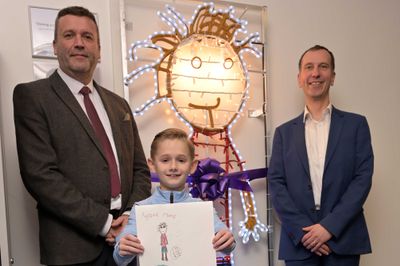
‘Shining a light on Colour Blindness’ competition winner unveils light sculpture at Aston University Winner 10-year-old Leo Evans helped unveil the feature of footballer Tyrone Mings The competition helped highlight the challenges of colour blindness - particularly in sport. A light sculpture named after the Aston Villa footballer Tyrone Mings has been unveiled at Aston University as part of a campaign to help raise awareness of colour blindness. In the UK there are approximately 3 million colour blind people (about 4.5% of the entire population), most of whom are male. Worldwide, there are estimated to be about 300 million people with colour blindness. The competition, ‘Shining a Light on Colour Blindness’, was launched by non-profit organisation Colour Blind Awareness and supported by various football club charities - including the Aston Villa Foundation. Young supporters were asked to take part by drawing a colourful picture of their favourite footballer. The winning entry was then made into a light feature. The winning artwork, which came from the Aston Villa Foundation, was transformed into a light feature and was selected to go on display inside the Aston University Vision Sciences building in the paediatrics bay, as part of the ongoing partnership between the Aston Villa Foundation and Aston University. Colour Blind Awareness is a non-profit organisation designed to highlight the relevance and impact of colour vision deficiency amongst those that live with it - including the challenges in sport. The organisation is part of an EU-funded project, Tackling Colour Blindness in Sport. Competition winner, 10-year-old Leo Evans from Erdington, helped unveil the light sculpture alongside Professor Anthony Hilton, pro-vice-chancellor & executive dean of the College of Health and Life Sciences. Professor Hilton said: “We are delighted for Leo, his winning drawing of Tyrone Mings looks fantastic as a light sculpture and we are proud to host it in our Vision Sciences building for our students, staff and visitors to enjoy, whilst raising awareness about colour blindness.” Commenting on his winning drawing, Leo said: “I am very proud that my picture won the competition and that Tyrone Mings liked it. I now better understand what being colour blind means and I hope my picture has helped someone else.” Cheryl Evans, Leo's Mum, said: “I couldn't be prouder of Leo and the fact that his drawing is of his favourite player Tyrone Mings makes it even more special. This competition has meant that as a family we have had many conversations about colour blindness and it has educated us all more on this topic. Well done Leo!” Kathryn Albany-Ward, CEO at Colour Blind Awareness CIC, said: “Aston Villa Foundation’s entry from Leo charmed the judges and who were delighted to award it first prize. We’re very grateful to Aston University for hosting the light feature and can’t wait to see it displayed. We hope its location in the Vision Sciences Department will help raise more awareness of a condition which affects 8% of boys and 0.5% of girls worldwide, impacting on their education and ability to perform to their best in sport if left unsupported.” Leo was met and congratulated by the head of the Aston Villa Foundation, Guy Rippon, and foundation manager, Ross Alexander. Ross said: “The Aston Villa Foundation would like to say a big congratulations to Leo for his amazing achievement! This is a really proud moment for Leo and we are thrilled that he was inspired by his favourite Aston Villa player. “It has also been a pleasure to have supported Colour Blind Awareness, who have done some great work in highlighting such an important and relevant topic during our coaching team’s workforce development. The support has culminated in a competition that was won by Leo, a participant in one of our Football in the Community holiday sessions. “The stunning light feature of Tyrone Mings will now be housed at Aston University for all to see and we are grateful for the University’s ongoing support with the Club.”


Hearing clinic in partnership with Specsavers opens at Aston University
Hearing clinic opens to students, staff and NHS referrals Training of audiology students is supported by on-site clinic Free hearing tests made available in partnership with Specsavers. A new hearing clinic opened in the School of Optometry at Aston University is providing clinical care to students, staff and members of the public while supporting the training of Aston University audiology students. The clinic, which is situated on the ground floor in the Optometry building on the University campus in Birmingham city centre, is run in partnership with Specsavers and offers hearing tests for free. Aston University's audiology team is working with Specsavers to provide hearing tests, dispense hearing aids and also offer counselling and advice alongside a full aftercare package. The clinic can also advise people on personalised noise protection and ear plugs for swimming. It is open to members of the public and accepts NHS referrals. Claire Wilkes, audiology programme director at Aston University said: “So far the clinic has had a lot of interest and uptake of hearing appointments. We are delighted to be working alongside Specsavers. Many of our students undertake work placements with the company, so we are very happy we’ve been able to grow our partnership further by opening this clinic on campus.” Specsavers is a key partner of Aston University, with graduates from both audiology and optometry going on to work for them. Last year, 62% of students who were placed in Specsavers clinics for support and training applied for jobs on graduation and got to interview. Of those interviewed, 61% are now employed by Specsavers. Humah Zaheer, Specsavers audiology director, who runs the clinic added: “I’m delighted to be involved in this initiative. As an Aston University audiology graduate from 2014 it feels like I’ve come full circle. Being able to offer students an insight into the ‘real’ world of audiology, as well as Specsavers, is a fantastic experience for their career development. “We’ve also been bowled over with the response from the public and are looking to expand the number of days we open the clinic from next year.” The hearing clinic on campus will enable students to practice their clinical and communication skills in preparation for long term work placements off campus. The skills lab equipment mimics equipment in the NHS, helping students better prepare for placements. The hearing clinic is open from 9am until 5pm every Wednesday, Thursday and Friday with plans to increase to five days a week in the new year. To find out more or book an appointment visit our website. You can also call 0121 270 7072.

Psychology students launch creative sessions to support wellbeing through art
The Aston Creative Wellbeing Group is run and facilitated by Aston University psychology students The group brings students together outside of class with an aim of supporting health and wellbeing through art The group will be running another nine sessions in spring 2023 due to its popularity. A student-led creative wellbeing group has been set up by psychology students at Aston University, with the help of their tutor, to connect student participants through art and help enhance their wellbeing. The Aston Creative Wellbeing Group, which showcases its creative work on its Instagram page, was so well attended in the autumn term - with more than 120 participants - it is now planning another nine sessions meeting weekly during the spring term to continue its mission to bring students together and support wellbeing. With some initial funding from the University welfare team to purchase ‘start up’ materials, the group ran a range of sessions including rock painting, making postcards, learning to crochet, painting and drawing and making festive decorations during the autumn 2022 term. Dr Kate Nicholls, senior personal tutor and teaching fellow in psychology at Aston University, explained why she supported the group to set up. Kate said: "I was keen to develop some student-led initiatives to support health and wellbeing in the School of Psychology. I also hoped it would help the students develop their professional skills and the practical application of their psychological knowledge. "It was art making and creative activities that sparked an interest from some final year psychology students and the Aston Creative Wellbeing Group was born. The group wanted to use the arts to enhance wellbeing, using creative activities to explore sense-making, aesthetic appreciation, provide entertainment and friendships.” Karla Hitchins, a final year psychology student who set up the group, said: “Running the group slides in nicely with my interests in art psychotherapy, but I also really enjoy arts and crafts in my own time. It has been great fun to facilitate this group. “The aim of the sessions is for people to have a safe space where they can connect with their creative side, as well as with other students. At the University, there are wellbeing and counselling services, but I don’t think there is anything quite like this. “Having somewhere to express your feelings, or to just have a creative outlet is incredibly important and I hope that eventually there will be more arts-based interventions for mental health and wellbeing at all universities.” Psychology student and group facilitator, Molly-Emma Taylor, said: “I've experienced a few mental health wobbles during this term, so having the wellbeing sessions has helped me a lot. "For example, the painting session was an amazing way to let out some pent-up feelings and it gave me time to connect with friends. I don't think I would have got so much out of it had I simply painted alone. “I think that the theme of everyone banding together every two weeks and making art, in whatever form it may be, is pretty awesome. It's always fun to see what everyone makes. “The social media aspect of the group on Instagram is nice too, because it means even if someone wasn't able to make it to a session they can still feel like a part of group and see what other people created.” Jacqueline Maloney, mental health specialist at Aston University said: "As a mental health specialist at the University, I have been thrilled to help promote and support our psychology Students’ initiative to provide creative wellbeing activities for our students. "I am a big believer in the therapeutic potential of the arts and through participation in these sessions I have witnessed students relaxing, laughing, trying new crafts, and enjoying time in creative endeavours. I am so pleased that this session will be continued into 2023." For more information about studying psychology at Aston University, please visit our website.

Fashioning Fusion: Villanova Professor Explains Clean Energy Breakthrough
On December 13, scientists at Lawrence Livermore National Laboratory announced a breakthrough that could change the future of clean energy. The long-awaited achievement of nuclear fusion was accomplished by researchers and, if harnessed on a larger scale, fusion energy could provide an energy option without the pollution of fossil fuels and without the radioactive waste of nuclear energy. A new world running on clean energy may not be imminent, but the state of ignition achieved is an important first step. Villanova University professor of mechanical engineering David Cereceda, PhD, received a U.S. Department of Energy Early Career Award from the Office of Fusion Energy Sciences for his research on fusion energy materials—and has worked at the Lawrence Livermore National Laboratory, located in California. "Ignition means that a nuclear fusion reaction becomes self-sustainable," Dr. Cereceda said. "The experiments performed at NIF [National Ignition Facility] last week reached for the first time in history a condition called scientific breakeven, meaning the scientists produced more energy from fusion than the laser energy used to drive it." The breakthrough discovery was made when 192 lasers focused on a cylinder the size of a pencil eraser. That container was filled with a small amount of hydrogen that was encased in a diamond. The resulting reaction that occurred was brief but significant, as this important step has proved allusive to researchers for decades. "Those who criticized fusion said that fusion was always five decades away. That's not true anymore," Dr. Cereceda remarked. "I'm not surprised about the announcement. It finally arrived after decades of hundreds of brilliant scientists and engineers carefully working on it." Still, the national laboratory says much work still lies ahead. Scientists will continue to push toward a higher fusion output and are looking at more efficient ways to produce ignition. Researchers also believe they may still be decades away from making fusion energy a mainstay and usable for the general public. "In my opinion, some of the most important challenges that remain on the path to commercial fusion energy are related to structural materials, tritium breeding blankets and laser technology, among others," mentioned Dr. Cereceda. "Multiple challenges remain to making it a commercial energy source, but this recent and historic breakthrough was a critical milestone."


It reflects the University’s strong and longstanding relationship with the accounting industry The University’s graduates achieved the fourth highest global pass rate in CIMA Operational Level exams It is the second year in a row the University has been recognised in this way. Aston University’s Accounting Department has won a Chartered Institute of Management Accountants (CIMA) Global Excellence Award at the CIMA Excellence Awards for the second year running. The annual Awards recognise institutions and individuals across the world going above and beyond to shape the next generation of Chartered Global Management Accountants and lead the accounting profession into the future. The Accounting Department has been awarded Global High Distinction - CGMA Campus of the Year 2022, reflecting the strong and longstanding relationship it has with the accounting industry and the professional bodies in accounting which benefits students throughout Aston Business School. The award reflects the University’s graduates achieving the third highest number of CIMA exams taken over the previous 12 months per university campus globally with above average global pass rate as well as the fourth highest global pass rate in CIMA Operational Level exams. Andy Lymer, professor of taxation and personal finance and head of department of accounting in Aston Business School, said: “Ensuring our graduates are well prepared for long and successful careers in the accounting profession is a key focus of our approach to designing and delivering our accounting degrees, and where we work on other degrees with our accounting teaching. “To be recognised for doing this at the level of one of the top three or four Universities in the world by one of the major global accounting professional bodies is clearly great news for our students - current, past and future. “It is also wonderful recognition for the great teaching team we have here that this award underlines are genuinely world class at what they do.”


Aston University launches degree in nursing starting in 2023
Nursing Studies BSc (Hons) will specialise in nursing adults Students will spend 50% of their time in work placements in the West Midlands region The nursing programme is based in Aston Medical School Aston University has launched a degree in nursing with its first intake starting its three-year course in September 2023. Approved by the Nursing and Midwifery Council (NMC), the Nursing Studies BSc (Hons) will specialise in nursing adults with a focus on community nursing, with work placements offered in hospital and community settings to best reflect where the NHS most urgently needs nurses. According to NHS Digital there are around 47,000 UK vacancies, that is a vacancy rate of 11.8% and in the Midlands region, in the first quarter of 2022 there were 9,336 nursing vacancies – making the West Midlands a hot spot for vacancies. The University is now taking applications for its first cohort of up to 40 students who will be based in Aston Medical School. They will be due to graduate in 2026, eligible to register with the Nursing and Midwifery Council as a Registered Nurse (Adult). Professor Anthony Hilton, pro-vice-chancellor and executive dean of the College of Health and Life Sciences, said: “I am delighted we now offer Nursing Studies which comes at a time when we are seeing a national shortage of nurses in the NHS and more locally in Birmingham we are seeing a significant gap in nurses trained in adult and community care settings. Nursing will be co-located within Aston Medical School to provide opportunity for truly interprofessional learning with our medical, pharmacy and wider groups of healthcare students. “We are excited to work with our local NHS Trusts to offer clinical practice education, in combination with our new state of the art health simulation facilities. We look forward to launching in 2023 and developing high quality nursing graduates to support the NHS workforce of the future.” Students will spend 50% of their time on work placements at various local hospital trusts including Sandwell and West Birmingham (with its new hospital opening in 2024), The Royal Orthopaedic Hospital NHS Foundation Trust, University Hospitals Birmingham – this includes The Queen Elizabeth Hospital, Solihull Hospital, Birmingham Heartlands and Good Hope Hospital, as well as Birmingham Community Healthcare Trust. There will also be opportunities for placements within various nursing homes, hospices and GP practices. There are significant opportunities for interprofessional learning with other healthcare students - because the nursing cohort will study some taught sessions alongside students in Aston Medical School, Pharmacy, Optometry and Audiology. New state-of-the-art healthcare simulation facilities will be used to support practical and clinical skills training. The simulation suite includes two hospital wards, a residential flat, an immersive room and high-fidelity mannequins. Jayne Murphy, programme lead adult nursing, Aston University: “Nursing is dynamic and challenging and requires a huge skill-set from specialist clinical skills to essential skills of communication, problem-solving and professionalism.” “There is no better time to start a career in nursing. The opportunities post-qualifying are endless and our students will have the potential to make a significant difference to people’s lives when they are often at their most vulnerable.” “Our nursing students will work with some truly inspirational people who will support them to be the best nurse they can be. The small cohort sizes at Aston University mean they will have a personalised experience in a supportive environment to help our students flourish during their studies and in their first post as a registered nurse.” Dr Alexander Rhys, NMC Assistant Director of Professional Practice, said: “Congratulations to Aston University which has become one of the latest education institutions approved against our standards to deliver a pre-registration nursing programme. It's vital that nursing and midwifery students receive the high-quality education they need to join our register and deliver the safe, effective and kind of care that people have the right to expect. We look forward to supporting Aston University as it educates the nurses of the future”. We are now taking applications for BA (Hons) Nursing Studies (Registered Nurse Adult Nursing) starting in September 2023. To find out more about the course or how to apply, please visit the course pages on our website. Deadline for applications is 25 January 2023.

Birmingham MP officially opens £1.5 million healthcare simulation facilities at Aston University
Paulette Hamilton MP officially opens healthcare simulation facilities at Aston Medical School and School of Optometry State-of-the-art facilities including medical simulation room with high fidelity manikins for students to practise real life scenarios opens The first in Europe ocular simulation suite allows students to refine skills in examining the health of the eyes and experience a wide range of eye disease. New £1.5 million healthcare simulation facilities have officially opened at Aston Medical School and in the School of Optometry at Aston University. The state-of-the-art facilities were formally opened by Paulette Hamilton, member of parliament for Birmingham Erdington, on Friday 2 December at a ribbon cutting ceremony that was attended by Aston University Vice-Chancellor Professor Aleks Subic as well as other members of the University executive and staff from the College of Health and Life Sciences. Commenting on the new facilities Paulette Hamilton MP said: “It’s been brilliant to visit and officially open the new healthcare simulation facilities at Aston University. “I know from my time as a nurse how important it is to have access to good training and the latest equipment. These fantastic facilities will give students the best possible learning experience as they prepare to enter their profession, providing healthcare in Birmingham and beyond.” Hosted by Professor Anthony Hilton, Pro-Vice-Chancellor and Executive Dean of the College of Health and Life Sciences, guests were invited to take a tour of the new facilities including a clinical skills simulation room which allows students to practise in emergency settings and an ocular simulation unit facility, the only one in Europe. Professor Hilton said: "We are delighted these new facilities have opened in time for the start of the new term and that students can benefit from practising their clinical skills in a variety of scenarios. “The acute care simulation room will allow for simulated emergency resuscitation scenarios that are very difficult to teach in real life situations, such as heart attacks, acute breathlessness and severe allergic reaction and will be of great value in training students of medicine, pharmacy and optometry.” The healthcare simulation facilities will be used by students studying medicine, pharmacy and optometry, where they will be able to practise in emergency settings using high quality manikins where they will simulate treating patients for acute conditions such as a heart attack or learning how to intubate a patient onto a ventilator. Professor Aleks Subic, Vice-Chancellor, Aston University said: “The launch of the Aston University healthcare simulation facilities marks an important milestone in the development of our digital health precinct within the Birmingham Knowledge Quarter. By establishing world-class medical imaging, advanced visualisation, and digital diagnostics capabilities we are in fact bringing Industry 4.0 to healthcare. “Our students from the Aston Medical School and School of Optometry in particular, will benefit immensely from this development as they will be able to detect a wide range of clinical conditions and diseases and explore different interventions and scenarios, safely within a simulated environment.” The high-fidelity acute care simulation room will also be equipped with recording facilities, a debrief room and control room. The funding has allowed for the purchase of other training equipment such as a hospital grade bed and single task trainer simulation equipment. For example, male and female catheterisation models, pelvic and rectal trainers, venepuncture arms, breast trainers and abdominal trainers. The facilities were part funded by the Office for Students which awarded the University £806,226 to set up the ‘high fidelity’ simulation A&E room with further expenditure by Aston University on the ocular simulation unit. The ocular simulation facility is unique in Europe. It allows students to refine their skills in examining the health of the front and back of the eyes and to experience a wide range of eye disease. One of the simulators allows students to utilise their smartphones to practise at home. They can gain direct feedback and be assessed by the simulators, allowing more flexible, diverse and intensive learning than can be achieve with clinical practice placements. Professor Liz Moores, deputy dean of the College of Health and Life Sciences, said: “The College of Health and Life Sciences is thrilled with this investment. The enhanced facilities will help to support many of our healthcare students, including those now applying for our new nursing degree. It will also support us with the introduction of the new pharmacy and optometry education standards, providing a step change in our ability to simulate a wide range of clinical scenarios.” For more information about studying in the College of Health and Life Sciences please visit our website.