
Experts Matter. Find Yours.
Connect for media, speaking, professional opportunities & more.

Next biochar webinars announced to reach global market
• Next series of biochar online events scheduled for August and September • Benefits of using sustainable form of charcoal to be highlighted • Original event attracted people from around the globe Two more virtual events have been planned to highlight the benefits of using biochar, which is a sustainable form of charcoal made from organic waste. The free events will be taking place on 24 August and 29 September and follow the popular presentation held last month by the Energy and Bioproducts Research Institute (EBRI) at Aston University. Organisers of the event, Biochar Webinar: Challenges, Benefits and Applications, were inundated with hundreds of businesses from across the globe, including in New Zealand and South Africa, signing up to find out more about how they could benefit from using the fuel source. Tim Miller, director of engagement at EBRI said they had received positive feedback from the first event, and so wanted to make sure a wider audience could find out more about it. “In the build-up to COP26 which will be happening in November, the world is going to be talking more and more about energy, sustainability and the path to net zero. This is why it’s so important for us to be able to showcase what we do within EBRI, along with the research, but also be the thought leaders in such an important subject which will be affecting us all. “This is why we have decided to release two more dates for the talk, and have also been mindful to host one later in the day so our counterparts in countries such as America will also be able to log in and find out more about biochar,” he said. Biochar has a wide variety of uses, including carbon capture, water treatment, soil improvement, odour control and industrial applications. The expert-led virtual session will help anyone with an interest in biochar to be able to find out more about how the multi-purpose material can help decarbonise rural and urban environments. The talks will be held on 24 August between 10am – 11am, and 29 September between 3 - 4pm. To sign up for the event, visit www.bioenergy-for-business.org/ebri-out-and-about/ For more details about the world-leading research taking place at EBRI, visit: https://www.aston.ac.uk/research/eps/ebri


/cloudfront-us-east-1.images.arcpublishing.com/gray/VTFRFP3RLBDQNHSADLYVFHUNMI.jpg)
#Experts in the media - Political science professor discusses 2020 Census data
The 2020 Census is out - and media are coming to Georgia Southern University to help breakdown the numbers and explain the details about how it all impacts Georgia. America is becoming more diverse, according to new data from the 2020 Census. Analysts say the biggest jump came, in the multiracial category. It went from nine million in 2010 to 33.8 million in 2020. That’s a 276 % increase. The Latino and Asian communities also saw big jumps. A political science professor at Georgia Southern says this data has a big impact on local communities. “Another thing is the redistricting process in general. The results of the Census are going to have a big impact on the redistricting process this year in state legislatures. For instance, some states are losing representatives, and some states are gaining representatives,” Kimberly Martin, Ph.D., assistant professor of political science and international studies, said. While Georgia and South Carolina are keeping the same number of representatives, Martin says the Census affects funding, and also gives lawmakers an idea of how demographics in their districts have changed over the past decade. August 13 - WTOC If you are a reporter covering this topic - then let our experts help. Contact Georgia Southern Director of Communications Jennifer Wise at jwise@georgiasouthern.edu for an interview with Professor Martin today.


Stepping back in time — Georgia Southern expert helps uncover day-to-day life of the woolly mammoth
It’s been an exciting time for those studying the now extinct animals that used to roam the continent. And recently, Katy Smith, associate professor of geology and curator of paleontology at Georgia Southern University, was asked to lend her expertise to a team of scientists who are piecing together the life and times of the massive wholly mammoth that once roamed the earth. We might not be able to study a walking, breathing woolly mammoth in real life, but what if we could track its movements and get a sense of where it traveled, from its birth to its death? For the first time ever, scientists have done just that. An international team of researchers published a paper this week in the journal Science that reveals the 28-year movement history of a male woolly mammoth. With exciting detail about where it roamed throughout northern Alaska, its seemingly favorite locations—as it returned time and time again—and where it eventually died, this paper offers unparalleled insight into an animal that lived approximately 17,000 years ago. August 12 - GIZMODO A full article is attached and is a captivating read. If you are a reporter looking to learn more or cover this interesting subject – then let our experts help. Contact Georgia Southern Director of Communications Jennifer Wise at jwise@georgiasouthern.edu for an interview with Katy Smith today.

As Afghanistan falls – what comes next?
After 20 years of war, trillions spent and thousands of casualties, the Taliban claimed control over most of Afghanistan this weekend with little resistance, just a few weeks after withdrawal of American and allied forces. And questions are already being raised: How could this have happened so quickly? Did no one see this coming? What revenge and havoc will the ruling Taliban seek on those who assisted coalition forces? What will happen to the Afghan refugees who are attempting to flee the country? And sadly, was this all for nothing? There will be a lot of coverage as the future unfolds for the people of Afghanistan and how the Taliban’s control will reshape the country and the region. And if you are a reporter covering this ongoing topic – then let us help. University of Mary Washington Political Science and International Affairs Professor Jason Davidson is an expert in American foreign and security policy, and international security. He is also the author of the Brown and Boston universities commissioned study, "The Costs of War to United States Allies Since 9/11," which focuses extensively on the contribution of America's allies in Afghanistan. If you’re looking to arrange an interview with Dr. Davidson, simply click on his icon now to arrange an interview today.



Three Aston University STEM pioneers shortlisted for Women in Tech Awards
• Three finalists from Aston University shortlisted for prestigious Women in Tech Awards • Two academics are up for the award which will be announced in October • A degree apprentice has also been nominated in the category Three STEM pioneers from Aston University are celebrating after being shortlisted for the prestigious Midlands Women In Tech Awards. Aston University’s Reham Badawy and Lucy Bastin have picked up nominations for the academic category while Jessica Morgan has been put forward for the apprentice category for the awards. The Midlands Women in Tech Awards are an opportunity to highlight and recognise the ongoing contribution of women in the tech sector. The aim of the awards is to raise the visibility of women in the tech space and enable the next generation to ‘see it and therefore aspire to it’. Jessica Morgan is studying a Digital Technology Solutions apprenticeship with Cap Gemini and Aston University, with experience working on projects within the public sector. She is in the final year of her degree apprenticeship and has been balancing work, studying and volunteering, while being on track for a first class honours. Reham Badawy is part of the Undergraduate Teaching Team at Aston University. Her research work has used smart tech to detect and monitor symptoms of Parkinson’s disease. She is a strong advocate for women in STEM and is a UK Ambassador for Women are Boring. Lucy Bastin has a Masters in GIS and a PhD in Urban Ecology. She is a senior lecturer in Computer Science and was recently on secondment to the Joint Research Centre of the European Commission. She developed web-based biodiversity information systems that support accessible and user-friendly reporting by the international community against policy and conservation targets such as the Sustainable Development Goals. Professor Kate Sugden, deputy dean for the College of Engineering and Physical Sciences at Aston University said: “We are delighted to see so many Aston University shortlisted candidates for the Women in Tech Awards. “In our eyes they are all winners and are great examples of our ongoing commitment to making significant contributions to the region and wider society.” Voting closes on August 20 and more details about the finalists can be found here: www.womenintechawards.co.uk The ceremony takes place on 7 October where the winners will be announced.


Podcast: 3D printing’s vital solution to medical problem caused by COVID-19
"They were looking to solve a problem and I was able to use my additive manufacturing knowledge to help them out, and the result of that was that we developed a new technology and span a company out of it." Dr Mark Prince Senior Lecturer in Mechanical Engineering Aston University New device created in Aston University lecturer's home during coronavirus lockdown Aston Business School expert explains how 3D printers are already used to make hearing aids, dental crowns and hips ‘Imagination is the only limit’ for additive manufacturing’s future, according to Dr Ahmad Beltagui A senior lecturer at Aston University is helping ear, nose and throat (ENT) clinics around the world by using the hi-tech ingenuity of 3D printing. Dr Mark Prince used 3D printing to prototype and produce a valve for a mask so that ENT surgeons could continue to examine and treat patients without fear of spreading the virus. Dr Prince, a senior lecturer in mechanical engineering at Aston University, was talking about his experiences in the latest episode of the 'Aston means business' podcast, presented by journalist Steve Dyson. The podcast also features Dr Ahmad Beltagui from Aston Business School, who talks about the wider benefits, some downsides and future potential of 3D printing in successfully disrupting traditional manufacturing. Dr Prince said his interest in additive manufacturing, or 3D printing, peaked after meeting two consultant ENT surgeons in the West Midlands. He said: "They were looking to solve a problem and I was able to use my additive manufacturing knowledge to help them out, and the result of that was that we developed a new technology and span a company out of it. "The company is Endoscope-i Ltd, founded in 2012 and now with an annual turnover of £200,000. The idea was simple: can we get medical endoscopic images of the ears and throat using a smartphone and we came up with a technique to do that." He said that, traditionally, he would have used large, expensive equipment to prototype the systems and new products. However, that wasn't possible with most of the university closed down at the height of the pandemic last year. He, therefore, had to look at other technologies that were safe to use in the home without breaking lockdown restrictions. Dr Prince explained: "When we are looking at diseases or concerns of the throat and nose we often stick an endoscope up the nose and down the throat, but of course you can't do that through a mask. "One of the founding members, Mr Ajith George, suggested that we could put a valve in the mask that allowed an endoscope to pass through it and allow the procedure to go ahead without breaking containment." "Work on the device started in mid-March 2020 and was ready for free supply to the NHS in November. Dr Prince added: "What that has allowed the NHS to do is any ENT clinic was able to fit it to a mask, put the mask on the patient, and carry on with an endoscopy procedure without all of the concerns of the pandemic." Meanwhile, Dr Ahmad Beltagui, a lecturer in operations and information management at Aston Business School, said you could get 3D printers from as little as £200 all the way up to expensive versions working with "exotic materials" like titanium. He said there were four main benefits to manufacturers: "Compared to traditional manufacturing methods you can produce shapes that are harder to produce; you can produce things in very small volumes; you can innovate faster and produce lots of prototypes, and you can produce things nearer to where they are required so you don't have to produce in a factory in one place and transport somewhere else." Dr Beltagui said: "The COVID-19 pandemic saw 3D printers used in homes to produce equipment such as cheap face visors for their local hospitals. The great thing about 3D printing is anyone can produce anything they want. "That's also the biggest risk – there is no control over what people produce or how safely they produce it. "At the beginning of the pandemic, someone in Italy found that they could produce some spare parts to keep the ventilators in their local hospital going. But then a few days later the manufacturer of those ventilators was considering whether or not it should take legal action." However, he said the printing machines had gradually become more reliable and there was a better level of quality, while the cost was coming down. Dr Beltagui added: "As to the future, the only limit is your imagination."


Homelessness expert on eviction moratoriums
Marybeth Shinn, Cornelius Vanderbilt Chair, Department of Human and Organizational Development, is available for commentary on eviction moratoriums and how they work. An expert on the topic of homelessness and affordable housing, Shinn is also the author of a recently published book, "In the Midst of Plenty: Homelessness and What to Do About It." Shinn can speak to: How an eviction moratorium works and consequences for it ending, including accumulated rents being due The health hazard that evictions and potential homelessness or congregate housing cause, especially as we continue to endure COVID Her view that we know what causes homelessness (lack of affordable housing, rising inequality, etc.) and have the resources to end it, but lack the political will Suggested government assistance to end the crisis and how affordable housing is the first step to getting people back on their feet (everything else, such as employment, comes second)


Covering World Breastfeeding Week? Our experts are here to help
August 1-7 is World Breastfeeding Week, and the University of Mary Washington has the ideal expert for any journalist looking to learn more or cover this important topic. Did you know that breastfeeding is one of the top maternal priorities for many organizations, including the World Health Organization (WHO), the American Academy of Pediatrics (AAP) and the Centers for Disease Control and Prevention (CDC)? Assistant Professor of Communication Elizabeth Johnson-Young has done extensive research on women’s intentions to breastfeed and how the communication they receive during pregnancy and postpartum from various sources such as doctors, lactation consultants, friends and family, magazines, books and parenting groups can impact the decision to breastfeed. She's also explored the connections between breastfeeding and body satisfaction. Dr. Elizabeth Johnson-Young is a published expert on health communication, especially maternal and family health. She is ready to help if you are looking to cover this topic - simply click on her icon now to arrange an interview today.

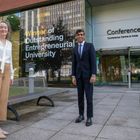
Rishi Sunak kickstarts Help to Grow scheme at Aston Business School
"It was a pleasure to host the chancellor at Aston Business School today. As a small business leader you have to know about all the key business functions and how to optimise them to drive high performance in your business." Paula Whitehouse, Aston Business School Paula Whitehouse (L) & Rishi Sunak (R) The Chancellor of the Exchequer met with Aston University’s deputy vice-chancellor engagement and associate dean enterprise of the College of Business and Social Sciences to launch Help to Grow: Management The scheme will support senior managers of small and medium-sized businesses to boost performance, resilience, and long-term growth The 12-week programme is 90% funded by the Government and participants can complete it alongside full-time work. The Chancellor has called on the leaders of small and medium-sized businesses to sign up to a new programme designed to hone their expertise as he attended one of the first courses in the UK today (August 2). Rishi Sunak joined a class taking part in the government-funded Help to Grow: Management scheme at Aston Business School, Aston University, alongside small business owners, to see first-hand how it is giving them the tools they need to innovate, grow and help drive the recovery from the pandemic. The Chancellor delivered a talk to participants at Aston Business School on the critical role small businesses can play in boosting UK productivity. He then took part in a group activity and led a discussion about their own business models and opportunities for growth. The scheme, which was announced at the March Budget and opened for applications in May, will give 30,000 SMEs access to world-class business expertise on everything from financial management to marketing and is a pivotal part of the government’s Plan for Jobs. Rishi Sunak, the chancellor of the exchequer, said: “Small businesses are key to our innovation and economy and will therefore be an essential part to our recovery from the pandemic, which is why we are levelling up their skills through the Help to Grow schemes. “I want to bring some of the best bits of management training from around the world to help boost productivity here in the UK. “Help to Grow: Management will ensure our brilliant SMEs seize every opportunity to grow, fuelling our Plan for Jobs by boosting productivity in all corners of the UK.” Experts in small business and entrepreneurship from Aston University have played a significant role in developing the programme. Paula Whitehouse, curriculum director for Help to Grow: Management and associate dean enterprise of the College of Business and Social Sciences, said: "It was a pleasure to host the chancellor at Aston Business School today. As a small business leader you have to know about all the key business functions and how to optimise them to drive high performance in your business. “Help to Grow: Management will combine this essential business education with the creation of a like-minded business network and support for the practical application of the learning to ensure businesses get immediate results. “I am excited to be working with Small Business Charter business school colleagues all over the country to roll out the Help to Grow: Management curriculum and ultimately to be introducing many more business leaders from the West Midlands into Aston's vibrant entrepreneurial community." Mark Hart, professor of small business and entrepreneurship at Aston University and associate director of Aston Centre for Growth, said: “The launch of the Government’s Help to Grow: Management programme for SMEs is a welcome addition at a critical time to the range of support available to small business leaders across the UK. “Small firms will drive the recovery as they have always done in previous economic downturns and equipping their leaders with the leadership and management skills from the UK’s leading business schools will ensure that they will build even more resilient, innovative and sustainable businesses capable of responding to the emerging opportunities in their chosen markets. “This is a practical, intensive 12-week programme designed by some of our top academics to provide the skills required to improve the performance and productivity of small firms across all sectors of the economy”. Mark Hart (L) & Rishi Sunak (R) take part in a class at Aston Business School

What does the latest federal ruling mean for DACA? A UConn expert weighs in.
Deferred Action for Childhood Arrivals, more commonly known as DACA, was introduced in 2012, and ithas enabled roughly 828,000 eligible young adults to work, attend school, and live out their lives in the United States, the only country they know as their home, according to the American Immigration Council. DACA is back in news, though, after a federal judge in Texas ruled that the program was unconstitutional, a decision that attorney, scholar, and expert Jon Bauer from the UConn School of Law says is shaky: The decision in federal court wasn’t a surprise to Jon Bauer, who directs the University of Connecticut Law School’s Asylum and Human Rights Clinic. Because Hanen is known for his conservative judicial philosophy, according to Bauer, the ruling was expected to interfere with DACA in some capacity. But Bauer said the ruling could be overturned. “The reasoning of the decision is very weak, in my opinion. The judge, I think, misconstrued the scope of the Department of Homeland Security's authority to engage in what's called deferred action, which is what the DACA program is,” Bauer said. Connecticut has 3,560 residents who have DACA, as of March 2020, according to the Department of Homeland Security which administers the policy. Current recipients aren’t in immediate danger of losing their status, since the ruling as of now only prevents first time applicants from getting DACA. Bauer said that non-citizens have long been allowed to work with deferred action. While the federal government can conceivably attempt a legislative path to citizenship for DACA recipients, the road ahead to any permanent solution is uncertain due to the divisive nature of the current Congress. July 31, 2021 – Hearst Connecticut Media The fate of DACA is important not just to the individual recipients, but to the immigration system and economy of the United States more broadly. If you are a journalist looking to know more, then let us help. Jon Bauer is a clinical professor of law and is the director of the UConn School of Law’s Asylum and Human Rights Clinic. He is a go-to expert in the areas of asylum and refugee law, immigration law, employment and housing discrimination, and legal ethics. Professor Bauer is available to speak with media regarding this most recent DACA ruling – simply click on his icon now to arrange an interview today.

