
Experts Matter. Find Yours.
Connect for media, speaking, professional opportunities & more.

Aston University pharmaceutical spin-out company shortlisted in life sciences industry awards
MESOX is a spin-out from the pharmaceutics group at Aston Pharmacy School The company partners with pharmaceutical and biotechnology companies to bring challenging therapeutics to market It has been shortlisted in the Medilink Midlands Awards 2024. A spin-out company from Aston University’s pharmaceutics research group has been shortlisted for a life sciences industry award. The Medilink Midlands Awards aim to showcase the very best collaborations between industry, academia and the NHS across the Midlands. The company, MESOX, founded by Dr Ali Al-Khattawi, a lecturer in pharmaceutics at Aston Pharmacy School, is competing in the Start-Up category for newly established companies that show a promising future. With in-depth expertise in particle engineering for drug delivery and pharmaceutical spray drying, MESOX uses IP-protected carriers to improve the bioavailability and efficacy of pharmaceuticals, partnering with pharmaceutical and biotechnology companies to bring challenging therapeutics to market. Medilink Midlands provides specialist business support to boost the region’s economic output from the life sciences industry. Working alongside the Midlands Engine and other strategic alliances, it helps stimulate additional and value-added growth of the Midlands as a prosperous community for life sciences. The awards winners will be announced at a ceremony taking place on Thursday 9 May at the Athena in Leicester. To celebrate Medilink Midlands’ 20th year anniversary of delivering business support, one finalist will be announced as the 2024 ‘Winner of all Winners’ and presented with a £5,000 prize for innovation development. Dr Ali Al-Khattawi, founder and CEO of MESOX, said: “We are excited to be nominated as a finalist for this award, which is a testament to the innovative research at Aston University that has led to MESOX and a great way to recognise the efforts of our team. “MESOX is expediting the development of life-saving therapeutics through cutting-edge carrier technologies. Our vision is to be a leading research-based pharmaceutical company in the Midlands one day and we hope this opportunity brings us a step closer to this goal.” Luke Southan, technology transfer manager at Aston University, said: “Aston University’s School of Pharmacy has always been a hotbed of innovation and entrepreneurship. This is most often seen through our many students who end up running their own independent pharmacy stores, but it is also the school that has created the most Aston spinouts. “MESOX is the latest example of this, and it is a company that is on track to be generating significant revenue and region impact over the next five years. This award nomination evidences the potential the company has to offer.”


Podcast: Equality must become the norm, not just a box ticking exercise
Equality, diversity and inclusion (EDI) must become “everybody’s business” EDI can reduce pay gaps and open up opportunities for SMEs Aston University now celebrating Athena Swan Gold award for gender equality. Equality, diversity and inclusion (EDI) needs to become “the norm” in organisations to escape “disappointing” government criticism that it is a waste of time. That’s the guidance coming from the latest episode of ‘Aston means business’, a podcast from Aston University presented by journalist Steve Dyson. Professor Shivani Sharma, the new deputy dean of people, culture and inclusion at the University’s College of Business and Social Sciences, explained that EDI cultures must become “everybody’s business” to address the existing gender and ethnicity pay gaps. Responding to recent government criticisms of EDI schemes, Professor Sharma said: “Not enough investment has gone into these roles because, if we look at the history, it tells us that just relying on everybody to do the right thing doesn’t work.” Also interviewed in the podcast was Omar Rashid, a director of The HR Dept, a human resources franchise for Birmingham Central & Wolverhampton. Mr Rashid, who specialises in diversity and recruitment, said that government criticism of EDI initiatives was “disappointing”. But he acknowledged: “I understand where they’re coming from because, if it’s seen as a scheme, as something we’ve got to do, and it’s not done properly, then maybe it is a waste of time and a waste of money. It has to be seen as the norm.” He said people need to realise they live in a multicultural world, with a diverse workforce, supply chain and customers, and that if implemented properly the benefits of EDI are there. Mr Rashid, who is also president of the Asian Business Chamber of Commerce in Birmingham, specialises in diversity and recruitment. He added: “There is opportunity there through different skills. “Each individual, whether it’s race, religion, will bring their own perspectives, their own unique skills, even people with a disability. It shouldn’t be seen as a barrier.” He said examples of a “tick box mentality” were where businesses might adopt Black History Month but do nothing for the other 11 months of the year, or provide a prayer room during Ramadan but not at any other time. He added: “When it’s tick box, it’s not worth it because you’ll have a business or someone who will do something for a short period of time. They half-heartedly did something without the conviction. Diversity shouldn’t be just a little bit here and there.” Professor Sharma went on to say that ‘world days’ such as International Women’s Day can act as a catalyst to focus attention on an issue. But she added: “It’s really important that why you’re doing that is clear, and that the strategy of raising awareness, to remove barriers to women, equitable inclusion in the workplace or in society, continues throughout the year.” She said that Aston University had recently gained an Athena Swan Gold award for promoting gender equality in higher education, but that the “scale” of the problem meant there was still lots more to achieve. She explained that proportions of women entering as students into higher education was really positive, as were degree completion rates. But she pointed to the fact that around 80 per cent of university vice chancellors identified as men, with low representations of ethnic minority women among professors. Professor Sharma added: “It will take a sustained effort to undo that over time.” She also praised the Inclusive Aston networking initiative at Aston University, with senior leaders mentoring colleagues of minority ethnic heritage. Mr Rashid said SMEs needed to look at the opportunities that a diverse workforce and culture can bring to their business. He added: “One SME business engaged with someone from an Asian background, wanted to tap into India, and guess what? He has the connections and they were able to open a branch in India.” Catch up on all of the previous ‘Aston means business’ podcast episodes here.

The Power of Impartiality: Exploring the Benefits of VisiLeap AI's Relevancy Assessment for Acceleroute's Patent Portfolio Unlocking Patent Portfolio Potential Acceleroute's patent portfolio is a treasure trove of innovative ideas and concepts. However, the challenge lies in identifying which patents are truly valuable and relevant in today's fast-paced technological landscape. With InventionShare's VisiLeap AI's relevancy assessment scorecarding, Acceleroute can now unlock the full potential of its patent portfolio organized by companies that could benefit as well as major data center considerations and new demands such as virtual and augmented reality, AI LLMs and AGI. Efficient Opportunity Identification By leveraging VisiLeap AI and human dataset creation and scorecarding, patent portfolios such as Acceleroute can be unbiasedly assessed as to their relevancy to global corporations or new high growth enterprises. This eliminates the guesswork and allows the AcceleRoute to fairly represent their portfolio without any bias. Maximizing ROI One of the key benefits of VisiLeap AI's relevancy assessment tool is its ability to maximize return on investment for Acceleroute's patent portfolio. By strategically identifying high-value patents in the context of leading technology companies and use case, the company can prioritize companies for licensing or acquisition of the portfolio. Staying Ahead of the Competition In today's competitive business landscape, staying ahead of the competition is crucial for long-term success. VisiLeap AI's assessment software gives Acceleroute the competitive edge by helping them identify the relevancy of each of the individual patents in the portfolio in the context of industry competitors and emerging technology trends. The portfolio currently has 39 US patents (with many equivalent Canadian patents) and two continuation's in process. In conclusion, the VisiLeap AI's relevancy assessment presents a solid opportunity for Acceleroute to unleash the full potential of its patent portfolio. To explore how this technology can benefit your organization contact us today for a personalized consultation. About InventionShare About VisiLeap About Acceleroute



Watching the solar eclipse Monday? Our expert has advice on how to do it safely
It's being called a "once in a lifetime" opportunity - and Monday's solar eclipse has almost everybody on the continent talking as well as planning and preparing to get a glimpse of this rare astronomical moment. Amid the excitement is a need for people to view the event safely, which is why NBC Connecticut recently caught up with UConn Associate Professor of Physics Jonathan Trump to explain what's happening and, if you're going to be gazing upwards, what you need to know and how to do it without getting hurt. An astronomical celebration is just around the corner. But if you want to see the solar eclipse for yourself, there are steps you need to take to do so safely. First and foremost: to watch this out-of-this-world display April 8, don’t even think about looking right at the sun. “Most important thing, do not look directly at the solar eclipse with your eyes,” said UConn associate professor of physics Jonathan Trump. “Here in Connecticut the eclipse will be about 90% which is pretty spectacular, but even 10% of the sun’s light is a lot of the sun’s light.” UConn is one of many organizations around the state holding a celebration and viewing event. “The next one is not going to be for another 20 years, so yeah this is a special event,” said Trump. Sunglasses aren’t strong enough to protect your retinas from these UV rays. “The ultraviolet light is what give us sunburns and it can severely damage the retina in the back of your eye and permanently scar your vision. So do not look directly at the sun,” said Trump. You can view the solar eclipse safely with certified solar eclipse glasses. If you wear eyeglasses, put the solar eclipse glasses on top of your glasses. And if you have solar eclipse glasses from the last phenomena visible stateside, which was seven years ago, you should get a new pair. Experts we spoke to say they have no more than a three-year shelf life. Looking to know more? Jonathan Trump is an observational astronomer and is available to speak with reporters about Monday's eclipse. Simply click on his icon now to arrange a time to talk today.


30th Anniversary of the Rwandan Genocide
This Saturday is the 30th anniversary of the Rwandan genocide is a solemn occasion that holds profound significance for the public, reminding us of the horrors of mass violence and the importance of remembrance, reconciliation, and prevention. This event matters as it serves as a stark reminder of the devastating consequences of ethnic hatred and political violence, urging us to confront past atrocities and work towards building a more just and inclusive society. By reflecting on the lessons learned from the Rwandan genocide, we can strive to prevent similar tragedies from occurring in the future and promote peace, tolerance, and understanding. Story angles of interest to a broad audience may include: Commemorating the victims and survivors of the Rwandan genocide Examining the root causes and historical context of the genocide The role of international community in responding to the genocide and lessons learned Efforts towards reconciliation, justice, and healing in Rwanda Addressing the long-term impact of the genocide on Rwandan society and its diaspora Strategies for preventing genocide and mass atrocities in the future. Connect with an Expert about the Rwandan Genocide For journalists with questions or looking to cover the Rwandan Genocide, what caused it and the state of Rwanda today here is a select list of experts. To search our full list of experts visit www.expertfile.com Richard A. Wilson, Ph.D. Gladstein Distinguished Chair of Human Rights and Board of Trustees Distinguished Professor · University of Connecticut Glen Duerr, Ph.D. Professor of International Studies · Cedarville University Stephen Sloan, B.B.A., M.A., PhD. Director of Institute for Oral History, Associate Professor of History · Baylor University Lisa A. Costello Professor, Writing and Linguistics & Director, Women's, Gender and Sexuality Studies Program · Georgia Southern University Photo Credit: Reagan M


The ChristianaCare Hospital Care at Home program, a national leader in providing acute care in a place most familiar to patients – their own homes – has reached a new milestone with more than 1,000 admissions since opening in December 2021. ChristianaCare’s innovative program enables patients with common chronic conditions, such as congestive heart failure and diabetes complications, as well as infections like pneumonia, to receive hospital-level care at home through virtual and in-person care provided by a team of physicians, nurse practitioners, paramedics and others. Technology kits deployed to patient homes ensure round-the-clock access to a health care professional, along with twice daily visits from caregivers, medication deliveries and mobile laboratory services. “This program is a wonderful example of how ChristianaCare is building a better health care system and meeting people’s health care needs through innovation, collaboration and an unwavering commitment to providing the very best care for the people we serve,” said Janice E. Nevin, M.D., president and CEO of ChristianaCare. “We are proud to be at the forefront of hospital care at home nationally, through the collaboration with leaders like Sen. Tom Carper of Delaware, who has championed this new model of care at the federal level; Medically Home, which partnered with ChristianaCare to help us design a program that best meets the needs of the communities we serve; and our own health professionals – we call them caregivers – whose expert care and coordination make this all possible. Together, we are creating health so that people can flourish.” ‘Just amazing’ for patients Patients are evaluated for the hospital care at home program when they come to Wilmington or Christiana hospital emergency departments. Those who can be treated at home receive a technology kit that connects them to the command center, powered by the ChristianaCare Center for Virtual Health. With a touch of a button, they can access an expert team of ChristianaCare doctors and nurses. But hospital care at home isn’t just virtual care—the technology supports an entire care team that works inside the patient’s home and remotely to provide optimal support at all times—just like in a hospital. Patients connect with their health care team with just the touch of a button. Carol Bieber, whose 98-year-old father, Bill, has been a hospital care at home patient, sees the difference it makes for him to wake up in his own bed, sit in his own living room and still get the care he needs to get better. "The whole hospital care at home experience is really calm and easy and familiar to him," said Bieber, who lives in Newark. “My dad is a people person, so to be able to connect with everybody who comes in to see him or talk to him on the screen is just amazing.” Innovative solutions for in-home care ChristianaCare’s Hospital Care at Home program was developed in 2021 after the Centers for Medicaid & Medicare Services (CMS) began the Acute Hospital Care at Home waiver program to allow Medicare beneficiaries to receive acute-level health care services in their home. U.S. Sen. Tom Carper, who represents Delaware, worked to pass the bipartisan Hospital Inpatient Services Modernization Act in 2023 that extended this program. Last month. Sen. Carper introduced the bipartisan At Home Observation and Medical Evaluation (HOME) Services Act that would expand this lifesaving and cost-saving program. “Hospital at Home – which grew out of the COVID pandemic – was an opportunity for us to meet seniors where they are,” Sen. Carper said. “It has delivered positive outcomes, higher patient satisfaction, and saves money. That is why when this program was about to go away with the end of the COVID public health emergency, I joined my colleagues across the aisle to extend the program for two more years. Today, especially as we celebrate the success of the program in Delaware with ChristianaCare, I’m encouraged that we can further extend that program!” Sarah E. Schenck, M.D., FACP, executive director of the ChristianaCare Center for Virtual Health, said the hospital care at home program has yielded lower readmission rates than brick-and-mortar hospitals. In addition, patient experience scores are about three times higher than the national average for a traditional hospital experience. Options like Hospital Care at Home give patients the care they need in the space they want, said Dr. Sarah Schenck, executive director of ChristianaCare's Center for Virtual Health. “We’ve been conditioned to believe that care only happens within the four walls of a hospital. For our patients who have loved ones at home or their pets, a favorite chair or favorite food, they’re now able to have all of that as they heal,” Schenck said. “Once our patients have experienced this, what we hear from them is that they are truly grateful.” Promoting healing – at home Helping patients recover in their homes also has been transformational for caregivers who get to see a different side of their patients and better understand what they need to successfully recover. “I can’t express how much I enjoy the patients and their families,” said Heather Orkis, a paramedic with the hospital care at home program. Patients aren't the only ones who enjoy the experience of Hospital Care at Home - so do the health care professionals who care for them. “To be able to enjoy the family and see these people get better in their own homes, with their families, their grandkids, their dogs, their cats – it’s just a completely different kind of medicine.” For Bill Bieber’s family, hospital care at home is more than health care. “It’s just the best thing ever,” Carol Bieber said. Families appreciate the frequent interactions with members of the Hospital Care at Home team.

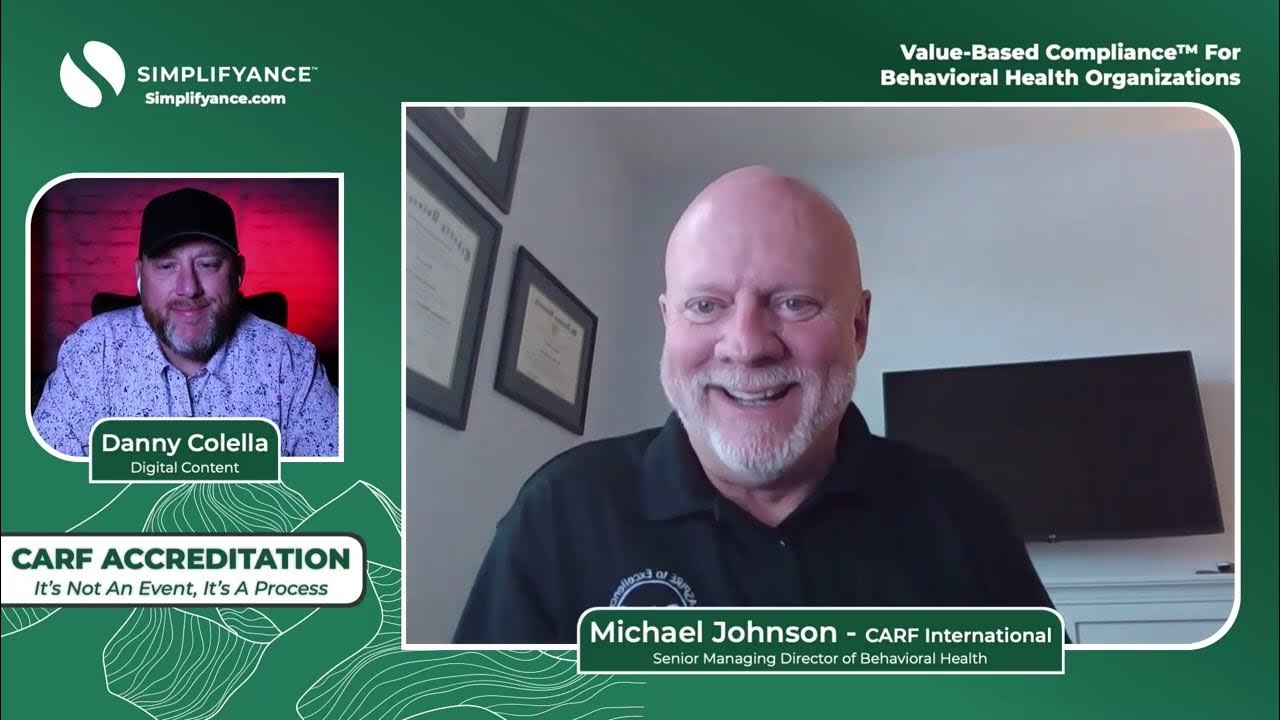
#Expert Podcasts: CARF Accreditation is a process, not an event
Recently, CARF International's Michael Johnson sat down with Simplifyance™ for a great conversation of all things accreditation. The podcast link is provided below. Simplifyance™ had the privilege of speaking with Michael Johnson, Senior Managing Director of Behavioral Health for CARF International. We delved into the world of accreditation, discussing its immense value, the supportive process for organizations during surveys, and uncovering key best practices. CARF is renowned for its commitment to ensuring excellence in healthcare delivery and service outcomes. Michael shared valuable insights into the accreditation process and shed light on how CARF assists organizations in achieving survey success. Michael emphasized the importance of person-centered care, evidence-based practices, and fostering a culture of accountability and learning. These elements are crucial in driving positive outcomes and delivering compassionate, effective care to those in need. And if you're a interested in knowing more about accreditation or the work CARF International does — let us help with your questions. Michael Johnson is Senior Managing Director of Behavioral Health at CARF and is an expert in treatment strategies for mental health and substance use disorder. View his profile below to arrange an interview today.


With the Port of Baltimore all but closed, how will the supply chain be impacted?
Following the incident of the container ship crashing into the Francis Scott Key Bridge at the Port of Baltimore and the bridge collapsing, there are now some supply chain concerns. While they may not be felt right away by consumers, there are a number of businesses that will be affected by it. Rick Franza, PhD, professor in Augusta University's James M. Hull College of Business and an expert on operations and supply chain management, said one immediate impact is where container ships will be diverted to for offloading. The Port of Baltimore is a major shipping hub and ranks first among U.S. ports for autos and light trucks. Now those ships will have to find other ports to unload their goods, which becomes a logistical problem as much as anything. “Most ports on the East Coast are at 70% to 80% capacity, which is where you want to be. You don’t want to have much more than that, but they’re going to have to,” said Franza. “It could affect a good bit of the eastern half of the United States.” Ports in Savannah, Charleston and New York, among others, will have to become the destination for those currently sitting outside Baltimore and those en route from around the world. The good news, Franza said, is that most foreign car manufacturers have plants in the United States so it will likely only affect those consumers looking for a certain brand or even a specific model. Baltimore is also one of the furthest inland ports and has the best rail service coming from it. The outbound goods coming off the ships will now face more of a transportation hurdle when they are diverted to another port. “It’s not just the capacity of the port, that’s one thing, but it’s also their capacity of the outbound items,” he said. “It may be more trucks are needed, and new routes are needed to move inventory. It now becomes a whole different set of providers for the trucks because it’s no longer the people in Baltimore.” Franza added companies will also have to decide which distribution centers they may want to use, whether it’s closer to the area they serve or closer to the port. All those factors affect where the items from overseas end up. While it’s not a good scenario, at the end of the day, he feels the consumer likely won’t see much of an impact. “First of all it’s going to take a while before we see any effect on certain things,” Franza said. “The bad news for inflation is that it’s going to raise the cost of transportation for the goods coming off the ships. Will businesses absorb the cost or pass them along to consumers?” Looking to know more? Then let us help. Richard Franza, PhD, is available to speak with media about trending issues like inflation, small business and the economy – simply click on his icon now to arrange an interview today.



MEDIA RELEASE: Voting for the CAA Worst Roads campaign is now open
Tired of swerving around potholes? Are you worried about your safety as a cyclist or pedestrian? Voting is now open in Ontario for the annual CAA Worst Roads campaign, and CAA South Central Ontario (CAA SCO) is giving citizens the opportunity to voice their concerns about the bad roads in their communities. "Our research shows that 65 per cent of members don't feel enough is being done to fix the roads," says Teresa Di Felice, assistant vice president government and community relations, CAA SCO. "This is causing a variety of concerning driving behaviours, including swerving to avoid potholes, slowing down for bad spots, and some even changing their route altogether to avoid a bad road. We encourage all Ontarians to vote for their Worst Roads and join the community of drivers, cyclists, transit riders and pedestrians committed to improving and actively working to help make our roads safer for all." Those surveyed say they spent $852 on average to repair their vehicle. According to a survey conducted by CAA SCO, 84 per cent of members worry about the state of our roads, with 42 per cent experiencing vehicle damage due to poor roads. Despite this, 82 per cent pay out of pocket to repair their vehicles, while only four per cent file a claim with insurance, and nine per cent forgo repairs altogether. "Either because of affordability or availability, many people are holding on to their cars a little longer these days; the last thing they want is expensive repair bills on an already stretched household budget. While inflation rates are cooling, many of us are dealing with a higher cost of living, making the investment in roads and supporting infrastructure more important than ever," adds Di Felice. Vehicle damage caused by potholes can range from $500 to over $2,000, with the average repair by those surveyed costing $852. "We know that the campaign works and that decision-makers are listening. Since its inception in 2003, we have seen road repairs move up and budgets prioritized. The CAA Worst Roads campaign has been a vital platform for Ontarians to nominate and vote for roads they believe need urgent attention. It covers issues like congestion, potholes, road signs, and traffic light timing for pedestrian and cycling safety." Ontario's top 10 list is verified by the Residential and Civil Construction Alliance of Ontario (RCCAO) and their members, including the Greater Toronto Sewer and Watermain Contractors Association (GTSWCA), Heavy Construction Association of Toronto (HCAT), and the Toronto and Area Road Builders Association (TARBA). "RCCAO is a proud partner and supporter of this year's CAA Worst Roads advocacy campaign, giving Ontarians a platform to raise awareness about the state of vital road infrastructure in their communities," said Nadia Todorova, executive director of RCCAO. Nominations for the Worst Roads campaign can be submitted online at www.caaworstroads.com from March 27 to April 19. Once the nominations are collected, CAA will reveal the top 10 worst roads in the province to the public. CAA conducted an online survey with 2,753 CAA SCO Members between January 10 to 19, 2023. Based on the sample size and the confidence level (95 per cent), the margin of error for this study was +/- 2 per cent.



Tackling Tik Tok - Our expert explains what the problem is and what's next for the Chinese owned app
TikTok is one of the most popular social media sites in the world. In the United States, more than 170 million people and businesses use the app on a regular basis. Now, the federal government has taken the first step in banning the China-based app unless the ownership group, ByteDance, sells TikTok. The House of Representatives passed a bipartisan bill in support of the ban, and now it awaits Congress to act. President Joe Biden has indicated he would sign the bill banning TikTok unless it’s sold, but whether it reaches his desk remains to be seen. This stems from the fear that China uses user information to their advantage. According to Lance Hunter, PhD, associate professor of political science in Pamplin College of Arts, Humanities and Social Sciences, the concern is well deserved. “Even if it’s a privately-owned enterprise, China can still control it, they can still manipulate it to some degree as if it was a state -owned enterprise,” said Hunter. Hunter’s research focuses on how informational warfare attacks influence politics worldwide. He said the algorithm TikTok uses can play a major role in informational warfare on two fronts. “One, it’s the data gathering, and that can be used for micro targeting because basically what TikTok can do is collect the data and provide information as to what certain individuals respond to an this is exactly how you can persuade them.” “Also, there is empirical evidence that China has used TikTok before to try to influence elections to some degree. One example in the 2022 midterm elections in which some candidates from both parties were targeted by TikTok accounts that were controlled by a propaganda agency operating within the Chinese government.” Hunter added the TikTok algorithm is more advanced than some other social media platforms and more effective in knowing what people like and why they like it. With so many AI-generated posts, it can be difficult for the consumer to decipher what is legitimate, and what isn’t. There are some red flags for people to be on the lookout for. “One thing the average person can do is be very wary of what you’re seeing and ask yourself does this seem legitimate?” he added. “If everyone is saying the exact same thing, that’s a tell sometimes. Also, where does this information originate from, and what are the timestamps on the posts? Something else is to look at the individual who made the post. Who are these people and who’s following them? You may be able to see if they are legitimate accounts.” While China, and Russia for that matter, are trying to influence people in several ways, Hunter said they are also trying to cause division among the American people. “They do want to influence elections at times, absolutely. But one of their other goals, and sometimes even more predominant goals for them, is to increase division, increase polarization, and that’s a great way to do that,” Hunter said. “Even if you have a temporary reaction, you’ve increased that division which could have longer term effects.” Are you covering this important and ongoing story? Then let us help with your stories and questions. Lance Hunter is an assistant professor of political science with a background in international relations. His research focuses on how terrorist attacks influence politics in democratic countries and how political decisions within countries affect conflicts worldwide. He is available to speak with media about this important topic - simply click on his icon to arrange an interview today.
