
Experts Matter. Find Yours.
Connect for media, speaking, professional opportunities & more.

Georgia Southern University launches ‘Together We Soar’ Campaign
Georgia Southern University proudly announces the launch of its comprehensive campaign, “Together We Soar: The Campaign for Georgia Southern University.” This transformative initiative aims to elevate the University’s impact on students, faculty, research, athletics, and the communities it serves. Georgia Southern, renowned for its majestic campuses adorned with southern live oaks and towering pines, symbolizes not just American freedom but also the promise, achievement and boundless potential of its students. The University’s trajectory is on the rise, reaching for greater heights in education and community impact. Central to this momentum is the unwavering support from alumni, friends and the community. Publicly launched last Friday evening, Together We Soar: The Campaign for Georgia Southern University aims to raise $125 million by 2026. More than $86 million has already been secured. Dr. Kyle Marrero, President of Georgia Southern, expressed his gratitude and vision for the University. “Georgia Southern is on the move, in motion, and soaring to new heights. The ‘Together We Soar’ campaign—fueled by the generous support of our alumni, friends, and partners—will ensure our ability to drive innovation, develop talent, transform lives, and propel the economic development of a growing region.” (L-R) Georgia Southern President Kyle Marrero, Vice President for University Advancement Trip Addison, Deputy Athletics Director of Development Davis Hendrickson, Executive Director of Development Julie Gerbsch, Director of Alumni Relations Ava Edwards, and University Campaign Co-chair Leonard Bevill on stage at the Oct. 20 launch event for Together We Soar: The Campaign for Georgia Southern University. The campaign has identified four primary objectives: Empower Student Success: The campaign aims to stimulate learning by recruiting high-achieving students, increasing student access, and promoting inclusive excellence and career readiness. Advance Teaching and Public Impact Research: The focus is on meeting regional economic needs, increasing faculty expertise, and enhancing research capacity. Elevate Athletics: The campaign seeks to attract and retain elite student-athletes, provide top-notch facilities, and boost the Competitive Excellence Fund. Enrich Campuses and Community Vibrancy: The goal is to improve the communities surrounding the campuses and teach about local wildlife, among other initiatives. Campaign co-chairs Mike Sanders and Leonard Bevill shared their excitement for the campaign and what it will mean for Georgia Southern. “I could not be more excited about Georgia Southern and its possibilities. Opportunities abound for our University and the Together We Soar Campaign is the catalyst. It is time to do ‘more with more.’” - Mike Sanders “‘Together We Soar’ is spot on. From across campus to athletics and throughout our community, we’re perfectly aligned and equipped to launch to historic heights. I’m very blessed and excited to be involved.” Leonard Bevill The campaign also highlights the significant economic impact of Georgia Southern, with a regional economic contribution of $1.1 billion in fiscal year 2022. The University plays a critical role in the economic growth and transformation of Southeast Georgia. Marrero said Georgia Southern invites all its supporters, alumni and the community to join this transformative journey. With collective support, there’s no limit to how high Georgia Southern can soar. For more information or to contribute to the “Together We Soar” campaign, visit GeorgiaSouthern.edu/TogetherWeSoar.


Cold and winter weather is about to settle in and CAA South Central Ontario (CAA SCO), Toronto Police Service (TPS), Ontario Provincial Police (OPP), and the Ontario Government want to know: are you winter ready? The four organizations have joined forces to help inform Ontarians that now is the time to get your winter tires installed, check your car battery and stock your car with an emergency kit with all the essentials needed for the winter months. “Our weather can be unpredictable, especially in the winter. It’s important to think ahead and prepare before driving conditions become hazardous,” says Nadia Matos, Manager External Communications, CAA SCO. “It all comes down to safety and there’s no time like the present to ensure you and your car are properly equipped.” TPS, OPP and the Ontario Government are also reinforcing the importance of driver behaviour. "The safety of Ontario’s roads is always a top priority, and we are continuing to work closely with our road safety partners to promote safe driving habits this winter season,” says Prabmeet Sarkaria, Minister of Transportation. “Road safety is everyone’s responsibility, so when you’re heading out, always remember to slow down and drive according to weather and road conditions. Together, we can keep Ontario’s roads and highways safe for everyone this winter.” “Winter driving can be stressful. Motorists need to be alert at all times when on the road, even in the most routine circumstances like driving to and from work,” says Police Constable Sean Shapiro, Toronto Police Service. “That includes slowing down and driving according to weather conditions and ensuring you give yourself plenty of time to get to your destination.” This year motorists also need to be aware of new amendments to the Highway Traffic Act. “It is now illegal to pass snowplows working side by side on Ontario highways. Only pass a snowplow if the lane is completely clear of any part of the plow, including its blade,” says Sargeant Kerry Schmidt, Ontario Provincial Police. Offenders may face a fine ranging from $150 to $1,000. This winter, before heading out on the road motorists can download and use the 511 app to check the weather and road conditions before they leave home. The 511 app can be found at 511on.ca or in the app store on your mobile device. Motorists should also refer to some other tips to help make their winter drive a safer one: Keep your gas tank at least half full at all times. Cold weather causes condensation in the system, which can lead to fuel-line freeze-up and can prevent your car from starting. Remove excess snow from your car before driving off. Any snow left on the roof might slide down onto the windshield and obstruct your vision. Keep your wiper fluid full. Keep extra fluid in your trunk. Make sure it’s rated for -40℃. Pack a fully stocked emergency kit. The kit should include a flashlight and extra batteries, warning devices (e.g., flares, reflective vests/strips), a first aid kit, blankets, jumper cables, non-perishable food and water plus a phone charger. Be sure to also keep an ice scraper, small shovel and snow brush handy in your car at all times.


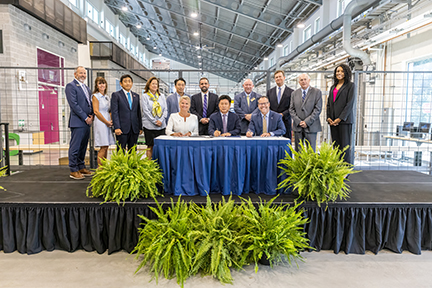
In a milestone collaboration aimed at fostering workforce development, innovation, and community enrichment, Hyundai Motor Group Metaplant America (HMGMA), Georgia Southern University and Ogeechee Technical College are signing a formal agreement to work together in addressing regional workforce needs while advancing academic excellence and technological innovation. Ogeechee Technical College President Lori Durden, HMGMA CEO and President Oscar Kwon, and Georgia Southern University President Kyle Marrero sign transformative agreement surrounded by officials from both institutions and HMGMA. The partnership will encompass a diverse range of initiatives that reflect the shared commitment HMGMA and its local education partners have to catalyze positive change for both the academic community and the broader society. Leveraging their respective strengths, this collaboration aims to address workforce demands, create transformative educational pathways, and drive impactful research endeavors. “Together, we are not just building cars; we are building futures, strengthening the community and driving progress,” said HMGMA CEO Oscar Kwon. “That is part of Hyundai’s mission: progress for humanity. Our partnership with these institutions reflects our shared vision for a brighter, more innovative future.” As part of this partnership, Georgia Southern University has committed to build on the success it has already seen in recruitment services for HMGMA. These services will include on-campus information sessions, dedicated company recruiting events, and on-campus interview days for graduating seniors. By bridging the gap between academia and industry, the University is ensuring that its students are well-prepared for the demands of the professional world. The university also will offer professional development certifications and courses for the company’s employees through its Continuing and Professional Education programs. “This partnership stands as a testament to the value of collaboration between academia and industry in driving holistic growth,” said Georgia Southern President Kyle Marrero. “By uniting forces, HMGMA and Georgia Southern University are forging a path that not only elevates educational opportunities but also cultivates a thriving community equipped to meet the challenges and opportunities of the future.” Georgia Southern also will strengthen its alliance with Ogeechee Technical College to create revised and expanded articulation agreements, pathway programs, and credit transfers. These initiatives will pave the way for the development of collaborative academic programs tailored to meet the specific workforce needs of the region. This includes exploring innovative degree pathways such as Advanced Manufacturing Engineering, as well as fostering additional academic collaborations that align with workforce-driven educational programs. Ogeechee Tech’s commitment includes continuing its record of providing training to local companies to include implementing the Electric Vehicle Professional Technical Certificate of Credit and Hybrid/Electric Vehicle Repair Technician Technical Certificate of Credit programs, and developing Industrial Maintenance Noncredit Training for HMGMA Employees. Additionally, Ogeechee Tech agrees to provide on-campus recruitment events and career fairs to current and past graduates. “Ogeechee Technical College is very excited about entering into this MOU with HMGMA,” said Lori Durden, president of Ogeechee Tech. “This has been several months in the making, and like other institutions and technical colleges in our region, we are going to do all that we can to support the efforts of our Governor to make Georgia the electric mobility capital of America. This is an exciting day for Ogeechee Technical College, and we look forward to supporting the evolving workforce development needs of this region.” With the Memorandum of Understanding, HMGMA will help promote educational opportunities in the region; develop internship, career pathway programs, and other appropriate work-based learning opportunities; and commit to exploring potential research, innovation, and commercialization projects. Interested in learning more or looking to talk with Georgia Southern President Kyle Marrero about this exciting new partnership ? Contact Georgia Southern's Director of Communications Jennifer Wise at jwise@georgiasouthern.edu to arrange an interview today.

Jacqueline Ortiz Honored for Increasing Patient Access to Interpreter Services
Fifty-eight years ago, a young man from Argentina wound up in surgery at a California hospital after stomach pains turned out to be peritonitis, a potentially life-threatening inflammation of the membrane lining the abdominal wall. He was discharged to his wife’s care, with one problem — neither the man nor his wife had any idea how to care for the open wound in his abdomen. Jacqueline Ortiz The couple did not understand the lengthy instructions delivered in English, and there was no interpreter to explain to them in their native Spanish what to expect. So, when the man tried to take a bath and discovered the gauze was stuck to his wound, he didn’t know what to do. Fear and uncertainty compounded an already stressful time. Jacqueline Ortiz wasn’t yet born when her father’s health care emergency took place, but growing up she heard the story over and over. It was more than family lore for Ortiz — it was a lesson. Ortiz said she wanted her mother, pictured with her at the DVTA event, to see the growing number of people working as interpreters to ensure people get the information they need in the language they understand. Ortiz, now the vice president for Health Equity and Cultural Competence at ChristianaCare, saw firsthand how the experience left her parents terrified of the medical environment. Removing barriers to good health Years later, Ortiz is a leader in advocating for patients to have access to qualified, culturally responsive medical interpreting services to remove communication barriers with providers and ensure the best possible care and outcomes. “Language access is what fills my heart and soul,” Ortiz said. Her pioneering efforts and enthusiasm for promoting the use of trained interpreters in health care earned Ortiz the inaugural Making an Impact Award from the Delaware Valley Translators Association (DVTA) during an event Sept. 9 at Widener University. In her role at ChristianaCare, she builds the organization’s capacity to reduce the incidence of disease and improve health outcomes, advance equitable health care services, and reduce health disparities for identified conditions and target populations through culturally competent care, including providing health care in patients’ native languages. She has over 20 years of experience researching, teaching and working in cultural competence and health equity, social networks, and economic sociology. “Language access is what fills my heart and soul,” Ortiz said. A vision for serving everyone Eliane Sfeir-Markus, CHI, president of the DVTA, said the award recognizes the efforts of those working to make interpreting and translation more available to people with limited English proficiency, and those who are deaf or hard of hearing. Ortiz’s pioneering work to expand language services for patients and implement comprehensive cultural competence training at ChristianaCare have set a standard for caring for patients in their native languages. “Jaki’s vision for a health care system that truly serves everyone, regardless of their cultural or linguistic background, is inspiring,” Sfeir-Markus said. “We as patients deserve someone who knows our culture to take care of us.” ChristianaCare has more than 20 health care interpreters and over 100 caregivers who have undergone additional training to provide interpreting services when needed. ChristianaCare has more than 20 health care interpreters — who wear eggplant-colored uniforms — and over 100 bilingual caregivers who have undergone special training to serve as interpreters in some settings. “Jaki is a well-known name in the field of interpreting and translation because she has advocated for education and professionalization of interpreters in health care,” said Claudia Reyes-Hull, MArch, CMI, CHI, manager of Cultural and Linguistic Programs at ChristianaCare. “Thanks to her advocacy, more health care systems are recognizing the need to have trained interpreters for their patients.” In accepting the award, Ortiz said interpreters play a critical role in health care by making it possible for patients — and their families — to take an active role in their own care and decrease the anxiety over visiting a health care provider. She credited the success of ChristianaCare’s interpreting and translations services and its continued growth to the collaborative spirit and camaraderie among its team of caregivers, particularly Reyes-Hull. Ortiz said her family’s personal experience with a lack of interpreting services during a hospital stay made them anxious about health care for years. “Probably all of us in this room have walked into a courtroom or a lawyer’s office or a hospital room or a clinic and introduced ourselves and seen that immediate response and relaxation in the person we were speaking with,” Ortiz said to the translators at the DVTA event. “You make those interactions within our legal, educational and health care systems so much better.”



Georgia Southern University biology professor and researcher Christine Bedore, Ph.D., is helping National Geographic explore the mysteries of shark attacks by sharing her expertise and years of fieldwork as part of the six-part series, “When Sharks Attack 360,” this month. The series, which kicked off July 3, is part of National Geographic’s SharkFest, which will run all month on National Geographic TV, Disney+ and Nat Geo WILD, with new episodes each night through July 11. All episodes are currently available for streaming on Hulu. In episodes 3 and 6, Bedore, an assistant professor in the College of Science and Mathematics who conducts research on sensory systems in sharks, discusses how shark senses may lead to bites by sharks on humans. While filming, she marveled at the channel’s cutting-edge VFX lab and their approach to educating viewers. “Working with National Geographic and the production team on this series was exciting because of the level of experience and creativity of the production team,” said Bedore. “It’s one of the most unique experiences I’ve had filming a documentary so far since it was done in a studio with a green screen, rather than in the field like we typically do. Using the virtual graphics in this series allows us to see these animals from a completely different angle. Although it was challenging to point at a shark that I couldn’t see at the time, we wouldn’t be able to see the detail of the animal at this level filming in the field.” Sharks have long captured the attention of both scientists and the public, and are fascinating animals for many reasons, according to Bedore, who has offered her expertise for previous episodes on Nat Geo WILD, The History Channel and BBC. They’re a species of immense size and diversity, and offer unique behaviors and interactions with other creatures, she noted. Understanding the behavior and physiology of sharks is critical to their survival, as they experience population declines due to overfishing and habitat changes. “In order to combat these changes and ensure the persistence of sharks in our oceans across the world, we first need to understand why they behave the way that they do,” Bedore said. “This series helps us do exactly that. For example, in episode 3 we discuss whether or not sharks can see in color. As a scientist that studies shark color vision, I’m often approached with the question, ‘who cares if sharks can see color?’ As you’ll see, the ability to see color could help sharks identify prey, predators or other objects.” In episode 6, Bedore helps viewers understand that visual acuity, or how clear an image is, may be more important than color when we think about why sharks sometimes have negative interactions with humans. “Being able to discuss my work in these areas through National Geographic’s shark month has been a rewarding experience in helping people understand why these events sometimes happen,” she said. “It’s exciting to study such charismatic animals and have the chance to share your enthusiasm for your research and the sharks with people across the world.” For more information on National Geographic’s “When Sharks Attack 360” visit here. The series can be seen on Hulu, Disney+ and Nat Geo WILD throughout July. To connect with Georgia Southern University biology professor and researcher Christine Bedore to learn more about this fascinating topic - simply contact Georgia Southern's Director of Communications Jennifer Wise at jwise@georgiasouthern.edu to arrange an interview today.

Florida Tech Shark Biologist Stars in National Geographic Program on Shark Attacks
Toby Daly-Engel, the distinguished shark biologist and director of Florida Tech’s Shark Conservation Lab, is a featured expert on “When Sharks Attack…and Why,” an eight-episode program debuting this week as part of National Geographic’s SharkFest 2023. The series debuts July 6 at 9 p.m. Eastern on National Geographic with new episodes airing nightly through July 12. It is also now streaming on Disney+, Hulu and the National Geographic website. The series will air on Nat Geo Wild starting July 26 at 8 p.m. Eastern. As its name suggests, “When Sharks Attack…and Why” investigates shark encounters in America and around the world. “Many attacks are appearing in new and surprising places,” the network notes. Episodes explore incidents in New York, California, Hawaii, Indonesia, Australia and elsewhere. At Florida Tech, Daly-Engel conducts research using a combination of genomics, field ecology and modeling to study shark mating systems and habitat use, and the impacts of climate change on shark populations. On the program, she is our expert guide to anatomical and physiological aspects of sharks, many of which are unique to this species. We first meet Daly-Engel in Episode 1, New York Nightmare. Filmed in her lab, she talks viewers through key parts of a shark’s body using a small dogfish shark. She tells viewers that while a shark’s sense of smell is often touted, these apex predators also have powerful hearing, far better than humans. (In a later episode, she notes a shark’s vision in murky waters is about 10 times stronger than human vision in those conditions.) “I really enjoyed delving into the science behind shark-human interactions,” Daly-Engel said, “and busting the myths that make people afraid of the water.” Daly-Engel is no stranger to SharkFest. Last year she was featured in another SharkFest series, “Shark Attack File,” and she has been on SharkFest and Discovery’s Shark Week programing multiple times, including 2021 when she appeared on three programs across both networks. Looking to know more about shark encounters and attacks? Then let us help with your coverage and questions. Toby Daly-Engel is an assistant professor in the Department of Ocean Engineering and Marine Sciences department at Florida Tech. He's available to speak with media about this topic - simply click on his icon now to arrange an interview today.


(WILMINGTON, Del. – June 22, 2023) For a fourth year in a row, Modern Healthcare has recognized ChristianaCare President and CEO Janice E. Nevin, M.D., MPH, as one of the nation’s 50 Most Influential Clinical Executives. The publication praised her and ChristianaCare for the innovative work being done to extend the reach of the health system via new offerings, including Hospital Care at Home, ChristianaCare Business Health Solutions and Virtual Primary Care. “Dr. Nevin has a bold, courageous and clear-eyed vision for the future of health care regionally and nationally,” said Nicholas Marsini, chair of the Board of Directors of ChristianaCare. “In service of our system’s vision of creating health together so that every person can flourish, she has committed ChristianaCare to transforming care delivery by aspiring to keep people healthy at home, radically simplify access and much more.” Dr. Nevin has led ChristianaCare since 2014. Under her leadership the health system has experienced substantial growth and maintained a high level of quality and safe care. In addition to numerous other accolades, Healthgrades has continually recognized ChristianaCare as one of America’s Top 50 Hospitals, and Forbes has repeatedly called ChristianaCare one of the country’s best health systems to work for. Modern Healthcare’s annual list of the most influential clinical executives honors currently or previously licensed clinicians in executive roles who are deemed by their peers and the senior editors of Modern Healthcare to be paving the way to better health through their executive responsibility, leadership qualities, innovation, community service and achievements inside and outside of their respective organizations. “These executives are broadening access to care through expansion and embracing digital tools to make their operations more efficient and their patients more connected,” said Mary Ellen Podmolik, editor-in-chief of Modern Healthcare. “They also are tackling workforce challenges by developing strategies to attract newcomers to the field. The complete list is included Modern Healthcare’s June 19 issue with awardee profiles available at www.modernhealthcare.com/50mostinfluential. About ChristianaCare Headquartered in Wilmington, Delaware, ChristianaCare is one of the country’s most dynamic health care organizations, centered on improving health outcomes, making high-quality care more accessible and lowering health care costs. ChristianaCare includes an extensive network of primary care and outpatient services, home health care, urgent care centers, three hospitals (1,299 beds), a freestanding emergency department, a Level I trauma center and a Level III neonatal intensive care unit, a comprehensive stroke center and regional centers of excellence in heart and vascular care, cancer care and women’s health. It also includes the pioneering Gene Editing Institute. ChristianaCare is nationally recognized as a great place to work, rated by Forbes as the 5th best health system to work for in the United States and by IDG Computerworld as one of the nation’s Best Places to Work in IT. ChristianaCare is rated by HealthGrades as one of America’s 50 Best Hospitals and continually ranked among the nation’s best by U.S. News & World Report, Newsweek and other national quality ratings. ChristianaCare is a nonprofit teaching health system with more than 260 residents and fellows. With its groundbreaking Center for Virtual Health and a focus on population health and value-based care, ChristianaCare is shaping the future of health care. About Modern Healthcare Modern Healthcare is the most trusted business news and information brand in the healthcare industry. Modern Healthcare empowers healthcare leaders and influencers to make timely and informed business decisions. To learn more or subscribe, go to www.modernhealthcare.com/subscriptions.

Health Professions Academic Building on the Armstrong Campus in Savannah Georgia’s only public medical school has received funding approval to open a new four-year campus in Savannah, an expansion that will provide greater access to education and training for medical students and ease the state’s ongoing shortage of physicians. The new campus of Augusta University’s Medical College of Georgia (MCG) is expected to enroll its first students on the Armstrong Campus of Georgia Southern University by Fall 2024, pending approval by the Liaison Committee on Medical Education, the accrediting body for medical schools in the U.S. and Canada. The campus will be located in the existing Armstrong Center and the Health Professions Academic Building of Georgia Southern’s Waters College of Health Professions. Located down the street from Savannah’s St. Joseph’s Hospital, it would be MCG’s third four-year campus in Georgia. The MCG educational experience is anchored at its main campus in Augusta, with another four-year campus located in Athens in partnership with the University of Georgia. “Georgia ranks 40th in the nation for both the number of active physicians and the number of primary care doctors,” Georgia House Speaker Jon Burns said. “Georgians experience this reality every day. Increasing opportunities within the University System of Georgia allows Augusta University’s Medical College of Georgia to educate and train more students and meets a clear need to make sure our communities receive better health care. Georgia needs more doctors, and I’m proud we are making this investment in our future.” The Board of Regents of the University System of Georgia (USG) on Tuesday approved $1.7 million for renovations at Georgia Southern’s Armstrong Campus to help make the new campus a reality. The money was included in the fiscal year 2024 state budget passed earlier this year by the Georgia General Assembly and signed by Gov. Brian Kemp on May 5. “We’re grateful to Governor Kemp, Speaker Burns, Lt. Gov. Jones and the General Assembly for their support in helping MCG and the university system expand one of the best public medical colleges in the nation and help get more doctors into our local communities,” USG Chancellor Sonny Perdue said. Four-year campuses provide the full spectrum of medical education, from basic sciences to clinical experiences. “This campus expansion is a momentous milestone for Augusta University and the Medical College of Georgia, standing as a testament to the unwavering support we have received from Speaker Burns, state Rep. Butch Parrish, Governor Kemp, the entire General Assembly and Chancellor Perdue,” said Augusta University President Brooks A. Keel, PhD. “Through this collaboration, we are forging a brighter future for health care in Georgia and fulfilling our shared commitment to producing more doctors for our state. I extend my deepest gratitude to all those who have championed this vision, including St. Joseph’s/Candler Health System, whose exceptional partnership has provided invaluable clinical experiences for our students. Together, we are bolstering the state’s medical community and strengthening Southeast Georgia’s access to quality health care.” MCG’s statewide educational model also has students learning at two-year, clinically focused regional campuses in every corner of the state, including the Southeast Campus, established in 2011 and based at St. Joseph’s/Candler in Savannah, and Southeast Georgia Health System in Brunswick. Other regional campuses include the Southwest Campus based in Albany and the Northwest Campus based in Rome. “This partnership with Augusta University and the Medical College of Georgia is another example of how together, the governor, our legislators, the University System of Georgia and Georgia Southern University are collaborating to meet the growing needs of Southeast Georgia,” added Georgia Southern University President Kyle Marrero. “These programs on our Savannah campus further Armstrong’s history of being a leader in training health care professionals and complement our efforts to expand nursing education and develop our future physician assistant program.” Through this partnership, Georgia Southern is providing approximately 23,000 square feet of instructional and lab space in its Armstrong Center and the Waters College of Health Professions’ Health Professions Academic Building. This includes 10,000 square feet of dedicated student group workspace and faculty and staff offices and 13,000 square feet of shared anatomy lab and large classroom space. The renovations include the creation of a new anatomy lab within the Health Professions Building, as well as minor renovations and new furniture, fixtures and equipment for the student group workspace and faculty and staff offices. The new campus would allow MCG to accept 40 more students per year, increasing its class size, already one of the nation’s largest, to 304 students per class. “As the state’s only public medical school, it is both our responsibility and commitment to produce more doctors for Georgia, and this growth in our class size is one way we can fulfill what I consider to be our most critical mission” said MCG Dean David Hess, MD. “This expansion would not be possible without the support of Governor Kemp, the Georgia Legislature, the University System of Georgia, Augusta University President Brooks Keel, and our colleagues at Georgia Southern University. I am also thankful for the unwavering support of St. Joseph’s/Candler Health System, including its CEO Paul Hinchey and chief medical officer Dr. Julia Mikell, a 1976 MCG graduate. Physicians and staff at St. Joseph’s/Candler have been exceptional educational partners, serving as a home base for our Southeast Campus, and providing rich clinical experiences for our third- and fourth-year students, for well over a decade. I know that commitment will extend to students at this new four-year campus.” “This is a sentinel event not only for the future of health care in Georgia, but also for Savannah and the region,” added Paul P. Hinchey, president and CEO of St. Joseph’s/Candler. “We have had a great relationship with MCG for more than a decade and our physicians have been instrumental as faculty in teaching third- and fourth-year students in Savannah. SJ/C has also served as a longstanding clinical site for nursing students from Georgia Southern and from the Armstrong campus. Creating a four-year medical school campus in Savannah will strengthen the medical community in Savannah and throughout Southeast Georgia. I want to thank Speaker Burns, Dr. Hess and the University System of Georgia for making this great vision a reality.” “I am excited to help build a campus that will continue MCG’s mission of educating the next generation of physicians,” said Elizabeth Gray, MD, associate dean at MCG’s Southeast Campus, based in Savannah and Brunswick. “I am confident that Georgia Southern will be an exceptional educational partner, and am excited to continue working with the leadership, physicians and staff at our longtime partners St. Joseph’s/Candler to help increase the number of physicians in this area of the state and beyond.” Interested in learning more? For more information about this exciting new development — simply reach out to Georgia Southern's Director of Communications Jennifer Wise at jwise@georgiasouthern.edu to arrange an interview today.

New research sheds light on how human vision perceives scale
Researchers from Aston University and the University of York have discovered new insights into how the human brain makes perceptual judgements of the external world. The study, published on 8 May in the journal PLOS One, explored the computational mechanisms used by the human brain to perceive the size of objects in the world around us. The research, led by Professor Tim Meese, in the School of Optometry at Aston University and Dr Daniel Baker in the Department of Psychology at University of York, tells us more about how our visual system can exploit ‘defocus blur’ to infer perceptual scale, but that it does so crudely. It is well known that to derive object size from retinal image size, our visual system needs to estimate the distance to the object. The retinal image contains many pictorial cues, such as linear perspective, which help the system derive the relative size of objects. However, to derive absolute size, the system needs to know about spatial scale. By taking account of defocus blur, like the blurry parts of an image outside the depth of focus of a camera, the visual system can achieve this. The maths behind this has been well worked out by others, but the study asked the question: does human vision exploit this maths? The research team presented participants with photographic pairs of full-scale railway scenes subject to various artificial blur treatments and small-scale models of railway scenes taken with a long exposure and small aperture to diminish defocus blur. The task was to detect which photograph in each pair was the real full-scale scene. When the artificial blur was appropriately oriented with the ground plane (the horizontal plane representing the ground on which the viewer is standing) in the full-scale scenes, participants were fooled and believed the small models to be the full-scale scenes. Remarkably, this did not require the application of realistic gradients of blur. Simple uniform bands of blur at the top and bottom of the photographs achieved almost equivalent miniaturisation effects. Tim Meese, professor of vision science at Aston University, said: "Our results indicate that human vision can exploit defocus blur to infer perceptual scale but that it does this crudely – more a heuristic than a metrical analysis. Overall, our findings provide new insights into the computational mechanisms used by the human brain in perceptual judgments about the relation between ourselves and the external world." Daniel Baker, senior lecturer in psychology at the University of York, said: "These findings demonstrate that our perception of size is not perfect and can be influenced by other properties of a scene. It also highlights the remarkable adaptability of the visual system. This might have relevance for understanding the computational principles underlying our perception of the world. For example, when judging the size and distance of hazards when driving.”


Professor James Wolffsohn and Dr Sònia Travé Huarte in collaboration with NuVision won the Medilink Business Award 2023 for a Partnership between Academia and Business The optometry researchers were recognised with an award for their partnership with a company that develops treatments for ocular diseases The collaboration has directly benefitted patients and enhanced global research knowledge. Researchers in the School of Optometry and Vision Sciences at Aston University have been recognised with an award for their partnership work with NuVision, a company that develops treatments for ocular diseases Professor James Wolffsohn and Dr Sònia Travé Huarte recieved the Medilink Business Award 2023 for a Partnership between Academia and Business at a prestigious ceremony held on 16 March in the Great Hall at the University of Birmingham. Professor Wolffsohn, who is also the head of the School of Optometry at Aston University, said: “We are delighted to have won this Medilink award in partnership with NuVision. This collaboration has directly benefitted our patients with this common chronic, debilitating disease, has enhanced global research knowledge in dry eye management and enhanced the local economy. The team at NuVision are exceptional and it is a pleasure to continue to innovate with them.” NuVision has an expert team of scientific, clinical and industry professionals dedicated to building innovative ocular biotherapies. It was founded in 2015 based on 15 years of translational research at the University of Nottingham. The company develops ocular biotherapies through research and innovation. The Medilink Midlands Business Awards 2023 are sponsored by the University of Birmingham and the Precision Health Technologies Accelerator Ltd. The awards event saw 13 life science companies based in the East and West Midlands receive awards from Start-Up to Outstanding Achievement. A further six companies received Highly Commended certificates. For more information about the School of Optometry and the Vision Sciences Research Group please visit our website.
