
Experts Matter. Find Yours.
Connect for media, speaking, professional opportunities & more.

Just before the holiday season, as he entered his final month as President of the United States, Joe Biden announced that he would be granting clemency to roughly 1,500 American citizens. The clemency acts, which included sentence commutations for individuals placed on home confinement during the pandemic and pardons for 39 individuals with non-violent offenses, were touted by the administration as the most ever in a single day in modern history. A month later, on January 17, he commuted the sentences of roughly 2,500 individuals convicted of non-violent drug offenses, shattering December's mark and giving him the most pardons and commutations of any president in United States history. The unprecedented size of the actions has been underscored throughout The White House’s press materials and has headlined most subsequent news coverage. But for Anton Robinson, JD, associate professor of law and director of Villanova’s Caritas Clemency Clinic in the Charles Widger School of Law, the importance of the clemency went far beyond the impressive scale. “Acts like these bring much needed awareness to the clemency process, and to the epidemic of excessive sentencing in United States courtrooms,” Professor Robinson said. “At our clinic, we are already having people call to ask about opportunities for pardons and additional support for their cases.” Public perception of presidential acts of clemency can, at times, be marred by partisan divisiveness. To some, these latest acts were overshadowed by President Biden’s earlier pardon of his son, Hunter, and eyes are already on incoming President Trump regarding how he might handle those charged in relation to the January 6 insurrection. Professor Robinson acknowledges that acts like these can cause people to “rightfully question the power that is being used,” but those are the outliers, not the norms, and steer the conversation away from the root purpose of clemency. “People deserve a second chance,” Professor Robinson said. “There’s a tendency for system actors to focus primarily on the crime committed when considering whether a person’s sentence should be cut short. But many are different people today—sometimes decades later—than they were at the time of the crime’s commission. “There is also no shortage of individuals in prison for whom a charge doesn’t tell the whole story. For example, a young person’s involvement in a crime, while sufficient for a legal conviction, might be weighed differently today, given increasing acceptance of scientific research on the portion of the human brain which controls decision-making, impulse control and executive function. Research shows all of that continues to develop well into adulthood.” Determining who fits the criteria for clemency, Professor Robinson says, is not always easy to do. Collecting records of good behavior that illustrate change while in a carceral setting is much more difficult than collecting records of bad behavior. That’s why entities like the Caritas Clemency Clinic, in which Villanova Law students work directly on behalf of such clients under Professor Robinson’s guidance, spend so much time talking to anyone who has had a relationship with the incarcerated person. “What we often find is that despite being incarcerated and having very little given opportunity, these individuals make their own opportunities to build community and rich relationships and try their best to contribute to society in a positive way,” Professor Robinson said. A military veteran who helped church members in poor health perform tasks. A nurse who spearheaded COVID vaccination efforts and natural disaster response. A counselor who helps guide youth away from destructive behavior and involvement with gangs. Those are the types of actions Professor Robinson references, all of which were highlighted specifically in the White House’s fact sheet for President Biden's December acts, just before the words “The United States is a nation of second chances.” “I'm hoping that these large acts of clemency encourage folks to think, ‘Hey, what about my loved one? What about me? I am a completely different person than I was 20 years ago, what can I do to try to secure my freedom and my ability to live the life that I've missed out on?’” Professor Robinson said. “It really is a great opportunity to remind ourselves that people are far better than the worst things that they've ever done, and that we have an opportunity to acknowledge that as a society and to encourage more of this action, both on a federal and state level.”


What does the Israel-Hamas ceasefire mean
After 15 months of war Israeli Prime Minister, Benjamin Netanyahu, announced Wednesday, January 15, his in the process of receiving approval for ceasefire from his security Cabinet in order to further the truce with Hamas. This ceasefire is not only expected to stop a war that has taken more that 46,500 lives, but also the phased release of dozens of American hostages and hundreds of Palestinians. Reports reveal that the ceasefire may be in effect by the end of the week. How will American citizens respond to what appears to be a resolution to the conflict in the middle east? International relations expert, Dr. Glen Duerr, has been a reliable source on the events occurring in the Middle East. Here are three valuable insights from a recent interview: Prime minister Benjamin Netanyahu needs the support from his security and full Cabinet to receive approval on will be a roughly six-week initial ceasefire phase. The Israel Supreme Court has up to 24 hours to approve The Prime Minister's ceasefire. It is estimated that the ceasefire will take full affect Sunday. What can we expect in the Middle East during the wait of the ceasefire? It was announced that there will be an emergency cabinet meeting held tomorrow renegotiating the deal after Prime Minister Netanyahu's office accused Hamas on reneging on part of the of the ceasefire. However a Hamas spokesperson Sami Abu Zuhri denied all accusations of Hamas reneging on the terms of the ceasefire. Is the conflict and delay of the ceasefire a prediction to the conflict that is to come? The first stage of the ceasefire will take about 6 weeks, allowing the phased release of American and Palestinian citizens. Hamas is expected to release at least 2 American citizens during the first phase and a a Senior administration official during the second phase. It is expected with each hostage released by Hamas a number of Palestinian detainees will be released. How will the phased release of Hamas hostages affect the culture of Americans? If you are a journalist covering the ceasefire between Israel and Hamas, look no further than our experts for valuable insight and expert knowledge. Dr. Duerr is an expert on this subject and is available to speak to media regarding this ongoing conflict in the Middle East and the ongoing the war between Israel and Hamas – simply click on his icon to arrange an interview. Or schedule an interview by contacting Mark Weinstein at mweinstein@cedarville.edu


Looking Back on the January 6th Insurrection
Dr. Meena Bose appeared on Canada’s Global News on January 6 to discuss the fourth anniversary of the Capitol Hill attack in Washington, where supporters of Donald Trump stormed the historic building in an attempt to overturn Joe Biden’s election win. Dr. Bose is a Hofstra University professor of political science, executive dean of the Public Policy and Public Service program, and director of the Kalikow Center for the Study of the American Presidency.



Image Credit: Petrovich9/Getty Images Plus Although time is a set duration of hours, minutes and seconds, the perception of time can vary dramatically based on the individual and especially during times of high stress and uncertainty such as disasters, recessions and most recently the COVID-19 lockdown. For example, ask anyone when a specific event occurred during the pandemic and they are likely to respond with, “That happened three months ago. Or did that happen three years ago?” While there have been studies on the feeling that there is not enough time or experiencing time as moving too slowly, Baylor University sociologists Matthew Andersson, Ph.D., and Paul Froese, Ph.D., investigated this sense of multifaceted time perceptions during the pandemic and their effects on mental well-being. Their findings – using national Gallup data collected in spring 2021 in the middle of the pandemic – were published in the journal Time & Society. “We know from existing research that people often experience time in altered ways whenever disasters strike, and we wanted to see if that was true during the pandemic as well,” Andersson said. The Baylor researchers found that Americans during the pandemic generally reported some degree of feeling rushed while also perceiving multiple types of time distortion involving slowness, quickness and days and weeks blending together. This disorientation also was frequently reported alongside other pandemic-related stressors, including economic strain, working from home, homeschooling a child and severe household conflict. Together, they complicated how people perceive time by disrupting routines and creating experiences of trauma, adding to the decline in mental well-being and an increase in feelings of loneliness. Time disorientation and mental well-being The top three findings of the study all demonstrate the connection between altered time perception and the mental states of an individual. “If time does not seem to be moving ‘normally,’ it is generally related to lower levels of mental well-being, such as increased depressive, anxiety symptoms or a lessened sense of control,” Andersson said. “We think this is because people tend to feel grounded or calm when they feel like time is moving as it should.” Secondly, the researchers found that individuals can often experience these time disorientations in multiple and contradictory ways, which can be related to even lower well-being. “Feeling rushed and feeling that time is slow are kind of opposites, but they are both related to having this sense of multifaceted blending of time,” Froese said. “We can show very clearly how these new stresses that were brought on by the pandemic created heightened senses of disorientation in terms of time.” More importantly, they found these time disorientations were affected by social, familial, physical and work situations, which created lower levels of mental well-being. “Specific forms of stress we were seeing during the pandemic, such as financial hardship, homeschooling, working from home and severe household conflict, all had relationships to experiencing different kinds of time distortions,” said Andersson. This was more evident in younger people “because it [lockdown] probably upended their daily routines in a much more dramatic way than it would have in somebody who's retired,” said Froese. Experience of time The rushed pace of industrialized society existed before the COVID-19 pandemic, but the stressors associated with the pandemic added to the feelings of time being out of control. “Our approach to capturing experiences of time rests on the assumption that individuals relate to time in complex ways,” Froese said. “We found original evidence to suggest that experiences of quickness, being rushed, slowness and indistinct boundaries of days all coincide, and that these multiple disorientations each relate to diminished mental wellbeing, to objective work and family demands, and to widespread exposures to pandemic-related stressors.” The survey was conducted as part of the Baylor Religion Survey, one of the most extensive national surveys of American religious beliefs, values and behaviors that produces unique data concerning religion, health and community in America today. The 2021 data collection by Gallup contained a section devoted to how the pandemic affected Americans’ activities, including how the pandemic changed the emotional lives of Americans. Looking to know more? We can help. Dr. Paul Froese is a professor of sociology and a research fellow for the Institute for Studies of Religion. He has been teaching and researching at Baylor since 2002. Dr. Matthew Andersson’s research focuses on health inequality as it unfolds across the life course. Specifically, he researches educational and socioeconomic inequalities in mental and physical well-being as they relate to childhood, adolescent and adulthood factors. Both experts are available to speak with media about this important topic - simply click on either expert's icon to arrange an interview time today.


The History Behind National Days of Mourning
A national day of mourning for Jimmy Carter, the 39th president of the United States, was held on January 9. Professor of Education Alan Singer talked to Newsday about the history of national days of mourning and how they are observed. Dr. Singer said, “There are no official criteria” for what constitutes a nationwide time to mourn or another symbolic nationwide pause. He also noted that a handful have been declared in modern American history for incidents besides the death of a president. President George W. Bush declared a national day of mourning for 9/11. In 1968, Dr. Singer said, President Lyndon B. Johnson declared national days of mourning for both Martin Luther King Jr. and Robert F. Kennedy because “they were national leaders who were assassinated.”


Expert: Meta ditches fact checking, a major loss for the American people
Meta moving away from fact-checking towards a "community notes" model is the equivalent of crowd-sourcing truth, says the University of Delaware's Dannagal Young. This shift in policy is a victory for intuition, common sense and lived experience over data, expertise and evidence. It also stands as another example of media institutions acting preemptively to avoid political and economic fallout under the incoming administration. Young, director of UD's Center for Political Communication and professor of communication, can talk about epistemology (how people understand the world) and how it relates to populism and populist leaders like incoming President Donald Trump. Young can also discuss the following: • The contents of Meta CEO Mark Zuckerberg's announcement video, in which he explains that recent elections mark a "cultural tipping point" in the direction of "free speech." "He's acknowledging that this policy change isn't a principled stance Meta is now taking, as much as a response to what he thinks the public is calling for (a dubious conclusion to draw from a narrow electoral victory)," Young said. • Zuckerberg's new stance, and how it will allow him to curry favor with the incoming administration because it allows Meta to avoid having to moderate Trump-friendly content. • Why content moderation and fact checking are expensive, and how moving away from that model is a "WIN-WIN-WIN for Meta: politically, culturally, and economically. And a LOSE LOSE LOSE for the American people: socially, culturally, and democratically," Young said.


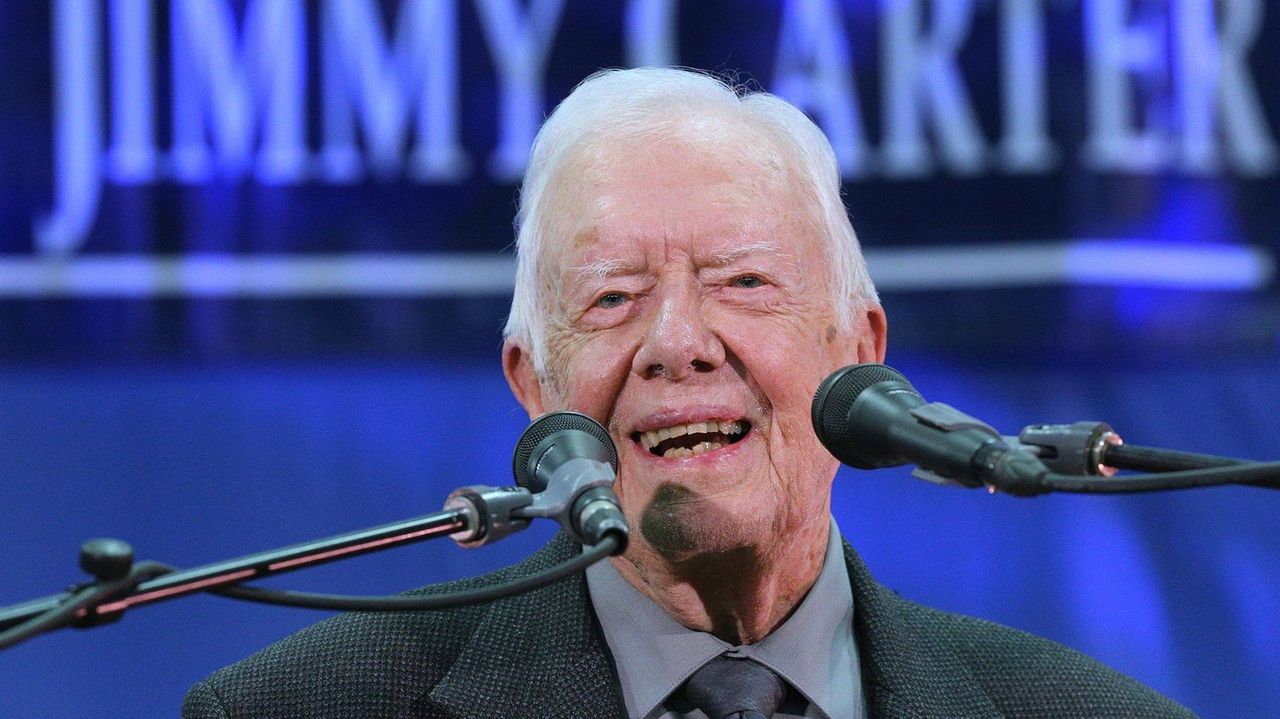
Legacy of Former President Jimmy Carter
Following the death of Jimmy Carter, the 39th president of the United States, Dr. Meena Bose was featured in a Newsday article about his legacy. Dr. Bose is a Hofstra University professor of political science, executive dean of the Public Policy and Public Service program, and director of the Kalikow Center for the Study of the American Presidency. She noted that Carter served under difficult economic and political times. “But then, of course, he went on to have a highly successful post-presidency winning the Nobel Peace Prize, being highly active in public housing policy, voting rights … and really was quite active on the public scene until just a few years ago,” she said. The article also referenced the Hofstra Cultural Center’s 1990 three-day presidential conference on the Carter administration, which President Carter and First Lady Rosalynn Carter attended.

Is all screen time bad? Experts weigh in on healthy habits for kids and teens.
With the winter holiday season upon us, many children and adolescents will be home from school for break. As with any extended periods of time outside of school, screen time for children will become a topic of discussion for families. "For academic benefits of screens, it isn't only about the screen 'time,' but about the type of activities youth are doing on screens," said Teya Rutherford, associate professor at the University of Delaware. "There is huge variance in the quality of engagement with online games, etc." During the holiday season, children and adolescents have way more time to fall down the rabbit hole of social media and general web surfing. The American Psychological Association recently released guidelines to help parents coach their teens to have healthier relationships with viewing videos online. Some of the findings include limiting screen time, monitoring content and teaching children and adolescents about misinformation. "This finding is in line with the literature on parental monitoring – in that, if parents monitor their adolescents’ use of social media, then outcomes (i.e., academic achievement) are often better for the adolescent, than for the adolescent whose parent does not engage in such monitoring behaviors," said Mellissa Gordon, associate professor at the University of Delaware. Rutherford can speak about creating engaging online environments, the science behind learning in online environments, motivating students to learn in STEM contexts and self-regulated learning. Gordon conducts research on the social mechanisms that influence adolescent and young adult development. In a 2023 Youth and Society study, she found that as middle schoolers’ social media use increased, their academic performance suffered. Both can be contacted by emailing mediarelations@udel.edu.

Health for the holidays: Expert provides tips for keeping diets in tact
'Tis the season for meals with friends and family and sneaking in snacks before New Year's resolutions put the fun to a halt. Indeed, the holidays are a time for celebration, but they can also make it challenging to maintain balance in our lives. Sharon Collison, licensed registered dietitian and instructor of clinical nutrition at the University of Delaware, says dietary substitutes, meal routines and comfortable clothing are key to savoring the season without going overboard. Collison, a board-certified specialist in obesity and weight management who provides medical nutrition therapy in the Nutrition Clinic in UD's College of Health Sciences, offered practical tips to help holiday revelers stay on the beam. How can folks enjoy their favorite holiday foods without overindulging? Don't skip meals on the day of the holiday. If you're overly hungry when the holiday meal is served, it will be harder to keep portions controlled. Also, make choices. Decide what foods at the meal are most appealing to you and eat a moderate portion (such as a cup). For example, if the meal has mashed potatoes and a sweet potato casserole, decide which one is most appealing to you and enjoy. Try to be more mindful about choices, eat slowly, and make sure you are aware of how much you are eating. Check-in with yourself throughout the meal and pay attention to fullness signals. How can we maintain a positive body image during the season of indulgence? Wear clothes that make you feel the most confident AND comfortable. Avoid clothing that is too tight, making you feel even more uncomfortable after eating. Also, make physical activity a priority during the holiday season. Several studies support the benefit of physical activity on body image independent of the effect on body weight. Will dessert kill diets, or is it all about balance? Absolutely not! Diets are the problem, not dessert. I recommend eating dessert while paying attention to portions and eating mindfully. Not allowing yourself dessert or depriving yourself can backfire and lead to extreme dieting and overindulging, which is more harmful to your well-being. What are some tips for moderating alcohol consumption at holiday parties? Alternate alcoholic beverages with a glass of water or flavored seltzer. This will help you stay hydrated, too. What are some festive non-alcoholic drink options for celebrations? Flavored seltzer with added orange slices and fresh cranberries. How do we stay active during the colder holiday months? Bundle up in layers and go for a walk/hike. Purchase inexpensive exercise equipment, such as a stationary bike, to exercise without going outside or to a gym. Set a daily step goal and reach it at home by walking and talking on the phone with family or friends, dancing, and cleaning. How can we handle food guilt or pressure to eat during family meals? Depending on your situation and family dynamics, consider talking to your family about perceived pressure to eat. Think about how you want to eat at holiday gatherings and tell your family you may eat differently than you did in the past. Ask them not to comment or draw attention and allow you to do what is best for you. Try to avoid extremes in eating; neither extreme works in the long run. Being too restrictive doesn't allow you to enjoy food. Food is meant to be enjoyed. Allow yourself to enjoy special foods over the holidays. Pay attention to both extremes so that you're not under eating or overeating. If you are still struggling with guilt or feel you are unable to avoid these extremes, consider working with a Registered Dietitian and psychotherapist who have the training to help you. How can we make healthy eating choices while traveling for the holidays? Consider packing some foods to give you more options. For example, bring everything you need to continue your breakfast routine. Plan ideas for lunches that you know help you feel your best. Since breakfast and lunch are closer to your regular routine, give yourself more flexibility with your dinner meal. Also, don’t be afraid to plan and research restaurants with options you feel good about. Lastly, set a goal to ensure each meal/snack includes a serving of fruit or vegetables, which will help you consume smaller portions of higher-calorie foods. How can we return to a balanced diet after a season of treats and large meals? If you avoid the extreme of eating much more than usual at holiday meals, you will much more easily be able to return to your regular food intake patterns. But try not to look at the holiday season as a time to avoid setting limits on food intake. Make choices where you want to eat more than you might otherwise eat, but make these choices mindfully, and try not to view any meal as an unlimited buffet. What small steps can we take to set healthy goals for the new year? Avoid the common goal of starting a diet on January 1 or 2. Instead, start increasing physical activity during the holiday season. Focus on what to add to your diet rather than what to avoid; try setting a goal to ensure that each meal/snack includes vegetables and/or fruit, get two servings of whole grains/day, or eat a plant-based meal once/day or three meals/week. What are some healthy swaps for traditional holiday dishes? The American Heart Association (AHA) has great heart-healthy holiday recipes. But here are some easy ways to modify your own recipes: • Use fat-free half-and-half in place of heavy cream or regular half-and-half • Use Truvia brown sugar baking blend instead of brown sugar (Tip: Reduce the portion of Truvia baking blend to half the amount of sugar.) • Substitute white whole wheat flour for white flour in baking recipes; this will increase dietary fiber without changing the texture of the baked good that would occur if substituted with whole wheat flour. • Use 1/2 full eggs + 1/2 liquid egg white to reduce calories/fat/cholesterol in any recipe (1/8 cup liquid egg/egg white = 1 egg). • Use applesauce instead of 1/2 of the oil in a recipe to reduce fat content and calories. • Use fat-free plain Greek yogurt in place of sour cream. • It's important that food tastes good and is enjoyed; too many modifications can take the enjoyment out of a favorite food. If any of these modifications change the taste/texture of the recipe too much, consider replacing half of the ingredients as suggested and still include half of the original ingredient (sour cream, oil, sugar, etc.) to reduce overall calories/fat/sugar.


Charges Dropped Against President-Elect Trump
Dr. Meena Bose talked to Fox News Radio stations around the country about a judge dropping the charges against President-elect Donald Trump in the D.C. case against him. The dropping of charges followed a request made by Special Counsel Jack Smith. Dr. Bose spoke to: WILS in Lansing, MI; WFLA in Orlando, FL; and WKIM in Memphis, TN. Dr. Bose is a Hofstra University professor of political science, executive dean of the Public Policy and Public Service program, and director of the Kalikow Center for the Study of the American Presidency.